
Ibrar Malik's Blog, page 3
November 4, 2018
Unraced Projects of the 1994 Season By Jasper Heijmans
1994 would change the Formula One forever, especially after the dark Grand Prix weekend in Imola. First Rubinho crashed badly with his Jordan 194, however he only broke his arm. On Saturday, Roland Ratzenberger died due a horrible accident during the qualification session, 12 hours later Ayrton Senna would die when his steering wheel from the Williams broke. Only bad things happened in 1994 ? No Nigel Mansell made his comeback with Williams and won the last race of the season.
Female F1 Team
Rumours spread in the paddock of an all-Woman F1 team that would made its debut. Giovanni Amati, who drove for Brabham previously, was rumoured to be one of the drivers. While Johnson & Johnson were rumoured to be the main sponsor. It was said that Cesare Fiorio was the person behind this plan. However, when I asked Fiorio about the all-woman F1 team he told me it was not true. Neither any plans were deployed for an all-Woman F1 team. Read the full story here.
Formula Project Engineering
French F3 team FPE (Formula Project Engineering) announced their five years plan in 1994. Their goal was to debut in the Formula One around 1998 / 1999. As happened multiple times in the 1990s many F3 and F3000 teams announced their interest in the Formula One. This counts also for FPE that never made one footstep in the Formula One.
Ikuzawa HW001
One of the best kept secrets in 1994 was the Ikuzawa HW001 designed by Tetsu Ikuzawa and supported by former Williams team manager Peter Windsor. The former Japanese driver Tetsu decided in early 1994 it was time to create his own Formula One team. The goal was to make their debut in 1998 with Kenny Bräck and Gil de Ferran behind the wheels. Enrique Scalabroni penned a brand new, future looking, car for the Ikuzawa team. The car was based on the rules that were rumours to be adapted in later years, though had most of the features of the current standards. In early 1995 John Watson, a former F1 driver, did several seating-tests for the car. Due the mid-90s slump in the Japanese economy, the team had to abandon their plans. Later it would know that Stewart integrated most of the key-people, thanks to Windsor, in his team. The HW001 became the SF01. Read the full story here.

Larrousse Junior Team
1994 was more or less a do or die year for the Larrousse team, once a team that showed some great progression ended up bankrupt. For me personally the Larrousse Junior Team is one of the few project I really don’t know what the real truth is, even though I wrote an post about their last months as a team, I’m still not convinced of it. Main reason are the rumours in 1994, and especially about the Junior Team. I would like to put a quote of the article i posted to give you just a slightly idea of the Junior Team.
“Larrousse, unofficially, changed its name to Junior Team Larrousse. The team stated that it was to quickly build their new car probably named JTL-01. Probably the team would use the blueprints of the Larrousse UK 1995 car, designed by Tino Belli. Normally this process would take months, while the new owners promised that the new car would make its debut during the San Marino GP at Imola. It is not sure which design they would use. Other drivers were rumoured as well. Érik Comas would return to the team while Christophe Bouchut would take the second car. In the meantime, Larrousse SA, the company that used to deal with the Larrousse F1 Team, remained in France’s equivalent of Chapter 11 Bankruptcy.” Read the full story here.
Lotus 109B
Recently I found out that there were plans for the Lotus 109B, if the plans were serious enough that the Lotus 109 would be rebranded to Lotus 109B I’m not sure though. The documents I came across accidentally were from Team Lotus them self. Stating that they were working on the installation of the ZA5D, however the title stated that this was the new Lotus 109B. No more information is available at this moment.
Team Mansell / Team Lotus-Mansell
If I recall it back correctly the very first rumours of Nigel Mansell and his own F1 team appeared in late 1989. However In 1994, when Mansell left the Formula One, the rumours got spread that Mansell was looking to become an team manager from his own team in the Formula One! The rumours even became bigger when Team Lotus was near bankruptcy and in desperate need to get money. The Team Lotus-Mansell was born in the media. Though Team Lotus appeared on the 12th of September 1994 with the following press release, deny any influence from Nigel Mansell.
“Nigel Mansell and are established friends but there is no truth in the rumour that he will become involved in the running of Team Lotus. “Our enormous respect for Colin Chapman’s achievements and the Team Lotus marque is obvious, but we shall not be working together in the future.”
Williams FW15D
During an ice cold January day in 1994, the Williams Renault team showed their brand new car at Estoril. For many years the Williams cars sported a distinctive yellow, blue and while livery, which was in deference to their main sponsor. Williams changed their livery. As Rothmans were the new title sponsor for the 1994 season. Accordingly, the livery changed with it. As the Williams FW16 wasn’t ready year, Williams appeared with the FW15 from 1993 with the 1994 regulations. This meant that the Williams teams arrived with their Williams FW15D “interim car” at the Portuguese tracks. The Williams FW15D used during all the early-season test session until February 1994. The FW15D did not impress well, the car was slow due the fact it had not the electronically features it used to have during the previous season. Frank Williams would later describe the car as “mediocre”.
If you want to learn more about that year, 1994 – The Untold Story of a Tragic and Controversial F1 Season is a new book which explains the various controversies, allegations and politics from that turbulent season. A free sample of the book can be viewed here. Alternatively you can keep up to date with this and future books by the author, as well as upcoming 1994 F1 blogs by signing up here.
[image error]


October 30, 2018
The Day Schumacher Drove a Ligier
Before we answer this let us remember the background surrounding this test. In early 1994 the Ligier team were in financial trouble following their team owner, Cyril de Rouvre, having been jailed on fraud charges. Benetton directors, Flavio Briatore and Tom Walkinshaw, bought the struggling French outfit in May 1994 following months of conveyancing. During this transaction, they were partly acting for the Benetton family – their paymasters – who wanted Ligier’s prized supply of Renault engines having failed to acquire them via more conventional means during 1993. This was because their rivals, Williams, had stopped Benetton advances towards the French engine supplier by giving Ligier assistance with gearboxes throughout 1993. Williams’ strategy was to keep Ligier competitive enough to maintain Renault’s interest in them. Following the 1994 acquisition, Walkinshaw owned a minor stake in Ligier but dreamt of owning the whole team and bringing them Grand Prix success with Ross Brawn. Whilst Briatore, another stakeholder, was simply happy to be a sleeping partner and saw the Liger purchase as just another of his investments.
 Walkinshaw (Left) and Briatore of Benetton. Neither were strangers to controversies, therefore many people consider Benetton guilty of the 1994 accusations simply because of their association.
Upcoming book contributor and Benetton’s Head of Aerodynamics in 1994, Willem Toet, explained the relationship between Benetton & Ligier following the acquisition. “In order to help Ligier out, track performance wise, without spending a fortune, an agreement was reached to provide “technical assistance”. We (Benetton) were asked to provide certain pieces of design related information. I was not happy to give the info but, as an employee, you don’t always have many choices. One can leave the team of course and that’s what I did a little while later when there was a “last straw” moment – this was one of my reasons for being unhappy with how things were going.”
“Anyway, the resulting help that was given led to Ligier people coming and working at Benetton to make parts – from our moulds! Strictly not correct and really upset a “few” people (inside the company). They arrived in full team clothing which is what created a stir inside the company. So to hide where they came from internally (totally unsuccessful) they were given some Benetton clothing. That pissed the workforce off even more as this was not a privilege given to the guys in the composite workshop they worked beside…. The team really didn’t want the closeness of the working relationship to come out in full! That would have been another day in Paris to see the headmaster – and would not have ended well for either team!”
“What justification was there? I recall being told at the time that Ligier was in trouble and that our help would only bring them towards competitiveness, not more. This was certainly perceived as a lower cost way for whoever had put money into buying the team to provide an improvement than funding independent research, but regrettably, it was almost certainly outside the law. Intellectually I understood the motives but emotionally I was (very) upset by what the team did. When I got a phone call offering me a dream job elsewhere I said yes where normally I would not have been interested. Having finished the rollout car design for the following year I resigned (with other reasons as well of course).”

 The 1995 Ligier’s looked suspiciously like Benetton’s. “It would, wouldn’t it” explained Ligier’s Technical Director & upcoming book contributor Frank Dernie. “Williams and McLaren (in 1995) have copied the Benetton, and I was at Benetton. It would be very silly if I’d copied the Pacific.”
During preseason 1995 Mosley visited the Ligier factory presumably to investigate their car’s striking resemblance to the Benetton B195? Walkinshaw stated afterwards “Mechanically, it (the Ligier) is totally different (from the Benetton) and structurally it is quite different as well. Aerodynamically, it’s as close as we can make it to being the same. I don’t know how you would end up with anything else if you take a core of engineers who have been working on the Benetton. Of course, the damn thing looks the same. But if you go into the detail of the car, there is nothing interchangeable” Transferring the much-sought-after Renault engines from Ligier to Benetton for 1995, left the former needing a power plant. At the last-minute Flavio Briatore somehow convinced the Mugen Honda concern to supply Ligier instead of Minardi. The decision left the latter team in a disastrous state, with a car designed for the V10 and parts already made. Giancarlo Minardi, the team’s owner, threatened legal action over the affair but the matter was eventually settled out of court when Briatore paid $1 million to Minardi as compensation.
Renault were considered the engines to have in F1 during the mid-1990’s, hence why Benetton and Briatore when to such lengths to acquire them for 1995. Indeed Martin Brundle famously said at the time “if Schumacher ever gets hold of a Renault, we might as well go home” and he was proved right. Using Renault power for the only year during his F1 career, Schumacher cruised to an easy 1995 title – even equaling Mansell’s 1992 record of winning the most races in one season. Before all of that, however, was his December 1994 Ligier test. Renault wanted the German to try out engine maps in preparation for 1995 which involved evaluating changes over two hot laps then coming into the pits to try another setup. It was too complicated to install the Renault into the 1994 Benetton, hence why Schumacher drove the Ligier instead.
 In 1994 Ligier usually qualified no better than midfield, this was despite enjoying the same electronics and Renault engine as reigning champions, Williams.
During the test, held at Estoril, Schumacher immediately lapped one second quicker than regular Ligier driver Olivier Panis’ lap time during the only day they both ran. The lap times are below;
Hill | Williams | 1:19.57
Collard | Williams | 1:20.84
Schumacher | Ligier | 1:20.84
Panis | Ligier | 1:21.80
Barrichello | Jordan (3.0l) | 1:22.17
Blundell | Tyrrell (3.0l) | 1:22.53
Katayama | Tyrrell(3.0l) | 1:22.55
Ligier was amazed by this especially because Panis, having won the F3000 title in 1993 and finishing all but one race during 1994, was considered F1’s rising star at the time. Panis later lapped within 0.13 seconds of Schumacher’s time on subsequent days when the German wasn’t driving. Vincent Gaillardot of Renault noticed something within the telemetry data which illustrated why Michael was able to go so much quicker than Panis. Frank Dernie, who had close ties to Ligier & Schumacher during 1994 exclusively confirmed “Panis saw several things Schumacher did which helped including…”
 What was Schumacher’s secret to being much quicker than his teammates in 1994?
What Dernie and Gaillardot of Renault refers to above is mind blowing and fully revealed in 1994 – The Untold Story of a Tragic and Controversial F1 Season, a new book due for release in January 2019. Telemetry data is used to illustrate not only what is referred to above, but also what Senna might have heard on Schumacher’s car during the Aida 1994 race. A free sample of the book can be viewed here. Alternatively you can keep up to date with this and future books by the author, as well as upcoming 1994 F1 blogs by signing up here.
Images courtesy; of Martin Lee, Fox 1 via https://commons.wikimedia.org/wiki/Ma... and Ford Motor Company
September 30, 2018
Brundle at McLaren
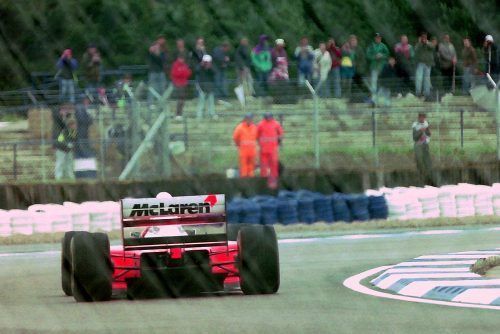 McLaren had been a dominant force during the 1980’s and early 1990’s, but had undergone major change for 1994 including a new engine supplier.
Unfortunately, the dream drive didn’t pan out as expected and McLaren suffered their first winless season in 14 years, partly because their new Peugeot engine proved uncompetitive and unreliable. “The team originally wanted Alain [Prost] in the car,” recalls Brundle. “We both went to test at Estoril, and I don’t think Alain was interested after he drove the car. Then I got in it, which turned out to be a bit of a bad omen really. I had stood and waited for Alain all morning. I got in it, and as I was on my out lap coming to start my very first flying lap, it threw a conrod so hard that it came through the sump and damaged the racetrack! I didn’t even start my first run. But having said that, I was very happy to be in a McLaren.”
Unfortunately, that was a sign of things to come for Martin, who then described his debut race for the team as “the nearest I had ever come to dying.” This was after his engine’s flywheel came off as he accelerated out of turn 3, which then triggered an almighty accident involving himself, Eddie Irvine, Jos Verstappen and Eric Bernard. Indeed the McLaren new boy would quickly come to learn the Peugeot engine had a habit of destroying itself, often with dramatic results. Even so, Brundle’s had high hopes for the British GP that year only for his engine to detonate itself off the start in spectacular fashion. “I think I did 383 metres…and BBQ half the grid” the furious Englishman later claimed.
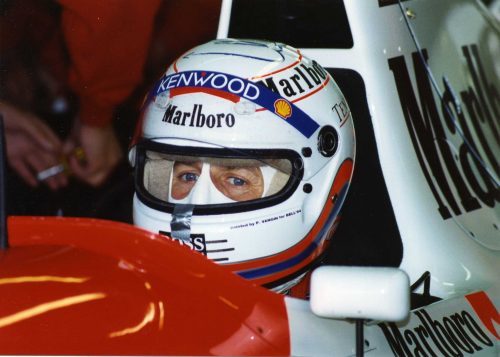 According to Brundle, he was blamed by Peugeot for the Silverstone engine failure. Mclaren, because of internal politics, chose to remain silent over the matter.
To add insult to injury, Peugeot then added to Brundle’s woes by covering their own back following the Silverstone retirement. The car giant got the McLaren back to the pits and fired up the engine to show it still worked, then they issued a press release effectively claiming Martin should have carried on. However according to the now livid Brundle “They conveniently forgot to mention the fire had melted the car’s rear suspension, undertray & rear wing, that the engine had used 8 of its 14 litres of oil and was never going to last.” It was internal politics because Peugeot was desperate to get their countryman, Phillippe Alliot, to replace Brundle and Alliot backers were prepared to go to ridiculous lengths. For instance, a previous side by side test between them had been rigged so Alliot posted a faster time because a chicane made from straw bales had been removed during his run. McLaren soon realised what happened because the telemetry showed his steering wheel pointed straight through that part of the track.
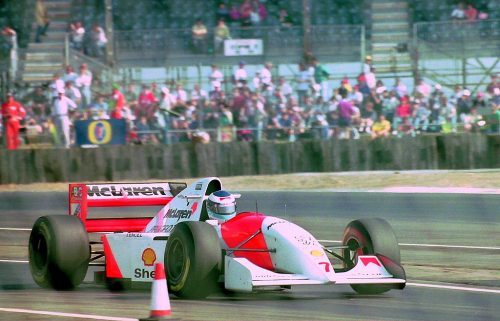 Hakkinen was McLaren’s golden boy in 1994. Had Peugeot successful managed to place Alliot in a McLaren race seat, Brundle would have been the fall guy.
Due to Hakkinen’s race ban following the German Grand Prix, Alliot drove at the Hungaroring but struggled, qualifying eight places behind Brundle. The Englishman claimed “I was no. 1. And, boy, was I enjoying it. Apart from loving the track, I was revelling in the new found responsibility and the fact that the team were focused on me instead of Hakkinen.” However, the unfortunate Brundle suffered yet more heartbreak during the race, when his car developed a problem on the last lap robbing him of a podium finish. Then at Suzuka, Martin Brundle narrowly missed hitting a tractor and instead collided with a marshal. “I really thought my number was up” fumed the Englishman who had feared for his life and that of the marshal who fortunately suffered nothing worse than a broken leg. His crash had been eerily similar to Jules Bianchi’s fatal accident at the same spot in 2014. Somewhat ironically Brundle had warned of these dangers and was one of the drivers screaming for a safety car over his radio when his car aquaplaned off the track.
After the final race of 1994, McLaren, Peugeot and Brundle all went their separate ways leaving Martin to put his case forward to become Schumacher’s teammate for 1995. In doing so he had a dig at Benetton’s 1994 second drivers; “Probably the best seat for me is the second Benetton ride. I think I’m the only guy who could mentally cope with Schumacher – and I think I proved I did before (in 1992). He destroyed me over four races but I came through the other end and did a solid job against him. I think I averaged 1 second off him the whole year – if only people realised then what a megastar he was. Perhaps I’d still be driving a Benetton!”
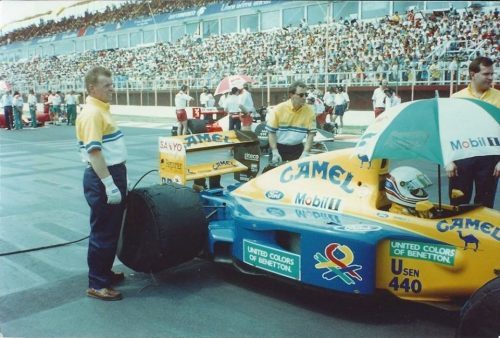 Brundle drove for Benetton alongside Schumacher in 1992 and claimed none of his 1994 teammates could mentally cope with the German’s speed and confidence like he did.
It’s a mystery to many F1 fans that Martin never won an F1 race during his 12-year career despite driving for McLaren and Benetton during the 1990’s and providing a huge threat to Senna in F3. Another mystery is why McLaren escaped any form of punishment despite having run an illegal gearbox during the 1994 San Marino GP?
1994 – The Untold Story of a Tragic and Controversial F1 Season is a new book which explains this and the various other controversies from that year. A free sample of the book can be viewed here. Alternatively you can keep up to date with this and future books by the author, as well as upcoming 1994 F1 blogs by signing up here.
Images courtesy; of Martin Lee via https://commons.wikimedia.org/wiki/Ma..., Alastair Ladd and Antony John Dennis.
August 30, 2018
Mansell’s 1994 Comeback
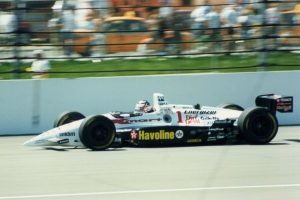
Mansell won the Indy Car title in 1993 during his rookie year. It was an astonishing achievement.
The upcoming book provides more detail, but essentially Nigel’s return to F1 in 1994 was a direct result of Senna’s tragic accident. Because F1 was left without any world champions on the grid and Schumacher was dominating races, Bernie Ecclestone needed to bring some positive news to a sport in crisis. F1’s commercial supremo, therefore, engineered Mansell’s return believing it would give Schumacher a worthy rival whilst also increasing television ratings. The deal worked for Williams because thus far their FW16 car proved troublesome to set-up so Mansell’s vast experience might help identify that elusive ‘sweet spot’. Moreover, the additional crowds Nigel would pull in during his comeback race, the French Grand Prix, would be attractive to Williams’ French engine suppliers (Renault). However Renualt were paying Mansell a superstar salary whereas their regular driver, Hill, was on a fraction of that amount. The question was how would Mansell compare with the new stars of Formula One like Hill, and Schumacher?
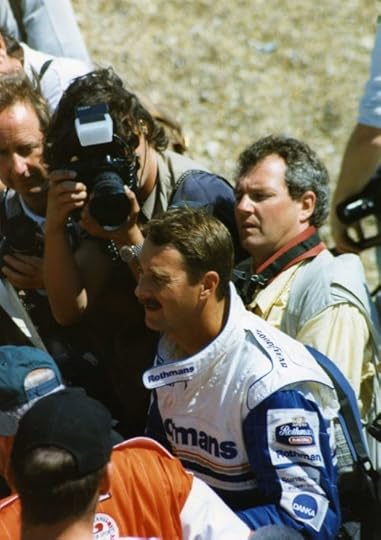 Nigel Mansell arriving for his first test in the Williams FW16.
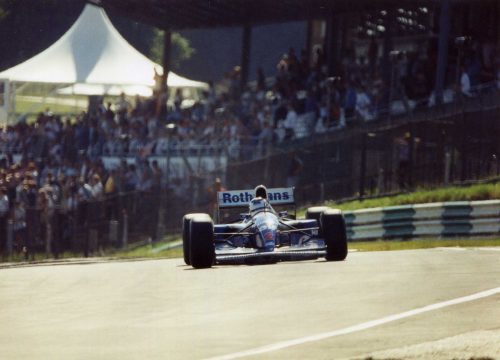 A record crowd turned out to watch Mansell testing the 1994 Williams prior to his first race. It underlined what a ‘box office’ draw he was at the time.
“That’s the first time I drove my balls off to get the pole,” Hill said after narrowly beating Mansell to the top spot. “It focused Damon,” Nigel later admitted, “because getting back in the car after two years, I shouldn’t have been anywhere near it.” Hill also claimed to have the 1992 world champion supporting his set up feedback within the team helped him gain respect and support internally. Due to his Indy car commitments, Mansell couldn’t return again until the final three races of 1994 at which point things were tougher. Because by then Hill had demanded David Brown, the key Williams engineer who assisted Mansell and Prost to their championships, worked on Damon’s car rather than the number 2 Williams. It was a clever move by Damon because David Brown and Mansell had a special relationship from 1992, So Hill’s move ensured Nigel didn’t outperform him upon his return.
The 41-year-old was also not used to standing starts because rolling starts were used in Indy cars and his 1992 Williams had been equipped with traction control. Therefore Mansell showed this rustiness by getting massive wheel spin and losing several places during all of his 1994 F1 starts. Furthermore, Mansell claimed to have arrived at F1 events “spaced out” because he was regularly flying backwards and forwards from his home in America. In addition, he was having to juggle impressing Williams enough to secure a full-time F1 drive with them whilst not harming Hill’s title challenge in the process. Nigel had been competing against David Coulthard for the 1995 Williams drive and things got so competitive between them, that the ex-world champion barred the Scot from entering his garage during the Japanese & Australian race weekends. As a joke, Coulthard banned signs appeared in the Williams pits with a photo of the unwanted colleague with a red diagonal stripe across it.
 Coulthard had finished a strong second before Mansell took over his seat for the final three races of 1994.
Mansell’s best showing did, however, come at the final race of the year after he out-qualified the two title contenders, Hill and Schumacher. Afterwards, the returning F1 star claimed; “I was told all sorts of things by the powers-that-be. ‘You will not be part of this race, don’t get a good start, watch the race, do not interfere…’ So I deliberately didn’t get a very good start and I just sat there and watched.” The race turned into an enthralling duel for the championship until Schumacher collided with Hill to take the 1994 crown under controversial circumstances. It gifted Mansell the win, but even that did not stop Williams committing to Coulthard for 1995. Nigel then joined the new exciting partnership of McLaren Mercedes, but this proved a major disappointment. After missing the first two races because he had struggled to fit into the car, Mansell then performed poorly before walking away from F1 after only two races with McLaren. Although that was Mansell’s final Grand Prix he hasn’t officially confirmed his retirement…
According to an upcoming book contributor and the man who replaced Mansell at McLaren in 1995, Mark Blundell, the chemistry between the two was never going to work. McLaren’s team principal, Ron Dennis, was such a different personality to Mansell and at the time the relationship was seen as a stop-gap so Mercedes could try to lure Schumacher for 1996. Blundell also states “I first knew Nigel when I was a test driver at Williams. Something needed trying, I forget what, and I heard him say, ‘Get the test monkey to do it.’ When I took his drive at McLaren I wanted to make some monkey comment in return, but never got the chance.”
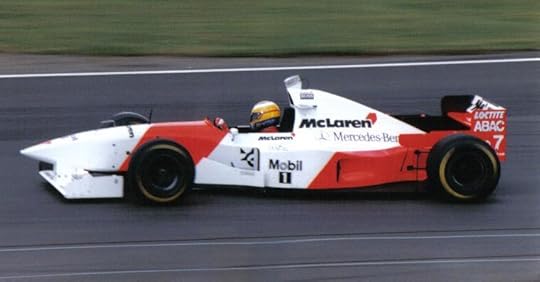 Mark Blundell (pictured in the 1995 McLaren) has kindly contributed towards the upcoming book. His insights are extremely valuable for many reasons.
1994 – The Untold Story of a Tragic and Controversial F1 Season is a new book which amongst other things explores why the Williams FW16 was initially difficult. Leading Senna to search for a reason why Schumacher’s Benetton had much better traction than his car. What did Senna hear on Schumacher’s car which troubled him and were his suspicions justified? The upcoming book explains this and various other controversies from that year. A free sample of the book can be viewed here. Alternatively you can keep up to date with this and future books by the author, as well as upcoming 1994 F1 blogs by signing up here.
Images courtesy; of Rick Dikeman, Fox 1 and Martin Lee via https://commons.wikimedia.org/wiki/Ma..., and Alastair Ladd,
July 31, 2018
Working Within Benetton During the 1990’s
The ex-Benetton mechanic has kindly contributed towards the upcoming book, but cannot be named because he still works in F1. However his anonymity means he can be brutally honest.
Benetton started 1996 with high hopes having just been crowned drivers and constructor’s champions. Despite losing Michael Schumacher, the Enstone team were gaining a hugely gifted racer in Jean Alesi. Their other incoming driver, Gerhard Berger, was F1’s elder statesman having partnered the likes of Ayrton Senna at McLaren. If Benetton could harness Alesi’s talent or Berger’s experience surely more success lay on the horizon. However, things didn’t quite pan out like that.
“Remember when Berger had an appalling start at Nurburgring in 1996” said the unnamed Benetton insider whose identity must remain a secret. “All he had to do was press the brake pedal and then press the line lock button to unlock the front brakes when the race started. Like a handbrake, this would have allowed our drivers to have the clutch ‘biting point’ ready when the red lights disappeared allowing a better getaway. But at the start of the race both drivers pushed too hard on the pedal, and at this high pressure the line lock would not release , even when the button was released. It only released when the drivers pushed the brakes again. Berger drove a couple of hundred yards with the front tyres locked up which completely wrecked those tyres and threw away a potential podium finish. Alesi had done the same, although to a lesser degree, and lost 9 places off the line. Now, in red mist mode, Jean dived inside Verstappen but out-braked himself and slammed into the side of Salo. Race over!” Afterwards Benetton looked at the data, did more tests and introduced measures so there wasn’t a simliar problem with the line lock button again.
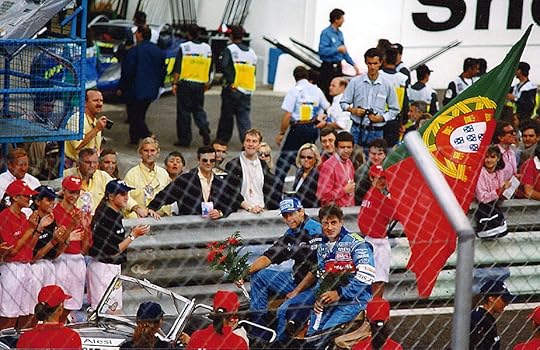
Berger and Alesi pictured in 1996. Both found the Benetton difficult to drive and crashed it numerous times during pre-season.
The former Benetton mechanic also describes the time Alesi wouldn’t stop for fuel during the 1997 Australian GP. “We had everyone from the team waving at him to signal his pit stop was due. It started with the pit board and after a few laps we were waving the lollypop over the pit wall at him.” Alesi, who had been fighting for a podium, then ran out of petrol and as his Benetton halted to a stop legendary TV commentator Murray Walker summed up the situation. “You can see by the body language of the Benetton mechanics that they are ab-so-lutely FURIOUS! Oh, Jean, you may look a bit worried. You’ve got a major problem sunshine when you get back to the pits!” In Alesi’s defence, his radio was broken during that race.
Afterwards, Flavio Briatore (Benetton’s boss) was asked what he would do if Alesi repeated these antics. Briatore answered “on the first lap he doesn’t pit I’ll wave a big gun. If he still doesn’t stop, I’ll start shooting.” In Ross Brawn’s recent book entitled Total Competition he described Benetton taking both Alesi & Berger for 1996 as a mistake. Brawn just wanted Alesi whereas Briatore insisted his teammate should be Berger. As Brawn feared, the Austrian proved a bad influence on Jean as one testing session at Silverstone illustrated perfectly. Berger drove the car in semi-wet conditions and having returned to the pits he told Alesi “slicks tyres are no problem.” Alesi tried them but crashed immediately because it was too wet for slicks – Berger had just been joking!
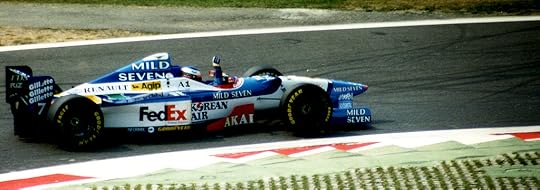
Alesi’s biggest success with Benetton came at the 1997 Italian GP when he claimed only his second ever pole position.
“I’m sure it was Alesi who the chief mechanic locked in the back of the truck at Silverstone after coming into the garage in a mood and pushing over a set of tyres like a kid” claimed our ex-Benetton friend. “Think it was Berger who came into the garage after an installation lap saying he had a snake in his overalls. Was his spare earpiece down his overall leg. Berger also came over the radio in a session saying the car is shit, bad set up. Engineer asks ‘what’s wrong?’ Berger just says its shit. Engineer; ‘OK let’s change something, oversteer? understeer?’ Berger, it’s just shit….. He was in P1 at the time. You always knew how much work you had to do during the weekend by the mood of the drivers.”
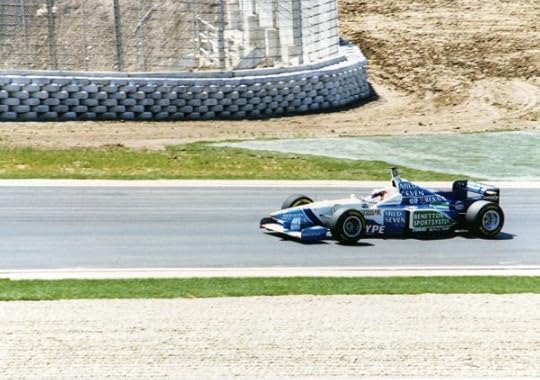
Having won 19 Grand Prix’s throughout 1994 and 1995, Benetton only won a single race during 1996 and 1997 with Berger and Alesi (pictured) as their drivers.
Driver issues also blighted Benetton’s qualifying session for the 1997 European GP. Having crashed his race car earlier that day Alesi, now in the spare, spun twice and was extremely lucky not to damage or “beached” the B197 before posting a lap time. The Benetton teammates then blocked one another during their quick laps, ending the session in a disappointing 8th and 10th position as a result. Unsurprisingly, Berger and Alesi were replaced for 1998 after both drivers fell out with senior team management. It was all a far cry from Benetton’s glory days with Schumacher, not least because the German went out of his way to ensure his mechanics were looked after as the following story demonstrates.
During a testing session in 1994 at the Paul Ricard circuit the German’s Benetton developed a technical issue and whilst waiting for it to be fixed, he gave some mechanics a ride in his new Bugatti supercar. Pete Hennessy was responsible for servicing Benetton’s Ford Cosworth engines mechanically in 1994 and was one of those taken around Paul Ricard by the seven-time F1 champion. Pete later recalled “not sure what turn it was but we were going very quick, he realised the brakes had failed, changed down two gears and deliberately spun the car. Think it went round twice and came to rest half a metre from the wall…..he said ‘that was close’. I said ‘you did all that in the time it took me to shit myself’…… I will always remember it, and how he was laughing at me…….memories.”

Schumacher with Pete Hennessy, shortly before that incident.
1994 – The Untold Story of a Tragic and Controversial F1 Season is a new book which aims to uncover the truth regarding the various Benetton accusations and politics. A free sample of the book can be viewed here. Alternatively you can keep up to date with this and future books by the author, as well as upcoming 1994 F1 blogs by signing up here.
Images courtesy; of Nic Redhead, Steve Gregory, Restu20, Andrew-44-19 via https://commons.wikimedia.org/wiki/Ma..., Pete Hennessy and Marco Castelli
June 28, 2018
Funny Stories From An F1 Mechanic
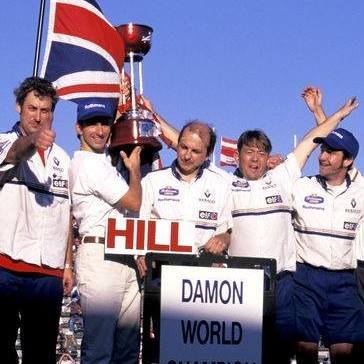 A very drunk Paul West giving it the thumbs up after Damon Hill’s 1996 Championship victory.
Paul has many enjoyable stories from his time within F1 including how he inadvertently contributed towards the rules. “The cars were kept for an hour after the race (for scrutineering purposes), it was allowed for two guys per car to clean them but nothing else, this happened until the 1997 Japanese GP. At this race some of the guys at Benetton suspected that Ferrari had a movable front wing so they got me, like an idiot, to put some pressure with my foot to see if it moved. There were some Ferrari mechanics watching and they reported to Nigel Stepney what I’d done, he came down and spoke to Dickie Stanford our team manager who asked me if I’d done it I said yes and I think because I was honest Stepney didn’t have anything done to me but from then on no personnel were allowed in parc ferme.”
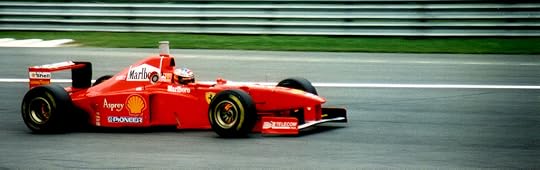 Schumacher’s 1997 Ferrari which Benetton mechanics believed had an illegal flexible front wing.
When researching for the book, I asked Paul if he remembered any ‘special’ engine maps Williams Renualt used during the 1990’s. “I don’t recall any radio messages to the drivers to use any special settings for starting or for better traction during a race” West explained. “I do recall in 1997 we had adjustable differentials, the reason I remember is that during the 1997 Monaco race, the one where we TOTALLY stuffed up our tyre selection, during the race Heinz Harald Frentzen was on the radio to our engineer because he wanted to soften off the differential for the conditions. Back then we only had so many buttons on the steering wheel and they all performed more than one task. So Tim Preston (Frentzen’s race engineer) got back to him and said something like; ‘On the straight you press the yellow button three times to bring up the diff mode and then you press the red button until you get the setting you want.’ Well Frentzen just goes off on the radio ‘On the f@#king straight there is no F@#KING STRAIGHT !! Which button to do what?’”
“This carried on for a few laps and then Frentzen, who was on intermediates, decides he wants the heavy grooved wets because someone passed him using them. Tim then said ‘no problem box…box’ well there was a problem because the only set we had mounted was on the spare car at the pit entry. Frentzen comes in, we change tyres and he sees that they are the same as we’ve taken off. He goes ballistic on the radio, totally mental. Tim tried to calm him down but the next lap or so he stuck it in the fence – game over! Funny thing is conditions were getting better, we always suspected he binned it on purpose because he was so mad. Oh and the reason for the tyre choice at the start, since the first European race we’d brought a guy from the Meteorological Office to do weather forecasting for us. The forecast for Monaco was missing page 2 which would have given us a heads up that the rain wasn’t going to clear as quickly as we thought. Very hi-tech this F1 stuff.”
 The car Frentzen “binned” at Monaco. His teammate, Jacques Villeneuve, hit the barrier and retired because he was trying to adjust the brake balance within the cockpit – thus rounding off a terrible day for Williams.
Paul was also questioned about the closeness of Williams’ relationship with Ligier in 1993, as the former supplied the latter with gearboxes. “That question made me smile” Paul replied. “The gearbox, I think it was TG4, had a lot of pre-load which meant that until it was hot it made the car VERY hard to push. We used hot air blowers and electric heaters to assist with freeing up the box. Poor Ligier being a long way down the pit lane had to put their cars on the rear jacks to be able to get them to the scales and back. It seemed to us that every time they went past our garage they were frowning at us! The idea was to save Ligier development costs plus we had a new box for that year so they were not needed anymore. I don’t remember how long the arrangement went on for, we were also doing gearbox work for Opel in the DTM at that time so the gearbox sub-assembly area was very busy.”
 The Ligier mechanics pushing their 1993 car along with THAT gearbox
Paul West has been an invaluable contributor towards the upcoming book, his stories of working within Williams during the 1990’s are extremely entertaining, informative, and perhaps merit a book of its own. A free sample of 1994 – The Untold Story can be viewed here. Alternatively you can keep up to date with this and future books by the author, as well as upcoming 1994 F1 blogs by signing up here.
Images courtesy; of Paul West, Martin Lee and Zep via https://commons.wikimedia.org/wiki/Ma...
May 31, 2018
What Do The Most Successful and Worst Car of 1994 Have in Common?
In 1991 a high-quality design team headed by Rory Byrne and Pat Symonds secretly worked on a Reynard F1 car. However, the project was eventually shelved and the team moved back to Benetton for 1992. “I was a director of the Reynard F1 effort so knew a lot about it” explains Willem Toet, Benetton’s Head of Aerodynamics in 1994 and one of the key contributors towards the upcoming book. “Pat Symonds, Rory Byrne and Adrian Reynard were the other directors. Afterwards we all went back to Benetton because Rory did a deal for the whole group. I don’t think there is a person on the planet who knows the story better than I do.” Their 1991 Reynard design morphed into the race winning 1992 Benetton and the B194 car, which Schumacher used to win the 1994 drivers’ championship, was an advanced evolution of it.
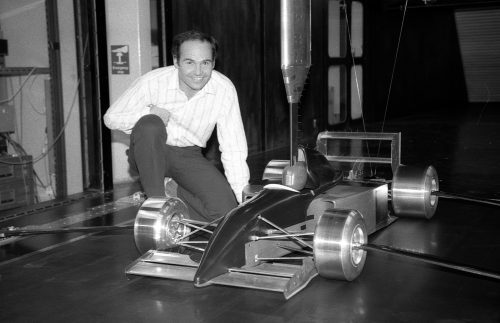
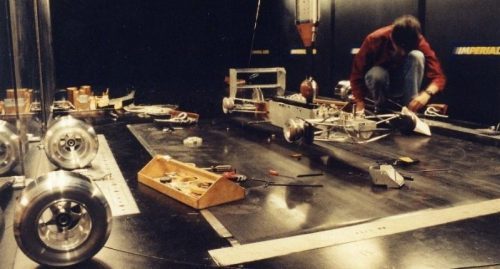 Some extremely rare photos of the 1991 Reynard F1 project conducting wind tunnel testing with Willem Toet (in the top photo).
Meanwhile Reynard sold the original 1991 design to Pacific who used it to create their own 1994 car, the PR01. In contrast to Benetton, Pacific had not undertaken any vital aerodynamic development on it and basically had no real knowledge of how to update the design. This combined with limited funds, meant Pacific was essentially using a three-year-old car during the 1994 season. The PR01 was also powered by an ancient Ilmor engine last used by Sauber before the previous season’s Italian GP.
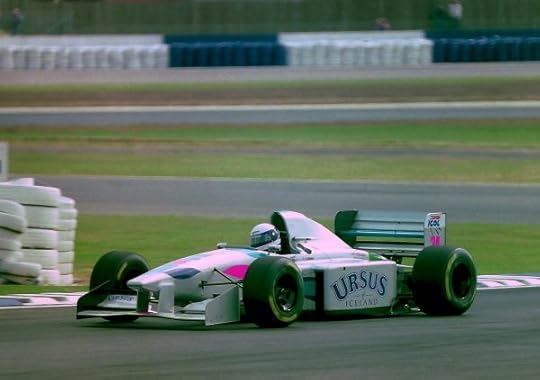
 Separated at birth; the worst car and the most successful car of 1994.
Pacific’s budget was tiny so the car had limited track testing and because of this, it suffered fundamental problems. Significant modifications were supposed to be carried out after the tragic San Marino Grand Prix but needed to be abandoned. This was due to a sponsorship deal not materialising – nothing new in F1 – but this story was particularly ironic. Pacific Grand Prix persuaded a cigarette company called Black Death to sponsor them for that fateful Imola race. They secured the deal by explaining how safe F1 was in 1994 because there had not been a death within the sport for 12 years. This was particularly important to Black Death because their logo featured a skull and crossbones.
Because the stickers for the cars did not arrive in time, Pacific ran without their new sponsor during Saturday qualifying where Roland Ratzenberger was tragically killed. The stickers arrived later that day and were ready to be put on the cars but for obvious reasons, the Pacific team declined the offer by now. “It’s actually a very difficult situation,” explained Pacific’s Graeme Glew. “The backing could be a saviour, but obviously it would have been inappropriate here.” The Black Death Company never appeared in Formula 1 after the subsequent accidents in F1 during that dark period. To add salt into Pacific’s wounds their team truck caught fire on the way back from that cursed Imola race. At the following Grand Prix, Max Mosley (the president of F1’s governing body, the FIA) then announced immediate and extensive safety modifications to be made to the cars. This measure, whilst necessary, did effectively wiped out Pacific’s budget for the remainder of the year. Upon hearing Mosley’s new safety measures Keith Wiggins, the Pacific team boss, said; “If my engines don’t bankrupt me, this stands a pretty good chance.” Despite enjoying success in lower categories where their drivers included David Coulthard and JJ Lehto, Pacific GP was finding F1 in 1994 tough going.
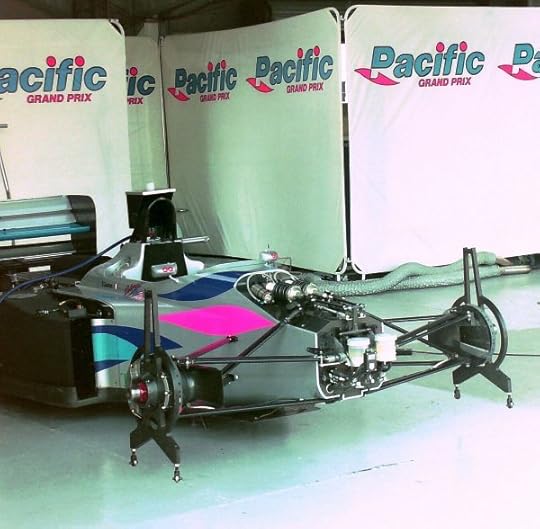 The FIA imposed immediate safety modifications onto the cars following the various accidents, but teams were in an uproar over the cost and haste of this. It led to lots of interesting politicking later on as detailed in the upcoming book.
In 1994 Pacific did not finish a single race and from the French Grand Prix onwards, neither car qualified. They scored a total of zero points that season. By 1995, the team merged with the dying Team Lotus. The obsolete Ilmor engines were replaced by Ford ED V8s and a whole host of new sponsors were brought in. Good news also came when the PR02 was guaranteed a start each race, with the Larrousse and Lotus teams disappearing from the entry lists and only Forti debuting. However that season proved little better with Pacific’s best finish being 8th in the German and Australian Grand Prix’s. At the end of 1995, the team withdrew from Formula One and Wiggins went back to Formula 3000, resurrecting Pacific Racing and by 1998, Wiggins closed the team for good. One can’t help but wonder how things might have differed for Pacific had they been their world not been turned upside down following the 1994 San Marino Grand Prix.
1994 – The Untold Story of a Tragic and Controversial F1 Season is a new book which gives unique insight into why 1994 was especially turbulent. Moreover it investigates the politics surrounding Benetton and the various cheating allegations. A free sample of the book can be viewed here. Alternatively you can keep up to date with this and future books by the author, as well as upcoming 1994 F1 blogs by signing up here.
Images courtesy of Martin Lee via https://commons.wikimedia.org/wiki/Ma... Alastair Ladd and Willem Toet.
April 28, 2018
Ayrton Senna – His Final Hours
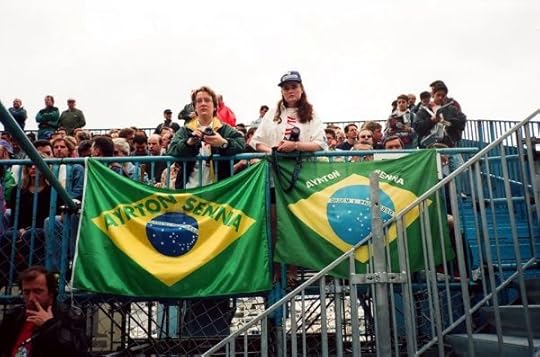 Ayrton Senna was a unique champion and is still adored by F1 fans today.
Senna was a complex, charismatic yet contradictory character who evoked strong emotions within others – qualities which were evident during the final hours of his tragically short life. The death of Roland Ratzenberger during qualifying for the 1994 San Marino GP, the first death at a race meeting in 12 years, deeply affected Senna. Indeed, the Brazilian commandeered an official FIA car to visit the accident himself as he wanted to understand what lessons could be learnt for the safety of others. It was something the triple world champion would be chastised for before the race. He then went to the medical center where he was met by his friend Professor Sid Watkins, F1’s senior doctor, who answered his questions with complete honesty. Upon learning that Ratzenberger was beyond medical help Senna could no longer hold back the tears. “You’ve got nothing left to prove. Give it up and let’s go fishing together” Watkins told him. Senna took a long time to think about his reply “Sid, I have to go on”. Those words must have haunted Watkins 24 hours later.
 Senna always showed great compassion towards his colleagues whenever they suffered horrific accidents. The driver injured in the above photo (Erik Comas in 1992) fully recovered.
Perhaps the most comparable experience the Brazilian had to draw upon was the 1990 Spanish GP when Senna visited the scene of Martin Donnelly’s near-fatal accident. In that example, he watched all the medical treatment the Ulsterman was receiving possibly watching him die from a crash. He watched all the needles and syringes and the tracheotomy. Then he went back to his garage, put his helmet back on, visor down, and with just 10 minutes left, did the fastest lap of Jerez ever of that track. Maybe that was Senna’s way of dealing with fear. He later reflected on that day; “I had to put myself together, walk out, go to the racing car and do it again, and do it even better than before. Because that was the way to cover the impact it had on me.” The next time Senna stepped into an F1 car after Ratzenberger’s tragic accident was the following morning. The Brazilian topped the warm-up time-sheets with a massive margin over the next car, just as he had done in Spain 1990.
 Senna always had great natural speed but was famous for harnessing his emotions to excel to even greater heights.
This is not to suggest the Brazilian was reckless. He was simply overcoming his fear by facing it head-on. At the 1994 San Marino GP there was an added incentive, Senna was determined to blow Michael Schumacher away and he wanted the German to know it. He had started that season as the overwhelming favorite to win the championship however Senna was being blown away by these upstarts, so he needed to reassert his authority on them. However Benetton appeared to be playing their own mind games; during that warm-up Schumacher was a massive 2.4 seconds slower, suggesting he might opt for an unfancied one-stop strategy in the race. Senna’s lap time suggested the more conventional two-stop strategy, but Schumacher’s lack of warm-up pace must have made the Brazilian wonder what his rival was up to.
Unknown to Benetton, Senna had other issues on his mind all of which is extensively detailed in the upcoming book. For instance, he had become increasingly concerned with F1 safety in recent times. Senna said in a pre-race interview how the reintroduction of refuelling in 1994 turned races into a series of sprints with low fuel levels. The triple world champion considered this to be an unreasonable strain on both drivers and cars. Senna felt this factor had not been considered when refuelling was pushed through. Hence why Niki Lauda urged him as F1’s most famous driver to reform the Grand Prix Drivers’ Association (GPDA) and lobby the FIA for better safety for its participants.
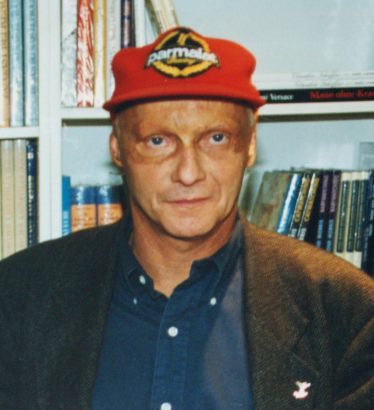 Lauda was an advocate of safety, not least because he was lucky to survive a fiery crash in 1976. After Senna’s death, it was Lauda who became GPDA spokesman.
On the way to the pre-race drivers briefing, Senna asked Berger and Hill to raise a complaint for him. The Brazilian didn’t want to be the instigator because he was in trouble with the FIA over his actions the previous day. Namely commandeering one of the official cars to visit the scene of Ratzenberger’s accident and not attending the obligatory post-qualifying press conference. So at the behest of Senna, a complaint was made about the FIA using a standard road car to lead the field around the formation lap at Aida. The road car was too slow and prevented F1 drivers from getting their tyres up to the correct temperature/pressure. This adversely affected the handling and ride height of the F1 machines during the opening laps of a race and was something Senna was especially worried about. Consequently, the FIA decided not to use their road car prior to the start of an F1 race again.
Among the last people to speak with Senna before that fateful race was former rival Alain Prost who told Autosport Magazine in 2014. “…I met him (Senna) on Sunday twice – the main constant was safety and the fact that we he was not happy with the situation, thinking that the Benetton was not legal.” Similarly, legendary Williams designer Adrian Newey said in his recent book “How to Build a Race Car” he was in the garage when Ayrton came running in to get into his car for the start. Newey had a quick chat with him and Senna reiterated his concern that he was about to battle an illegal car-driver combination. Newey said; “He went into that race with all that buzzing in his head. But he went in, above all, with a desire to win. Ayrton was one of the fiercest, most passionate competitors the sport has known..”
1994 – The Untold Story of a Tragic and Controversial F1 Season investigates these allegations against Benetton, the subsequent politics and much more. A free sample of the book can be viewed here. Alternatively you can keep up to date with this and future books by the author, as well as upcoming 1994 F1 blogs by signing up here.
Images courtesy; of Martin Lee, Vikiskiss, Stuart Seeger and Osado via https://commons.wikimedia.org/wiki/Ma... and Méhes Károly


