
Ibrar Malik's Blog
October 16, 2020
Interview With GP Rejects
GP Rejects: Now you have written a second book, “Lotus: Beyond The Colin Chapman Era”, focusing on the 1982 to 1989 period of the original Team Lotus period. How did you get involved with writing a second book?
Back in 2013 GPrejects forum member neilwhite_design started a thread stating he was writing a book covering Team Lotus’ final years of 1983 – 1994. Like most F1 fans, I was excited by this prospect because the reasons for Lotus’ decline had never fully been clear to me. I therefore offered to read Neil’s 1989 chapter to ascertain the reasons behind Lotus decline, as that was the time Lotus went from being podium finishers (in 1988) to non qualifiers (at Spa 1989).

Since 2013 I gradually got more involved in helping Neil, and increasingly it became clear he did not have the time or the will to finish this book off. Initially we were going to co-author this book together however a few months ago, Neil told me his other commitments needed to take priority so did not want to be carry on anymore. Leaving me to finish this project off alone. I would have preferred to carry on with Neil to ease that burden, but we parted on amicably and I’m very proud of the end result. Not least because the contributors for this book include Frank Dernie, Peter Wright, Willem Toet and a few other F1 insiders.
Considering that the team continued until the end of 1994 before closing, why does this book not cover the 1990 to 1994 period? An initial assumption would be because of the amount of ground to be covered would be too great. If so, could this be the focus of a third book from yourself?
Your initial assumption is spot on. Lotus’ decline was unusual: it was not a spectacular, swift or a sudden affair. Instead, it was a death by a 1000 cuts spanning years if not decades. Read any F1 forum on this subject and you’ll see many fans are not clear as to the detail behind those 1,000 cuts, or indeed how or why they came about. This book sheds light on them by guiding readers through all of Team Lotus’ races between 1983 (just after Colin Chapman’s death) to the end of the 1989 F1 Season (when Lotus were clearly struggling). There may be a follow up book investigating Lotus’ final years of 1990 – 1995 depending on how well this book does. The reason Lotus’ 1983 to 1995 years aren’t all within a single book is simple, this decline story is one that needs to be covered in detail. Remember there are 1000 cuts to cover.
 Many rated Lotus’ 1984 chassis, the 95T, as one of the best within F1. Thus showing Lotus’ post Chapman decline was not as straight forward as it seems. Credit: Paulo Guereta
In our previous interview, you were able to give a small exclusive, giving a tale about the rejectful Pacific team at the 1994 Portuguese Grand Prix. Are you able to give any ‘sneak-peeks’ to any exclusives in this book (especially if it involves any reject drivers or teams, like Johnny Dumfries?)?
There are many exclusives within this book not least because Lotus’ decline has, in my opinion, been criminally underreported. For instance Peter Wright exclusively discusses why Lotus did not continue with active suspension beyond 1987 and what his assessment of that year’s system was. Another exclusive is why hasn’t Lotus’ headquarters and location in far flung Norfolk (hours away from F1’s heartland of Oxfordshire) been questioned before? Proud to say the book does exactly that. By way of a comparison, the Onyx team, operated out of a similarly unusual F1 factory to that of Lotus’ Ketteringham Hall base. Onyx’s & Lotus’ headquarters were both very expensive & restrictive in terms of their ability to house things like onsite wind tunnels etc which became essential for on-track success during the mid 1980s onwards.
In 1989 the Onyx team had just been taken over by the eccentric Belgian millionaire, Jean-Pierre Van Rossem, the owner of Moneytron. After a difficult first year the flamboyant Van Rossem sold the team, after bemoaning about the cost of running it from such expensive premises. By July 1990 the team had finally moved out of it, but by then money was so tight for Monteverdi (the new name for Onyx), things like broken suspension parts were reported to have been welded together to save costs rather than replaced. Karl Foitek, father of Gregor Foitek, then withdrew his funding and barred his son from driving what he now considered was a death trap. Shortly before the 1990 Belgian Grand Prix the team was closed down, the victim of too many unpaid bills.
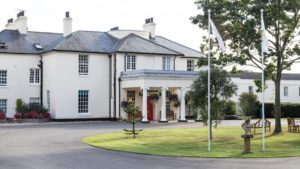 The Onyx’s team grand headquarters known as Westergate House. Just like Lotus’ Ketteringham Hall base this building was grade 2 listed meaning installing a wind tunnel here would have been impossible. Credit: www.barchester.com/homewestergate-hou...
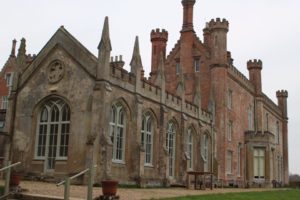 Lotus’ base which was very different to typical F1 factories even back in the 1980s, let alone today
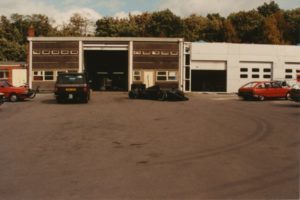 Tyrrell’s base was humble in comparison to Lotus’. Meaning their property costs would have been significantly less. Also because this building was not pretty or historic, Tyrrell would have been able to obtain planning permission for a wind tunnel here. Credit: Nigel Beresford
Interestingly Williams and McLaren both relocated to cheaper but more purpose built F1 bases during the mid 1980s to improve their on track performances. The latter team subsequently poached Lotus’ key asset in Senna for 1988 who was impressed by McLaren’s new headquarters. Those two teams just happened to dominate the 1980s and 1990s. Whereas Lotus had started the 1980s as their equal, but chose not to follow their lead on this front. The reason why is interesting and discussed within the book. Instead Lotus remained within their grand but expensive headquarters (a bit like Onyx), up until their demise in 1995. So naturally, the book questions that decision using insights from Willem Toet (an F1 wind tunnel expert), and Frank Dernie (Lotus’ Technical Director in 1989).
I am aware that in 1989, Tyrrell and Lotus finished the season just a single point apart in fifth and sixth in the Constructors Championship, despite a massive difference in budget. How did this happen? Was the Judd engine to blame? (Williams used the Judd engine for one year in 1988 and finished 7th in the championship, yet won the title with Honda in 1986 and 1987, and finished second with Renault in 1989, suggesting that Judd may have been the weak link for Williams.)
The Judd engine was a factor, but not the only reason. Because in 1988 Williams still managed to beat Tyrrell in the constructor’s championship despite using the Judd’s unlike Lotus a year later. You’ll need to read the book to understand all of the reasons why and one of its contributors is Tyrrell’s Nigel Beresford, race engineer to Jonathan Palmer and Jean Alesi. Beresford helps readers understand this story well, because the process of Tyrrell eclipsing Lotus actually started back in 1987, and led to Tyrrell thrashing Lotus in 1990. In both 1989 and 1990, Tyrrell’s budget was a pittance in comparison to Lotus’ who enjoyed vast Camel sponsorship money. Making this story all the more interesting. Indeed, the book charts Tyrrell’s rise during the late 1980s as well as Lotus’ decline to see what lessons can be learnt.
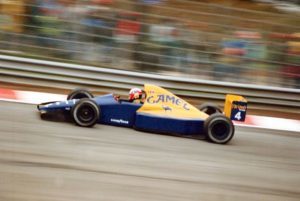
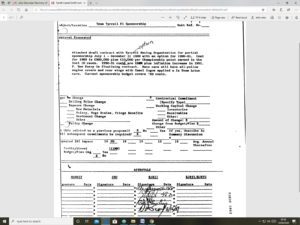 Camel & Tyrrell got together in 1989 and had drafted a sponsorship contract spanning the 1990 & 1991 seasons. However Camel stuck with Lotus on account of their Lamborghini “manufacturer” engine. Credit: Nigel Barrett
I seem to recall reading on social media somewhere that you also cover Colin Chapman’s links with John DeLorean with regards to the DeLorean DMC-12, a car made famous by the Back To The Future trilogy of films of the 1980s (my personal favourite film trilogy of all time). Can you tell us much of this chapter of the book, and whether there was a connection between the DeLorean deal and the Lotus F1 team? Did the failure of the DMC-12 impact financially on the F1 team?
Again this is another major exclusive within the book, as it explores this very point. The DeLorean Motor Company collapsed in late 1982 and some of the £77 million of UK taxpayers money used to fund it went missing. Then Lotus were dragged into the subsequent investigations into those missing taxpayers millions (which could have been used to fund the NHS for instance). It proved to be one of the UK’s biggest tax scandals of the 1980s. Colin Chapman’s key finance man, Fred Bushell, remained in charge of Team Lotus’ finances until July 1989, when he was arrested over the DeLorean affair. In 1992 Bushell pleaded guilty to conspiring to defraud. He was sentenced to three years in jail, fined £1.6m and ordered to pay costs of more than £800,000. Since this whole affair had been ongoing since the period the book covers (1983 – 1989), it therefore investigates to what extent this whole thing hung over Team Lotus and their readiness to invest within the team.
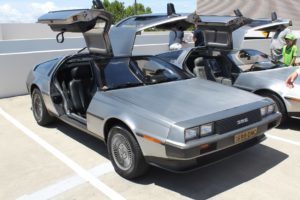 The DMC DeLorean sports car which was featured in the 1985 film Back to the Future. This car was at the centre of the Lotus/DeLorean affair during the 1980s. Credit Jeremy from Sydney Australia.
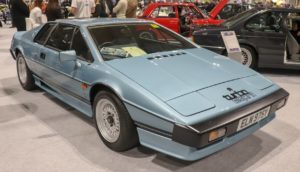 Colin Chapman himself claimed the DeLorean chassis was very “Lotus like” having been based on their Esprit Turbo. This is presumably is why Lotus were able to design the DeLorean in a quarter of the usual time. Credit: Vauxford
I understand that “Lotus: Beyond the Colin Chapman Era” is independently published. Why was the decision taken to go down this route? It is also available in various formats and at differing price points. Can you explain these different purchase options please? And where can we obtain these?
It was a conscious decision to self published this book because the subject matter is so controversial, because of the aforementioned exclusives on the DeLorean affair and the questioning’s of Lotus base etc. Quite honestly I did not want any editors to censor things. It’s also why I believe this subject matter has been criminally underreported in the last 25 years since Team Lotus folded. The book is only available via Amazon at the moment, either via Paperback or Ebook here: https://www.amazon.co.uk/dp/B087L72WJQ?ref_=pe_3052080_397514860 A hard copy may follow in due course and if that is something of interest then I would encourage people to sign up here; http://www.1994f1.com/contact/ to receive an email notification about this.
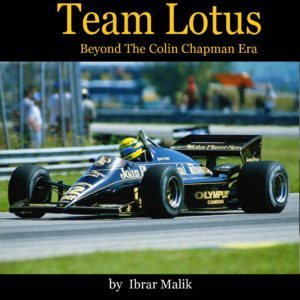 The book is available via Amazon, either via Paperback or Ebook here: https://www.amazon.co.uk/dp/B087L72WJ... (credit Dima Moroz)
After publishing these two books, do you have plans for a third, fourth, or even fifth book? And what else might the future hold for you personally?
Whilst I do have the research, contacts and knowhow to turn the follow up book (charting Team Lotus between 1990 – 1995) into a reality. Quite honestly, I need a bit of a break before even looking into it. Writing is a book and dealing with the subsequent social media side of things is much tougher than one imagines so I need to think twice before putting myself through all of that again. In the meantime, I also need to find a job to pay the bills, so that is what I will be doing for the rest of 2020.
Back in 2013 GPrejects forum member neilwhite_design started a thread stating he was writing a book covering Team Lotus’ final years of 1983 – 1994. Like most F1 fans, I was excited by this prospect because the reasons for Lotus’ decline had never fully been clear to me. I therefore offered to read Neil’s 1989 chapter to ascertain the reasons behind Lotus decline, as that was the time Lotus went from being podium finishers (in 1988) to non qualifiers (at Spa 1989).
Since 2013 I gradually got more involved in helping Neil, and increasingly it became clear he did not have the time or the will to finish this book off. Initially we were going to co-author this book together however a few months ago, Neil told me his other commitments needed to take priority so did not want to be carry on anymore. Leaving me to finish this project off alone. I would have preferred to carry on with Neil to ease that burden, but we parted on amicably and I’m very proud of the end result. Not least because the contributors for this book include Frank Dernie, Peter Wright, Willem Toet and a few other F1 insiders.
Considering that the team continued until the end of 1994 before closing, why does this book not cover the 1990 to 1994 period? An initial assumption would be because of the amount of ground to be covered would be too great. If so, could this be the focus of a third book from yourself?
Your initial assumption is spot on. Lotus’ decline was unusual: it was not a spectacular, swift or a sudden affair. Instead, it was a death by a 1000 cuts spanning years if not decades. Read any F1 forum on this subject and you’ll see many fans are not clear as to the detail behind those 1,000 cuts, or indeed how or why they came about. This book sheds light on them by guiding readers through all of Team Lotus’ races between 1983 (just after Colin Chapman’s death) to the end of the 1989 F1 Season (when Lotus were clearly struggling). There may be a follow up book investigating Lotus’ final years of 1990 – 1995 depending on how well this book does. The reason Lotus’ 1983 to 1995 years aren’t all within a single book is simple, this decline story is one that needs to be covered in detail. Remember there are 1000 cuts to cover.
Many rated Lotus’ 1984 chassis, the 95T, as one of the best within F1. Thus showing Lotus’ post Chapman decline was not as straight forward as it seems. Credit: Paulo GueretaIn our previous interview, you were able to give a small exclusive, giving a tale about the rejectful Pacific team at the 1994 Portuguese Grand Prix. Are you able to give any ‘sneak-peeks’ to any exclusives in this book (especially if it involves any reject drivers or teams, like Johnny Dumfries?)?
There are many exclusives within this book not least because Lotus’ decline has, in my opinion, been criminally underreported. For instance Peter Wright exclusively discusses why Lotus did not continue with active suspension beyond 1987 and what his assessment of that year’s system was. Another exclusive is why hasn’t Lotus’ headquarters and location in far flung Norfolk (hours away from F1’s heartland of Oxfordshire) been questioned before? Proud to say the book does exactly that. By way of a comparison, the Onyx team, operated out of a similarly unusual F1 factory to that of Lotus’ Ketteringham Hall base. Onyx’s & Lotus’ headquarters were both very expensive & restrictive in terms of their ability to house things like onsite wind tunnels etc which became essential for on-track success during the mid 1980s onwards.
In 1989 the Onyx team had just been taken over by the eccentric Belgian millionaire, Jean-Pierre Van Rossem, the owner of Moneytron. After a difficult first year the flamboyant Van Rossem sold the team, after bemoaning about the cost of running it from such expensive premises. By July 1990 the team had finally moved out of it, but by then money was so tight for Monteverdi (the new name for Onyx), things like broken suspension parts were reported to have been welded together to save costs rather than replaced. Karl Foitek, father of Gregor Foitek, then withdrew his funding and barred his son from driving what he now considered was a death trap. Shortly before the 1990 Belgian Grand Prix the team was closed down, the victim of too many unpaid bills.
The Onyx’s team grand headquarters known as Westergate House. Just like Lotus’ Ketteringham Hall base this building was grade 2 listed meaning installing a wind tunnel here would have been impossible. Credit: www.barchester.com/homewestergate-hou...Lotus’ base which was very different to typical F1 factories even back in the 1980s, let alone todayTyrrell’s base was humble in comparison to Lotus’. Meaning their property costs would have been significantly less. Also because this building was not pretty or historic, Tyrrell would have been able to obtain planning permission for a wind tunnel here. Credit: Nigel BeresfordInterestingly Williams and McLaren both relocated to cheaper but more purpose built F1 bases during the mid 1980s to improve their on track performances. The latter team subsequently poached Lotus’ key asset in Senna for 1988 who was impressed by McLaren’s new headquarters. Those two teams just happened to dominate the 1980s and 1990s. Whereas Lotus had started the 1980s as their equal, but chose not to follow their lead on this front. The reason why is interesting and discussed within the book. Instead Lotus remained within their grand but expensive headquarters (a bit like Onyx), up until their demise in 1995. So naturally, the book questions that decision using insights from Willem Toet (an F1 wind tunnel expert), and Frank Dernie (Lotus’ Technical Director in 1989).
I am aware that in 1989, Tyrrell and Lotus finished the season just a single point apart in fifth and sixth in the Constructors Championship, despite a massive difference in budget. How did this happen? Was the Judd engine to blame? (Williams used the Judd engine for one year in 1988 and finished 7th in the championship, yet won the title with Honda in 1986 and 1987, and finished second with Renault in 1989, suggesting that Judd may have been the weak link for Williams.)
The Judd engine was a factor, but not the only reason. Because in 1988 Williams still managed to beat Tyrrell in the constructor’s championship despite using the Judd’s unlike Lotus a year later. You’ll need to read the book to understand all of the reasons why and one of its contributors is Tyrrell’s Nigel Beresford, race engineer to Jonathan Palmer and Jean Alesi. Beresford helps readers understand this story well, because the process of Tyrrell eclipsing Lotus actually started back in 1987, and led to Tyrrell thrashing Lotus in 1990. In both 1989 and 1990, Tyrrell’s budget was a pittance in comparison to Lotus’ who enjoyed vast Camel sponsorship money. Making this story all the more interesting. Indeed, the book charts Tyrrell’s rise during the late 1980s as well as Lotus’ decline to see what lessons can be learnt.
Camel & Tyrrell got together in 1989 and had drafted a sponsorship contract spanning the 1990 & 1991 seasons. However Camel stuck with Lotus on account of their Lamborghini “manufacturer” engine. Credit: Nigel BarrettI seem to recall reading on social media somewhere that you also cover Colin Chapman’s links with John DeLorean with regards to the DeLorean DMC-12, a car made famous by the Back To The Future trilogy of films of the 1980s (my personal favourite film trilogy of all time). Can you tell us much of this chapter of the book, and whether there was a connection between the DeLorean deal and the Lotus F1 team? Did the failure of the DMC-12 impact financially on the F1 team?
Again this is another major exclusive within the book, as it explores this very point. The DeLorean Motor Company collapsed in late 1982 and some of the £77 million of UK taxpayers money used to fund it went missing. Then Lotus were dragged into the subsequent investigations into those missing taxpayers millions (which could have been used to fund the NHS for instance). It proved to be one of the UK’s biggest tax scandals of the 1980s. Colin Chapman’s key finance man, Fred Bushell, remained in charge of Team Lotus’ finances until July 1989, when he was arrested over the DeLorean affair. In 1992 Bushell pleaded guilty to conspiring to defraud. He was sentenced to three years in jail, fined £1.6m and ordered to pay costs of more than £800,000. Since this whole affair had been ongoing since the period the book covers (1983 – 1989), it therefore investigates to what extent this whole thing hung over Team Lotus and their readiness to invest within the team.
The DMC DeLorean sports car which was featured in the 1985 film Back to the Future. This car was at the centre of the Lotus/DeLorean affair during the 1980s. Credit Jeremy from Sydney Australia.Colin Chapman himself claimed the DeLorean chassis was very “Lotus like” having been based on their Esprit Turbo. This is presumably is why Lotus were able to design the DeLorean in a quarter of the usual time. Credit: VauxfordI understand that “Lotus: Beyond the Colin Chapman Era” is independently published. Why was the decision taken to go down this route? It is also available in various formats and at differing price points. Can you explain these different purchase options please? And where can we obtain these?
It was a conscious decision to self published this book because the subject matter is so controversial, because of the aforementioned exclusives on the DeLorean affair and the questioning’s of Lotus base etc. Quite honestly I did not want any editors to censor things. It’s also why I believe this subject matter has been criminally underreported in the last 25 years since Team Lotus folded. The book is only available via Amazon at the moment, either via Paperback or Ebook here: https://www.amazon.co.uk/dp/B087L72WJQ?ref_=pe_3052080_397514860 A hard copy may follow in due course and if that is something of interest then I would encourage people to sign up here; http://www.1994f1.com/contact/ to receive an email notification about this.
The book is available via Amazon, either via Paperback or Ebook here: https://www.amazon.co.uk/dp/B087L72WJ... (credit Dima Moroz)After publishing these two books, do you have plans for a third, fourth, or even fifth book? And what else might the future hold for you personally?
Whilst I do have the research, contacts and knowhow to turn the follow up book (charting Team Lotus between 1990 – 1995) into a reality. Quite honestly, I need a bit of a break before even looking into it. Writing is a book and dealing with the subsequent social media side of things is much tougher than one imagines so I need to think twice before putting myself through all of that again. In the meantime, I also need to find a job to pay the bills, so that is what I will be doing for the rest of 2020.


October 10, 2020
A Tribute to Gunnar Nilsson by Simon Stiel
Gunnar’s name struck me when I started reading motorsport books for the first time. It was different to read of a driver that died young during the 1970s, not while racing but of testicular cancer. At school, we laughed nervously as we were taught by speakers from teenage cancer charities how to look out for symptoms. In the 1970s it was very different.
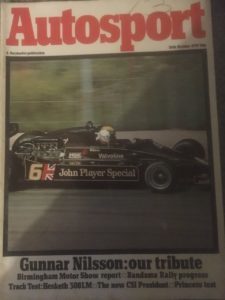 Gunnar had been on the front cover of Autosport in 1975 when British spectators witnessed his abilities. In 1978, he was mourned on the cover.
When I got the opportunity to write my first motorsport feature, I chose Gunnar. I wrote it during the summer of 2007 and I found it a surreal experience calling people like Gunnar’s team-mate and friend Mario Andretti and others. Vintage Racecar published my piece and I had an idea about doing a book on Gunnar. It looked like it would just remain an idea as I struggled to find money to commit to the project as well as a publisher who would accept the proposal. There were several rejections.
Then during the winter of 2016 I came across a page on Facebook about a book being written by Darren Banks about British driver Stephen South, another talent who never got to show his gifts in Formula One. Following an accident in 1980, South had only spoken three times publicly about his career. I commented on the page, connected with Darren and later got to meet him. Darren had approached many people, written a manuscript with South cooperating and had found a publisher. I got a copy of the book and it was an extraordinary achievement recounting South’s career and the insights from motorsport insiders. It inspired me to carry on the research about Gunnar. To be honest, had I not found Darren’s page, I would not have carried on with it.
I have managed to visit Gunnar’s hometown of Helsingborg twice to meet Gunnar’s friends and a stone was unveiled for him at the town’s sports museum. Gunnar’s name is now on the walk of fame there.
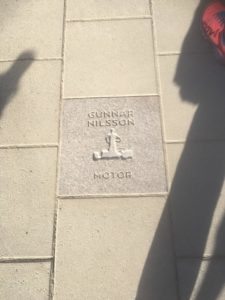 There was a ceremony to unveil a Walk of Fame at Helsingborg’s Sports Museum to honour the town’s prominent athletes. Gunnar was one of them.
The kindness of many people in Sweden has been great and touching. People who have contributed their memories have ranged from Gunnar’s childhood friends, his contemporaries in Formula Vee, Super Vee, Formula Three and friends like Indy 500 winner Danny Sullivan, mechanics and his journalist friends including Fredrik Af Petersens.
Fredrik wrote his book about Ronnie and Gunnar called The Viking Drivers in 1979. He has very kindly given my book his blessing as well as being very helpful too. I would not have got anywhere without them and other authors have been helpful with advice and counsel about research and how to interview people. One such person has been historian Ed McDonough who I have known since I was 12 years old.
As with Darren’s book, Ibrar’s book about 1994 and Richard Jenkins’ book about Richie Ginther, the book will be for Performance Publishing. I have selected them because of their interest in Lotus matters through Absolute Lotus magazine and their growing reputation. At the time of writing, Darren and Richard’s books have been shortlisted by the RAC Motoring Book of the Year award.
As British people fell in love with Swedish talent like the band ABBA or Bjorn Borg at Wimbledon during the 1970s, they fell in love with Ronnie Peterson and Gunnar Nilsson. If Ronnie was named Super Swede, Gunnar was called Crown Prince as he was deemed the heir to succeed Ronnie. Gunnar had risen quickly. Racing was initially a fun thing to do with friends from Helsingborg and then Gunnar made his competition debut in 1971 in Formula Vee. Five years later he would be on the grid for Team Lotus at Kyalami for the South African Grand Prix. In just his second reason, he would be a race winner at the Belgian Grand Prix at Zolder. As Gunnar signed for the new Arrows team for the 1978 season the future looked bright for him.
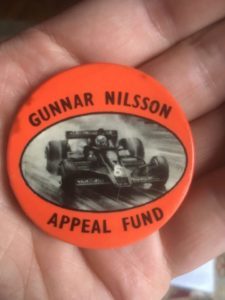 Gunnar’s campaign captured the attention of many and this badge features artist Michael Turner’s painting of Gunnar’s victory at Zolder.
Then he found out he was sick with cancer. 1978 would be spent not at the racetracks but going in and out of Charing Cross Hospital, London. During the summer, he would find out it would be terminal. He would mourn Ronnie who died after an accident at Monza in September. On 20 October just six weeks afterwards, Gunnar would die.
But not before organising a cancer treatment campaign that had as its original aim a new linear accelerator for Charing Cross Hospital. In the end, the campaign raised enough for a whole new wing at Charing Cross to be built. The Gunnar Nilsson Suite was opened in November 1981.
When Gunnar was ill, he said: “I have had an absolutely fantastic life up to now, unfortunately I’ve got this s*** now.” I aim to celebrate that life and the great legacy he left behind.
Gunnar Nilsson: A Free Spirit will be published soon by Performance Publishing
Gunnar had been on the front cover of Autosport in 1975 when British spectators witnessed his abilities. In 1978, he was mourned on the cover.When I got the opportunity to write my first motorsport feature, I chose Gunnar. I wrote it during the summer of 2007 and I found it a surreal experience calling people like Gunnar’s team-mate and friend Mario Andretti and others. Vintage Racecar published my piece and I had an idea about doing a book on Gunnar. It looked like it would just remain an idea as I struggled to find money to commit to the project as well as a publisher who would accept the proposal. There were several rejections.
Then during the winter of 2016 I came across a page on Facebook about a book being written by Darren Banks about British driver Stephen South, another talent who never got to show his gifts in Formula One. Following an accident in 1980, South had only spoken three times publicly about his career. I commented on the page, connected with Darren and later got to meet him. Darren had approached many people, written a manuscript with South cooperating and had found a publisher. I got a copy of the book and it was an extraordinary achievement recounting South’s career and the insights from motorsport insiders. It inspired me to carry on the research about Gunnar. To be honest, had I not found Darren’s page, I would not have carried on with it.
I have managed to visit Gunnar’s hometown of Helsingborg twice to meet Gunnar’s friends and a stone was unveiled for him at the town’s sports museum. Gunnar’s name is now on the walk of fame there.
There was a ceremony to unveil a Walk of Fame at Helsingborg’s Sports Museum to honour the town’s prominent athletes. Gunnar was one of them.The kindness of many people in Sweden has been great and touching. People who have contributed their memories have ranged from Gunnar’s childhood friends, his contemporaries in Formula Vee, Super Vee, Formula Three and friends like Indy 500 winner Danny Sullivan, mechanics and his journalist friends including Fredrik Af Petersens.
Fredrik wrote his book about Ronnie and Gunnar called The Viking Drivers in 1979. He has very kindly given my book his blessing as well as being very helpful too. I would not have got anywhere without them and other authors have been helpful with advice and counsel about research and how to interview people. One such person has been historian Ed McDonough who I have known since I was 12 years old.
As with Darren’s book, Ibrar’s book about 1994 and Richard Jenkins’ book about Richie Ginther, the book will be for Performance Publishing. I have selected them because of their interest in Lotus matters through Absolute Lotus magazine and their growing reputation. At the time of writing, Darren and Richard’s books have been shortlisted by the RAC Motoring Book of the Year award.
As British people fell in love with Swedish talent like the band ABBA or Bjorn Borg at Wimbledon during the 1970s, they fell in love with Ronnie Peterson and Gunnar Nilsson. If Ronnie was named Super Swede, Gunnar was called Crown Prince as he was deemed the heir to succeed Ronnie. Gunnar had risen quickly. Racing was initially a fun thing to do with friends from Helsingborg and then Gunnar made his competition debut in 1971 in Formula Vee. Five years later he would be on the grid for Team Lotus at Kyalami for the South African Grand Prix. In just his second reason, he would be a race winner at the Belgian Grand Prix at Zolder. As Gunnar signed for the new Arrows team for the 1978 season the future looked bright for him.
Gunnar’s campaign captured the attention of many and this badge features artist Michael Turner’s painting of Gunnar’s victory at Zolder.Then he found out he was sick with cancer. 1978 would be spent not at the racetracks but going in and out of Charing Cross Hospital, London. During the summer, he would find out it would be terminal. He would mourn Ronnie who died after an accident at Monza in September. On 20 October just six weeks afterwards, Gunnar would die.
But not before organising a cancer treatment campaign that had as its original aim a new linear accelerator for Charing Cross Hospital. In the end, the campaign raised enough for a whole new wing at Charing Cross to be built. The Gunnar Nilsson Suite was opened in November 1981.
When Gunnar was ill, he said: “I have had an absolutely fantastic life up to now, unfortunately I’ve got this s*** now.” I aim to celebrate that life and the great legacy he left behind.
Gunnar Nilsson: A Free Spirit will be published soon by Performance Publishing
April 20, 2020
Senna at Lotus
As we mark the upcoming 26th anniversary of Ayrton Senna’s passing, most will undoubtedly dwell upon the more celebrated cornerstones of his extraordinary career. His obliteration of the opposition during qualifying at Monaco ’88, or the race at Donington ’93. His compelling personality which shone through during interviews. Or what might have been with Williams had he not tragically met his untimely death at the 1994 San Marino Grand Prix. This blog aims to be slightly different, by briefly looking at Ayrton’s formative years at Lotus.
Coming into 1985, the Norfolk based team had not won a race since the sudden death of its charismatic founder, Colin Chapman, in December 1982. Lotus had endured a turbulent 1983 season. But they bounced back superbly to become regular front-runners again during 1984, enjoying their most successful season since 1978. The newly released book, Team Lotus: Beyond the Colin Chapman Era, details precisely how the team achieved this. But by the end of 1984, it seemed a key ingredient to elevate Lotus back to the winner’s circle was missing. Enter, Ayrton Senna – Lotus’ new signing for 1985.
 Senna was widely touted as a future world champion following his stellar performances within the unfancied Toleman during 1984.
Within his single season at Toleman, Senna had scored as many points as every other driver for that team combined within their history. He had even matched the points scored by Nigel Mansell in 1984, who was the man he would be replacing at Lotus. This, despite the Brazilian having, had inferior equipment to the Englishman. Thus coming into the 1985 F1 season, the press were expecting big things of Team Lotus and their new signing, Ayrton Senna. F1’s rising star was also the first driver to be signed to Lotus following Colin Chapman’s untimely passing.
The son of a wealthy businessman, Senna began his motorsport career in karting aged 13. After graduating to open-wheel racing in 1981 driving in Formula Ford 1600, he won the 1982 British and European Formula Ford 2000 Championships. He then triumphed in the 1983 British Formula Three Championship, which put him on the radar of several F1 teams. After impressing in tests for Williams, McLaren and Brabham, the first two teams made offers for 1984 in exchange for him signing long-term contracts, whilst Brabham also showed interest.
However, ultimately this came to nothing, due to their main sponsor Parmalat wanting an Italian driver and Piquet (Brabham’s number one driver) allegedly putting a stop to Senna joining his team. It then looked like he would sign for Team Lotus, having been approached by Peter Warr. However, when John Player rejected the appointment, Senna signed for the midfield Toleman team. It gave him the space to learn the cars and circuits without being under the microscope, as he would have been with one of the big names. This plan paid off handsomely as he would join Lotus with equal number one status, on a salary nearly twelve times what Peter Warr had offered him a year previously.
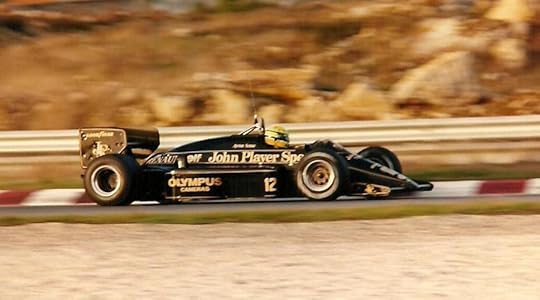 The Lotus 97T was the car to beat during 1985 preseason testing. With Senna on board, perhaps this might be Lotus best chance for championship glory?
Senna’s & Lotus First Win Post Chapman’s Death
The new Estoril circuit played host to round two of the 1985 Championship, and Senna continued to impress his new employers by taking his maiden pole position, three places ahead of his teammate, De Angelis in fourth. Come the start, the circuit was hit by torrential rain which didn’t let up throughout the race. Nevertheless, the drivers braved the atrocious conditions which would see several of them spinning out after aquaplaning. Whilst others complained of not being able to see anything when following other cars, due to the spray. Senna had no such complaints as he romped home to his first win as though he was driving on a different circuit to everyone else. “That race,” Renault driver Patrick Tambay said of the 1985 Portuguese Grand Prix, “was a nightmare. It was p*ssing with rain from start to finish, very, very flooded everywhere, the cloud ceiling very low and the light very poor. It was survival of the fittest.”
F1’s new superstar had shown what he was capable of at Monaco the previous year, and he now underlined that with what he later described as his greatest ever victory. “People later said that my win in the wet at Donington in ’93 was my greatest performance – no way! I had traction control! Ok, I didn’t make any real mistakes, but the car was so much easier to drive. It was a good win, sure, but, compared with Estoril ‘85, it was nothing, really” Senna would later claim. Meanwhile, De Angelis in the other Lotus finished a lapped fourth. He had been unable to match his teammate’s pace (partly due to a slow puncture). Nevertheless, this result, along with Senna’s win, elevated Lotus to the top of the Constructors’ Championship for the first time in seven years. Moreover, this had been the first time the 97T had run in the wet, and the circuit had been very different layout to that of the previous race in Rio. Therefore, the omens looked good for the season ahead for the boys from Ketteringham Hall.
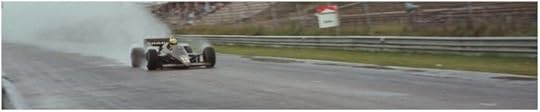 Senna later described his Estoril 1985 win as one of his greatest given the conditions that day.
Before the following event in Monaco, the jewel in F1’s crown, Peter Warr issued a statement informing rival teams that Senna was contracted to Lotus until the end of 1987. This had followed rumours that Enzo Ferrari had approached the Brazilian for 1986. However, Senna had reportedly asked for a figure which Ferrari told him was “stupid money!” The Brazilian again showed why he was potentially in such demand, as he secured another pole position, his third in four races. Within the confines of the Monte Carlo circuit, the young Brazilian’s unique technique of stabbing the throttle to ensure his turbo worked more effectively proved even more effective.
A Personal Recollection of Monaco 1985 by Daran Brookes
“Myself, and my friend had already booked our tickets for Monaco 1985 before Senna had won at Portugal in the Lotus. So the idea of him in a proper race-winning car had just added to our expectation for the trip. We went down in a coach stopping only briefly in Paris on the way before arriving at our hotel in Nice on the Friday ready for qualifying on the Saturday & the race on Sunday. We had treated ourselves to Hotel Mirabeau grandstand tickets which were quite expensive at the time but well worth it as not only did they include seats which offered a great view but also a splendid lunch on both days which was served round the five-star hotels pool by waiters in immaculate white uniforms.”
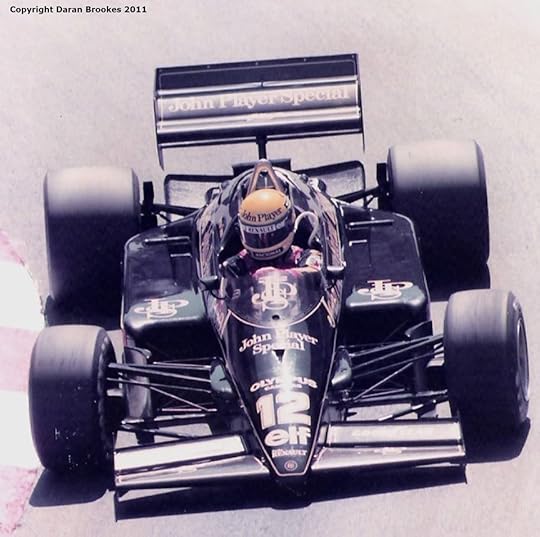
“I remember waiting with literally bated breath and camera at the ready for the cars to appear for the first session on the Saturday. Sure enough, Senna in the Lotus was the first one round, foot jabbing at the throttle as he flew past us before turning right into the tunnel. The second time round and I took the above picture. The shot was taken with a 200mm telephoto lens but the reason I managed to get it so close to the action and was able to take both the pictures of De Angelis Lotus & other cars in the race as well, was that one of Bernie’s minions had left a hole in the catch fence and I had managed to position myself perfectly to get some great images. Unfortunately it was filled in for the Sunday which meant I took hardly any pictures on the actual race day.”
“For the race, Senna had qualified his Lotus on pole but his car started trailing a smoke trail early on and I think went bang on lap 12 unseen by us. The race then became a battle between Prost and Alboreto with Patrese, Mansell, Laffite and Piquet in close pursuit. Clearly, we only had a small view of the track but we didn’t need a commentary on the race thanks to the group of crazy Italians in one of the flats on the infield from where we sitting. They had a TV in their room but when the cars came round they would dash onto the flats small balcony and scream their support for the Ferraris as the red cars sped by. They went especially bonkers when Alboreto took the lead and we thought the balcony would collapse as they jumped up and down as he drove past. But then there was a mass moan of disappointment from inside in the flat as he spun along with Lauda on the fluids left by the enormous Piquet/Patrese smash on the main straight and he had to rejoin the race back in fourth.”
 Senna was famous for bullying his car around the tight and twisty Monte Carlo circuit.
“There was drizzle starting towards the end but it finished with Prost first, Alboreto had battled back to a great second and De Angelis a steady third. The marshalls then opened the track as the rain started to fall more steadily and we were allowed to walk around the top part of the circuit, then down the hill to the start-finish straight. Having avoided getting run over by Clark of the Course Jacky Ickx on his motorbike, we discovered on a raised gantry Murray Walker interviewing Martin Brundle and Jonathan Palmer about their races. And being a bunch of British formula one fans abroad we began some good-natured chanting which seemingly didn’t go down too well with the sports greatest commentator.”
“On the race weekend these days a large number of billboards covering the spot where the Mirabeau grandstand used to be so the shots that I got of these two Lotus’ as well the other cars are no longer possible which is sad but I still have the original enlargement of Senna next to my desk. A true genius in one of the best looking F1 cars ever.”
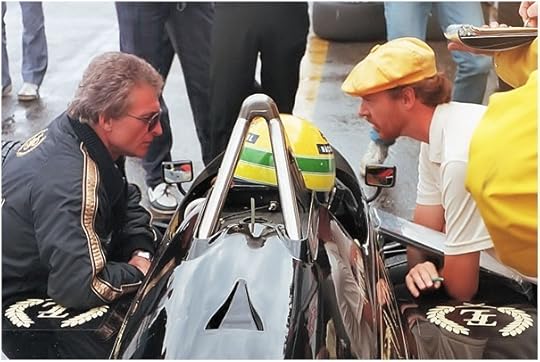 Following his stellar performances, Team Lotus eventually built itself around Senna.
Beyond 1985
Senna’s time with Lotus marked the team’s final flowering as a Grand Prix winning outfit. Given better equipment, he would have become champion with them. The newly released book, Team Lotus: Beyond the Colin Chapman Era, details precisely why this did not happen. Nevertheless, after three seasons and six Grand Prix wins for the team, Senna departed for McLaren. The Brazilian did subsequently go on to win the drivers title at the first time of asking, whereas Lotus’ fortunes took a sharp nosedive thereafter.
Throughout his time at Ketteringham Hall, he ingratiated himself with his engineers in a way that previous Lotus drivers like De Angelis and Mansell had not. This was one of the reasons why Lotus eventually focused all its efforts on him. However, as it increasingly became clear to the Brazilian that Lotus were not going to provide him with a Championship winning car yet again in 1987, Senna began to distance himself from the team. The Brazilian undoubtedly had the skill in the car. He had raced more maturely during 1987, particularly in comparison to 1985, so looked more like a champion in waiting. Hence why it was a particular shame there were not enough funds to undertake more development of the 1987 Lotus car, to allow Senna to go for the title. The subsequent battles between himself and the two Williams’ that year would have been epic for watching F1 fans.
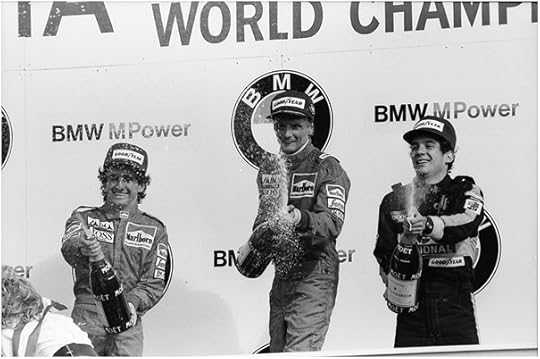 Senna would become accustomed to spraying the champagne after races.
During the three years that Senna spent with Lotus, we saw a lot of the personality traits that would go on to define his later career. Behind the scenes however intrigues fermented between himself, his Lotus Team Boss (Peter Warr), engine suppliers and sponsors. Again the newly released book: Team Lotus, Beyond The Colin Chapman Era explores all of this and is proud to bring some fresh analysis and exclusive content on this subject. It includes exclusive insight from
Frank Dernie – Lotus’ Technical Director Between 1989/90.
Peter Wright – The man behind Lotus’ active suspension during the 1980s.
Antony Hayes – Historian for Team Lotus, and someone who worked there during the 1980s & 1990s.
Willem Toet – Designer of championship-winning Benetton’s and Ferrari F1 cars & F1 aerodynamics/wind tunnel expert.
Nigel Beresford – Tyrrell’s Race Engineer to Palmer, Alesi and Modena
It guides readers through all of Senna’s races for Lotus and the book is brought to life by over 150 rare images like those seen above. It also pulls no punches in its final summation of the effect that Senna had on the once glorious Lotus Team.
 It is available to purchase now, just click on the front cover image to view a free sample. The Kindle version is priced at only £9.99. You simply will not find a better value e-book.
You can find out more about this book here whilst an abridged version is currently available to purchase on Audio Book Format here. You can also listen to a free sample within the above link.
Coming into 1985, the Norfolk based team had not won a race since the sudden death of its charismatic founder, Colin Chapman, in December 1982. Lotus had endured a turbulent 1983 season. But they bounced back superbly to become regular front-runners again during 1984, enjoying their most successful season since 1978. The newly released book, Team Lotus: Beyond the Colin Chapman Era, details precisely how the team achieved this. But by the end of 1984, it seemed a key ingredient to elevate Lotus back to the winner’s circle was missing. Enter, Ayrton Senna – Lotus’ new signing for 1985.
Senna was widely touted as a future world champion following his stellar performances within the unfancied Toleman during 1984.Within his single season at Toleman, Senna had scored as many points as every other driver for that team combined within their history. He had even matched the points scored by Nigel Mansell in 1984, who was the man he would be replacing at Lotus. This, despite the Brazilian having, had inferior equipment to the Englishman. Thus coming into the 1985 F1 season, the press were expecting big things of Team Lotus and their new signing, Ayrton Senna. F1’s rising star was also the first driver to be signed to Lotus following Colin Chapman’s untimely passing.
The son of a wealthy businessman, Senna began his motorsport career in karting aged 13. After graduating to open-wheel racing in 1981 driving in Formula Ford 1600, he won the 1982 British and European Formula Ford 2000 Championships. He then triumphed in the 1983 British Formula Three Championship, which put him on the radar of several F1 teams. After impressing in tests for Williams, McLaren and Brabham, the first two teams made offers for 1984 in exchange for him signing long-term contracts, whilst Brabham also showed interest.
However, ultimately this came to nothing, due to their main sponsor Parmalat wanting an Italian driver and Piquet (Brabham’s number one driver) allegedly putting a stop to Senna joining his team. It then looked like he would sign for Team Lotus, having been approached by Peter Warr. However, when John Player rejected the appointment, Senna signed for the midfield Toleman team. It gave him the space to learn the cars and circuits without being under the microscope, as he would have been with one of the big names. This plan paid off handsomely as he would join Lotus with equal number one status, on a salary nearly twelve times what Peter Warr had offered him a year previously.
The Lotus 97T was the car to beat during 1985 preseason testing. With Senna on board, perhaps this might be Lotus best chance for championship glory?Senna’s & Lotus First Win Post Chapman’s Death
The new Estoril circuit played host to round two of the 1985 Championship, and Senna continued to impress his new employers by taking his maiden pole position, three places ahead of his teammate, De Angelis in fourth. Come the start, the circuit was hit by torrential rain which didn’t let up throughout the race. Nevertheless, the drivers braved the atrocious conditions which would see several of them spinning out after aquaplaning. Whilst others complained of not being able to see anything when following other cars, due to the spray. Senna had no such complaints as he romped home to his first win as though he was driving on a different circuit to everyone else. “That race,” Renault driver Patrick Tambay said of the 1985 Portuguese Grand Prix, “was a nightmare. It was p*ssing with rain from start to finish, very, very flooded everywhere, the cloud ceiling very low and the light very poor. It was survival of the fittest.”
F1’s new superstar had shown what he was capable of at Monaco the previous year, and he now underlined that with what he later described as his greatest ever victory. “People later said that my win in the wet at Donington in ’93 was my greatest performance – no way! I had traction control! Ok, I didn’t make any real mistakes, but the car was so much easier to drive. It was a good win, sure, but, compared with Estoril ‘85, it was nothing, really” Senna would later claim. Meanwhile, De Angelis in the other Lotus finished a lapped fourth. He had been unable to match his teammate’s pace (partly due to a slow puncture). Nevertheless, this result, along with Senna’s win, elevated Lotus to the top of the Constructors’ Championship for the first time in seven years. Moreover, this had been the first time the 97T had run in the wet, and the circuit had been very different layout to that of the previous race in Rio. Therefore, the omens looked good for the season ahead for the boys from Ketteringham Hall.
Senna later described his Estoril 1985 win as one of his greatest given the conditions that day.Before the following event in Monaco, the jewel in F1’s crown, Peter Warr issued a statement informing rival teams that Senna was contracted to Lotus until the end of 1987. This had followed rumours that Enzo Ferrari had approached the Brazilian for 1986. However, Senna had reportedly asked for a figure which Ferrari told him was “stupid money!” The Brazilian again showed why he was potentially in such demand, as he secured another pole position, his third in four races. Within the confines of the Monte Carlo circuit, the young Brazilian’s unique technique of stabbing the throttle to ensure his turbo worked more effectively proved even more effective.
A Personal Recollection of Monaco 1985 by Daran Brookes
“Myself, and my friend had already booked our tickets for Monaco 1985 before Senna had won at Portugal in the Lotus. So the idea of him in a proper race-winning car had just added to our expectation for the trip. We went down in a coach stopping only briefly in Paris on the way before arriving at our hotel in Nice on the Friday ready for qualifying on the Saturday & the race on Sunday. We had treated ourselves to Hotel Mirabeau grandstand tickets which were quite expensive at the time but well worth it as not only did they include seats which offered a great view but also a splendid lunch on both days which was served round the five-star hotels pool by waiters in immaculate white uniforms.”
“I remember waiting with literally bated breath and camera at the ready for the cars to appear for the first session on the Saturday. Sure enough, Senna in the Lotus was the first one round, foot jabbing at the throttle as he flew past us before turning right into the tunnel. The second time round and I took the above picture. The shot was taken with a 200mm telephoto lens but the reason I managed to get it so close to the action and was able to take both the pictures of De Angelis Lotus & other cars in the race as well, was that one of Bernie’s minions had left a hole in the catch fence and I had managed to position myself perfectly to get some great images. Unfortunately it was filled in for the Sunday which meant I took hardly any pictures on the actual race day.”
“For the race, Senna had qualified his Lotus on pole but his car started trailing a smoke trail early on and I think went bang on lap 12 unseen by us. The race then became a battle between Prost and Alboreto with Patrese, Mansell, Laffite and Piquet in close pursuit. Clearly, we only had a small view of the track but we didn’t need a commentary on the race thanks to the group of crazy Italians in one of the flats on the infield from where we sitting. They had a TV in their room but when the cars came round they would dash onto the flats small balcony and scream their support for the Ferraris as the red cars sped by. They went especially bonkers when Alboreto took the lead and we thought the balcony would collapse as they jumped up and down as he drove past. But then there was a mass moan of disappointment from inside in the flat as he spun along with Lauda on the fluids left by the enormous Piquet/Patrese smash on the main straight and he had to rejoin the race back in fourth.”
Senna was famous for bullying his car around the tight and twisty Monte Carlo circuit.“There was drizzle starting towards the end but it finished with Prost first, Alboreto had battled back to a great second and De Angelis a steady third. The marshalls then opened the track as the rain started to fall more steadily and we were allowed to walk around the top part of the circuit, then down the hill to the start-finish straight. Having avoided getting run over by Clark of the Course Jacky Ickx on his motorbike, we discovered on a raised gantry Murray Walker interviewing Martin Brundle and Jonathan Palmer about their races. And being a bunch of British formula one fans abroad we began some good-natured chanting which seemingly didn’t go down too well with the sports greatest commentator.”
“On the race weekend these days a large number of billboards covering the spot where the Mirabeau grandstand used to be so the shots that I got of these two Lotus’ as well the other cars are no longer possible which is sad but I still have the original enlargement of Senna next to my desk. A true genius in one of the best looking F1 cars ever.”
Following his stellar performances, Team Lotus eventually built itself around Senna.Beyond 1985
Senna’s time with Lotus marked the team’s final flowering as a Grand Prix winning outfit. Given better equipment, he would have become champion with them. The newly released book, Team Lotus: Beyond the Colin Chapman Era, details precisely why this did not happen. Nevertheless, after three seasons and six Grand Prix wins for the team, Senna departed for McLaren. The Brazilian did subsequently go on to win the drivers title at the first time of asking, whereas Lotus’ fortunes took a sharp nosedive thereafter.
Throughout his time at Ketteringham Hall, he ingratiated himself with his engineers in a way that previous Lotus drivers like De Angelis and Mansell had not. This was one of the reasons why Lotus eventually focused all its efforts on him. However, as it increasingly became clear to the Brazilian that Lotus were not going to provide him with a Championship winning car yet again in 1987, Senna began to distance himself from the team. The Brazilian undoubtedly had the skill in the car. He had raced more maturely during 1987, particularly in comparison to 1985, so looked more like a champion in waiting. Hence why it was a particular shame there were not enough funds to undertake more development of the 1987 Lotus car, to allow Senna to go for the title. The subsequent battles between himself and the two Williams’ that year would have been epic for watching F1 fans.
Senna would become accustomed to spraying the champagne after races.During the three years that Senna spent with Lotus, we saw a lot of the personality traits that would go on to define his later career. Behind the scenes however intrigues fermented between himself, his Lotus Team Boss (Peter Warr), engine suppliers and sponsors. Again the newly released book: Team Lotus, Beyond The Colin Chapman Era explores all of this and is proud to bring some fresh analysis and exclusive content on this subject. It includes exclusive insight from
Frank Dernie – Lotus’ Technical Director Between 1989/90.
Peter Wright – The man behind Lotus’ active suspension during the 1980s.
Antony Hayes – Historian for Team Lotus, and someone who worked there during the 1980s & 1990s.
Willem Toet – Designer of championship-winning Benetton’s and Ferrari F1 cars & F1 aerodynamics/wind tunnel expert.
Nigel Beresford – Tyrrell’s Race Engineer to Palmer, Alesi and Modena
It guides readers through all of Senna’s races for Lotus and the book is brought to life by over 150 rare images like those seen above. It also pulls no punches in its final summation of the effect that Senna had on the once glorious Lotus Team.
It is available to purchase now, just click on the front cover image to view a free sample. The Kindle version is priced at only £9.99. You simply will not find a better value e-book.You can find out more about this book here whilst an abridged version is currently available to purchase on Audio Book Format here. You can also listen to a free sample within the above link.
March 31, 2020
Monza 1994. Team Lotus’ Last Hurrah.
One of the victims from a turbulent 1994 F1 season was Team Lotus, who finally succumbed to their financial struggles during the year. Like Brabham two years earlier, a once-great name would vanish from F1. Lotus was Jim Clark, Jochen Rindt, Emerson Fittipaldi and Ayrton Senna first top team in F1, in the case of the former two…their legacies were associated with Ketteringham Hall. The upcoming 1983-1989 print book charts how Team Lotus went from being regular front runners during the mid-1980s to midfielders only a few years later.
After its release on 1/5/2020, we then intend to write a follow-up print book covering the team’s final years of 1990 -1995. This follow-up book explains how Lotus then changed ownership at the end of 1990 and went from merely surviving that winter to finishing an incredible fifth in the 1992 constructor’s championship. It seemed the former seven-time world champion team was on a clear upward trajectory having re-establishing themselves as regular point scorers. More good news came in the form of their leading driver, Herbert, resigning within the team for another 5 years by the end of 1992. Unfortunately this revival under Peter Collins proved short lived because behind the scenes debts were still piling up. The team only survived two more seasons in F1 after 1992.

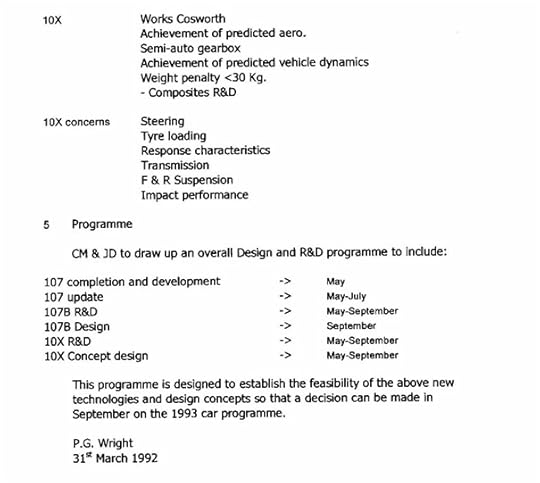 The follow-up Team Lotus book (covering their 1990–1995 period) will detail the reasons behind Peter Collins’ failure to implement the exciting “10x” development plans for 1993? Or retain future star drivers like Hakkinen?
Coming into 1994, Lotus’ had just finished 6th in the previous year’s constructors championship and had been battling teams like Ligier, Sauber and Ferrari who had all enjoyed “works” engine contracts. Whereas Lotus had been enduring “customer” engines ever since 1991. Therefore the team believed the only way for them to beat those ahead would be via an exclusive engine deal with Mugen Honda for 1994. “Although it was a ‘works’ deal, we still had to pay for it, however, it did give us A – Exclusivity and B – Development potential” according to Team Lotus’ Head of Archives, Antony Burton who will be a key contributor to our upcoming Lotus books. “If you think about how we did with the Ford HB V8 Series 5 engine and think of what we could have done with the latter Series 7 that Benetton Formula received. We were hitting above our potential. That meant that we would always be playing second best as long as we were stuck with the V8. A costly decision, for sure, but one with a definite view to the future.”
It was a big gamble because it either had the potential to make or break the team given their fragile financial position at the time, indeed some debts had been outstanding since 1991. Lotus’ ability to race in 1994 despite its tight finances was largely thanks to certain creditors rescheduling their payments. All of which meant results were critical to the teams’ survival beyond that year. Readers of the 1994 book will know that fateful season saw various technical restrictions imposed upon teams, whilst the upcoming 1990 – 1995 Lotus book will detail how they conspired against Ketteringham Hall. This partly explains why we saw the team at the back of F1 grids throughout most of that year. Nevertheless, the Hethel based team with a fighting spirit like no other just carried on believing things would eventually come good for them.
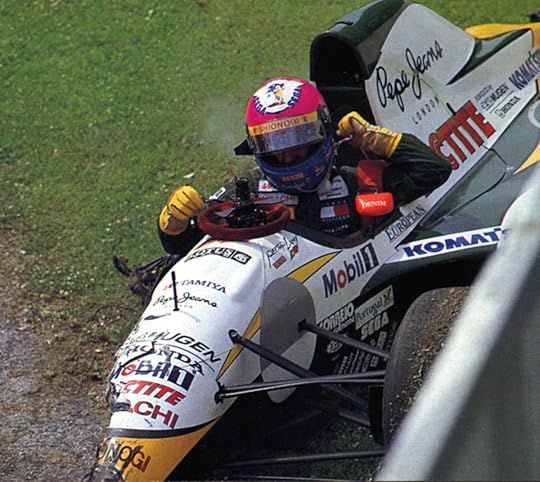 1994 could not have been worse for Lotus. For the first time in their 40 year history, the team failed to score any points during a GP season. The 1990-1995 book investigates why.
Despite the challenges facing them, it is inspiring just how loyal Lotus’staff were to the dream of re-establishing the iconic brand as F1 frontrunners. Remember, 1994 was probably one of F1’s toughest seasons in modern times. Meaning some mechanics had to work over eighty-hour weeks thanks to the ever-changing rules during that year (again details of which are contained within the 1994 book). In addition to this, Lotus had to work with a new engine supplier for the upcoming season. Mugen was founded by the son of Honda’s owner and provided engine tuning & performance parts to its parent company. A new for 1994 Mugen engine (known as the ZA5D) with involvement from Honda (one of F1’s most successful engine manufactures) was promised to Lotus partway through the season. Until then the team had to use an updated 1993 engine which ironically Footwork had ditched for the customer Ford V8 engine. Footwork thereby did the exact opposite to Lotus during the 1993/94 offseason in regards to engine choice and the 1990 – 1995 book will, therefore, investigate which gamble proved the better choice. The new ZA5D Mugen engine therefore gave all at Ketteringham Hall hope, when lesser teams might have thrown in the towel.
The team’s plan for 1994 was to covert their 1993 car to a passive suspension and install the (older spec) Mugen engine along with a new semi-automatic gearbox as an interim solution. This was to be known as the 107C until Lotus’ new for 1994 car (the 109) would be ready around the Spanish Grand Prix. The 107C was 45 kilograms overweight partly because the team didn’t want to waste precious development funds on their interim car. Again the upcoming Lotus book covering their 1990 – 1995 period will detail how events then conspired against Kettingham Hall throughout the 1994 season, even after the newer 109 chassis was launched. Meaning for the first time in the team’s 40 year history they were staring at a pointless season as 1994 approached its final quarter. By contrast Footwork (who remember had swapped Mugen’s for a customer Ford V8 in 1994) had been extremely competitive in the early races of 1994. So much so they even were accused of cheating via hidden & invisible legal driver aids after the Aida race (again alluded to in the 1994 book) just like the winners of that event, Schumacher & Benetton, were.
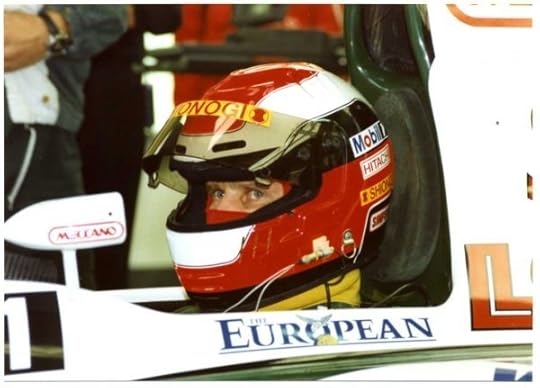 Herbert admitted he lost motivation driving for Lotus in 1994 after the Englishman had been outqualified by a Simtek at that year’s Hungarian GP.
The 1994 Italian Grand Prix, round 11 of 16, would be the crucial race for Team Lotus because this is where their new Mugen engine would debut. In comparison to the older unit it was more powerful (1,000 RPM’s more), 13kg’s lighter, and had a lower Center of Gravity. At a test before the crucial Monza race Herbert armed with that new ZA5D engine, lapped the Silverstone circuit 3 seconds quicker than his British GP qualifying time. It would have put him 3rd on the Silverstone grid. Would the new engine transform the 109’s handling and traction for the rest of the season? That was what Lotus believed and the upcoming 1990-1995 Lotus book explores the detail behind the Hethel based team thinking on this front. In summary, this new Mugen engine was Lotus’ final throw of the dice…it was win or bust from here on in. No half measures anymore.
Ketteringham Hall’s leading driver qualified 4th with the new Mugen at Italy thus proving his impressive Silverstone testing time was no fluke. His average qualifying position for the season thus far had been 20th. Whereas his teammate (Zanardi, at home ground) was forced to use the older engine because Lotus did not have any spare gearboxes compatible with the newer Mugen. Evidence of how bad the team’s finances were by this point. Lotus’ number two driver managed a season’s best 13th on the grid, 1.4 seconds adrift of Herbert. Zanardi claims in his autobiography he would have been on pole with the new Mugen and suggests the telemetry between himself and Herbert proves that via his speed in corners. Nevertheless, there was a buzz of excitement in the Lotus pits afterwards because Mugen had made promising indications. Should the team secure a podium at Monza then financial support towards the future of Team Lotus might be forthcoming from Japan, which in turn might attract new potential new sponsors?
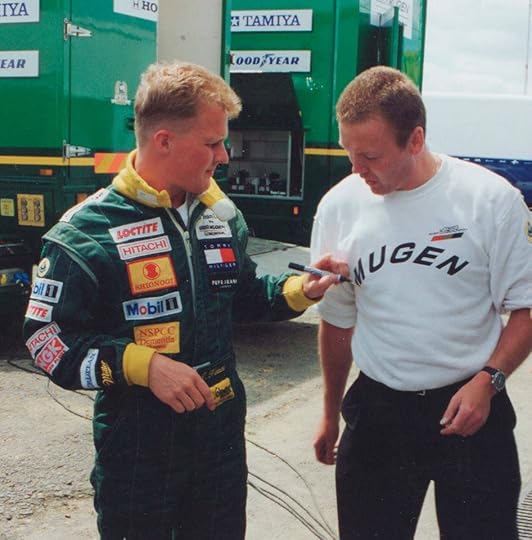 The man from Mugen found himself very popular at Monza.
At the green light, Herbert got a better start than 1994 championship contender Hill’s Williams and was eying up Berger’s Ferrari for 2nd position heading into the first chicane. Unfortunately, Irvine’s Jordan behind him missed his breaking point so smashed right into the back of the Lotus 109. This sent Herbert into a spin and left the furious driver beached over one of Monza’s high kerbs, unable to get going again. Behind the pair, carnage ensued as 21 other cars tried picking their way past the stranded Lotus. The team were then handed a lifeline when the race was stopped and the Lotus (equipped with the new engine) was recovered back to the pits. Unfortunately there proved too much damage to its floor, meaning Herbert took to the spare car – equipped with the older & slower Mugen engine – instead. To add salt to the team’s wounds, Herbert was then late out of his pits meaning he took that restart from the pit lane, rather than his 4th position on the grid.
Zanardi, possibly the only man in the Lotus pits happy about Herbert’s predicament, was now elevated to the team’s leading driver at his home event. However, the Italian was now the subject of Lotus’ bad luck. Because at the restarted race, Zanardi had been fighting over 10th place with the leading Benetton of Verstappen during the opening lap. Unfortunately at the Ascari Chicane, the Dutchman missed his breaking point and ran into the Lotus (with the older Mugen), thus ending the Italian’s race soon afterwards. Herbert’s race lasted 13 laps longer because the alternator failed in that spare car, which had not turned a wheel all weekend. The Englishman had moved up 10 places by that point, so some much-needed points were still possible had reliability been on his side.
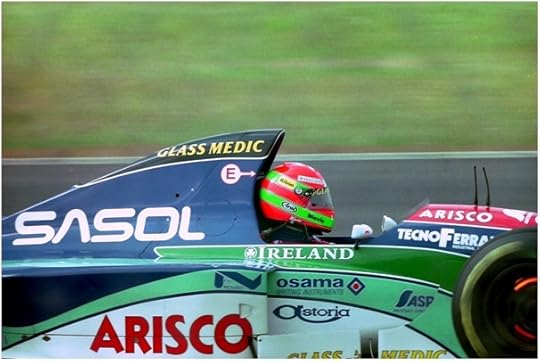 Irvine was banned from almost as many races as Schumacher during 1994 owing to his crash record. This is on top of the Irishman’s various other offences (like those demonstrated at Monza 1994 or winding up Senna in 1993). Yet interestingly Irvine is largely just seen as a lovable rogue by F1 fans now unlike Schumacher.
“Irvine has done far too much damage this year and should be properly penalised” said a furious Herbert after this race. Whilst Lotus team boss Peter Collins added: “Formula One doesn’t need drivers like this. Irvine’s brain has obviously been removed and it is about time that his license is too.” It was Irvine’s second run-in with the stewards that weekend because the Irishman’s Friday qualifying times had been deleted owing to him completing too many laps during the session. The rookie driver jokingly said “maybe we will be ok if we say a junior employee held out our pit board” following the Benetton fuel fire verdict which had just been announced. If you don’t get the joke, then read the 1994 book.
Considering that Alesi’s Ferrari didn’t finish the race, and Berger’s had been held up during his pitstop. Had Herbert been able to continue with the new Mugen engine then there’s was a very strong chance he would have been on the podium, thus securing the additional Mugen support promised. With that, it’s inevitably tempting to think that the Lotus story could have ended differently. As things turned out this result was the final nail in Lotus’ coffin because the following day its directors placed the struggling team into administration. Herbert, being one of Lotus most valuable assets was soon sold off and this blog explains what happened during the rest of his year. Whilst various subsequent efforts were made to revive the team.
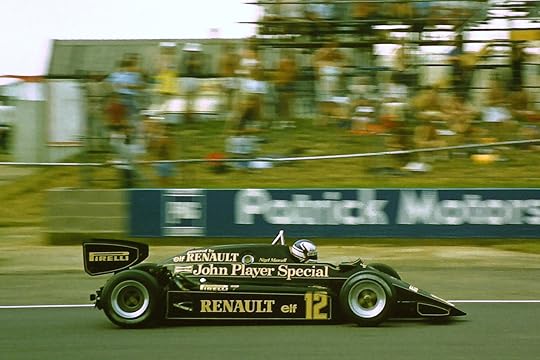 It was even rumoured that their former driver and 1992 F1 world champion, Nigel Mansell, might purchase the team.
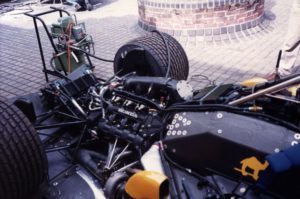 Lotus’ demise story is even more tragic when you consider they had turbo engines, Ayrton Senna & Active Suspension all before Williams – one of the most successful teams of the 1980s and 1990s.
It did not help matters that Lotus were unable to recreate the speed shown with the new engine until Herbert’s last testing session with the team, just after the Portuguese Grand Prix. Again the 1990 – 1995 Lotus book will explain this, why the team failed to score a point during those final four races of 1994 (with the new Mugen engine). Moreover, it will look into What Lotus could have done differently to survive? For instance was moving to Mugen for 1994 the right choice or their final death nail? Whereas the upcoming 1983 – 1989 book will detail how Team Lotus got themselves into serious financial problems during the 1990s (whereas comparable teams like Williams only when from strength to strength).
A question for you to ponder… What is it with Team Lotus that makes it appealing? Is it the cars? The drivers? Or history? To key book contributor and Team Lotus Head of Archives, Antony Burton: “it is/was the spirit of Team Lotus… I often say to people that we were the only outfit in F1 with the name Team in it, for that is what we were. A TEAM.” It’s a spirit and commitment which inspires one to fight against the odds, something you just can’t buy. Thus we hope to capture some of that same spirit in our forthcoming Lotus books and make Colin Chapman proud. Indeed taking inspiration from the Lotus founder we have even been trying to reduce the print book’s weight to reduce delivery costs for you readers.
If you enjoyed reading about this little bit of Team Lotus history, then you’ll enjoy the new book: Team Lotus, Struggling Beyond The Post Colin Chapman Era. You can find out more about this book here whilst an abridged version is currently available to purchase on E-Book format here or Audio Book Format here. You can read/listen to a free sample and get more details of the book by clicking on the above links. If you prefer additional detail over the cheaper price than the Lotus print book is for you. If you are unsure, then please consult the below table:
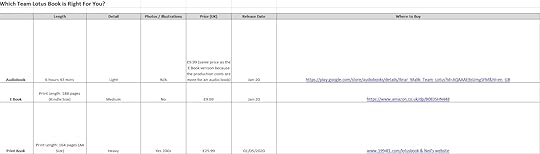 I would recommend the print book…as I think the extra detail is worth the extra money. However I understand not everybody wants to spend £25.99 on a book hence why we have alternative options.
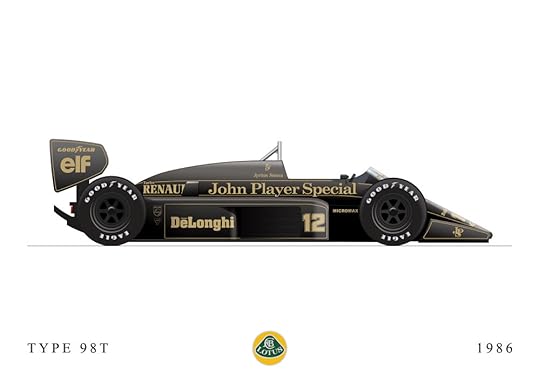 Those who pre-order the print book will receive a choice of Lotus F1 car print similar to the above on 170gsm A4 glossy photo paper
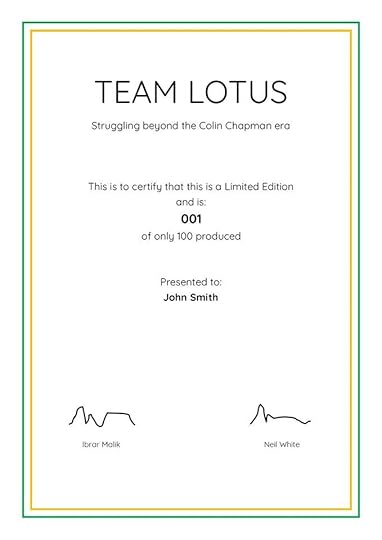 Print book owners will also receive this complimentary certificate with the authors printed signature. If you would like your book signed in real life by both authors (Neil White & myself) please contact us here.
Please note we are only planning to print 100 copies of this book, and unless demand dictates otherwise that will be it. Thus pre-ordering is highly recommended to avoid disappointment. After the print book is released on 1/5/2020 we then intend to start work on a follow-up book covering Team Lotus’s final years from 1990 onwards. If you would like to receive updates on this project then please sign up here; http://www.1994f1.com/contact/
Support future books (whilst getting your hands on exclusive research) here: https://www.patreon.com/newbook
Thanks to Antony Burton, Jon Maplestone & Simon Stiel for helping with our ongoing Lotus book project. The photos used were courtesy of; Antony Burton, Stephen Lathamq, Alastair Ladd. Martin Lee and www.passionea300allora.it/forum/topic/60806-03-gran-premio-di-san-marino-1994/, with the latter two licensed under the Creative Commons Attribution 2.0 Generic license.
After its release on 1/5/2020, we then intend to write a follow-up print book covering the team’s final years of 1990 -1995. This follow-up book explains how Lotus then changed ownership at the end of 1990 and went from merely surviving that winter to finishing an incredible fifth in the 1992 constructor’s championship. It seemed the former seven-time world champion team was on a clear upward trajectory having re-establishing themselves as regular point scorers. More good news came in the form of their leading driver, Herbert, resigning within the team for another 5 years by the end of 1992. Unfortunately this revival under Peter Collins proved short lived because behind the scenes debts were still piling up. The team only survived two more seasons in F1 after 1992.
The follow-up Team Lotus book (covering their 1990–1995 period) will detail the reasons behind Peter Collins’ failure to implement the exciting “10x” development plans for 1993? Or retain future star drivers like Hakkinen?Coming into 1994, Lotus’ had just finished 6th in the previous year’s constructors championship and had been battling teams like Ligier, Sauber and Ferrari who had all enjoyed “works” engine contracts. Whereas Lotus had been enduring “customer” engines ever since 1991. Therefore the team believed the only way for them to beat those ahead would be via an exclusive engine deal with Mugen Honda for 1994. “Although it was a ‘works’ deal, we still had to pay for it, however, it did give us A – Exclusivity and B – Development potential” according to Team Lotus’ Head of Archives, Antony Burton who will be a key contributor to our upcoming Lotus books. “If you think about how we did with the Ford HB V8 Series 5 engine and think of what we could have done with the latter Series 7 that Benetton Formula received. We were hitting above our potential. That meant that we would always be playing second best as long as we were stuck with the V8. A costly decision, for sure, but one with a definite view to the future.”
It was a big gamble because it either had the potential to make or break the team given their fragile financial position at the time, indeed some debts had been outstanding since 1991. Lotus’ ability to race in 1994 despite its tight finances was largely thanks to certain creditors rescheduling their payments. All of which meant results were critical to the teams’ survival beyond that year. Readers of the 1994 book will know that fateful season saw various technical restrictions imposed upon teams, whilst the upcoming 1990 – 1995 Lotus book will detail how they conspired against Ketteringham Hall. This partly explains why we saw the team at the back of F1 grids throughout most of that year. Nevertheless, the Hethel based team with a fighting spirit like no other just carried on believing things would eventually come good for them.
1994 could not have been worse for Lotus. For the first time in their 40 year history, the team failed to score any points during a GP season. The 1990-1995 book investigates why.Despite the challenges facing them, it is inspiring just how loyal Lotus’staff were to the dream of re-establishing the iconic brand as F1 frontrunners. Remember, 1994 was probably one of F1’s toughest seasons in modern times. Meaning some mechanics had to work over eighty-hour weeks thanks to the ever-changing rules during that year (again details of which are contained within the 1994 book). In addition to this, Lotus had to work with a new engine supplier for the upcoming season. Mugen was founded by the son of Honda’s owner and provided engine tuning & performance parts to its parent company. A new for 1994 Mugen engine (known as the ZA5D) with involvement from Honda (one of F1’s most successful engine manufactures) was promised to Lotus partway through the season. Until then the team had to use an updated 1993 engine which ironically Footwork had ditched for the customer Ford V8 engine. Footwork thereby did the exact opposite to Lotus during the 1993/94 offseason in regards to engine choice and the 1990 – 1995 book will, therefore, investigate which gamble proved the better choice. The new ZA5D Mugen engine therefore gave all at Ketteringham Hall hope, when lesser teams might have thrown in the towel.
The team’s plan for 1994 was to covert their 1993 car to a passive suspension and install the (older spec) Mugen engine along with a new semi-automatic gearbox as an interim solution. This was to be known as the 107C until Lotus’ new for 1994 car (the 109) would be ready around the Spanish Grand Prix. The 107C was 45 kilograms overweight partly because the team didn’t want to waste precious development funds on their interim car. Again the upcoming Lotus book covering their 1990 – 1995 period will detail how events then conspired against Kettingham Hall throughout the 1994 season, even after the newer 109 chassis was launched. Meaning for the first time in the team’s 40 year history they were staring at a pointless season as 1994 approached its final quarter. By contrast Footwork (who remember had swapped Mugen’s for a customer Ford V8 in 1994) had been extremely competitive in the early races of 1994. So much so they even were accused of cheating via hidden & invisible legal driver aids after the Aida race (again alluded to in the 1994 book) just like the winners of that event, Schumacher & Benetton, were.
Herbert admitted he lost motivation driving for Lotus in 1994 after the Englishman had been outqualified by a Simtek at that year’s Hungarian GP.The 1994 Italian Grand Prix, round 11 of 16, would be the crucial race for Team Lotus because this is where their new Mugen engine would debut. In comparison to the older unit it was more powerful (1,000 RPM’s more), 13kg’s lighter, and had a lower Center of Gravity. At a test before the crucial Monza race Herbert armed with that new ZA5D engine, lapped the Silverstone circuit 3 seconds quicker than his British GP qualifying time. It would have put him 3rd on the Silverstone grid. Would the new engine transform the 109’s handling and traction for the rest of the season? That was what Lotus believed and the upcoming 1990-1995 Lotus book explores the detail behind the Hethel based team thinking on this front. In summary, this new Mugen engine was Lotus’ final throw of the dice…it was win or bust from here on in. No half measures anymore.
Ketteringham Hall’s leading driver qualified 4th with the new Mugen at Italy thus proving his impressive Silverstone testing time was no fluke. His average qualifying position for the season thus far had been 20th. Whereas his teammate (Zanardi, at home ground) was forced to use the older engine because Lotus did not have any spare gearboxes compatible with the newer Mugen. Evidence of how bad the team’s finances were by this point. Lotus’ number two driver managed a season’s best 13th on the grid, 1.4 seconds adrift of Herbert. Zanardi claims in his autobiography he would have been on pole with the new Mugen and suggests the telemetry between himself and Herbert proves that via his speed in corners. Nevertheless, there was a buzz of excitement in the Lotus pits afterwards because Mugen had made promising indications. Should the team secure a podium at Monza then financial support towards the future of Team Lotus might be forthcoming from Japan, which in turn might attract new potential new sponsors?
The man from Mugen found himself very popular at Monza.At the green light, Herbert got a better start than 1994 championship contender Hill’s Williams and was eying up Berger’s Ferrari for 2nd position heading into the first chicane. Unfortunately, Irvine’s Jordan behind him missed his breaking point so smashed right into the back of the Lotus 109. This sent Herbert into a spin and left the furious driver beached over one of Monza’s high kerbs, unable to get going again. Behind the pair, carnage ensued as 21 other cars tried picking their way past the stranded Lotus. The team were then handed a lifeline when the race was stopped and the Lotus (equipped with the new engine) was recovered back to the pits. Unfortunately there proved too much damage to its floor, meaning Herbert took to the spare car – equipped with the older & slower Mugen engine – instead. To add salt to the team’s wounds, Herbert was then late out of his pits meaning he took that restart from the pit lane, rather than his 4th position on the grid.
Zanardi, possibly the only man in the Lotus pits happy about Herbert’s predicament, was now elevated to the team’s leading driver at his home event. However, the Italian was now the subject of Lotus’ bad luck. Because at the restarted race, Zanardi had been fighting over 10th place with the leading Benetton of Verstappen during the opening lap. Unfortunately at the Ascari Chicane, the Dutchman missed his breaking point and ran into the Lotus (with the older Mugen), thus ending the Italian’s race soon afterwards. Herbert’s race lasted 13 laps longer because the alternator failed in that spare car, which had not turned a wheel all weekend. The Englishman had moved up 10 places by that point, so some much-needed points were still possible had reliability been on his side.
Irvine was banned from almost as many races as Schumacher during 1994 owing to his crash record. This is on top of the Irishman’s various other offences (like those demonstrated at Monza 1994 or winding up Senna in 1993). Yet interestingly Irvine is largely just seen as a lovable rogue by F1 fans now unlike Schumacher.“Irvine has done far too much damage this year and should be properly penalised” said a furious Herbert after this race. Whilst Lotus team boss Peter Collins added: “Formula One doesn’t need drivers like this. Irvine’s brain has obviously been removed and it is about time that his license is too.” It was Irvine’s second run-in with the stewards that weekend because the Irishman’s Friday qualifying times had been deleted owing to him completing too many laps during the session. The rookie driver jokingly said “maybe we will be ok if we say a junior employee held out our pit board” following the Benetton fuel fire verdict which had just been announced. If you don’t get the joke, then read the 1994 book.
Considering that Alesi’s Ferrari didn’t finish the race, and Berger’s had been held up during his pitstop. Had Herbert been able to continue with the new Mugen engine then there’s was a very strong chance he would have been on the podium, thus securing the additional Mugen support promised. With that, it’s inevitably tempting to think that the Lotus story could have ended differently. As things turned out this result was the final nail in Lotus’ coffin because the following day its directors placed the struggling team into administration. Herbert, being one of Lotus most valuable assets was soon sold off and this blog explains what happened during the rest of his year. Whilst various subsequent efforts were made to revive the team.
It was even rumoured that their former driver and 1992 F1 world champion, Nigel Mansell, might purchase the team.Lotus’ demise story is even more tragic when you consider they had turbo engines, Ayrton Senna & Active Suspension all before Williams – one of the most successful teams of the 1980s and 1990s.It did not help matters that Lotus were unable to recreate the speed shown with the new engine until Herbert’s last testing session with the team, just after the Portuguese Grand Prix. Again the 1990 – 1995 Lotus book will explain this, why the team failed to score a point during those final four races of 1994 (with the new Mugen engine). Moreover, it will look into What Lotus could have done differently to survive? For instance was moving to Mugen for 1994 the right choice or their final death nail? Whereas the upcoming 1983 – 1989 book will detail how Team Lotus got themselves into serious financial problems during the 1990s (whereas comparable teams like Williams only when from strength to strength).
A question for you to ponder… What is it with Team Lotus that makes it appealing? Is it the cars? The drivers? Or history? To key book contributor and Team Lotus Head of Archives, Antony Burton: “it is/was the spirit of Team Lotus… I often say to people that we were the only outfit in F1 with the name Team in it, for that is what we were. A TEAM.” It’s a spirit and commitment which inspires one to fight against the odds, something you just can’t buy. Thus we hope to capture some of that same spirit in our forthcoming Lotus books and make Colin Chapman proud. Indeed taking inspiration from the Lotus founder we have even been trying to reduce the print book’s weight to reduce delivery costs for you readers.
If you enjoyed reading about this little bit of Team Lotus history, then you’ll enjoy the new book: Team Lotus, Struggling Beyond The Post Colin Chapman Era. You can find out more about this book here whilst an abridged version is currently available to purchase on E-Book format here or Audio Book Format here. You can read/listen to a free sample and get more details of the book by clicking on the above links. If you prefer additional detail over the cheaper price than the Lotus print book is for you. If you are unsure, then please consult the below table:
I would recommend the print book…as I think the extra detail is worth the extra money. However I understand not everybody wants to spend £25.99 on a book hence why we have alternative options.Those who pre-order the print book will receive a choice of Lotus F1 car print similar to the above on 170gsm A4 glossy photo paperPrint book owners will also receive this complimentary certificate with the authors printed signature. If you would like your book signed in real life by both authors (Neil White & myself) please contact us here.Please note we are only planning to print 100 copies of this book, and unless demand dictates otherwise that will be it. Thus pre-ordering is highly recommended to avoid disappointment. After the print book is released on 1/5/2020 we then intend to start work on a follow-up book covering Team Lotus’s final years from 1990 onwards. If you would like to receive updates on this project then please sign up here; http://www.1994f1.com/contact/
Support future books (whilst getting your hands on exclusive research) here: https://www.patreon.com/newbook
Thanks to Antony Burton, Jon Maplestone & Simon Stiel for helping with our ongoing Lotus book project. The photos used were courtesy of; Antony Burton, Stephen Lathamq, Alastair Ladd. Martin Lee and www.passionea300allora.it/forum/topic/60806-03-gran-premio-di-san-marino-1994/, with the latter two licensed under the Creative Commons Attribution 2.0 Generic license.
January 5, 2020
Pedro Lamy’s 1994 Silverstone Testing Accident
This is a special blog to celebrate the upcoming launch of the audio book: Team Lotus, Struggling Beyond The Post Colin Chapman Era.
It has been co-written by Ben Green, who is the proud owner of the Lotus F1 car Pedro Lamy crashed during that Silverstone test in May 1994, just prior to that year’s Spanish Grand Prix. If you have read the book: 1994 The Untold Story of a Tragic and Controversial F1 Season, you’ll know Lamy’s crash and it’s subsequent fallout, was hugely significant to F1 that year. Ben’s Lotus chassis is the 107C (chassis no 1).

This is the (restored) Lotus 107C that Lamy almost was killed in during that fateful day at Silverstone in May 1994. Ben purchased the chassis from Team Lotus during 1995
1994 Lotus 107C
At the end of the 1993 season, Team Lotus’ finances were in a bad way. The newly released book: Team Lotus, Struggling Beyond The Post Colin Chapman Era details how and why Team Lotus got there by the early 1990’s. Their Chris Murphy designed 107B was fast but unreliable, whilst its complex active suspension and customer Cosworth HB engines had drained resources.
Along came Honda with the Mugen brand and an updated 1989 ZA5 V10 engine, a no cost factory option. Furthermore, F1 rules for 1994 have changed, in comes mid-race refuelling with reduced fuel tank sizes inside cars. Active suspension is also banned so it’s back to Penske dampers and ant heave bars.
Three new type 107C chassis are built as an interim before the arrival later in the season of the new for 1994 Lotus 109, which was narrower than the 107B tub. The new Mugen V10 engine allowed a slimmer engine cover, but the tub forward of the mirrors was kept the same to keep its impact test certification. A new semi-automatic gearbox (normal clutch, paddle shift gear changes) was introduced.
A signal from the steering wheel paddle would rotate the gear selection barrel to the next gear via a Moog valve and electronics to raise or lower engine revs and retrying selection until the gear is found. This was worth at least half a second per lap. The hand shift blister on the tub was kept in case the new change didn’t work.
Drivers for 1994 would be Johnny Herbert and Pedro Lamy with Alex Zanardi as their test driver.
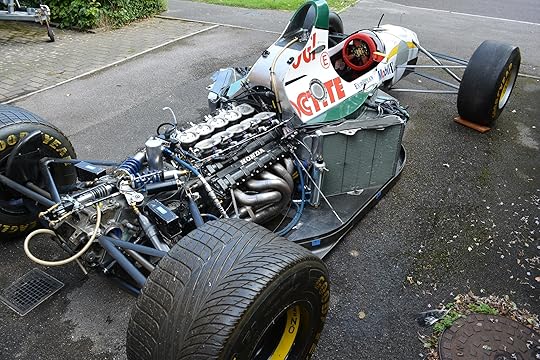 Ben’s 107C Lotus has been restored as a non-running rolling chassis, Ben has most history including setup and development sheets, the car was raced in F1 up until the 1994 British Grand Prix.
The Races
Brazil and Aida races, Herbert’s 107C (01 chassis) is slow but reliable finishing just outside the points. The Mugen Engine by 1994 standards is heavy with a high Centre of Gravity, extra cooling with heat exchangers and oil radiators adding to the weight issue. Traction out of corners is a big problem increasing downforce with wing angle making little difference but robbing the car of speed down the straights.
Imola arrived and Herbert’s car has clutch failure in final practice so chassis 01 gets promoted to race car. At the start Lamy connects with Lehto’s Benetton, the collision wrecks both cars. With debris all over the track the safety car was brought out to clear the damaged cars & wreckage. Ayrton Senna and Roland Ratzenbergers sad deaths are well documented & start a safety crusade within the sport. At the next event, Monaco, the FIA impose significant & immediate car changes upon teams in order to make the sport safer. However the teams were angered by the FIA’s timescales and the costs. Virtually every team’s car designer complained they were not consulted about these FIA proposals announced at Monaco 1994. They therefore felt cutting back significant on downforce, without any corresponding reduction on power output, would create more (not less) safety problems for F1.
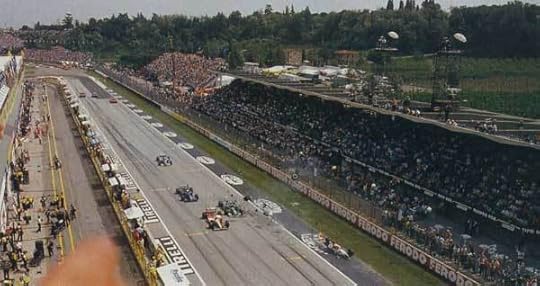 Lamy & Lehto’s accident during the fateful 1994 Imola race. It subsequently brought out the safety car, an Opel Vectra. Did this contribute to Senna’s fatal crash?
Lamy’s Silverstone Test & Accident
To the gauge the effects of the FIA mandated car changes, hurriedly introduced at Monaco 1994, Lamy’s 01 race chassis from Monaco had the under tray cut back further than the axle line to remove all of the diffuser downforce. Whilst testing this solution, the rear wing suddenly failed when approaching a 150 mph corner. It led to one of F1’s most violent accidents. Indeed, Lamy’s car struck the barrier with enough force it vaulted OVER a 10 foot debris fence which to protect spectators. Because it was a private test, fortunately no one was in that area at the time of Lamy’s crash. But had it been a grand prix meeting, there would have been hundreds of spectators in the vicinity! In fact Lamy’s Lotus eventually ended up in a pedestrian walkway underneath the circuit.
Herbert, the first man on the scene, was horrified by all of the wreckage and initially feared the worst for his teammate. When asked about this incident afterwards the Englishman later said: “I had been following Pedro, about 100 yards behind, when his car spun. There was lots of dust and it just took off. I stopped my car and jumped out but at first I couldn’t find him. Then I could see the tub had been thrown on to the other side of the fence. I couldn’t believe it, he was half-way down the tunnel.”
“The back end of the car was on fire. Even his helmet was steaming. The marshalls soon appeared and I helped them put out the fire. I didn’t really want to go in there but I had to. I feared the worst after what’s happened recently. He was unconscious when I got to him but he gradually came to. He was breathing heavily and obviously in pain. They put his legs in splints and carried him to the helicopter to be taken to hospital. It was as horrifying as any as the recent accidents we’ve had.’” (source; https://www.independent.co.uk/sport/m...)
As bad as the crash was, the 22-year-old Lotus-Mugen Honda driver broke both kneecaps and a thigh, it could have been much worse for Lamy. Fortunately he made a full recovery and was back in a F1 car by the end of the season. Meanwhile a fierce debate raged over whether the FIA mandated car changes hastily imposed on teams following Imola 1994, might have anything to do with this particular incident? All of which led to some interesting politics between Benetton team boss (Flavio Briatore) and FIA President (Max Mosley).
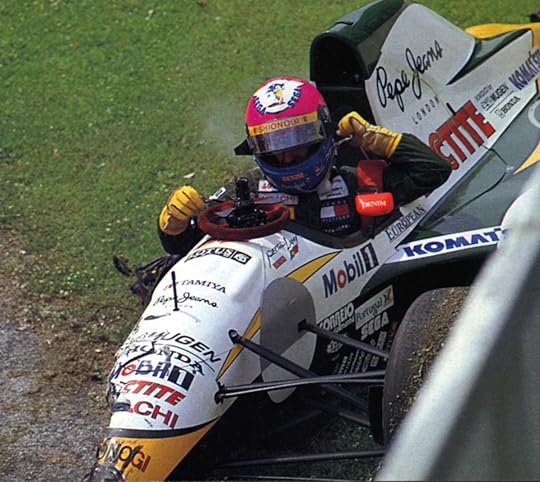 The subsequent fallout & politics resulting from Lamy’s Silverstone testing accident (not pictured above) is detailed within the book: 1994 The Untold Story of a Tragic and Controversial F1 Season.
According to Ben, the actual failure causing Lamy’s crash was fatigue of 2 studs connecting the gearbox to the rear wing mounting. Ben believes this was caused by the vibration of the rear wing allowed by the removal of the rear wing links to the under tray. Wire stays are introduced along with a small gearbox bracket to solve the problem. The 01 chassis is stripped of undamaged spares and placed on the wind tunnel roof.
 Ben took these back in 1994 it shows Lotus 107C rear wing mounting bolts with added stainless steel brackets to support bolt outer end ,and the stays wires , this was added after Lamy’s Silverstone crash.
At Team Lotus.
1995 and the rebuild (Written by Ben Green)
“Having visited Team Lotus as a supplier earlier in 1994 I had seen the damaged chassis sitting twenty feet up and upon returning in 1995 with the receiver in place I negotiated the purchase of the damaged tub along with a spare, undertray ,wheels a gearbox case set and radiators. Team creditors were glad to recover some money so supplied a fully decaled engine cover, rear wing and nose. The final receiver auction later in the year at Brighton supplied a full set of dampers linkages, A frames and other spares. Ebay providing all the Tony James wiring looms, enough for several cars in fact.
Due to the damage to the tub and engine mountings, it was decided to rebuild this as a show car. Only 4 pins hold the complete rear engine gearbox and suspension to the chassis tub, they had all failed as designed in the crash. Fuel hoses had dry break connectors, the fire damage was from a refuelling port leak and the ATL fuel cell remained intact. The largest item missing was the engine, because all the Mugen Honda units were returned to Japan not for resale.
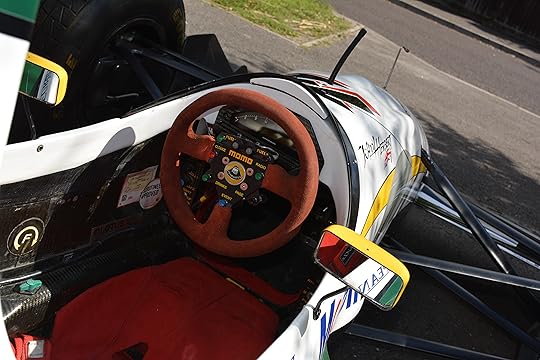
Initially The 01 tub was designed back in 1992 for the Judd GV V10 engine but then the Cosworth HB substituted. A nonworking installation engine from a Tyrrell was acquired from engine developments at Rugby, so we now had a rolling chassis with a F1 V10 engine. A Carbon Honda Inlet tray was located but not the variable inlet system that moves with engine speed.
Very little Information on the installation and layout are available other than photos. Team Lotus supplied chassis 01 history sheets with setup details, test results and development progression. Back in 1994 a full size layered drawing was made to check plumbing, wiring loom runs and clearances. This was mounted on a wall but looks to have gone missing, this would be very useful. The suspension A frames manufactured from steel extrusions then welded are coated with a crack detection paint that is not resistant to corrosion. In fact all the steel fixtures and fittings have had to be lightly over painted, the magnesium gearbox parts have been lacquered to prevent the white oxide appearing.
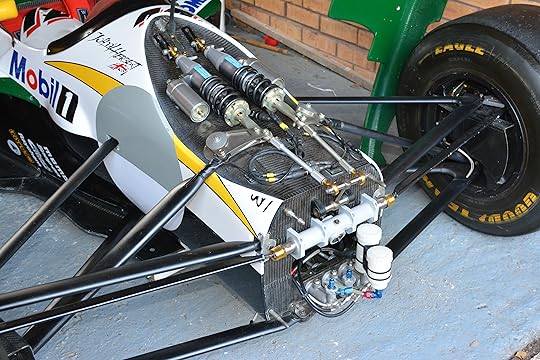
The Original wheels and tyres have been injected with a sealant that looks to have solved the leaking air issue we had and hold pressure for weeks. Next project is to get the brakes working, original AP Racing calipers but no pads that fit. Original Dashboard is unusual for the time in having a full liquid crystal display but all warning lights. Gear number and other information available by scrolling by the driver, again a Honda item and surprisingly heavy with its separate driver unit and cabling. The Steering wheel had a Buckle from the crash (not surprising) and shows the pushback through the system when a wheel impacts, this was gently straitened with a hydraulic press maybe this should have been left buckled rather than restored.
But at least all the buttons and paddles work.”
Ben Green
If you enjoyed reading about this little bit of Team Lotus history, then you’ll enjoy the upcoming audio book; Team Lotus, Struggling Beyond The Post Colin Chapman Era. Click here to listen to a free sample and get more details of this book.
It contains masses of detail & research and will provide excellent value for readers with an RRP of £12 (UK) or $15.50 (USD). I am hoping to be involved in future books detailing the complete Team Lotus’ Downfall story. Other books planned may cover the periods between 1978-1983 & 1990-1995.
Receive future Lotus book updates here; http://www.1994f1.com/contact/
Support future books here (whilst getting your hands on more exclusive research): https://www.patreon.com/newbook
Thanks to Ben Green for helping with this blog & for providing some photos. The other photos were courtesy of; http://www.passionea300allora.it/foru... & http://www.ayrton-senna.net/david-bra... and is licensed under the Creative Commons Attribution 2.0 Generic license.
It has been co-written by Ben Green, who is the proud owner of the Lotus F1 car Pedro Lamy crashed during that Silverstone test in May 1994, just prior to that year’s Spanish Grand Prix. If you have read the book: 1994 The Untold Story of a Tragic and Controversial F1 Season, you’ll know Lamy’s crash and it’s subsequent fallout, was hugely significant to F1 that year. Ben’s Lotus chassis is the 107C (chassis no 1).
This is the (restored) Lotus 107C that Lamy almost was killed in during that fateful day at Silverstone in May 1994. Ben purchased the chassis from Team Lotus during 1995
1994 Lotus 107C
At the end of the 1993 season, Team Lotus’ finances were in a bad way. The newly released book: Team Lotus, Struggling Beyond The Post Colin Chapman Era details how and why Team Lotus got there by the early 1990’s. Their Chris Murphy designed 107B was fast but unreliable, whilst its complex active suspension and customer Cosworth HB engines had drained resources.
Along came Honda with the Mugen brand and an updated 1989 ZA5 V10 engine, a no cost factory option. Furthermore, F1 rules for 1994 have changed, in comes mid-race refuelling with reduced fuel tank sizes inside cars. Active suspension is also banned so it’s back to Penske dampers and ant heave bars.
Three new type 107C chassis are built as an interim before the arrival later in the season of the new for 1994 Lotus 109, which was narrower than the 107B tub. The new Mugen V10 engine allowed a slimmer engine cover, but the tub forward of the mirrors was kept the same to keep its impact test certification. A new semi-automatic gearbox (normal clutch, paddle shift gear changes) was introduced.
A signal from the steering wheel paddle would rotate the gear selection barrel to the next gear via a Moog valve and electronics to raise or lower engine revs and retrying selection until the gear is found. This was worth at least half a second per lap. The hand shift blister on the tub was kept in case the new change didn’t work.
Drivers for 1994 would be Johnny Herbert and Pedro Lamy with Alex Zanardi as their test driver.
Ben’s 107C Lotus has been restored as a non-running rolling chassis, Ben has most history including setup and development sheets, the car was raced in F1 up until the 1994 British Grand Prix.The Races
Brazil and Aida races, Herbert’s 107C (01 chassis) is slow but reliable finishing just outside the points. The Mugen Engine by 1994 standards is heavy with a high Centre of Gravity, extra cooling with heat exchangers and oil radiators adding to the weight issue. Traction out of corners is a big problem increasing downforce with wing angle making little difference but robbing the car of speed down the straights.
Imola arrived and Herbert’s car has clutch failure in final practice so chassis 01 gets promoted to race car. At the start Lamy connects with Lehto’s Benetton, the collision wrecks both cars. With debris all over the track the safety car was brought out to clear the damaged cars & wreckage. Ayrton Senna and Roland Ratzenbergers sad deaths are well documented & start a safety crusade within the sport. At the next event, Monaco, the FIA impose significant & immediate car changes upon teams in order to make the sport safer. However the teams were angered by the FIA’s timescales and the costs. Virtually every team’s car designer complained they were not consulted about these FIA proposals announced at Monaco 1994. They therefore felt cutting back significant on downforce, without any corresponding reduction on power output, would create more (not less) safety problems for F1.
Lamy & Lehto’s accident during the fateful 1994 Imola race. It subsequently brought out the safety car, an Opel Vectra. Did this contribute to Senna’s fatal crash?Lamy’s Silverstone Test & Accident
To the gauge the effects of the FIA mandated car changes, hurriedly introduced at Monaco 1994, Lamy’s 01 race chassis from Monaco had the under tray cut back further than the axle line to remove all of the diffuser downforce. Whilst testing this solution, the rear wing suddenly failed when approaching a 150 mph corner. It led to one of F1’s most violent accidents. Indeed, Lamy’s car struck the barrier with enough force it vaulted OVER a 10 foot debris fence which to protect spectators. Because it was a private test, fortunately no one was in that area at the time of Lamy’s crash. But had it been a grand prix meeting, there would have been hundreds of spectators in the vicinity! In fact Lamy’s Lotus eventually ended up in a pedestrian walkway underneath the circuit.
Herbert, the first man on the scene, was horrified by all of the wreckage and initially feared the worst for his teammate. When asked about this incident afterwards the Englishman later said: “I had been following Pedro, about 100 yards behind, when his car spun. There was lots of dust and it just took off. I stopped my car and jumped out but at first I couldn’t find him. Then I could see the tub had been thrown on to the other side of the fence. I couldn’t believe it, he was half-way down the tunnel.”
“The back end of the car was on fire. Even his helmet was steaming. The marshalls soon appeared and I helped them put out the fire. I didn’t really want to go in there but I had to. I feared the worst after what’s happened recently. He was unconscious when I got to him but he gradually came to. He was breathing heavily and obviously in pain. They put his legs in splints and carried him to the helicopter to be taken to hospital. It was as horrifying as any as the recent accidents we’ve had.’” (source; https://www.independent.co.uk/sport/m...)
As bad as the crash was, the 22-year-old Lotus-Mugen Honda driver broke both kneecaps and a thigh, it could have been much worse for Lamy. Fortunately he made a full recovery and was back in a F1 car by the end of the season. Meanwhile a fierce debate raged over whether the FIA mandated car changes hastily imposed on teams following Imola 1994, might have anything to do with this particular incident? All of which led to some interesting politics between Benetton team boss (Flavio Briatore) and FIA President (Max Mosley).
The subsequent fallout & politics resulting from Lamy’s Silverstone testing accident (not pictured above) is detailed within the book: 1994 The Untold Story of a Tragic and Controversial F1 Season.According to Ben, the actual failure causing Lamy’s crash was fatigue of 2 studs connecting the gearbox to the rear wing mounting. Ben believes this was caused by the vibration of the rear wing allowed by the removal of the rear wing links to the under tray. Wire stays are introduced along with a small gearbox bracket to solve the problem. The 01 chassis is stripped of undamaged spares and placed on the wind tunnel roof.
Ben took these back in 1994 it shows Lotus 107C rear wing mounting bolts with added stainless steel brackets to support bolt outer end ,and the stays wires , this was added after Lamy’s Silverstone crash.At Team Lotus.
1995 and the rebuild (Written by Ben Green)
“Having visited Team Lotus as a supplier earlier in 1994 I had seen the damaged chassis sitting twenty feet up and upon returning in 1995 with the receiver in place I negotiated the purchase of the damaged tub along with a spare, undertray ,wheels a gearbox case set and radiators. Team creditors were glad to recover some money so supplied a fully decaled engine cover, rear wing and nose. The final receiver auction later in the year at Brighton supplied a full set of dampers linkages, A frames and other spares. Ebay providing all the Tony James wiring looms, enough for several cars in fact.
Due to the damage to the tub and engine mountings, it was decided to rebuild this as a show car. Only 4 pins hold the complete rear engine gearbox and suspension to the chassis tub, they had all failed as designed in the crash. Fuel hoses had dry break connectors, the fire damage was from a refuelling port leak and the ATL fuel cell remained intact. The largest item missing was the engine, because all the Mugen Honda units were returned to Japan not for resale.
Initially The 01 tub was designed back in 1992 for the Judd GV V10 engine but then the Cosworth HB substituted. A nonworking installation engine from a Tyrrell was acquired from engine developments at Rugby, so we now had a rolling chassis with a F1 V10 engine. A Carbon Honda Inlet tray was located but not the variable inlet system that moves with engine speed.
Very little Information on the installation and layout are available other than photos. Team Lotus supplied chassis 01 history sheets with setup details, test results and development progression. Back in 1994 a full size layered drawing was made to check plumbing, wiring loom runs and clearances. This was mounted on a wall but looks to have gone missing, this would be very useful. The suspension A frames manufactured from steel extrusions then welded are coated with a crack detection paint that is not resistant to corrosion. In fact all the steel fixtures and fittings have had to be lightly over painted, the magnesium gearbox parts have been lacquered to prevent the white oxide appearing.
The Original wheels and tyres have been injected with a sealant that looks to have solved the leaking air issue we had and hold pressure for weeks. Next project is to get the brakes working, original AP Racing calipers but no pads that fit. Original Dashboard is unusual for the time in having a full liquid crystal display but all warning lights. Gear number and other information available by scrolling by the driver, again a Honda item and surprisingly heavy with its separate driver unit and cabling. The Steering wheel had a Buckle from the crash (not surprising) and shows the pushback through the system when a wheel impacts, this was gently straitened with a hydraulic press maybe this should have been left buckled rather than restored.
But at least all the buttons and paddles work.”
Ben Green
If you enjoyed reading about this little bit of Team Lotus history, then you’ll enjoy the upcoming audio book; Team Lotus, Struggling Beyond The Post Colin Chapman Era. Click here to listen to a free sample and get more details of this book.
It contains masses of detail & research and will provide excellent value for readers with an RRP of £12 (UK) or $15.50 (USD). I am hoping to be involved in future books detailing the complete Team Lotus’ Downfall story. Other books planned may cover the periods between 1978-1983 & 1990-1995.
Receive future Lotus book updates here; http://www.1994f1.com/contact/
Support future books here (whilst getting your hands on more exclusive research): https://www.patreon.com/newbook
Thanks to Ben Green for helping with this blog & for providing some photos. The other photos were courtesy of; http://www.passionea300allora.it/foru... & http://www.ayrton-senna.net/david-bra... and is licensed under the Creative Commons Attribution 2.0 Generic license.
December 20, 2019
A Summary of 1994 – The Untold Story of a Tragic & Controversial F1 Season
You may recall that I wrote an article for the Summer 2019 Edition of Auto Tradition Magazine summarising the 1994 book. Well here it is…

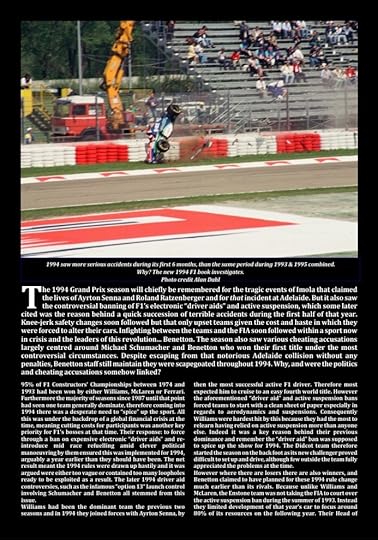
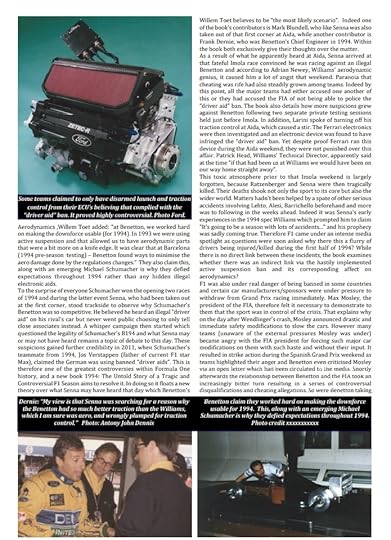
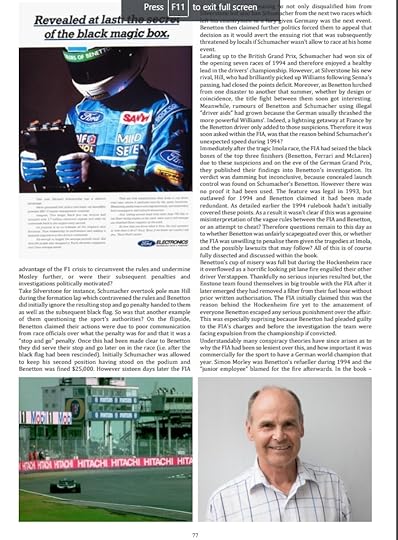
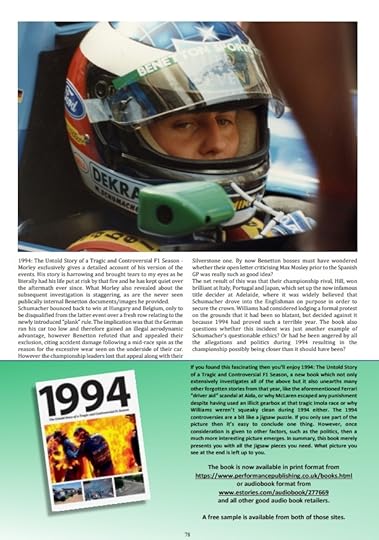
Do look out for a simliar article either in Auto Tradition or Abosulte Lotus Magazine summarising the upcoming audiobook Team Lotus & Their Decline Between 1983 & 1990
 Click here to support/guide this Lotus project
Do look out for a simliar article either in Auto Tradition or Abosulte Lotus Magazine summarising the upcoming audiobook Team Lotus & Their Decline Between 1983 & 1990
Click here to support/guide this Lotus project July 31, 2019
Schumacher’s Ferrari Controversies
In 1996 Schumacher moved to Ferrari and by 1997 key former Benetton personnel like Ross Brawn or Rory Bryne (the B194 designer), Tad Czapski (the engine electronic’s guru) joined him. Ferrari then went from being an occasional race winner to serial championship contenders over a sustained period. Questions have since been asked, why did Schumacher and his former Benetton colleagues stick together? Was it because they had sidestepped the rules in 1994 and did it subsequently at Ferrari? Dark rumours began to circulate that they somehow knew how to create an undetectable traction control implying they also may have achieved this in 1994. That latter point is discussed in detail within the book, but once Schumacher arrived at Ferrari in 1996 he did work with their existing technical team. His sublime performances within a poor F310 car suggested the German’s skill didn’t solely rely on his former Benetton colleagues. This is confirmed by his then Ferrari teammate Eddie Irvine, “We were really in the shit in 1996. I remember when the car came out I said, ‘That looks worryingly different from everyone else’s car.’ It turned out everyone else was right and we were wrong”
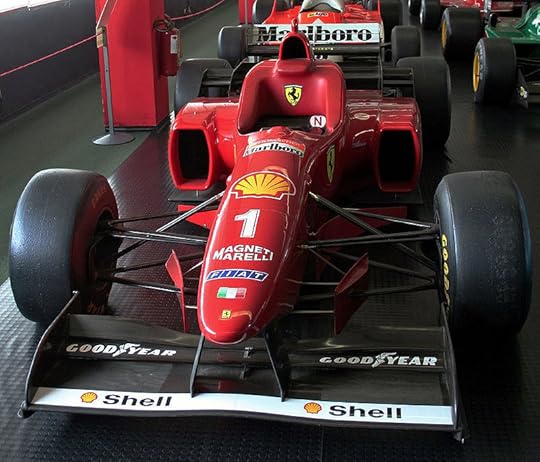
Schumacher won three races in this car which impressed teammate Eddie Irvine who later admitted, “That was the year that Michael really earned his money”
Because the 1996 car was so poor and unreliable it soon became apparent Ferrari’s technical team needed restructuring and strengthening in order to become championship winners. Hence the reason Schumacher called upon his former Benetton colleagues as he knew they could sort out Ferrari’s technical woes. If Schumacher, Brawn et al used illicit methods to turn Ferrari around then one would have expected an immediate jump in performance after that took effect. However, this did not occur instead Ferrari didn’t become the best car in F1 until 2000, thereby showing their rise was gradual and over a number of years. In addition, at Benetton, it was alleged that only Schumacher’s car was given those questionable devices but not the number 2 car. There was never this same suggestion at Ferrari even though the same senior figures were involved. Despite this speculation continued that Schumacher and his ex-Benetton colleagues were somehow sidestepping rules at Ferrari which 1994 – the Untold Story touches upon, but the new upcoming book (FIA – Ferrari International Assistance) details extensively. For instance, during the summer of 1998 rumours circulated that Ferrari ran illegal driver aids to help them under braking and acceleration. Ron Dennis of McLaren, Ferrari’s bitter rivals for the championship, suspected an intelligent brake-balance system so he visited Ferrari during the Austrian GP and threatened to protest if his suspicions continued. At the following race in Germany, Ferrari then performed poorly leading to suggestions they had removed their system after McLaren’s actions.
 The 1998 Ferrari was also accused of having illegal driver aids within it. It was a car worked on by many former Benetton engineers who were with Schumacher during 1994.
Max Mosley felt inclined to dismiss these suggestions “I know McLaren talks about that. There are interesting things at Ferrari, yet nothing illegal. I believe McLaren has understood that and is well on the way to finding an equivalent system.” Ross Brawn added; “It’s just bullshit. You can’t defend yourself against an accusation like that, so it’s a very nasty, malicious thing to say. If someone says you have a fantastic system that no one can detect, how can you prove them wrong? We are one of the few teams that have our software scrutineered before we actually use it. So we are very sure, and the FIA is very sure, that our software is completely legal.” For whatever reason Germany proved an exception as Ferrari was competitive again for the rest of the season. At the next race, Hungary, Dennis tried to defuse the situation; “Anyone can rerun the tapes from Austria and you can see the wrong wheels are locking up into the corners – it’s not the unloaded wheel that’s locking up, but the loaded one. We believe that now there has been either an optimisation of the system – or something has changed – because now there’s every reason to believe that the system is in accordance with the regulations. And to substantiate that view we have over the past four weeks, asked many questions of the FIA and sought clarification”
 Was Ron Dennis’ allegations in 1998 payback, sour grapes or genuine?
All this mudslinging had come months after Ferrari successfully protested against McLaren’s braking system which allowed drivers to apply the brakes on the rear wheels independently thereby assisting both turn in and traction. Dennis was livid how his system had been declared illegal following Ferrari’s protest in early 1998 at a time McLaren was dominating races, whereas the system had been allowed in late 1997 when McLaren wasn’t as competitive. Perhaps Dennis’ main motivation for threating Ferrari later that summer was payback. In the end, McLaren didn’t protest against Ferrari nor did anyone else, so whatever devices the Italian team were running in 1998 was deemed legal.
During that year many decisions went in Ferrari’s favor, which was convenient for TV viewers given the championships standings at the time. Dennis might feel had Ferrari’s devices been on the McLaren the outcome may have been different. In any case, it boils down to how rules were interpreted so one could not call any Ferrari devices cheating, for the same reason one cannot call McLaren’s braking system in 1998 cheating either. Essentially both teams invented clever new technologies which were not previously legislated for. So F1 rules needed to be clarified as these new devices appeared, similar to how English law is constantly updated following judgements.
During 1998 teams were experimented with throttle maps, and other devices to emulate traction control within the interpretation of the rules. Dennis admitted “Ferrari seems to be doing quite a good job of it” but didn’t actually suggest their system was illegal. Nevertheless, dark rumours continued into the early 2000s that Schumacher and his ex-Benetton colleagues had some undetectable traction control. There were also suggestions the powers-that-be in F1 were letting them do so because of the commercial benefits of Ferrari being successful in F1. Similar to how in 1994, people suggested the same was occurring because a German world champion would help increase F1’s commercial possibilities.
1994 – The Untold Story of a Tragic and Controversial F1 Season is a new book which explains this and the various controversies, politics and cheating accusations from that year. To order and view a free sample of the book click here. Alternatively, you can purchase an audiobook version here
Images courtesy; of tonylanciabeta, Tristram Biggs and Brian Snelson via https://commons.wikimedia.org/wiki/Ma...
Schumacher won three races in this car which impressed teammate Eddie Irvine who later admitted, “That was the year that Michael really earned his money”
Because the 1996 car was so poor and unreliable it soon became apparent Ferrari’s technical team needed restructuring and strengthening in order to become championship winners. Hence the reason Schumacher called upon his former Benetton colleagues as he knew they could sort out Ferrari’s technical woes. If Schumacher, Brawn et al used illicit methods to turn Ferrari around then one would have expected an immediate jump in performance after that took effect. However, this did not occur instead Ferrari didn’t become the best car in F1 until 2000, thereby showing their rise was gradual and over a number of years. In addition, at Benetton, it was alleged that only Schumacher’s car was given those questionable devices but not the number 2 car. There was never this same suggestion at Ferrari even though the same senior figures were involved. Despite this speculation continued that Schumacher and his ex-Benetton colleagues were somehow sidestepping rules at Ferrari which 1994 – the Untold Story touches upon, but the new upcoming book (FIA – Ferrari International Assistance) details extensively. For instance, during the summer of 1998 rumours circulated that Ferrari ran illegal driver aids to help them under braking and acceleration. Ron Dennis of McLaren, Ferrari’s bitter rivals for the championship, suspected an intelligent brake-balance system so he visited Ferrari during the Austrian GP and threatened to protest if his suspicions continued. At the following race in Germany, Ferrari then performed poorly leading to suggestions they had removed their system after McLaren’s actions.
The 1998 Ferrari was also accused of having illegal driver aids within it. It was a car worked on by many former Benetton engineers who were with Schumacher during 1994.Max Mosley felt inclined to dismiss these suggestions “I know McLaren talks about that. There are interesting things at Ferrari, yet nothing illegal. I believe McLaren has understood that and is well on the way to finding an equivalent system.” Ross Brawn added; “It’s just bullshit. You can’t defend yourself against an accusation like that, so it’s a very nasty, malicious thing to say. If someone says you have a fantastic system that no one can detect, how can you prove them wrong? We are one of the few teams that have our software scrutineered before we actually use it. So we are very sure, and the FIA is very sure, that our software is completely legal.” For whatever reason Germany proved an exception as Ferrari was competitive again for the rest of the season. At the next race, Hungary, Dennis tried to defuse the situation; “Anyone can rerun the tapes from Austria and you can see the wrong wheels are locking up into the corners – it’s not the unloaded wheel that’s locking up, but the loaded one. We believe that now there has been either an optimisation of the system – or something has changed – because now there’s every reason to believe that the system is in accordance with the regulations. And to substantiate that view we have over the past four weeks, asked many questions of the FIA and sought clarification”
Was Ron Dennis’ allegations in 1998 payback, sour grapes or genuine?All this mudslinging had come months after Ferrari successfully protested against McLaren’s braking system which allowed drivers to apply the brakes on the rear wheels independently thereby assisting both turn in and traction. Dennis was livid how his system had been declared illegal following Ferrari’s protest in early 1998 at a time McLaren was dominating races, whereas the system had been allowed in late 1997 when McLaren wasn’t as competitive. Perhaps Dennis’ main motivation for threating Ferrari later that summer was payback. In the end, McLaren didn’t protest against Ferrari nor did anyone else, so whatever devices the Italian team were running in 1998 was deemed legal.
During that year many decisions went in Ferrari’s favor, which was convenient for TV viewers given the championships standings at the time. Dennis might feel had Ferrari’s devices been on the McLaren the outcome may have been different. In any case, it boils down to how rules were interpreted so one could not call any Ferrari devices cheating, for the same reason one cannot call McLaren’s braking system in 1998 cheating either. Essentially both teams invented clever new technologies which were not previously legislated for. So F1 rules needed to be clarified as these new devices appeared, similar to how English law is constantly updated following judgements.
During 1998 teams were experimented with throttle maps, and other devices to emulate traction control within the interpretation of the rules. Dennis admitted “Ferrari seems to be doing quite a good job of it” but didn’t actually suggest their system was illegal. Nevertheless, dark rumours continued into the early 2000s that Schumacher and his ex-Benetton colleagues had some undetectable traction control. There were also suggestions the powers-that-be in F1 were letting them do so because of the commercial benefits of Ferrari being successful in F1. Similar to how in 1994, people suggested the same was occurring because a German world champion would help increase F1’s commercial possibilities.
1994 – The Untold Story of a Tragic and Controversial F1 Season is a new book which explains this and the various controversies, politics and cheating accusations from that year. To order and view a free sample of the book click here. Alternatively, you can purchase an audiobook version here
Images courtesy; of tonylanciabeta, Tristram Biggs and Brian Snelson via https://commons.wikimedia.org/wiki/Ma...
Schumacher’s Ferrari Controversies (Part 1)
In 1996 Schumacher moved to Ferrari and by 1997 key former Benetton personnel like Ross Brawn or Rory Bryne (the B194 designer), Tad Czapski (the engine electronic’s guru) joined him. Ferrari then went from being an occasional race winner to serial championship contenders over a sustained period. Questions have since been asked, why did Schumacher and his former Benetton colleagues stick together? Was it because they had sidestepped the rules in 1994 and did it subsequently at Ferrari? Dark rumours began to circulate that they somehow knew how to create an undetectable traction control implying they also may have achieved this in 1994. That latter point is discussed in detail within the book, but once Schumacher arrived at Ferrari in 1996 he did work with their existing technical team. His sublime performances within a poor F310 car suggested the German’s skill didn’t solely rely on his former Benetton colleagues. This is confirmed by his then Ferrari teammate Eddie Irvine, “We were really in the shit in 1996. I remember when the car came out I said, ‘That looks worryingly different from everyone else’s car.’ It turned out everyone else was right and we were wrong”
Schumacher won three races in this car which impressed teammate Eddie Irvine who later admitted, “That was the year that Michael really earned his money”
Because the 1996 car was so poor and unreliable it soon became apparent Ferrari’s technical team needed restructuring and strengthening in order to become championship winners. Hence the reason Schumacher called upon his former Benetton colleagues as he knew they could sort out Ferrari’s technical woes. If Schumacher, Brawn et al used illicit methods to turn Ferrari around then one would have expected an immediate jump in performance after that took effect. However, this did not occur instead Ferrari didn’t become the best car in F1 until 2000, thereby showing their rise was gradual and over a number of years. In addition, at Benetton, it was alleged that only Schumacher’s car was given those questionable devices but not the number 2 car. There was never this same suggestion at Ferrari even though the same senior figures were involved. Despite this speculation continued that Schumacher and his ex-Benetton colleagues were somehow sidestepping rules at Ferrari which 1994 – the Untold Story touches upon, but the new upcoming book (FIA – Ferrari International Assistance) details extensively. For instance, during the summer of 1998 rumours circulated that Ferrari ran illegal driver aids to help them under braking and acceleration. Ron Dennis of McLaren, Ferrari’s bitter rivals for the championship, suspected an intelligent brake-balance system so he visited Ferrari during the Austrian GP and threatened to protest if his suspicions continued. At the following race in Germany, Ferrari then performed poorly leading to suggestions they had removed their system after McLaren’s actions.
The 1998 Ferrari was also accused of having illegal driver aids within it. It was a car worked on by many former Benetton engineers who were with Schumacher during 1994.
Max Mosley felt inclined to dismiss these suggestions “I know McLaren talks about that. There are interesting things at Ferrari, yet nothing illegal. I believe McLaren has understood that and is well on the way to finding an equivalent system.” Ross Brawn added; “It’s just bullshit. You can’t defend yourself against an accusation like that, so it’s a very nasty, malicious thing to say. If someone says you have a fantastic system that no one can detect, how can you prove them wrong? We are one of the few teams that have our software scrutineered before we actually use it. So we are very sure, and the FIA is very sure, that our software is completely legal.” For whatever reason Germany proved an exception as Ferrari was competitive again for the rest of the season. At the next race, Hungary, Dennis tried to defuse the situation; “Anyone can rerun the tapes from Austria and you can see the wrong wheels are locking up into the corners – it’s not the unloaded wheel that’s locking up, but the loaded one. We believe that now there has been either an optimisation of the system – or something has changed – because now there’s every reason to believe that the system is in accordance with the regulations. And to substantiate that view we have over the past four weeks, asked many questions of the FIA and sought clarification”
Was Ron Dennis’ allegations in 1998 payback, sour grapes or genuine?
All this mudslinging had come months after Ferrari successfully protested against McLaren’s braking system which allowed drivers to apply the brakes on the rear wheels independently thereby assisting both turn in and traction. Dennis was livid how his system had been declared illegal following Ferrari’s protest in early 1998 at a time McLaren was dominating races, whereas the system had been allowed in late 1997 when McLaren wasn’t as competitive. Perhaps Dennis’ main motivation for threating Ferrari later that summer was payback. In the end, McLaren didn’t protest against Ferrari nor did anyone else, so whatever devices the Italian team were running in 1998 was deemed legal.
During that year many decisions went in Ferrari’s favor, which was convenient for TV viewers given the championships standings at the time. Dennis might feel had Ferrari’s devices been on the McLaren the outcome may have been different. In any case, it boils down to how rules were interpreted so one could not call any Ferrari devices cheating, for the same reason one cannot call McLaren’s braking system in 1998 cheating either. Essentially both teams invented clever new technologies which were not previously legislated for. So F1 rules needed to be clarified as these new devices appeared, similar to how English law is constantly updated following judgements.
During 1998 teams were experimented with throttle maps, and other devices to emulate traction control within the interpretation of the rules. Dennis admitted “Ferrari seems to be doing quite a good job of it” but didn’t actually suggest their system was illegal. Nevertheless, dark rumours continued into the early 2000s that Schumacher and his ex-Benetton colleagues had some undetectable traction control. There were also suggestions the powers-that-be in F1 were letting them do so because of the commercial benefits of Ferrari being successful in F1. Similar to how in 1994, people suggested the same was occurring because a German world champion would help increase F1’s commercial possibilities.
1994 – The Untold Story of a Tragic and Controversial F1 Season is a new book which explains this and the various controversies, politics and cheating accusations from that year. To pre-order and view a free sample of the book click here. Alternatively, you can keep up to date with this and future books by the author, as well as upcoming 1994 F1 blogs by signing up here.
Images courtesy; of tonylanciabeta, Tristram Biggs and Brian Snelson via https://commons.wikimedia.org/wiki/Ma...
Schumacher won three races in this car which impressed teammate Eddie Irvine who later admitted, “That was the year that Michael really earned his money”
Because the 1996 car was so poor and unreliable it soon became apparent Ferrari’s technical team needed restructuring and strengthening in order to become championship winners. Hence the reason Schumacher called upon his former Benetton colleagues as he knew they could sort out Ferrari’s technical woes. If Schumacher, Brawn et al used illicit methods to turn Ferrari around then one would have expected an immediate jump in performance after that took effect. However, this did not occur instead Ferrari didn’t become the best car in F1 until 2000, thereby showing their rise was gradual and over a number of years. In addition, at Benetton, it was alleged that only Schumacher’s car was given those questionable devices but not the number 2 car. There was never this same suggestion at Ferrari even though the same senior figures were involved. Despite this speculation continued that Schumacher and his ex-Benetton colleagues were somehow sidestepping rules at Ferrari which 1994 – the Untold Story touches upon, but the new upcoming book (FIA – Ferrari International Assistance) details extensively. For instance, during the summer of 1998 rumours circulated that Ferrari ran illegal driver aids to help them under braking and acceleration. Ron Dennis of McLaren, Ferrari’s bitter rivals for the championship, suspected an intelligent brake-balance system so he visited Ferrari during the Austrian GP and threatened to protest if his suspicions continued. At the following race in Germany, Ferrari then performed poorly leading to suggestions they had removed their system after McLaren’s actions.
The 1998 Ferrari was also accused of having illegal driver aids within it. It was a car worked on by many former Benetton engineers who were with Schumacher during 1994.Max Mosley felt inclined to dismiss these suggestions “I know McLaren talks about that. There are interesting things at Ferrari, yet nothing illegal. I believe McLaren has understood that and is well on the way to finding an equivalent system.” Ross Brawn added; “It’s just bullshit. You can’t defend yourself against an accusation like that, so it’s a very nasty, malicious thing to say. If someone says you have a fantastic system that no one can detect, how can you prove them wrong? We are one of the few teams that have our software scrutineered before we actually use it. So we are very sure, and the FIA is very sure, that our software is completely legal.” For whatever reason Germany proved an exception as Ferrari was competitive again for the rest of the season. At the next race, Hungary, Dennis tried to defuse the situation; “Anyone can rerun the tapes from Austria and you can see the wrong wheels are locking up into the corners – it’s not the unloaded wheel that’s locking up, but the loaded one. We believe that now there has been either an optimisation of the system – or something has changed – because now there’s every reason to believe that the system is in accordance with the regulations. And to substantiate that view we have over the past four weeks, asked many questions of the FIA and sought clarification”
Was Ron Dennis’ allegations in 1998 payback, sour grapes or genuine?All this mudslinging had come months after Ferrari successfully protested against McLaren’s braking system which allowed drivers to apply the brakes on the rear wheels independently thereby assisting both turn in and traction. Dennis was livid how his system had been declared illegal following Ferrari’s protest in early 1998 at a time McLaren was dominating races, whereas the system had been allowed in late 1997 when McLaren wasn’t as competitive. Perhaps Dennis’ main motivation for threating Ferrari later that summer was payback. In the end, McLaren didn’t protest against Ferrari nor did anyone else, so whatever devices the Italian team were running in 1998 was deemed legal.
During that year many decisions went in Ferrari’s favor, which was convenient for TV viewers given the championships standings at the time. Dennis might feel had Ferrari’s devices been on the McLaren the outcome may have been different. In any case, it boils down to how rules were interpreted so one could not call any Ferrari devices cheating, for the same reason one cannot call McLaren’s braking system in 1998 cheating either. Essentially both teams invented clever new technologies which were not previously legislated for. So F1 rules needed to be clarified as these new devices appeared, similar to how English law is constantly updated following judgements.
During 1998 teams were experimented with throttle maps, and other devices to emulate traction control within the interpretation of the rules. Dennis admitted “Ferrari seems to be doing quite a good job of it” but didn’t actually suggest their system was illegal. Nevertheless, dark rumours continued into the early 2000s that Schumacher and his ex-Benetton colleagues had some undetectable traction control. There were also suggestions the powers-that-be in F1 were letting them do so because of the commercial benefits of Ferrari being successful in F1. Similar to how in 1994, people suggested the same was occurring because a German world champion would help increase F1’s commercial possibilities.
1994 – The Untold Story of a Tragic and Controversial F1 Season is a new book which explains this and the various controversies, politics and cheating accusations from that year. To pre-order and view a free sample of the book click here. Alternatively, you can keep up to date with this and future books by the author, as well as upcoming 1994 F1 blogs by signing up here.
Images courtesy; of tonylanciabeta, Tristram Biggs and Brian Snelson via https://commons.wikimedia.org/wiki/Ma...
June 29, 2019
Did a Return to Simpler Cars in 1994 Contribute to the Accidents?
“The cars are immediately less stable without the electronic suspension. As a consequence, they are harder to drive and we’ll have more cars spinning and going off the track”
Ayrton Senna, Williams Driver (Killed during San Marino GP)
“Several commentators said it was the elimination of driver aids (to blame for the accidents), a classic post hoc point. It was an intensely stupid inference but was nevertheless widely reported.”
Max Mosley, FIA President
Following the tragedies of the 1994 San Marino GP, a mass-media hysteria gathered and called for immediate repercussions but couldn’t agree on what they should be. Some suggestions were constructive, some destructive, most were frankly a veiled attempt to turn tragedy into titillation. Generally, the fewer journalists knew about F1, the greater the mock outrage was. FIA President Max Mosley was initially at pains to avoid a knee-jerk response…that was until Karl Wendlinger suffered an almost fatal crash at Monaco less than two weeks later. Mosley then came under intense pressure from outside the sport to impose urgent safety measures, but teams were in an uproar over the haste of such action. They argued Mosley’s measures would not be safer until the knock-on effects were established, this led to more problems which are detailed in the upcoming book.
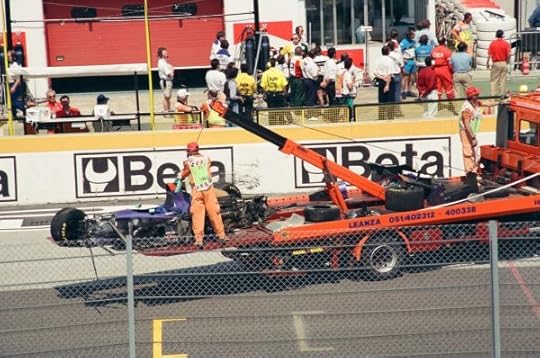 Mosley felt it was a statistical cluster that so many accidents happened at Imola 1994. But choose his words carefully afterwards to avoid being branded as irresponsible by a media baying for blood.
Meanwhile, the debate raged whether the banning of driver aids and active suspension played any part in the accidents. Reigning world champion Alain Prost stated “The cars are more difficult to drive (in 1994). They are traumatising on the physical side.” And it was Senna’s early experiences in the 1994 Williams which prompted him to claim “It’s going to be a season with lots of accidents…” Martin Brundle, who replaced Senna at McLaren, adds “Some of the cars still had aero optimised for all the goodies and suddenly all the goodies weren’t there, so you ended up with – in F1 terms – a slightly agricultural fix while you were getting the rest of it together. You certainly had less control of the car.” Senna’s prophecy seemly came true as it was supported by the statistics. By the end of May 1994, F1 suffered nine serious accidents resulting two fatalities and five major injuries and two very lucky escapes. Compare that to 1993 and 1995 where there were five and three major accidents by June in those respective years. Fortunately, none of the accidents in 1993 and 1995 resulted in serious injuries or fatalities.
Undoubtedly F1’s luck had run out during that dark period in 1994 and whilst the above statistics tell a story, one must remember accidents can happen at any time. Likewise there was no direct connection between those nine accidents either, however, in the majority of cases drivers were pushing too hard in unfamiliar cars. The 1994 Williams was notoriously unpredictable to drive on the limit at the time. This stemmed from not appreciating how difficult it was converting their car back to passive suspension and remarrying the aerodynamics accordingly. Furthermore, Williams’ Paddy Lowe believes “traction control brought qualities to the car the driver didn’t really appreciate. Everybody had been running traction control for at least a year, if not two (by ’94), so going to a car that suddenly doesn’t have it is going to be quite a handful.”

Damon Hill applied caution in his driving until he was more familiar with the 1994 spec cars whereas Senna, rightly or wrongly, took greater risks.
Nevertheless, Mosley’s view was; “The small teams did not have them last year and in 1991 virtually nobody had them. It is inconceivable that a driver of Senna’s skill would be inconvenienced by a lack of driver aids”. Furthermore, in Mosley’s autobiography, he highlighted most F1 drivers acquired their skills in cars not equipped with electronic aids. It would be foolish to lay the whole blame for the 1994 accidents solely on the banning of driver aids alone, as there were many other factors involved all of which is detailed extensively in the upcoming book. For instance, teams tried extreme car setups to try to retain their “knife edge” aerodynamics even though they now had passive suspensions.
Meanwhile, fuel companies no longer had to worry about fuel economy during races, due to the introduction of refuelling, so they started to brew extremely potent fuels which increased the power of the engines. Damon Hill adds “One thing that changed was the width of the tyres for 1993. The rears were narrowed (from 18 to 15 inches) and I don’t think that was terribly good. That carried through to 1994, so maybe with active suspension, the effect of that change was masked a little in 1993. “That meant there was less development on those tyres on passive suspension. When I first tested for Williams at Imola (in 1994) we had the much bigger rear tyre. It was very stable, lots of traction and great to drive. But when we went to the narrower rear tyre the car was a lot less comfortable.”
A new book entitled 1994 – The Untold Story of a Tragic and Controversial F1 Season is a new book, which not only covers this topic in more detail but it explains how the driver aid ban was forced through, extremely late and against teams wishes. It is available from Performance Publishing’s website where you can also read a free sample of the book. Alternatively, sign up at; www.1994f1.com/contact to receive exclusive information on the followup book and have new blogs emailed to you.
Images courtesy; of Alan Dahl and Martin Lee via https://commons.wikimedia.org/wiki/Ma...
May 31, 2019
Ayrton Senna – What Caused his Crash?
One of the most fundamental mysteries of the 1994 Formula One season was why Ayrton Senna, one of the sport’s greatest ever drivers, crash fatally at a relatively easy corner?
To this day, no-one knows for certain why Senna crashed. Many theories of varying credibility have been put forward. My personal view is Senna, desperate to break free from the car behind, carried a bit too much speed into Tamburello the car went slightly offline onto a part of the track known to be extremely bumpy. The ride height was still too low after the safety car so it “bottomed out”. This also caused the peaky aerodynamics on the Williams to stall resulting in a catastrophic loss of grip made worse by tyres not up to working pressures or temperatures. This view is shared by Hill who drove an identical car to Senna, and Schumacher, who had the clearest view of what started the crash. In my humble opinion, they are the two best people to judge its cause.
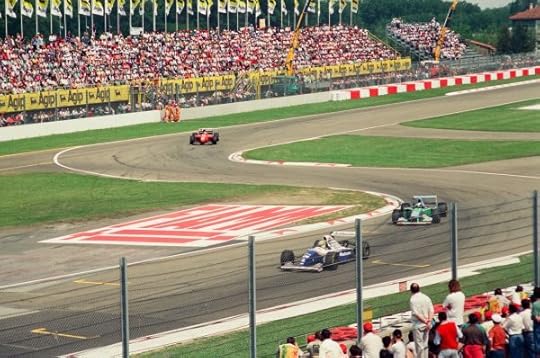 Senna leading Schumacher moments before the crash.
The pursuing Schumacher later explained what unfolded at Tamburello on lap seven. “I saw that Senna’s car was touching the track at the back quite a lot on the lap before. It was very nervous in that corner, and he nearly lost it. Then on the next time through he did lose it. The car just touched the track with the rear skids, went a bit sideways, and then he just lost it.” We know Senna did 188mph through Tamburello on lap six and 193mph on lap 7. We also know from video footage that Senna took a faster but bumpier line. This sent huge sparks flying from the rear of his car – evidence of “bottoming”. The largest plume appears as he left the third dark strip of resurfaced tarmac in the middle of Tamburello. Throughout qualifying and practice, you can see Senna’s car “bottoming” through Tamburello much more than others. The difference then was, he did not have Schumacher right up behind him, his car was not fat with fuel and he would not have had tyre temperature/pressure issues caused by an Opel Vectra.
In Damon Hill’s 2016 autobiography (see above) the Englishman said he applied greater caution than Senna through Tamburello after the safety car, instead preferring to wait for the optimal heat and temperatures in his tyres. Hill also details the bumps at Tamburello explaining how he took a slower line than Senna to avoid the worst of them. Immediately following Senna’s crash Patrick Head, Williams Technical director stated; “The car was set up the same as Hill’s. The two were identical for springs and settings, but the underside of Hill’s car is unmarked”. Whereas there were suggestions the floor on Senna’s car was heavily worn.
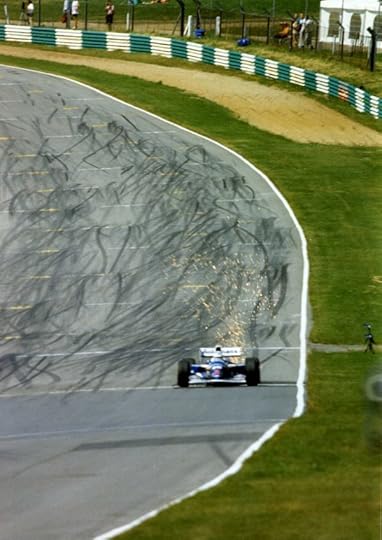 The Williams FW16 bottoming, as indicated by the sparks emanating from the rear of the car
Furthermore, an unnamed driver suggested to Autosport magazine at the time that Tamburello wasn’t as easily flat out as people believed. Stating it was much more difficult with the passive suspension than the active ride used in 1993. Admittedly quoting an unnamed driver isn’t the greatest source, however, Autosport magazine is known for its credibility. Ex Formula One driver Jonathan Palmer said from his own experience of Tamburello “If the car is right, its actually not a real corner: it’s flat, foot down, you don’t really think about it….But if the car’s set up isn’t right – which includes cases where the car is bottoming out too much – the picture changes considerably.” Also consider that crashes due to driver error on apparently easy flat corners do happen, case in point Kevin Magnussen at Eau Rouge, Spa 2016. Alternative reasons why Senna crashed, include a partial/total steering column failure, and a slow puncture from debris from the Lehto/Lamy startline crash causing the car to bottom out. Which is the view that Williams designer Adrian Newey gives within his book below:
Whilst my book is not about what caused Senna’s accident, it is well known that the triple Formula One Champion died believing that Schumacher’s Benetton was illegal. If there is any truth behind these accusations, then – out of respect to Senna – that truth must be known. A new book entitled 1994 – The Untold Story of a Tragic and Controversial F1 Season is a new book, which sheds light on hirtherto unpublished facts & stories regarding that fateful year. It is available from Performance Publishing’s website where you can also read a free sample of the book. Alternatively, sign up at; www.1994f1.com/contact to receive exclusive information on the followup book and have new blogs emailed to you.
Pleased to announce an audio book version of 1994: The Untold Story is now available for purchase from the below websites. In fact you can listen to it for free at Audiobooks.com or estories.com via their initial trial period.
If you enjoyed 1994 – The Untold Story, and would like to see this second book become a reality, then please become a supporter to the second book by clicking here
Images courtesy; of Alan Dahl, Alastair Ladd and Martin Zustak
To this day, no-one knows for certain why Senna crashed. Many theories of varying credibility have been put forward. My personal view is Senna, desperate to break free from the car behind, carried a bit too much speed into Tamburello the car went slightly offline onto a part of the track known to be extremely bumpy. The ride height was still too low after the safety car so it “bottomed out”. This also caused the peaky aerodynamics on the Williams to stall resulting in a catastrophic loss of grip made worse by tyres not up to working pressures or temperatures. This view is shared by Hill who drove an identical car to Senna, and Schumacher, who had the clearest view of what started the crash. In my humble opinion, they are the two best people to judge its cause.
Senna leading Schumacher moments before the crash.The pursuing Schumacher later explained what unfolded at Tamburello on lap seven. “I saw that Senna’s car was touching the track at the back quite a lot on the lap before. It was very nervous in that corner, and he nearly lost it. Then on the next time through he did lose it. The car just touched the track with the rear skids, went a bit sideways, and then he just lost it.” We know Senna did 188mph through Tamburello on lap six and 193mph on lap 7. We also know from video footage that Senna took a faster but bumpier line. This sent huge sparks flying from the rear of his car – evidence of “bottoming”. The largest plume appears as he left the third dark strip of resurfaced tarmac in the middle of Tamburello. Throughout qualifying and practice, you can see Senna’s car “bottoming” through Tamburello much more than others. The difference then was, he did not have Schumacher right up behind him, his car was not fat with fuel and he would not have had tyre temperature/pressure issues caused by an Opel Vectra.
In Damon Hill’s 2016 autobiography (see above) the Englishman said he applied greater caution than Senna through Tamburello after the safety car, instead preferring to wait for the optimal heat and temperatures in his tyres. Hill also details the bumps at Tamburello explaining how he took a slower line than Senna to avoid the worst of them. Immediately following Senna’s crash Patrick Head, Williams Technical director stated; “The car was set up the same as Hill’s. The two were identical for springs and settings, but the underside of Hill’s car is unmarked”. Whereas there were suggestions the floor on Senna’s car was heavily worn.
The Williams FW16 bottoming, as indicated by the sparks emanating from the rear of the carFurthermore, an unnamed driver suggested to Autosport magazine at the time that Tamburello wasn’t as easily flat out as people believed. Stating it was much more difficult with the passive suspension than the active ride used in 1993. Admittedly quoting an unnamed driver isn’t the greatest source, however, Autosport magazine is known for its credibility. Ex Formula One driver Jonathan Palmer said from his own experience of Tamburello “If the car is right, its actually not a real corner: it’s flat, foot down, you don’t really think about it….But if the car’s set up isn’t right – which includes cases where the car is bottoming out too much – the picture changes considerably.” Also consider that crashes due to driver error on apparently easy flat corners do happen, case in point Kevin Magnussen at Eau Rouge, Spa 2016. Alternative reasons why Senna crashed, include a partial/total steering column failure, and a slow puncture from debris from the Lehto/Lamy startline crash causing the car to bottom out. Which is the view that Williams designer Adrian Newey gives within his book below:
Whilst my book is not about what caused Senna’s accident, it is well known that the triple Formula One Champion died believing that Schumacher’s Benetton was illegal. If there is any truth behind these accusations, then – out of respect to Senna – that truth must be known. A new book entitled 1994 – The Untold Story of a Tragic and Controversial F1 Season is a new book, which sheds light on hirtherto unpublished facts & stories regarding that fateful year. It is available from Performance Publishing’s website where you can also read a free sample of the book. Alternatively, sign up at; www.1994f1.com/contact to receive exclusive information on the followup book and have new blogs emailed to you.
Pleased to announce an audio book version of 1994: The Untold Story is now available for purchase from the below websites. In fact you can listen to it for free at Audiobooks.com or estories.com via their initial trial period.
If you enjoyed 1994 – The Untold Story, and would like to see this second book become a reality, then please become a supporter to the second book by clicking here
Images courtesy; of Alan Dahl, Alastair Ladd and Martin Zustak


