Nancy F. Castaldo's Blog, page 3
March 4, 2025
Congratulations, Elizabeth Shreeve on ON AN OCEAN JOURNEY: Animals in Motion through the Seas!
 On an Ocean Journey has an unusual origin story: it began with the artwork. Back in 2007, Alaska-based artist Ray Troll created a beautiful set of murals for a marine science laboratory operated by the National Oceanic and Atmospheric Administration (NOAA) in Pacific Grove, California. (It’s worth a visit if you’re in the Monterey area; go to 1352 Lighthouse Avenue, near Asilomar State Park). When budget cuts forced NOAA to abandon the building, Ray held onto the original colored pencil drawings.In early 2022, Ray sent me an email. Would I consider a picture book collaboration? Imagine my delight! I’m a big Ray Troll fan, and apparently I’d caught his attention through my earlier books. Ray soon filled my inbox with gorgeous depictions of marine animals. On the phone, he briefed me on the NOAA project. Then it was up to me to transform a collection of images into a picture book. What a joy to explore storylines inspired by these stunning, scientifically accurate renderings!Writing STEAM books requires a substantial amount of research. Often it is the most fun part of our writing process. Did you meet any challenges in your research journey? You might think the research for this book was buttoned up; after all, Ray had worked closely with scientists at NOAA on the murals. They focused on an oceanic pattern known as the Pacific Decadal Oscillation (PDO), which describes warmer and cooler phases of water temperature over ten-year increments in the Northern Pacific. Interesting…but was that the right topic for a picture book? To me, Ray’s bold images seemed best-suited to a younger audience. So, what was my angle? I decided not to decide. Instead, I dove into research. I outlined key facts for each species: range and habits, role in the food web, important features, and conservation status. Soon I was swimming in some deep waters of information on marine zoology.
 (Author and artist at the former NOAA marine lab in Pacific Grove, CA)Often one of the most difficult parts of crafting our books is not deciding what to include, but deciding what to leave out. What did you choose to leave out of this book and why? Ray provided about 50 images. We decided that each one deserved a page, so I had way too many for a 32-page format (22 drawings ended up in the book, including a few new ones). After color-coding the factual material on each animal, I spread drawings on our big table and began to edit. Some images were particularly striking; those made the cut. (Fortunately, Ray’s favorites coincided with mine.) Ray is a big fan of fish, but I wanted a variety of creatures including reptiles, birds, and marine mammals. Sorry, fish! Many beauties hit the floor. To increase the overall appeal of the book, I gave preference to animals that ranged beyond the North Pacific into other ocean environments. As I winnowed, I admired the dynamic quality of Ray’s drawings. A theme emerged: how do animals move through the water? I wrote a fact-filled manuscript entitled “One Ocean in Motion.” My agent sent it out. Darn, no takers! I started over. This time I kept it simple, with a structure that goes from shallow water to ocean depths. The two images of divers serve as bookends for the opening and ending, while a full spread of predators closing in on a baitball of sardines provides a high point. Less science, more poetry! I hope the final version lets Ray’s artwork shine, as it should.
 (Artwork with color-coded research notes: plenty to choose from!)What tip can you share with teachers who want to use your book in the classroom? On an Ocean Journey will be a fun read-aloud and also lends itself to creative writing and art projects for Grades K-2. The “Field Guide” at the end provides details on each animal, along with links for learning about the ocean and how to protect it. You’ll find an Activity Kit created by the publisher, with input from Ray and me, on my website . One activity instructs student to arrange a set of images in the order of their choosing. Add imagination and color. Voila, a story!
 Congratulations on this book release! What comes next for you? Can you give us a peek at what you are currently researching? My next publication will be a middle grade book entitled Dinosaurs to Dragons: The Lore and Science of Mythical Creatures. It’s coming from Atheneum/Simon & Schuster in the next year or so, with artwork by Violeta Encarnacion combined with photographs. The project has stretched my science-oriented mind into archaeology, mythology, and history. It’s a thrill to discover new topics, and a privilege to share with young readers.
 About the author: ELIZABETH SHREEVE grew up in a family of writers and scientists who taught her to pay attention to horseshoe crabs, seabirds, and other wonderful creatures along the Atlantic coastline. Now based in California, she writes books for young readers that celebrate the origins and diversity of life on Earth. Her recent books include The Upside-Down Book of Sloths, The Oddball Book of Armadillos, and the award-winning Out of the Blue: How Animals Evolved from Prehistoric Seas. Learn more about her books, author visits, and fishy adventures at ElizabethShreeve.com and on social media @ShreeveBooks.


February 11, 2025
Congratulations, Carrie Tillotson, on Alpacas Here, Alpacas There!

 Writing STEAM books requires a substantial amount of research. Often it is the most fun part of our writing process. Did you meet any challenges in your research journey?
Oh, definitely. Once I had decided on the compare and contrast structure of looking at alpacas lives in both South and North America, it was sometimes hard to get the Andean perspective on alpacas. Much of the work I found was written by North Americans who were not native to the culture, or the sources I found were written or produced in Spanish, which I don’t read or understand very well anymore. I reached out to the Centro de Textiles Tradicionales del Cusco (CTTC), and one of their board members graciously reviewed an early version of the manuscript. She also asked the indigenous weavers that the CTTC works with many of my questions about raising alpacas in the Andes. I am forever grateful to them, and a portion of the proceeds from this book are donated to the CTTC, whose mission is to aid in the survival of textile traditions of the Cusco region of Peru.Another challenge I faced was the gaps in my knowledge and context of Quechua culture as an outsider. I wanted to be accurate and respectful of both the alpacas and the Andean people for the parts of the book portrayed in South America, so I asked my editor if we could hire an authenticity reader. It was very helpful to get her insights. She even connected me with an alpaca farmer in Peru who was happy to meet with me over Zoom and chat through What’s App. Below is a photo he sent me regarding my questions about the types of grass alpacas eat. I can’t thank them both enough for their help!
Writing STEAM books requires a substantial amount of research. Often it is the most fun part of our writing process. Did you meet any challenges in your research journey?
Oh, definitely. Once I had decided on the compare and contrast structure of looking at alpacas lives in both South and North America, it was sometimes hard to get the Andean perspective on alpacas. Much of the work I found was written by North Americans who were not native to the culture, or the sources I found were written or produced in Spanish, which I don’t read or understand very well anymore. I reached out to the Centro de Textiles Tradicionales del Cusco (CTTC), and one of their board members graciously reviewed an early version of the manuscript. She also asked the indigenous weavers that the CTTC works with many of my questions about raising alpacas in the Andes. I am forever grateful to them, and a portion of the proceeds from this book are donated to the CTTC, whose mission is to aid in the survival of textile traditions of the Cusco region of Peru.Another challenge I faced was the gaps in my knowledge and context of Quechua culture as an outsider. I wanted to be accurate and respectful of both the alpacas and the Andean people for the parts of the book portrayed in South America, so I asked my editor if we could hire an authenticity reader. It was very helpful to get her insights. She even connected me with an alpaca farmer in Peru who was happy to meet with me over Zoom and chat through What’s App. Below is a photo he sent me regarding my questions about the types of grass alpacas eat. I can’t thank them both enough for their help!
 Often one of the most difficult parts of crafting our books is not deciding what to include, but deciding what to leave out. What did you choose to leave out of this book and why? I left out some of the more basic facts about alpacas. For example, that they spit when agitated, have no upper teeth, or that they poop in communal dung piles. I didn’t want to the book to read like an encyclopedia entry about alpacas, but rather wanted to focus on the theme of comparing and contrasting alpaca life between North and South America. It was hard to leave out some of those interesting facts, but I wanted to stay true to my vision of sharing how, for both alpacas and humans, that no matter where we live we all follow similar rhythms of life.
 What tip can you share with teachers who want to use your book in the classroom? It can be used in the language arts classroom to compare and contrast the two different settings in the book—South America and North America. How are alpacas’ lives different depending on where they live? How are they similar? For a math-based lesson, have students make a Venn diagram characterizing the features of alpaca life that are the same and different depending on their location. For social studies units, extend the compare and contrast thinking to discuss how people from various parts of the world have diverse ways of living, or how humans are in relationship with their environment through farming. Or use it in the science classroom to talk about the relationship between the needs of plants and animals and the places they live.
Congratulations on this book release! What comes next for you? Can you give us a peek at what you are currently researching?
My next picture book hasn’t been announced yet, but I can say that it’s a silly, hopefully laugh-out-loud, informational fiction picture book that I can’t wait to share more about soon. I am also currently researching for a nonfiction book on another one of my favorite animals.
What tip can you share with teachers who want to use your book in the classroom? It can be used in the language arts classroom to compare and contrast the two different settings in the book—South America and North America. How are alpacas’ lives different depending on where they live? How are they similar? For a math-based lesson, have students make a Venn diagram characterizing the features of alpaca life that are the same and different depending on their location. For social studies units, extend the compare and contrast thinking to discuss how people from various parts of the world have diverse ways of living, or how humans are in relationship with their environment through farming. Or use it in the science classroom to talk about the relationship between the needs of plants and animals and the places they live.
Congratulations on this book release! What comes next for you? Can you give us a peek at what you are currently researching?
My next picture book hasn’t been announced yet, but I can say that it’s a silly, hopefully laugh-out-loud, informational fiction picture book that I can’t wait to share more about soon. I am also currently researching for a nonfiction book on another one of my favorite animals.
 About the author: Carrie Tillotson is the award-winning author of picture books like Alpacas Here, Alpacas There; Counting to Bananas, an Oregon Spirit Book Award Honor Book and Amazon Editor’s Pick; B Is for Bananas, a Good Housekeeping Kids’ Book Award winner, SCBWI Crystal Kite Honor winner, and Bank Street College of Education Best Books of the Year selection. After getting a master’s degree in public health, Carrie worked as a biostatistician for more than ten years and now sculpts her interests in science into playful picture books. She lives in Oregon with her husband, son, and two dogs, who are always going bananas. Carrie is represented by Tracy Marchini at BookEnds Literary Agency. Visit her at CarrieTillotson.com.Nancy Castaldo is the author of many award-winning books for young readers. Look for news about her latest releases here.
February 6, 2025
Why Names Are Important
 Why are these name changes important? Think about your own name. Your parents, most likely, took great care to select your name. You might be named after an ancestor or saint, or your name might have a special meaning. Imagine having a teacher who decided they wanted to call you something different. While our geography has no say in what it is called, mountains and water bodies carry names that also have a rich history.
 The Koyukon people inhabiting the area around the great mountain in Alaska called the peak "Denali" for centuries until a random gold prospector in the late 1800s, who supported William McKinley's run for president, renamed it "Mount McKinley." The name, McKinley, continued until it was returned to Denali in 2015. Naming natural and public places, like streets and bridges, reflect how communities want to be perceived. “Wherever we go in the world and whatever we do – walking around town, looking up a telephone number, surfing the internet, reading a recipe book or shopping for new clothes – we encounter names of places. They surround us, providing us not only with a sense of place but also with a means of finding our way about, searching for information and organizing the world we live in. For all of us, a place name is a reference point of our language and our identity," said . There are other reasons why geographical names matter. “It may seem trivial when an airline passenger confuses Dulles airport in Washington, D.C. with Dallas in Texas or when they arrive in Sydney in Canada’s Nova Scotia instead of Sydney, Australia. However, it is not trivial when duplication or lack of clearly recorded and easily available names result in confused instructions to emergency services, who cannot reach people in time."
 Let's return to your own name and how that name reflects your own identity and place within your community. Random name changes do have an impact and should not be taken lightly. Connections to our history are integral in understanding our country's character. The names of our places continue to teach our history to our citizens. Changing them creates confusion, lack of identity, and miscomunication. In addition, it is expensive and unnecessary.
February 5, 2025
Congratulations, Ann Marie Stephens, on CATawampus! and sCATttered!
 Can you share with us a bit about the inspiration for these books? What was your initial spark? I guess I should go ahead and admit I’m more of a dog person. Though for some reason, cats gravitate to me. They follow me around houses, try to grab my hair, and stray cats seem to find me when I travel. I do appreciate kitty quirks and I enjoy watching them defy gravity and land on their feet. My first cat book in the series, is CATastrophe! A Story of Patterns. I wanted to create a story where the characters were struggling to make patterns but still landing on their feet so to speak. Casting a group of hyper, messy yet resourceful cats seemed like the perfect pairing. My publisher asked for four more books after that and the brainstorming began. I chose math skills relevant to kindergarten and first grade and ones that are also building blocks for second grade and up. I put the cats in relatable situations and made room for lots of mistakes. I taught in elementary schools (mostly first grade) for 31 years. What happens in my books is similar to what took place in my classroom. We would try out new math concepts in practical ways. We’d struggle, we’d make messes, then one day things would fall into place. Math is hard for so many kids. I want my books to help make it exciting.
 Did you meet any challenges in your book’s journey from inspiration to completion? There are many challenges when writing a series. Uniformity is essential. The characters’ actions and reactions need to stay true to who they are. Language, voice, and pacing need to be consistent. My editors and I thought we should put the word “CAT” in each of the titles. Not so easy. I made a master list of CAT words and chose what I thought could work. I created stories and themes around the words while also figuring out how to include a math skill. sCATtered! A Story of Estimation, called for some disorganization to accompany the idea of being scattered, which is fitting because the concept of estimation, as it relates to elementary classrooms, can feel a bit that way. Kids basically need to make an educated guess despite not being able to actually count, or while dealing with weaknesses in number sense or visual perception. Young kids typically want to get the exact number, but the truth is, sometimes they are very far off the mark. In the story, my cat characters are shopping, baking, decorating, and cleaning for the arrival of their Grandma from Catmandu. They estimate in everything they do, giving readers a chance to see realistic applications of estimating and join in or choose a cat they think might be close in their guess. Jenn Harney’s illustrations provide the visual reinforcement kids need for math, while illuminating relatable family dynamics and challenges. CATawampus! A Story of Shapes focuses on a STEM project to build a robot and how wonky it gets. Kids often forget to check their design plans before they gather the best materials and adapt. Eventually they do all these steps through trial and error and this is echoed in the events of the story. Engineering projects call for the use of specific materials though they are often quite varied. In this story, the cats are searching for basic 2D shapes in their 3D world. As with young kids, they confuse or forget the characteristics such as, number of sides or corners. The cats rush to complete their robot and there are consequences. It’s in good fun and, best of all, they don’t give up. Overall, my goal for this series is to find organic, applicable ways to work math into the real world, while also conjuring up some laughs.
 STEAM stands for Science, Technology, Engineering, Art, and Math. You’ve chosen to highlight math in these fun books. Why?I like to think that maybe math chose me because it’s hard to believe I chose it. Math has never been my favorite subject. Not even close. In fact, I can call it my least favorite. As a student, I found it boring and too precise for my creative, right-brained approaches to life. The idea for Arithmechicks Add Up, the first book in my other series about fuzzy chicks who do math, came as a result of combining art and addition while teaching first grade. I was always looking for ways to make math seem imaginative or colorful. My students who struggled in the subject, and even the ones who didn’t, appreciated my efforts. I loved hunting down math picture books that could reiterate what we were learning. When I wrote mine, I wanted them to be math plus story to equal a balance. One of the positives of math is that it is indeed all around us. Kids use it every day when they follow a schedule, sign into computers, or set an alarm. Knowing that math has a purpose helps promote interest and application. I hope my cats (and chicks) are helping kids feel supported and understood when it comes to the challenges of math. I also hope they love and relate to the cat shenanigans and emotions that the illustrator, Jenn Harney, has masterfully created.
 What tip can you share with teachers who want to use your books in the classroom? I’d love to see educators use my books in small groups, large groups, and centers. Reading the books at whole group time is great for introducing a new skill or reinforcing an existing one. Small group time allows for more discussion and participation. Centers provide moments for close examination of illustrations and the Easter Eggs Jenn planted. Readers can’t wait to locate all of the worms, dragonflies, or toy mice on the pages! The cat books can go in reading baskets, libraries, reading rooms, and math, STEM, and language centers. Kids can illustrate their own cat pictures and math concepts or create different characters and mix math into their own original stories. Students can gather in groups to engineer robots out of shapes or work as individuals for a real robot rumpus! Teachers can fill jars with everyday objects and have kids estimate the contents. The inclusion of picture books in math instruction and the activities they can lead to are endless. Lastly, I hope educators who use my books in any form tag me on social media. I love witnessing and celebrating the efforts and inventiveness of teachers.
 Congratulations on these book releases! What comes next for you? Can you give us a peek at what you are currently working on? Thank you so much! After these two books, I have a picture book titled, SO MANY BOOKS!, cowritten with Sue Fliess, coming out April 10. It’s a rhyming book about books! Then the fourth story in the CATastrophe Tale Series, CATerwaul! A Story of Sorting, releases in December, and the last one in the series, CATapult! A Story of Movement and Position, debuts in 2026. I’m working on writing a few other picture books, an early reader series, and some collaborations, while my agent shops a board book series, another early reader series, and multiple picture books. I’m actively pursuing school visits, workshops for writers and teachers, and I’m doing some educational writing. I try to work on many things at once so I don’t get distracted by rejection or riddled with impatience directed at the pace of the publishing industry. I should also add, none of the books I’m currently writing or submitting have anything to do with math. Science? Maybe.
 About the author: Ann Marie Stephens is the author of numerous picture books including the Arithmechicks series, the CATastrophe! series, the upcoming So Many Books, coauthored with Sue Fliess, and more. Her books have been translated into several languages and have been featured on lists such as, Fuse #8, Children’s Book Council, and Hot Off the Press. Ann Marie’s poetry and literacy work has been included in Bon Appetit Magazine and on NPR. She is also a retired, award-winning elementary teacher with over 30 years in the classroom. While teaching, she received several grants for her inventive literacy projects. She’s taught dozens of original writing and education-based workshops for both children and educators. She was a contributing author for Kwame Alexander’s The Write Thing, and a co-writer for Scholastic’s Trait Crate Plus for third and fifth grade. She is represented by Emily Mitchell at Wernick & Pratt Agency and lives in Virginia.Website: https://www.annmariestephensbooks.com... amstephens_X: amstephens_Facebook: AMStephensAuthorBluesky: amstephens.bsky.social
February 4, 2025
Congratulations, Darcy Pattison, on JEREMY, THE BRITISH GARDEN SNAIL!
 This book began because I set myself a strange little puzzle. I’d started a book series, ANOTHER EXTRAORDINARY ANIMAL, that included a bird, spider, mammal, marine mammal, reptile, and amphibian. The series is about an individual animal, not a species, and each animal was named because of some interaction with humans. Beyond that, they needed an interesting story with a beginning, middle and end. Finally, I needed a scientist who could answer questions about the animal and its life. I thought the series was done.And then, along came a snail. An unusual snail with an interesting story. It had a left-coiled snail instead of the usual right-coiled snail. And the snail’s scientist kicked up a fuss online with a viral social media campaign to find it a mate, #snaillove. How could I resist?Writing STEAM books requires a substantial amount of research. Often it is the most fun part of our writing process. Did you meet any challenges in your research journey? This book was straightforward in its research. The hardest thing sometimes is to gather the courage to contact the scientists involved. In this case, the scientist specializing in snail genetics, Dr. Angus Davison at University of Nottingham, in Nottingham, England, agreed to a video interview. To prepare, I read his research papers and studied the species of snail. During the interview, Dr. Davison answered lingering questions and provided reference photos for the illustrator. He also agreed to vet the manuscript when it was completed.
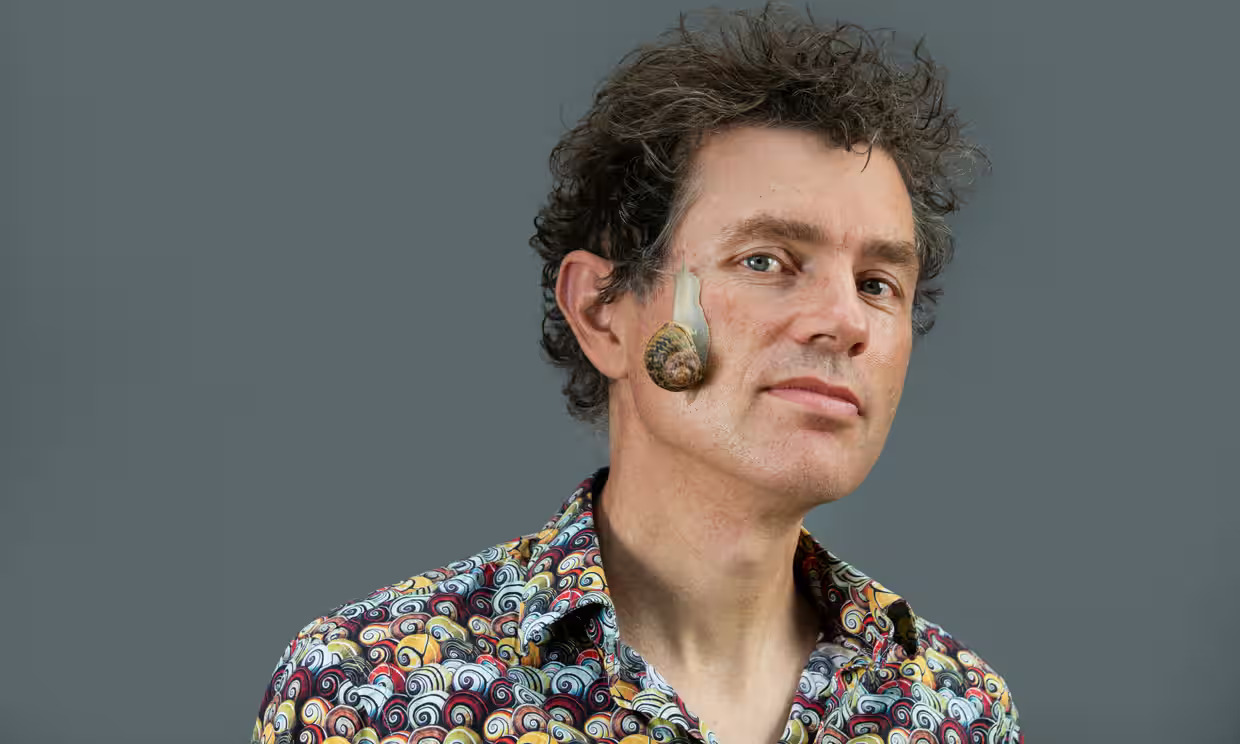 (Dr. Angus Davison, genetics professor, studies the heredity and inheritance in snails.)Often one of the most difficult parts of crafting our books is not deciding what to include, but deciding what to leave out. What did you choose to leave out of this book and why? Genetics is a tough subject for elementary school readers. For example, genes can be recessive, which means they may not be expressed in an individual for several generations. Instead of talking about these specifics, the story reads: “However, from his study of genetics, Angus knew that he might not see another left-coiled snail for several generations.”It avoids the specific topic of recessive genes but gets across the information needed, namely, that you must study several generations to understand heredity and inheritance. The audience’s age—elementary school—meant the topic of genetics was just briefly introduced.
 What tip can you share with teachers who want to use your book in the classroom? The scientific question facing Dr. Davison was whether the left-coiled snail was a product of heredity or an accident of nature. One odd thing about snails is that they are hermaphrodites, which means they have both male and female parts. However, the twist of the snail’s shell means that right-coiled snails need right-coiled snails to mate and left-coiled snails need left-coiled snails to mate. But left-coiled snails for this species are very rare. Dr. Davison turned to citizen science and asked people to examine snails in their gardens to see if they could find a left-coiled snail in a #snaillove campaign. They found two for the initial study, but eventually found about 45 slef-coiled nails.Without help from the public and without the viral social media campaign, Dr. Davison could not have done his experiments on heredity and inheritance in snails.In first and third grades, the NextGen Science Standards ask kids to understand that certain traits can be passed from parent to child. This story is a perfect introduction to the concepts of heredity and inheritance. Did the snail Jeremy inherit the left-coiled shell from his parent? The answer is an overwhelming, “No.” In addition, citizen science made Dr. Davison’s experiments successful. Kids can discuss how and when a scientist might appeal for help to their community. Ask kids to participate in the annual Christmas bird count from Audubon Society, one of the oldest known citizen science projects. Or consult Zooniverse.org for other projects.
 Congratulations on this book release! What comes next for you? Can you give us a peek at what you are currently researching?
 Coming this summer is CLIMATE: How Wladamir Köppen Studied Weather and Drew the First Climate Maps. As the subtitle implies this is the story of Wladamir Köppen, the scientist who drew the first climate maps. His maps are still used today, with slight modifications. He took vague ideas about climate and solidified them into a world-wide map that still shapes our future today. Fortunately, he wrote an autobiography, so starting the research was easy.
 About the author: Children’s book author and indie publisher DARCY PATTISON has written over seventy award-winning fiction and non-fiction books for children. Five books have received starred PW, Kirkus, or BCCB reviews. Awards include the Irma Black Honor award, five NSTA Outstanding Science Trade Books, five Eureka! Nonfiction Honor book (CA Reading Assn.), two Junior Library Guild selections, two CLA Notable Children’s Book in Language Arts, a Notable Social Studies Trade Book, a Best STEM Book, an Arkansiana Award, and the Susannah DeBlack Arkansas Children’s History Book award. She’s the 2007 recipient of the Arkansas Governor’s Arts Award for Individual Artist for her work in children’s literature. Her books have been translated into ten languages.Always active, before her tenth birthday, she (almost) climbed the Continental Divide, turning back at the last twenty yards because it was too steep and great climbing shoes hadn’t been invented yet. She once rode a bicycle down a volcano in Bali, Indonesia and has often hiked the Rockies. She recently hiked New Zealand’s backcountry for a taste of Kiwi life, and then strolled the beaches of Australia. On her bucket list is kayaking the Nā Pali Coast of Hawaii and eating curry in Mumbai.
January 13, 2025
Reseeding Altadena
 Today, in the midst of all the fire devastation in Los Angeles, one community is searching for seed donations. The Altadena Seed Library is searching for donations to help reseed their community. Many local Altadena farmers and growers lost generations of crops at community gardens and backyards. This also means that wildlife has lost habitat and food. Seeds are needed, as are donations.
 I hope you can help!
December 11, 2024
Congratulations, Lydia Lukidis on UP, UP HIGH!
 It all started in 2019 when I started writing the book DEEP, DEEP DOWN: TheSecret Underwater Poetry of the Mariana Trench. I learned a ton about myself asan author and for the first time, I merged my passions for poetry and STEM inone book. That’s when I realized I love writing lyrical texts! The book receiveda ton of love for which I’m eternally grateful. It won numerous awards includingthe SCBWI Crystal Kite Award winner for the Canada and North America Divisionand a Silver Birch Express Honor (Forest of Reading). I also got to travel toToronto for the Ontario Library Association, and to Washington, to give apresentation about ocean conservation at the Smithsonian Natural History Museumand to give workshops with the Open Book Foundation. These were huge milestonesin my career. That’s when my agent Miranda Paul asked me, why not write a bookabout journeying up, up high into the Earth’s atmosphere? I was immediatelysold. I had already learned that when Miranda suggests you write something, youneed to write it. Because she’s somehow magic and understands the industry aswell as her clients’ aptitudes with razor sharp precision.
 Writing STEAM books requires a substantial amount of research. Often it is the most fun part of our writing process. Did you meet any challenges in your research journey?
 I read a ton of books, websites, and journals in my research process. I alsowatched interviews and videos. All that information gave me great content tostart writing the book, but there were still some lingering questions thatremained. That’s when I reached out to several experts; I spoke to aweather/atmosphere expert from the NOAA, a NASA astronaut (that was very hard toachieve), and well as the man who space jumped. Without their valuable input,the book would not be fully accurate.
You must have a wealth of information from all of that research. Often one of the most difficult parts of crafting our books is not deciding what to include, but deciding what to leave out. What did you choose to leave out of this book and why?
I read a ton of books, websites, and journals in my research process. I alsowatched interviews and videos. All that information gave me great content tostart writing the book, but there were still some lingering questions thatremained. That’s when I reached out to several experts; I spoke to aweather/atmosphere expert from the NOAA, a NASA astronaut (that was very hard toachieve), and well as the man who space jumped. Without their valuable input,the book would not be fully accurate.
You must have a wealth of information from all of that research. Often one of the most difficult parts of crafting our books is not deciding what to include, but deciding what to leave out. What did you choose to leave out of this book and why?
 My issue is that I find everything fascinating! The earlier drafts of the bookwere text and content heavy, which doesn’t work for a picture book. Of course, Ihad to accept that I can’t fit it all in so I cut things out. A lot of the backmatter got cut as well as other elements in the atmosphere. I focused on tryingto keep the most engaging ones that children would find interesting.
Can you share a tip with teachers who want to use your book in the classroom?
My issue is that I find everything fascinating! The earlier drafts of the bookwere text and content heavy, which doesn’t work for a picture book. Of course, Ihad to accept that I can’t fit it all in so I cut things out. A lot of the backmatter got cut as well as other elements in the atmosphere. I focused on tryingto keep the most engaging ones that children would find interesting.
Can you share a tip with teachers who want to use your book in the classroom?
 I created a teacher guide filled with activities and games connected tocurriculum. Educators, librarians, and parents may access it here:
Readers guides are the best! I'm sure teachers will find your guide useful in the classroom. Thank you for sharing your book with us. Congratulations on the January 1 release. What comes next for you? Can you give us a peek at what you are currently researching?
I created a teacher guide filled with activities and games connected tocurriculum. Educators, librarians, and parents may access it here:
Readers guides are the best! I'm sure teachers will find your guide useful in the classroom. Thank you for sharing your book with us. Congratulations on the January 1 release. What comes next for you? Can you give us a peek at what you are currently researching?
 About the author: Lydia Lukidis is an award-winning author of 50+ trade and educational books forchildren. Her titles include DANCING THROUGH SPACE: Dr. Mae Jemison Soars to NewHeights (Albert Whitman, 2024) and DEEP, DEEP, DOWN: The Secret UnderwaterPoetry of the Mariana Trench (Capstone, 2023) which was a Crystal Kite winner,Forest of Reading Silver Birch Express Honor, and Cybils Award nominee. Ascience enthusiast from a young age, Lydia now incorporates her studies inscience and her everlasting curiosity into her books. Another passion of hers isfostering a love for children’s literacy through the writing workshops sheregularly offers in elementary schools across Quebec with the Culture in theSchools program. Lydia is represented by literary agent Miranda Paul from theErin Murphy Literary Agency. To find out more about Lydia check out these socialmedia links: Website & order UP, UP HIGH: Blog: Twitter: FB: Bluesky:
August 26, 2024
Let's Get The Lead Out
Lead popped up in my news feed this week with two stories impacting our health and the health of wildlife.
The first was Troy, NY's desire to declare an emergency due to lead water pipes. Like many old cities in America, Troy's water pipes need an overhaul to remove dangerous lead that impacts the health of all residents as well as visitors who eat in their restaurants.
I wrote about how lead impacts the quality of our drinking water in WHEN THE WORLD RUNS DRY. Flint, Michigan became the poster city lead poisoning. While their contamination was caused by reckless management, the water crisis there highlighted a problem many communities can face.
The other story focused on the needless death of a beloved, young, California condor, in one of America's western national parks. The 5-year-old male condor, named 1K was the 1,000th hatched since the successful California Condor Recovery Program began in 1982. The bird, like the majority of released endangered condors, became poisoned by lead ammo left behind in animal carcasses. I wrote about the recovery and lead poisoning of California condors in BACK FROM THE BRINK.
Lead is a dangerous substance that impacts our health and the health of the entire environment. Lead ammo can be easily replaced. Lead pipe removal requires adequate funding.
Explore the ways you can rid lead from your community. Support lead ammo bans and funding to replace old water pipes.


April 22, 2024
Earth Day 2024
As a naturalist, environmental educator, and journalist, I can't avoid celebrating Earth Day's purpose and mission. I appreciate the stories on national media that acknowledge the beauty of nature and the need to protect our planet. However, I also feel a bit overwhelmed by it all. I wonder if my fellow environmental journalists and activists share this experience.
I watched a video of a young Italian activist crying this morning. I get it. I feel like crying often, too. Immersing ourselves in the fate of our planet, watching species go extinct, experiencing the disinterest in people around us, and bearing witness to it all is overwhelming.
So how do we move forward? I counter my research and writing on issues that often frighten me with stories of hope and success. I turn to celebrating the small victories, which I believe are the seeds of change. I'll admit, on Earth Day I also turn off media, go outside and let nature do its thing. I listen to the bird song when I wake up and breathe in the world around me. I spend time watching spring unfold, a small victory in itself.
How will you celebrate Earth Day today?

February 17, 2024
Galapagos Books and News
Visiting the Galapagos Islands to research Back from the Brink was one of my favorite research trips. When I was a budding naturalist in college I became focused on herpetology - all things reptile and amphibian. As an adult I became a trained turtle rehabilitator, so visiting and learning about the tortoises on the islands was on my bucket list. And so, I've also kept up on the islands long after my visit. I'm happy to share that the Galapagos Conservancy announced improvements to Isabela's giant tortoise breeding center. Read about it here.


Here are additional books focused on the islands for adults and kids to enjoy: