
Mark Todd's Blog, page 12
June 29, 2013
Novelist Barbara Chepaitis talks nonfiction for fiction writers
We're delighted to host friend and colleague Barbara Chepaitis as our guest blogger this month. Barbara writes mostly SF, including her wonderful supernatural/SF FEAR series about empath Jaguar Addams.
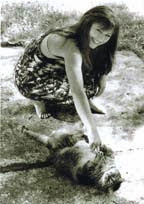 But one of her more recent projects was real and personal -- helping save and return a war-wounded eagle from the deserts of Afghanistan -- and the book chronicling that experience is Saving Eagle Mitch.
Here's a bit more on Barbara:She has ten published books, eight in fiction and two in nonfiction, including Saving Eagle Mitch (SUNY 2013), The Green Memory of Fear (Wildside Press 2011), Feathers of Hope (SUNY, 2010), A Lunatic Fear (Wildside Press 2004), Something Unpredictable (Simon & Schuster 2003), These Dreams(Simon & Schuster, 2002), Learning Fear (Ace 2000), Feeding Christine(Bantam 2000), Fear of God (Ave 1999), and Fear Principle (Ace 1998). She was a finalist in the 2003 Sundance screenwriters contest and has written four other screenplays. She has numerous shorter works collected in a variety of anthologies, and she also has experience in radio drama, voice-over work, and editing.
But let's hear what Barbara has to say about ...
REALITY TRIPPING: How to Write Nonfiction for Fiction Writers
 I’ll admit it. I have a vexed relationship with reality. In my experience, it refuses to obey an inherently logical narrative arc, while it tosses its participants into a constant wrangle between structure and imagination. Okay, I’m not just talking about dealing with reality as a person, which is tough enough. I’m talking about dealing with it as a writer. I started my career in fiction, and have had a lifelong love affair with that craft. Then, a few years ago, I was asked to write a nonfiction book, about a bird sanctuary in my area. Of course, I took the gig. I’m a writer. I take on challenges, particularly paying ones. I stretch and grow, and shop for shoes. Besides, I love the sanctuary, Berkshire Bird Paradise, and Pete Dubacher, who runs it, is remarkable, so the subject appealed. Hence, I signed on to write Feathers of Hope. One aspect of writing nonfiction is deceptively simple. You research your topic. I spent time at the bird sanctuary, followed Pete around, interviewed him and his family, and visitors and experts, gathering all the information I could. But you also need a narrative motion, and a voice to shape your story. Deciding on narrative arc involved a lot of staring off into space and asking myself why I ever thought this was a good idea, until I remembered that nonfiction is a journey of discovery. So what was I trying to discover? What central questions did I want to ask and perhaps answer? For me, it was clear: Why would someone spend their life caring for a thousand birds? And how in the name of all that’s strange would they support that dream? Corollary questions occurred: As humans, how do we relate to birds? What do they mean to us, imaginatively and emotionally and physically? Once I had my questions, the story arc was about finding answers. My fiction skills helped me in that, because questions are also at the heart of fiction. What will a given character logically do if, for instance, they’re stuck overnight in a grocery store and the apocalypse begins? Both fiction and nonfiction writers are all about What If, and What For, and How and Why, but nonfiction is both less and more personal. It’s less personal in that you gather material from outside yourself rather than from within your archetypal imaginative stew. It’s more personal because you have to discover your own voice, rather than the voice of the characters. In fiction, the feeling tone, the dialogue, the cadence of the prose, all grows from the characters and their world. In nonfiction, I have to write with my own voice, discover my own feeling tone. I think that’s what makes my narrative nonfiction students feel exposed. It’s what makes me feel exposed. I’m writing from my throat, not the throats of my characters.
 Believe me, as I worked my way into a comfort zone with that, I hit the delete key a lot. And a lot more. And then again. Fortunately, I have a background as a storyteller as well, and ultimately that voice was my primary writing friend. Nonfiction writers have to get comfy with their heard voices, which is why I make my students read out aloud, talk about their story, and howl. Don’t all writers howl? Writing my first nonfiction book wasn’t an experience I sought, but I’m glad I had it. In fact, it led to In fact, it led to one of the most startling and unexpected ventures I’ve ever had: saving an Eagle named Mitch who was shot in the war in Afghanistan. Yes. Really.
 When the book came out, Pete Dubacher got an email from a Navy SEAL and former Army Ranger stationed in Afghanistan, asking if he’d help them bring a war wounded eagle they’d rescued to the US. Because Pete’s very busy with his thousand birds, I took on the task. After six months of battling the kind of astonishing obstacles and amazing weirdness only reality can throw at you, I had another nonfiction book to write: Saving Eagle Mitch: One Good Deed in a Wicked World. That book came out this May, and has gotten a four star review from San Francisco City Book Reviews . Writing nonfiction hasn’t improved my relationship with reality much, and I still run back to my fiction with great joy and relief, but I highly recommend the nonfiction experience. It asks you to dig in, to discover, to give voice, in a way that will only feed you. Will I write more? You bet. And if you haven’t tried it, you should. As Dr. Seuss said, these things are fun, and fun is good.
+ + +
Barbara Chepaitis is faculty director for the popular genre fiction component of Western State Colorado University’s MFA in Creative Writing.
You can find her nonfiction works on Amazon or at SUNY Press, and her Jaguar Addams series of fiction at wildside books.
Some LINKS to find out more about Barbara and her writing:
San Francisco City Book Review
Amazon
Berkshire Bird Paradise
wildside books
Thanks, Barbara, for letting us feature your marvelous words and projects this month!


June 22, 2013
Strange, strange attractors
(A solo posting by Mark)
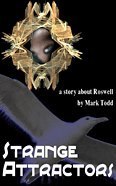 Strange Attractors began as a 10-hour debate over what really happened in the New Mexico desert in 1947 as Kym and I drove home from four days of events commemorating the 49th anniversary to the (in)famous UFO crash in Roswell. The town was doing a test run before launching the 50th anniversary kick-off to the annual celebration, and we'd scored press passes for everything at their inaugural festival.
We'd listened to panels and seminars, attended meetings with researchers, physicists, and abductees -- and yes, watched parades down Main Street featuring local children dressed up like little green men.
Later, we incorporated a lot of what happened during those four days into the pages of Book One of the Silverville Saga, Little Greed Men.
But I couldn't get out of my head that everything I'd seen and heard about Roswell seemed so ... so implausible. As an amateur astronomer, I'd spent hundreds of hours peering through a telescope, and I'd read dozens of books on astrophysics. I'd finally concluded that it seemed as probable -- perhaps even more plausible -- that the reported ET visitors had come from the future than from a neighboring star.
That was the kernel for Strange Attractors: A Story about Roswell. And to be honest, a more accurate subtitle would have been "A Story that incorporates Roswell as One Thread."
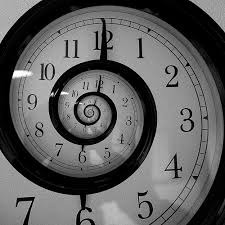 As I got into the story, I became more interested in the implications of time travel than the events at Roswell, particularly certain quantum mechanical experiments that suggest future events can influence past ones.
(Here's a great video at New Scientist that explores a sample thread of some of that research. At the end of Strange Attractors, I suggest further readings about other complex and intriguing experiments suggesting how the future may well influence the past.)
The story that emerged braided together events in three time periods -- all of which interconnect and influence one another. And I decided to embrace the implications of time paradoxes in what could and couldn't occur.
By the time I had the story developed, I'd also incorporated eugenics, nanotech eco-terrorism, fractal geometry, archetypal dream analysis, and even Japanese origami.
The scary thing is that they all seemed to work together to tell my little tale about "Roswell."
 For the record, I still believe in ET; I think the astronomical probabilities that we're not alone are too high to believe we're the only examples of sentient, intelligent life. But as to whether they've made it to our little neighborhood in the galaxy ... not so much.
Strange Attractors is the middle book of a planned trilogy and, given the complex issues of causality and time, the middle seemed the best place to start. (I think I made the right choice.) And when my head quits spinning, I'll have to decide whether the next book is the prequel or the sequel.
You can find the novel at Amazon, Barnes & Noble, assorted libraries and bookstores, and if you click on the "Strange Attractors" tab at the top of this blog, I've arranged for blogger friends to pick up the trade paperback at a 20 percent discount.
 Strange Attractors began as a 10-hour debate over what really happened in the New Mexico desert in 1947 as Kym and I drove home from four days of events commemorating the 49th anniversary to the (in)famous UFO crash in Roswell. The town was doing a test run before launching the 50th anniversary kick-off to the annual celebration, and we'd scored press passes for everything at their inaugural festival.
We'd listened to panels and seminars, attended meetings with researchers, physicists, and abductees -- and yes, watched parades down Main Street featuring local children dressed up like little green men.
Later, we incorporated a lot of what happened during those four days into the pages of Book One of the Silverville Saga, Little Greed Men.
But I couldn't get out of my head that everything I'd seen and heard about Roswell seemed so ... so implausible. As an amateur astronomer, I'd spent hundreds of hours peering through a telescope, and I'd read dozens of books on astrophysics. I'd finally concluded that it seemed as probable -- perhaps even more plausible -- that the reported ET visitors had come from the future than from a neighboring star.
That was the kernel for Strange Attractors: A Story about Roswell. And to be honest, a more accurate subtitle would have been "A Story that incorporates Roswell as One Thread."
 As I got into the story, I became more interested in the implications of time travel than the events at Roswell, particularly certain quantum mechanical experiments that suggest future events can influence past ones.
(Here's a great video at New Scientist that explores a sample thread of some of that research. At the end of Strange Attractors, I suggest further readings about other complex and intriguing experiments suggesting how the future may well influence the past.)
The story that emerged braided together events in three time periods -- all of which interconnect and influence one another. And I decided to embrace the implications of time paradoxes in what could and couldn't occur.
By the time I had the story developed, I'd also incorporated eugenics, nanotech eco-terrorism, fractal geometry, archetypal dream analysis, and even Japanese origami.
The scary thing is that they all seemed to work together to tell my little tale about "Roswell."
 For the record, I still believe in ET; I think the astronomical probabilities that we're not alone are too high to believe we're the only examples of sentient, intelligent life. But as to whether they've made it to our little neighborhood in the galaxy ... not so much.
Strange Attractors is the middle book of a planned trilogy and, given the complex issues of causality and time, the middle seemed the best place to start. (I think I made the right choice.) And when my head quits spinning, I'll have to decide whether the next book is the prequel or the sequel.
You can find the novel at Amazon, Barnes & Noble, assorted libraries and bookstores, and if you click on the "Strange Attractors" tab at the top of this blog, I've arranged for blogger friends to pick up the trade paperback at a 20 percent discount.
June 15, 2013
Why Tell All When You Can Just Hint?
 All month, we’ve posted Silverville Series “Hint Fiction” on our Write in the Thick FB page – mini-stories of 25 words or less that each suggest some subplot or story within the series.
And it’s fun but challenging to capture these threads in such a tight space. (At least you get to write the title outside the word count, so you can hint a bit more.)
Here’s a sample from our Silverville Saga series:
TIME ENOUGHBuford could make a bundle with the time portal – if he could only figure out how to stop it from killing any more patrons. (Book Three: The Magicke Outhouse)
It’s sort of like syllabic poetry, where you have to figure out how to say something meaningful in lines with a prescribed number of syllables (Haiku is a great example of syllabics with its form of three lines, where the first has seven syllables, the second has five, and the third line again has seven syllables.)
Hint Fiction and other similar limited word-count stories are the fictional equivalent of syllabics.
 Robert Smartwood invented the form and coined the term. Check out his marvelous collection gathered from a contest he sponsored a couple years back:
Hint Fiction: An Anthology of Stories in 25 words or fewer
.
Robert Smartwood invented the form and coined the term. Check out his marvelous collection gathered from a contest he sponsored a couple years back:
Hint Fiction: An Anthology of Stories in 25 words or fewer
.But Hint is only one of a number of micro-fiction forms.
Two of our other faves are Dribble and Drabble.
Dribble is a story implied in (gasp) six or fewer words. The most famous example, supposedly by Hemingway, is this one:
“For Sale: Baby shoes. Never worn.”
Drabble is a story that tells its tale in exactly 100 words.
The charm of these micro-stories is that the shorter the stories are, the more the writer must relinquish the back story and meaning to the imagination of the reader. In some ways, it’s a good exercise in authorly humility.
Using the same thematic kernel, here are three (non-Silvervillean) micro-stories, first a dribble, then a hint, and finally a drabble:
Dribble
THE FIELD TRIPThey found a head – another one.
Hint
THE FIELD TRIP
After the flood, her team worked the field by the cemetery. Then she noticed the half-covered head. She’d come back later, maybe keep this one.
Drabble
THE FIELD TRIPWhat a lovely day. Sara waved to the others a hundred yards away as she turned over sandy clumps with her rake.
The rescue team had found seven bodies so far. But according to town records, the flood had uncovered and washed dozens into the fields next to the cemetery.
Her rake uncovered a head, and she stopped. Recently buried and fairly well preserved, based on the exposed features and hair. Too bad the rake’s tine had punctured one eyeball. She smiled and reburied the head.
She’d return that night to reclaim the parts she’d need for her science experiment.

We just love the economy of these micro-story forms.
We've modified the original intent of Smartwood's Hint Fiction form just a bit for our own purposes, of course, by using various threads and stories within the world we've created for the Silverville Saga series.
Instead, we're previewing these threads for folks who've not yet read this or that book; we're also reminding those who have read the books about the various stories contained within the saga -- a chance to revisit those threads in 25 words or less.
Check out the tab at the top of our blog page for the accumulating hint stories for each book within the Silverville Saga, or drop by our Write in the Thick FB page on Mondays and Thursdays this summer to see the latest installments.
And, of course, we’d love to see some of you post a dribble, hint, or drabble here of your own for us to ooh or ahh over!
June 8, 2013
Silverville Saga Petting Zoo
.jpg) Silverville is full of critters.
Silverville is full of critters.The stories feature, with some prominence, an assortment of dogs, cats, and horses as well as buffalo, chickens, pigs and -- well all sorts of folks feathered, furried, or otherwise!
No wonder, since Kym-n-Mark have a long history of close associations with animals -- and even way back before "Kym-n-Mark," when it was just Kym and just Mark.
Kym grew up on a Minnesota horse farm, training weanlings and one-year-olds for the arena and, eventually, competing with the older horses in gymkhana, barrel-racing, and jumping. When she didn't have a horse in hand or under saddle, she usually wandered around with a kitty in her arms. (She's always had a soft spot in her head for cats.)
Mark's not much better. He also grew up with horses, but the soft spot in his head didn't develop until he started collecting dogs -- exponentially. First there was one, then two, then four, then eight, and eventually 30. No, not a puppy mill: Mark had a sled dog kennel.
When Kym-n-Mark got together, the hers-his-theirs menagerie was definitely destined to live in the country.
Those glory days are over, and they now only have a dozen assorted critters (well, maybe a few more now and then).
But with so many animals in their personal lives, KnM were bound to find room for a few animals in the Silverville Saga. And most live double lives -- one at home in Doyleville, Colorado, and the other in Silverville.
Everyone who's read Little Greed Men knows that the speckled cow dog named Portia has an important role. That's her stage name. The real dog is called "Porsche," after the car. (The kids were into cars at the time and wanted to spell it that way. At least they didn't suggest Lamborghini).
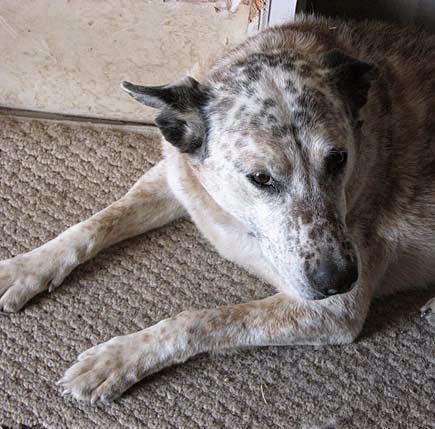 "Portia"
Same for Grady's trusty mount, Ol' Moss, who has featured roles in Little Greed Men and All Plucked Up. Yep, based on a very feisty horse named "Belle." And yes, just as described in the book, that ornery horse did strike at an electrified fence the first time she touched it.
The chickens in APU are courtesy of their daughter's coup, laying eggs a plenty, and Chantale's buffalo, Tatanka,in LGM, is courtesy of their experiences with a neighbor's exotic beef operation a little ways down the road. (But that's another story.)
In the third book in the series, The Magicke Outhouse, a different neighbor's "house pig" (named Breakfast) gets a leading role (decided to keep the name this time – just couldn’t top it!)
The list could go on, but you get the idea. So many animals, so few pages to write them all in.
Silverville *is* full of critters, just like Kym-n-Mark's own lives. And if the Silverville Saga has a cast of significant characters, the most significant personally are those that come from their own private petting zoo.
(For information on all the Silverville Saga books, visit our official Website.)
June 2, 2013
Should I Get a Writing Degree?
 (A solo post by Mark)
"Should I think about enrolling in a writing course or maybe a writing program?"
I get that question a lot, and the answer is always soul-searching for me. The advice is cheap, but the consequences to an aspiring or even established writer (more on that later) are enormous.
I get the question because my day job is half writing teacher and half program director for an MFA in Creative Writing. But it's not a simple question to answer.
Sometimes, the answer I give is "No." That used to be easy because almost all the MFAs out there focused on literary writing. Not really the ideal environment for someone who wants to publish popular genre fiction. Plus students -- often "grown ups" -- ha tveo pull up tent stakes and give up lifestyles, friends, and home.
For the January 2011 issue, Writer's Digest asked me to write an article about the whole lit-vs-genre MFA issue, so I got a chance to give advice to (gasp) an even bigger group of writers. But the question doesn't go away with the recent proliferation of so-called "low-residency" MFAs, the decision is harder to blow off (or, in my case, advise). These programs let someone take most of the classes online and only attend campus classes during scheduled vacation time.
The other factor is that a small number of MFAs finally focus on genre fiction.
In fact, that's what my program does. It sounded like a good idea to me because that's what I wish I could have done.
Of course, I got there without the vetting and training of such a degree, and hence the odd situation I find myself in when someone -- often a potential student -- asks me for my honest opinion about whether or not to spend the money and time. Is it worth it?
I have to confess my honest answer isn't "Yes." Instead, it's "Maybe." And then I turn the question into one of my own: "Is it worth it to you?"
Last year, we had a New York Times best-selling author become a student in the program. She's a successful children's author, but she wanted to retool to pursue adult fiction. In her opinion, the fast-track to that change was getting direct training from author-teachers who knew that publishing culture and those markets already.
She confirmed my faith that the answer can be "yes." But at the same time, I still don't think it's the right answer for everyone. Although neither Kym nor I come even close to being "best selling," we still came to writing fiction from a background as professional journalists -- we knew already what it was like to make a living as authors and the realities of depending on writing as a way to make that living.
In that sense, I think "maybe" is still the best answer. There are many paths to succeeding as an author -- and on many levels. One path might be an MFA. But the only time I flat out say "Yes" is when I see a combination of talent, commitment, and experience that tells me a student is coming into the program with eyes wide open.
+ + +
If interested, here are three schools out there that focus on genre fiction:
Seton Hill (Pennsylvania) Stonecoast (So. Maine) Western (Colorado) There are also good online genre writers support groups (Yahoo comes to mind), as well as Goodreads and LinkedIn groups, but all too numerous to list! And please feel free to add specific ones you think are useful in comments to this posting.
May 24, 2013
The Art of Thinking Like a Publishing Writer
 Russell Davis
Our guest blogger this month is author Russell Davis, past president of the Science Fiction & Fantasy Writers of America. He’s also a professor for one of the only low-residency (read: mostly online) MFA programs in the country to specialize in popular genre fiction, and the only one that uses successful, publishing authors rather than academics to teach the classes.
Here’s his official bio:A best-selling author and editor, Russell has written and sold numerous novels and short stories in virtually every genre of fiction, under at least a half-dozen pseudonyms. His writing has encompassed media tie-in work in the Transformers universe to action adventure in The Executioner series to original novels and short fiction in anthology titles like Under Cover of Darkness, Law of the Gun, and In the Shadow of Evil. In addition to his work as a writer, he has worked as an editor and book packager, and created original anthology titles ranging from westerns like Lost Trails to fantasy like Courts of the Fey. He is a regular speaker at conferences and schools, where he teaches on writing, editing and the fundamentals of the publishing industry. Russell now writes and edits full time, as well as teaches for Western's MFA in Creative Writing. His newest work, The End of All Seasons, a collection of short fiction and poetry, came out in April 2013, and he is presently working on several new projects.
Russell has been a good friend and mentor to us both for a dozen years, offering useful and sometimes scary insights into the publishing world. So we decided, hey, why should we horde all the anxiety? Let’s share it with our friends!
Without more ado…
ON PICKING & CHOOSINGRussell Davis
I’ve been teaching at the graduate level for three years now, and while I’d done quite a bit of teaching before, it had always been as a guest or at a conference. I’d never experienced teaching the same class multiple times, trying to cover the same material over multiple students. It’s eye-opening, and one of the things I’ve learned is that I’m not consistent – at least, not yet. Like writing, teaching is an ongoing, evolutionary process. I’m still figuring stuff out, refining what I say and how I say it, all in an attempt to give more clarity to my students.
One of the things I talk about a lot in our MFA program is “writing consciously,” but I only realized this past semester, as I was reviewing my plans for the summer session, that I haven’t been explaining myself as well as I could. Bear with me and you’ll see what this has to do with my own work as a writer, and more importantly, my most recent collection The End of All Seasons.
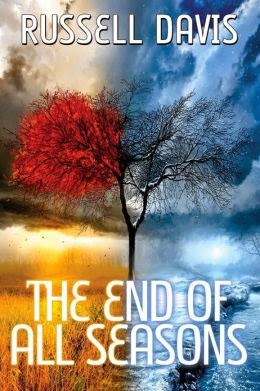 When I talk to my students about writing consciously, what I’m really getting at is that as writers we must pick and choose our words, sentences, paragraphs, punctuation, grammar, plots, characters, dialogue, and even our ideas with deliberate care. The temptation to jump on the adrenaline, roller-coaster ride of a new idea is extreme – to say the least – but far too often for the less-experienced writer, it leads to a horrible crash. The words get jumbled, the sentences contain flawed syntax, the plot is filled with holes, the characters are two-dimensional, and the dialogue flat and clichéd. But all of that is going to happen anyway. It will. That’s why it’s called a first draft.
What I really want them to do is practice the art of thinking like a publishing writer, especially when they revise. I want them to make deliberate choices then, because riding that roller-coaster is a hell of a lot of fun and I don’t want to take that away from them. But once the ride is over, far too many of them don’t want to go back and be deliberate with their work – and that’s when I see the crash. There’s no sense of revision, of picking and choosing, of making choices about what works and what doesn’t.
In my own work, I’ve made this mistake far too many times to count. It’s easy to get in a hurry. This perhaps explains why it took two years for me to finish The End of All Seasons, and that was mostly a collection of reprints. I wanted the choices I made to make sense to the reader, and that’s hard to do in a collection that includes a creative non-fiction essay, four poems, and fourteen short stories in genres as different as speculative fiction and western. I believe our language has power and beauty, even in its rawest form, but that even more can be accomplished by making choices.
So, all of this begs the question. Now that the collection is out, did I make the right choices – in terms of what I included and in terms of the individual pieces themselves? There’s the hard part, right? After the fact, when it’s too late to do anything about it, discovering not whether I think I made the right choices, but what readers think. And the only way I can answer that is if people pick it up and write a review or send me a note.
I guess I’ll have to wait, but I’m sure that I’ll find out.
And that’s the really hard part. Picking and choosing seems easy by comparison.
+++++++++++++++++++++++++++++++
Thanks so much, Russell, for agreeing to share your insights, and to enter into conversations with those stopping by at our blog this week.
Find out more about/from Russell:
Visit his Website and blog at http://www.morningstormbooks.com/Sit at his feet (well, by computer except for summers) at Western’s MFA in Creative Writing at http://www.western.edu/mfaBuy The End of All Seasons at Amazon, B&N.com, Wildside Press, or other fine bookstores nationwide.
May 17, 2013
Come chat with best-selling author Russell Davis
First, an announcement --
 Our guest blogger next week will be best-selling author and editor Russell Davis, former president of the Science Fiction & Fantasy Writers of America. He's written and sold novels and short stories in virtually every genre of fiction, and he's agreed to a chat with anyone who drops by. In April, Wildwood Press published Russell's latest collection of multi-genre short stories, An End to All Seasons -- even including a few poems. (Russell's undergrad degree was in poetry!)
Silverville Saga Update
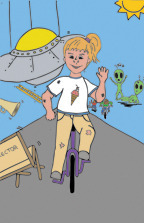 Art by Joely MatuszczakWe're also pleased to report that the Gunnison Country Magazine has just published an excerpt from the second book in the series, All Plucked Up. They used a scene where our twentysomething protagonist, Pleasance Pantiwycke, is trying to escape black marketeers by fleeing on a unicycle down Main Street (what could go wrong, right?). Of course, she ends up colliding with a film crew's set for the novel's in-story movie, Silverville vs. the Flying Saucers (again, what could possibly go wrong with that brilliant escape plan?)
Magazine staff artist Joely Matuszczak provided a marvelous cartoon illustration of the scene for the excerpt (pictured at right), and the publication goes to welcome centers and chambers across the state for distribution to tourists all summer long -- talk about promo shelf life and coverage!
Sign up for a free copy of Plucked
And don't forget to sign up for the end-of May Goodreads Giveaway (link to the right and top) for All Plucked Up.
 Our guest blogger next week will be best-selling author and editor Russell Davis, former president of the Science Fiction & Fantasy Writers of America. He's written and sold novels and short stories in virtually every genre of fiction, and he's agreed to a chat with anyone who drops by. In April, Wildwood Press published Russell's latest collection of multi-genre short stories, An End to All Seasons -- even including a few poems. (Russell's undergrad degree was in poetry!)
Silverville Saga Update
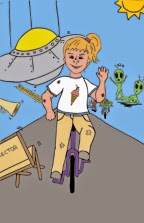 Art by Joely MatuszczakWe're also pleased to report that the Gunnison Country Magazine has just published an excerpt from the second book in the series, All Plucked Up. They used a scene where our twentysomething protagonist, Pleasance Pantiwycke, is trying to escape black marketeers by fleeing on a unicycle down Main Street (what could go wrong, right?). Of course, she ends up colliding with a film crew's set for the novel's in-story movie, Silverville vs. the Flying Saucers (again, what could possibly go wrong with that brilliant escape plan?)
Magazine staff artist Joely Matuszczak provided a marvelous cartoon illustration of the scene for the excerpt (pictured at right), and the publication goes to welcome centers and chambers across the state for distribution to tourists all summer long -- talk about promo shelf life and coverage!
Sign up for a free copy of Plucked
And don't forget to sign up for the end-of May Goodreads Giveaway (link to the right and top) for All Plucked Up.
May 11, 2013
Telling stories that matter
Any storyteller worth her or his salt knows that a good tale is only partly about what happens.
At an early reading for Little Greed Men, an audience member commented that this Silverville story held multiple surprises that made the book a fun read. Then that person asked us if we’d always intended to make the ending ironic.
It’s a great question, but we didn’t have time to explain that actually, no, that wasn’t what we envisioned at all when we first started writing the project.

It didn’t take us all that long to outline the main ingredients for Book One of the Silverville Saga, and the outer story knitted together around Billy Noble, a drifter who comes to town and tries to cash in on Silverville’s self-generated UFO notoriety.
We twisted the plot to keep readers guessing and, hopefully, chuckling at the series of events and antics that propel the story toward the conclusion. But despite the laughs and unexpected complications we devised, the story didn’t feel that memorable to us.
What was missing in the first draft was a reason for readers to care about what happens.
That missing part is what’s known in the trade as an inner story arc – not what happens *to* characters but rather how events change characters, making them more (and sometimes less) sympathetic. In other words, the inner story is about giving readers a reason to care about how story events affect and maybe even change characters. The brain follows the outer arc, but the heart responds to the inner one.
Our first draft lacked heart.
We decided Billy needed to be a bit broken when he comes to town. He’s clever but cynical, a charmer but also a con artist. And we gave him a backstory that makes readers want him to succeed – not in the scam so much as in life.
And we raise the stakes when we revised the relationship he develops with Skippy. In the first draft, Skippy had a minor bit part, but we soon realized she had the potential to help Billy discover that Silverville is more than just a grafter’s score; we decided to make her a bit broken herself, which let us develop them both in ways where they could help heal each other.
In the end, Silverville is about redemption – for the characters as well as for the town. But it’s also about learning that we don’t always get what we want. Sometimes we get what we need.
It was still important to us that the book be funny. But we wanted the book to delve into things that matter. Humor became a way to tell the outer arc, but we decided the inner arc should make readers care about the other issues the story raises.
Sure, the story holds its share of surprises, but the biggest one for us was when we realized we hadn’t understood what our own story was really about until we developed why we, too, cared about our characters.
To us, that was the greatest irony of all.
(Little Greed Men, Book One of the Silverville Saga, is available at Amazon and Barnes & Noble, as well as select independent bookstores. Check out our Website to point you to ways to pick up the book.)
May 4, 2013
Silverville Saga as Stand-Alone and Series
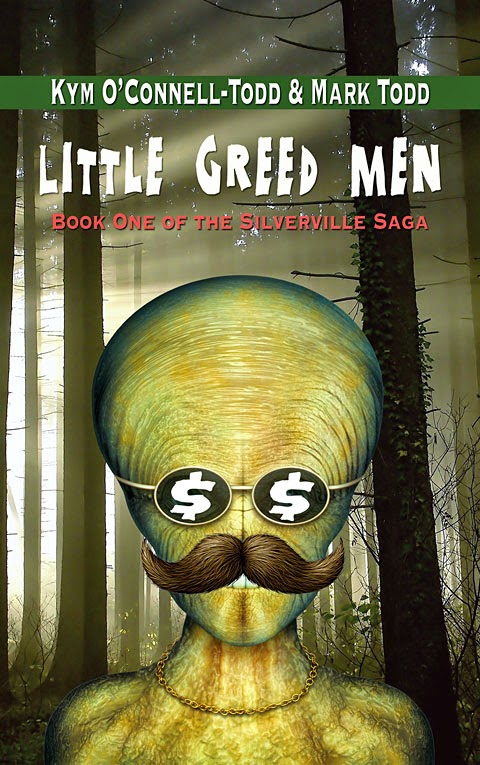 When we wrote the first Silverville novel, we intended the book as a stand-alone. We saw it as a one-off with a funny premise, and it never occurred to us to return.
But once the book found a home, the publisher wanted more along the same lines. In fact, he thought the ending begged for a sequel.
We didn’t agree.
We liked the ironic note we ended the (now first) book. And even though we’re currently developing the outline of the fourth in the series, we don’t think we’ll ever go back and clear up the little misunderstanding that closes the story of Little Greed Men. We like how readers find out more than any of the characters. We like how jokes are better when you don’t have to explain them.
Instead, we became intrigued with the place more than the characters (even as we declare and contend that characters are what make a good story – more on that in a moment). And that became the angle propelling us into subsequent visits to Silverville – a place where anything is possible.
Once we realized we’d constructed a setting that allows for unusually stretched-out suspensions of disbelief, we recognized that we needn’t fear writing the dreaded same-song-second-verse scenario so many serials suffer from.
At the same time, we both love good series. If a story hits the sweet spot, of course we want to go back. Everybody does. And it only takes a glance down the roster of latest releases promoted on Goodreads or Amazon – even the marquee outside the local cinema – to discover how popular and effective the series franchise has become at (re)capturing audience and building fan bases.
Our solution for giving our audiences a taste of the sweet spot without the redundancy was to bring new
 characters with new stories to a place where anything is possible, where improbable coincidences guarantee chaos. The skinny: We treat Silverville as a kind of character who interacts with whatever cast and whatever storyline we concoct.
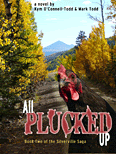
 For Little Greed Men, a drifter stumbles into a (supposed) UFO scam; for All Plucked Up, out-of-town black marketeers encounter a curse and so much more; and for The Magicke Outhouse, a pushy and (yes) plucky librarian intern becomes side-tracked into a time-portal business. What none of them ever understand is how Silverville nudges them toward a Twilight Zone with a mind of its own.
In some ways, Silverville is like a funhouse, and so long as we find new rides and attractions – along with new, quirky personalities willing to take the ride – we’ll keep plotting and returning.
We try to write each book as a stand-alone, so new fans don't have to reader them in order. But it's a series now nevertheless. We hope readers find sweet spots that make future visits to worth the return.
And as long as Silverville remains impossible, it’s our favorite character.
Check out all the books in the Silverville Saga.
April 28, 2013
Silverville Saga, Book I - now available!
.jpg) Start the Silverville Saga at the beginning with Book One,
Start the Silverville Saga at the beginning with Book One, Little Greed Men, just released in late April.
(and coming as an e-book in early May)
What happens when a town's local resident spots a UFO?
Silverville sees nothing but dollar signs.
First an amusement park and museum, then a celestial motif for the whole town. Con artists and embezzlers, tourists and kooks, all get caught up in the frenzy, some hoping to make a quick buck, others seeking a spiritual message from beyond the stars.
Ride along on this irreverent adventure that reveals Colorado mountain culture at its most outrageous, and where just about everybody shares in the madness of money, murder, and mayhem.
+ + + + + + + + + +
The book originally came out through Ghost Road Press and became a One Book/One Valley reading, a Colorado Blue Spruce Young Adult Fiction Award nominee, and a recommended reading at the Library of Congress by the Washington Center for the Book.
We're very excited the book has now moved to its new home at Raspberry Creek Books, which reissued the story as Little Greed Men: Book One of the Silverville Saga in a new (and once again more affordable) trade paperback..
We've also revised this new edition and, although it can be read as a standalone (all the Silverville books can), we've inserted foreshadowing for the three books in the series that follow.
Available at Amazon, Barnes and Noble, and a widening circle of independent bookstores.
+ + + + + + + + + +
Praise for Little Greed Men
I loved this book. It's trite to say I couldn't put it down, but that's the truth. Even more, I'm looking forward to the next book by the Todds. Great plot development, and they nailed the characters and the setting. It's hard to believe this is a first novel. This is a thoroughly enjoyable and entertaining book filled with humor, intrigue, and likeable, memorable characters. It starts at an attention-snagging pace and grows throughout. A delicious romp through a tight adventure.– W.C. Jameson, History Channel commentator and author of eighty books about the West, more recently the novel Beating the Devil and the biography Billy the Kid: Beyond the GraveAny reader in the West will recognize Silverville with a knowing grin – and often enough, a knowing shudder. The Todds have written a funny book about a townful of people we’d just as soon know from a literary distance but suspect we might live next door to – or maybe even closer…. This book about close encounters of every kind is further evidence that any search for intelligent life in the universe might not stop very long at our planet.– George Sibley, New York Times best-selling author of Part of a Winter, Dragons in Paradise and, most recently, the historical nonfiction Water WranglersHow far will a mountain town go to get more tourists? Clear to Arcturus, maybe, and along the way to the stars, there are con men, scam artists, hustlers, perhaps even a few honest citizens -- a howling funny ride all the way. – Ed Quillen, syndicated columnist for The Denver Post and former co-publisher of Colorado Centralmagazine.


