Shelley Neese's Blog, page 6
April 4, 2024
Bible Fiber: Ezekiel 10
Check out Bible Fiber on Apple Podcasts or wherever you listen to your podcasts or subscribe to our Youtube channel
Welcome to Bible Fiber, where we are encountering the textures and shades of the biblical tapestry through twelve Minor Prophets, two reformers, and one exile. I am Shelley Neese, president of The Jerusalem Connection, a Christian organization devoted to sharing the story of the people of Israel, both ancient and modern.
This week, we are studying Ezekiel 10, the third section of the prophet’s four-part visionary experience covered in Chapters 8-11. The prophet’s body remained in his home in Babylon while his mind and spirit witnessed increasingly horrific scenes in Jerusalem. Like a dream, the vision’s sequencing is difficult to follow, and the characters enter and exit without introductions or farewells.
Everything the prophet saw overwhelmed him, from the temple’s sickening abominations in Chapter 8 to the unrelenting slaughter of the guilty in Chapter 9. With Jerusalem desecrated, Yahweh had no other choice but to abandon his temple city. Chapter 10 and 11 focus on the departure of the divine presence, a climatic event in the first half of Ezekiel.
In his first-person account, Ezekiel reported, “Then I looked, and above the dome that was over the heads of the cherubim there appeared above them something like a sapphire, in form resembling a throne” (10:1). A year had passed since Ezekiel’s first encounter with the throne chariot by the River Chebar. Although the prophet remained in awe of the divine glory, he was not as shocked as he had been when God first appeared before him.
When trying to describe the first encounter, Ezekiel’s Hebrew was garbled (1:5-25). He relied heavily on analogy, explaining what he saw through comparisons. The enthroned presence of God was “like gleaming amber” (1:4) and the living creatures moved “like a flash of lightning” (1:14). In the second encounter, in Chapter 10, the prophet’s grammar was clear and the descriptions more direct as if Ezekiel was using the opportunity to collaborate and clarify his first description (1:5-25). The prophet appeared in his right mind, less undone, even if an encounter with the Lord almighty always has a transformative impact.
Man in Linen
In the opening event of the vision sequence, the man in white linen returned, the same angelic being that in the last chapter had spared the righteous by marking their foreheads. The reappearance of the man in linen connected the killing spree in Chapter 9 to the throne chariot’s departure in Chapter 10. Ezekiel made no effort to introduce the anonymous scribe, presuming his audience was already familiar with the man who did Yahweh’s bidding. The executioners were nowhere to be found. They were either still carrying out violent tasks elsewhere or the slaughter was finished. Instead of acting as an agent of God’s mercy, the man in linen took part in the delivery of God’s judgment. Jerusalem entered phase two of their punishment: destruction by fire.
Addressing the man in linen, God told him to reach into the chariot and fill his hands with burning coals to scatter over Jerusalem (10:2). Ezekiel had noticed in his first vision that the chariot contained burning coals, but at that point he did not know their purpose (1:13). Apparently, the chariot was more than divine transportation. Like all ancient chariots, it also had a military dimension; it was a vehicle of God’s punishment. Coal in the Bible was often associated with ritual purification processes. In Isaiah, a seraph touched the prophet’s lips with a hot coal from the Lord’s altar as a symbolic gesture of atoning for Isaiah’s sins (Isa. 6:6). But the coal scattered over Jerusalem was part of his punishment, like the brimstone that rained down on Sodom and Gomorrah (Gen. 19:24-25).
The historic reality is that the Babylonian invaders, under the orders of Nebuchadnezzar, set Jerusalem aflame. However, in Ezekiel’s vision, the man in linen distributed the punishment and the throne chariot provided the weaponry. As a prophet, Ezekiel peered behind the cosmic curtain and saw Jerusalem’s future destruction from a heavenly vantage point. Yahweh was in control. Yahweh was the instigator. The Babylonians were unwittingly at his service.
Yahweh on the Move
One noticeable difference between the first appearance of God’s throne chariot and the second is that the human form with a gleaming torso and fiery legs was no longer seated atop the sapphire throne (1:27; 10:1). As the chariot descended on the south side of the temple complex, the vast expanse above the throne was vacant. Yahweh’s movement and the direction of his voice are elusive. The text relays, “Then the glory of the Lord rose up from the cherub to the entryway of the temple; the house was filled with the cloud, and the court was full of the brightness of the glory of the Lord” (10:4). Yahweh’s billowing bright cloud of glory originated from inside the temple, not the chariot, and enveloped the temple court. This is the Shekinah, God’s dwelling presence that often made itself known in tangible ways.
During the executioners’ scene in Chapter 9, Ezekiel spotted God’s glory as it began to move away from the Holy of Holies to the threshold of the temple (9:3). God’s restlessness in that scene foreshadowed his coming departure from the whole of Jerusalem. As the movement ramped up in Chapter 10 so did the volume of the events. As the cloud swelled in the court, the creatures’ wings reverberated throughout the temple complex. In the first vision, the sound of the wings’ vibration imitated rushing waters. In the second vision, Ezekiel compared the noise to the thunderous voice of God (1:24; 10:5).
According to Ezekiel’s hard-to-follow narrative, Yahweh rose from the inner sanctum and moved to the threshold of the temple (10:4). From there, his presence filled the outer courtyard where he mounted the chariot and headed towards the east gate (10:18). The dreamlike state of the vision makes the various actions hard to visualize. By the passage’s end, Yahweh was back on his throne chariot. Ezekiel reported, “the cherubim spread their wings and rose from the ground, and as they went, the wheels went with them” (10:19). The cherubim took flight over the east gate and towards the Kidron Valley.
Cherubim
Ezekiel’s first and second visions clearly describe the same throne chariot with a quartet of protective creatures and a surreal wheel system. The most obvious difference between the two accounts is that in the commissioning vision, Ezekiel referred to the creatures as hayyot which translates “living creatures.” In the second vision, Ezekiel no longer called them hayyot. Instead, he called them cherubim.
Perhaps because the first vision occurred in Babylon, the sculptures of the ancient Near East influenced Ezekiel’s language. He described the composite creatures like those that flanked the entrances to nearby Babylonian temples and palaces. Certainly, they possessed many similar features to the iconic hybrid creatures of Assyrian architecture. The prophet had a new point of reference in Jerusalem, with the nearby temple. His religious vocabulary came more readily. It occurred to him that the creatures closely resembled the cherubim that stood in the temple’s Holy of Holies.
To his Jewish audience, cherubim was a more relatable term. Ever since God placed cherubim with flaming swords at the gates to the Garden of Eden, the figures were associated with the guardianship of God’s presence (Gen. 3:24). According to God’s blueprint for the tabernacle, golden cherubim also stood atop the mercy seat on the Ark of the Covenant (Ex. 25:18-22). The tabernacle artisans even embroidered cherubim on the veil that cordoned off the inner sanctum (Ex. 36:35). Cherubim were the image that separated the sacred from profane spaces on earth.
Over the centuries, the biblical descriptions of cherubim and their representation in popular art diverged. In the Renaissance period, classical artists depicted cherubim as whimsical, chubby-cheeked winged toddlers. Although the cute angels of Christian art have ingrained themselves in our collective conscious, they are nothing like the Bible’s presentation of majestic fierce beings.
Certainly, the static cherubim that adorned the temple paled in comparison to the dynamic cherubim that propelled God’s throne chariot. For starters, the living cherubim had four wings and four faces while the temple cherubim had two wings and one face. The living cherubim possessed wheels, but the temple cherubim had no need for mobility. Oddly, the living cherubim had human hands under their wings, a feature never associated with the statues in the temple. In Ezekiel’s vision, as the man in linen gathered coal to scatter over Jerusalem, the cherubim’s human hands almost acted like gadget arms, reaching into the chariot, and grabbing the coals. In Ezekiel’s second vision, he described the cherubim and their wheels as completely covered with eyes, a detail left out of the first vision (10:12). The eyes were either real eyeballs representing God’s omniscience, or eye-shaped gems bedazzling the cherubim.
The differences between the temple cherubim and the throne cherubim underscore the vast separation between the things of earth and the things of heaven. The tabernacle and temple were an attempt at capturing the glory of God’s heavenly throne room, but they were humble imitations of the supernatural realities. Even Solomon’s temple at the height of its beauty and splendor was a poor man’s replica of what awaits in heaven. The author of Hebrews described the temple as “a sanctuary that is a sketch and shadow of the heavenly one” (Heb. 8:5).
Chariot
Ezekiel 10 is divided into two sections, each marked off with the transition statement “then I looked” (10:1, 9). The second section provides a full description of the throne chariot’s appearance and function (10:9-17). Even though much of the account repeats Chapter 1, Ezekiel understood that as a prophet who experienced a personal theophany, it was his duty and privilege to share the revelation with others. The main points of clarification in Chapter 10 concerned the throne chariot’s purpose. The throne chariot was Yahweh’s transportation out of Jerusalem.
Spiritual Realm
Four times in Chapter 10, Ezekiel referred to “the glory of Yahweh” instead of naming Yahweh directly in the vision (10:4, 18-19). Why did Ezekiel choose to refer to God indirectly and what does “glory of Yahweh” mean?
In Ezekiel’s vision of the departing presence, the glory of the Lord was represented by a cloud. God’s glory coming in the form of a cloud would have been familiar to Ezekiel and his audience. In the early days of Israel’s wilderness wandering, the Israelites were comforted by the divine cloud as it settled atop the tabernacle and filled the tent with the divine glory (Ex. 40:34). Throughout those forty years, the cloud was a constant reassurance that Yahweh abided in their midst. When the cloud lifted, it was time for the people to decamp and move to the next site. As they moved sites, the cloud moved as well, demonstrating that Yahweh remained with his itinerant people. The most terrifying aspect to Ezekiel’s vision was that Yahweh’s cloud of glory was moving out of Jerusalem without the covenant people. Acting with his own free and divine agency, God did not invite the Jerusalemites to follow him. The glory of God made a solo exit.
The Jewish people understood their creator, the one true God, was not bound to a single building. The temple gave them a space to access the divine presence, to worship him in a centralized location, and to offer their sacrifices. God chose Jerusalem and set his name on the city (Deut. 12:11). He also declared his eternal affinity for Jerusalem. The Psalmist wrote, “For the Lord has chosen Zion, he has desired it for his dwelling, saying, ‘This is my resting place for ever and ever; here I will sit enthroned, for I have desired it” (Ps.132:13-14). But God chose to abide in the temple, and he was free to leave the temple when it became a house of rebellion and offense.
When Solomon dedicated the First Temple, he correctly observed “Even heaven and the highest heaven cannot contain you , much less this house that I have built!” (1 Kings 8:27). With this admission, the Shekinah glory filled Solomon’s temple so that all those present would witness Jerusalem’s divine favor. The consecration of Solomon’s temple was reversed in Ezekiel’s vision. The cloud of glory that had filled the temple at its dedication exited, as a sign of God’s disfavor. Ezekiel witnessed the temple’s decommissioning. With the withdrawal of the divine presence, God revoked the temple’s once holy status.
The chapter ends on a note of sadness and suspense. Where was the glory of God going and would he return? Ezekiel 11 completes the story of God’s gradual departure from Jerusalem. Join us next week for part two of the departure narrative.
Thank you for listening and please continue to take part in this Bible Reading Challenge.
Please pray for the release of the Israeli hostages held by Hamas for over six months. I can only imagine the brutal conditions that they have been forced to endure. I can only radically empathize with the hostage families back in Israel who are waiting by the phone for some sign of imminent release or rescue.
We pray together, “Blessed are You Adonai, Lord our God, King of the universe, who frees the captive.”
That’s all for this week. For all the Biblical references, please see the show transcript on our blog or by signing up for our emails at www.thejerusalemconnection.us/ I do not say all the references in the podcast but they are all in the transcript.
Send me a message. I will respond. Bible Fiber is available on YouTube or wherever you listen to your podcasts.
The post Bible Fiber: Ezekiel 10 appeared first on Shelley Neese.


March 21, 2024
Bible Fiber: Ezekiel 9
Check out Bible Fiber on Apple Podcasts or wherever you listen to podcasts! Or Subscribe to our channel on Youtube
Welcome to Bible Fiber, where we are encountering the textures and shades of the biblical tapestry through twelve Minor Prophets, two reformers, and one exile. I am Shelley Neese, president of The Jerusalem Connection, a Christian organization devoted to sharing the story of the people of Israel, both ancient and modern.
This week we are studying Ezekiel 9, a continuation of the vision that began in Chapter 8 with the prophet’s depressing sneak peek into Jerusalem’s abominations. Presumably, Ezekiel remained in his home with his visitors, but he sat there in an altered state of consciousness as the vision played out.
After showing Ezekiel the reprehensible practices in the temple, Yahweh pronounced judgment on Judah. At three different points, Yahweh reiterated that his pity had run out (8:18; 9:5, 10). His compassion tank was on empty.
Six executioners and one scribe
Ezekiel watched as God summoned six executioners forward to take their places in the temple courtyard. The executioners each wielded a weapon for slaughter (9:2). Initially, Ezekiel referred to them as “guards,” but their task was not to protect the temple city. Although he also referred to them as “men,” they behaved more like angelic assistants than regular mortals. They only purposed to do God’s bidding.
Besides the six executioners, God summoned one scribe, a man dressed in linen with a writing kit strapped to his side. The scribe also has angelic-like qualities. The word Ezekiel used for writing kit was an Egyptian loanword to describe a professional scribe’s carrying pouch. Scribal kits usually contained a writing palette, a pen, and two colors of ink.
Momentarily, Ezekiel’s attention shifted to the temple’s inner sanctum, away from the executioners and scribe. He noticed “the glory of the God of Israel had gone up from the cherub on which it rested to the entryway of the temple” (9:3). Despite Ezekiel’s priestly background, he lacked access to the Holy of Holies, as he was not the High Priest. However, in his visionary experience, he could peer into the Holy of Holies. After seeing the gleaming amber figure atop the throne chariot, the sight of his earthly footstool does not shake Ezekiel.
The Glory
In the dreamlike recount of the Jerusalem vision, Yahweh’s glory seems to exist at several points simultaneously. When the vision began, his glory addressed Ezekiel from the mobile throne chariot. In the tour of the temple abominations, his glory seems to be walking alongside Ezekiel as his guide. Then suddenly, Ezekiel spies his glory rustling in the Holy of Holies.
According to Jewish understanding, Yahweh’s presence always sat atop the Ark of the Covenant’s mercy seat. The cherub Ezekiel mentioned was one of two statues originally placed by King Solomon on either side of the Ark. Although their height is unknown, the Bible describes their fifteen-foot wingspan as stretching across the entire length of the room (1 Kings 6:23-28). Ezekiel’s mention of Yahweh’s stirring within the temple was almost parenthetical, but it foreshadowed the most climatic moment in the first half of Ezekiel: Yahweh’s full departure from Jerusalem (11:23)
X-mark
The six executioners congregated by the temple’s bronze altar. They awaited Yahweh’s signal to dispense his judgment. Mercifully, Yahweh first gave instructions to the scribe: “Go through the city, through Jerusalem, and put a mark on the foreheads of those who sigh and groan over all the abominations that are committed in it” (9:4). God tasked the scribe with separating the faithful from the unfaithful. When the executioners moved through the city, they had to spare all x-marked individuals. Interestingly, the criteria for selection were whether they were visibly and audibly grieving Jerusalem’s spiritual decline. In distinguishing between the repentant and unrepentant, Yahweh was looking for passion and zeal. Those who were quietly discomforted by idolatry, but remained silent, did not receive the saving mark. The mark was reserved only for those who loudly lamented Jerusalem’s rebellion and protested the rampant sin that had taken over their city.
The scribe moved through Jerusalem, marking the righteous with a tav on their forehead. Tav is the last letter in the Hebrew alphabet. Scholars do not quite know what the letter was meant to represent in Ezekiel’s vision. In the block script still used today, tav is rectangular. In the paleo-Hebrew cursive script, the letter was written as two intersecting lines, like an “X”.
Christian thinkers in the early church—like Origen and Tertullian—were keen to notice that an x-mark was cross-like in appearance. Ezekiel’s imagery suited Christian theology: all those with marked by the cross of Christ were saved from the penalty of death. Whether or not the x-mark was a cross, Ezekiel’s imagery of righteous folk bearing a permanent mark on their foreheads inspired Christian apocalyptic literature. In the book of Revelation, 144,000 believers will appear with Jesus on Mount Zion with a visible seal on their foreheads as a sign of their salvation (Rev. 14:1).
Ezekiel’s vision was not the only time in the Bible that God placed a physical marker on the righteous to spare them from his wrath. From the very beginning of Israel’s history, God had Abraham undergo circumcision as a symbol of his dedication and obedience (Gen. 17). Circumcision continued to be a visible marker separating Abraham’s descendants from the surrounding peoples. When Moses neglected to circumcise his son, the Lord almost killed him had it not been for the quick knife work of his wife Zippora (Ex. 4:24-26).
The Passover is the most obvious comparison to the saving powers of Ezekiel’s scribal ink. When the angel of death passed over Egypt, it killed the first born in every Egyptian home. However, the Israelites who covered their doorposts with the blood of a lamb were spared (Ex. 12).
Once the scribe’s task was complete, Yahweh ordered the six executioners to move through the city, cutting down everyone without the forehead marking, even women and children (9:6). They started at the temple courtyard, where the elders from the previous vision were still gathered to worship the sun. Quickly, the temple courtyard turned into a slaughterhouse. According to the laws of the Torah, corpses defiled both the temple and the priests (Num. 19:11-22). However, their idolatry had already voided any normal purity standard. God commands, “Defile the house and fill the courts with the slain” (9:7).
Interpreting the Babylonian attack
Only five years after Ezekiel’s vision, the Babylonians attacked and burned Jerusalem in 587 BCE. Like the six executioners, Nebuchadnezzar’s army slaughtered everyone in its path without discrimination or pity. The book of Lamentations describes slain bodies of the old and young cluttering the streets of Jerusalem (Lam. 2:21).
Ezekiel’s vision offered a prophetic interpretation of a near-future event. The Babylonians were God’s agents of destruction, summoned by him. It might appear to other nations that the Babylonian attack surprised Yahweh. Because of the prophets, expelled Israelites could look back on their plight and understand that God had tried to warn them for decades. Their exile did not challenge God’s sovereignty; it proved God’s sovereignty.
The carnage Ezekiel witnessed in his vision left him weak. He collapsed and cried out to God for mercy. Overwhelmed, he cried, “Ah Lord God! Will you destroy all who remain of Israel as you pour out your wrath upon Jerusalem?” (9:8). The prophet worried that after the slaughter, the Israelites would be extinct without even a surviving remnant. When God first called him to the prophetic office, he made his forehead hard like flint to withstand the callous response of his audience (3:9). However, nothing prepared him for the violent actions of God. He tried to intercede on behalf of the people, but it was too late.
Rather than answering Ezekiel directly, God justified his judgment. He reiterated he could no longer tolerate their infidelity, violence, and injustice. He said, “The guilt of the house of Israel and Judah is exceedingly great; the land is full of bloodshed and the city full of perversity” (9:9).
Although God’s reply may have left the prophet unsatisfied, Ezekiel’s actual answer came through the scribe. The prophet reported, “Then the man clothed in linen with the writing case at his side brought back word, saying, ‘I have done as you commanded me” (9:11). The scribe’s task was to ensure that the righteous and unrighteous experienced different fates. His laconic announcement that he completed his task meant the remnant was secure. The remnant was Ezekiel’s last hope.
Sheep and goats
Although the scribe marked the foreheads of the righteous, it seems doubtful that every righteous person in Judah avoided being killed by the Babylonians. That is not the way God works in the world today when horrible things happen. Righteous people die alongside everyone else in wars, accidents, and terrorist attacks. It’s a dangerous way of thinking to assume only those who miraculously survive life-threatening events are right with the Lord. What I believe, based on the Bible’s description of a remnant, is that many of the x-marked people survived the attack and became the progenitors of the revived nation of Israel. However, I am sure that the attack killed plenty of righteous people as well. If so, from the standpoint of eternity, their death was only a departure from the present life, but they were secure in their eternal life. When God promised the scribe would separate the faithful and unfaithful, it might not have only related to the earthly dimension of life.
The New Testament also mentions a day when God will separate the righteous from the unrighteous. In the gospel of Matthew, Jesus told a parable of a shepherd tasked with separating the sheep in his flock from the goats (Matt. 25:31-46). The sheep represented the righteous, who treated others with loving kindness and honored God. When they fed the hungry, clothed the naked, gave water to the thirsty, and welcomed strangers, they were serving and honoring Christ himself. The goats represented the unrighteous. They lacked compassion and only cared about themselves, ignoring the plight of the oppressed and marginalized. On the Day of judgment, God would put the sheep at his right hand and the goats on his left. The sheep would receive eternal life as a reward, while the goats would face eternal punishment.
Thank you for listening and please continue to take part in this Bible Reading Challenge. And please keep the nation of Israel in your prayers as the country continues to accomplish its war goal of releasing the remaining hostages and eradicating Hamas.
For all the Biblical references each week, please see the show transcript on our blog or by signing up for our emails at www.thejerusalemconnection.us/ I do not say all the references in the podcast but they are all in the transcript.
Send me a message. I will respond. Bible Fiber is available on YouTube or wherever you listen to your podcasts.
Shabbat Shalom
The post Bible Fiber: Ezekiel 9 appeared first on Shelley Neese.
March 14, 2024
Bible Fiber: Ezekiel 8
Check out Bible Fiber on Apple Podcasts or wherever you listen to podcasts
Welcome to Bible Fiber, where we are encountering the textures and shades of the biblical tapestry through twelve Minor Prophets, two reformers, and one exile. I am Shelley Neese, president of The Jerusalem Connection, a Christian organization devoted to sharing the story of the people of Israel, both ancient and modern.
This week we are studying Ezekiel 8, the prophet’s second visionary experience. Ezekiel had been living in exile for five years without any updates about the situation in Jerusalem. One day, toward the end of his 430-day stint of lying on his side, he envisioned a messenger of God, fiery like gleaming amber, picking him up by his hair and supernaturally transporting him to Jerusalem. Out of all the prophets, Ezekiel may be the best at delivering a well-crafted hook.
In describing his transport, Ezekiel said, “the spirit lifted me up between earth and heaven and brought me in visions of God to Jerusalem” (8:3). In my imagination, Ezekiel traveled the thousand miles from Babylon to Jerusalem in the same manner the characters traveled in Madeline L’Engle’s science-fiction book The Wrinkle in Time. In the book, Meg Murray, the main character, moved between places and eras by “tessering,” wrinkling the fabric of space-time. Ezekiel was reluctant to “tesser” which is why his divine guide had to grab hold of his hair. Again, this is all in my head where literature sometimes colors the Bible’s missing details and tessering is L’Engle’s made-up verb. According to the biblical text, Ezekiel’s body remained in Babylon, but his mind had a full sensory experience in Jerusalem.
Ezekiel noted that the vision occurred “in the sixth year, in the sixth month, on the fifth day of the month” (8:1). Ezekiel used the sixth year of King Jehoiachin’s reign as his reference point, even though Jehoiachin was exiled in Babylon alongside him and not actually ruling over anything. (There is a lot more to say about King Jehoiachin, but I am going to save that for the episode on Ezekiel 17.) Ezekiel’s date works out to 18 September 592 BCE. According to his precise chronology, the Jerusalem vision occurred fourteen months after he first saw an apparition of God’s throne chariot by the Chebar River and accepted his call to the prophetic office.
According to the text, a delegation of elders was with Ezekiel in his home when he had the visionary experience. They were likely lay leaders who came to Ezekiel seeking an oracle from the Lord. Despite the excesses of his sign-acts, the people recognized him as a prophet. Perhaps they inquired about Jerusalem and the fate of their compatriots, or they came because his elaborate sign-acts were a sight to behold.
When Ezekiel felt the hand of God fall upon him, he looked and saw the same humanoid figure with fiery legs and a gleaming torso he had seen atop the throne chariot (8:2; 1:27). Once again, the prophet was careful to describe his theophany through analogy and simile, so he did not accidentally show irreverence. He described the figure that “looked like a man” and stretched out “the form of a hand” (8:3). Whereas before the divine hand fed him a scroll, this time the hand grabbed a lock of hair and spirited him away to Jerusalem.
In real life, Ezekiel never returned to Jerusalem after his deportation; he died in exile. Although the purpose of the visionary trip to Jerusalem is not stated directly in the text, it seems God wanted Ezekiel to witness for himself the widespread apostasy that had taken hold of the temple. If Ezekiel was perturbed by his calling because he did not think Jerusalem deserved to be destroyed, God changed his mind (3:14). His divine tour guide took him through a series of four scenes that grew progressively disturbing.
In the first scene, Ezekiel found himself at the northern gate to the temple’s inner court. Blocking the gateway to enter the temple complex, he spotted “the image of jealousy” (8:3). Naming the idol was less important to Ezekiel’s escort than the jealous reaction it provoked in Yahweh. Although he did not specify what patron deity the carved statue represented, it was most likely a statue of the Canaanite goddess Asherah. The book of 2 Kings attests that during the evil King Manasseh’s reign, he placed an Asherah pole in the temple (2 Kings 21:3). King Josiah later burned Manasseh’s Asherah pole during his campaign to purge Judah of idolatry (2 Kings 23:6).
Beside the seated statue, Ezekiel saw the glory of the God of Israel atop his radiating throne chariot (8:4). The first two times Ezekiel encountered God’s glory, he collapsed on the ground. The third time, he stayed on his feet, absorbing the irony of the juxtaposition of the wooden statue next to the overpowering brilliance of Yahweh. God asked Ezekiel, “Mortal, do you see what they are doing, the great abominations that the house of Israel are committing here, to drive me far from my sanctuary?” (8:6). They have polluted God’s sanctuary by their idolatrous impulses. Yahweh and pagan deities can have nothing to do with each other. The temple was never meant to be shared by Yahweh and graven images.
As they continued their walk-and-talk through the temple complex, the divine guide led Ezekiel to a second scene. Standing by the entrance to the temple court, Ezekiel spotted a hole in the wall. The divine guide instructed him to dig a bigger hole through the wall where he found a secret entrance (8:8). As he peered into an unidentified room, perhaps a temple storage area, the guide instructed him to go further inside for a distinct vantage point. Carved on the walls all along the room’s perimeter, there were reliefs of “creeping things and loathsome animals” (8:10). In the cover of darkness, seventy leaders of the house of Israel gathered with censers and burned incense to the idols (8:11). Each idol had its own attentive devotee (8:12). Surprisingly, Ezekiel recognized one leader as a man named Jaazaniah, whose father Shaphan had been one of King Josiah’s political appointees (2 Kings 22:3)!
Ezekiel’s reference to exactly 70 elders may have been a callback to Moses and his election of 70 elders. In Exodus, soon after God saved the Israelites from slavery in Egypt, he invited 70 men to join Moses and Aaron at Mount Sinai in a ceremony to ratify their covenant (Ex. 24:1,9). The 70 elders were later called upon to help Moses govern the camp. Because they were faithful men, God empowered them with the same holy spirit as Moses to help shoulder the burden of leadership (Num. 11:16-30). At Sinai, the 70 elders affirmed the covenant. But in Ezekiel’s vision, there were 70 elders who betrayed the covenant, an upsetting reversal of Sinai.
The divine guide turned to Ezekiel said, “Mortal, have you seen what the elders of the house of Israel are doing in the dark, each in his room of images? For they say, ‘The Lord does not see us; the Lord has forsaken the land” (8:12). This is the epitome of dark irony. While they complained that Yahweh had abandoned them and no longer paid attention to Judah, he was present and observing their deeds. Meanwhile, they rationalized worshiping their lifeless statues which were inherently sightless. They claimed Yahweh was indifferent to their hardship, but really, that was their own rationalization for unacceptable behavior. He was not at all indifferent!
As they left the first foreboding scene, the guide escorted him to witness even “greater abominations” (8:13). At the entrance of the north gate, they came upon Judean women weeping for Tammuz (8:14). In this third brief scene, the guide offered no additional explanation. We do not have any biblical background information on Tammuz; this is the only time the pagan god is mentioned.
However, Tammuz is well-known by historians of the ancient Near East because he was a popular god in Mesopotamian mythology. An agricultural deity, Tammuz was associated with vegetation and the cycles of the seasons. In the cult of Tammuz, supplicants took part in a mourning ritual where they lamented Tammuz’s banishment to the underworld every summer, hoping to ensure his resurrection during the planting season.
The most heinous part of the women’s supplication to Tammuz was that Yahweh had associated his covenant responsibilities with the fertility of the land. Because the people of Israel and the land of Israel were critical pieces of the covenant, he promised that obedience to him warranted agricultural blessings (Lev. 26:3-5). God promised that if they followed his decrees and kept his commands, he would send rain and make the grounds generate plentiful crops. Instead, the women bypassed Yahweh and pleaded with a foreign god to bless them with harvests.
In the house of horrors that had become the temple, one apostasy surpassed the next. The tour started in the courtyard and progressed toward the Holy of Holies. At every stage, the abominations became worse. In the last scene, Ezekiel stood between the porch and altar, the closest access point to the inner sanctum. He observed twenty-five men turning their backs toward the temple and facing eastward, prostrating themselves before the sun god. Although the text does not identify the men as priests, they had to be if they worked in such proximity to the inner court of the temple. Ezekiel, who came from a priestly family, was appalled.
King Manasseh was the first to introduce sun worship into the Jerusalem temple, despite an explicit ban against the solar cult since the days of Moses (Deut. 4:19). He even installed horses and chariot monuments in dedication to the sun god, which Josiah had promptly removed (2 Kings 23:11-12). Every threat to the religion of Yahweh that Josiah destroyed made a triumphant return after his death. All his reforms were reversed. What greater betrayal could there be than the priests meant to facilitate Yahweh worship, turning their backs on his temple to worship the sun, an object of his creation.
The first of the Ten Commandments gives the fundamental principle underlying the entire covenant relationship between Yahweh and Israel: “You shall have no other gods before me” (Ex. 20:3). Certainly, after seeing the detestable spiritual state of Jerusalem, Ezekiel understood God’s decision to unleash his wrath. Yahweh had to abandon the temple. There was no other choice.
The people of Judah sensed that disaster was coming. Babylon had long been breathing down their neck. But instead of repenting and returning to Yahweh, they appealed to every false god of their neighbors. Desperate, they turned for help to any god other than the one true God. Asherah was a Canaanite god that had long captured their devotion. The animal idols in the dark room suggest some converted to the Egyptian pantheon with its worship of beetles, crocodiles, hawks, jackals, baboons, and snakes. In the Egyptian Book of the Dead, animals play a role in the journey to the afterlife. Perhaps the elders appealed to Egyptian gods because at least one political camp in Judah thought Egypt’s army was their only hope of defeating the Babylonians. If that is the case, the other camp may have worshipped Tammuz to placate the gods of their Babylonian oppressors.
Whatever the reason for their disloyalty, the temple that was dedicated to the sole worship of Yahweh had become a multi-idol breeding ground. Notice that religious pluralism is not a modern invention, but an age-old temptation. However, Ezekiel was clearly not a promoter of interfaith lessons. Syncretism was reprehensible to God in the Old Testament, and it remained to be so in the New Testament. The apostle Paul warned the church in Corinth, “You cannot drink the cup of the Lord and the cup of demons. You cannot partake of the table of the Lord and the table of demons” (1 Corinth. 10:21-22).
Since Ezekiel’s deportation five years earlier, every sector of the society had deviated from pure worship in their own way: the elders, the women, and the degenerate priests. Yahweh told Ezekiel that idolatry was not even the worst of the problems. They had also filled the land with violence (8:17). Their ethical and moral provocations piled on top of their spiritual apostasy. The accumulation of their crimes forced God’s hand. He could not abide in a temple once dedicated to him where he was no longer acknowledged.
In the dark and in secret, the people had professed that Yahweh no longer saw them and that he had already abandoned the land (8:12). Ironically, when they assumed he was not watching, God paid the utmost attention to their abominations. However, their profession turned out to be a self-fulfilling prophecy. Ezekiel 8 purposed to answer the question of why God was ready to give up on the covenant. The abominations in the temple proved God was not being oversensitive. It was really that bad.
Next week we are reading Ezekiel 9. The visionary experience that began with Ezekiel’s transport to Jerusalem continues for the next three chapters. Ezekiel 8-11 is one literary unit. While his divine guide whisked him away at the start of Chapter 8, the guide will deposit him in his home at the end of Chapter 11. When he regains consciousness, the same exiled elders are sitting there waiting for his response, as if no time had passed for them while Ezekiel was “tessering” across space.
Thank you for listening and please continue to take part in this Bible Reading Challenge. And please keep the nation of Israel in your prayers as the country continues to accomplish its war goal of releasing the remaining hostages and eradicating Hamas. I have been thinking a lot about how Ezekiel was also a hostage living in exile and what better prophet to read and study as we empathize with the Jews who are once again traumatized by captivity.
For all the Biblical references each week, please see the show transcript on our blog or by signing up for our emails at www.thejerusalemconnection.us/ I do not say all the references in the podcast but they are all in the transcript.
Send me a message. I will respond. Bible Fiber is available on YouTube or wherever you listen to your podcasts.
Shabbat Shalom
The post Bible Fiber: Ezekiel 8 appeared first on Shelley Neese.
March 25, 2021
Passover and the Layers of Remembrance
By Shelley Neese
On the evening of March 27th, Passover begins. Last year, I remember thinking how horrible it was that Israel’s first lockdown for coronavirus had to take place on the most festive night on the Jewish holy calendar. Normally, throughout the Seder meal of matzah, wine, bitter herbs and charoset, the story of the Exodus is told and reenacted through ritual and tradition. I wondered how Jewish families would manage to conduct those acts of collective memory in isolation, without the chance to gather and connect. It was such a strange concept to Jewish minds at the start of the pandemic that nonorthodox leaders in Israel and the Jewish world even briefly considered rescheduling Passover. How could anyone have known then in April 2020 that a whole year’s worth of Jewish feasts and festivals, family moments, and rituals and rites would be conducted mostly alone with one’s smallest nucleus of family. It always seems strange to think back to the start of the pandemic and our perception of what we were entering into as a world.
Just a month ago, I was on the phone with my 94-year-old grandfather, Doug Ford, planning a Passover Seder meal for his congregation in Alabama. He had been a pastor of the same church for sixty years and one of his faithful congregants had the idea to do a full-blown Passover Seder with everyone in the congregation. I agreed to help since my own family has been doing seders for many many years in our home with guests so we were equipped to teach our way through the prayers and meal. Before we had our own seders in the states, as young students in Israel we were attending seders with our friends and neighbors. I always remember with an orthodox Jewish friend got to the cup of redemption in the Seder meal, looked at me and said, “I bet you are thinking about Jesus in this part.”
Only a week after that phone conversation with my grandpa, he died from coronavirus. I know he was 94 but the loss still feels shocking. My grandfather was one of the healthiest most energetic people that I knew, that anyone knew. In his lifetime as a pastor, he had administered over 2,000 funerals himself and a record number of weddings and baptisms. If the Guinness Book of World Records accounted for the person who had stood at the most bedsides and prayed for the sick and dying, my grandfather would have won it without any competition. I could never imagine anything taking his life, much less the virus. Before he passed away, he called two of his children in the middle of the night and told them “Love not the world, neither the things that are in the world.”
Recently, I read that verse from I John, chapter 2 in its context. I was delighted to see that just a couple verses down from the verse that my grandfather chose to be his last was another verse assuring those he left behind of his fate. It says, “And the world passeth away, and the lust thereof: but he that doeth the will of God abideth forever.” I am certain that my grandfather abideth forever.
And I am keeping my promise to go to his congregation and have a Passover Seder meal with them. Passover Seders are about the act of remembrance. Every ceremonial washing, dipping, and eating in the meal is awash with symbolism for the moment that God stretched out his hand and delivered his people from slavery into the promised land.
For Christians who participate in the Passover meal, we are doing it in remembrance of the whole story, from Exodus to Jesus. The Last Supper was the disciples meeting to observe the Passover with wine, matzah, and herbs. When Jesus commands his followers to eat this bread and drink this cup in remembrance of Him, He is referring to moments of ritual in the Passover diner and holding up the Passover elements of wine and matzah. In my opinion, there is no richer and more authentic way to take communion than in the context of a Passover Seder.
This year, there will be one more layer to an already rich and multilayered ritual. I will be remembering my grandfather, my last promise to him, and his promise to me that whoever doeth the will of God abideth forever.
The post Passover and the Layers of Remembrance appeared first on Shelley Neese.
March 23, 2021
What Do the New Dead Sea Scroll Fragments Tell Us?
By Shelley Neese
By now you have probably heard that March 17th the Israel Antiquities Authority made a stunning announcement that they had discovered dozens of small Dead Sea Scroll fragments. These small pieces of parchment are the first inked scrolls to be found in sixty years. Two scribes are responsible for the scrolls, written in Greek except for the name of Yahweh which is written in Paleo-Hebrew.
The Dead Sea Scroll Unit responsible for reconstructing the fragments reported that the fragments are from a larger scroll found in the same cave in the 1950s. The reconstructed verses are from Zechariah 8:16 –17 and Nahum 1:5–6.
For the last five years, the Israel Antiquities Authority under the leadership of their director Israel Hasson, has been quietly conducting a rescue effort called Operation Scroll. Their goal has been to systematically excavate every cave in the Judean desert. Since the first Dead Sea Scrolls were found in 1947, archaeologists have been in a race with Bedouin looters to unearth additional caches of Dead Sea Scrolls before they get lost to the black market. Bedouin have had the upper hand for the last six decades.
In 2017, Operation Scroll located a new Dead Sea Scroll cave, not one of the previous caves that was already known by archaeologists. Disappointingly, no new scrolls were found, but they unearthed a piece of blank parchment, scroll jar fragments and scroll covers. They knew they were on the right track.
The cave where these new scroll fragments were found is called the Cave of Horrors. It has been a dangerous recovery effort as the cave can only be reached by rappelling down a cliff face. During the excavation process, the team endured suffocating dust.
The Cave of Horrors had been used by Jewish rebels hiding during the Bar-Kokhba revolt almost two thousand years ago. They left behind coins minted during the revolt, arrowheads, combs, and sandals. Apparently, though, the cave played a role in other parts of human history as well. The IAA reportedly found a 6,000-year-old child’s skeleton and a large basket said to be over 10,000 years old which would be the oldest basket ever found in the world and it was in remarkably good condition.
When I saw this announcement, I could not help but immediately wonder if the timing of these scroll fragments had something particular to reveal to the believing world at this moment in our history. I will let all of you be the judge of how these prophetic utterances may be exactly what God wanted to bring to the world’s attention at this time.
Zechariah 8:16-17 says, “These are the things you are to do: Speak the truth to each other and render true and sound judgment in your courts; do not plot evil against each other, and do not love to swear falsely. I hate all this, declares the Lord.” For now, I am writing this verse on the chalkboard in our kitchen as an alert to myself and my family.
Nahum 1:5-6 says, “The mountains quake before him and the hills melt away. The earth trembles at his presence, the world and all who live in it. Who can withstand his indignation? Who can endure his fierce anger? His wrath is poured out like fire; the rocks are shattered before him.”
For historical context, Nahum was a prophet whose personal biography we know almost nothing about. He introduced himself in the first chapter and first verse as being from the town of Elkosh, an unidentified town lost to history. Nahum’s name means comforter and his poetry is designed to show the hand of God in the fall of Assyria and how that same hand will go on to comfort Israel, one of Assyria’s many victims in its brutal expansion. Nahum spends every chapter of his short book listing out the evil practices of the Assyrians famous for their cruelty in battle and oppressive policies as administrators. Only a hundred years before, God had sent Jonah to the capital of Assyria, Nineveh, to call for their repentance from their evil ways. Repentance did not last long apparently. Nahum was correct in predicting the downfall of the vile empire. In 612 BCE, an alliance of Medes, Persians, and Babylonians attacked Nineveh and brought down the Assyrian army for good. Perhaps the finding of these Dead Sea Scroll fragments from Nahum will comfort modern Israel from her current distress.
Nahum’s first chapter includes this promise from Yahweh to his covenanted people: “Look, there on the mountains, the feet of one who brings good news, who proclaims peace. Celebrate your festivals, Judah, and fulfill your vows. No more will the wicked invade you; they will be completely destroyed.”
Nahum and Zechariah are referred to as minor prophets but the message that they brought to the Israelites of their day still has potent power to all of us listening for the voice of God today.
The post What Do the New Dead Sea Scroll Fragments Tell Us? appeared first on Shelley Neese.
May 16, 2020
COVID-19 and Biblical Archaeology
By Shelley Neese
The Coronavirus has been unkind. Many have experienced loss—whether it is an actual death of a loved one, a business going bankrupt, harsh quarantines, or a high school senior who will miss graduation. Here is one more hurting sector you can add to the list: biblical archaeology.
Archaeologists that work in Israel are still processing the casualties that the pandemic has wrought. Foremost among these are ransacked ancient sites that fell prey to looters taking advantage of minimal surveillance. Next in line is the disbanding of one of the foremost archaeological programs in the United States. Lastly, and arguably most heartbreaking, was the cancelation of almost every volunteer-based excavation scheduled to take place in the Summer of 2020.
Israel enforced social distancing early and severely. Much of the Israel Antiquities Authority (IAA) went into telework mode by March 15. That shutdown included the IAA’s Theft Prevention Unit, a group charged with protecting Israel’s 30,000 archaeological sites from looters and vandalism. Organized networks of Palestinian looters and traders were keen to take advantage of the lack of oversight. A Jewish watchdog organization called the “Guardians of the Eternal” reported last week that at least 100 archeological sites in Judea/Samaria have been ransacked in the last two months. The Hirbet Astunah archeological site in the Shiloh Valley, Tel Parsin in Northern Samaria, and the Mt. Kabir Nature Reserve are just three of the looted multi-period sites. What exactly was stolen from these sites may never be known, but the damage the vandals have done is permanent.
Looters are not the only ones taking advantage of reduced surveillance. According to the Jewish News Syndicate, the Palestinian Authority has also usurped control over Tel Aroma, an ancient Hasmonean fortress in northern Samaria. During an official ceremony, they declared the ruin a Palestinian Heritage Site. The Guardians of the Eternal reports that while illegally paving an access road to the ridge, the Palestinian Authority damaged portions of the ancient wall and reservoirs.
The Coronavirus’s global economic impact has also wounded the academic world. In early April, the nation’s largest archaeology program at a Protestant institution, Southwestern Baptist Theological Seminary, shuttered its archaeology program permanently. Five professors were let go and twenty-five graduate students found themselves without a program. Southwestern Baptist said the closure was due to campus-wide budget reductions “necessitated by the financial challenges associated with COVID-19.”
Chris McKinny, historical geographer, and archaeologist with the Tel Burna project in Israel, was saddened by the news. “Evangelical academic institutions,” McKinney says, “need to make a much greater commitment to support research and education in the area of biblical geography, customs, and, especially, archaeology.” McKinney asks, “If evangelical institutions with historic connections to biblical archaeology will not maintain their commitment to the discipline, then who will?”
As of now, even with the IAA getting back to work and travel restrictions beginning to lift, most of Israel’s summer archaeological digs have already been canceled. Before Passover, Prime Minister Netanyahu made the difficult decision that no flights would be allowed into Israel until the spread of the virus was under better control. Many field archaeologists, unable to make proper plans or give the green light for the thousands of summer volunteers, had to call it quits. Granted, archaeologists who work in Israel are accustomed to sudden stops due to the difficult political situation, but they expect war and rockets, not a microscopic enemy.
Shimon Gibson, a Jerusalem archaeologist at the University of North Carolina Charlotte, had to halt his Mt. Zion excavations for the first time in twelve years. Dr. Scott Stripling at The Bible Seminary canceled his fourth year of excavations at Shiloh. According to Stripling, “I waited as long as possible to cancel the summer season, but I have now set my sights on summer 2021.” Israeli archaeologist Aren Maeir at Bar Ilan University began consulting with virologists as soon as COVID-19 surfaced in Israel. He waited until after Passover but ultimately had to cancel his summer excavations at Gath, the possible hometown of Goliath. When asked about the long-term impact of a lost year of archaeological excavation, Maeir said, “things that waited for 3,000 years can wait another year.”
In addition to volunteers, tourists usually descend in droves on the archaeological parks throughout the country, like Masada, Qumran, and Sepphoris. As of last week, twenty national reopened but limited pre-registration was required, as were masks and temperature checks. Oren Gutfeld, owner of Israel Archaeological Services, spends most of his spring and summer providing logistical and administrative help to excavation projects happening all over Israel. It was a thriving business until the pandemic hit. Gutfeld says, “My company was supposed to give archaeological services to Tel Shimron, Akko, Abel Beit Maacah, Midras and others. I lost all my income and had to furlough my workers.”
There is at least one way that COVID-19 has benefited archaeology. At the start of the outbreak, one anonymous Israeli man returned an ancient ballista stone he had stolen fifteen years earlier from a display at the City of David. The stone was likely catapulted by the Roman army during the siege of Jerusalem in 70 CE. According to journalist Moshe Manies, the man was a brazen youth but as an adult had become an orthodox Jewish believer. The ballista stone weighed heavy on his conscience. For the moment, the returned relic will have to serve as a symbol of hope that the human heart is still the most valuable thing of all. COVID-19 may cause ruin, but it can also trigger enlightenment.
Weeping may tarry for the night, but joy comes with the morning. Psalm 30:1-5 ESV.
The post COVID-19 and Biblical Archaeology appeared first on Shelley Neese.
March 31, 2020
Communal worship, individual worship, and family worship
By Shelley Neese
When I lived in Arizona from 2011 to 2014, I had a Messianic pastor who led an evangelical congregation. He was raised as a religious Jew and came to know Jesus as the Messiah right before his Bar Mitzvah. He was kicked out of his home when he told his parents about his newfound faith. He opted for homelessness over rejecting Jesus and never looked back, eventually reconciling with his family as well.
My husband I were talking with him one morning after the service about how he conducted Sabbath in his family life as a Jewish follower of Jesus who did not attend a Messianic congregation but instead found a home in the Christian church. We were genuinely curious because when we had lived in Israel for three years, the Sabbath had been very easy to keep. We attended the only Christian/Messianic congregation in the town of Beer Sheva and they met on Saturdays because Sunday was a regular work/school day. We walked to church because there were no buses. We did not participate in commerce because there were no stores open. We basically were keeping Sabbath in the beginning not out of special conviction but out of normalization. It was only once we came back to the states and started our family that we had to work out what Sabbath would look like in our family living outside of the land. That is why we had questions for our pastor. We wanted to know what it looked like for him. What he said has always stuck with me.
He said what he loved about the Christian church was their ability to worship God communally. The Church had a long history of bringing many people together of many different tongues and tribes to bow together before the King. The Church elevated the role of communal learning as well. In addition, the Church impressed him for its consistency on the point of encouraging individual worship. There are zillions of different daily devotional tools out there and even if Christians struggle with the discipline of alone time in the Bible and in prayer, it is always the goal. What came next was what struck me. My pastor said that what he missed most about his Jewish upbringing was not communal or individual worship. That need was met in the Church. What he missed was family worship. That was where Christians struggled. That is what we had not yet built the tools for to pass down to each generation. In regards to our questions about how he kept Sabbath, he said that Sabbath was the way he had been taught to do family worship and the way he continued to maintain family worship in his Messianic home. The meal, the gathering around the table, the songs, the prayers, and the rest. That was the Holy of Holies for his personal family life.
I have been thinking about that conversation as we walk through these uncertain times. During the Corona pandemic, I am seeing that all of us in the Church have had to reinvent the wheels on our Sunday routines. We suddenly find ourselves with our families 24 hours a day and cut off from our broader communities. In the case of parents with younger kids, like myself and many others, we are also cut off from any kind of solitary time. I have seen many people comment that the empty streets of Dallas or Washington DC look like Sabbath in Jerusalem. We have been forced into a multi-day, multi-week, and possibly multi-month Sabbath. In my own family life, I am trying to use this time to hone our skills in family worship. It isn’t always perfect, and its often a little chaotic, but it is beautiful in all its messiness. And most importantly, I feel God in my home in these moments. I encourage all of you in your family life to use this time for good, for family worship. May we all grow closer to one another and to our Messiah. May we use this time to strengthen our weakness.
The post Communal worship, individual worship, and family worship appeared first on Shelley Neese.
November 26, 2019
Christian Media Summit 2019, Jerusalem
By Shelley Neese
The first week in November, I had the privilege of attending the Christian Media Summit in Jerusalem. Sponsored by Israel’s Government Press Office, this event has been going on annually for the last 3 years. The goal of the summit is to spread greater accuracy on reporting on Israel, which is not something that the Israeli GPO takes for granted. The organizers of the summit have achieved the highest standard and the schedule of events and speakers only gets more impressive every year.
This year there were 150 participants from 30 countries. The participants came from all areas of “media,” including radio, television, podcasts, and traditional news. In addition to the Christian media veterans—like Earl Cox and Chris Mitchell—they brought in 20 handpicked Christian college students from all over the world who are finishing their degrees in some form of journalism and communications.
The four-day summit was jam packed with panels, day trips, tours and special speakers. At the kickoff event, on a Sunday night, 200 members of media gathered at the new Friends of Zion museum where Prime Minister Netanyahu, Ambassador David Friedman, and Jerusalem Mayor Moshe Lion addressed the group and took questions. At last year’s summit, Netanyahu stated that Israel has no greater friends in the world than Christian Zionists. This year, under political duress, he reminded everyone in attendance that if he remains Prime Minister Jerusalem will never be divided.
The next day we heard from Reuven Azar, the Prime Minister’s foreign policy advisor, about the key role that Israel should play in a Middle East that seems to be changing on an hourly basis. We heard next from author Einat Wilf about the Palestinian claim to a “right of return” and how this has been morphed into a “war of return.” A dynamic panel talked to the group about ways that they have had success in confronting the BDS movement and exposing its ties to terrorism. A Palestinian human rights activist even spoke about the example of Soda Stream. BDS pressured Soda Stream to move its industrial complex out of the West Bank and in turn 500 Palestinians lost their jobs, many of whom have still not been able to find work. That night we got on a bus and went to the Shalva Center. Many of you have probably heard of the Shalva Band, a YouTube sensation. The Shalva Center is a world class center that provides transformative care and empowerment to children with disabilities. The story of the center’s humble start from a few kids to what it is today had me in tears. When the Shalva Band ended the evening with a special performance, we were overcome by their infectious joy. Our participants got up and spontaneously danced around the room and on stage.
Our Tuesday started at 5:30 am on a bus to the Golan Heights. After stopping at the Mount of Beatitudes for prayer, we went on to the Valley of Tears, one of the most important battle sites in the 1973 war. Lt. Col. Jonathan Conricus briefed the group about the situation on Israel’s northern front today and what Israel is doing to protect itself from the Hizballah threat and Iranian influence. We also visited the Trump Heights village in Golan Heights and participated in a special proclamation ceremony. After a pastor, rabbi, and Druze leader prayed for the protection and future of the Golan, we all signed a special note of recognition of Israeli sovereignty over the Golan and prayed communally for the area to flourish. We topped of the evening with a special dinner with IDF soldiers stationed in the Golan.
The last day of the summit we went to President Reuven Rivlin’s home. If you are paying attention to the post-election day fiasco in Israel, you know that President Rivlin’s role has gone from largely ceremonial to incredibly critical. He was gracious to carve out time to spend with our group in between meetings as he tries to keep Israel from having to go to its third election this year.
I came home with a full heart and a renewed strength to continue working here in the U.S. to advocate for Israel’s interests and the protection of the Jewish people. I feel armed with new understanding and information about how we can fight anti-Semitism and the BDS movement. While it was wonderful spend a few intensive days with other like minds in this battle, I know that normally Israel is not surrounded by friends in the press. We are the minority in this vocation, but we will press on in making a big noise.
Shabbat Shalom
The post Christian Media Summit 2019, Jerusalem appeared first on Shelley Neese.
November 25, 2019
Teaching the Holocaust
By Shelley Neese
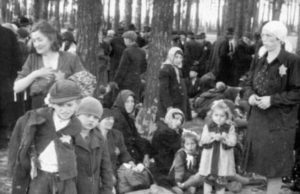
Last photo taken of Irene Weiss’s family after arriving to Auschwitz.
My 13-year-old son came home one day from school and told me that he was working on a research project for his English class. They were studying the Holocaust. The class had read the Diary of Anne Frank in the format of a play with each student taking a reading role. Each student was tasked with researching about a topic connected to the Holocaust. My son wanted to do his project on the faith and heroic efforts of Corrie ten Boom and her family.
Jerusalem Connection has stayed very active in the area of Holocaust education ever since our beloved Pat Mercer Hutchens of blessed memory launched her portrait series: Auschwitz Album Revisited.
I reached out to the teacher to let her know that we had a Holocaust survivor living right here in our county and asked if she would like her to come speak to her class. This excellent teacher did not hesitate for a second. She responded that it would be a great honor and then decided to extend it beyond her English class and to over a dozen other classes studying the Holocaust. With the help of a friend at Northern Virginia’s Jewish Community Relations Council, what resulted was an assembly of 400 students meeting together in a High School theater on November 22nd.
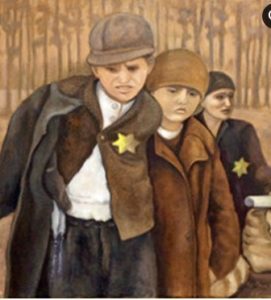
Irene Fogel’s family waiting in the grove. Oil Painting by Pat Mercer Hutchens from the series Auschwitz Album Revisited.
Our special Holocaust survivor was Irene Weiss. I first met Irene at a dinner to honor Holocaust Survivors at George Mason University in 2013. Pat Hutchens had given dozens of prints from her Auschwitz Album Revisited series and they were auctioned off with the proceeds going to Hillel’s Holocaust Education efforts on campuses. What made that night extremely special was that one of the survivors speaking at the dinner was Irene Weiss. Pat had painted the 13-year-old Irene’s family from a photo in the Auschwitz Album. She gave her presentation on stage with the painting right next to her. It was an amazing tribute.
Thankfully at 88 years old, Irene is still healthy and willing to share her story. She talked for over an hour with the 400 students, showing them pictures and answering their questions. Irene was 13 years old when she and her whole family were deported to Auschwitz on a train. Upon arrival, she was quickly separated from her mother, younger sister, and two brothers. Unbeknownst to her, they were killed in the crematorium within the hour. Irene should have gone to the “not-fit-for-work” line with her mother and brothers but because she had on a head scarf that made her appear older, she was considered “fit-to-work,” as was her sister Serena. They were stripped and deloused and stationed in the storage houses. For eight months, they sorted through the thousands of coats, shoes, eyeglasses and millions of other personal items that piled up each day. When Irene asked the other prisoners about the possible whereabouts of her family, they pointed to the smoke coming from the chimney.
The Auschwitz Album is the only surviving photographic evidence of the selection process at concentration camps. The Nazi official who took the pictures seemed to be doing routine documentation. Twenty-five years after the war ended, the album became public when it was donated to Yad Vashem. It was the first time that Irene saw pictures of her family from the day of their seperation.
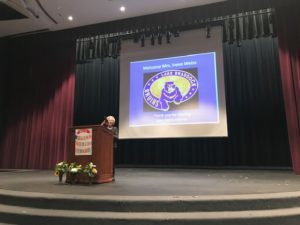
Irene Weiss at Lake Braddock Secondary School Assembly
In the album, Irene found a picture of her mother in a grove with her sons, waiting to go to what they thought was the shower. Irene knew her experiences in the concentration camp were real but seeing the album was a confirmation to the haze that had fallen over her memories, and it was another chance to see the faces of her long-lost loved ones.
Learning about the Holocaust from books is one thing. Hearing from a survivor is something that is remembered for a lifetime. I hope and pray that the 400 kids who had the honor and privilege to meet with Irene Weiss will be impacted for life. I hope that they made a commitment in their young hearts and minds last Friday, “Never Again!”
Please click here if you would like to donate 75.00 to our Holocaust Education efforts at The Jerusalem Connection and receive a print of Irene Weiss from the Auschwitz Album Revisited.
The post Teaching the Holocaust appeared first on Shelley Neese.
October 10, 2019
Sukkot and Deuteronomy 32
By Shelley Neese
We are in the middle of the High Holidays on the Jewish calendar. Rosh Hashanah and Yom Kippur have come and gone and Sukkot, also known as the Feast of Tabernacles, begins this Sunday night on October 13th. According to Jewish tradition, on the Sabbath between Rosh Hashanah and Sukkot, Deuteronomy 32 is read as a community. I encourage all of us as Christians to take the time to do our own reading of Deuteronomy 32 during this season.
Deuteronomy 32 is an incredible chapter of the Torah which represents the whole of the Israelite story up to this point and also contains a message of exhortation and caution for the Israelites’ next chapter. It is this portion of Deuteronomy that makes a break in style and format with the rest of the covenant book. The chapter is a seventy-line poem. Tradition holds that Moses sang it to the people on his last day of life.
The song begins as a reminder to the Israelites of this generation to pass on their spiritual inheritance—to tell their children and grandchildren about the miracles they witnessed in their deliverance from Egypt and their wanderings in the desert. Moses sings, “Remember the days of old; consider the generations long past. Ask your father and he will tell you, your elders, and they will explain to you.”
Moses reminds them of their chosenness and the responsibility that accompanies that gift. He says, “When the Most High gave the nations their inheritance, when he divided all mankind, he set up boundaries for the peoples according to the number of the sons of Israel. For the Lord’s portion is his people, Jacob his allotted inheritance.”
Moses goes on to assure them of their victory in battle as they ready their armies to conquer the land, a conquest that must take place without him. When they settle the land, they are commanded to follow God’s ways and stay faithful to Him in not going after other gods.
What Moses sings next perfectly fits the theme of Sukkot. Moses warns them that after the wanderings and after the battles, they will settle in the land and they will have the comforts that land possession affords: milk, meat, wine, cheese, oil, and wheat. The poem is a cautionary tale against the dulling effects of a full stomach on the desire for a relationship with their protector God.
Sukkot, also known as Feast of Tabernacles, is a sacred assembly built around the idea that we annually go through the process of stripping ourselves of material comforts so we may rely only on God. We all understand the danger of creature comforts dulling our thirst and hunger for our creator and our savior. Living in relative abundance of food, work, and shelter, puts all of us under threat of forgetting God. Except that on Sukkot, the people are commanded in every generation to take seven days and dwell in sukkot, the same booth like structures the Israelites called home in their forty years of wandering.
Leviticus 23 states that on the Feast of Tabernacles, the people are commanded to “live in temporary shelters for seven days: All native-born Israelites are to live in such shelters so your descendants will know that I had the Israelites live in temporary shelters when I brought them out of Egypt. I am the Lord your God.’”
When Jews celebrate Sukkot, they build sukkot in lots of different ways. The sukkah walls can be made out of canvas, tarp, or any material that will not blow away. For the roof, branches and sticks are laid across the top. Families often like to decorate their sukkah. During the seven days of Sukkot, Jews eat all their meals and spend most of their time inside the sukkahs. Some families even sleep in them.
Sukkot is one of the most important Jewish holidays during the year. Sukkot is a holiday built on the theme of humility but it is meant to be a celebration, not a fast or a time of mourning. When I lived in Israel, I used to love taking night walks in my neighborhood and seeing all of the sukkot built on the tops of buildings, squeezed onto apartment terraces, and taking over every inch of common green space.
I imagine it was similar to when Jesus went to Jerusalem during Sukkot to visit the Temple and taught in the Temple courts. The Bible says, in the book of Zechariah, that when the Messiah returns the whole world will go to Jerusalem to celebrate Sukkot. As many of you know, more and more Christians from all over the world are going to the Feast of Tabernacle celebrations in Jerusalem. Israeli Tourism officials estimate 50,000 Christians flooding the capital for this year’s feast. Last year, the International Christian Embassy of Jerusalem had 6,000 representatives from over 100 countries in their parade of the nations.
During this holiday, Jews remember how they once had no land or permanent possessions. They had to depend on God for their food, water, and shelter. That is why the book of Ecclesiastes is the reading of choice for this holiday.
“Indeed, all things will pass away, but God remains the same yesterday, today, and forever!”
Shelley Neese is the author of The Copper Scroll Project and President of The Jerusalem Connection.
The post Sukkot and Deuteronomy 32 appeared first on Shelley Neese.