
Harold Davis's Blog, page 157
May 28, 2015
Rainbow Bridge, Tokyo
In the eighteenth century, Tokyo—then known as Edo—was the world’s largest city, with a population of over one million. Today, Tokyo is still one of the world’s great metropoli, sprawling over an almost unimaginable population and area with numerous “cities within the city,” districts that are important in-and-of themselves.
The Rainbow Bridge crosses northern Tokyo Bay between two of these districts, Shibaura and the Odaiba waterfront development in the Minato district.

Rainbow Bridge, Tokyo © Harold Davis
Walking across this graceful suspension bridge is an uplifting experience in several sense of the word. The graceful curves of the bridge take you high above the bustle of the city, at the same time making the lines of modern Tokyo apparent.
As I crossed the Rainbow Bridge with my camera in the dusk of a foggy November day, I tried to align the curves of the bridge with the lines of an apartment complex in Odaiba in image that uses selective focus to contrast the curves in the Rainbow Bridge with the linear spaces of the buildings beyond.
300mm, 1/200 of a second at f/5.6 and ISO 400, hand held; processed in Adobe Camera RAW and Photoshop, and converted to black and white using Perfect B&W.


May 26, 2015
Sweet Pea after O’Keeffe
After seeing some of my photos mistaken for O’Keeffe’s luscious flower paintings, I took another look at the wondrous botanical art of Georgia O’Keeffe. The sensuous, indeed sexual, nature of the O’Keeffe portrayal of flowers is a pretty obvious characteristic of her paintings.

Flowering Sweet Pea © Harold Davis
What wasn’t clear to me until I took this further look was the extent to which O’Keeffe plays with magnification and scale. Essentially O’Keeffe is often painting extreme macro compositions, although they do not always seem that way to the viewer because of how they have been magnified and sometimes distorted. In its own way, this is a very photographic approach to painting, as I like to think I approach photography in a painterly way.
Click here to see some of O’Keeffe’s sweet pea paintings (opens Google images in a separate tab/window).

May 24, 2015
Dogwood & Friends
A Matilija Poppy pokes out in the middle of a covert of flowering dogwood, cosmos, old-fashioned roses, echinacea, and climbing mallows. Enjoy!

Flowering Dogwood & Friends © Harold Davis
Photographed straight down on my light box for transparency, and captured using my Zeiss 100mm macro lens, five exposures each at f/22 and ISO 64, exposure times from 1/5 of a second to 3 seconds; tripod mounted; exposures processed and combined in Nik HDR Efex Pro, Adobe Camera Raw, and Photoshop, with finishing touches added using Photoshop, Nik Color Efex Pro, Topaz Adjust, Topaz Simplify, Topaz Impression, and Nik Viveza.

May 21, 2015
Floral Fantasies
These floral fantasies are created and photographed as collages on the light box, then processing in Adobe Camera Raw, Photoshop, Nik, Topaz, and using LAB color adjustments. What fun!

Bright As a Summer’s Day © Harold Davis
Photographed with my Zeiss Otus 85mm at f/16 and ISO 64 in two panels, each panel with eight exposures ranging from 1/15 of a second to 15 seconds. First I combine the captures in each panel using the techniques explained in my Photographing Flowers for Transparency FAQ. Then I use Photoshop to combine the left and right sides of this floral panorama, for an extremely high resolution file.

Shadow of the Solarized Moon © Harold Davis
The workflow for processing these images is laborious but a great deal of fun. Learn more via my books, my online webinar recordings, or in a Harold Davis workshop (there are only a few spaces left in my Flower workshop in Maine this August).

Flowers Will Reach the Black Empire © Harold Davis

May 19, 2015
Historic D Ranch, Point Reyes
Point Reyes National Seashore is probably unique among the American National Parks in that this public land is shared with working cattle and dairy ranches. These ranches date from the early 1800s and are very much a part of the history of Point Reyes. Many have been in the same family for generations.
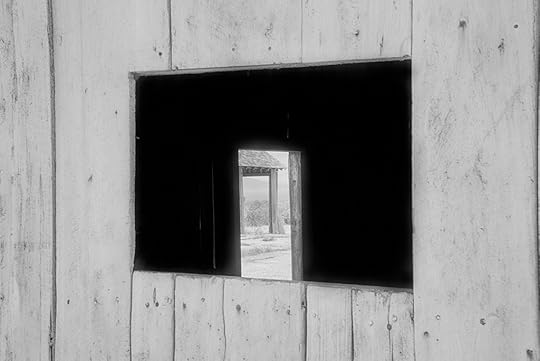
D Ranch, Point Reyes © Harold Davis
Parking my car beside the road, I scrambled down a steep bank, crossed through a tunnel under the road, and found myself in the abandoned out-buildings of D Ranch. The scene shown in the image—a door within a door within a window—with stark contrasts between light exterior wood and dark interior was too good to pass up, so I stopped to make this monochromatic image with my camera on my tripod.
Related story: Monterey Cypress Row on Point Reyes.

May 18, 2015
Mona Lisa wants to photograph Italy with Harold Davis
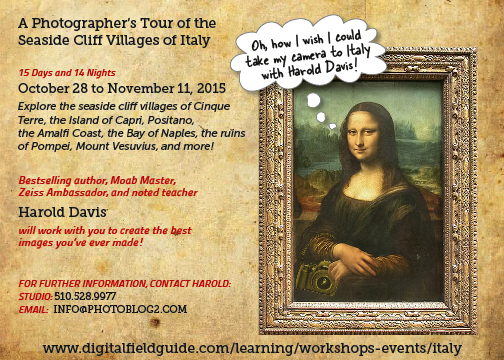
Prospectus and itinerary: www.digitalfieldguide.com/learning/workshops-events/italy
Registration details: www.digitalfieldguide.com/italy-registering
Click here to download graphic as e-Card PDF

Monterey Cypress Row on Point Reyes
On my way to teach a weekend Seascapes and Wildflowers workshop at the western tip of Point Reyes, California I stopped to photograph the well-known row of Monterey Cypress trees at the Marconi operations center. This tree tunnel is one of the largest in the world made up of these trees, and marks a historically significant wireless location. Certainly, there is something very dramatic about coming upon these trees standing by themselves in the windswept landscape of Point Reyes.

Memory Lane © Harold Davis
By the way, the workshop was great fun with a truly compatible group of photographers. Many photos were made, participants came from as far away as Florida and New Jersey, and the sense of community that marks the truly successful workshop was indeed present. The workshop base was the historic Coastguard Boathouse, where we were surrounded night and day by elephant seals and sea lions. Thank you Point Reyes Field Institute for hosting this—and many other—memorable workshops over the years!
Here’s an iPhone capture from the classroom window at the Boathouse of the ramp used to guide out rescue boats when the place was operational, with the window cloudy with salt spray.
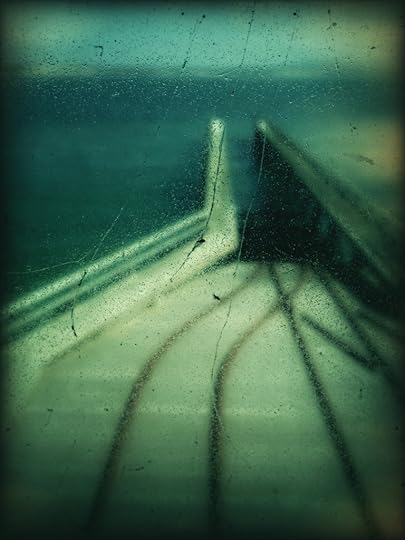
Coastguard Boathouse Window © Harold Davis

May 14, 2015
An angel watching out for me
The barista at Farley’s in Emeryville, California makes the nicest designs in the Latte foam!

Coffee © Harold Davis

May 13, 2015
Flickr and a perfect trifecta of tagging errors
Long-time readers of my blog will know that I am no fan of the perspicacity and wisdom of the powers-that-be at Flickr and their Yahoo masters. This is despite the fact that I have been a Flickr member since 2005, with at last glance a 5,647,849 view count on Flickr. A case in point I wrote about fairly recently is Flickr’s foolishly implemented attempt to venture into photo licensing (see Flickr and me, and stock photography: Adventures in Licensing in the Internet Era and The worst mistake you can make with customers).

Passion for Petals Painterly © Harold Davis
The latest Flickr foray into egregious idiocy comes with a Flickr site redesign. In all fairness, the redesign is actually pretty attractive and functional. The problem is with a feature that Flickr implemented, namely auto-tagging of one’s photos. A software robot analyzes images, and adds tags. The point of course is to make searching easier, because search engines mostly use words, not visuals. The problem is that the Flickr’s robot isn’t all that good at recognizing subject matter.
For example, Passion for Petals Painterly, the image shown above, created using photography of flowers, Photoshop, and Topaz Impressions is tagged on Flickr (opens in new tab, scroll down to see the tags) “pastel”, “drawing”, and “food”—a perfect trifecta of tagging error since none of the tags are correct.
The problems with the tagging feature could be chalked up to it being an early software version. Obviously, automated image recognition software is a hard challenge. But my frustration stems from the fact that there is no way to turn this feature off globally. I take a great deal of care with my work, and I really don’t like it being tagged incorrectly. To remove the incorrect tags from my images on Flickr, and there are many of them, would mean going through my photos one-by-one and clicking the little X above each errant tag. No thank you!

May 12, 2015
Mallow
Like Clematis this is a single blossom, photographed on a light box, inverted to black in LAB, and then converted to monochrome using a virtual Infrared filter. The steps are shown here in inverted order (last is first, and first is last).
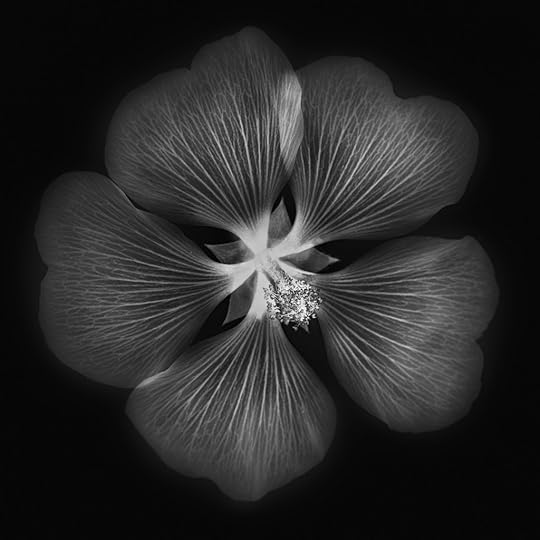
Mallow in IR © Harold Davis
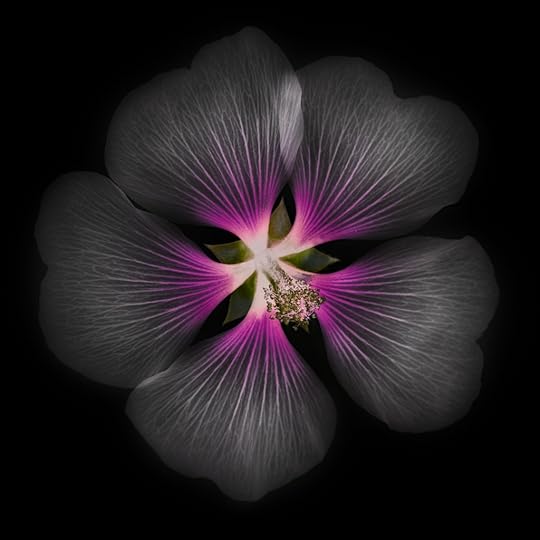
Mallow on Black © Harold Davis
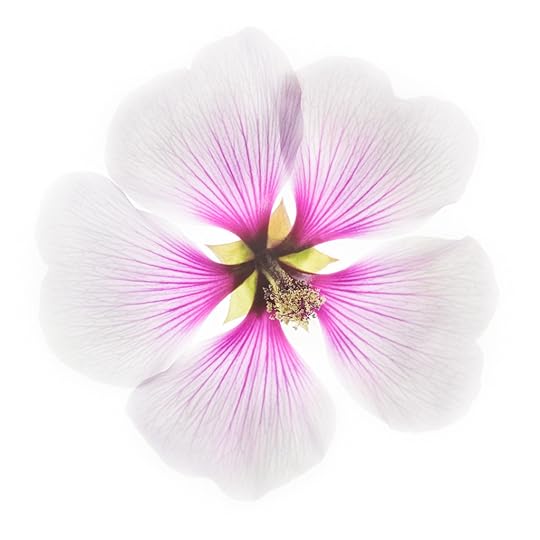
Mallow on White © Harold Davis
Post-production is so much part of my photographic art that I felt desolated when my production machine gave up the ghost last week. Admittedly, I’ve lived with it for many years, and made it mine. But it has taken me quite some time to get my new computer configured the way I like it—probably worth it, as it is up to handling the enormous files and sizes that I find myself often editing deploying.


