Helen Mathey-Horn's Blog, page 6
November 12, 2021
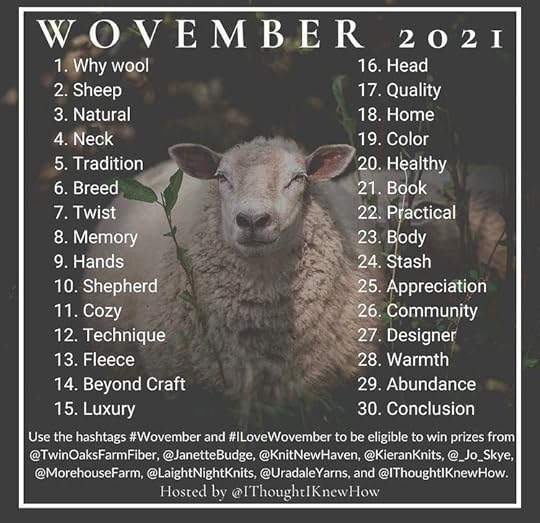
Wovember 13 – Fleece
I don’t feel competent to tell you what makes the best fleece. (I can tell you a few things that make it a bad one.) Here are few ‘stories’ of my fleece adventures.
One of the first was getting a fleece from the ag department at the college I went to school in South Texas. They weren’t interested in the sheep for their fleece (just meat/milk) so they didn’t do anything to protect the fleece. You have to know that there is a nasty ‘grass’ like plant with terrible little spiky burrs in South Texas. Not large burrs like from dock, but smaller than a baby’s pinkie nail and sharp. That fleece had them and I think I finally gave up and tossed it. But I learned. It was free and any spinner right now is going….”Oh yeah, FREE, that should have been a RED FLAG!”
While living in Germany there were fleeces available for sale, but the one I still find most my interesting story/find was in Ireland. We went on a trip there during Spring Break (while living in Germany) and I had researched ahead where I might find a fleece in the Cork area. I was put in contact with a local couple, I called and they invited us out to their home/farm.
Oh it was delightful, from the huge flowering rhododendrons in the yard to the peacock (yes, live) on the porch roof to the kitchen with a fireplace/hearth you could literally stand in.
We visited and compared cultures of farming. They finally asked how we got their ‘number’. Then we went to look at the fleeces. They had Jacob sheep. We picked out a fleece in their garage and they bundled it up and put it in an empty diaper box that was handy and away we went. I think it cost me all of about $5.00. The Irish had just adopted the Euro and neither one of us was sure what to pay/charge so this might be the best buy I ever made.
Another fleece I bought was at a Christmas Market in Germany. It was a Coburg Fuchs Schaff a breed local to south-east Germany. A soft creamy reddish color. Very pretty. The closest American breed in look and feel might be the California Red.
Then there was the Navaho Churro fleece I bought while in Arizona near Taos. Double coated so I got two types of yarn from it, a soft woolen yarn from the inner fiber and hard hairy one from the outer fiber. It wasn’t a very large fleece but it was fun to spin.
I’ve had some wins and losses on picking out a fleece, but mostly I’ve made some connections with shepherds and spinners and gotten not just fleeces but memories.


Wovember 12 – Technique
I am not going to share the techniques I’ve learned as that could be a rather long, boring blog entry, and others have done it better. Instead I am going to crystalize the technique resources that I have found useful over the years.
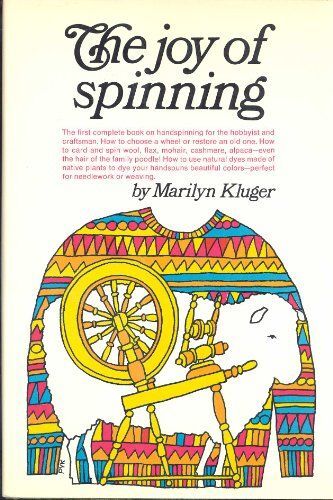
If you type in Yarn Spinning Techniques into a search engine one thing you might get it is a list of books on techniques. yarn spinning techniques – Bing This is SOOOOOO Far from what was available back in the early 1970’s when I started spinning and was looking for help/information. The only book I found was “The Joy Of Spinning”. A book I still own.
Also available was SpinOff magazine. https://spinoffmagazine.com/, in those days it was strictly black and white. Information on spinning does not go out of date, even if there are newer ideas for spinning, so I understand why back copies of SpinOff are still in demand. There are not many magazines that I ‘keep’ past a month or so, but SpinOff is one of the few. I imagine some day I should give them to a good cause like a local spinning group as reference material, but until then…
Those two are my ‘prize’ technique sources. You also might get lucky and have a spinning guild in your area as a help/reference. How to check? Again SpinOff comes to the rescue with a directory of national and international spinning guilds.
And be careful how you enter your search in Google. If you don’t indicate Spinning Wool or Yarn, you could end up exercising with no yarn to show for the effort.
November 10, 2021
Wovember 11 – Cozy
What is cozier than woolly socks or mittens? A woolly wrap? When the temperatures drop most people think of cozy things…warm woolen mitten, a fireplace, a scarf. Okay, things warm to eat and/or drink may be on your list also.
This is the time of year it feels good to be knitting on that HUGE wool blanket/afghan you are making. The weight and warmth on your legs and body feels not only fine, but good. In summer it can be sweat inducing, but now it is cozy, part of that hygge feeling which in English often just translates into coziness.
“Hygge (/ˈh(j)uːɡə/; Danish:; Norwegian:) is a Danish and Norwegian word for a mood of coziness and comfortable conviviality with feelings of wellness and contentment. As a cultural category with its sets of associated practices hygge has more or less the same meanings in Danish and Norwegian, but the notion is more central in Denmark than in Norway. The emphasis on hygge as a core part of Danish culture is a recent phenomenon, dating to the late 20th century.”
Thank you Wikipedia.
Having lived on the German border next to Denmark for at least two years I really get their ‘vibe’. I used to cross over at Padborg, this was the late 1980’s, and go to a furniture/furnishings store there, less than three miles from my apartment. This was long before Ikea was an idea, or at least I was unaware of Ikea.
This store staged their wooden, very lightly varnished (maybe only oiled?) furniture with all kinds of ‘knickknacks’. The table settings were fantastic. If I were to go back in time and want a dream job it would be stage setting those tables. Candle sticks, candles, candle rings, napkins and other decorative items for the table, plus table clothes and table cloth toppers and napkins and oh my!
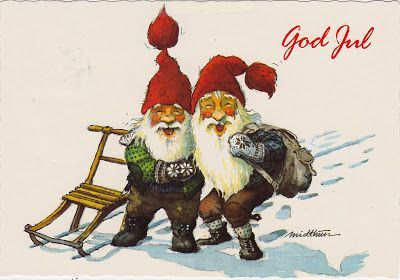
All the colors of the rainbow, but they weren’t garish. Usually one color and white per table but as they had lots of models of tables they really could put out a rainbow’s quantity of colors. And it being Denmark there was a lot of red and white used freely (National colors and flag colors). It was so inviting in the winter to walk through the store, sheep, gnomes (called nisse), pastries, candles, table linens…
As it got dark there even earlier than even the upper US states, you needed all the bright and happy and coziness you could create.
So wishing you a cozy (hygge) winter season with all the wool you want.
Wovember 10 – Shepherd
I don’t have much for shepherd, except respect. Even if I had the space, I’m not certain I’m cut out to be a shepherd. It is a responsibility to take care of another creature. So, I’ll applaud them and buy the fleece from their animals to support them.
And a non-sheep picture. Something I seem to be able to manage…orchids. I noticed one of my orchids was reblooming so I snapped a picture.
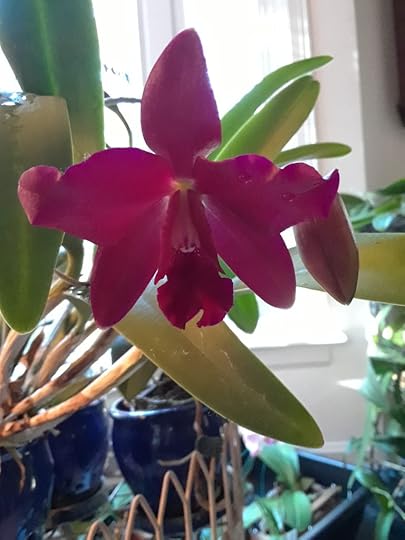
There are two more stalks with buds also, so potentially 6 blooms in all!
November 9, 2021
Wovember 9 – Hands
If you are a ‘tactile’ person, wool and spinning are definitely for you. The best thing I can do for my hands in winter is spin with a fleece that has been only gently cleaned, leaving in the natural lanolin. The same stuff you pay big bucks for in any hand cream and hint…it comes from the same source, the fancy company only ‘cleaned’ it up a little.
As I type this I can feel the dryness on the back of my hands, so this is a good reminder to myself to go an play with my wool.
‘Hand’ can conjure up a second thought and that is the ‘feel’ of the fiber, how ‘bouncy’ or ‘not-bouncy’ a given wool feels. That is mostly due to the crimp in the wool fibers. Again if you are into tactile senses wool is a natural soothing substance/fiber in my books.
And looking over the Wovember words I notice that they did not include feet or socks, so I’ll throw them in with ‘hands’. Wool Socks! One of the best investments you can make for your feet. Just saying.
November 8, 2021
Wovember 8 – Memory
Everything is a song…darn it. Now it is “Cats”.
Wool is elastic and will ‘snap’ back to it’s original shape if given a chance. Cotton doesn’t have this ‘memory’. So sweaters of cotton will sag out of shape, but wool ones won’t.
Okay there is a limit and if you want to mess up wool’s memory the things not to do are …
1)’agitate’ it vigorously or 2)shock it with going from one temperature extreme to the other (hot to cold or cold to hot…usually it is the hot to cold water treatment that ‘shrinks’ wool)
If you do both (agitate and temperature change) this is known as ‘felting’ and might be what you want to do but not if you want your wool knit garment to look like you originally created it.
Wool can go into water, it can be soaped (dish soap is useful) just don’t ‘work’ it hard. Let it sit in a huge vat of soapy water …drain…place it in a vat of water of similar/same temperature to rinse…repeat until the water is clear. Then lay out to dry on towels or screen – FLAT.
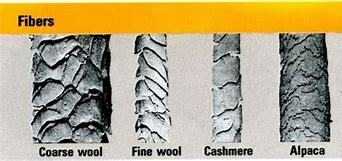
The magic is the shape of wool fibers and the scales that make them up. Both can work for you, if treated with care, or against you if you get overly vigorous and agitate.
November 7, 2021
Wovember 7 -Twist
This time it is Chubbie Checkers “Lets do the Twist” running through my head. Everything is a song.
Twist when related to fiber has to do with which way the fiber is spun. Z-twist or S-twist, see picture for examples.
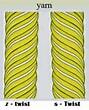
It is self-explanatory if you think of the letters Z and S. Look at the slant in the letter….look at the slant of the fibers in your yarn and there you have it.
Now this is primarily good for ‘singles’, or yarn that has not been ‘plied’ where two or more strands are twisted together. In plied yarn there is the twist of the plies and then the twist of the plied yarn. There is a whole jungle out there of what you can do with a strand of yarn after you’ve made it, and I won’t even try to go there.
And more explanations exist on how much twist to add. Some want low twist or as other’s call it ‘under spun’ yarn and some want super twisty, or ‘over spun’ yarn. Each have their place. I can hardly begin to tell you which you want and for what applications.
For me, as long as the yarn ‘holds together’ and does not ‘kink back on itself’ I consider it has just the right amount of twist.
Now getting the same amount of twist through all your spinning…the best advice I’ve seen is “Make a sample of what you want your end yarn to look like and keep it by your wheel so you can refer to it.” Not that I’ve ever actually done that, but then I spin for enjoyment and figure out what to do with my yarn later.
To ‘set’ the twist is what you do after you’ve spun the yarn, you soak it and then, usually, hang it to dry. Over twisted will usually twist something fierce, so adding some ‘weight’ to the skein as it dries will help straighten the yarn. (Some…usually…as in knitting, some things will not ‘block out’, but that leads to tomorrow’s word.)
November 5, 2021
Wovember 6 – Breed
I’m going to start with reposting the Oklahoma State University sheep breed archive.
If you didn’t take time the other day to fall down this rabbit hole take time today.
You’re welcome.
I’m assuming if your are reading Wovember posts, you are into wool and wool comes from sheep, so…
And if you aren’t interested in sheep you still might want to look at Oklahoma State University’s Breeds of Livestock site for other breeds you might have interested in. Their listings are for livestock breeds worldwide and it is pretty interesting.
November 4, 2021
Wovember 5 – Tradition
“Tradition! TRADITION! (dum, dum-di-dum, di dum) TRADITION!”
Okay, “Fiddler on the Roof” is running through my brain. Which has nothing to do with sheep or wool so we’ll leave it there.
I started messing around with ‘wool’ back in high school in the late 60’s early 70’s (now I have dated myself). It seemed to be a time when people got interested in ‘back to the nature’ kind of movements. I’m not sure why I was interested except I liked fiber arts and making my own yarn seemed like a thing to do.
My gateway ‘drug’ was weaving, but once you’ve started that you go back a step to ‘making your own yarn/string’.
Of course there are side diversions of ‘dyeing your fiber’ with natural materials. Even my aunt ended up doing some for a display at the county historical society and she was hardly a ‘back to nature’ type.
My parents came from farm back grounds, but neither family ever had sheep, so this acorn did not fall close to the tree. Yes, I’ve toyed with raising some, but decided it was a learning curve too high for this suburban girl. Cheaper in the long run to subsidized someone else’s dream.
So that’s my take on “tradition”.
November 3, 2021
Wovember 4 – “Neck” or Nothing
If we are discussing fleeces, I think it would be NOTHING.
After the rump and belly, this is probably the third least desirable piece of fleece. Even if a shepherd ‘coats’ their flock, the neck is pretty exposed to all the chaff and grasses a sheep might toss around. It won’t have ‘dags’ of urine or poop, so I guess if you are willing to work at getting the bits of grass out it should be good quality. Seems like a lot of work for small return.