Helen Mathey-Horn's Blog, page 5
November 23, 2021
Wovember 23 – Body
Body? –
The shape of sheep bodies? – can vary a lot like any species with lots of different breeds
The feel of wool against your body? – Depends with the finest of the wool like merino being the softest.
Your body as you spin or knit? – Pay attention and rest and stretch appropriately.
Your body’s skin? – That lanolin sure can keep your hands soft in winter.
Or the feel, touch of the fleece and fibers in your hand? Perhaps I’ll go with this one. In yarn the ‘body’ of the yarn is the feel you get when you squeeze the garment you’ve made. Okay that’s my definition and perhaps others will disagree. But when you grip something and release, does it spring back to what it was?
Take a bit of fleece, or yarn, if you grasp the tips in one hand and the cut end with the other and tug does it return to its length and shape when you release it? Wool is just so springy in this way. One reason wool garments (usually) keep their shapes so well. Yes, you can mistreat it by doing something dumb like putting it through the washer and drier and end up with something that shrinks. That is never going to spring back! But if you soak and rinse with minimum agitation and lay flat to dry (see that on all those store bought clothing labels!) Wool will keep it’s ‘body’ and hug to your body shape appropriately.
So what does agitation (with or without sharp temperature changes) do to wool? Take a look at a wool fiber.
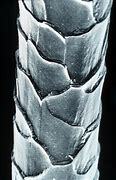
Heat allows those overlapping scales to ‘open’. If you agitate too vigorously or drop the temperature too quickly the scales will catch and close on each other. And there is no going back from it by ‘reheating’. You might think of it as the albumin-whites of eggs which are also proteins. Once they change (in the case of eggs – heated) there is no going back to the previous form of the protein.
Wool can take heating (multiple times) because the protein chemistry is not changed, but it can be ‘locked’ in agitation with the other fibers around it and then there is no going back. This is called felting and sometimes it is what you want.
I probably should quit with my explanation there as I don’t know all the ins and outs.
Wool will keep its body if you treat it with care. Hey, just like your own. Wash with gentle balanced soaps, don’t ‘scrub’ too hard, nice temperatures, air dry (well maybe not the last).
Oh as for what kind of soap to use with wool? Dish soap will do just fine. Dish soap is designed to remove oily and non-oily food stuffs. It is the oil that is really hard to get off dishes with just water. Why?
Okay one more dive into chemistry…water is a polar substance. One end of the molecule is like a negative end of a magnet and the other end like the positive. Overall water is ‘neutral’ but those tiny little magnets are attracted to other molecules that have similar positive or negative areas. Molecules like these are called POLAR…get it…with POLES. Oils on the other hand are molecules that don’t have these negative and positive areas on their molecules (hence they are called NON-POLAR) and are not attracted to water molecules, while water molecules are very attracted to each other and other polar substances or substances that will break into ions. This is why sugar (polar) and salt (ionic) dissolve so well in water, but butter (non-polar) does not.
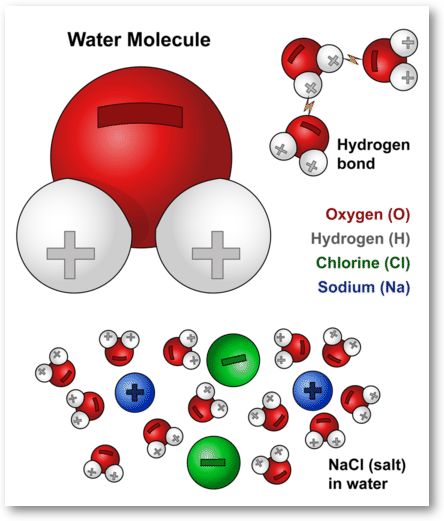 (Pretend the blue “+” and green “-” in this picture are ends of other polar molecules.)
 So how does soap get the oil off your dishes and wool? Soap molecules have one end that is polar and another end that is non-polar. The non-polar end of soap will ‘stick’ to the oily non-polar food parts (stick is an over simplification but work with me here) and the polar end is attracted (sticks) to the polar water. When the water is removed, the polar end of soap is going with the water and the other, non-polar end of the soap molecule sticking to the dirt, drags the ‘dirt’ with it down the drain. In the case of wool, the oily part is carried away with the soap. The non-oily part could have been rinsed away with just plain water. Which is why if you wish to keep the ‘grease’ in the wool, most people might just ‘rinse’ their fleece with water.
So today is really all about chemistry, but that wasn’t a prompt so we’ll just leave it there.
Sorry about the long explanation. Hope your head is not spinning too much.


November 21, 2021
Wovember 22 – Practical
Practical? What is Practical about wool and making your own yarn?
That was my first impulse to this prompt.
There is plenty practical about wool the fiber…it will keep you warm and also keep you cool. It is environmentally sustainable and recyclable. The variety it comes in is exciting. It need not be difficult to handle if you will be ‘gentle’.
As to making your own yarn…Practical…perhaps not.
You do not have to raise and shear your own sheep to enjoy spinning wool. Trust me there are plenty of shepherds out there that would like their wonderful fleeces to go to good homes. Also an infinite variety of wool types to be found.
Spinning your own yarn – practical? Well I suppose it isn’t if you are in a hurry or need a very specific yarn or a huge quantity of that yarn. Go buy it if it makes you happy.
But if you are into the ‘slow’ food process part of the slow movement, then you might enjoy spinning your own yarn. I’m not going to advocate for the slow movement, but I think the idea of connecting to the products you use and making them last more than a few uses or wearings is a good thing.
With spinning, wool or cotton or other fibers, you are very tactilely involved with the process. It can be meditative, but also frustrating when you ‘lose’ your yarn because it breaks or the spinning wheel takes up too fast and pulls it out of your hands, or your drop spindle ‘drops’. Very easy to lose your cool.
But back to PRACTICAL…wool fiber is…renewable, recyclable, dyeable, spinable, warm, but also cool if woven very thin and worn loose, an ‘old fiber’ that is infinitely ‘new’ again, PRACTICAL.
November 20, 2021
Wovember 21 – Book(s?)
I mentioned in an earlier post the first book I had on spinning, The Joy of Spinning. (Same book different cover.)
There are many resources out there in book form, videos and online.
If there is a guild in your area you probably can get ‘one on one’ instruction. They may also have a library of resources you may checkout/borrow. You might keep your eyes open for events at summer fairs and reenactment gatherings.
I also looked for some other sources I know of or like and I’ve included links.
The Joy of Handspinning (Web site)
The Fleece and Fiber Source Book Carol Ekarius and Deborah Robson – Will take you from animal to spun yarn
How to Spin Wool (YouTube)
Getting started (Web blog) With terminology
Respect the Spindle What Abby Franquemont doesn’t know about drop spindles doesn’t exist…If you have to start somewhere I would suggest here.
The Alden Amos Big Book of Spinning – CLASSIC
The Spinner’s Book of Yarn Designs – Once you’ve got the basics this will teach you how to spin different types of yarns
Where I found most of the above books
OSU Breeds of Livestock – And still one of my all time favorite places on line – not for spinning instruction but for learning about breeds of sheep and other animals raised by humans around the world. My husband and I live in Oklahoma and my husband attended OSU in the mid-60’s so besides being a fantastic resource we have kind of a personal connection to this university.
November 19, 2021
Wovember 20 – Healthy
I mentioned in the Wovember 9th – ‘Hands’ post that to have a good fleece you have to have healthy sheep. Sheep like other livestock (and people) need to be healthy to perform, produce at their best. So rather than go over the topic again I’ll just say, people who think shepherds mistreat their sheep don’t know much about taking care of sheep. And as a side note if you are looking for something to keep your hands healthy during winter’s drying weather, find some lanolin…the ‘grease’ found in fleeces.
If you work with a fleece that has not been ‘washed’ or you ‘wash’ your fleece with care there should still be lanolin present which will soothe your hands as you spin. How wonderful to get a great yarn and soft hands at the same time. Mental soothing with the spinning and physical soothing of the hands.
Spinning is healthy for you!
Wovember 19 – Color
Color and wool! FUN! FUN! FUN!
I’ve already mentioned the various natural colors you can find in fleeces on the 3rd. Today I’ll mention how easily wool takes up color.
Dyeing wool is fun and pretty easy. The most important things to remember are go slowly with temperature and don’t agitate the wool. If you have lots of time (and perhaps patience, because I want to see the results now!) dyeing wool is easy.
This is really a bigger topic than I can address in a blog post. There are mordants (‘to bite’ they help the dye attach to the wool) and dye stuffs both natural and synthetic. Natural dyes are ‘iffier’ in the amount of dye to be found in the material and what color you get can vary from plant to plant (or animal – cochineal) and from year to year. I include more below. What kind of metal pot and tools you use can influence the color, because of this enamel is suggested. How long to heat the dye stuff and the wool in the dye liquid can vary. **IMPORTANT NOTE – any pots, tools, whatever you use for dyeing should never be reused for cooking. Designate them only for the purpose of dyeing**
If you are in a hurry there is the magic of plastic wrap (saran), food coloring, and microwaving. Yes, you can microwave dye wool. I would suggest finding directions before doing this the first time which will not be hard, and as in the **above, that microwave should only be used for this purpose from there on out.
I’m sorry to give you a ‘tease’ about this, but the topic is really way too large for me to elaborate on and I’m certain that I will forget to include some step. I will tell you a fun and gateway ‘drug’ to learning and dyeing wool is Kool Aide. Yes, Kool Aide…just get the sugar-less packages (the ones you have to add your own sugar to). You don’t need the sugar or the sugar-substitutes in the diet ones. Some of the sugar colors can be a little garish, but fun. And if you are in doubt about the range of colors you can get…take a look.
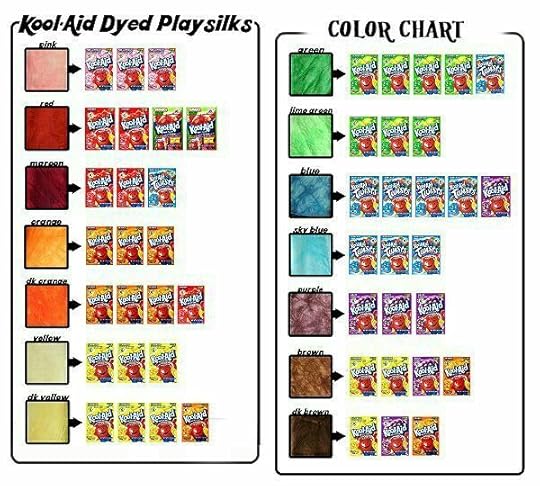
It says ‘Playsilks’, but wool will give you the same range or colors. And if you have some silk fiber around…well more fun!
And if you are interested in ‘natural’ dyes there are books and blogs available. Two easy natural dyes which most people can find are dried Onion skins (Yellow onions give – ‘wait for it’ – Yellow) and Marigolds (Yes, the same ones possibly already in your garden). Lots of books and sites. This one looks useful. And if you have a walnut tree, you probably already realize how dark the hulls of the walnut can stain things. Go collect them (with gloves) and use them for dye.
Once you start using natural sources you will quickly be tempted to use everything you see, but not everything makes a good dye material and not all dyes are ‘color-fast’. Some fade in light, some just fade in time even if you keep them out of bright light. Both these would be labeled ‘fugitive’ dyes. Unfortunately some of the prettiest dyes are in this category.
Another problem with natural dyes is finding a good ‘red’. As you might imagine there are…lots of yellows, greens and browns. To get red naturally you are dependent on madder(plant source) or cochineal(animal source).
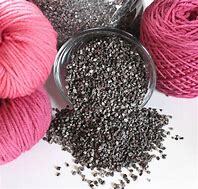
Those little ‘metallic’ looking flakes are actually small dried bugs/insects called cochineal that are used as the dye material. Not gross, or at least I don’t think so. An aside – my ex-husband brought home his aide one day when I was ‘cooking up’ cochineal. The guy had a sense of humor when he found out I was ‘boiling’ bugs.
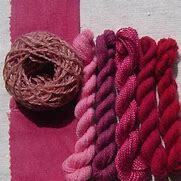
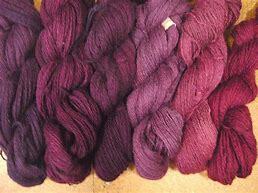
Now for blues, usually from indigo, and as mentioned above, another book’s worth of technique and information. This is probably the hardest color to create. Usually from from the indigo plant, although woad is another plant that can be used, and the process is not only long and tricky but ‘stinky’ which is saying something, since the other ones mentioned aren’t odor free.
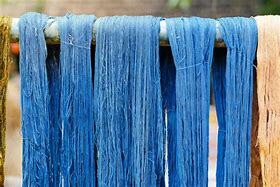
More ‘dips’ will get you darker blues.
And the last hard color to dye naturally is purple and this was one reason ‘purple’ was reserved for royalty. I’ll not go into sources and history…again a whole book’s worth of information.
After all this work to make wool into another color, perhaps you are appreciating a little more the natural colors the fiber comes in.
One more side note. If you try any dyes on ‘colored’ wool, i.e. anything but ‘white’ wool, you will have another rabbit hole of experimentation to fall down and range of colors.
Drat, I just remembered I didn’t say anything about the difference between dyeing in the fleece or as yarn. Most everything I wrote above assumes you are dyeing yarn in hanks/skeins. If you do use loose wool it should first be clean and second…don’t agitate it as it sits in the dye bath. Finally, ‘dyed in the wool’ will be darker and more intense in coloring than dyeing wool in the skein. And that is where that term comes from. You’re welcome.
Whew, that got long. I knew it would as the topic is BIG!
November 17, 2021
Wovember 18 – Home
The words wool and spinning evoke a picture of a woman (or women) sitting near a fireplace spinning wool or perhaps knitting. Gemutlich would be the Germany word, but cozy has already been used.
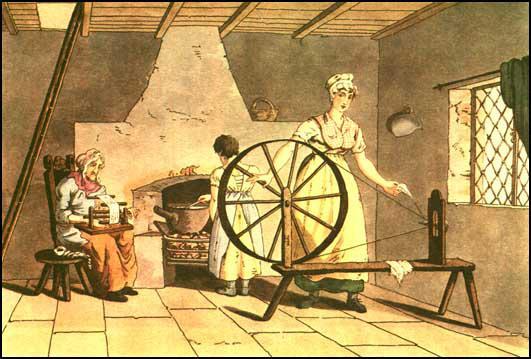 The woman on the left is ‘reeling’ yarn.
In days past home spinning and weaving were considered patriotic. I’m talking just before and during the American Revolution.
The British wished to maintain a monopoly on many things and one of the products was wool. They attempted this by passing laws. They didn’t mind the colonists raising sheep for wool, but they didn’t want them spinning and weaving it into products for the colonies or sale elsewhere that would compete with British manufacturers. The British wanted that wool shipped to their spinners and mills in England and then send the finished fabric back to the colonists for sale. Yes, they wanted the middle-man cut of the profits.
George Washington was sworn in as the first President of the United States in a suit of entirely American raised, spun and manufactured wool. A deliberate choice on his part. Yes, it is amusing to think that the suit he wore had symbolic significance, but it is still true today that we often scrutinize our politicians’ choices in clothing, etc. so perhaps not so strange, just and early example of ‘Buy American’.
Homespun was an early colony necessity, but technology was changing fast and, except on the frontiers, people wanted milled yarns and fabrics. So Grannie’s spinning wheel soon became ‘decorative’ or even burned.
This was probably true for about the next two hundred years and then we hit the late nineteen sixties and seventies and the hippie movement back to the earth roots. I was never a ‘hippie’ in living off the land in a commune kind of way, but I, like many, was interested in crafts. I bet if you are of a certain age you macraméd something…I rest my case. The idea of home and home-made was strong for a while and it seems to be making a resurgence again. I guess each generation or so has to find its roots and rediscover some of the good things from the past.
November 16, 2021
Wovember 17 – Quality
You know the adage, “You get what you pay for”? Very true when it comes to fleece.
First, real shepherds take care of their animals. If they are intending to sell the fleece to be spun they will also take care of how that growing fleece is protected, including ‘blanketing’ or ‘coating’ the animals with changes in coats as the sheep’s fleece gets larger. This keeps debris such as hay or straw from falling or getting into the fleece. That kind of debris can be picked out by the spinner in preparation to spin, but it is a ‘pain’ and to get a ‘clean’ fleece is a joy.
They make certain their animals are properly feed and in good health, otherwise the wool will have weak spots that break in the processing/spinning of the wool…no fun for a hand spinner and I imagine a commercial operation would just toss such a fleece. So, monetarily it pays to keep them healthy.
It is irritating that people who say they are ‘concerned’ about animal-welfare, sometimes target farmers/shepherds that raise sheep and say they are unethical in how they tend their animals.
Granted perhaps large farming operations might cut corners, but if you want the best money for your animal’s fleece, you have to invest in a healthy animal to get it.
You might have noticed this in yourself if you’ve ever had an instance where you were unhealthy for a period of time, eating poorly or whatever. You’ll notice it in brittle finger nails and brittle, lackluster hair. Same will be noticed in sheep because…hair and nails are made of the same chemicals as wool.
One aside and more comment… A few years back my husband and I were using up time waiting to move and were watching a nature show about a pair of voles (? some small wild animal) and the male they named Oscar. Well the upshot was…Oscar got eaten by an owl before the end of the show. We…two grown mature adults…were so bummed by that ending even though it is part of the circle of life that to this day if we are watching a nature show and we feel that one of the animals is going to ‘buy it’, we start referring to that animal as Oscar. It would not have been so bad or memorable if he hadn’t had a NAME. When you name something…you become concerned in it’s well being. Many/most people who raise sheep for the small wool consumer (hand spinner) usually have smaller flocks and they KNOW their animals…including giving them individual names.
When you’ve named an animal…you have an emotional investment in that animal that translates to quality.
So, I’ll get off my soapbox.
November 15, 2021
Wovember 16 – Head
I certainly have no idea what they were thinking when they used the prompt ‘Head’.
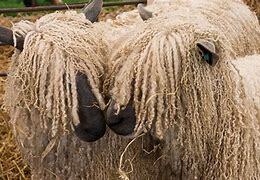
Maybe some ‘head’ shots of various sheep will fill the day?
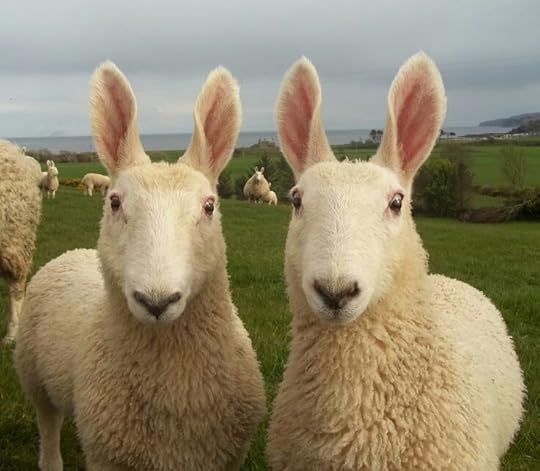 Ears UP
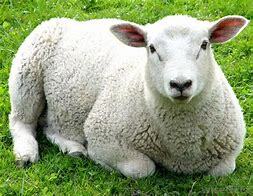 Ears Out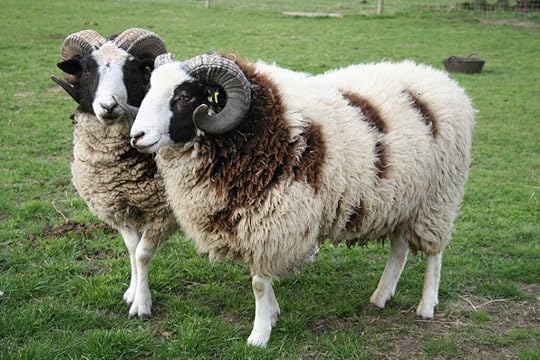
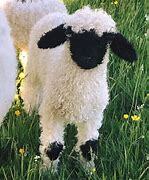 Ears Down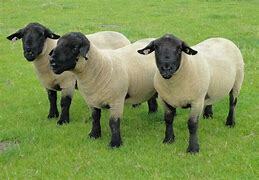
White heads/faces, Black heads/faces.
Wooly heads, non-wooly heads.
Just shows that when you think you know what a ‘sheep’ looks like, the reality is way beyond your imagination.
And for good measure ‘Bob Marley’ style.
November 14, 2021
Wovember 15 – Luxury
Most people think of wool from sheep when they think of spinning. That can be the tip of the iceberg.
Spinning fibers can be plant fibers such as ramie, hemp, flax, bamboo, and cotton. But as the picture for Wovember is of an animal we will stick to fibers to spin from sheep (of course), yaks, mohair goats, llamas, vicunas, guanacos, camel, worms (silk) and even your pet dog’s ‘fluff’ in some breeds.
When thinking of luxury, we might limit this to silk, and vicunas.
And of course there are plenty of books. One author to mention is Judith MacKenzie. For the plant based there is Stephanie Gaustad. And no, I don’t consider it ‘cheating’ to include luxury plant sources for spinning (silk?). Once you’ve started spinning, anything is fair game. Some are easier than others. Wool is probably the easiest and therefore the gateway drug, I mean fiber to the world of spinning.
And in the world of wool there are certain breeds that are considered a step above the rest in luxury. Merinos being the kings, which is only appropriate as they were developed in Spain. Merinos can be found world-wide with Australia’s sheep agriculture being firmly based on them. Which leads us to Shrek. And this is why sheep need to be annually sheared.
Another luxury fiber is vicuna. As they are wild, and small, the fiber is difficult to harvest and not a lot per animal at a time. They are related to alpaca which are domesticated so you can get a similar fiber, but vicuna is the ‘luxury’ of the two.
And bison (buffalo) fiber. What???? The problem there again is ‘harvesting’ as bison are notoriously bad tempered. Collecting it off bushes in areas where buffalo ‘ah’ roam is the easiest.
And finally there is qiviut or quiviuk which is the inner coat fiber of the muskox. And again ‘harvesting’ is more like foraging in the right areas.
It is probably a toss up between Vicuna, Muskox, and Merino for luxury fiber of the world (not forgetting bison). I find it interesting that the best/luxury fibers come from the animals that have to endure the coldest climes…should tell you something about how effective those fibers are.
If you get your hands on any of these it will cost you, but be well worth it.
November 13, 2021
Wovember 14 – Beyond Craft
I’m not certain what they were intending with this prompt. I suppose most people do think of spinning and use of wool in the ‘craft’ category. (Originally it would have been the ‘necessity’ category.)
Perhaps they are thinking of the art of ‘felting’ which doesn’t usually serve a ‘useful’ role, but more decorative. Or maybe it is all the unique ways you can spin wool into yarn, some not useful in terms of making fabric but interesting. Some are used in fabric manufacture. Boucle yarn comes to mind. Thick and thin yarns are also another. That last link has an article on Art Yarns.
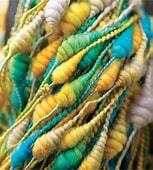
And another article.
If you can think of it, someone has tried it. And looking at the pictures I forgot about the idea that you can add bits and bobs to yarn as you spin. Some of it can get pretty wild.
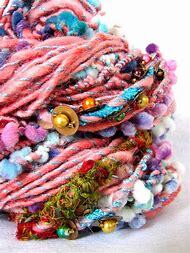
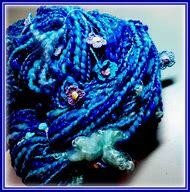
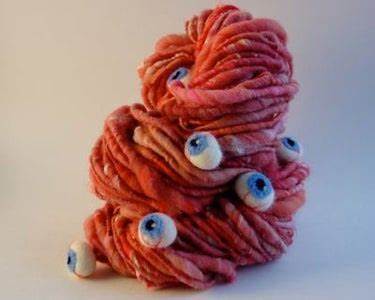
There are books on spinning these types of yarns and a few suggestions on how to use them. The book I linked is by Jacey Boggs and if you have ever seen an interesting ‘art’ yarn somewhere it is probably hers. She does some incredible things with fiber and additions.
What to do with these yarns. Petting them comes to mind. That is, just enjoying them for their own beauty. They can also be used in weaving and knitting to create interesting surfaces and fabric, but at this point I get outside of my abilities to describe what to do.
One last thing, if you are not yet a spinner and you decide to have a go at it, prize your first lumpy, bumpy, uneven yarn. Put it some where safe to look at in the future. It is amazing how hard it becomes to recreate that type of yarn once you become even a little proficient at spinning. None of us know why that is…but it is true.