Rachel Lyon's Blog, page 2
March 4, 2024
Fruit of the Dead Week
Today begins publication week for Fruit of the Dead.
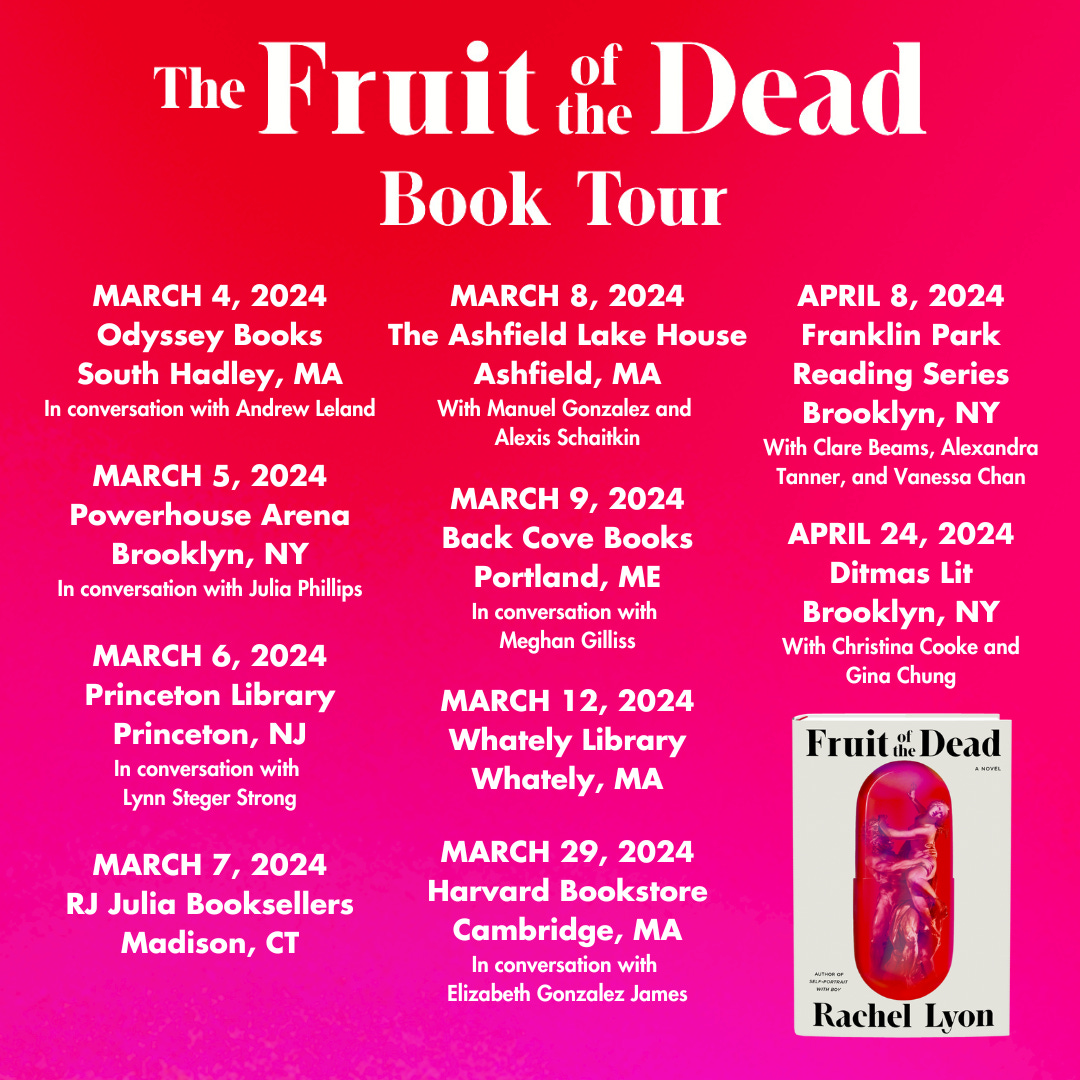
The book comes out tomorrow, but if you’re in Massachusetts you can get a copy today, 3/4, at Odyssey Books, where I’ll be in conversation at 7PM with the very excellent Andrew Leland (The Country of the Blind: A Memoir at the End of Sight). You can register for that free event right here.
Tomorrow, 3/5, I’ll drive down to New York to chat with the kind and brilliant Julia Phillips (Disappearing Earth, Bear) at Powerhouse Arena in DUMBO, my neighborhood of origin. That event starts at 7, too, and will be followed by some light partying: cake, wine, chitchat, merriment. Register here.
On Wednesday 3/6 at 7PM I’ll be at the Princeton Public Library in conversation with Lynn Steger Strong, whose novels (Flight, Want, Hold Still) and Substack I have admired so much and for so long I’m afraid I will have to work very hard not to go mute with starstruck awe.
The next day—Thursday, 3/7—I’ll drive up to Madison, CT, where I’ll read from and discuss the book at 6:30 PM at RJ Julia Booksellers.
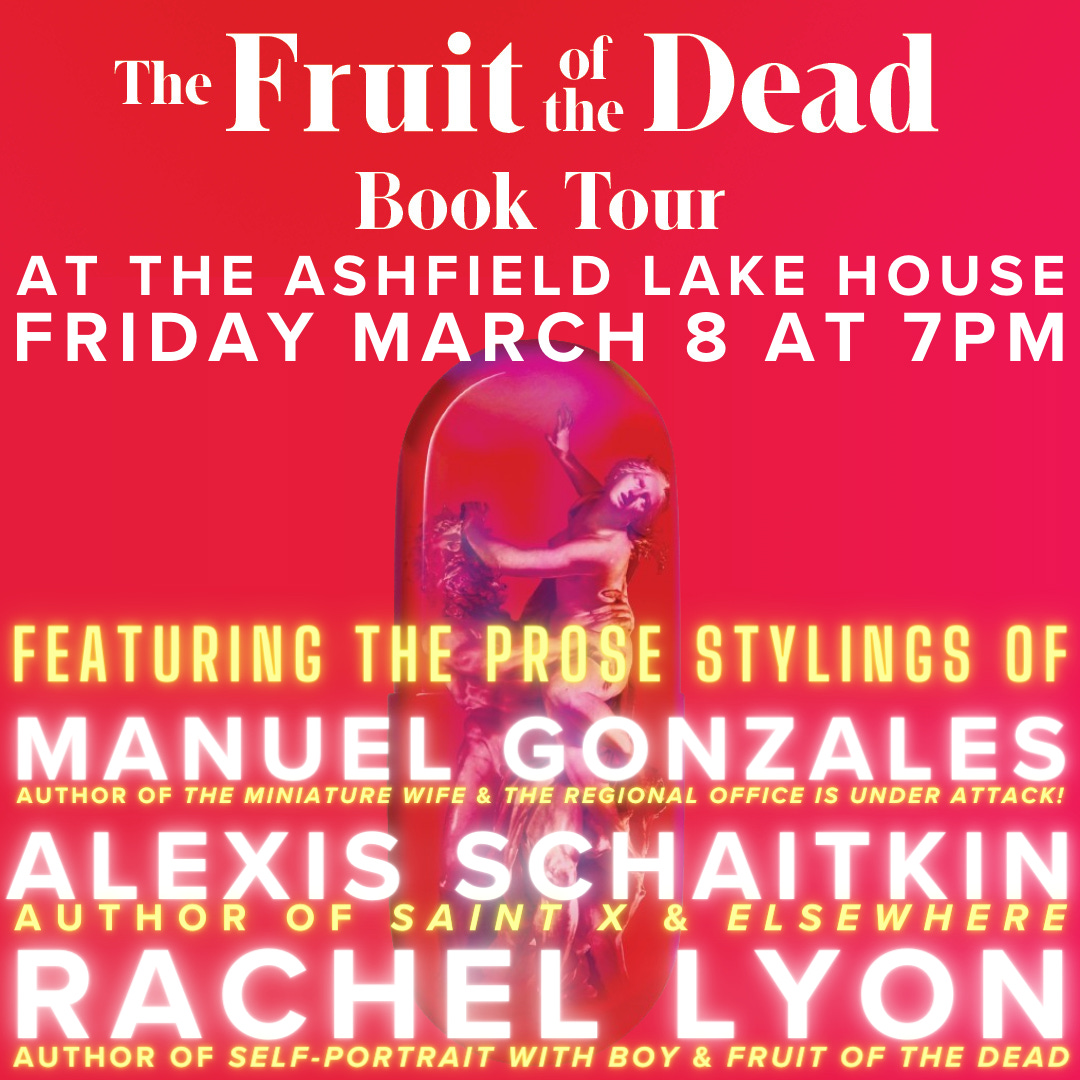
I’ll be back home long enough to do a reading / party at The Ashfield Lake House at 7PM on Friday, 3/8, where I’m sure to be totally outclassed by the charming and accomplished Alexis Schaitkin (Saint X, Elsewhere) and Manuel Gonzales (The Miniature Wife and Other Stories, The Regional Office Is Under Attack!, and the forthcoming Blackthorne Island)—
—but I’ll turn right around the following morning and drive up to Maine for the weekend, where I’ll discuss the book with Meghan Gilliss (author of the exquisite novel Lungfish) at 6:30 PM at Back Cove Books in Portland, ME.
If you can’t make it to any of the above, please feel free to check this list of upcoming shenanigans on my website. In MA, you may be free to join me at, e.g., the Whately Public Library at 6PM on 3/12, or to come hear me in conversation with the wonderful Elizabeth Gonzalez James (The Bullet Swallower) at the Harvard Bookstore on 3/29. In New York, hot tip, you’ll truly enjoy any / all of these incredible reading series, featuring a few absolute literary stars:
Franklin Park on 4/8, with Clare Beams (The Illness Lesson, The Garden), Vanessa Chan (The Storm We Made), and Alexandra Tanner (Worry)
Ditmas Lit on 4/24, with Gina Chung (Sea Change, Green Frog), Christina Cooke (Broughtupsy), and Jessie Ren Marshall (Women! In! Peril!)
Pete’s on 5/16, with Gina Chung again (yay!), Crystal Hana Kim (If You Leave Me, The Stone Home), and Andy Jiaming Chang (Cinema Love)
Tables of Contents on 6/17, with Ayana Mathis (The Twelve Tribes of Hattie, The Unsettled) and Sally Wen Mao (Ninetails, The Kingdom of Surfaces, Oculus, Mad Honey Symposium)
Feelings in the BackIt can be difficult to let a book out of one’s own little control freak’s clutches, and into the real world. There is very little left for me to do, now, aside from sharing my calendar and news with you, and encouraging you to order the book.
You might think that, having relatively little left to do, I’d be sitting here at my desk feeling relaxed, even serene. You might think I’d be, you know, accepting the things I cannot change. You would be incorrect! Turns out, accepting the things one cannot change is not. Easy. Perhaps that’s why they cooked it into a prayer. As my little tour approaches, and various other uncontrollables loom on the horizon, I have been feeling very anxious indeed. I’ve been waking up at four in the morning, bug-eyed with inane concerns. What if there’s a snowstorm!?!? (Nothing to be done about the weather!) What shoes shall I wear to all these events!?!? (Does it matter?) Do my wedding shoes still fit!?!? (They never did!)
My own sleep problems have been compounded by the sleep problems of my 3 1/2 year-old, who has been wandering out of his newly converted toddler bed every morning before dawn, animated by some tragic hope of playing with me (“Make the dump truck talk, Mama”), or reading with me (“Read the truck book, Mama”), or generally having me to himself for a couple hours. It’s sweet, but, wow, to be woken up by him in this way, after a night of sleep already plagued by restlessness and worry, is to be torn to pieces, eyelids first, by pity, exhaustion, love, and seething rage.
You might think it would be reassuring to have this lovely little tour to look forward to. To know that I will get to sleep and wake—a couple mornings, anyway—alone, in hotel rooms, with no bodies to tend to but my own. You would be correct! The primary reason to go on a mini book tour like this one is to celebrate with friends, admired colleagues, and maybe even a few strangers who happen to be interested in the book—and, truly, unreservedly, I cannot wait to hug the friends I’ll see, to sign some books, to have some real, wide-ranging, joyful, fascinating conversations! But, for me, the second reason for going on tour—and it’s a close second—is to get the hell away from my beloved family.
Which is all the more infuriating because I know that I will miss the crap out of those little boogers while I’m gone. Already I’ve been welling up like a goon when the baby comes over to spontaneously smash her face into my thigh, becoming glassy-eyed composing little notes for my partner to read to our 3-year-old at bedtime. But there you have it. Love and work are endless tunes that rarely play in the same key or tempo. If they do happen to unfold in harmony, it’s often accidental. The problem of my ambivalence is a side effect of this rich life, which I feel exquisitely lucky to have.*
In Other NewsI’m very happy to report that People Magazine listed Fruit of the Dead among their six best books to read in March.
LitHub mentioned Fruit among nine of “March’s Best Sci-Fi and Fantasy Books”—which, you know, I’d maybe challenge that designation? Like, if you’re a hard-core sci-fi/fantasy nerd you’ll probably be disappointed in my “lit fic” style “mythical retelling,” but, whatever, maybe not! Give it a shot!
Publishers Weekly re-upped their review of Fruit, calling it a “highly anticipated sophomore novel,” which was very nice.
The book also got sweet mentions in NYLON and PureWow.
Tertulia’s presale campaign for Fruit of the Dead continues through publication day. If you order the book through them, you can get 20-50% off.
I hope to see you soon.
*If you too have been feeling lucky to be alive, not to mention free, housed, adequately nourished, and for the most part unafraid for your loved ones, especially in light of the bloodshed, famine, and 30,000+ dead in Gaza, please join me in taking a few simple actions through Jewish Voice for Peace.


February 15, 2024
Countdown to Pub Day
Greetings from sunny Los Angeles, this foreign land where my family and I have been for about seven weeks. It is quiet and lovely in the neighborhood where we’ve been staying. The camellias are in bloom. A lemon tree bends over the stone wall that lines our driveway, laden with fruit. Neighboring yards teem with fragrant lavender and sage, Jurassic aloe. There are eucalyptus and palms, glamorous bougainvillea and dark, twisted olive trees. There is a manmade pond where dozens of turtles sun themselves in ancient meditation.
Meanwhile my three-year-old is half-feral with individuation, and the 18-month-old continues to communicate her needs via her signature, blood-curdling scream. We are by far the noisiest people in the neighborhood.
Thanks for reading Postcards from Mountain House! Subscribe for free to receive new posts and support my work.
Parenting two young children full-time with minimal help has been intense and challenging, no doubt about it. A couple of times I’ve thought, This is as bad as it gets. It can’t get harder than this. And then I’ve looked at the news out of Gaza, and thought, God, how dare I. Of course it can. Of course it can.
It is an unspeakable gift to feel safe. To live without daily, hourly, minute-to-minute fear for my life and the lives of my little loves.
Just as it can feel simultaneously difficult and heart-twistingly precious to be with my children right now, it can feel really, dissociatively weird to be promoting a book: joyful and exciting on one hand, petty and frivolous on the other. I don’t know how to live with this divide, within, except I know it helps to take some action, however small. So, before I share my book news with you, let me share two links to resources I’ve found useful when the hopelessness, bewilderment, and despair get to be too much. You probably already know these, but they bear re-sharing:
Protect Palestine’s list of 3-minute tasks makes emailing your representatives, signing a petition, and more, very easy to accomplish in a narrow window of time.
I’ve found sane, justice-centric community in the organization Jewish Voice for Peace.
Book NewsAll right, all right. So here’s a little good news. Fruit of the Dead comes out in just nineteen days! A week ago I opened a box full of finished books and held one in my hands for the very first time. She is shinier than I expected! She is really a glorious object.
If you’ve read previous Postcards you already know it is immensely valuable to an author to preorder her new book. If you’ve already preordered, thank you!!! I have a hand-drawn 2024 wall calendar with your name on it, and would be thrilled to mail you one as a thank-you gift. Just reply to this email with your receipt and address.
If you’ve been meaning to support Fruit of the Dead, but have been deterred by the cost of the brand-new hardcover, I have a sweet little deal for you. The book discovery app Tertulia is currently offering 50% off preorders if you sign up for a 30-day trial, or 20% off the book with the code LYON before 3/5, no strings attached.
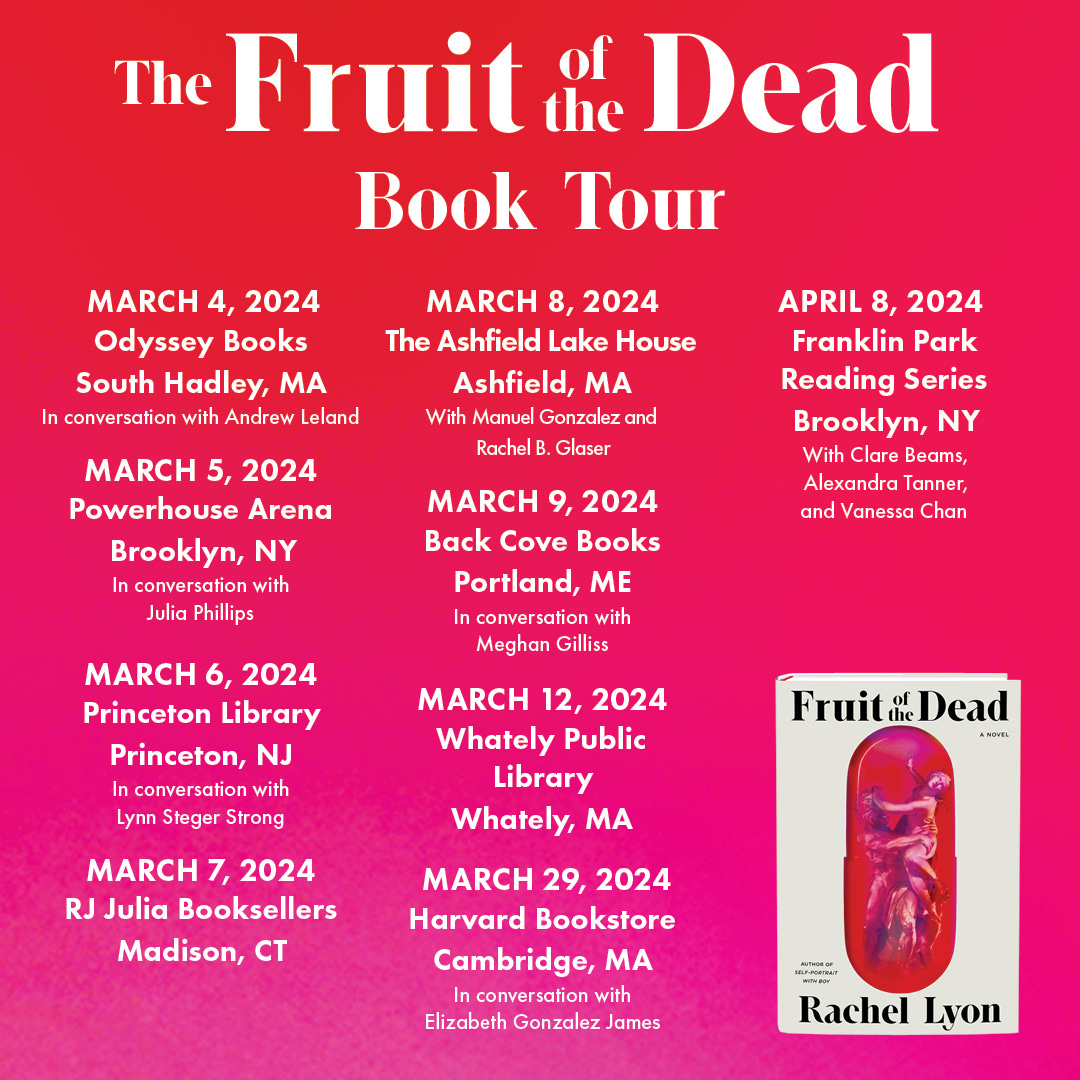
Orrrrrr you could buy the book at one of these exciting in-person events. Just look at this beautiful lineup of kind, brilliant writers I’ll be hanging out with! If I happen to be in your neighborhood, come join the party. I’d love to see you.
Finally, few other minor delights:
Fruit of the Dead has officially achieved starred-review bingo! After Kirkus, which I reported on in a previous letter, Publishers Weekly gave Fruit her second star—
and, last week, Booklist, the book review journal of the American Library Association, gave her a third.
NetGalley UK has featured the British edition of Fruit of the Dead among its March 2024 books of the month.
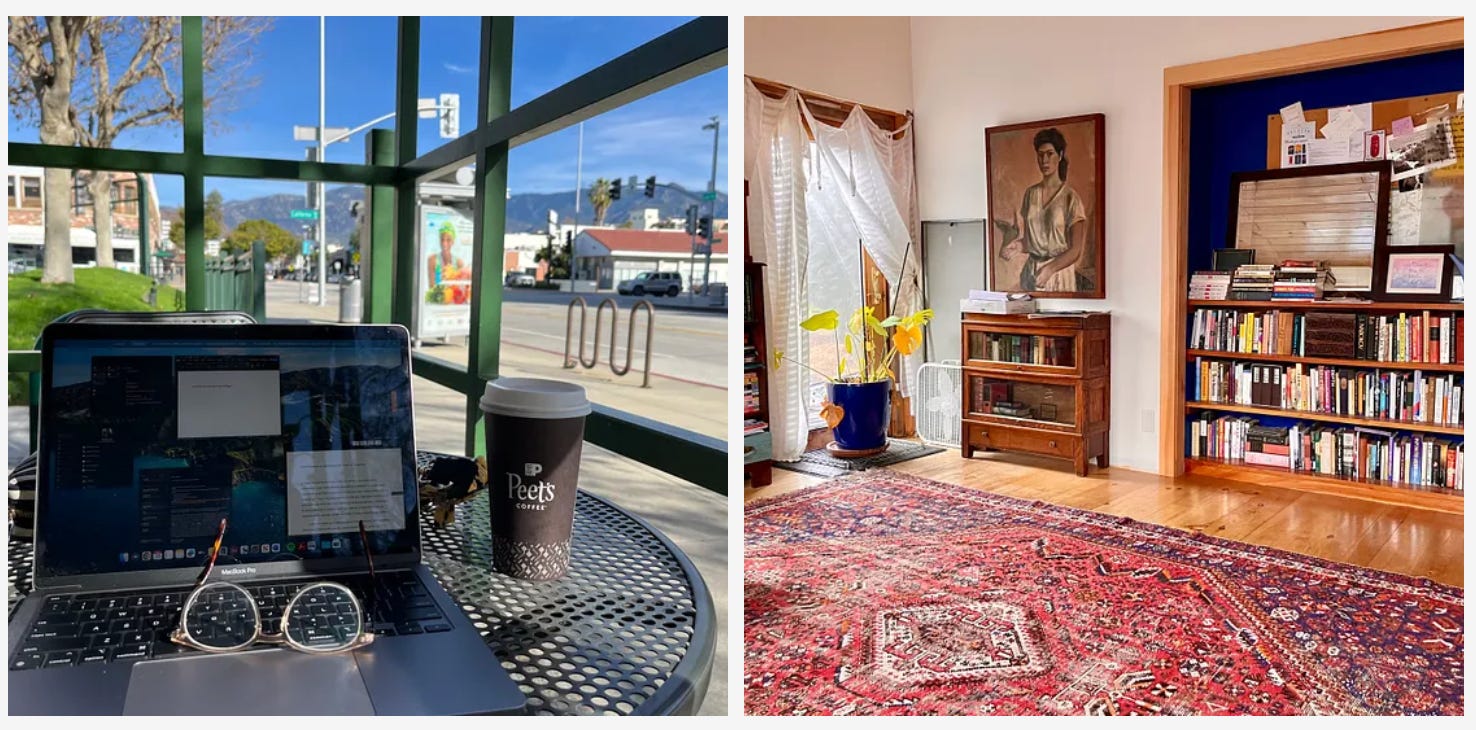
My friend, wonderful writer and overall mensch Danielle Lazarin, hosted me on her beautiful series “In Process With,” via her intimate and thoughtful Substack, Talk Soon. Here are the photos I sent her of my writing spaces, current (outside a Peets in Pasadena) and usual (the room where I work at home). Subscribe to Talk Soon here. It is lovely.
Thank you for reading. Thank you for your support. Thank you for being in community with me. I’ll write again soon. For now, be safe, and be well,
xo Rachel
Thanks for reading Postcards from Mountain House! Subscribe for free to receive new posts and support my work.
January 1, 2024
118: A Blessing for the New Year
Years ago, when I was working on my first book, I spent a little time in Croatia with a poet friend. We stayed in a hotel on the coast, on a beautiful inlet where waves crashed against high rocks in the mist, which would go suddenly, intermittently brilliant in brief, dizzying moments when the sun pierced through the cloud cover. It was the off-season, November 2015, and the place smelled like stale cigarettes and cleaning fluid. At meals we often had the hotel restaurant to ourselves. We had rented no car, so we walked everywhere—a path on the edge of a dramatic cliff, up and down the winding road into the quiet town. The trip was only a couple of days, but my conversations with this friend (who lives in France, so I see her very rarely) invigorated my writing practice, fortified my creative confidence, and changed the course of that novel. Shortly after that trip, I began rewriting SELF-PORTRAIT WITH BOY, beginning to end. A year and a half later, it was complete.
Looking back, I recall a lot of casual drinking on that trip. Glasses of wine at the pizza place in town. Cocktails in the empty dining room. Whiskies in a smoky bar at one in the afternoon, surrounded by local old men who laughed at us, American women on vacation at the wrong time of year. I was not yet willing to give up alcohol completely. I was drinking a lot—often alone, sometimes at work, and certainly after work, every single night. By the time SELF-PORTRAIT WITH BOY was accepted by Scribner, and then scheduled for publication, I’d become aware that, if I was interested in taking myself seriously, if I wanted to achieve even a meager degree of self-respect—not to mention refrain from alienating my romantic partner and most of my friends—I’d better quit. I gave myself until the end of 2017. On New Years Day 2018, a friend handed me a cocktail and I couldn’t say no; I did, however, successfully quit a week later. When the hardcover edition of SELF-PORTRAIT came out in February ‘18, I’d been sober less than a month.
It was during what I think of now as my last drunk summer—the summer of 2017—that I wrote what would become the original paragraphs of FRUIT OF THE DEAD. Those paragraphs were pretty psychedlic: steeped in metaphor, pulsing with almost erotic surreality. Over the years that followed, of course, I rewrote (and re-rewrote, and re-re-rewrote) them, but through all those versions I tried to preserve that quality of lush exaltation. I appreciated—I appreciate even now—that they reflect the state I was in at the time: already eulogizing the substance-enabled euphoria I’d soon give up, already mourning the drinking I loved. Here they are as they appear now, after much rewriting, in the eleventh chapter of the advance review copy I keep on my desk:
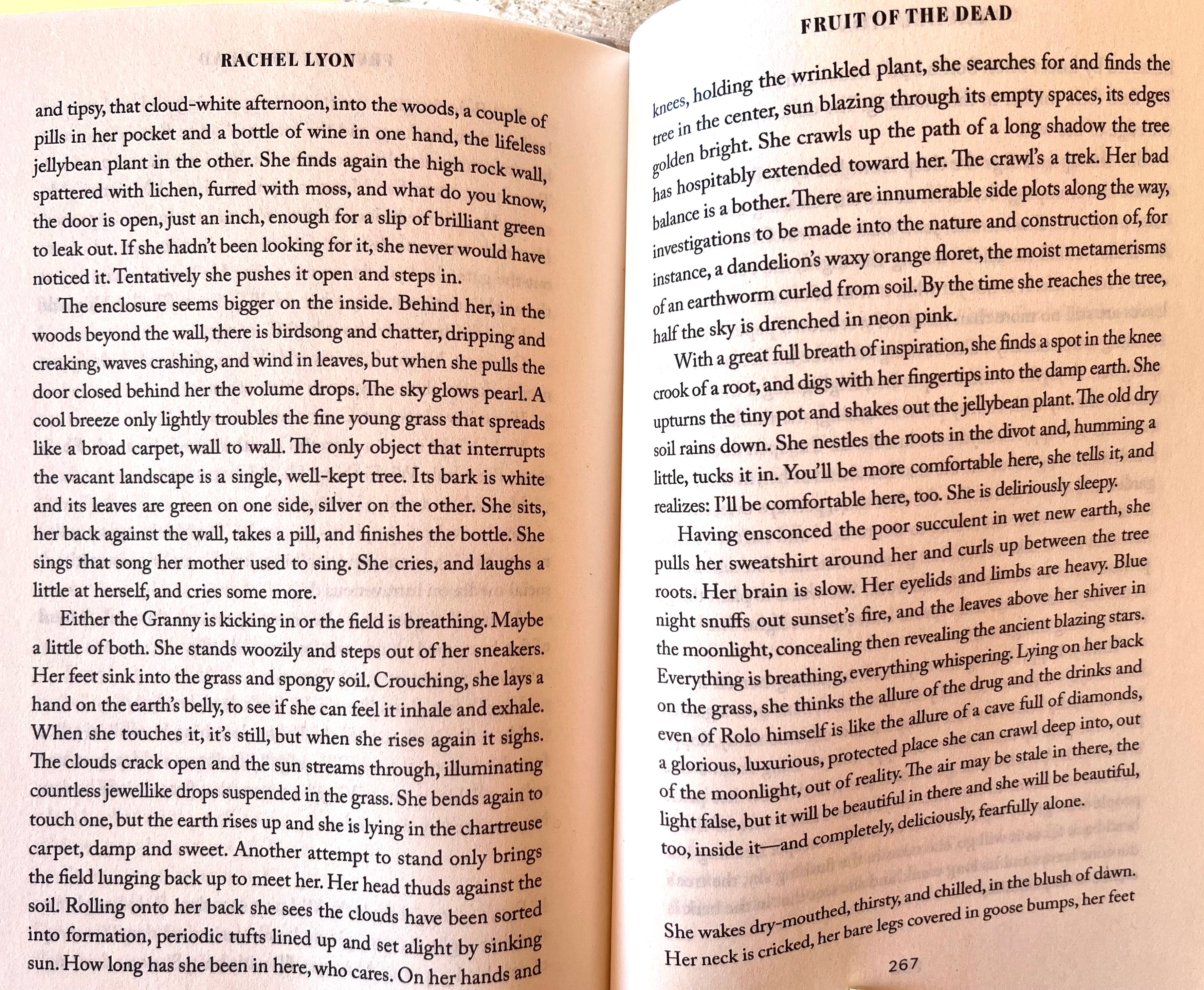 Having given you this sneak peek, I’m contractually obligated to suggest that you preorder FRUIT OF THE DEAD. <3
Once sober, I learned (very slowly) to forget a little how much I loved to get fucked up. Or, more accurately, I learned to replace that romance with something else, something more grounded, honest, and real. At any rate, it is no coincidence that the protagonist of FRUIT is a young woman, a girl, who’s just beginning to have some increasingly dangerous fun with substances. This is part of what the book is, to me: both retroactive warning about and nostalgic paean to “the allure of the drug and the drinks . . . like the allure of a cave full of diamonds, a glorious, luxurious, protected place [to] crawl deep into, out of the moonlight, out of reality . . . [where one can be] completely, deliciously, fearfully alone.”
Now it is New Years Day, 2024 (what? how!), the most popular day of the year to quit or at least pump the breaks on your substance abuse. The first few years of my sobriety, I stayed pretty quiet about it. I was afraid of relapsing—if I’m honest, I was half-planning to relapse. And, you know, relapse is always possible! I still do this thing one day at a time, as they say. But, as I approach my sixth anniversary, as well as the publication day of this book, I feel moved, I guess, just to say, if you’re struggling, you’re not alone. Corny but true. For me, living without alcohol was very fucking difficult at first, but it has gotten easier every year, and every year I’m more sure that it’s worth it, more grateful to be present for my life.
Anyway. I’d like to close with this. As luck would have it, that same friend who helped me move through and complete my first book, she recently started a Substack, and she posted something yesterday that I’d like to reshare, in part, here. It’s a blessing for your creative spirit in 2024. It’s a little like a series of New Years resolutions, a little like a prayer. I won’t quote the full thing here—I’d encourage you to read her whole, moving piece, “Creating Space for Threshholds”—but I’d like to share this fragment:
Blessing the Creative Spirit in 2024May you take time to set up workspaces that inspire you.
May you feel the ennui, then get to work.
Don’t wait for inspiration. Be curious and serious about your own process.
May you honour your longing but not drown in it.
When you need community, may you find those who feed you and avoid those who don’t.
May you see projects to completion. May you know when to keep going. May you know when to call it quits.
Break bread. Lose interest. Take breaks. Take naps. Have a snack. Go for a walk.
May you hold space for thresholds and cross over in big and small ways into the unknown.
May we all honor our longing, and not drown in it.
Happy new year,
Rachel
p.s. I have more calendars available, which I’m sending as thank-you gifts to those who preorder FRUIT OF THE DEAD. Email me your address + a screenshot of your receipt before 10 AM this Friday, 1/5, and I’ll happily mail you one. :)
p.p.s. One more thing. I have been enraged to learn about Substack’s despicable policies enabling Nazi propaganda and hate speech. Due to this platform’s blatant greed and bewildering commitment to profiting off of white nationalists, I have turned off paid subscriptions, so they may not profit, at the very least, off of you or me. I am also currently looking into other, less fucked-up platforms, to which I might migrate Postcards from Mountain House. If you have any suggestions, let me know.
December 7, 2023
117: In Praise of Amateurism
A few months ago, back in September, I started my three-year-old on violin lessons. I studied violin myself when I was a kid, from the age of four through high school and college, and it has been very important to me over the years, if decreasingly so as I’ve gotten older. Yes, I share many folks’ uncontroversial opinion that playing an instrument from a young age offers a kid many benefits—a familiarity with, even a love of, music; a good ear; community; joy; a willingness to fail and fail again and then improve, slowly, over time, which is to say, discipline—but also I have a personal, emotional investment in it all. Violin has been a part of me ever since I can remember. I wanted to share that with him.
So I rented him a heart-meltingly cute 1/16-sized instrument. I enrolled him in a Suzuki program a half hour away and committed to driving him back and forth twice a week. I finagled childcare for his 15-month-old sister, who was too disruptive during his first lesson to be allowed back (!). It was going to be a schlep, but it would be worth it.
If the perceptive reader thinks, here, “I’m being set up,” well. You’re on to something.
Postcards from Mountain House is a reader-supported publication. To receive new posts and support my work, consider becoming a free or paid subscriber.
As soon as it became clear that it would take months if not years for my son to be able to make actual music, he decided violin was not for him. If, in the car and during mealtimes, he often asked—still does, in fact—to listen to those tedious/meditative variations on “Twinkle, Twinkle, Little Star,” in his mind, his relationship with the instrument itself was kaput. He put down his adorable 1/16-size and refused to pick it up again.
For a while I thought maybe I ought to lead by example, with the hope that, over time, he’d be inspired to try again. His teacher liked this idea. He brought more sophisticated music for us grown-ups to play. We worked our way through a couple of canonic duets by Telemann. They were easy and beautiful. I was in Heaven.
Except that, while his teacher and I played together, my son would: Empty the wastebasket. Use the wastebasket as a helmet. Walk into walls. Open drawers. Draw on the whiteboard. Draw with whiteboard markers on everything else. Roll around on the floor. Climb on the piano. Knock over my music stand. Pull on my clothes. Whine. Just, generally, do everything in his limited power to communicate to me, his adult, that he did not want to be there.
After a couple of weeks of this, I thought, okay, I hear you. Clearly this whole fiasco has been more for me than it has been for you. We can quit for now. We can try again when you’re four, if you want to. I canceled the rest of our classes. I received a refund in the mail. Our adorable 1/16-sized rental violin has been returned. And my poor overprogrammed three-year-old has a few more hours free, during the week, to do things he actually enjoys, like play with his trucks, jump on the couch, and knock over his sister.
They don’t call them threenagers for nothing. My son is amazing: he’s smart, funny, articulate, imaginative, naturally sweet-natured, and adorable to boot. He can also be difficult! Too often, I find myself hitting my limit with him far more quickly than I expect. Our altercations will escalate from zero to sixty—or eighty, or a hundred—seemingly without any warning at all. Only when I go back and postmortem a flare-up in retrospect will I realize that, wow, entering that situation, I was already depleted. From the get-go, I was coming in at a disadvantage. Some essential need was not being met.
Still, during this short period when I was playing violin again, one of these essential needs was outlined for me. I’ve missed violin. Playing my instrument feeds a wolf in me, as the saying goes, that’s been dormant too long, and that, asleep, has been slowly starving.
This shouldn’t have come as a surprise. I’ve known a long time that I feel the same way when I go too long without writing. Irritable and easily triggered. Somewhere on the spectrum of off-my-game to bewildered. Generally low-key depressed.
That said, I am uncomfortably rusty, and can play only fractionally as well as I used to. Which is why it took me so long—took me, indeed, until my own child was somewhere in the range (read: on the young end) of old enough to start lessons himself—to pick it up again. I was afraid of my own mediocrity. Or, no: afraid not of the mediocrity itself but of what feelings it might elicit. When I was young and playing more seriously, and would go too long without practicing, it could send me into a tailspin of frustration and self-doubt not to be able to play with the facility I expected. Happily, I have found that, at forty, after many years of neglecting my instrument, being able to play it at all brings me joy enough to balance out my technical frustrations.
And the technical frustrations, they are real! As this was all going on, I was sent another little invitation from the violin spirits. A filmmaker friend asked my partner and me to record a few minutes music for a video he was making to support fundraising efforts around the beloved / beleaguered radical hippie summer camp where he and my husband met, in their teens. (Incidentally, this camp was the inspiration for the fictional summer camp in my forthcoming novel. It has been a special, even essential place, for generations of kids, and its demise, should it fail to raise these funds, will leave too many young people without a safe place to go, to feel free, to be who they are among peers that respect them.) At any rate, as my husband and I worked through various musical ideas together, I often found myself frustrated by the slowness of my fingers, the inconsistency of my intonation, the shakiness of my bow. It was exasperating, it was humbling, it was rewarding. (See the beautiful video, set to our music, here.)
Anyway. This is the pleasure of amateurism. Being able to do a thing not well enough to be a virtuoso, but well enough for oneself. Well enough to lose one’s ego in the sweetness of process. To help out a friend. To make something of value.
Speaking of amateur products of value . . .
Do You Want a FRUIT OF THE DEAD Calendar?You can have one! Free! It is my gift to anyone who has preordered FRUIT OF THE DEAD. Just reply to this note with proof of your purchase (e.g. a screenshot of your receipt) and the address where you’d like me to send it. I’ll get it in the mail to you as soon as possible.
If you haven’t preordered the book yet, and would like to, click here for the US edition) and here for the UK). Preorder links are on the right-hand sides of both pages.
Lastly, should you feel moved to help offset the costs of printing and mailing these calendars, and to support this work I am doing more generally, I invite you to take advantage of this totally optional offer to join my paid subscribers for 20% off. The handwritten thank-you card I will send you, along with your calendar, will convey only fractionally my immense gratitude for your support.
Thank you. Let’s be amateurs together.
In Other News . . .FRUIT OF THE DEAD has received a starred review from Kirkus! They write,
Lyon’s skillful and luscious prose encourages empathy for both Cory and Emer. The book gets to the visceral heart of Cory’s broken spirit, her fractured relationship with her mother, and the love that binds them together despite everything. Readers need not be overly familiar with the myth to enjoy the well-told story… An affecting novel with touches of the fantastical, weaving explorations of power, youth, wealth, and familial love.
Off The Shelf kindly included FRUIT OF THE DEAD among their 20 Most Anticipated Books of 2024.
The very generous Julia Kastner interviewed me about the book for Maximum Shelf, a weekly feature on Shelf Awareness .
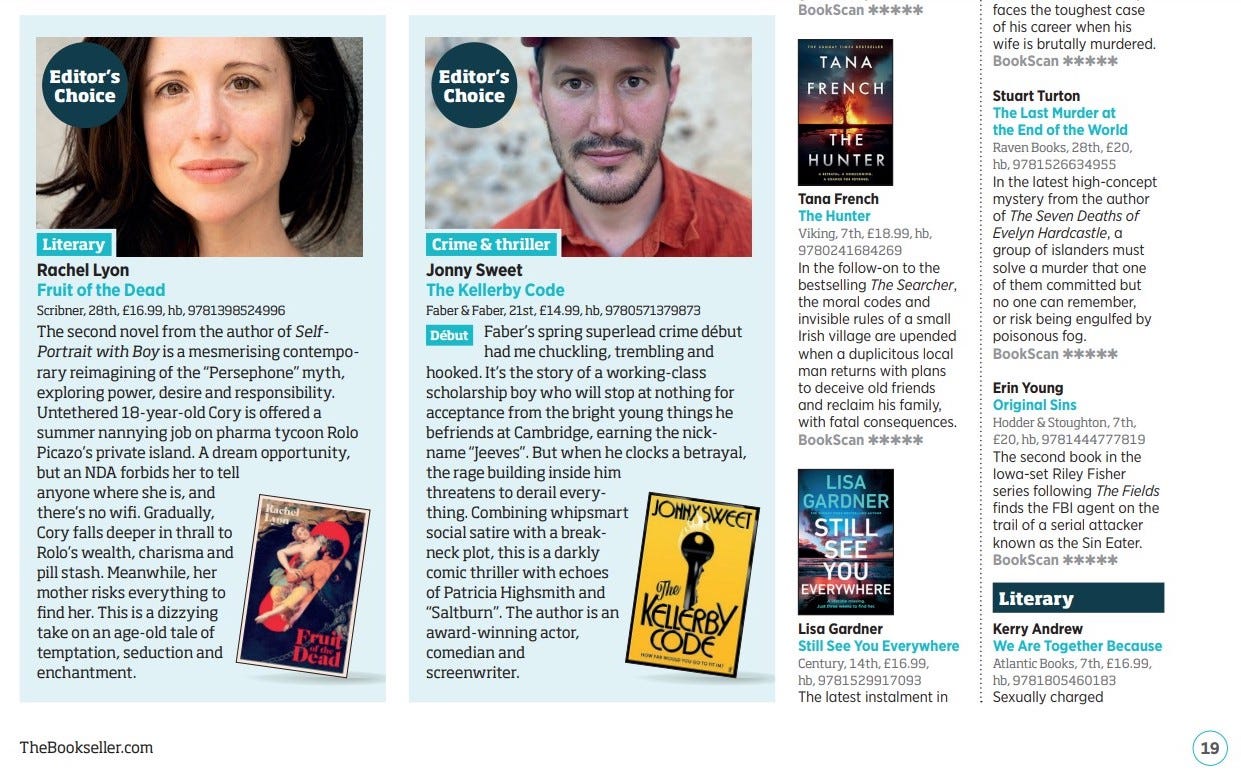
And Madeleine Feeny included FRUIT OF THE DEAD as an Editor’s Choice pick for March ‘24 in The Bookseller:
November 27, 2023
116: A Calendar for You
Four months out from publication is a difficult time for an author. One has done all the work one can possibly do—i.e., writing the darn thing, then fixing all the errors one can find—and all that’s left is to sit on one’s rear and wait for things to happen. Meanwhile people are throwing around startling words and phrases—I shudder even to type them here, but my dreams ring with the cadence of “Oprah”—and it’s impossible to know if, and to what extent, one’s humble book will ascend, or if it will simply expire before it gets the chance to hike even the foothills of these highest peaks of grandeur—!!!
I mean. Champagne problems. But waiting is harrowing! It gives me all the rollercoaster feels: fear and excitement, panic and perfectionism, discontentment and despair. My one-size-fits-all solution to getting stuck in a hellish feelings-cycle of this kind is: make stuff.
Postcards from Mountain House is a reader-supported publication.
If you are reading this, you are probably familiar with the concept of book swag. E.g. the excellent Allegra Hyde created an instructional guide called How To Make a Terrarium for folks who pre-ordered her novel ELEUTHERIA. Hua Hsu makes these great zines in conversation with his memoir STAY TRUE. Me, I am not an artist, though I did major in art as an undergrad—at a storied institution that is not however known for its art school—and I do like to draw. My point is, these images I’ve been making, they’re not expert, by any means. But I feel like, bound together, they do something. They make something unusual, something dark and imperfect, but alive. Which is why, without further ado, I am introducing . . .
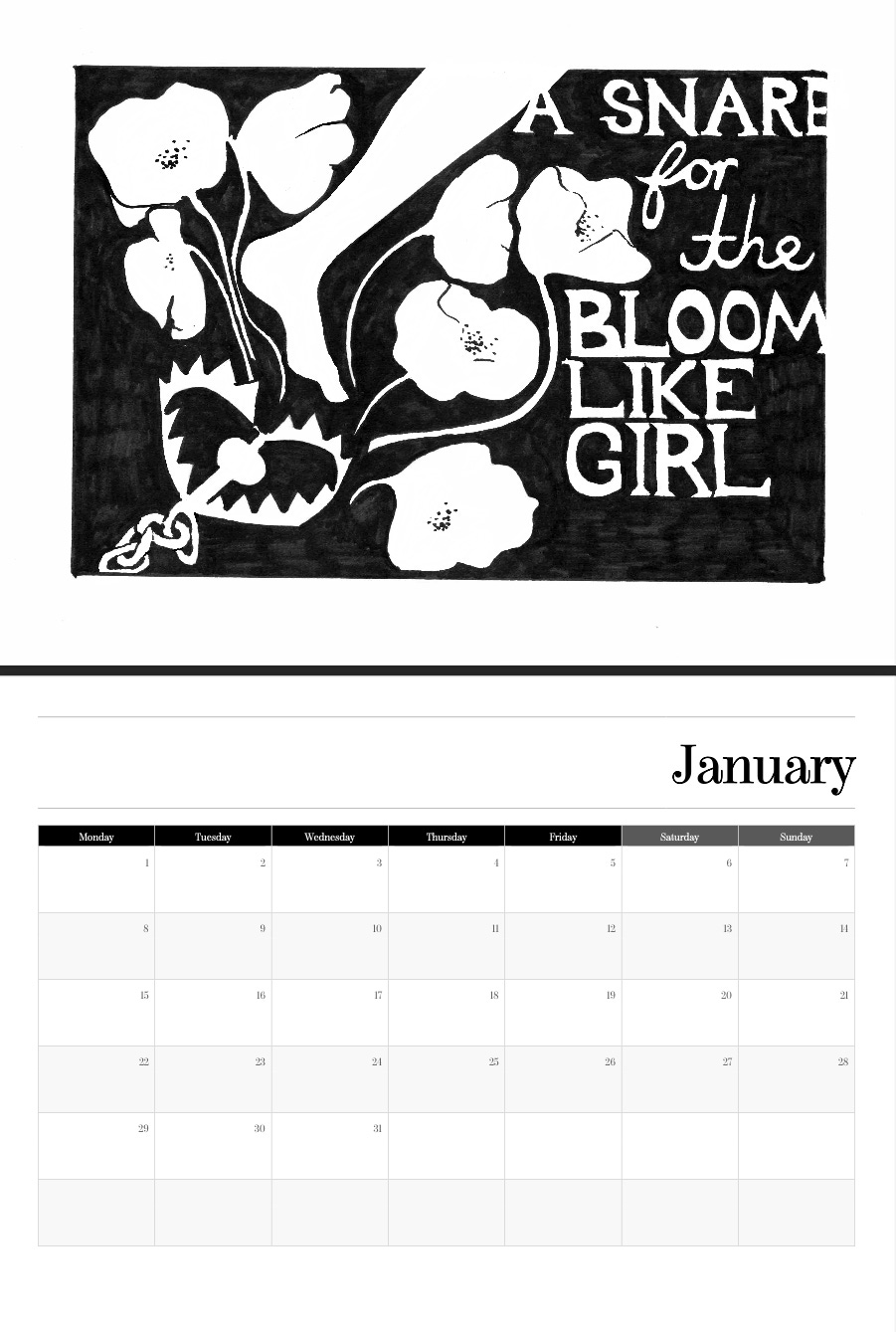
The FRUIT OF THE DEAD 2024 Wall Calendar!A handy, glossy, black-and-white adornment for your office or kitchen, featuring hand-Sharpied illustrations of lines adapted from the Homeric Hymn to Demeter, which I used for the twelve chapter headings in FRUIT OF THE DEAD.
Here’s a screen shot of January (from the PDF, because these things are not yet printed):
Here’s September (my favorite):
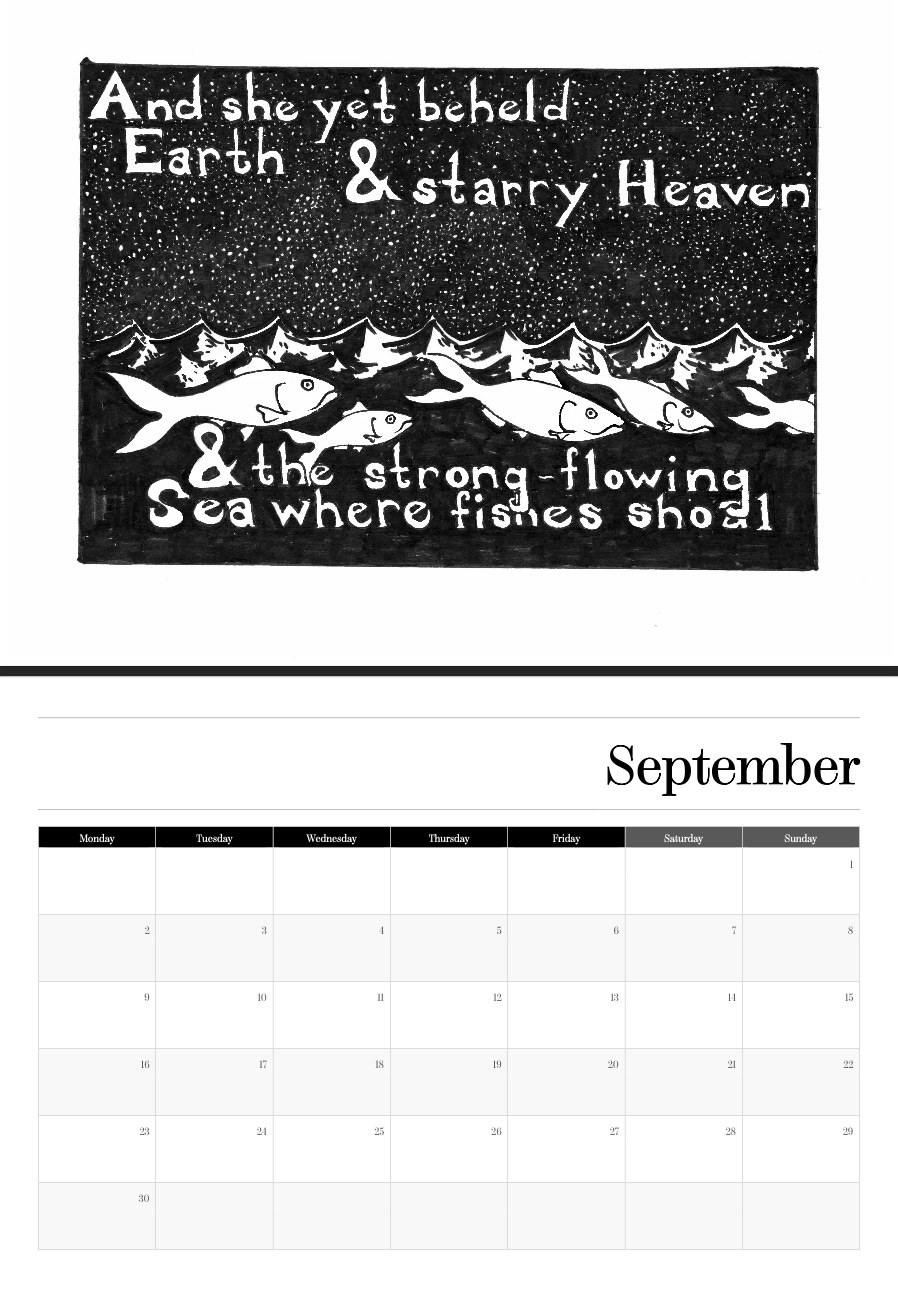
I am getting a limited run of these wall calendars printed myself, and would love to send you one (while supplies last!, as the infomercials say). If you would like a wall calendar of your own, or to give as a gift, here’s what to do:
Preorder FRUIT OF THE DEAD before 12/31/23 at your local bookstore, Bookshop.org (to get it on its US publication date, 3/5/24), or Waterstones.com (to get it when it comes out there, on 3/28/24), and reply to this email with your proof of purchase. (Probably, it being Cyber Monday, you can still find a few great deals via other online booksellers.)
(Optional!) To help offset the cost of printing and mailing these things, I have turned on paid subscriptions to this Substack, but am running a special offer at a reduced cost. If you have the bandwidth to become a paid subscriber, I’ll write you a personalized card and send it along with your calendar. Just let me know in your preorder info email whether to make out the card to you or to someone else, and click this link:
I’ll try to share more images from the calendar in the next few weeks, on Instagram if not right here. If the calendar becomes too expensive to manufacture, I’ll stop doing it. But I’m hopeful that this cockamamie idea will work. I like it, both in its own right and as a way of sharing my book as a physical gift in advance of the holidays, though the novel itself doesn’t publish until March.
Anyway. Let me know if you want one, and thank you for supporting my work. I can’t wait to get these calendars out in the world.
Rachel
Postcards from Mountain House is a reader-supported publication. To receive new posts and support my work, consider becoming a free or paid subscriber.
October 23, 2023
115: The Blurb Scourge
I started this letter a couple of months ago, when a friend of mine who has no relationship to the literary industry sent me a link to an Esquire article about “book publishing’s broken blurb system.” I have literally never thought about this, she said. Is it really this bad? The Esquire piece was actually the second so-called think piece I was aware of that had to do with this issue; the first was an article in The Atlantic entitled “The Blurb Problem Keeps Getting Worse.”
Coincidentally, I happened to be working on a second round of blurb requests for FRUIT OF THE DEAD, so, commiseration-wise, these pieces couldn’t have come at an apter time. I read eagerly, bitterly, nodding to myself, agreeing, Yes, yes, this is all true! Blurbs are sometimes phony and often subject to adjectival inflation! The blurbing process is nepotistic and exclusionary! It puts an undue burden on writers, stressing out those of us who have to request them, and imposing hours of uncompensated labor upon those who dole them out! What’s more, this burden falls, as economic burdens always do, disproportionately on a very few high-profile writers, including a tragically small number of writers of color.
Thanks for reading Postcards from Mountain House. Subscribe for free to receive new posts and support my work.
Time has gone by, since then. The blurb-request stage for this particular book is now, happily, in my rearview. My requests are officially out in the world, praising/begging a few brilliant authors on my behalf, and we are now in an early stage of pre-publication marketing—which is, I’ll just say, a lot more fun. See: the following mini-video!
Any writer will tell you that requesting blurbs is the worst. To put yourself out there, to approach a bunch of writers you, often shyly, admire—and who, you have to assume, are way too busy to bother with the likes of you—and then to ask for something without offering anything in return, is nerve-wracking at best. It’s hard for first-time authors because we already feel like outsiders in a cliquish industry, and it’s hard for authors who have published before because those of us who have blurbed others’ books are highly aware that blurbing can be a real chore.
Perhaps this goes without saying, but, fortunately/unfortunately, the lack of compensation for blurbing is a feature, not a bug: obviously, if writers were paid to lavish praise upon each others’ books, our blurbs would have no value. So the work itself must remain unpaid.
That said, on the giving end, I tend to follow a rather unfortunate cycle: (1) accepting the request because I’m eager to please, and the literary industry is small, and I want to be on everyone’s good side; then (2) leaving the manuscript untouched for too long, regardless of my interest in it, because, what with my various other time commitments—see: children—the time I have to write, to read, is already encroached on from all sides, and I find myself becoming resentful about anything that might interfere with that.
Incidentally, two manuscripts I’m actually looking forward to finishing are sitting on my desk right now, having gone untouched for days because I’ve been working on a new book, and my manic obsession with / wolfish protection of that project has left all my other responsibilities to molder in the shadows.
But, then, (3)—sometimes, I admit, after some nagging by the author or editor or publicist who has sent me a poor, neglected manuscript like the above—I get to actually read the damn thing. And here, I have found, more often than not, comes the pleasure of this work. In practice, even when it may not end up being my absolute favorite book ever, I tend to find it quite meaningful to get to sit with a manuscript, and consider it deeply. To excavate what about it feels most valuable, and to attempt to articulate that honestly, eloquently, and efficiently. It’s really a privilege to get to sit with another writer’s work in that way, and to help them along, professionally speaking—even in this perhaps increasingly valueless way.
Which is why, during the aforementioned period of blurb requesting, I mostly tried (with mixed success) to put my self-consciousness aside, and use the request itself as an opportunity to, first, stay in touch with writers I know and love, and, second, write a few fan letters to those I don’t know, but whose work I admire. And I found it actually became enjoyable—difficult, yes, but lovely. To sit down and devote an hour at a time to writing a note of admiration. To put into words what it is about others’ work that’s meant so much to me. To get to tell them how I’ve learned from them, and explain, in a sentence or less, how I might see my own work in relation to theirs.
Having receiving a few notes like this, myself, I know that reading this sort of love letter can mean the difference between another discouraged day and feeling hopeful, even inspired. For isn’t it nice to know when someone happens to be thinking about and appreciating your work. And isn’t it so deeply valuable—essential, even—to feel that your hard work is known.
Long story short, no matter how many think pieces are published on the topic, I think we can all agree it remains highly unlikely that the practice of blurbing will ever really be abolished. So how can we change it? Writers can shoulder only partially the burden of modifying the practice. It is the job of publishers, editors, and agents to do what they can to (A) protect the writers they represent from being overburdened with blurb requests, and (B) make publishing were more accessible to writers from all backgrounds, so that the burden of blurbing can be shared more equitably.
As writers, our part is, I think, just to be as honest as we can. Firstly, about our willingness and capacity to blurb or not to blurb; and, secondly, in our attempts to convey what we feel is most valuable about the books we do blurb. Only these two degrees of honesty can, I think, counteract the problem of blurb inflation.
—
Lastly, a little news:
I’ve started cohosting a reading series here in Western Mass, at the rustic and magical Dream Away Lodge in Becket, MA. We’ll be hosting 3 readers the third Saturday of the month until December, when the Dream Away closes for the season; then we’ll reopen in April. If you’re in the area, drop by our final event of the fall season on November 18! You can find out more about this and future events by following me, my cohost Kate Senecal, or the Dream Away itself on Instagram. And if you’re a writer who will be in the area at some point in the spring or summer, let me know! We’re booking now.
As always, if you are curious about my book or just want to support my work, please preorder the US edition of FRUIT OF THE DEAD at Bookshop.org, or get the UK edition at Waterstones.com.
Thanks for reading Postcards from Mountain House! Subscribe for free to receive new posts and support my work.
August 31, 2023
The Pre-Publication Whirlwind –and– A Great Renaming
Last week I got to go to Seattle and San Francisco with a really outstandingly sweet group of authors for a pre-publication, publishing industry event called Simon & Schuster Selects. It was a whirlwind trip, beautifully planned, during which I got to meet some very kind and fascinating people, including a whole lot of truly wonderful booksellers. It was, to be honest, one of the most exciting moments in my writing career so far.
Also I got to spend a few significant hours alone, during a week in late summer when, after months with a maniac 1-year-old and an emotionally whacked-out ‘threenager’ without a moment to myself, I had reached pretty much utter depletion. In other words, it was a beautiful respite.
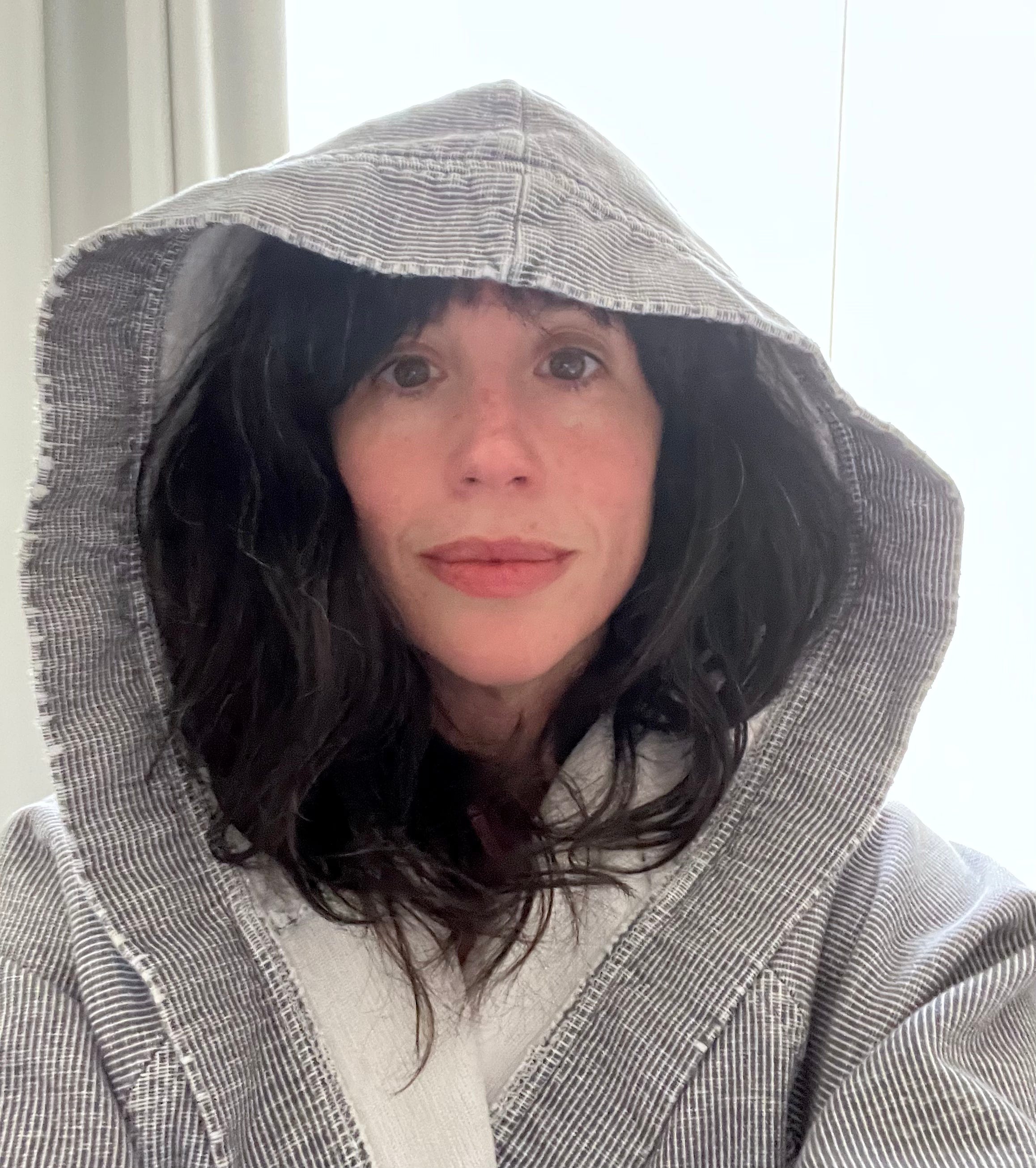 The hotels we stayed in had very good robes.
It was really great to get away. The babies stayed home with my partner and all three had a pretty fun few days while I got to be in the world as an adult, a writer, a chit-chatter, a walker, a flyer, a taxi passenger, a consumer of media, and an eater of good food cooked by professionals. I got to be in the world in ways I used to be in the world, before the pandemic and before I had children: in ways that, it turns out, I still need to be in the world sometimes.
Not that it was easy, exactly. Our first morning in Seattle we had some time to ourselves and I wanted nothing more than to find a nail salon and get a manicure. I had a latte (!) and avocado toast at the hotel, then put in my earbuds and walked about three miles up the edge of the bay in gloomy, windy, salt-smelling weather, listening to a very upsetting podcast, until I reached a salon that was open at 9 AM. Ladies, I was in my feelings. When I left the salon less than an hour later with nails the color of the pill capsule on my book cover, I passed a small day care with an outdoor play area full of toddlers, and I burst into tears. I’m not talking, like, one small tear wistfully trickling from one glassy eye. I’m talking, like, full-on Claire Danes face. One small child who was sitting comfortably in a Cozy Coupe looked out at me with concern, with skepticism. I realized I was being a creep, and kept walking.
A few hours later, I was presenting my novel to a group of booksellers as the sun sank over the bay, stuffing myself with tuna tartar and tiny falafel, chit-chatting like a champ, and feeling pretty great about everything.
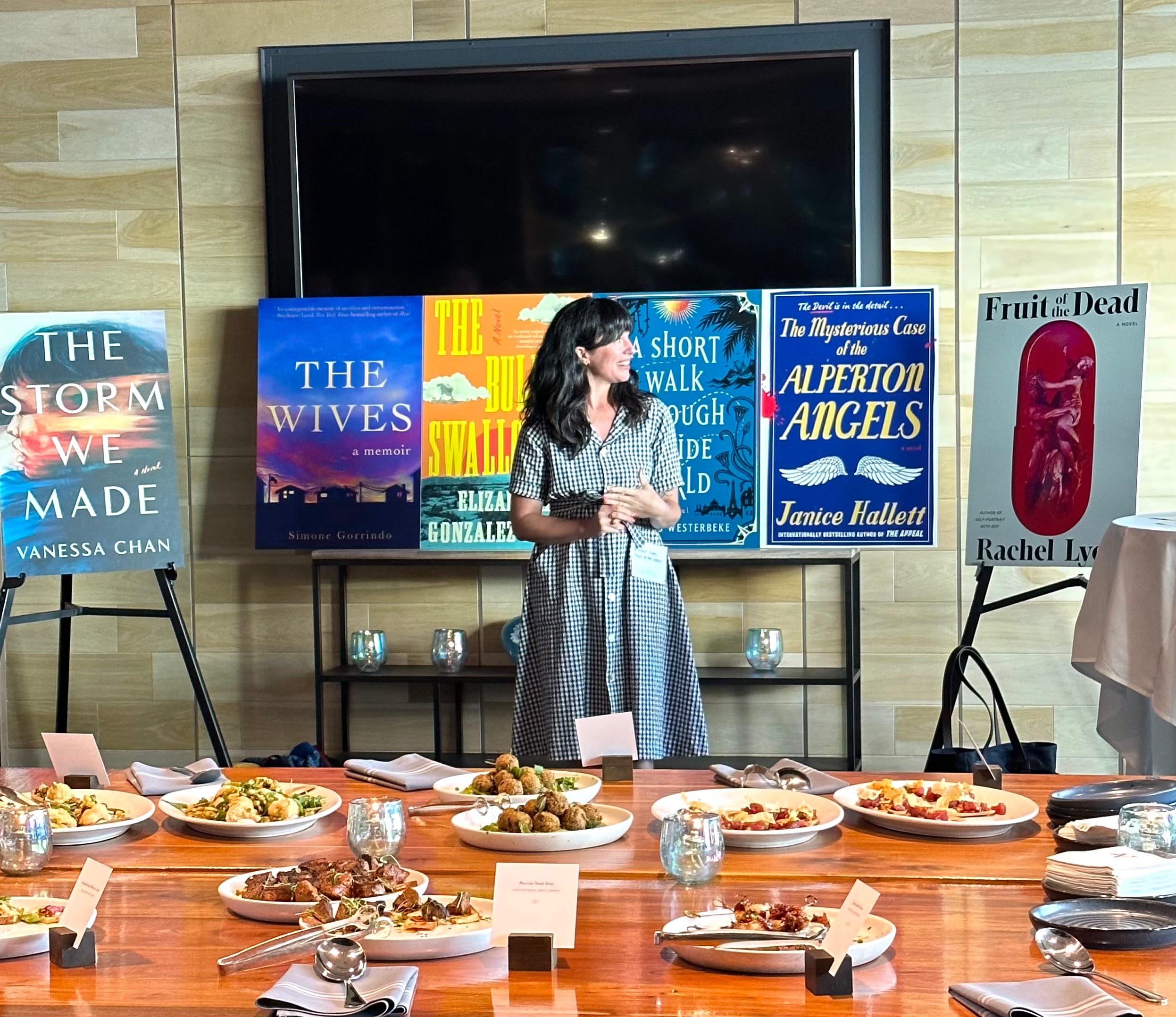 Simon Selects in a nutshell: lots of delicious food, six gorgeous books, and me nervously twisting my fingers.
I have talked about this before, in this newsletter, and it is hardly a revelation. But to hold these conflicting selves in one self can be so, head-spinningly difficult. I don’t know how anyone does it. No, correction: I don’t know how everyone else does it. The only solution I have found for it is to sort myself out in fiction. Fiction! It’s so simple by comparison. Even the most complex and dimensional fictional characters are more easily metabolized than one, real, confounding self. They have to be. They only exist for a few hundred pages.
I want to say more about sorting out the self in fictional characters. About how, in FRUIT OF THE DEAD, I attempted to tease the new self I was already recognizing as mother out from the old self I was writing toward—a reckless young woman given to playing with fire—in order to create two characters on the page who felt authentic to me, who felt real. I want to talk about how feeling real, in fictional terms, is actually very unlike being real. How fiction, like painting, is not a simulacrum so much as it is a creation in and of itself, which may evoke a few, assorted, finite aspects of reality, that is all. But I’m not really ready to say all that yet.
I will say. Hearing the other authors I traveled with pitch their books, I was hooked. You can learn more about them (and preorder, if you are so inclined), at the following links. From left to right in the photo above:
Vanessa Chan’s sweeping historical novel, about a Malayan housewife who becomes a spy for the Japanese during WWII: THE STORM WE MADE
Simone Gorrindo’s intimate, intelligent debut memoir, about her experience among a tight-knit group of Army wives, after her husband joins the US Army Special Ops: THE WIVES
Elizabeth Gonzalez James’s wild, speculative nouveau-Western, inspired by the story of her great-grandfather, a bandito who was shot in the face and left for dead by the Texas rangers in 1895: THE BULLET SWALLOWER
Doug Westerbeke’s epic debut, starring a 9-year-old French girl who believes she can outrun a fatal illness if she spends her life traveling the world: A SHORT WALK THROUGH THE WIDE WORLD
Janice Hallett’s clever, inventive crime novel about an investigative journalist compelled to revive a long-dormant case about a baby born into a cult: THE MYSTERIOUS CASE OF THE ALPERTON ANGELS
And, of course, my second novel:
One last note.
You may have noticed I have gone ahead and renamed this Substack. Back when I started this thing, years ago, as a TinyLetter, the concept was all about writing prompts. I had been doing a lot of teaching and I was thinking a lot about process. I wanted a place where I could articulate, formalize, and collect those thoughts, and where, hopefully, they might turn out to be useful for someone else.
Since then, the newsletter has evolved. It’s a more flexible thing now than it was. My intentions for it have changed. What I need from it has changed. For one thing, I have been doing less teaching, and my approach, when I have taught, has become less kitschy, less focused on generative exercises, more concerned with the strange alchemy of revision.
For another thing, though, as I have grown more accustomed to parenthood and to life in the woods as a city girl, I’ve felt an increasingly profound need for connection. Connection on my own terms, I mean: connection with other adults, on a creative and more or less intellectual level, like what I experienced on the West Coast last week; connection characterized by a kind of honesty that, for me, can only be achieved by sitting down and writing for a while, in a room of my own, alone.
So I’m calling this thing Postcards from Mountain House. Maybe just for now, maybe forever. I hemmed and hawed for a long time, actually, before finally deciding just to call it how I imagine it. To evoke, I guess, the casualness of this endeavor, the idea that I’m simply sending out these smallish, rambling little missives, to you, from my writing room on the side of a mountain, in the interest of not much more than just staying in touch. Who isn’t glad to receive a postcard?
Thank you for staying connected with me.
Rachel
Thanks for reading Postcards from Mountain House! Subscribe for free to receive new posts and support my work.
July 17, 2023
114: Be Gentle
My husband was away last week for work, and though I had a couple of visits planned with family and friends, I had no childcare save for that of my own frazzled invention. Our days have been long, and intermittently cranky. When it was nice out we went to the lake, where I split my attention between my eldest, newly three (fortunately he did not drown) and the baby, who seems dead set on eating all of the sand, and choking on all the world’s infinite tiny rocks.
Mostly, though, the weather has been violently wet. We are at a high elevation so have been spared the worst of the deadly flooding that’s plagued the majority of the East Coast, lately, but our thunderstorms have been plentiful and epic. Inside torrential rain pounding on our metal roof raises the general decibel level, eliciting competitive screaming from the children; outside, our long driveway became, last week, an unruly obstacle course of ravines and spontaneous streams.
Today, fortunately, the three-year-old is back at his sweet preschool for a short summer program. Next week, I’ll be consumed by some intensive teaching at what promises to be a super fun and illuminating Summer Writers Conference hosted by One Story. But this week, and for my two other weeks of partial freedom / partial childcare (though as childcare goes it’s not nearly enough: four four-day weeks, seven hours per day, of coverage for just one of our two kids), I nevertheless have a few capital-G Goals.
I’m working on a couple of short stories. I’m making a few notes for my next novel, for whenever I may have the time and space to start it in earnest. And, today, I am writing to you. Sending out a small flare just to say: hello. I’m still here. We’re still connected. I’m still working, and, through working, I’m remaining myself. Not just a mom / cleaning person / errand runner / laundress / bad cook / exhausted consumer of quality television, but a writer with a semi-functioning mind, a complete person with an inner life that wants, very much, to be tended to.
Thanks for reading Writing / Thinking / Living! Subscribe for free to receive new posts and support my work.
If you’ve been reading these letters for a while, you might notice I’ve slightly renamed this Substack. I have a couple reasons for this. First, I’ve been feeling like, though the initial “writing/thinking prompts” project was cute enough when my audience was (I imagined) mostly students and former students who might have been interested in continuing to give my short exercises a whirl, these days, the bulk of you no longer fit that description.
Secondly, though, I have found that I am no longer so interested in the whole “writing/thinking prompt” concept. Even in the class I’ve been teaching, here at our small-town local library, I haven’t been as interested in offering prompts, per se, as I am in setting aside some protected, quiet space and time, during which the students are invited to write what they want to write. I’m interested in letting the work grow, more organically, out of that listening silence, and in sharing and discussing work—both their own and that of writers I admire—and letting writing tips grow, if at all, organically, from that discussion.
Which leaves me with this small conundrum of what to rename this newsletter. I guess I have a few okay options. The one I like best, which I’ve kept coming back to, is the name of this installment: Be Gentle. The phrase has simple origins: it’s what I say over and over, many times a day, to my three-year-old as he plays near or with his baby sister. Be gentle. Are you being gentle? Sometimes he hugs her or kisses her cheek with such intentional delicacy my heart melts, and I’m sure my instruction is working. Other times he fully just sits on her, or knocks her over from a seated position so her poor head clonks on the floor. He is not much more than a baby himself; his frontal lobe is only fractionally developed. Still, I repeat the phrase, a kind of refrain for these long, unstructured days.
Be Gentle strikes me, too, as good advice for writers, FWIW, in this strange and often thankless (though, sometimes, if rarely, euphorically exciting!) economy of publishing. Widely applicable, too, I think. For instance, Be Gentle with your work: listen to it and honor what it seems to want to say. Be Gentle with yourself: remember that editors are overtaxed, across the board, that not everyone will read your work thoroughly or even cursorily, that rejections are part of the process. Try not to let the meat grinder of it all get you down. And Be Gentle with other writers’ work. To write a book (or a story, or a poem, a good one) requires a whole lot of time that most of us don’t feel we have, as well as a whole lot of energy, and it’s hard for most writers, I think, who are, generally speaking, pretty used to remaining pretty private, to feel, upon and leading up to publication, much more public, much more exposed.
And yet . . . as convicted as I am about all that, I also know that Be Bentle sounds a bit . . . touchy-feely? And, moreover, does not always apply. There have been times during the editorial process, for instance, when I’ve felt like, if anything, my mantra was or should have been, like, Be Ruthless. There have been times when, as an instructor, I’ve felt it more productive to be playful, or pushy, or strict. And there have been many times, as a writer, when I’ve felt like the more productive stance vis-a-vis my own writing has been not Be Gentle so much as Be Humble, or Be A Person, or, like, Maybe Embrace A Little Freaking Levity, Once in a While, And Don’t Be So Self-Serious???
So . . . I’m not sure. What do you think? If you have any suggestions, I’m open to them. I’ve left the comments option available for this post, temporarily; as long as comments remain civil, respectful, relevant, and, uh, gentle, I’ll continue to leave that option available and to read through them.
Thank you for reading, and thinking, and writing, if you write. As always, if you are moved to support my work, you can preorder my forthcoming novel FRUIT OF THE DEAD from Bookshop.org or elsewhere. It’s so pretty, isn’t it?

June 13, 2023
Prompt 113: Giving The Novel A Face
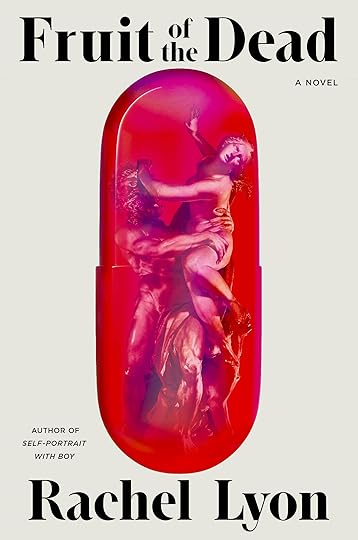
This week I was given the go-ahead to share the jacket design for my forthcoming novel FRUIT OF THE DEAD. I shared it a few hours ago on Instagram. Now I’m sharing it here, along with the very exciting new preorder link.
If you are into: contemporary reimaginings of ancient myths, insidious May-September romances, mother-daughter drama, addiction drama, “haunting and ecstatic novels that vibrate with lush abandon” (!), and/or if you are simply willing to support my work, please consider preordering this book.
For one thing, the ultimate success of any novel in this dreary, late-capitalist world depends in large part on preorders. For another, the clever, luminous—dare I say iconic??—dust jacket, designed by Math Monahan and Jaya Micelli, will look beautiful on your shelf. Behold! Bernini, encapsulated:
Subscribe for free to Writing/Thinking Prompts:
In my experience it can be awfully strange to see your book’s cover for the first time. It’s as if, for the past five years, you’ve been carrying on a lengthy and overwrought correspondence with an anonymous pen pal. You’ve learned all about her: what makes her tick, her peculiar wiring, the quality of her wit, her flaws and weaknesses and contradictions. But when she finally sends you a photo, you have trouble reconciling the layered, multifaceted personality you’ve come to know with anything as telegraphic, as instantly interpretable, as a human face. She may feel familiar—maybe you recognize some irony in her smile, or worry between her eyes—but she looks like no one you ever could have imagined. And maybe it comes as a kind of revelation, the idea that everyone else in her life, presumably, everyone else who’s met her and will meet her, over the course of her life, will see and interpret her face first, before getting to know the rest of her. And how will their preconceptions about her change, as she ages? And what have they assumed about her that you never could? Only you, you realize, seeing her face for the first time, have had the privilege of learning her this way, from the inside out.
And yet it doesn’t take long to psychically integrate this photo of her exterior with your sense of her interior, however complex and nuanced that sense may be. In fact, sitting down to write her back, having tacked her photo to your bulletin board, you find very quickly that her image becomes a kind of shorthand for all the complexity and contradictions within. Her posture signifies her relative openness or defensiveness to the world; her hairstyle signifies her self-consciousness or abandon. As her exterior is integrated into her interior, within you, her character is written.
Incidentally, there’s a writing exercise I like to do with my students, sometimes, which goes something like this. A weaving of exterior appearance and interior qualities. Nothing too one-to-one. We start with the outside and move inside, or vice versa. We focus less on the topography of the body than on the way the body moves. Her breath: is it shallow? Quick? Deep and relaxed? Her gesticulations: are they broad and slow, narrow and precise? Having sketched out a painstaking portrait of the body in motion, we spend half an hour writing one, highly specific, formative memory from her past.
Anyway.
I have been sitting with this jacket design for a couple of months, and while I’m still completely psyched about it, by now I am used to it. I have incorporated it into my sense of the novel: it feels representative of, and deeply connected to, the book I wrote. My novel, she has a face! Strange as it may sound, I feel like I know her a little better now.
Novels, though, unlike people (fictional and otherwise), can have multiple faces. This morning, my editor at Scribner UK sent me a first pass on another jacket design, for the same book, to be published in the UK. How strange, and how thrilling, to get the chance to connect with my book a whole new exterior. Sort of like seeing the same character in a totally new context: a reticent coworker, run into at night, dancing her heart out in a neon pink wig.
Your prompt today, should you choose to accept it, is to undertake the above writing exercise. Optional sub-prompt: Write an addendum, featuring the same character in a new context, in a wig.
Thanks for reading Writing/Thinking Prompts! Subscribe for free to receive new posts and support my work.
May 8, 2023
Prompt 112: To Be Forty, To Do Whatever You Want
I turned forty a couple of weeks ago. Having just gotten Covid, we were planning a small outdoor get-together at our house, a few friends, food, children running in and out of the woods, but the weekend turned out rainy and cold, so we postponed. Instead, a friend I’ve loved since high school came for the weekend with her husband and baby and a gorgeous homemade lemon chiffon cake, and I had a small crisis over mushroom ragout, and in the morning my friend and I snuck away, leaving the husbands in charge of the kids, to huddle under the covers and talk about friendship and people we know and the ways in which our lives have changed, and how else they might change, now, soon, or years from now.
The following weekend (also cold, also rainy), I came down to New York to celebrate with my city friends in the very wet, very chilly, very loud backyard of a Brooklyn bar, where we yelled at each other over the noise about how different life is, now, and how long it had been (some of them I hadn’t seen since before the pandemic), and I shoved my phone in everyone’s faces so they could admire my children, and stayed out until 11:30, which, at this point, for me, let me tell you, is madness. When the baby woke up at 6 AM the next day, I felt like someone had sucked out my brains with a straw, and then kept sucking until the sides of my skull began to cave it. It was great.
Thanks for reading Writing/Thinking Prompts. Subscribe for free:
Forty is an unglamorous milestone. It lacks the relief of 30, it lacks the gravitas of 50. I was prepared to glide right through it without much fuss. Which is to say: I was unprepared.
A friend at the Brooklyn party — a novelist I admire — remarked, “I crossed this Rubicon back in February, and would like to pass on to you know what someone said to me then: ‘Now that you’re forty, you can do whatever you want.’” My novelist friend is tall. I am short. I looked up at her. “I haven’t yet found this to be true?” she noted. “But I hope you do!”
I repeated her rallying cry to several forty-year-old friends over the course of the night. I felt like I had been invited to spread a kind of gospel. We’re forty! We can do whatever we want! It was fun, but in a way it rang, for me, as her, untrue. Aspirational at best! For one thing, you know (you know!), as life goes on, responsibilities multiply. I cannot do whatever I want because, at forty, I have reoriented my life around my work, my marriage, my progeny . . . . This reorientation is intentional and, for the most part, I am at peace with it, but it comes at a cost. For instance, though I have managed — so far! — to teach two classes this semester, mostly in person, I have had to leave campus immediately afterward. I’ve skipped all the exciting evening events I might otherwise have attended, readings, talks, celebrations, in the interest of rushing home to breastfeed. I haven’t even met the majority of my colleagues.
For another thing, as we age, our range of options and choices tends to narrow, not expand. I’ve been thinking about this often, in my current job, teaching college students: how an all too arbitrary choice we make in our teens, like whether or where we go to college, can have lifelong consequences in a variety of departments, from the basics — e.g. breadth of education, economic mobility, and social sphere — to deeper issues like habits of thought and of deportment, personal style, and identity.
I’ve been reflecting on how superficial were the factors that went in to my own choice of college. It was informed, in large part, I’m sorry to say, by prestige; in lesser but not inconsequential part by the romance of Gothic architecture. Certainly at seventeen or eighteen I lacked the self-knowledge to make any kind of informed decision about where I might be happiest — rare, I imagine, is the teenager who does have that kind of wisdom, perhaps rarer still the teen who believes happiness is possible, or even real — and indeed I was pretty miserable at school. But even that misery, itself, had lasting consequences: it led, in an indirect way, to my ending up on a certain island off the coast of New Hampshire, which I drew on, years later, in writing the fictional setting for my forthcoming book, and where I ended up meeting some of my dearest people, one of whom eventually became my husband. I have no regrets, but I do sometimes wonder how differently things — how differently I — might have turned out, had I attended an institution where I’d felt safer, freer, and more encouraged to fail — for fail I would, of course, and often.
It was this sense of a lifelong process of narrowing — this feeling of life, as it goes on, as a kind of reverse flow chart — that inspired that small crisis, the night of my birthday. As we four adults at the table talked about aging — its freedoms, its obligations, its regrets — and, intermittently, interrupted this conversation to tend to the children and put them to bed — I became aware of a creeping sense of finality. I have been so many different people all my life, was the gist of this feeling, but as I’ve gotten older my evolution has slowed to stasis. The person I am now is the person I’ll be for the rest of my life. No more phases! No more experimenting! Just this, for better and for worse, until death.
A week later, in Brooklyn, I mentioned that birthday dread to another writer friend. She’s forty-five, and promptly laughed at the idea that anyone ever really stops evolving. You’ll keep changing, she reassured me — and I looked around at the other forty-five-year-olds who’d come, that night, and thought, coincidentally (?), that there was a kind of lightness about them all. In fact, many if not most of these individuals have lately entered a fresh, romantic phase of life. One has just broken up with a long-term partner who could never meet his needs. Another is in the difficult but relieving process of divorce. Many are newly in love! They seemed profoundly free.
There’s nothing like looking outside of oneself to assuage a little fit of solipsism.
The cold and rain have finally given way, up here, to sunshine. It’s spring, for real, now, the trees have budded, the mayflies woken up, and tulips are bobbing their Easter egg heads. I’ve been forty long enough that I don’t have any real feelings about it, anymore. We have three more weeks of classes, and then the constraints on my time and attention will loosen up a bit. I’ll be free, again, to work on a new novel project, which has been nagging at me in quiet moments: in the car, just before sleep, and in the early morning, before everyone else wakes up. For now, all I’ve gotten down are a few notes, a timeline, voice memos describing a few imagined scenes. Until I am available to sit down and write a paragraph or two, I’m trying to keep it alive this way: like a rumor I heard somewhere, whose source I have forgotten, but whose metaphorical significance feels weighty, somehow: mysterious and meaningful.