Timothy P. Brown's Blog, page 83
March 26, 2023
Today's Tidbit... Disintegrating Football Pants
Early football players wore tight-fitting, all-purpose pants worn at the gym or for other athletic activities, but as the game became power-oriented in the 1890s, they added quilted pads to the front of their pants.
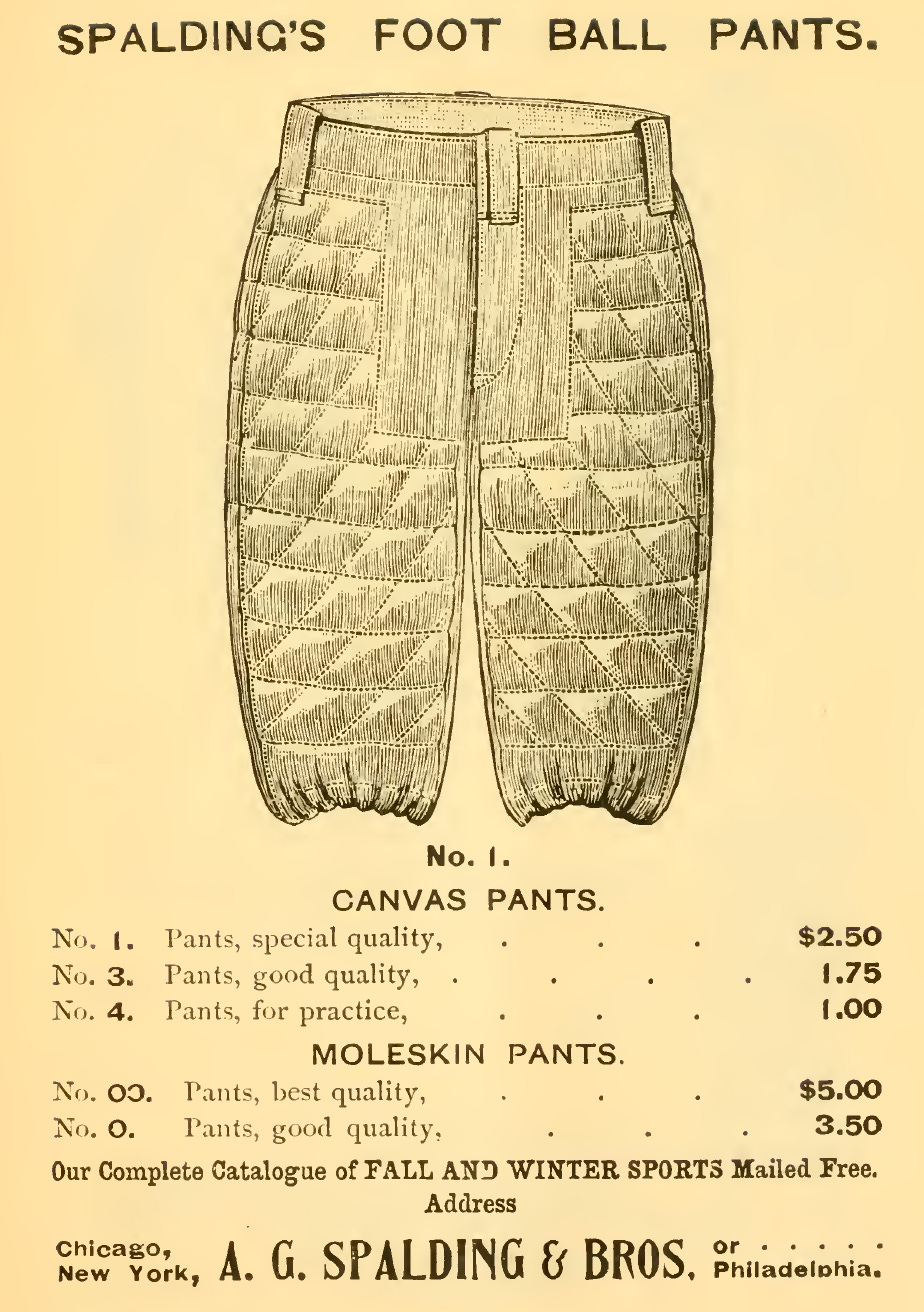 Spalding advertisement (1893 Spalding's Official Football Guide) - Click any image to enlarge -
The 1900s saw cane ribs integrated into the thigh pads to offer mechanical protection while the knees remained padded with felt or hair.
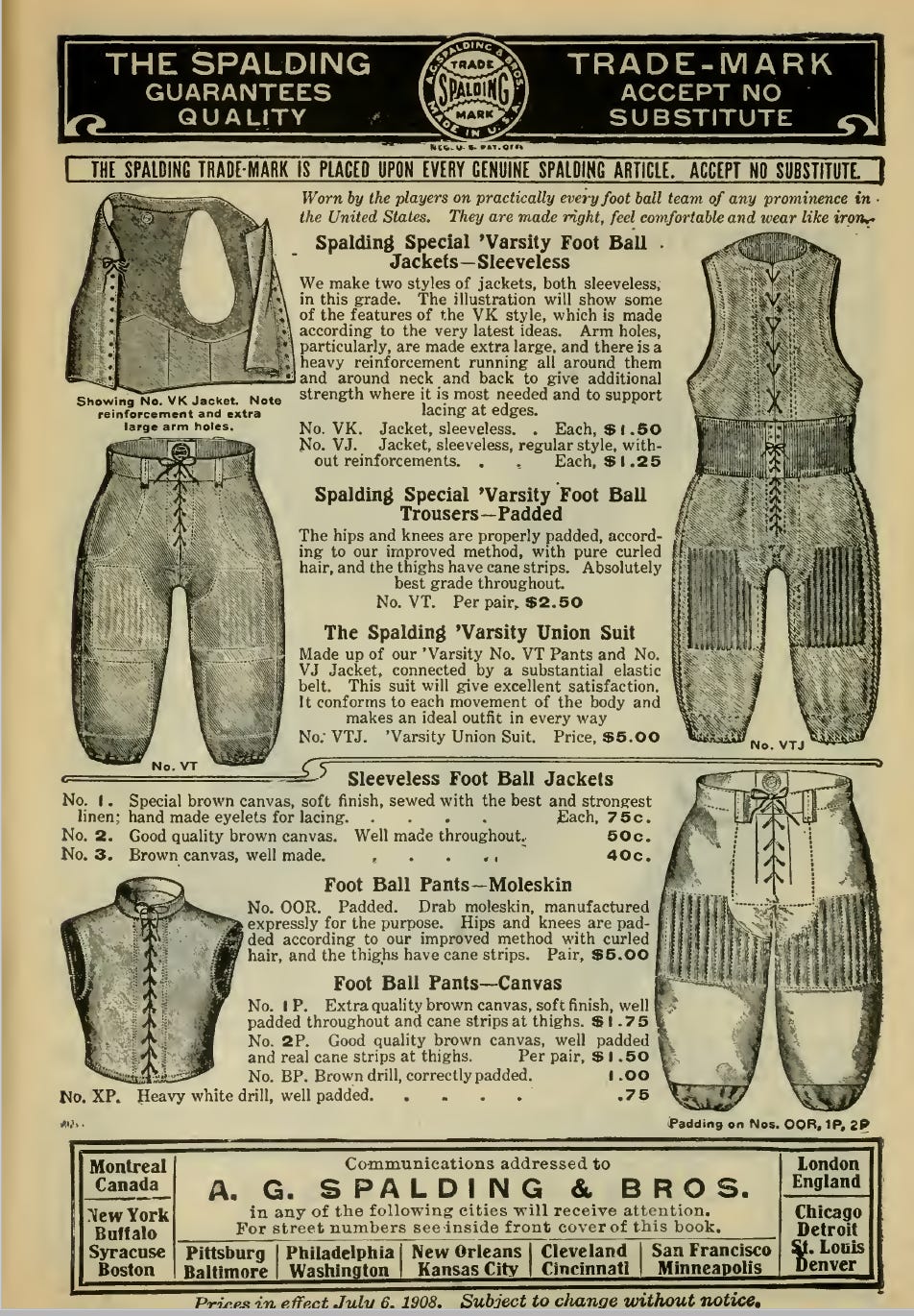 Spalding advertisement(1908 Spalding’s Official Foot ...


March 25, 2023
Today's Tidbit... College Football's Losingest Coaches
Most fans could easily name half the top ten college football coaches with the most career wins, though the coaches that worked at lower levels may be more challenging to recall. (Two coaches tied for tenth place, so the top ten includes eleven coaches.) The coaches that achieve this level of success have two things in common: they won at a high percentage (.605 or above) and were head coaches for many years (at least twenty-seven).
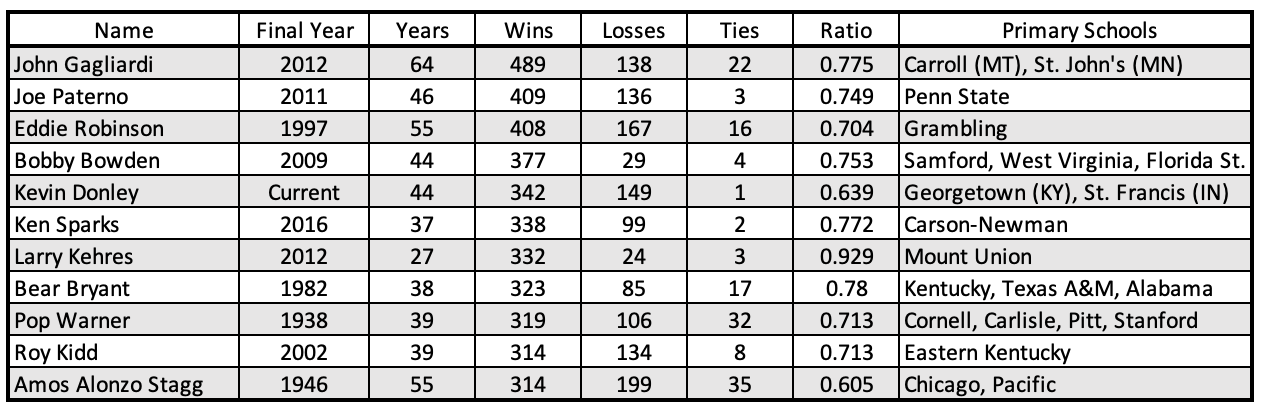 Adapted from Wiki’s list of college football coaches with 200+ w...
March 24, 2023
Today's Tidbit… IFA Rule #23 Offside
This is #23 in a series covering football's original 61 rules adopted by the Intercollegiate Football Association in 1876. We review one rule each Friday.
We reviewed Rule 22 last week, which established the rule covering onside and its complement, offside. Unfortunately, I jumped the gun and described how offside players were not supposed to participate in the play. That is what Rule 23 tells us, cited here:
Rule 23: Every player when off side is out of the game and shall not touch the ball in an...
March 23, 2023
Today's Tidbit... 1903 Purdue Football's Tragic End
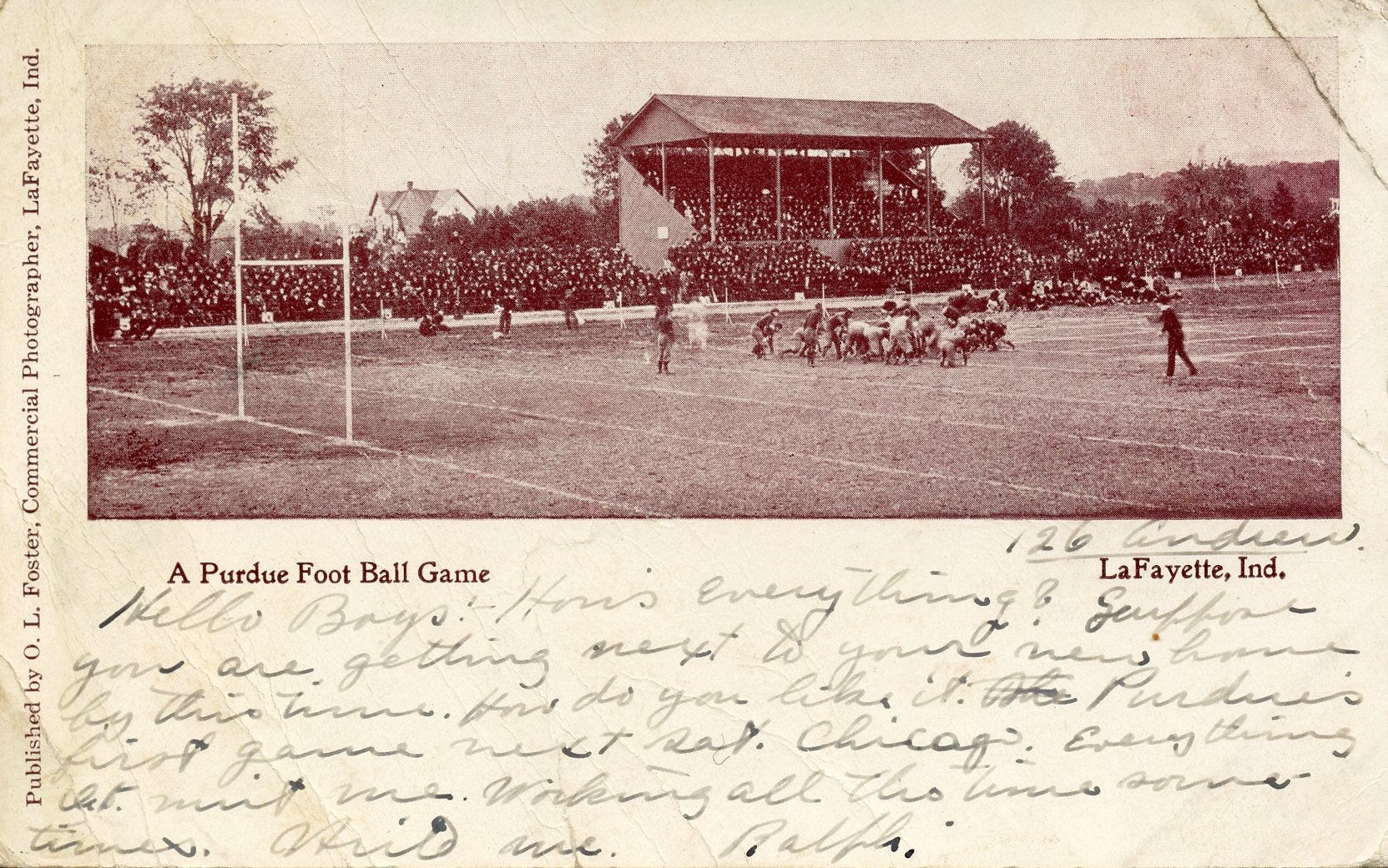 A 1903 game at Purdue’s Stuart Field. (RPPC, Personal collection)
The image above shows an RPPC mailed in 1909 from West Lafayette, IN, to Will Hubbard in Bosler, Wyoming. Mailed by a Purdue student named Ralph, the message asks how things are going in his friends’ new home and mentions that Purdue opens the 1909 season playing at UChicago.
Although Ralph mailed the postcard in 1909, the image shows a game played at Purdue's Stuart Field in 1903, the only year football fields had partial checkerbo...
March 22, 2023
Today's Tidbit... Keeping Score At The Big House
Football was first played on college greens and local pastures lacking the simplest creature comforts. However, things improved quickly as the top games moved to polo grounds and professional baseball stadiums with the capacity to seat thousands or tens of thousands.
In part, to limit the commercialism of the game, some leading colleges banned games played off campus, which pushed schools to build on-campus stadiums. Most were simple wooden structures that handled football, baseball, and track. O...
March 21, 2023
Today's Tidbit... Gamesmanship, the Big Ten, and the Rose Bowl
Fans today recall the Big Ten, Pac-8/10/12, and Rose Bowl partnership as seventy-plus years of marital bliss, interrupted near the end by outsiders sticking their noses into a place they did not belong. But the relationship was strained at times when one or another of the partners said, "It's not you. It's me that's the problem."
One of those times came in 1960 when both partners were going through some things. Big Ten and Pacific Coast Conference (PCC) teams played one another in Pasadena from 1...
Pigskin Dispatch Podcast: Eliminating the Second-Half Kickoff
Pigskin Dispatch podcaster Darin Hayes and I discuss a recent TidBit about eliminating the second-half kickoff, an idea discussed on multiple occasions by the pre-1940s rules committees, and discuss how the game could look different today.
Click here to listen, or subscribe to Pigskin Dispatch wherever you get your podcasts.
Subscribe for free and never miss a story. Support this site with a paid subscription, buy me a coffee (or two), or buy one of my books.
March 20, 2023
Today's Tidbit... Name On Tape (NOT) On Football Helmets
Elements of football history that are part of the rules or occur in games are more accessible to research than more informal parts of football. Teams’ practice and offseason activities are also not as well documented as other parts of the game. For example, college yearbooks show team pictures, crowd shots, and game action images, but few describe and include photos of practices and offseason workouts. Likewise, newspaper reports on team practices often told which players were running with which...
March 19, 2023
Today's Tidbit... Separating the Ladies and Gentlemen
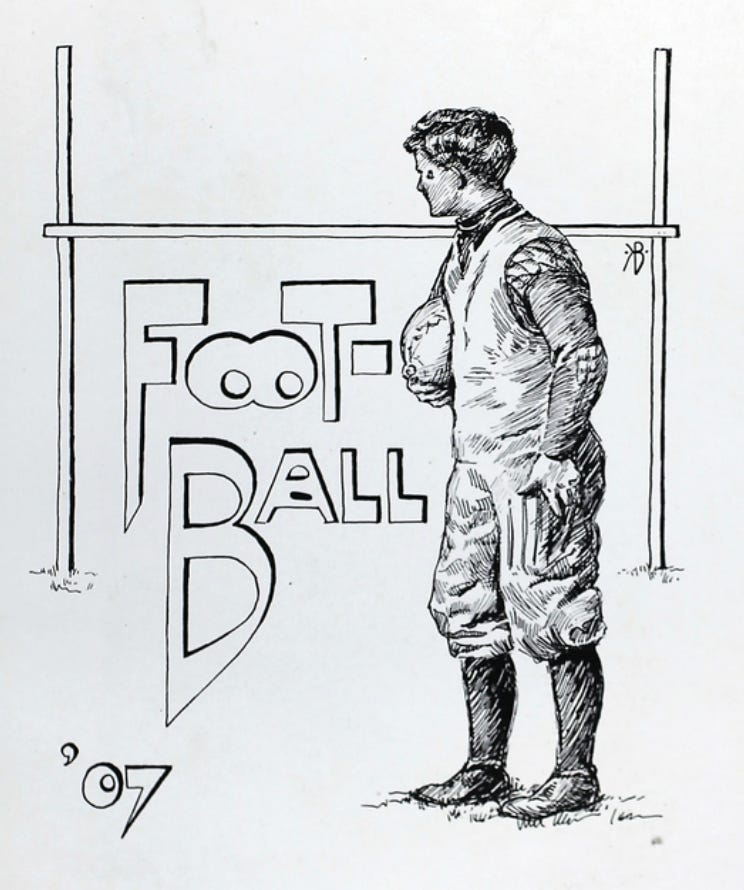 This image is not directly related to the story but is a good-looking illustration from Oberlin’s 1909 yearbook.
Ordinarily, images of the crowds at football games are interesting because they indicate who attended games and the fashions they wore. The two RPPCs we'll review today are from the 1909 Oberlin-Heidelberg game and show us several other aspects of football crowds from the first decade of the twentieth century.
The image below shows Oberlin at home during the 1908 season, playing an unkn...
March 18, 2023
Today's Tidbit... Shooting Down The Flying Wedge
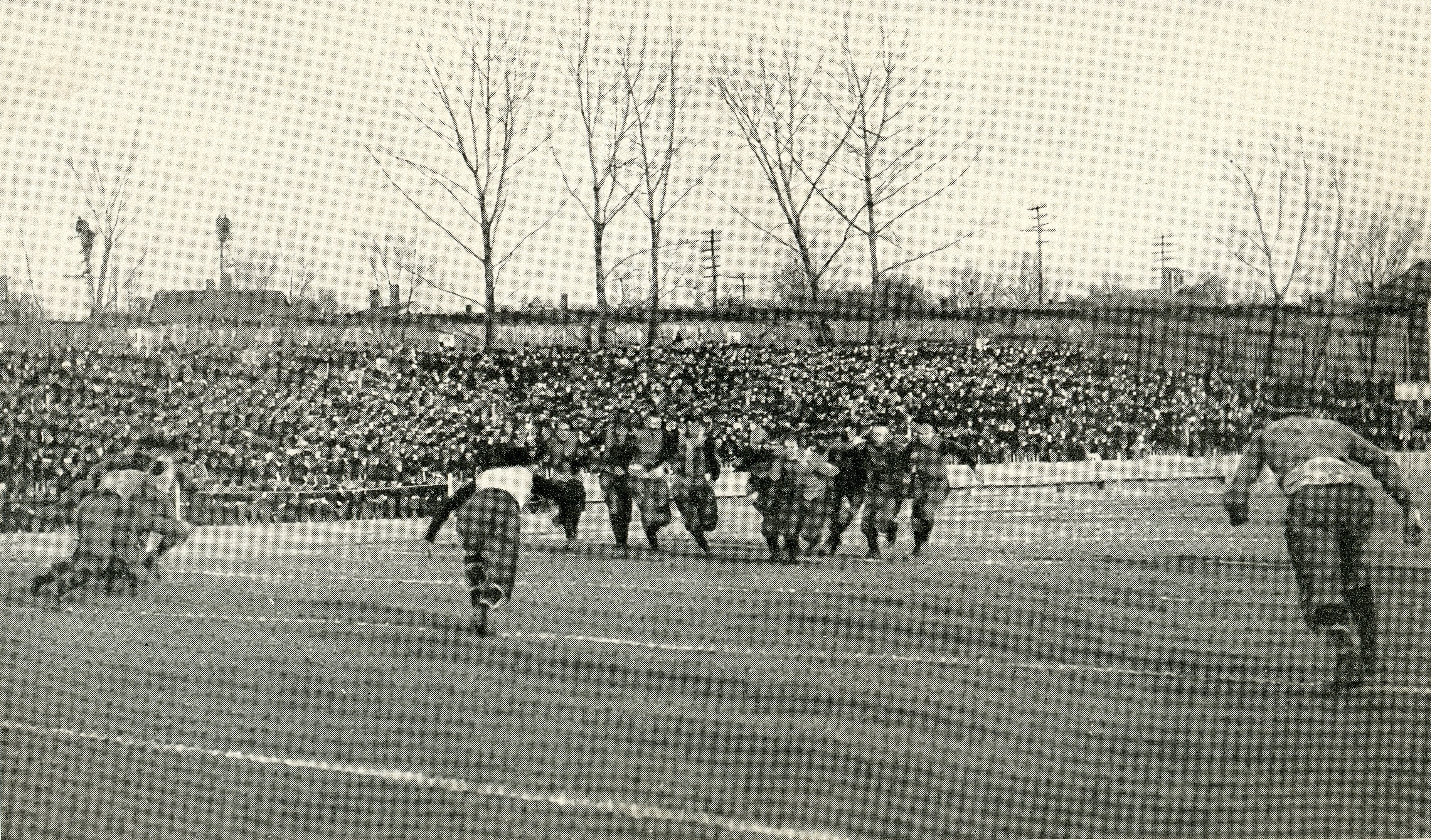 The original flying wedge, Harvard’s famous formation about to attack Yale on November 10, 1892. (Parke Davis, 1911)
Lorin Deland developed the flying wedge, which Harvard showed for the first time in the 1892 Harvard-Yale game. As football was played at the time, kickoffs occurred at the start of each half and following each score. Unlike today, the team that had been scored on did the kicking, but they retained possession by kicking the ball a few inches or feet (like soccer) before picking it ...