Roderick T. Macdonald's Blog, page 21
August 6, 2018
Why I Write Fantasy: The Three Fours #2: Bram Stoker’s Dracula
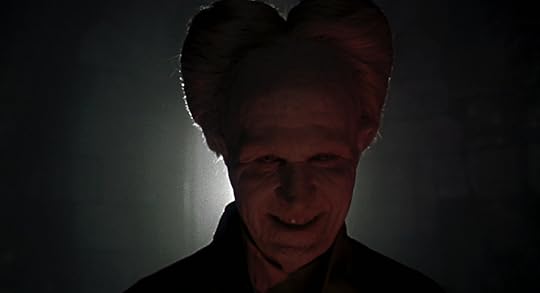
Oh yeah. The music, the costumes, the saturated colours, the visual style that played with realism and then deliriously ignored it to tell its story in its own defiant way, and managed to sweep me up in it.
I watched this movie four times in a rather dilapidated cinema in Dundee, complete with decayed but still rippling red curtains, formerly plush seats (probably some sort of 70s velour well past its sell-by date), dusty empty alcoves in the walls to either side, and a balcony from which an excellent view was to be had: it was an old actual theatre repurposed, and like the film, it held many memories, perhaps not all happy.
This movie captured me from the first chords playing over the Columbia pictures logo. Now if you’ve read my blog for a while, you’ll know I have been a sucker (yes, I went there) for horror movies since my early teens and the very tame, but highly atmospheric old Hammer Horror films. Francis Ford Coppola’s opus turns all the atmospherics up to 11, the visuals and music combining to make it a sensory experience, a movie as much felt as seen. Or maybe that’s just me. And of course it makes Dracula the hero, when in most of the films I’d seen up to then he was the adversary. Here he is the protagonist (again the villain getting the best of the story!) and the plot is one of love and redemption, which was probably not the first thing most audiences would think of when considering a Dracula movie before this film arrived. Here is Dracula as Satan in Paradise Lost, the noble rebel against god, his greatness highlighting the depth of his fall, but in this version he can be redeemed, unlike Satan who degrades and regresses throughout Milton’s poem, this cinematic sinner is given a chance at redemption, despite his crimes.
Now, if you do not fall under the spell of this film, there are many ways to drive buses through plot holes, and more than brave Keanu’s accent to snigger at. I choose not to folks. I choose not to.
More powerfully than in Highlander I was swept up into this intensely gothic world, of heightened drama and sensation, passion and desire writ large, with its own disorienting laws of movement, a visual language created to entrance the viewer and allow for the fantastical. For a couple of viewings, even though I loved the medieval knight/saint reference of Dracula’s eyes looking upward in death as the old iconography so often used to depict the blessed in prayer or martyrdom, I still wanted Dracula and Mina to run off and live eternally ever after in oceans of blood. Nowadays that might happen – gotta make a franchise! Of course that outcome being okay depends on your conveniently ignoring the five hundred years Dracula spent killing people (which I could, because Gary Oldman has charisma), and the consequences of their ongoing existence together as undead groom and bride.
So, rather than Dracula being destroyed, as is usual for the monstrous versions of the villain, this one is allowed back into the grace of god through his rediscovery of love, and receiving of love from another. In both versions the vampiric threat is ended, but in this one Dracula also gets a positive resolution to his story. The monster lover in me wasn’t keen on this reading, but I reluctantly had to concede that it made much more sense for Dracula to die, be forgiven by his god, and then be reunited in death with his reincarnated wife, who just killed him… well let’s not parse that one too closely! This film is far more about the feel and impression of things than the explanation of them, and in this movie, it feels right to me that Dracula is not simply destroyed, but transformed, and his evil undone. Dracula’s arc comes full circle in the film, once again looking upon the cross in adoration, the rift healed. That is why for me, despite the fact that my inner teenager would much rather see Dracula win and be a prince of darkness forever, (which in this universe would be, and has been, his hell), I find I must accept the bittersweet happiness of earthly love being his gateway to salvation, and Mina’s freedom. I’m going on. Did I say I love this movie?
I also loved how it played the old world of Dracula’s origins against the emerging modern world of Victorian London, a setting in which Dracula makes sense: the nineteenth century is a time in which mysteries could still exist, and strange corners of the globe could still be home to monsters and allow you to imagine it to be so with relative ease. Today, with every spec of the earth trod by intrepid travellers filming their every move, and satellites circling with unblinking eyes over us all, it is very hard to imagine anywhere left undiscovered. This is why I really think King Kong should go interstellar, and Skull Island be an alien planet. I’m not saying that’s a great idea, but the Pacific just isn’t big enough to hide prehistoric islands in anymore. Not when we sadly have islands out there made of our own trash.
Anyway, Bram Stoker’s Dracula: a world I drowned in, and was drawn, tugged back into the cinema to see over and over again. Beauty, tragedy, redemption. A triumvirate I find hard to resist. And that music, oh that sweet music.


August 2, 2018
The Writing Life: The White Rabbit Beckons
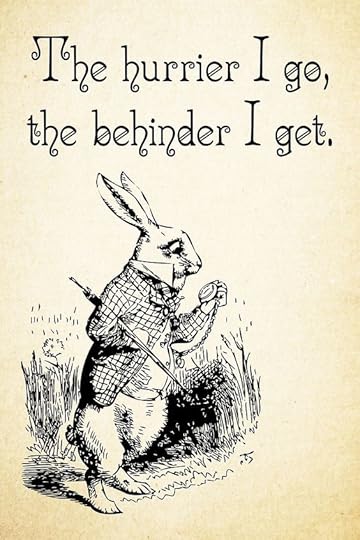
So: thoughts have been gathered, and revision begins.
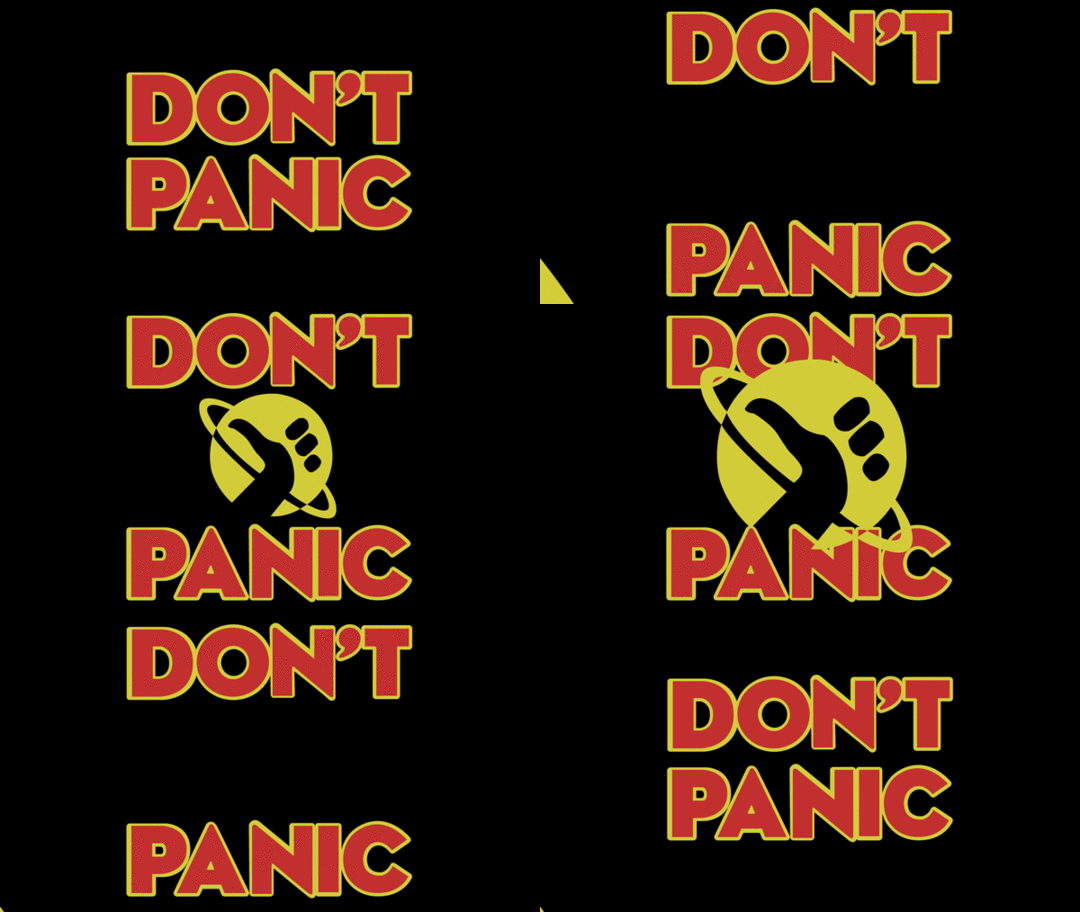
There is a lot to do. So right now I’m oscillating between this.
And this.
The thing is not to blindly rush in, or panic about how much there is to do, though that is tempting. I have to remind myself not to get bogged down in minutiae (so easy!), and stick with the big picture.
One foot in front of the the other, breathe. Take your time. You might not have a lot of it, but rushing just wastes it.
Let’s look over another chapter or two before bed. Tomorrow will bring with it more opportunities to advance. So I’ll do that then.
July 30, 2018
Why I Write Fantasy: The Three Fours #1: Highlander
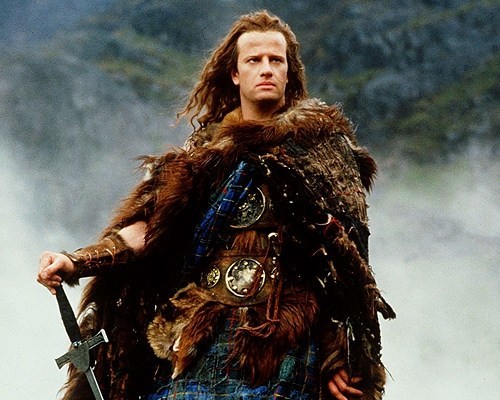
Spoilers for a 30+ year old movie follow. And for Alien3 too. You’ve been warned.
There are only three movies I’ve paid to see more than once in rapid succession, and each time I ended up seeing the film four times in the theatre. In each case I was lured into the atmosphere of the movie, and the rich universe it created, I went again and again because I wanted to participate again in that fantasy, be fascinated by its characters (especially its villains, I can’t lie) but most of all to relive the rich experience of being, temporarily, in that world.
The first was Highlander. I recently rewatched it after probably a twenty year gap, and it still rocks, though some of the 80’s incidental music that never used to register as out of place does intrude now. Many are the nitpicks you could have with this film, (Egyptian Spaniard played by a Scotsman, anyone?) but I loved the world it created, the leapfrogs through time, the scene shifts, the way, right from the opening monologue by Sean Connery, it very successfully created its own world, alongside our own.
It is a great example of the creation of a mythology in very quick steps, doesn’t explain everything because it doesn’t have to, just flows along showing us what we need to see to stay engaged, propelled by a fantastic soundtrack by Queen, which unlike the incidental music has entirely stood the test of time. I cried again when watching the “who wants to live forever” scene, even though I’ve seen it god knows how many times, just a perfect mixture of setting, acting, and music. It also, very rarely of all the movies I’ve watched, successfully uses flashbacks to give itself more depth, even though you maybe saw the fashback originally only half an hour ago, in terms of the movie’s time line it seems like hours back, and really works.
And of course it was largely set in my homeland, which was a plus. How beautiful Scotland looks in that film. It really is that beautiful in life too, moreso. The scenery was a star, of Scotland and New York, the scene cuts fun to start anticipating, a film made consciously in an overt style, which is still refreshing to see today, after all these years. The New York cops deserved their own TV show, especially the captain!
And yes, there is cheese. Not everything works, but a lot does, and the film was filled to the brim with imagination and audacity, enough to carry the absurd plot right the way through to its Headhunter 4 – Cops 0 finale! “What does baffled mean?” I loved it! And when you love something, the absurdities either fall away, or get embraced as part of the charm.
We don’t talk about the sequel. We just don’t. I watched all the other movies in the vain hope something could be salvaged. I liked the Mario Van Peebles entry, to be honest, but it was still unnecessary. The TV series did nothing for me. Highlander is best considered in isolation. Man that sequel, it eclipsed Alien3 as the most anticipated and then most disappointing cinema experience I ever had – (we don’t talk about The Last Jedi either) it took me a very long time to forgive Alien3 for killing Hicks and Newt at the start, along with the very improbable magical mystery emergency egg that somehow got on the Sulaco – yes I’ve heard the arguments, they are all utter balls. There is no way an uber paranoid Ripley would not scour and scan that ship from top to bottom before going into cryo, just sayin’.
But unlike Alien3, which I have rewatched multiple times and have come to really appreciate, there is no saving Highlander 2. So let’s just pretend it never happened.
Highlander also boasts one of the greatest cinematic villains ever. In my opinion. The Kurgan is a total boss at being evil, and the film perhaps revels too much in his violence, his amorality, his charisma, but it also explains why he must lose. He himself yells it out in the cathedral scene. “It’s better to burn out, than fade away!” Becoming a mortal doomed to fade and die would have been a nightmare for him. He is destined to lose because if he won he’d lose his reason for existence. It is the Kurgan, and Clancy Brown playing him that elevates the film from standard escapist hero’s journey with swords (always a plus for a fan of fantasy, and this is a fantasy) to something more interesting: a treatment also of the antagonist’s motivations, why he is powerful and terrifying, but also showing why he can and should be defeated, why in a sense he might welcome that, burning out as a human roman candle rather than fading away as a feeble old man.
And yes, I saw the wires on the second viewing, and every time after. The DVD I just bought did a good job of making them less obvious.
So there you have it, the first movie I just had to keep going back for, to sit in the dark and let another world welcome me in. There were two more films like that to come in the next decade, and if they don’t directly inspire the stories I write, they certainly influence the way my imagination shapes scenes and settings, and my desire to create worlds that people just might like to dive into over and over again.
July 26, 2018
The Writing Life: Gathering Your Thoughts, or Dealing with Developmental Editorial Feedback
So I received my developmental notes for The Killer and The Dead last week. These notes were a collection of thoughtful comments and suggestions on plot, structure, pacing, writing, setting, and character. Plus a ton of in-text comments on specific aspects of the book, good and bad, pointing out places where improvements could be made, moved, removed or added, depending on the topic at hand. In short, an invaluable service that I highly recommend to anyone serious about their writing and about submitting their writing to the public as a professional.
Now I’ve had these documents in hand (or on drive) for a week. I have also had extensive beta feedback from other readers in this past week. Very insightful and inspiring.
What have I done with it? I’ve read it. Paused. Read it again. Let it sit in my mind, kicked at it idly, but not with significant intent for a couple of days.
Then I started making notes. I annotated the developmental letter, anaylsing some of the advice and suggesting to myself some responses. Mostly I let the ideas sink in, let my conscious and subconscious begin to play with them. I read some email from my beta readers. I replied, because I think well by writing and talking. I began to suggest more concrete responses to the notes and feedback I was receiving, started to conceptualise what I was going to do, and where in the text. I started writing notes on new content. I worked on identifying which thematic threads I was most likely to tap as keys to rewrites, to give everything a harmonious purpose in my mind, and to help guide me to specific end goals and effects in the writing.
At a certain stage you realize that this could be a staggeringly complex exercise. You can’t even conceive of the flowchart you’d create to catalogue the physical actions in the book, the character evolutions, the emotional moments, the themes and motifs that you want to reinforce, or remove. The effing continuity issues, which are universal in any novel writing exercise.
I took a shower, went to sleep. Played some pool. Put my mind back into slow cycle, picked at a few strands of the book here and there, had pleasant imaginings of small corners, fragments of scenes, how minor changes can make a huge impact. Try not to think about whether or not they will make the right impact. No second guessing – this is why I work on having a harmonious frame of mind, and a cohesive strategy for the whole book before I start rewriting. I wait for the ‘click’: the thing that makes everything else make sense, and that allows all the many cogs and wheels and constituent parts of the book to work together and become something more. Sometimes a small scene you retool can help you find the key to all the changes you might want to make across the entire book. Sometimes not, you just get a cute character note added that is pleasing to you, and hopefully to the reader. Now, in thinking about the book, you must think about the reader, the time of the first draft and doing things for fun and for yourself is past. Now you need to shape your text for other eyes. That requires a shift in thought, and it too can take a while to happen.
The ‘click’ happened a couple of days ago. I know the direction I’m going to take, and what it means for every character in the book. What I hope it will mean for the reader, and for me, as the writer. The click could have been one of a few things, that’s why I took the time to gather my thoughts, to move around and through the options, to feel them out without a sense of mad urgency, so that the one that felt best would become apparent. I think it has. I’m going to start the rewrites this weekend. I’ll find out if my plans survive first contact with the text, and if they don’t, well, I’ll have to improvise!
This is my experience of this stage of the editing process. I don’t believe you should dive in too fast after getting developmental feedback. I believe you should stop, take stock, sleep, breathe it in deeply, and let the feedback rest a while. I don’t have a whole lot of time, so more than a week before starting to work was unrealistic, but this week of not rushing in, of spending time thinking, speculating, calmly re-evaluating the feedback – which can be overwhelming at first, having your baby picked apart by a professional other – is I think essential for me. I need to have certainty going forward, to know how and why I’m going to make many changes to the text, move it closer to its final form. There is time for more debates on specifics, more discussion of flashpoints and crucial moments and how to handle them, how to fit them into the overall narrative, but the important thing is to have a plan, and for that plan to have a unifying principle. I think I have that now, and how sweet it is.
July 23, 2018
Why I Write Fantasy: Today’s Reasons
I write fantasy because I want to put words together in magical patterns that cause as much delight in others as putting them down did for me.
I write fantasy because I want to say something new in a genre dominated by tradition.
I write fantasy because I want to explore strange new worlds and seek out new civilizations.
I write fantasy because the lure of the unknown is irresistible. And it is unknown until I pin it down with words. And even after. That’s what makes it so damn unknown, and so irresistible.
I write fantasy to explore ideas.
I write fantasy to say, “Look! I did this!”
I write fantasy because I like to tilt at windmills.
I write fantasy because I’m only half here, and I want to be with the half that’s there.
I write fantasy to challenge myself to do better.
I write fantasy because the grass really is greener over there. Unicorns wouldn’t eat it otherwise.
I write fantasy because I want to see what is around that corner, over that hill.
I write fantasy because I want to share the dream.
I write fantasy because it burns within me, and it is better to let the flame burn than to stomp it into ashes.
I write fantasy because I see shining eyes wink at me, and invite me to join the dance.
I write fantasy because I can do no other.
July 19, 2018
The Writing Life: Reading Your Own Writing
Ah, my writing holiday is almost over, as I get the developmental edits on The Killer and The Dead back tomorrow. I have one more night of imagining I’ll get a note of stunned awe, and thanks for writing such a thing of searing beauty.
And writers out there, you do hope for that kind of feedback, don’t you?
Of course that is not what I’ll get, and not what I want. The searing beauty can come later, after working in the word mines a while longer. I’ll get flaws pointed out, suggestions for alterations of pacing or character, ideas for things that feel like they are missing, or parts that seem superfluous. Positives will be pointed out, negatives discussed with a view to eliminating or inverting them, finding a way to make weaknesses strengths. That’s the fun, if you can call it that, of the developmental edit, it’s there to help you dig through your book, find the gold, discard the tailings, or perhaps rework them, smelt some unused ore into something shiny and fine.
I’m really stuck on metal metaphors this week! Next week I’m going organic!
Of course to do all this I’m going to have to read my own words. Which is always easier said than done at the start of the process.
I think, for me, maybe not for other writers, I have two basic reading modes of my writing when I’m not in the groove of actually working on it, when the self-conscious mind is cast aside. That doesn’t happen for me at first. My first instinct when reading my own work is to cringe. I find fault, read the first page and see a blizzard of errors and things to improve, mentally barf, just a little, and wonder if it is even worth me reading on. The cringe is powerful, and sometimes I stop right there and decide to come back later, because I’ve slipped too far into the negative, and need to rebalance the way I look at my own writing.
The other way is hilarious (to me, I’m not going to make it remotely funny for you). I’ll come back, start the read again, be kinder to myself through the passage that I cringed at, and move on. I start thinking “you know, this isn’t half bad…” another page or two “this is pretty good right here…” another few pages, “damn! That was sweet! I mean, I totally nailed that, and how cool was the construction? Eh? Eh? I know! It was effing awesome! Did you like how I…? Of course you did! High self five!!” From cringe to euphoric delusion in 15 pages tops. It is amazing.
During the second type of reading I can still spot flaws, make notes, but I’m so enamoured of the parts I view as good that I’ll forgive myself whatever it is I see that needs to be fixed, and view it as an opportunity to bring everything up to the level I imagine the good stuff is at. So that is good, but in general the euphoric reading style is almost worse than the cringe, because I’m more blind to real flaws then than I can ever be when cringe-reading. I’m reading it as I imagine I want it to be, not as it is. I forget how much extra stuff is in my mind informing what I’m reading, and forget that another person who reads my words is not going to know how or why I got there, or possess all the background info I have that gives the words far more context than they currently give themselves. A new reader is only going to be picking up my world from the words I put down. Euphoric reading often forgets the reader you are ultimately writing for, and as such can be dangerously self serving.
And this is why we need outside readers folks, or at least why I do, and why hiring a professional to burst your bubble in the nicest possible way is for me a must. Because good feedback allows me to approach my writing more dispassionately, as a sequence of problems to be solved, and to take the emotion out of my reading and become more professional myself in my approach, with identified goals and objectives to be met. I can still hoot with glee when I solve a problem in what I think is some style, but I am working within a framework, and I have the next issue to move on to, to resolve. It also reminds me to read the book as an artifact to be read by others, to consider how to share information, emotion and action with readers who are not as intimately involved in all the behind the scenes work as I have been. This is not easy, which is why multiple editing passes are needed, to strip the book down to bare rock and then build it back up to the forest covered hill or flower filled valley I hope the reader will enjoy exploring. It isn’t easy, but it is, in a masochistic kind of way, fun.
He says now, before the work has begun!
July 16, 2018
The Hammer and the Fall
In creative life, many do not appreciate the time taken between the hammer and the fall. Now I’m going to be all metal and talk about hammers and striking and forging, but the metaphor could just as easily be the time taken between the seed and the flower, and be about soil and water and nurturing, but I like the hammer metaphor better, while recognizing (I hope!) that not everything is indeed a nail.
So with that caveat made, what am I talking about, the hammer and the fall?
The time taken between the having of an idea, and the forging of it into shape.
For some this is short, the hammer falls quickly, repeatedly, and the idea is forged and tempered at speed, the artist in tune with their vision, the art ready to be produced. But for others, for many creative people, the hammer can sit on the ground, seen, waiting, and not picked up – but it is there. You have the idea, but you’re not yet ready to work on it. The reaching for the hammer can take a long time too, that’s when you toy with the idea, think it through, daydream about it, argue with it, whatever your process is: but the hammer is not yet in hand, the idea not yet pinned in place on the anvil, ready to be made into something new.
Even once you have a strong sense of an idea, and the hammer in hand, it may take a long time before you raise the hammer, get it ready to drop – you are waiting for the idea to be ready, or more likely (at least in my case) for you yourself to be ready to express it and then, only then, after potentially years of waiting, are you finally ready to drop the hammer on the idea, to start forging it into the thing you have so long dreamed of.
That is the time taken between the hammer and the fall. Sometimes everything fits and you can strike immediately, in other cases you or the idea or a combination of the two need time to get to a place where you can commit to the act of creation, and are ready to make something new. It cannot be rushed, but also should not be ignored.
And that is why the hammer waits to fall, it waits for the right time, the right moment, the right mode of expression. For magic to be made, the hammer must strike truly, and it is something that waits within us as writers or artists, gathering weight and momentum, life experience and time served, until its moment comes to fall, and strike.
And then it is glorious.
The hammer and the fall. Potential energy and kinetic. Harness both in your writing or art and you are, at that moment, become so much more. It does not matter if the heavens or the masses sing your name, in that moment you are realized. In that moment you are whole, as an artist. In that moment you are real.
And that is glorious.
July 12, 2018
Mystery Blogger Award
[image error]
I kept saying I’d do this, and finally I have got around to it! Thanks Mitch for my first ever blog award nomination!! I feel all grown up now!
The Rules:
Use the logo and list the rules
Thank whoever nominated you and provide a link to their blog
Tell your readers 3 things about yourself (see below)
Answer the questions you were asked (see belower)
Nominate other blogs and notify them (see belowerer)
Ask your nominees 5 questions of your choice, with one weird or funny question
Three things about me:
I like parties when they’re over, that’s when I can finally relax and enjoy them.
I’m a sucker for games with expansions. The more the merrier.
I just bought a new shaft for my pool cue. I didn’t need it, but it is my first indulgence since getting a new job, and it is 1 inch longer than the old one. I’m going to find out if size matters in a shaft. I’ve just realized that this too is a form of expansion for my pool game. I’ll be here all day…
The questions I was asked:
1) What moment or choice in your past do you wish you could undo? Mitch, this is a doozy! Never believe anyone who says I regret nothing, or I have no regrets. They will be lying, deluded, or dangerously incurious about their own lives as lived. Edith Piaf and Frank Sinatra may have sung prettily, but they have a lot to answer for in helping to promote a culture of no regrets. At least Frank (I believe) didn’t much like that line in his song. If I could turn back time (Cher) to undo moments and choices I’d break the dial. But I can’t, so am forced to go on, living with the things I cannot change, and vowing to do/be better. That’s Frank again, but I don’t hold that against him!
2) Funniest movie/s you ever saw? South Park: Bigger, Longer & Uncut. There’s a lot of story behind it, with some regrets liberally sprinkled in, but it was an incredible release in a bad time. It isn’t as funny on a rewatch. You had to be there. I laughed until I cried and couldn’t breathe, regrouped for a while, then got hit by the next comic avalanche. The first Hangover movie was a hilarious breath of fresh air too, with no associated regrets! (Apart from watching the next two, and seeing the magic die…)
3) Greatest song/s you’ve ever heard? I’ve already mentioned this online and so will never use it as a security question or answer on anything. Gates of Babylon by Rainbow is simply the greatest song ever written or performed. It completely changed my twelve year old life. I do regret that it has led to my present day deafness though.
4) Greatest truth you’ve ever learned? That it’s a long way to the top, if you want to rock’n’roll.
5) What are the last words you want to hear before dying, and/or the first words you want to hear after dying? “Look away from the sea, I can take you anywhere…” OR “Wake up.” Before or after is fine.
Nominate Other Blogs:
These are folk with tales worth telling, perspectives worth sharing. There are so many more, but these will do for today!
JM Williams : http://jmwilliams.site/
Darkwood https://kaiyahartauthor.online/
Educated Unemployed Indian https://educatedunemployedindian.com/
Life of Chaz https://lifeofchaz.com/
The Lily Café https://thelilycafe.wordpress.com/
Choices in error https://erroneouschoices.wordpress.com/
Dirty Sci-fi Buddha https://dirtyscifibuddha.com/
Jennifer M Zeiger https://jennifermzeiger.wordpress.com/
An Author’s Travails https://anauthorstravails.wordpress.com/
The Darkest Tunnel https://thedarkesttunnel.wordpress.com/
Itanndy https://itanndy.com/
Dread Poets Sobriety https://dreadpoetssobriety.com/
Unbolt Me https://unbolt.me/
Morgan Hazelwood https://morganhazelwood.com/
Five questions for my nominees:
1) What journey has made the longest lasting impression on you?
2) Which book, if any, has most completely transported you into another world, or another person’s experience?
3) What is your favourite thing about home?
4) What smell, if any, transports you back to childhood?
5) Do you put your pants on one leg at a time?
July 9, 2018
Why I Write Fantasy: To Write the Classic Non-Human Races, in Other Books, Later
In the fantasy of my youth non-human races were always part of the magical formula that took me from the mundane here, to the fantastical there. Talking animals, creatures from greek myth, folklore figures brought to life, all of them were part of that secret world just around the corner and over the hill that I kept on wanting to find, but never quite could.
The classic fantasy races of Tolkien soon came to dominate the landscape, followed by their fantasy role-playing equivalents and variants. It was expected, I thought, to write a fantasy with dwarves, and elves, and goblins/orcs. And humans of course. But not hobbits – I never wanted to write hobbits, perhaps because they were too familiar, or their story too well told by their creator, it was hard to imagine saying more about them. kender, on the other hand… nah, I couldn’t touch them either!
Funnily enough, the first books I wrote had none of the ‘classic’ fantasy races present. Nope, I tell a lie – goblins were there from the start, I even had a goblin character for a while – pretty ahead of my time in 1985! Maybe I was kicking against the expectation early, but I went out of my way to create different types of human, then two non-human races not derived from any other book or game I knew of, and then I weakened and threw a bunch of elves into the second one, haha! (I already had my Pern rip-off dragon, I’m ashamed to say!) I also had a thinly disguised balrog as potential hero in book two – things started to go decidedly into left field by that stage, and I was having fun throwing anything I wanted into the mix and seeing what stuck, as I had pantsed my way into a complete mess and couldn’t see a way to end book two, let alone fight my way to a coherent five book series, so I think I kind of let myself go nuts with the plot twists as I was hoping I’d somehow find a new driver for the story that would help me work my way to the end. That didn’t quite work out.
The book that I spent many years on did have the classic trio of dwarves and elves and goblins, but written to a particular thematic purpose that let them be familiar, yet different in nature from the Tolkien or D&D versions I was by then so used to. I was being arch and full of ideas, so they had in some way to be archetypes and carry my ideas around, proclaiming their ‘not-Tolkienness’ to the world. It was a phase, what can I say, and in a few years you may get to check them out as I do intend to revamp that book now – there’s plenty of good story in there, and I’m no longer precious about every syllable, and divorced enough from it to gut it as necessary when the time comes. I quite look forward to that, in fact! (And so should you, honest!)
In creating The World Belt I decided that I didn’t want the classic races there, this was not the world for them. But demons and the undead are a-ok, you understand! The stories of The World Belt explore magic, and the influence of magic upon humanity, and having other races I felt would dilute the focus of the stories. Dwarves and elves are cool, but they don’t need to show up in Aranvail, at least not until that portal starts reaching to other worlds…
When I do eventually write a story with those classic fantasy races in it I plan to go full Tolkien, and be unashamed in exploring the tropes around each, while at the same time providing a good ‘why’ for each race’s culture, philosophy, and actions in the world. It isn’t enough for fantasy races to just be anymore for me, they also need to have a reason, and a purpose (as Tolkien’s did), or they are just window dressing to make the world you have created different, and I think they deserve more, which is maybe why I’m holding fire on producing those stories, because when I do those, I’ll have to work hard to do them right.
July 5, 2018
The Writing Life: Taking a Writing Holiday
So I had this plan (not for a giant wooden badger) to start writing the first draft of my next book while The Killer and The Dead is off getting developmentally edited. You know, use the time, maximize my word counts, get the first few chapters of The Slavegirl and the Traveller banged out and be ahead of the game for next year. I mean I have the story plotted out in quite a bit of (exhaustive) detail, so it wouldn’t be too hard to just jump into it, right? I even know what the opening line will be!
Yeah, well, the opening line can just wait. This last half year has been one long frantic rush, with July 2nd as its highly anticipated terminus. I reached it. It’s time to stop, for just a little while.
Time to not think about writing stories for a week or two. Time to recharge my batteries, to go out and experience life, nature, art, to refill the creative well with inspirational experiences. Mostly I’ll be in bed or in front of a screen, but you get my lofty ambitions.
I’m a little tired. I could do with a break. I mean I’d like to do extra writing if I could, but should I confuse my brain by jumping ahead onto a different project for three weeks, probably start getting right into it, only then to have to switch gears back to writing Stahl in TKATD? That seems like a strategy that could backfire. Better to write some nice blogs when not time crunching, including the ones I got nominated for (thanks again!), and to do some mundane book related work. Pay some more attention to my FB reading and writing groups again, catch up on Goodreads updates, add more keywords to my advertising campaigns. Do new ad copy and try other strategies. Watch more research videos and not feel like it is time taken away from writing, but time being spent usefully in service of writing. And maybe go to a museum, up a hill, into a gym. Lord am I lardy right now!
Watching TV and movies might be fun again – recently I always felt it was time taken away from writing (apart from watching The Expanse, which has just been awesome all the way) but now I can be mindless, not always thinking about plot and character, give my brain a break and let it come back to those ideas of its own accord, rather than forcing it there. It’s not as if I ever really stop thinking about story ideas – even when writing this draft of The Killer and The Dead I was daydreaming and writing down snippets for both The Slavegirl and The Traveller and the sequel to The Thief and The Demon. (When I write a series set on another world, the books will NOT be The X and The Y! But in The World Belt, that’s the way it’s going to be! Until it isn’t, of course.)
So taking a vacation from writing, from the pressure to produce, seems like a good idea right now. I have another five months to come of deadlines, and need to be refreshed and able to take them on. Burning the writing candle at both ends by trying to get a few chapters of the next project started now, while a good idea in the abstract, is perhaps setting myself up for writing burn out down the line, and I don’t want to go there! If writing stopped being fun, stopped being a useful expression of my creativity, a need that is only satisfied by doing, then it would be very hard for me to keep doing it, and I want to – I have so many plans for the future! To implement those plans I need to manage myself to get to that future refreshed and always eager to keep exploring new writing horizons, and that means, for now, putting down the composing pen.
Over there. Where I’m going to leave it. For a couple of weeks. Honest.