
Chuck Wendig's Blog, page 202
August 29, 2013
Flash Fiction Challenge: Choose Your Setting
You know the drill: Random number generator or d20. Roll it. Grab a setting from the list below and go forth and write yourself around 1000 words of fiction set in that location.
Due in one week, by September the 6th, noon EST.
Post at your online space.
Link back here.
The list, then, is:
A Starbucks during the Apocalypse
The gates of Heaven
A slaughterhouse
A library on an alien world
Satan’s palace, Pandaemonium
Inside a giant creature
On a pirate beach
In a penal colony built by elvish astronauts
Route 66 during a tornado
On a crashing plane
Inside the virtual reality landscape of a robot’s mind
The NYC subways
Ancient Sumer
A monster brothel
A shopping mall in Arizona
In a police department during an epic blizzard
In the base of the Moon Nazis
In a serial killer’s nightmare
A distant island far from home
Lost in New Jersey
Choose. Write. Rock it.


August 28, 2013
Ten Questions About Sherlock Holmes: The Stuff Of Nightmares, By James Lovegrove

I am a fan of James’ fiction reviews, so when given the chance to give him a place to talk about his new Sherlock Holmes novel, the answer was an easy, “Oh hell yeah.”
Tell Us About Yourself: Who The Hell Are You?
I the hell am James Lovegrove, author of more than 45 books, father of two sons, husband of one wife, owner of a cat and a dog. I am in my late forties and have been a professional writer since I left university. I live on the south coast of England with a view of the sea from my study window, which I never stare out at dreamily when I should be working, honest. I review fiction regularly for the Financial Times and I am a complete, out-of-the-closet comics nut, contributing consistently to the bimonthly magazine Comic Heroes. I’m Capricorn, stand six foot two in my socks, weigh don’t-know-how-many pounds but probably more than I should weigh, and have been known to be cantankerous.
Give Us The 140-Character Pitch: Where Does This Story Come From?
It’s Sherlock Holmes meets steampunk Iron Man analogue. With added French kickboxing.
How Is This A Story Only You Could’ve Written?
No one else would be crazy enough to. A mash-up of a classic detective fiction character with a steampunk superhero? I am uniquely positioned to be the fellow who came up with that idea. Mainly because I am into comics (see above) and I have been a Holmes nut ever since my father read most of the stories and novels to me when I was a wee lad.
What Was The Hardest Thing About Writing Sherlock Holmes – The Stuff of Nightmares?
Making sure the plot worked. I’m something of a novice to the detective genre and there are various rules and stipulations you just have to abide by, e.g. clues cannot fall into the hero’s lap, he must find them for himself. It was tricky getting the story absolutely right so that it worked as both mystery and rollicking action-packed thriller, and I owe a great deal to my editor Cath Trechman, who shepherded me through the whole process and offered brilliant and cunning solutions to any plot holes I inadvertently dug.
What Did You Learn Writing Sherlock Holmes – The Stuff of Nightmares?
Make sure your mystery plot is completely, thoroughly sorted out beforehand. I’m an instinctive plotter. I rough out a synopsis for each novel, but by the time I’m halfway through actually writing it I’ve almost always strayed some distance from the original storyline and am flying by the proverbial seat of my pants. That’s fun, and it keeps things fresh, but with a detective tale there has to be a consistent backbone to build the novel around. I learned that lesson on the job, and I’m pretty proud of what I achieved with the novel and the new skills I picked up in the process.
What Do You Love About Sherlock Holmes – The Stuff of Nightmares?
It kicks butt. It moves along at a fast lick. It’s got twists and turns and loop-the-loops. But it also succeeds as a Sherlock Holmes novel and is firmly canon, in my mind. I went to great pains to make sure it fitted into the established timeline of Holmes adventures, and I used a glancing reference from one of the stories as the niche into which to slot it. I also think I’ve captured Watson’s (and Conan Doyle’s) literary voice pretty well, not aping it slavishly but adapting it to dovetail with my own style and vice versa.
What Don’t You Like About It?
That it had to finish. I had a blast writing it. The first draft took me seven weeks, the rewrites (with edits) a further week. I haven’t turned out a novel that quickly since my debut, The Hope, back in 1988. I was on fire with this one.
Give Us Your Favorite Paragraph From The Story:
(Sherlock visits Mycroft at the Diogenes Club)
Holmes’s brother awaited us there, and the pair fell to talking immediately, without preamble or greeting, as was their wont. I never failed to be amazed by the difference between them – the corpulent and well-connected Mycroft, the wiry and antisocial Sherlock. It seemed almost inconceivable that two such dissimilar creatures could have sprung from the same set of loins. The sole feature this study in contrasts shared was a prodigious, voracious intelligence.
What’s Next For You As A Storyteller?
I’m three quarters of the way through my sixth Pantheon novel, Age Of Shiva, which tackles the Hindu gods. After that, it’s another Holmes, Gods Of War, which is, I guarantee you, the first Sherlock Holmes godpunk novel ever.
James Lovegrove: Website
August 27, 2013
The Four Fears That Stop You From Writing, By Andrea Phillips

Today, to build off of yesterday’s paean to authorial fear, Andrea Phillips (author of the above pictured Creator’s Guide to Transmedia Storytelling and also of the new serial pirate story, The Daring Adventures of Captain Lucy Smokeheart) stops by to unpack that fear a little more and to talk about the specific flavors of fear that find us in our worst moments — and, also, just what the hell we can do about it.
Writers! Today I’d like to talk to you about one of the deep, dark secrets that unite the society of writers as one. I know this is Wendig’s house, but surprise! that dark secret isn’t bourbon, blood rituals, or sticky, crumb-infested keyboards. It’s the fact that we’re all RIDDLED WITH FEAR.
Now I’m not talking about the more serious kind of anxiety where your heart pounds so hard and loud it feels like a hobo is using your bed as a trampoline when you try to sleep at night. That’s maybe best fixed by talking to a kindly tweed-garbed professional with a lightning-fast Rx pad. I dunno, I’m not a doctor. (Though I’ve had my dance with that kind of anxiety, and it is incredible how well-managed it is if I just ditch caffeine and get some regular exercise. …YMMV.)
For now let’s stick to the more ordinary and commonplace fear that doesn’t keep you from living… it just keeps you from writing.
Like home-made ice cream, these anxieties come in many, many delectable and word-stopping flavors. As many as you can imagine! And we’re all writers, so our imaginations can cough up some really impressive and persuasive things to be afraid of. …Go team?
For right now let’s chuck ‘em into a few quick categories. Though this is by no means an exhaustive list, my friends.
FEAR ABOUT (LACK OF) TALENT
The great idea I have is too ambitious, I can’t execute on it.
I’m just not good enough.
This thing I am writing sucks, it will never be better, and when I am done writing it everyone will hate me for having produced such a steaming pile of rhino dung.
This is one of the most common, dare I say garden-variety fears a writer must face. The yawning lack of self-worth, the hopelessness, the certainty that any success you acquire is by chance and certainly can’t last.
This is fundamentally how writing is, ducklings.
Writing is an uncomfortable act. You’re making yourself vulnerable — exposing the softest, squishiest bits of your psyche and putting them out there in public where people will know what is in your deepest heart of hearts, and just might stomp on it with extreme prejudice.
Your good ol’ reptile brain perceives this as a threat to your personal safety. No sense hating the reptilian bits of your brain, though. Its job is to minimize risk, and it does it to keep you as fat and happy as it can. So it comes up with tons of fantastic reasons for you to not actually take any risks at all.
But being a creator is fundamentally about acknowledging that risk and then saying “fuck it” and heading into that mofo heart-first. It doesn’t matter if you (or your craft, or your project) are good enough if you’re not writing. The only way to become good enough is to write more words.
FEAR ABOUT FEEDBACK
They’re just being nice to me because they don’t want to hurt my feelings.
I can’t even get my friends to read my stuff so I must be really terrible.
Oh no! Someone said something terrible about my work! It is 100% accurate and I should swear a blood oath to never handle language again in my life.
This fear is often first encountered in the proto-stages of your career when you’re workshopping or having beta readers go through a manuscript. But even after publication, these same fears pop up again and again. In impeccable circular logic, any bad feedback is completely true; good feedback is just people trying to get on your good side even though the work sucks; and no feedback means you’re so bone-grindingly bad nobody can even bear to break the news to you.
This is crazypants.
You will save yourself so much mental energy and so much sanity just by accepting what people say about your work at face value. Sure, your parents may tell you they loved your story no matter what, and maybe even your close friends… but you probably shouldn’t be seeking feedback only from people who love you in the first place. Just sayin’.
And bad reviews… well, you can’t write something that will be all things to all people. Some are going to hate what you have on offer. This is OK, it takes all types. But once you get over the first flush of rage or panic over a bad review or a harsh crit, sometimes you’ll realize it’s exactly what you needed to hear, or at least a fair warning to the kinds of people who were never going to be fans of your work in the first place.
And again: If your work really is in fact that bad… the only way to get better and do better is to write more words.
FEAR ABOUT PUBLICATION
I will die in poverty at this rate.
I don’t know how to promote so I’m doomed.
I don’t know the secret handshake or which way the pentagram should be facing or how to pronounce “fthagn” so I’ll never be published/I won’t sell.
These are fears about stuff that happens after you’re done writing. Secret handshake notwithstanding, it is actually true that you might not earn a living as a writer, and in this day and age doing a ton of promotion is a mighty effective tool to furthering your career. (You can still have a viable career without it, it’s just… a lot harder.)
This, o luscious rabbits, is why you should come into a writing career with clear eyes and managed expectations. But you know what? This stuff shouldn’t affect your writing one way or the other.
In many cases writers worry about this stuff before even completing a manuscript and starting on the query treadmill. These fears keep you from writing, or from finishing, or keep you writing slowly, all because as long as you haven’t actually failed yet you haven’t lost your beautiful golden daydream where you’re an instant #1 bestseller. Having a dream crushed by reality is hard, yo.
Wouldn’t you rather make an honest go of it and actually find out? Maybe the thing you’re working on really won’t publish, but so what? Don’t borrow trouble; you won’t know unless you try. The only path to succeed is to write more words.
FEAR ABOUT BEING JUDGED
People will laugh at me for writing this kind of thing.
People will finally know how screwed up I am inside if I write this.
The last thing I did was so super-spectacular and well received that I have set an impossibly high bar. I will forever be unfavorably compared to my own rad self.
What we have here are two run-of-the-mill starter fears and one for the newly hatched writer to look forward to one day. But really these are two sides of the same neurotic coin. All of them involve what other people think of your work, and by association what they think about you as a human being.
This is another fear with an atom of truth behind it, alas. Remember how I said that writing is uncomfortable, and makes you vulnerable? Yeah, sure, there’s a chance your great-uncle will never look you in the eye again once he reads that steamy scene where your characters make hot love with three quarts of pickled herring and a set of fishing lures.
But this is a fear that leads you into pulling your punches. You start to back off the intensity of your writing, the truth of it. You’re so afraid to get hurt that you clam up and hide so nobody ever gets the chance.
This makes your writing suck. The absolute best work you have in you is always going to be the stuff that’s closest to your heart, the stuff that’s absolutely the hardest to let another human being read. It’s risky to show people those deep and true parts of yourself, but life is risk. Look that fear in the eye, spit it in the face, and then write more effing words.
The Fear Never Gets Any Easier, By Tom Pollock

Here’s a guest post by author Tom Pollock, who wrote the fantastic City’s Son (and who was kind enough to blurb Under the Empyrean Sky). Here Tom talks about the fear all authors experience, and it’s a short but powerful horse-kick of a read. He nails it.
The truth about the fear is: it never gets any easier.
It’s March 2013 - I feel like I have a herd of specially miniaturized buffalo stampeding through my lower bowel and I’m sweating enough that if this writing gig doesn’t work out I could probably get a job as a water feature at Buckingham Palace. My finger’s hovering uncertainly over the return key on my laptop, pointlessly so, because I’ve already hit it, and even though I want to, I know there’s no way I can take the email I’ve just sent back.
I’ve sent in the last round of edits on The Glass Republic, the sequel to The City’s Son, which just enough people read and liked to mean that there’s a readership to piss off and disappoint if I’ve fucked this up. The book’s off to the printer’s tomorrow. That’s it. No more changes. It is now, officially TOO LATE. In my head, I can hear the typeset falling with the ominous thud of a coffin lid. This is the first time I’ve ever been in this situation with a book already out, and yet the sensation is eerily familiar. In fact this feels almost exactly like it did back in…
August 2012 - I’m sitting at my computer, furiously hitting refresh on Twitter as The City’s Son is about to break like a glorious, urban fantastical wave over the literary world. Anyone who has tried to talk to me for the past week has received a spew of hyperactive and incomprehensible mumbling in response, and I appear to have wholly lost the ability to hold objects in my hands. It’s been a year of eighty hour weeks, sleepless nights, and my fiancée pointedly referring to my book as ‘the other woman,’ and laying an empty place for it at the dinner table, a brilliant rhetorical tactic only slightly undermined by the fact she has to tell me about it on the phone, because I’m not at home having dinner because I’m writing my fucking book.
It all comes down to this. What if everyone hates it? Worse, what if no one reads it? Worse, what if they do read it, but simultaneously misconstrue and read too much into it and come away convinced that I derive sexual kicks from getting butt-naked except for a Nixon mask and choking the life from innocent penguins? No, you’re right, no-one reading it would be way worse.
GODSFUCKINGDAMMIT WHY WON’T TWITTER LOAD? I haven’t been this stressed since…
March 2009 – I’m sitting at my keyboard. The return key is still pressed under my index finger, and I know with a sickening certainty that no matter how slowly I lift my digit, even if I leave it there for ever and get catheterised and never leave my seat, it won’t get un-pressed again. There’s no getting that email back – the email that contains my query and the first three chapters of my novel. And even though in reality, if this agent rejects it, and the one after her, and the one after him, it won’t make the book any less worth writing; won’t make it any less a story I needed to tell, right now it feels like it would. I’ve spent a year and a half telling myself I can do this, and I’m terrified of finding out I was wrong.
It never gets less scary, I don’t expect it to any more. Also, I try not to let the fact that it never gets easier fool me into thinking it was ever really hard in the first place. Being a soldier is hard, being a miner is hard, being bloody nurse is fucking hard, and sure, being a writer can be hard too, but mostly it’s the “ Particularly Fiendish Sudoku” kind of hard, rather than the “I have to stick a catheter in this guy, then turn around and get up to my elbow in this other guy’s turd-canal, and then tell this guy he isn’t going to be around to see his daughter’s fifth birthday before heading home for three hours sleep before coming in to do it all again tomorrow” kind of hard.
Everything’s relative, and nothing worth doing is ever easy, and there are a million other things I could be doing, and so every now and then the question naturally arises: “If it never gets any easier, why carry on?”
For you, maybe it’s necessity, maybe your life, or your livelihood or your sanity really do depend on putting one word in front of another, in which case, like the soldier and the sailor and the nurse before you, go forth and do what you do. Godspeed to you. Power to your pen.
But if you’re like me? If it isn’t necessary, if you could be doing something else? Well then, I guess all you can do is smile maniacally at the backwards ‘QWERTY’ the keyboard raised in bloody bruising the last time you smashed your forehead into it, because apart from necessity, there’s only one other answer to ‘why carry on?’:
‘Because it’s worth it.’ And it is, I mean it really is.
What if I’ve forgotten how? What if the last one was a fluke? What if it doesn’t come, and still doesn’t come tomorrow, and again the day after that? What if I can’t What if I can’t What if I can’t?
It’s August 2013 and with a friendly herd of miniature buffalo thundering their way towards my colon, I sit down to write.
August 26, 2013
The Face (And Regency Dress) Of Male Feminism

Hello, class. Today’s filmstrip is called Scalzi Owns The Dudebros.
(The too-long-didn’t-read is that some Dudebros — or, rather, Douchebros, as I like to call them — thought to make the Scalzi-in-a-dress charity photo a meme about what feminism looks like in much the same way they made a meme out of Kelly Martin Broderick, who had her picture stolen and used for the same toxic anti-feminist meme.)
Scalzi’s post has been linked over at Metafilter, with accompanying commentary that is occasionally reasonable and witty, and is just as occasionally toxic or (perhaps overly) critical.
I don’t know that I’d call myself a feminist. I mean, I like to hope that I am and that I support those ideas and those goals — I just figure I’m probably not very good at it. I try. I do! I believe that the scales are way fucking imbalanced in favor of all the shiny happy money-having white straight gender-normative dudes and I think it takes effort and agency to balance those scales back toward an under-served and often oppressed population. I just worry about calling myself a feminist because, well, the world is home to real feminists walking the walk and talking the talk. I feel like I’m amateur hour karaoke. Not yet ready for adult swim.
*waggles arm floaties*
Just the same, I’ve seen actual commentary — fair, understandable commentary — that says, “Oh, guys like John Scalzi, Jim Hines and Chuck Wendig get to be heroes for calling this stuff out but soon as a woman says it she’s labeled a troublemaker or a slut or she gets rape and death threats.” And that’s true. And that sucks. And I say that with no sarcasm. That genuinely dulls the knife-blade that I call a heart. That’s fucked up and it isn’t the way I want things to be.
I think it’s important for us guys having our party on Heteronormative White Dude Mountain to acknowledge that privilege. It’s there. Big and shiny and practically bulletproof.
But I also think it’s important for us to hopefully use that privilege, such as it is, to do good things instead of bad. (It’s like, “By the vagaries of fate I was born rich and my parents gave me this sweet Maserati despite the fact I did nothing to deserve it. So let’s drive it fast and use it give food to the homeless! VROOMY-VROOM VROOM, PRIVILEGE AT THE WHEEL!”)
We can take the criticism and slings and arrows for being male feminists — flawed as we may be — but I do hope you’ll see us as allies in this fight. As boosters and mouthpieces — not heroes, not white knights, but as friends. And we have to accept that, in being male feminists (or whatever we call ourselves or are called by others), we won’t get rape threats or death threats.
I see that a lot of folks don’t believe in privilege or they think it’s somehow attempting to diminish them instead of increase the rights of others. Here’s privilege: the criticism that we get will never match the criticism you get. Men get to be sexually adventurous and it’s boys will be boys. Women do it and they’re slut-shamed or viewed as tarts and targets instead of as having agency and choice. A guy can get on the VMAs and be as batshit as he wants and nobody will call him out for his male traits — but Miley Cyrus or Lady Gaga does it and all you can hear about the next day is how trashy they were, how they were dressed, how “oversexualized” they were. Scalzi — or I — can say what we’re going to say and we’ll never catch the kind of shitty, vile, bilestorm that splashes on the heads of someone like Anita Sarkeesian or Caroline Criado-Perez. This world is home to countries where a girl will literally get acid splashed in her face or get her stoned or get her killed just for showing some skin or having an opinion. I know of no present country or culture where a matriarchy will do the same to men for getting uppity with his ideas or daring to flash a patch of scrotum. That is privilege. And it is woefully real.
We’re not equal in what we make in our pay.
We’re not equal in what we get to do.
We’re damn sure not equal in the criticism leveled our way.
And we dudes have to acknowledge that. That’s what our privilege is. Ours is the privilege to do what we want to do — hell, to have the excuses to do what we want to do — and not be judged.
Privilege is real and hopefully we can do something good with it instead of something bad.
Crowdsourced: Top Ten Paranormal Romance Books
So, as you’ll note, Monday is at present the day I pop by to ask you about your essential reads in a given category — now thanks to Carol McKenzie we’re doing the tallying.
Today, it’s paranormal romance.
Here’s the top ten — well, okay, twelve because the last several were tied in their number of mentions — paranormal romance as decided by you cats and kittens.
Talk about it in the comments.
Agree? Disagree? What’s missing?
1. J.R. Ward: Black Dagger Brotherhood series
2. Nalini Singh: Psy-Changeling series
3. Karen Marie Moning: Fever series
4. Jeaniene Frost: Night Huntress
5. Kresley Cole: Immortals After Dark series
6. Kelley Armstrong: Bitten
7. Nalini Singh: Guild Hunter series
8. J.R. Ward: Lover Awakened
9. Stephenie Meyer: Twilight
10. Sherrilyn Kenyon: Dark Hunters series
11. Delilah Dawson: Wicked As They Come
12. Gena Showalter: Lords of the Underworld series
(The next ten authors listed, with some repeats from above, were: Richelle Mead, Nalini Singh, Thea Harrison, Angela MacAllister, J.R. Ward, Charlaine HArris, Elizabeth Hunter, Diana Rowland, Marjorie Liu, and Karen Marie Moning.)
Crowdsourcing The Essentials: Non-US, POC Sci-Fi and Fantasy?
Would @ChuckWendig and @jimchines talk about non-US, POC SFF?
— Joyce Chng (JDamask) (@jolantru) August 23, 2013
Author Joyce Chng (aka J. Damask) asked me the other day on Twitter to talk about non-US SFF written by persons of color — and woefully, I thought, I am utterly ignorant of the subject and — I mean, jeez, do I even have a single book to recommend? I don’t. And that’s on me not paying enough attention to these sorts of things, and so I told @jolantru I’d open up a post about it.
And it dovetails nicely with my Monday “crowdsourcing the essentials” posts, I think.
So, let’s talk about the essential reads that fit those categorizations: non-US and written by persons of color.
Who wants to start?
August 23, 2013
Flash Fiction Challenge: Another Ten Words
Last week’s challenge: Subgenre Frankenstein.
I’m going to give you ten words. Your job is to work all ten of these words into a flash fiction story, ~1000 words in length. That’s it. End of mandate.
The story’s due in a week: Friday, August 30th, noon EST.
Post at your online space.
Link back here.
The ten random words are as follows:
Funeral
Captivate
Deceit
Brimstone
Canyon
Balloon
Clay
Disfigured
Willow
Atomic
August 22, 2013
Questions For You Runnin’ Types
Tonight, I upped my game somewhat significantly and in fact unexpectedly — jumping from six minutes of running without stopping (and dying) to nine minutes without stopping (and dying). I attribute this in part to the inclusion of music, which got me amped up to keep running.
So, some questions for you Humans Who Run (yes, I’m prejudiced against robots, shut up):
a) What music do you listen to when you’re running?
b) I got a pair of Nike running shoes new (though on clearance) — though some folks say it’s worth investing in a real shoe. Like, ones actually designed to fit my wide-ass shovel-feet. Anybody got any suggestions for where to go to get that? Or any advice at all, re: shoes? SHOULD I RUN IN FLIP-FLOPS? DO THE COOL KIDS RUN IN CROCS? Are roller skates considered cheating?
c) Apps. What apps do you use for running? To track, to motivate, to whatever. Also, what appetizers do you like to eat while running? I am partial to gooey mozzarella sticks!
d) Dumb flailing monkey question — I’m running with headphones on and sweet jesus the headphone cords are trying to fucking kill me when I go. At a distance I must look like I’m jogging through a spider’s web — playing cat’s cradle with my headphone cable is not exactly energizing. This time I wrapped it around the phone and just… well, held the damn thing while I played music, but it’s not ideal.
THOSE ARE MY QUESTIONS, RUNNERS OF THE PLAIN.
Please provide me succor in these hard times or the tribe will burn me at the pyre.
August 21, 2013
Ten Questions About Crux, By Ramez Naam
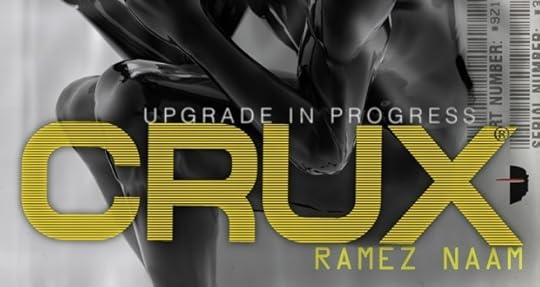
I met Ramez at last year’s Worldcon and at the time was just hearing about his book, Nexus, out with Angry Robot — I am regrettably a slow reader and I crawl through a TBR list (that seems to be multiply every time I blink my pretty little eyes), but finally getting around to Nexus showed a helluva book — an exciting thriller that just so happened to be whip-smart about its subject matter. So, here’s Ramez to talk about the sequel (which drops Tuesday):
TELL US ABOUT YOURSELF: WHO THE HELL ARE YOU?
I’m Ramez Naam. I’m a total dilettante. I spent most of my adult life working on software, some of which you’ve probably used. And I’ve written books about science – about topics like genetically tweaking humans and hacking the brain and whether we should do those things, and about climate change and how to grow more food and make better solar panels and save the planet and whatnot.
And I also happen to write sci-fi, starting with my debut novel Nexus and now its sequel Crux. Which, I’ve gotta say, is super fun.
GIVE US THE 140-CHARACTER STORY PITCH FOR CRUX:
Illegal nano-drug links minds. Spies, hackers, super-soldiers. Chinese clones, Buddhist monks, uploaded posthumans, and explosions, oh my.
WHERE DOES THIS STORY COME FROM?
The first book in this series, Nexus, was an outgrowth of research I did for my non-fiction book More Than Human. I’d done all this research on technology in the lab to make people stronger and faster and smarter, and – most interesting to me – this field called ‘neural prosthetics’ where doctors were putting implants in people’s brains to restore vision and hearing to the blind and death, to give paralyzed people control over robot arms and cursors on computer screens, and even, in animals, to restore damaged memory and intelligence.
And when you dig into this research, you see that the line between restoring function and improving function is super blurry. For example, if I can use a brain implant to send video from a camera worn on a pair of glasses into someone’s brain, it turns out we can probably also use that same implant to let someone project out of their brain whatever image they’re imagining. And in the animal studies where they have implants that restore damaged memory and intelligence, they can actually boost memory and intelligence, and create rats and monkeys that are smarter than normal.
So when I sat down to write a sci-fi story that eventually became Nexus, that tech was the most amazing thing I could think of basing a book around, and to make it just a little more fun, I thought, heck, why don’t we package it up as a street drug that happens to be illegal?
And then I threw in explosions and spies and augmented super-agents and a cold war between China and the US and Buddhist monks and emergent group consciousness and biotech black markets in Thailand because, hey, those are all cool too.
HOW IS THIS A STORY ONLY YOU COULD’VE WRITTEN?
I’ve got the science background from my earlier book, of course. I’ve got the software background – and the Nexus tech is also a software platform, which is key to the story, because there’s a lot of hacking that goes on. But there are other elements that make it uniquely me. A lot of the story is about the counterculture – the technology gets picked up by and driven forward by hackers, subversives, people out on the fringe. I’ve spent the last decade and a half or so in Burning Man culture, out on the West Coast. Those are my people. It’s an incredibly creative community, an incredibly exuberant community, and also incredibly anti-authoritarian in a way that I wanted to bring to the page –in descriptions of music and dance and parties, in the dialogue and the value systems of the characters.
And then there’s the War on Drugs and War on Terror angle. A lot of the conflict in Nexus and even more in Crux is driven by the fact that the Nexus technology – and lots of other advanced biotech and nanotech – is highly illegal. It’s illegal for a reason – this sort of tech has been abused in various terrible ways. But that also means that government is trampling on people’s civil rights, locking them up without due process, and preventing all sorts of positive uses that could be happening. I’m a big civil libertarian, and while I went out of my way to show both the pro and con perspective to this kind of tech – the ways it can be uplifting and the ways it can be abused – I think I had a unique steeping in the civil liberties issues that I could bring to bear, along with all the tech and underground culture and explosions.
WHAT WAS THE HARDEST THING ABOUT WRITING CRUX?
Living up to Nexus! The first book was so well received that I was honestly just plain nervous that a sequel would pale in comparison. But there’s not much you can do except write the best book you can. And the reviews seem to think Crux is at least as good, so I’m happy there.
WHAT DID YOU LEARN WRITING CRUX?
I bit off a more complex story with Crux. I have more storylines going at once, and they all intersect in some pivotal and climactic ways. I did that intentionally – more threads and more points of view means you get a much richer view of the world. It’s a lot more nuanced, and you can see, in a lot of cases, where various characters have very different views of the world. In some cases, characters that you’re rooting for are working towards really divergent goals, which means conflict between them is a real possibility, and as that looks more and more likely, the tension just ratchets higher and higher.
To pull that off, I had to improve my craft, to keep all the storylines compelling and hard to put down on their own, to keep the overall book always fast to read, and at the same time to make sure the reader never felt lost. What I’m hearing from readers is that it worked, and I’m glad, because that was definitely a stretch of my skills for me.
WHAT DO YOU LOVE ABOUT CRUX?
Heh. I loved running into a friend who I’d given an early draft to read and having her chide me (only half serious) for keeping her up until 3am the night before because she couldn’t put the book down. That’s music to an author’s ears!
I also love that this is the middle of a three-book series and it’s very much the Empire Strikes Back of the three. I’m an optimist, and there are some happy and beautiful things in this book, but it’s also a book with some dark and ominous tones, and the promise of an epic and world-changing climax in the final book.
WHAT WOULD YOU DO DIFFERENTLY NEXT TIME?
Next time I’d take what I know about Crux and go back in time and insert little bits of it into Nexus. And I’d take what I know about the third book and go and insert it into Crux! Writing a series, you’re always thinking ahead and doing your best to lay groundwork for the next book, but you also always reach a point where you think, “Dang! It would have been awesome to lay a breadcrumb for this in the previous book!”
GIVE US YOUR FAVORITE PARAGRAPH FROM THE STORY:
So many choices! But here’s a passage I like, and that doesn’t give too much away. Two of my characters, Kade and Feng, have been ambushed by bounty hunters seeking the price on an extremely sought-after piece of information in Kade’s head. And because Kade and Feng are mentally linked via Nexus nodes in their brains, Kade sees the fight from Feng’s perspective, complete with the benefit of some of the unique ways in which Feng experiences the world. Oh, and Feng just happens to be a cloned Chinese super-soldier engineered, enhanced, and trained from birth for this sort of thing:
“Then Feng was among them, his mind cool and hard. Time slowed for Kade as his friend’s combat trance enveloped him, stretching out every instant into a long, deadly span. The flight paths of unfired bullets shone in Feng’s thoughts, brilliant lines of red light extending from the muzzles of their guns. The bounty hunters’ bodies cast echoes of future blows and kicks that he foresaw.
Feng moved like a dancer, calm and graceful. He leapt over the plane of fire of a swinging pistol, rolled under another as he converged on the first bounty hunter. His mind was utterly absorbed. This was samadhi. This was meditation. Guns exploded and the bullets were living things in Feng’s mental map, ripping out of the muzzles, shockwaves rippling visibly through the air, flinging themselves at the spots Feng had occupied fractions of a second ago.
Then Feng reached the first bounty hunter, and the man went down with his neck snapped.”
WHAT’S NEXT FOR YOU AS A STORYTELLER?
The third and final Nexus book! It’ll be out in 2014. And it’ll be the most riveting, explosive, and world-changing of the three.


