Jennifer Eckert's Blog, page 2
January 25, 2018
Book Review – Far From the Tree by Robin Benway
 Far From the Tree by Robin Benway is the winner of the 2017 National Book Award for Young People’s Literature. Grace, Joaquin and Maya, the three main characters in Far from the Tree are biological half siblings.
Although they share the same birth mother, each child has followed a different path and they only reconnect as older teens. Far From the Tree is told from multiple perspectives, and each child has a unique story to tell. All three are linked together by secrets, shame, and a desire to know more about their identity.
There are very few well-written Young Adult books that understand the world of adoption as well as Far from the Tree does. What makes author Robin Benway even more interesting is that she does not have a personal connection to adoption. Benway spent a year doing her research on adoption and in my opinion, similar to the popular and well-done T.V. show This Is Us, she is able to tell this story from a realistic and respectful adoption platform.
Today, the word “family” has many definitions. It is no longer confined to the dated perspective of a mother, father and biological children. We see now that families are made up of many constellations. Sexual orientation, DNA or formal paperwork no longer defines what it is to be a family. Far From the Tree respects these many definitions and presents the reader with several different family make-ups.
Benway also writes about a common theme for adoptees: their desire to know their history in an understandable way. Adoptees often have a gap in their early histories, and she is able to explain through the characters why they have such a strong need to know this initial “Chapter 1” in their book of life.
Early in the story, Grace discovers she is pregnant by her high school boyfriend. She makes an adoption plan and places her newborn daughter into an adoptive home. This event pushes Grace to find her siblings and, eventually, their birth mother.
Joaquin has unique struggles of his own. He is the only one who has not been formally adopted and is still in foster care, and he is close to aging out of the system. Joaquin carries with him a secret past that has caused him to put up walls and he resists letting others get close. We see this young man eventually take a risk and allow himself to take a chance at opening his heart and be loved.
Maya has a sister who is the biological child of her adoptive parents. She is the only one in her family who has dark hair and is not “blood” related. Maya’s family looks perfect from the outside, but beyond the facade it is quite the opposite. This complicated family situation forces Maya and her sister to grow up quickly as they face their family falling apart.
Once the siblings build a trusting relationship with one another, they make a plan to find their birth mother. It is during this time that they are forced to share what feels most vulnerable to them.
The book addresses almost every topic that comes up in the world of adoption: identity, race, culture, fitting in, grief, loss, abandonment, trust, shame, and feeling misunderstood, to name a few. Benway is able to weave these topics together in a heartfelt way and give the reader a true understanding of how the adoptee may view their world.
We do know that the journey of adoption is complex and each adoptee carries their own truth and perspective. While being adopted or in foster care can be complex and challenging, Benway gives hope to all those touched by adoption as her characters move forward on a path of healing from the hurts of the past.
Written by Jennifer Eckert, LICSW
Boston Post Adoption Resources
The post Book Review – Far From the Tree by Robin Benway appeared first on Boston Post Adoption Resources.


December 14, 2017
The Gift of Forgiveness
The most valuable gift you can give to yourself this holiday season is the gift of forgiveness.
Why Forgiveness?
Many of us carry unresolved issues from the past. It might feel like carrying a heavy ball and chain. It can be anger from a minor slight or the rage of a major grievance. We all experience the heaviness of carrying the load of anger after we have been unfairly hurt. Research has shown that forgiveness is linked to mental health symptoms such as depression, anxiety, and other mental health issues.
The pain can replay in our minds like a bad movie. We think about things we wished we had said or done differently. We think about other outcomes or different endings. We fantasize about what life would be like if it had played out in another way. These hurts can take over like a thick blanket covering your entire body. The grief can come from others, or from an internal self-bully that is carried around inside of us and beats us up regularly.
This is where choice comes in. We have a choice on what we spend our time thinking about each day. How much space in our minds do we want to devote to the past and the painful events that left us scared and angry? Ask yourself, “Do I want to let this go or hang on to it?” You may find it helpful to get out a pen and paper and make a chart of “Pros” and “Cons.” The results might surprise you.
You have a choice.
Suggested Practices
The best gift you can give yourself is to set your agony free. Try letting go of it for one day. Then one week. Then one month. Practice letting it go. If a thought pops up, you can say, “Leave! You are no longer a part of my life.” See what happens.
Forgiveness is a process. Like any habit, it takes time to develop and take hold. Once you establish a habit, you can let go of the grief, creating more room in your life for the things that bring you peace and joy. It may be helpful to take out your “Pros and Cons” list to review when you’re finding it challenging to let go. By simply reviewing the list, you separate yourself from the feelings and create distance; this gives the feelings less power and you are more able to let go and spend your energy on what is important to you.
Meditation and mindfulness can be your guide on this road to forgiveness. A regular practice of meditation and mindfulness can retrain your mind to let go of the things that are not serving you. Over time you will see that negativity no longer has a strong hold on you. A daily meditation practice will have lasting effects. There are excellent guided free meditations online to help you get started. Here are a couple of my favorites:
Mindful.org 10 Minute Guided Meditation on Forgiveness
Calm.com Forgiveness Meditation ($)
Deepak Chopra Guided Meditation on The Law of Intention
Another recommended practice is starting a forgiveness journal. Writing about past pains and obstacles can be cathartic. Write a letter to yourself on why you want to be free of this pain. This self-healing practice can have a profound effect on your life.
Painting, drawing, music, or any form of creativity you enjoy can help to release past hurts. Simply ask the question “Why am I holding on to this?” You can ask yourself this question while you engage in your creative outlet. Continue this as a practice and set time in your daily calendar to make space for this exercise.
Therapy or a support group can allow for further work on forgiveness. Either by connecting with peers or seeking individual support to dive deeper into letting go can allow for greater growth.
Lastly, another question you may want to ask yourself is, “What would my life look like if I let go of the story of this pain? How would my life change?” See what your answers are.
Forgiveness is a form of self-care. The better we take care of ourselves the more profoundly we can heal. This is the ultimate gift we can give to ourselves.
Written by Jennifer Eckert, LICSW
Boston Post Adoption Resources
The post The Gift of Forgiveness appeared first on Boston Post Adoption Resources.
November 15, 2017
Sorting Through Conflicting Feelings on Adoption Day
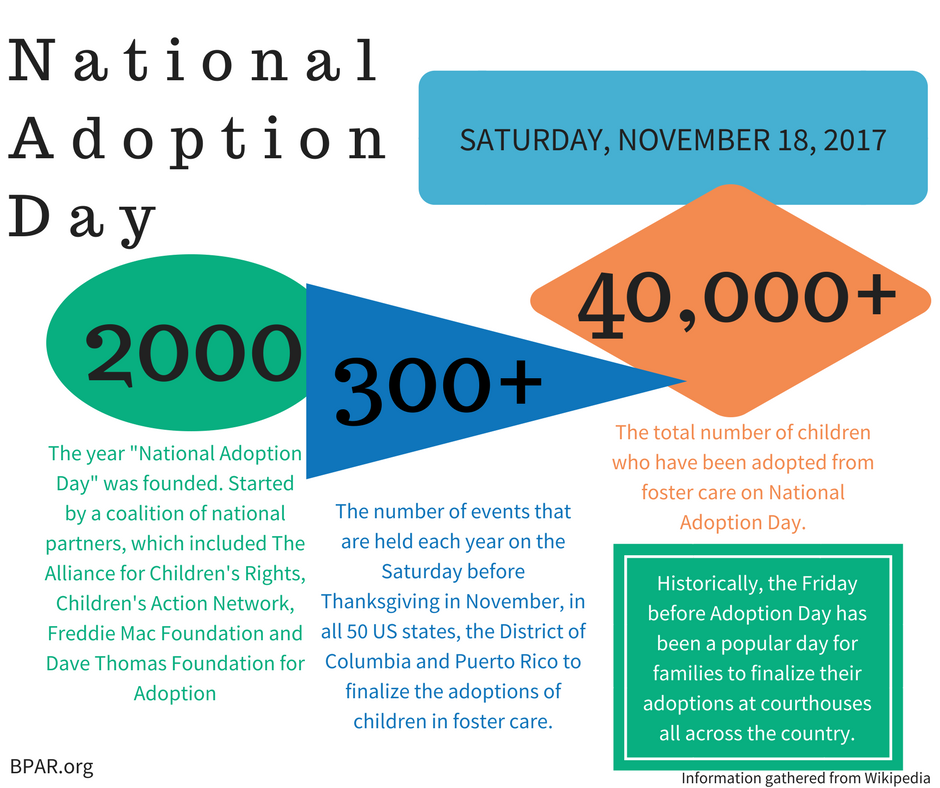
 This year on National Adoption Day, approximately 5,000 children will be formally and legally adopted into “forever families” across the United States. Celebration cakes will be shared and extended families will honor the newest members of their families. We at Boston Post Adoption Resources recognize the importance of this day. Permanent families are created and expanded. These are life-changing days that most surely will have a profound effect on each family member.
How do child adoptees view adoption day?
Children of all ages are adopted on this day. Those that are adopted as babies will have little memory of the actual day. As they grow older, the photos of this significant day will carry much importance. For older children and teens, this is a day of mixed emotions. Making sense of their many disparate feelings can be confusing for the child, and at the same time hard for family members to understand. During this celebration, a child might feel excitement and joy, but also worry, sadness and much trepidation.
Often not acknowledged is this sorrow and sadness the child might be feeling. He or she might feel sad that his or her birth family cannot raise them. They might be struggling with the loss of the fantasy that Mom and Dad would someday be healthy enough to care for them and give them the happy life that they dream of. Indeed, there are many losses that a child might be grappling with: the loss of the fantasy that mom and dad would someday be healthy enough to care for the child; the loss of biological siblings and relatives; and the loss of culture and heritage, to name a few. Many of these children have struggled with profound feelings of sadness and fears that they were not wanted and loved, or not worthy of love. Adoption Day will trigger some or many of these feelings and emotions. Some children will show their feelings of sadness, by crying, or being angry; others may be quiet or overly pleasing. These deep-rooted feelings come out in different ways. This can be confusing for everyone: “On such a joyous day why am I feeling this way?” Adoptive parents may wonder the same thing, and they often experience their own mixed feelings of excitement and worry.
Many adoptees have said, “Being adopted is like starting a book on Chapter 2.” For the child who has been living with birth parents or foster parents, he or she may know parts of their “Chapter 1.” However, most likely there is confusion and missing information or misinformation. For the child who has had multiple placements in foster homes, the “Chapter 1” can include painful and sad memories.
How can families ease the adoption transition?
The more educated families are regarding adoption issues, the stronger their families will be. Building trust, and feeling safe and truly loved takes time. The more open and truly empathetic caregivers are to their adopted children, the healthier their children will be. The more comfortable parents and families are talking about adoption and challenges on this adoption journey through life, the more resilient that adopted child will be. Once strong foundations are established, the secure scaffolding goes up. Step by step the relationship is formed, slowly built upon, and continually strengthened.
Securing solid relationships is the goal. At different times in our lives we may need some guidance and extra tools to help with making our connections stronger. Asking for supports is a strength not a weakness. The beauty in this is that there are open hands and arms to help adoptive families. Knowing how and when to ask for guidance is the key. When the adoptee knows and feels that he is not alone on the journey, the road becomes hopeful and safe.
Boston Post Adoption Resources provides support for children and families throughout this adoption journey. Visit our BPAR website and learn more about our services and our book, Adoption is a Lifelong Journey.
Written by Jennifer Eckert, LICSW
Boston Post Adoption Resources
The post Sorting Through Conflicting Feelings on Adoption Day appeared first on Boston Post Adoption Resources.
October 11, 2017
5 Parenting Pearls of Wisdom from Mr. Rogers
Our team at BPAR has learned much from one of our favorite writers and TV personalities, Mr. Rogers. Although Fred Rogers is not with us anymore, his perspective on children and families is hands down one of the best we have found.
We wanted to share a few of Fred Roger’s thoughts on parenting that are so simple yet profound.

Image Source:http://bit.ly/2xYTaTE
1. “Children feel far more comfortable and secure when things happen predictably – with routines, rituals and traditions. Those traditions, big or small, create anchors of stability, especially in rough seas.”
2. “Respect the child. Treat him as a person. The best thing a person can feel is to be accepted as he is, not as he will be when he grows up, but as he is now, right this very minute.”
3.“If we grow up fearing mistakes, we may become afraid to try new things. Making mistakes is… a natural part of the way we learn. It’s an important lesson, at any time of life, but certainly the earlier the better. We all make mistakes as we grow, and not only is there nothing wrong with that, there’s everything right about it.”
4.“It may be painful for us to see our children modifying or even rejecting ideas that were important to us and adopting others that could never be comfortable for us. But out of that difference may come the reinforcement of two other important values. One is tolerance, and the other is awareness that people who disagree over the things they hold dear really can live together in love and respect.”
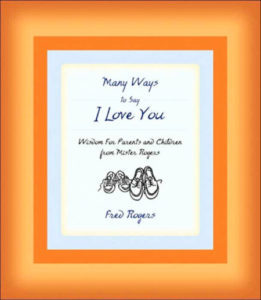
image source: www.hachettebookgroup.com
5.“Since we were children once, the roots for our empathy are already planted within us. We’ve known what it is like to feel small and powerless, helpless and confused. When we can feel something of what our children might be feeling, it will help us begin to figure out what our children need from us.”

– from Many Ways to Say I Love You*
*Rogers, Fred. Many Ways to Say I Love You: Wisdoms for Parents and Children from Mister Rogers, Hachette, 2006.
Written by Jennifer Eckert, LICSW
Boston Post Adoption Resources
The post 5 Parenting Pearls of Wisdom from Mr. Rogers appeared first on Boston Post Adoption Resources.
August 30, 2017
5 Ways to Help your Adopted Child Transition to a New School Year

Image Source: https://bit.ly/2voT4VD
Saying good-bye to the summer is hard for all of us! Packed with cookouts, visitors, road trips, camps, beach days and play dates galore, leaving the beach and the relaxed days of warm weather is not easy. These lazy summer weekends and vacations will all soon be a memory.
New starts can be difficult for even the most resilient people. Meeting new people, new friends and new schedules can at times feel overwhelming. Knowing where your locker is or trying to remember the combinations can be a challenge for even the the most organized.
Here are 5 ways you can help your child ease into the school year in a positive, stress-free manner:
Maintain a calming presence. This means parents and caregivers. Children will most often take your lead. If your child knows that you are calm and positive they will be too. Make sure you are organized and have a plan to manage your own anxiety and sadness if it comes up. Remember it can be just as hard for the parent to say goodbye too!
Help kids explore their worries. Talk about what the new school year will look like for your child. Ask questions of them such as, “Are you thinking about your new teacher and class?” Ask open ended questions which will spark a conversation and allow you to see how your child is feeling about the start of a new school year. For children who have a difficult time expressing their emotions, use feelings cards, play and books (see list below) as a catalyst for conversations.
Review their new routine. Children feel more safe and confident when they know what to expect. You could take a trip to the school so that your child is familiar with the space, attend any orientations or have a poster or calendar up on the wall of a daily or weekly schedule (activities, dinner time, homework time, etc.). You can also help build excitement by investing in something new for the school year (i.e. backpack, crayons, etc.).
Get back to a sleep schedule. The summer is a beautiful and special time filled with late nights watching the stars or making s’mores by the fire, which means that sleep schedules get shifted. With the start of school it’s important for kids to get back on track with going to bed early so they can get enough sleep.
Make a plan for what you both need to say goodbye. It can be very difficult for kids to separate from their parents but it is an important step for them to take. If your child is anxious about separating help them figure out what they need to say goodbye. Perhaps you have a special handshake or a memento they can take with them to look at throughout the day and be reminded of you. You can practice doing this at home ahead of time. Try not to linger too long with the goodbye, as it will make it more difficult for the both of you.
Written by Jennifer Eckert, LICSW
Boston Post Adoption Resources
For further reading and resources on supporting your adopted child’s transition back-to-school, check out:
Adoption Is a Lifelong Journey, by Kelly DiBenedetto, Katie Gorczyca and Jennifer Eckert
Adoption and the Schools: Resources for Parents and Teachers, edited by Lansing Wood and Nancy Ng
The post 5 Ways to Help your Adopted Child Transition to a New School Year appeared first on Boston Post Adoption Resources.
August 2, 2017
Why Saying Goodbye Is Hard for the Adopted

Image Source: http://bit.ly/2vpPbhY
Saying goodbye can be difficult for all of us. The thought of not seeing someone we care about can be painful as well as distressing.
When I think about this topic, I immediately think about toddlers being dropped off at pre-school, only to have a meltdown as the caretaker says goodbye and leaves the classroom. Crying may occur and the separation becomes intense for both the child and the caregiver. Both the child and the caregiver often feel deep emotions when saying goodbye.
For the adopted person, saying goodbye can be intense. Old feelings of loneliness, separation, and abandonment can come flooding in. Leaving may trigger many of the difficult emotions that we have carried with us for so long.
The adoptee may be confused by the overwhelming amount of feelings that a goodbye can trigger. The pain can even become physical and present as stomachaches, headaches, anxiety, anger, or depression. Leaving or having someone important leave can prompt all of these symptoms. This can include school or camp ending, a long vacation ending, saying goodbye to visiting relatives and more. These and other endings or transitions that we experience during the end of the summer months can spark different reactions.
How can we help ease this pain when our adopted child or loved one must say goodbye? Caregivers may not even know that this is happening and may miss the signals when their child is hurting or acting out as a way to simply cope with the pain of loss.
First, acknowledging that saying goodbye and or leaving can be painful and sad. This can help tremendously. Allowing the child, teen, or adult to express these sad and raw feelings of saying goodbye can help to normalize what they are experiencing. You are saying to them, “I understand,” “I get it”.
Having the caretaker say, “It looks like saying goodbye to your camp friends is tough. How are you doing with this?”
Just being there and showing an understanding of what they might be feeling can help to ease the pain. Sometimes just saying nothing or taking the lead of the child can be the most comforting. When we feel understood, respected, and cared for, we can begin to feel whole again.
Written by Jennifer Eckert, LICSW
Boston Post Adoption Resources
The post Why Saying Goodbye Is Hard for the Adopted appeared first on Boston Post Adoption Resources.
June 22, 2017
School’s Out!
It is the time of year everyone has been waiting for! A time for a break in routine, a time for unstructured days and sleeping a little later. While all of this time-out is very healthy for children and families, the ending of school can be a difficult transition for adopted children.
The end of structure, routine and knowing what to expect next is no longer present. Days that are unstructured and full of down time can be difficult for many adopted children. Structure in our day can represent safety and security. Knowing what is next can be reassuring to the adoptee.
Saying good bye to friends and teachers can represent loss and trigger sadness for many adopted children. The fall seems so far away and the uncertainty of which new teacher the child will have as well as classmates can weigh heavy and stir up uneasy feelings.
Parents and caregivers can acknowledge this transition. School is ending and while it should be fun it can bring up sadness too. “ How are you feeling about school ending?” or “what is it like to have school ending?” “ What feels hardest with school ending?”
Having end of year parties and saying good-bye often bring mixed feelings. Setting aside a quiet time during the day or evening to talk about this with your child can reassure them that these feeling are normal and expected.
by Jennifer Eckert, LICSW
Boston Post Adoption Resources
**This summer, BPAR is running weekly adoptee groups for Boys and Teens. Participating in group therapy can help your child transition into summer and are a great opportunity to connect with others that share similar experiences in a safe, supportive, and accepting environment.
Check out our group therapy page here to learn more and sign up! **
The post School’s Out! appeared first on Boston Post Adoption Resources.
June 14, 2017
Father’s Day
 Many adoptees or children in foster care may be thinking about Father’s Day this week. Ads for cards, gifts and activities centered on Father’s Day are a constant reminder. For some it is their biological or birth father. This may be a time for them to try and make sense of exactly what Father’s Day represents for them. It can trigger many thoughts and emotions without a safe outlet to explore them.
Adoptees or children in foster care may have some information about their birth mothers and why they were placed for adoption. However, many do not have any information about their birth fathers. They may have questions such as: Does he know I exist? Does he ever think about me? Does he love me? Will I ever meet him? Do I look like him? Am I like him? Was he good at sports? Was he musical? What is he like? These are all normal and very appropriate questions.
How can you help your child or loved one with this? Simply acknowledge what they are feeling and thinking. Listen in a non-judgmental way. Try and put yourself in their shoes. Should your child express anger or sadness, let them know you understand and that it is ok to have these feelings. Ask your child to tell you more as well as what would they like you to do to help them?
It is important that on this day you recognize their loss and be there with them as they work through these complex emotions. A simple lighting of a candle to acknowledge them can be comforting. Writing a poem, letter or short story can help to express the feelings and emotions that this day is triggering. Again, ask them “What can we do today to honor your birth father?” There is a chance they might have an idea that will bring some comfort and safety to this holiday.
This Father’s Day we honor all fathers!
Written by Jennifer Eckert, LICSW
Boston Post Adoption Resources
The post Father’s Day appeared first on Boston Post Adoption Resources.
May 25, 2017
Welcome to the Neighborhood
 Meet Mr. Roger!
You may notice a member of our BPAR team lounging around the office, sometimes in his signature cable knit sweater. He is gentle, kind and a good listener, all the qualities needed for a good therapist. We would like to introduce you to Mr. Roger, BPAR’s therapy dog.
Roger came to us from The Seeing Eye in Morristown New Jersey. The Seeing Eye has been providing guide dogs for the blind at no cost since 1929. They are a philanthropic organization whose mission is to enhance the independence, dignity, and self-confidence of blind people through the use of Seeing Eye dogs. (To find out more about the program check out http://www.seeingeye.org/)
Roger was trained at The Seeing Eye as a service dog. He studied hard and almost made graduation; however, due to unforeseen circumstances, Roger had to leave school. He had to leave his family and friends and start a new life in a strange and unknown home.
We wanted to tell you Roger’s story because we have all been there. What feels like a failure or a set back to us can be hard to accept and can difficult to more forward. We had a detailed, deliberate plan, and now it has been derailed. We are forced to accept the unacceptable. In the moment it seems like a catastrophe, the end of the world.

Photo by Beth Shedd, PhotOptimist
Take a moment and reflect on times in your life when you were faced with a challenge or a set back. We are required to change course, but in the long run it turns out to be a good decision. Our lives are changed for the better. Set backs can teach us lessons we would never have learned if things had gone as we planned.
Roger is now in a loving home and is a therapy dog at BPAR. He is continuing his education and is very happy with his new life and career.
Please welcome Mr. Roger, or Roge, the next time you are at BPAR. He has a gift for making people smile and guiding them back to the present moment!
Written by Jennifer Eckert, LICSW
Boston Post Adoption Resources
The post Welcome to the Neighborhood appeared first on Boston Post Adoption Resources.
May 10, 2017
Motherly Self-Love
“The Most powerful relationship you will ever have is the relationship with yourself” –Steve Maraboli
Over the last few weeks I have spoken to many women about their feelings surrounding Mother’s Day. Most of the women I spoke with voiced how complex and hard Mother’s Day can be for them. It can bring up feelings of loss, loss of a mother, loss of a child or the hope for a child. The day can weigh heavy on mothers who feel guilty that they are not always the perfect parent, daughter or wife. It can be a reminder of relationships that we wish were different, the ongoing fantasy of a loving and flawless connection with those closest to us. Many spoke of the mixed emotions they feel surrounding this day, which can leave many feeling alone or with a heavy heart.
 The clinicians at BPAR encourage staff and clients to practice the concept of self-care. To many of us this is a foreign idea. The thought of taking good care of ourselves may seem selfish or unnecessary. We may not feel worthy of taking the time to do something nourishing or gratifying for ourselves. Most of us are not in the habit of putting ourselves first or making extra time for being kind to ourselves.
Can we honor ourselves this Mother’s Day by beginning a daily practice of self-care? Can we take some time and recognize that every day we are all doing the very best we can? Can we maintain a healthy relationship with ourselves on a consistent basis? Is it possible to make the time each day to nurture, love and respect ourselves? Can this be the gift that we give to ourselves to hold for the rest of the year?
How do we incorporate this concept into our lives? Start by challenging yourself to make one small change. Begin with a journal or a log of these changes. For example, one of the easiest and proven effective self-care practices is to keep a “Gratefulness Log”. List 5 things that you are grateful for every evening before you go to bed. Keep the book next to your bed and fill it in every night. It can be as simple as being grateful for your warm bed or food in your refrigerator.
Other self-care activities can include:
Meditation. There are many free guided meditations online
Connect each day with a friend or loved one who makes you smile or feel good
Take a 5-10 minute walk without distractions
Take a hot bath (without your phone*) and listen to calming music. (*If the music is on your phone, silence notifications)
Cut down time on social media and devote that time to something you like
Have a good laugh. Watch a comedy or a short Youtube video. (Cat videos can be hilarious and only take a minute)
Spend time with your pet or in nature. Imagine the advice a dog or a tree would give to you if you asked. Imagine how they would describe what is most important in life
Exercise in the way that makes you happy- dancing, running, cycling –just make sure you are enjoying it. Update your music playlist with upbeat songs that get you moving
Notice 10 new things while walking to work or driving in your car
Tell a loved one how you feel about them, in person or in a note
Give your self a compliment every day
Sign up for daily positivity blogs and newsletters; these reminders can help ground you throughout the day
Read books that encourage self-care, reflection and positivity
Don’t underestimate the benefits of a regular spiritual practice
Forgive yourself, forgive others, and let it go.
These are just a few suggestions to get you started. You can begin your own list as ideas come to mind. There are many books, blogs, podcasts and films on positivity and self-care for additional ideas. (Check out BPAR’s recommendations page for some suggested resources).
“There is only one corner of the universe you can be certain of improving, and that’s your own self.”-Aldous Huxley
Be good to yourself this Mother’s Day and the days that follow.
Written by Jennifer Eckert, LICSW
Boston Post Adoption Resources
The post Motherly Self-Love appeared first on Boston Post Adoption Resources.