
Sharon Bala's Blog, page 3
January 25, 2023
Winner? Take all.
The Journey Prize winners were announced yesterday. Winners plural. Ten to be exact. This edition of the Journey Prize breaks 33-years of tradition, which usually sees a long list of 10-12, a short list of 3 (and once, two), and one winner. That’s standard operating procedure for literary prizes - a broad spotlight that narrows until the winner stands alone, holding the pot. But for this special edition, which is a showcase of Black talent, the jury chose to do something different. The jury, by the way, was David Chariandy, Esi Edugyan, and Canisia Lubrin. Name a more iconic trio. I’ll wait.
I don’t know why they chose to go this route but I’ve been on my share of juries and have some ideas. Sometimes, the winner is unanimous, a book or story that stands so obviously head and shoulders above its peers that there’s almost no discussion. Just as often, the jury is divided and the winner is a compromise, the first choice of two jurors but not the third. Or the entry that everyone can agree they love equally though it isn’t anyone’s first choice. Which is no slight on the winner because by the time a jury gets down to choosing a short list, an entry has already run the mother fucking gauntlet.
Stories in the Journey Prize anthology must charm many, many gatekeepers. First, the editorial board of a literary magazine greenlights publication. These mags have vanishing resources, limited space, and strict word counts. I guest edited one issue of one magazine and it was excruciating to turn away stories, compelling, beautifully composed stories, on the grounds that I had twenty five pages and had to choose the combination of prose that fit exactly within those pages, no more, no less.
Second, the story must be chosen, out of all the stories published that year, as one of three that gets put forward for the prize, assuming the publication in question has the resources and wherewithal to submit.
Third, the jury must like the story enough to longlist it. Any time I do jury duty, I’m acutely aware of the idiosyncratic nature of taste. A different combination of judges reading the exact same stories or books could have and would have made different choices. The year I juried for the Journey there were stories that could have absolutely made the longlist if a different combination of authors were making the call. And by the time we got to the short list, it was agony. That’s often what happens. There are three spots and maybe five or six books that (in the jury’s idiosyncratic opinion, in that particular moment of that particular day) deserve a place.
What does it mean, then, to award one winner and what does it mean when a jury chooses ten? I haven’t got insider information and was not - sadly - a fly on the wall during deliberations but if I was on the jury, for this historic year when emerging Black authors are finally being offered a small portion of their due, I would also be inclined to say fuck it, all these stories and these authors deserve the spotlight.
You know what I think is revealing? Have a look at where the winning stories were published. Twelve stories total. Four(!) from Prism International. (Good eggs) Two from no where. Two stories that were turned away at every gate. Or two stories that were nurtured in private because those authors didn’t see themselves or their stories reflected in magazines. Or… well, I don’t know. Maybe two stories that were written specifically because the doors were thrown wide and the guards took a holiday.
Taste is a tiny bit nature and mostly nurture, formed by the stories we were raised on and the steady diet we were fed by teachers and book sellers. And if, for most of your life, all you see and read is one kind of story, told by one kind of person, guess what happens to your taste. When gatekeepers share the same narrow taste…. that’s how you end up with a paucity of Black representation. It’s nothing to do with writers or their stories and everything to do with flawed gatekeeping.
In a perfect, equitable world we wouldn’t even need special editions. Good on the jury for handing out ten crowns. Massive congratulations to Christina Cooke, A.Z. Farah, Zilla Jones, Sarah Kabamba, Téa Mutonji, Lue Palmer, Terese Mason Pierre, Jasmine Sealy, Dianah Smith, and Iryn Tushabe, whose twelve stories I cannot wait to read. You can pre-order your copy of the Journey Prize Stories now.


January 19, 2023
This ain’t National Geographic
There is a moment in V.V. Ganeshananthan’s Brotherless Night when the first person protagonist declares: “Even now I do not wish to translate that word, kottiya. Must we explain each humiliation to be believed?” (pg. 113)
It’s a powerful moment in a powerful scene, but even out of context, the line is important for what it can teach us about craft. Writers who are not white sometimes struggle with this particular issue. How much of the culture/ language of the story should we translate? Can we assume the reader knows the definition of a salwar kameez? Must I explain that ammachi means maternal grandmother? That cousin brother is a male cousin and not, in any way, incestuous?
Authors, take heart. There’s a simple solution to all of this. Just assume no one will ever read your story. Write for an audience of one and let that one be you.
There are two good reasons for this approach. First, publication is ANGST-RIDDEN and something every author looks forward to with gritted teeth. The only part of the process you are sure to enjoy is the writing. So if you aren’t amusing yourself, what’s the point?
Second, it’s a fool’s errand to write with any particular audience in mind. Readers are special snowflakes, each with their own life experiences, culture, and ways of seeing the world. You are never going to be able to curate your work in such a way that each and every reader fully understands every word or undercurrent or moment of subtext or character motivation.
We’re writing fiction, not a National Geographic article. If you start defining every little thing, the pace will grind to a halt and that’ll be the end of the reader’s attention. Focus on the characters and the story. Include nothing that the characters would not themselves think. Forget the reader.
When editors italicize salwaar kameez or idiyappam, when publishing houses ask for glossaries, they are not only doing so for the benefit of an imagined reader, they are imagining a very specific reader. Guess what skin colour that reader has? Guess what language he speaks? Guess his gender (hahah. trick question). Guess his sexuality.
Readers are all kinds of people. And it is a truth universally acknowledged that good stories, told well, transcend cultures, borders, ethnicity, language, and time. Otherwise, how do you explain the enduring appeal of Shakespeare, Austen, Jesus’ parables, or Lord Buddha’s life story? Or the fact that I have been reading Tolstoy for decades and still only have the foggiest idea what a samovar is.
Lately, I’m noticing a sea change. Sugi Ganeshananthan’s novel, that I quoted above, came out this year and includes plenty of Tamil words, some translated, others not, none in unnecessary italics. Reema Patel’s Such Big Dreams - set in India and told from the perspective of a narrator for whom English is (at least) a third language - is full of words and slang that I assume are Hindi or possibly Marathi, none of it italicized, almost none of it explained. These authors know readers are intelligent.
Many of the words in Michael Crummey’s Galore are a mystery to me but it’s still one of my favourite books of all time. His writing is better for being true to the characters, for his commitment to their dialect. And listen, if Crummey’s not including a glossary for words like dunch and skerry and slut lamp, then neither am I, and neither should you.
January 12, 2023
Toast is not exotic
As a rule, in my writing, I never italicize non-English words. At first, this wasn’t a conscious decision. It was just common sense. Italics indicate emphasis. And if a story is from the point of view of a Spanish-speaking character, say, then words like hijo and lo siento and hola would have no particular emphasis in the character’s mind.
When my short stories were published, editors sometimes italicized the non-English words. To be honest, I didn’t notice. Probably no one asked my permission. Or maybe they did and I was too green around the gills to know better or refuse.
But after The Boat People came out, a reader asked how I’d convinced the editors not to italicize the Tamil words. And that stopped me short. Because the fact is - bless my editors - it never came up. Speaking with other writers, hearing them tell their stories about fighting their editors on this very thing I’d taken for granted, I became more aware of the italics. And now, as a reader, seeing italics used inappropriately sets my teeth on edge. Imagine a dishevelled preacher ranting in the dessert. That’s me. AUTHORS! EDITORS! DO NOT ITALICIZE NON-ENGLISH WORDS. CEASE AND DESIST.
Let’s say a story is written from the perspective of a character called John. If John is having toast for breakfast, would you italicize toast? No, you would not. Because it looks idiotic. Italics around non-English words seem to telegraph the message: “hey! look! here is something exotic!” Which…come on now, since when is warmed up Wonder bread exotic? We’re agreed here, right? So please let us extend the same courtesy to a character called Mahindan who is eating appam. Let him finish his meal in un-italicized peace.
The mistake editors and publishers and yes, sometimes writers, make when they italicize non-English words is to temporarily lose sight of their craft (and also, I’d argue, their own common sense). They lose sight of the character and the story’s point-of-view and pander to the reader.
Why is the reader at the centre of the story instead of the character? And also, who is this imagined reader exactly? More on them next week. Meantime, here are some other, entirely different, thoughts on toast.
January 4, 2023
Hired pen
It’s a new year and I’ve got a slate of new client offerings. If you’re working on a creative writing project and need professional feedback, mentorship, or one-on-one support to kick start revisions, I’m your pro. Full details and pricing are here, along with client endorsements. I’m currently booking for Fall 2023 and Winter 2024.
ExperienceFor the past several years, I’ve been helping clients with their fiction - and occasionally non-fiction - through a manuscript evaluation service. The author sends me their draft. I read, consider, then return detailed feedback. We have a couple of meetings and off they go to tackle a big revision. It’s great work, especially when writers report back on how much their books have evolved.
Sharon Bala’s thoughtful reading, clear-eyed questions, and deep dedication to her role as a mentor transformed my novel into a truer, stronger version of itself.— Janika Oza, author of A History of Burning
In 2020 I began mentoring through the Diaspora Dialogues Long Form Mentorship Program. Working with authors one-on-one, over the course of several months, watching their expertise grow, and their manuscripts improve in real time, has been an absolute privilege and one of the great joys of the past three years.
I’ve worked on literary fiction, fantasy, speculative fiction, historical fiction, family sagas, short fiction, and memoir. Some writers I’ve worked with have been traditionally published (that’s industry jargon for not self-published). Some have signed with agents. An author I mentored in 2020 has an exciting debut novel coming out this spring.
ExpertiseI figured out how to do this work by practicing with my author friends. You get adept at diagnosing the problems in a story when you’re routinely parsing the works-in-progress of experienced talents. And you quickly learn the art of gentleness when someone else takes a scalpel to your manuscript. Mainly I’ve absorbed these skills by studying the master - my editor Anita Chong, whose preferred punctuation is the question mark. Recently, a writer I was mentoring congratulated my Socratic Method. Who do you think taught me that?
[Sharon’s] feedback about arc, character and voice was invaluable to my manuscript and helped me work through sticky spots that weren’t working at a crucial point in my revision process, between an early draft and the draft I ended up submitting to land a publisher.— Carmella Gray-Cosgrove, author of Nowadays and LonelierPhilosophy
I believe in guidelines, not rules, that asking questions is infinitely more useful than prescribing answers. This is art, not science, and there’s no single formula to describe all narratives. There are many traditions of storytelling and I’m the expert in precisely none of them.
However, I do know a few things about the tools of craft and how to wield them. And I’m adept at ferreting out that interesting, buried, storyline. Yeah. That one. The complicated, dishy thing you didn’t mean to write, perhaps don’t want to write, but maybe need to write? I don’t know. Just a suggestion.
Always, always, I aim to empower writers. It’s your book. You’re in the driver’s seat and know what’s best. My role is to guide, to help you find your way through the maze you’ve created to the story at the centre only you know how to tell.
If you’ve hit the wall on your manuscript, are struggling with revisions, or seeking a mentor, get in touch. It would be my pleasure to help.
Sharon’s thoughts on character development, story arc, pace and plot were critical, nurturing and insightful. Her in-depth notes helped me craft a more complete and contained story world for my characters. If you need another set of eyes to guide your work in a positive direction, look no further than Sharon Bala.— Xaiver Michael Campbell
January 1, 2023
Thou shalt have no commandments
The stubborn ram in my nature bristles whenever I hear directives like must or can’t or don’t or need.
Don’t write a flashback in present tense.
Every story needs plot. (LOL.)
Every story must have a single protagonist.
Don’t write prologues or epilogues.
Non-english words must be in italics.
You can’t move between minds in a single scene. Who do you think you are, Virginia Woolf?
This sort of black and white advice might be well-meaning. Or is it sinister, an attempt to quash a writer’s ambition and keep them in their place, bound within the confines of the western tradition, an automaton pumping out the kinds of stories that some market-driven authority believes are most commercially viable?
Well, for the moment, let’s assume this counsel comes from a good place. Fact remains, it’s all nonsense. There are no rules for good writing. There are only guidelines which will serve you 75-95% of the time. Proof: for every “rule” there are a million exceptions. Suzette Mayr’s The Sleeping Car Porter includes flashbacks masterfully written in present tense. The forthcoming debut by Jamaluddin Aram - Nothing Good Happens in Wazirabad on a Wednesday - is brimming with point-of-view characters instead of a single protagonist. Importantly, I think, Aram’s storytelling style is distinctly non-western, which is to say the narrative is communal and indirect, without anything so dull as a clear moral lesson. When we throw out the rule book, we make room for other modes of storytelling, a wider breadth and diversity of literature, and frankly, more interesting tales. Even commercial fiction (for our purposes here, I mean fiction that sells well and makes a lot of money and is generally more concerned with telling a gripping yarn than, say, the poetry of a sentence) is full of broken “rules.” Louise Penney is a great one for mind weaving within a scene, within even a paragraph.
Writers, go forth. Write the story you want to write. Tell it the way you’d want to read it. And then, in revisions, yes, consider the guidelines. Is the prologue spoiling the ending? Is the epilogue trying too hard to leave your reader with a particular message? Is the rotating point-of-view confusing? Are the polyphonic voices fragmenting the story? If yes, is this what you intend? Approaching a draft with curiosity - asking yourself questions and holding yourself to account - is a better, more interesting, approach than burying a work-in-progress under arbitrary commandments.
December 28, 2022
Exclamation points
There’s an old Seinfeld episode where Elaine is dating one of her authors (ah, the 90s). She comes home to find he’s making dinner and asks if there are any phone messages (ah, the 90s), then takes umbrage when she sees he hasn’t added an exclamation point to the happy news about a friend’s new baby.
When it first came out, I only understood part of the joke: Elaine and the gang will latch onto any reason to break up with a paramour. But now I understand the rest of it. Of course Jake Jarmel isn’t tossing around exclamation marks willy nilly. He’s a good writer. He’s probably using his prose to emphasize the point instead of lazily relying on punctuation.
Elaine Benes though… not a great editor.
December 20, 2022
Best of 2022
It’s been a while since I’ve done a yearly round up but here are a dozen of my favourite reads (so far) this year. In no particular order:
Such Big Dreams by Reema Patel (novel): The stand out in this novel is its first person protagonist, a former street kid turned office peon who lives in a slum and is underestimated by everyone she meets. But Rakhi’s no one’s bitch.
Because of Nothing At All by Paul Sunga (novel): Full of surprises and riven with dark humour.
Fifth Sun by Camilla Townsend (non-fiction): Accessible and fascinating history of the Aztecs that kept me company in a cold and dreary January.
Lesser Known Monsters of the 21st Century by Kim Fu (short stories): One of the most inventive collections I’ve ever read, each story its own madcap experiment.
Sequence by Arun Lakra (play): This brainy script kept me on my toes.
We Measure The Earth With Our Bodies by Tsering Yangzom Lama (novel): There were passages in this novel during which I unconsciously held by breath.
The Verifiers by Jane Pek (novel): Finally a truly well written whodunnit.
Animal Person by Alexander McLeod (short stories): The stand-outs in this collection are the first and last stories which are brilliant on their own and subtly reflect on each other making them stronger as a pair.
All This Could Be Different by Sarah Thankam Mathews (novel): The sentences are sublime.
Botticelli in the Fire by Jordan Tannahill (play): A romp!
The last two are new releases coming in 2023 and well worth pre-ordering:
Birnham Wood by Eleanor Catton (novel): Un-put-down-able. A masterclass in juggling multiple points-of-view.
Desperada by Sofia Mostaghimi (novel): If you’re over the white-lady-goes-abroad-to-find-faux-enlightenment story and ready for something more honest and raunchy, this one’s for you.
And a bonus trio of pop culture goodies:
Slash/Back (movie, Crave): Shot on a shoestring in Pang, Nunavut, with a cast of non-actors, this light-hearted horror about a group of teen girls who go alien hunting, has all the appropriate jump scares and spectacular visuals. But for me the stand out was the sound track. Here’s the trailer.
Astrid and Lily Save the World (limited series, Crave): A binge-able delight about two best friends who accidentally become monster hunters while dealing with all the usual highschool bullshit. Big Buffy vibes except instead of a creep-o showrunner it’s all women and non-binary folks behind the camera and the gaze shows. Have made the appropriate witchy sacrifices in hopes of a second season.
Articles of Interest (podcast): Avery Truffleman is one of the most thorough and throughful content producers in audio. This season’s seven episode arc is all around preppy style. Turns out I’m interested in fashion? You will be too.
December 14, 2022
Tell me without telling me
The other day I put on a coat I hadn’t worn in several months, put my hand in the pocket, and pulled out a scrunched up poop bag.
You know that “tell me, without telling me” meme that went viral a couple of years ago? Here’s a funny example from TikTok. And a zinger from Twitter:
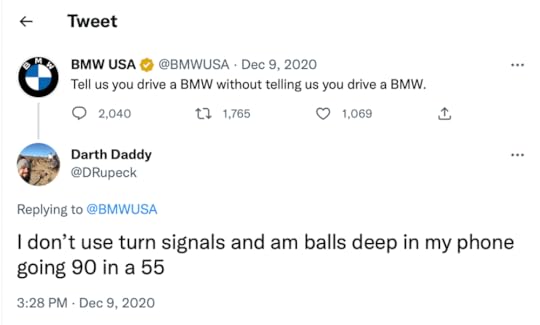
It occurred to me, when I found that poop bag in my coat pocket, that it was one of those revealing details I’m always harping on about in my writing workshops or with the authors I work with and mentor. Show don’t tell. Cut the tell; leave the show.
Showing is a muscle you strengthen with time and practice. You practice on the page as you write. You practice on the page as you read and notice how other authors reveal rather than explain. You practice off the page, as you live your life, as you put your hand in your pocket and crushed up dog treats or a soother or a lighter or a piece of chalk or a crumpled medical mask. Tell me it’s the 2020s without telling me.
December 12, 2022
Workshops
Head’s up: I’m leading two workshops in January. Space is limited in both so get a jump on those resolutions and sign up fast.
STORY DISSECTIONThe first workshop is IN PERSON. Weeeeeeeeeeeee!!!!!!!!! I’ve been cooking this session up since, I kid you not, 2019. I was talking to Memorial University about being their Writer-in-Residence for an upcoming semester and got this great idea for a small group session called Story Dissection. Here’s how it works: we close our eyes and listen to a story together. (Seriously, how nice does that sound? Don’t you want to return to story time on what will probably be a grey and freezing Saturday in January?) And then, we roll up our sleeves, get out the literary scalpels, and conduct a dissection. We’ll understand how has the author used all the tools of craft to build their story, to ensure sufficient tension and curiosity and interesting characters. Join this session you’ll leave having learned a thing (or six) about craft AND you’ll hone your dissection skills. I ran a virtual version of this workshop last year, when I was the writer-in-residence at Memorial. It went well but in person will be more interactive and fun. And if you were at that session in 2021, know that we’ll be dissecting a totally different story. This workshop is free and made possible by The Writers’ Alliance of Newfoundland and Labrador. We are lucky to have them. You must be a member (and in St. John’s on the 14th) to attend. Membership is free for writers who are Black, Indigenous, and/or People of Colour. If you write, you’re a writer so tell your imposter syndrome to take a running leap off Signal Hill and sign up already.
Saturday, January 14
2-5pm
The Lantern in St. John’s (35 Barnes Road)
Free! Space is limited and you must register here by January 4 to attend. Registration doesn’t guarantee admission. Selected participants will be contacted by January 9.
The second workshop is virtual and focused on dialogue. This one’s for writers who are past the beginner stage (ie. Do you know the difference between direct, indirect, and summary dialogue? If so, giddy up). It’ll be focused on how to write dialogue that multi-tasks and how to write conversations that surprise, with a hat tip to that elusive unicorn: subtext. And we’ll get into the more esoteric too, like the philosophy of quotation marks.
Saturday, January 28
12:30 - 2pm NST
$17. Attendance is capped at 15 and already half-sold out. Sign up here. Vite, vite!
My dialogue workshop is part of The Winter Writing Weekend hosted by the Afterwords Literary Festival. There are other workshops, interviews, and panel discussions that weekend. Check the whole schedule out.
June 15, 2021
Care a lot
Recently, a straight white guy tried to mansplain threading and bikini waxes to me. I smiled and wandered away. No, actually, I’m not sure about the smile. It might have been a scowl. Difficult to say. I’ve never had much of a poker face and my days of tolerating the senseless monologues of idiotic men are over.
A few days earlier, at the park a different white man had asked where my accent was from. I could have said Ontario. Or Japan. Instead, I channelled Lucille Bluth (RIP), called my puppy, and walked away.
We are living in a liminal time, still in a pandemic but partially vaxxed. Like hibernating animals, gradually, sleepily, returning into the world. I don’t know about you but I’m finding the transition strange. Small talk is a forgotten language. I’m happy to see friends but interacting at length with acquaintances is a bridge too far. And navigating awkward or infuriating conversations? That’s a core competency I’ve lost. I propose this is for the best. Why did we waste so much time and energy frantically searching for the verbal off-ramp in nightmare conversations with people we’d never met before and please god would never meet again, when all the while we could have been at home in soft pants re-watching Spaced?
Let’s leave politeness behind in the beforetimes. Politeness is toxic waste anyway - gaslighting and/ or misogyny and/or racism poorly concealed in the guise of civility.
“It is the summer of caring a lot but not giving any fucks,” says writer Lyz Lenz. AMEN. For me 2021 is shaping up to be this kind of year: lots of care, zero fucks given. Last year, I worked a lot. Too much. Because it turns out the only holidays I take involve planes and since all my trips were cancelled, I just kept thoughtlessly working. And then it was the end of December and I hadn’t taken a break beyond the 10 days I was in Ontario and I was furious. Sometimes burn out manifests as rage. This year my resolutions were: 1. get a puppy and 2. work less. The two are incredibly compatible.
Yeah, I like money. But I’m also a writer and a lot of the work I was doing was unpaid or underpaid. This year, I’m focusing my energy on work I care a lot about. Some of this is mentorship. Some of it is volunteer. A lot is my actual work: writing. For the rest I’m being strategic, saying no quite a bit more than yes.
I used to feel bad (okay, I still do sometimes) turning down requests. Which is illogical. Feeling bad about not wanting to do something is akin to politeness: a waste of energy. Heading into the after times I want to give zero fucks about the silliness that doesn’t matter and care a lot about the things and people that do.
Sharon Bala's Blog

- Sharon Bala's profile
- 140 followers

