Reagan Rose's Blog, page 3
July 30, 2025
Transhumanism, Christian Productivity, and Why I Donât Use the Term âSecond Brainâ
In recent years, the concept of a digital “second brain” has gained traction in the world of self-improvement and among creative professionals. A second brain is a note-taking system designed to help you overcome information overload in the modern age.
Tiago Forte, author of Building a Second Brain, defines the problem a second brain is designed to overcome:
Anything you might want to accomplishâexecuting a project at work, getting a new job, learning a new skill, starting a businessârequires finding and putting to use the right information. Your professional success and quality of life depend directly on your ability to manage information effectively.[1]
The solution, we are told, is to create a second brain. Externalize and organize the information such that our note-taking system becomes an extension of ourselves. This all sounds great at first. But the concept of a second brain actually carries some serious worldview baggage, and Christians would be wise to approach the topic with discernment.[2]
But while I’m a big fan of personal knowledge management (PKM), I refuse to use the term second brain. As you’ll see the concept of a second brain purposefully carries worldview implications that believers should think twice about. More broadly, I trust this little exercise will help Christians to think more biblically about how they use technology for self-improvement and personal productivity, and the latent philosophical assumptions they may be unknowingly imbibing.
The Ultimate Purpose of Personal Knowledge Management
I recently spoke on how to create a note-taking system. And I noted how important it is to think carefully about the purpose for your PKM as you design it. Are you seeking to collect notes and references from which you will write a book, are you wanting to store recipes, save interesting quotes, or just manage your personal thoughts in a more organized manner? The purpose for your system will affect how you design and use it.
But what is the ultimate purpose of creating a personal knowledge management system or second brain? Here is how Tiago Forte answered that question in a 2022 interview.
The ultimate purpose of PKM is to usher in the era of transhumanism â the fusion of man and machine. I think we are destined to use technology to enhance and augment our natural abilities. We already use prosthetic devices to improve our eyesight, our hearing, and even the beating of our hearts. But we are only beginning to do the same with the most powerful capability of them all: thinking and the human mind. I see PKM as the early stages of this historic transition, using simple software and human behaviors to amplify our intelligence. Everything we want to do, achieve, have, or experience is limited only by our imagination and intelligence, which means if we find a way to do that, there is almost nothing we canât accomplish both as individuals and as a society.[3]
It sounds almost comically ambitious at first, as if my little collection of Apple Notes is somehow going to guide mankind into its utopian next phase of human evolution. But Tiago is serious. When he says “second brain,” he means it literally.
But what really struck me about this quote was the last line, â…if we find a way to do that, there is almost nothing we canât accomplish both as individuals and as a society.â
Now, why does that sound so familiar?
Oh yeah.
Then they said, âCome, let us build ourselves a city and a tower with its top in the heavens, and let us make a name for ourselves, lest we be dispersed over the face of the whole earth.â And the Lord came down to see the city and the tower, which the children of man had built. And the Lord said, âBehold, they are one people, and they have all one language, and this is only the beginning of what they will do. And nothing that they propose to do will now be impossible for them.
Genesis 11:4-6 (ESV)
Forte’s ultimate vision for personal knowledge management is a digital Tower of Babel. This is the philosophy of transhumanism. And it might sound a little kooky at first until you realize he is far from the only one who thinks this way about technology and personal improvement.
Transhumanism is the Religion of Silicon Valley Samsungâs Silicon Valley Office, Photo by NBBJ
The scientific developments that helped build the West were a result of a Christian worldview. Look back to the writings of Bacon, Galileo, Kepler, Pascal, and Newton, and you see a drive to discover and innovate driven by their service to God. Louis Pasteur wrote, “The more I study nature, the more I stand amazed at the work of the Creator.â
But now in the post-Christian West our advancements are driven mostly by agnostics or atheists, many of whom are self-declared transhumanists. This is especially true in the world of technology. And it’s reflected in the fields in which they work. Areas like AI, bio-tech, reproductive technology, and life extension, are attempts to transcend mankind’s limitations. While the old scientists saw in the pursuit science a kind of worship of God, the new technologists seek only to make themselves into gods.
Transhumanism is the philosophy behind Elon Musk’s inter-planetary ambitions with SpaceX and Neuralink. It drives Sam Altman of OpenAI, the company behind ChatGPT. As far back as 2017 he was writing in hopeful terms about “the merge,”[4] a time when humans and AI would become deeply intertwined. Jeff Bezos of Amazon, has invested billions into biotech research to reverse aging, and views human mortality as a frontier to be conquered. And, over the past several years, Mark Zuckerberg has continually bet the Facebook farm on a series of transhumanistic projects like a virtual reality metaverse, life extension technology, and artificial intelligence.
But what exactly is transhumanism? âTranshumanism is a futuristic social movement. Its adherents believe that immortality is attainable in the corporeal world through the wonders of applied technology.â[5] Transhumanism is the religion of Silicon Valley. It’s salvation without confession of sin, without repentance, and without Christ. It’s man’s attempt to save himself. And while it may look and sound futuristic, the lie behind transhumanism is as old as mankind itself.
In the garden, mankind was sinless; perfect human beings. Adam and Eve weren’t fallen, but they were finite. Still the serpent deceived Eve with the promise of more. And it’s the same deception that drives transhumanism today, âye shall be as godsâ (Genesis 3:5, KJV).
Leading Transhumanist philosopher and politician Zoltan Istvan isnât shy about this fact, writing for the Huffington Post in 2016 he said:
We must force our evolution in the present day via our reasoning, inventiveness, and especially our scientific technology. In short, we must embrace transhumanismâthe radical field of science that aims to turn humans into, for lack of a better word, gods.[6]
And yet this kooky, sci-fi-sounding worldview is the dominant philosophy of the leaders driving the technological innovations shaping our world. And the transhumanists are shaping the way we think about how technology can help us become more productive.
This is something we have to keep in mind as we look at the latest tech innovations. Their makers and purveyors believe this world is our home, and all of their hopes are built on self-salvation via technology. But believers know that we don’t belong to this passing world (1 John 2:17). We have our hopes set higher.
âBut our citizenship is in heaven, and from it we await a Savior, the Lord Jesus Christ,â
Philippians 3:20 (ESV)
Okay, so what’s all this have to do with how you take notes?
The Christian Worldview and Your PKM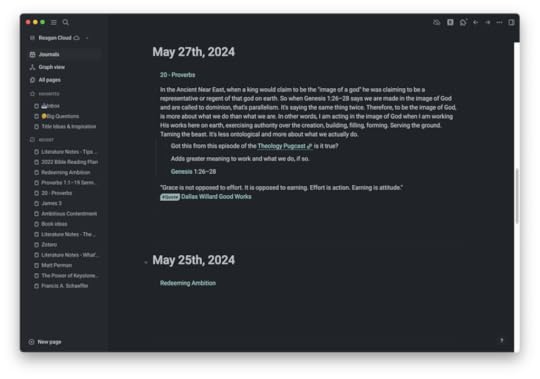 A snapshot of my LogSeq PKM Daily Note
Personal productivity, of which personal knowledge management is a sub-category, is a pursuit of self-improvement. And every philosophy of productivity contains a theology. Which means there are theological connotations even to how you think about your note-taking systems. My Notion app helps me stay organized and plan long-term goals, my Obsidian vault enables me to save and organize my notes for writing projects. But these systems are not a second brain. They may help me overcome certain obstacles, but they will never (and can never) enable me to transcend my creatureliness in the way Forte or the transhumanists suggest.
Technology can help us overcome certain limitations. My productivity tech stack genuinely helps me get more done, better fulfill my commitments, and even facilitates my spiritual habits that help me walk closely with the Lord. I believe we can, to a small degree, legitimately mitigate aspects of the curse on our work through the use of the common grace technology. But the transhumanist wants to draw a line that goes up and to the right, from small improvements in my organizing to transcendent übermensch. And not only is this impossible, I believe the pursuit itself is dishonoring to God.
This is about accepting our limits of creatureliness not as a problem to be overcome, but as good parts of God’s limited to design for us as humans. God has given limits to our minds. Some of our limits are the result of the noetic effects of the curse. But some of those limits are the God-designed aspects our finitude he gave us before sin ever entered the picture; limits intrinsic to humanity over which God declared “it is very good” (Genesis 1:31), and the same humanity Christ put on at His incarnation.
We give thanks to Him for the massive blessing of tools and technology that can help us in the task of stewarding our lives and vocations for His glory. And we recognize that even if they are designed by godless transhumanists, many of the innovations we have today and be used in a God-honoring way.
We can plunder the Egyptians of these common grace tech tools for the glory of God. But we’ve got to be sure we aren’t inadvertently packing their idols into our saddlebags along with the other treasures.
Use Tech; Donât Idolize It
So what can we do to avoid inadvertently importing transhumanist ideas into the way we think about our productivity technology? Let me leave you with five principles that may help.
We should accept technological advances as common grace gifts from God. He creates the blacksmith of the sword and the ravager who slays with it (Isaiah 54:16), and He is sovereign over both. Thus even godless transhumanists can create technology that is useful for believers.[7]We should acknowledge that human innovation in this world, though amazing at times, is marred by sin and the curse. Technology cannot save us, and it always comes with some negative side-effects. Don’t buy the hype; no technology is an unmitigated good.Technology can be used discerningly to aid in our sanctification. The printing press brought Bibles in our homes, my prayer app helps me remember prayer requests, my PKM helps me write articles for Christian readers. Digital note-taking apps, to-do lists, VPNs, and e-readers can be used wisely and productively to our advantage as believers.Always consider the telos of technology. Which is to say look to the ultimate purpose of any tech you are using. Seek to use it to overcome sin, seek to improve yourself as an act of stewardship, but do not seek to transcend essential human nature. There are limits to our humanity that are God-designed and good and not in need of improvement or transcendence. We are not God.Be a tech-realist. Technology is cool. But Christians musnât engage with technology as wide-eyed optimists awaiting a Silicon Savior. Nor do we reject all technology as though our Lord were not sovereign even over the hearts of unbelieving technologists. When it comes to technology, Christians operate as we have always had to in this fallen world, with trust in the goodness of Godâs creation, while simultaneously acknowledging the curse and manâs fallen nature. It’s only when we hold these two truths together, trusting in the indwelling Spirit to help us, that we can discern through the thorny maze of technology and productivity.Final ThoughtsWe live in an age of unprecedented digital opportunity. Tools that help us capture ideas and organize information are genuine blessings. But we must acknowledge that these tools are being shaped by worldviews that seek to redefine what it means to be human. The language of âsecond brains,â augmented minds, and human-AI fusion is more than mere marketing hype, it reflects a theology, one rooted in the transhumanist dream of transcendence apart from God.
As Christians, we must approach our personal knowledge management, and all of our productivity, not as a means of becoming gods, but as a way of better glorifying the One true God.
So take notes, organize your ideas, and improve your memory and creativity. But build your PKM not as a second brain, but as a tool of stewardship.
FootnotesTiago Forte, Building a Second Brain: A Proven Method to Organize Your Digital Life and Unlock Your Creative Potential (New York: Atria Books, 2022), 17.â©ï¸This isn’t a criticism of Forte’s PARA methodology, which I think is quite helpful. I am critiquing the transhumanistic assumptions Forte holds and others hold and which are connoted in the term second brain.â©ï¸Tiago Forte, âBuilding a Second Brain: An Interview with Tiago Forteâ The Bullet Journalist (Bullet Journal), June 13, 2022.â©ï¸Sam Altman, âThe Merge.â Sam Altmanâs Blog, Decemberâ¯7,â¯2017.â©ï¸Wesley J. Smith, âThe Impossibility of Christian Transhumanismâ First Things, March 24, 2022â©ï¸Zoltan Istvan, âTranshumanism and Our Outdated Biologyâ HuffPost, April 21, 2016.â©ï¸See Tony Reinke’s God, Technology, and the Christian Life for more on how Isaiah 54 elucidates God’s providence over technology even in the hands of the ungodly.â©ï¸.numbered-list-yo {list-style:numbered!important;}

July 24, 2025
Reagan’s Roundup: July 24th, 2025
Your weekly roundup of insights and resources to help you get more done for the glory of God.
In Todayâs Issue:Personal Note-Taking SystemsA Christian Vision for ExerciseThe Pace of Motherhood10 Proverbs for Slaying Destructive Phone HabitsFrancis Bacon on Taking NotesDear steward,
This month, I’ve been focusing on the theme of knowledge management.
Last week, I shared with you The Ultimate Guide to Going Paperless at Home, which deals with how to organize and digitize your important documents.
This week, I wanted to look at organizing your personal notes. From Bible reading, book notes, lectures, quotes, ideas, goals, or whatever else you jot down and would like to revisit later, having a place to store your thoughts is increasingly important in todayâs information-saturated world.
Do you keep your notes on paper? Notebooks? A filing system? Notecards? If you go digital, what apps do you use? And how do you keep your notes from being spread out across a dozen different places, such that you can never find the important thing you wrote down when you need it?
Check out the latest episode of the Redeeming Productivity Show to learn How to Create a Personal Note-Taking System.
Brought to You by Shortform Deep Insights from the Best Books
When it comes to reading non-fiction, I’m not reading just to be entertained; I’m there to learn.
And that means I’m underlining, writing notes, pausing to think, and often seeing what others have written about the book in my hand.
That’s why I love Shortform. Their book guides help you quickly glean the key points from great books on productivity, career, leadership, and more, without all the fluff.
Just this week, I was revisiting How to Take Smart Notes By Sönke Ahrens. Shortform’s guide to the book helped me re-cement some of the key concepts and even make some connections I’d missed the first time I read it!
If you are a non-fiction reader who wants to take your learning deeper, I recommend Shortform. You can get a 20% discount using my link: shortform.com/reagan
Weekly WordWorth Your TimeA Christian Vision for Exercise (7 mins) David Mathis shares 10 principles he learned on his journey to become a better steward of his body.Struggling to Keep Up in Motherhood? Let the Spirit Set Your Pace. (4 mins) âBefore the dawn of social media, the temptation to set our schedules and to-do lists by other mothers was limited to neighbors, peers from church, or fellow carpool moms. However, social media tempts us to keep up with mothers all around the globe as we compare our realities to their curated clips.â10 Proverbs to Slay Destructive Phone Habits (10 mins) Daniel Szczesniak shows how ancient biblical wisdom principles apply to a modern problem that many of us face.Words of Wisdom“My son, if you receive my words
and treasure up my commandments with you,
making your ear attentive to wisdom
and inclining your heart to understanding;
yes, if you call out for insight
and raise your voice for understanding,
if you seek it like silver
and search for it as for hidden treasures,
then you will understand the fear of the Lord
and find the knowledge of God.”
â Proverbs 2:1-5
Take your Christian productivity to the next levelâWrite down the thoughts of the moment. Those that come unsought for are commonly the most valuable.âÂ
â Francis Bacon
Listen to the Podcast â The Redeeming Productivity Show is available on all podcast platforms and YouTube.â
Get the Book â Grab a copy of âRedeeming Productivity: Getting More Done for the Glory of Godâ
Join the Academy â Get access to all of our courses, workshops, private community, planner, and moreââ
Use the Planner â The all-in-one productivity system designed for Christians
July 23, 2025
How to Create a Personal Note-Taking System
From Bible reading, book notes, quotes, ideas, goals, or whatever else. Having a place to store your thoughts is increasingly important in todayâs information-saturated world.
But how do you build a personal note-taking system that can store your thoughts without itself becoming an onerous burden to maintain?
LinksSubscribe to the â â â â â â â â â â â â â â â â â â â â â â â â newsletterâ â â â â â .Join â â â â â â â â â â â â â â â â â â â the â â â â â â â â â â â â â â â â â â â â â â â â â â â â â â â â â â â â â Redeeming Productivity Academyâ â â â â â â â â â â â â â â â â â â â â â â â .Use the â â â â â â Christian Productivity Plannerâ âJuly 17, 2025
Reagan’s Roundup: July 17th, 2025
Your weekly roundup of insights and resources to help you get more done for the glory of God.
In Todayâs Issue:The Ultimate Guide to Going PaperlessProverbs on Listening to AdviceIs ChatGPT Making You Dumb?When You’re Dreading Monday MorningsLittle Videos Are Cooking Our BrainsDear steward,
About ten years ago, I oversaw the process of helping an institution of higher education go paperless. We had decades of paper filesâtranscripts, applications, you name it. There were rooms of giant metal filing cabinets and aisles upon aisles of boxes filled with paper in off-site storage.
It was a massive project, and it took six months just to get the processes and systems in place to start moving things to the new digital system. But through the process, I learned a ton about creating good file management systems and was able to apply those principles to my own personal document management. And thatâs what I wanted to share with you today.
I just published The Ultimate Guide to Going Paperless at Home.
In it, I show you a step-by-step process for scanning, organizing, and purging your paper files so you can eliminate clutter and find that document when you need it.
Hope you find it helpful!
Weekly Word“The way of a fool is right in his own eyes, but a wise man listens to advice.”
â Proverbs 12:15
Christian productivity isnât just about doing more. Itâs about doing whatâs right. That often means humbling ourselves to receive counsel. Wisdom listens before acting; folly charges ahead alone.
Worth Your TimeIs ChatGPT Making You Dumb? (32 mins) A recent MIT study showed that writers who depended on large language models like ChatGPT for an extended period of time may be in danger of stunting their ability to write, recall, and think clearly. How should Christians think about our engagement with AI, based on these findings?When Youâre Dreading Monday Mornings (4 mins) Kaitlin Feebles shares some wise advice for believers who are struggling to find joy in their jobs.Little videos are cooking our brains (7 mins) Vox has an interesting piece on how short-form videos on platforms like TikTok, YouTube Shorts, and Instagram reels are affecting our brains. The research seems to confirm what a lot of us have concluded intuitively: itâs not good.Words of WisdomâPeople will come to adore the technologies that undo their capacities to thinkâ
â Neil Postman, Amusing Ourselves to Death
P.S. If youâre a long-time follower of Redeeming Productivity, youâll know John MacArthur was a major influence on my life and ministry. He went to be with the Lord this week. I wrote this little tribute to how the Lord used him in my life.
Take your Christian productivity to the next levelListen to the Podcast â The Redeeming Productivity Show is available on all podcast platforms and YouTube.â
Get the Book â Grab a copy of âRedeeming Productivity: Getting More Done for the Glory of Godâ
Join the Academy â Get access to all of our courses, workshops, private community, planner, and moreââ
Use the Planner â The all-in-one productivity system designed for Christians
The Ultimate Guide to Going Paperless at Home
Do you have piles of papers or filing cabinets bursting at the seams? Maybe you’ve dreamed of going paperless, but the idea of scanning everything and sorting it into your computer sounds way too intimidating.
I created this guide to help you go paperless in your home as painlessly as possible.
Most of us donât aspire to create our own personal Library of Congress. We donât want elaborate folder hierarchies or extensive metadata to maintain for each file. Instead, we simply need an efficient system that helps us locate important documents when neededâwhile keeping our homes free from unnecessary clutter.
Hereâs what weâre going to create today:
A small physical file box with folders for your important filesA physical inbox for papersA system for scanning and organizing files on your computerA regular cadence for purging & organizing your physical filesThis system revolves around a three step framework:
Capture (Daily)File (Weekly)Purge (Yearly)
Now letâs talk about how to get you there.
The Tools Youâll NeedA Physical File Box & FoldersIn my opinion, this should be as small as possible. Over time, you wonât need to keep many physical files, and having a smaller box is a helpful constraint to avoid hoarding.
 Firebox / Safe
Some documentsâlike passports, birth certificates, and Social Security cardsâyouâll want to store in a firebox. Preferably, choose one that is also waterproof. Even if your area isnât prone to flooding, if thereâs a fire, the firefighters will likely flood your home putting it out.

This is a decent waterproof fire safe from SentrySafe, but they come in all shapes and sizes.
A Physical InboxThis is a paper tray youâll use to collect documents that need to be processed.
 Computer File System with Backups
Since we’re moving paperless, we need to have an organized and trustworthy place to store our digital paper files.
I use an iCloud subscription on my Mac that encrypts and syncs my Documents folder to the cloud. If I can’t access my computer for whatever reason, I can recover my files from there. It’s also nice because they are accessible from a phone as well.
You can also use Microsoft OneDrive, Dropbox, or an external hard drive you back up your computer.
Ideally, you’ll want to follow a 3â2-1 backup strategy for important files. That’s 3 copies of your data, in two different media, with one copy stored in a separate location. Personally, in addition to my iCloud backup, I also backup to a local hard drive and to the cloud via Backblazeâjust to be safe.
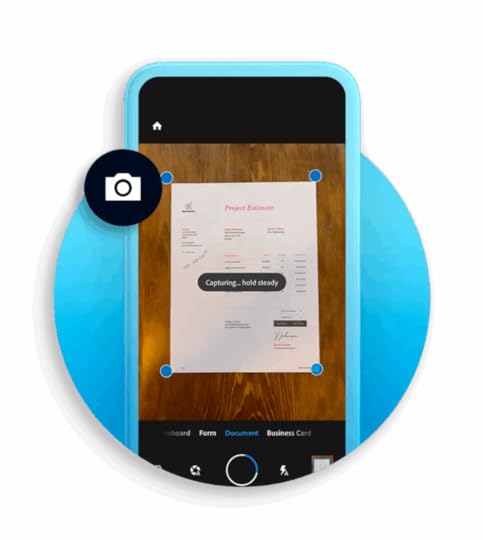
Scanner or Scanning App on Your PhoneYou can use a fancy flatbed scanner or just use your phone to scan documents. Adobe Scan is a great app for this (available on both iOS and Android).
 Optional: A Paper Shredder
If you end up purging a lot of old documents, thereâs probably some sensitive info you donât want to just toss in the trashâespecially tax documents. If you have access to a shredder at work, ask for permission to use it (thatâs what Iâve done in the past). Or you might just want to pick up a paper shredder to keep at home.
The Initial SetupOnce youâve got your tools, itâs time to set up your system, create your folder structure, and start putting files in their proper places.
This part can get tricky, so Iâll give you a step-by-step plan to make it simple and help you tackle the project in manageable chunks.
Weâre going to deal with physical files first, since our goal is to go paperless. But along the way, weâll be creating a more organized digital file system to scan intoâand eventually migrate your existing digital files into that system, too.
Step 1: Gather All Physical FilesIf youâve got piles of paper, old file cabinets, or things stuffed away in drawers, nowâs the time to get it all out. Weâre going to find a home for everythingâand get rid of most of those papers in the process!
Step 2: Purge, Keep, ScanWeâll take two passes on most of your physical files. In this first pass, the goal is just to make three piles. Weâre not categorizing or filing anything yet.
These are the three piles you’ll be making:
Purge – Files you can easily get again online, or it’s outside the required retention period, toss it.Scan & Keep – Files that would be difficult or costly to replace, and for which you may need the original.Scan & Shred – Files you aren’t legally required to retain in physical form, but you can imagine needing them later.
Here’s a PDF checklist with examples that you can print off to help you with this step:
Paperless ChecklistDownloadStep 3: Organize Your Scan & Keep FilesNow that youâve completed your first pass, set the purge pile aside (we’ll be adding to this later, so save the actual shredding until the end). We’re going to go through both the Scan & Keep pile a second time and begin sorting them into folders.
This is where people often get stuck. The temptation is to create a bunch of folders upfront and try to anticipate everything you might need. But you only need folders for what you currently have. You can always add more categories and folders later.
Go through the Scan & Keep pile and group similar documents together.Sticky notes can help at this stage, so youâre not committing to folder names just yet.Once youâre happy with the groupings, write your category names on your folders.Then file the Scan & Keep documents into their proper folders.Doesnât that feel great?
Step 4: Organize Your Scan & Shred FilesNow letâs tackle your Scan & Shred pileâand this is also the time to set up your digital file system.
In your computerâs Documents folder (or wherever you plan to store your digital files), create the same folder names you used in your physical filing system.Go through your Scan & Shred pile as you did with the Scan & Keep pile. Group similar items using sticky notes. Some categories may overlap, and others may be new.Add any new category names as folders on your computer.Place each stack into your physical inbox, separated by category. Step 5: The Initial ScanYou now have two groups to scan: the Scan & Keep files (now in your file box) and the Scan & Shred files (in your inbox).
Start with the Scan & Keep files. Try to scan these in one sitting, or if you are interrupted, leave a note in your filebox where you stopped so when you come back to it you know where you left off. Many may not need scanningâfor example, if you can already access them online or have existing digital copies. If you do, simply download or move them to the appropriate folder. Scan just whatever you think may be necessary to keep a digital copy of. Then move on to the Scan & Shred files. You can chip away at these gradually. Theyâre already categorized in your inbox. If it’s a big pile, put on a podcast, sermon, or audiobook and aim for 30 minutes a day until itâs done.As you scan each file, move the digital version to its appropriate folder. Then toss the physical paper in the Purge pile for shredding.
Step 6: ShredNow itâs time to discard everything from your Purge pile and your completed Scan & Shred pile. You can use your own shredder, borrow one at work, or use a paid shredding service like FedEx Office.
Maintaining the SystemCongratulationsâyouâre paperless!
Youâve done the hard work. Youâve built your file system, found a home for everything, and cleared out the clutter.
But the key is to keep the piles from growing back. Thatâs where the 3-step maintenance routine comes in:
Capture (Daily)File (Weekly)Purge (Yearly)1. CaptureWhenever you receive a new paper document that may need to be saved, place it in your physical inbox. You donât have to decide what to do with it right awayâjust capture it for processing later.
2. FileOnce a weekâideally during your weekly reviewâgo through each paper in your inbox and ask:
âDo I need to keep this?â If not, toss it.âDo I need a paper copy?â If yes, scan it, then file both the digital and paper versions. If not, just scan it, save it in the proper digital folder, and toss the original.3. PurgeYouâll inevitably end up storing more paper than necessary, some files will become irrelevant, and youâll need to make space for new ones.
I recommend doing a purge once a year. The best time I’ve found is right after tax season. You’re already going through your files, why not clear things out as long as you’re in there.
Just repeat the step-by-step process from above. It wonât be nearly as painful the second time since you should have far fewer papers to sort through. This annual purge is the way to keep your system tidy and functional.
ConclusionHopefully, this step-by-step guide has given you the confidence to tackle that intimidating pile of papers. Just follow the plan, take it one step at a time, and youâll soon be enjoying the freedom of the paperless life.
July 15, 2025
John MacArthur’s Influence on My Life
Pastor John MacArthur went to be with the Lord yesterday, July 14th. He was 86 years old. You can read the full statement from the church here.
In light of his passing, I wanted to take a moment to write a little tribute to Pastor John. The Lord used him mightily in many believers’ lives, so it is a fitting way to honor his legacy by recounting just a few ways his teaching has shaped my own life and ministry.
I had the opportunity to graduate from The Master’s Seminary, serve as a deacon at Grace Community Church, and work at Grace to You for several years. And before that I listened to hundreds of his sermons and was a voracious reader of his books. So, it’s safe to say MacArthur has had no little influence on me. But, if I had to narrow it down to one thing, it was John MacArthur’s high regard for the Word of God that has had the deepest impact on my life, and the ministry of Redeeming Productivity itself.
The Clarity of ScriptureI did my undergraduate education in Grand Rapids, Michigan. While I was there, I fell under the influence of a pastor named Rob Bell.
The Enemy really did a number on me at Mars Hill. But the worst part was that in that church, my confidence in God’s Word was eroded. The specific point of attack was the clarity of the Bible.
The assaults on Scripture’s understandability were mostly indirect. They came in subtle insinuations like, “Well, you know so many scholars disagree on this interpretation,” and “This is poetic language, we aren’t meant to understand it,” or in the false humility of rhetorical questions like, “Who are we to think we can understand the Bible?” But they had their effect.
By the time I finished college, I was confused and adrift. I was keenly aware that if I couldn’t reliably understand the Bible, then my entire worldview was resting on quicksand. Without the special revelation of Scripture, how could I know who God is? What He wanted from me? Or even have the confidence to know the gospel itself was true and that Christ was a worthy object of my faith?
This crisis of faith also happened to come during the 2008 financial crisis, which hit my home state of Michigan extra hard. So, upon graduating from college in 2009, I couldn’t find a job in my degree field. So, I ended up working for my friend’s janitorial company. I work nights cleaning office buildings. And every night, I’d hear John MacArthur on Christian radio as I drove between job sites.
I’d heard his name before, but this was my first introduction to his Bible teaching. The thing that first struck me about MacArthur’s teaching was the confidence, and not in a good way. I’d been well trained to be skeptical of anyone who claimed to know what the Bible meant by what it said. So at first, I thought, “Man, this guy is arrogant!”
But I kept listening.
And, over and over again, Pastor John didn’t just declare what the passage meant; he proved the meaning from the Bible. He’d use the context, cross references, and air-tight logic to whittle down the possible interpretations, until you were convinced this was exactly what the passage meant.
It was during those late nights that I developed a conviction that God’s Word could be understood. And if it could be understood, I reasoned, I needed to understand it. And so a hunger for the Word was born in me that eventually led to me pursuing a biblical education at The Master’s Seminary.
The Authority of ScriptureJohn MacArthur is a bit of a polarizing figure.
Most people only have a passing familiarity with his ministry because of the theological controversies he’s been involved in. But what people don’t realize is that John MacArthur was just a Bible teacher who actually believed God’s Word has relevance for our lives. That since it’s God’s Word, it can speak authoritatively on issues, and that our role is to obey what it says.
When I was a member of Grace Community Church, I remember hearing new seminary students remark (sometimes with obvious disappointment) that the regular Sunday sermons weren’t all diatribes and controversy. In fact, during my 7 years there, most Sunday messages were pretty boring! What I mean is they weren’t full of hot takes or take downs. It was just the simple, steady teaching of God’s Word.
The difference with John, however, was that unlike so many modern preachers, when Biblical teaching came into conflict with the spirit of the age, instead of avoiding the issue or apologizing, John would show how the Scriptures speak to that issue. And he would do so directly. He didn’t mince words. But he did this not because he was a brawler just looking for a fight, but because he actually believed that God’s Word had authority.
From John MacArthur, I learned that when the Scriptures speak, God speaks. It can be tempting to treat the Bible as merely theoretical, a safe book to be brought out just on Sundays for a comforting word. But John taught in a way the forced you to see that the Bible’s teachings aren’t merely notional, they are packed with promises and, indeed, commands. And our role isn’t to excuse or minimize those commands, but to to joyfully submit to Christ’s Lordship as expressed through His Word even when that submission is out of step with the world.
The Sufficiency of ScriptureA third doctrine I learned from MacArthur, and saw exhibited in his teaching ministry, was that of the sufficiency of Scripture.
The New Testament says that God’s Word contains all that we need for life and godliness (2 Peter 1:3) and that by it we may be fully equipped for every good work (2 Timothy 3:15â17). And these were truths I heard again and again from John’s pulpit ministry, and which trickled down to me through my professors at the seminary.
John MacArthur showed me how the Bible’s teachings aren’t merely relegated to the “spiritual” parts of our lives, but His Word has relevance for all areas of life. The Scriptures inform how you do business, how you parent, how you think about current events, and, yes, how you get things done.
Redeeming Productivity was born out of my conviction that, as important as the issues of work and time management are to our lives, the Bible must surely speak to them. It was a conviction arising from a strong belief in the doctrine of the sufficiency of Scripture. And that was something that the Lord taught me through the ministry of John MacArthur.
Conclusion56 years of ministry is quite the legacy. And I’m sure many of you could share stories of how the Lord used John MacArthur’s ministry in your life. But I just wanted to take a moment here to give thanks to the Lord for how he used this man to shape my Christian life and the ministry of Redeeming Productivity.
Please, be praying for the Lord’s comfort for John’s family and Grace Community Church, as well as for wisdom and direction for the many ministries that he had a hand in.
Is ChatGPT Making You Dumb?
A recent MIT study showed that writers who depended on large language models (LLMs) like ChatGPT for an extended period of time may be in danger of stunting their ability to write, recall, and think clearly. How should Christians think about our engagement with AI, based on these findings?
The study: https://www.media.mit.edu/publication...
LinksSubscribe to the â â â â â â â â â â â â â â â â â â â â â â â â newsletterâ â â â â â .Join â â â â â â â â â â â â â â â â â â â the â â â â â â â â â â â â â â â â â â â â â â â â â â â â â â â â â â â â â Redeeming Productivity Academyâ â â â â â â â â â â â â â â â â â â â â â â â .Use the â â â â â â Christian Productivity Plannerâ âJuly 10, 2025
Reagan’s Roundup: July 10th, 2025
Your weekly roundup of insights and resources to help you get more done for the glory of God.
In Todayâs Issue:Personal Knowledge ManagementProverbs 18:15Exercise & the Writing LifeCreating Distraction-Free FocusMartin Luther on Changing DiapersDear steward,
To thrive in our information-saturated world, we need systems. Just as a to-do list system can help you be a person of your word, the same applies to how you manage information.
Creating a personal knowledge management system (PKM) is a worthwhile endeavor for any Christian seeking to be faithful in stewarding their life for Godâs glory, but who also finds that disorganization is getting in their way.
You want a reliable way to find that tax document when you need it, or resurface that quote you jotted down months ago. These are the times when having a simple plan for organizing your information comes in handy. And it doesnât have to be some big, complex thing that takes up all your time.
The way I see it, most people would be well served by having a plan for handling two things:
Documents – Tax returns, legal documents, insurance policies, receipts, and other files.Notes – A place to store things like quotes, ideas, book summaries, Bible study or sermon notes, etc.Over the next few weeks, Iâll be sharing some tips on how to organize your knowledge so you can find the important stuff when you need it.
Next week, weâll begin by looking at how you can organize your important documents. And Iâll share an easy-to-follow process for moving towards being (mostly) paperless.
Brought to You by Shortform Apply Insights from the Best Books to Your Life
There’s a difference between reading books and applying what you learn. And that’s one of my favorite benefits of using Shortform guides.
Shortform book guides help you quickly glean the key points from great books on productivity, career, leadership, and more, without all the fluff.
These guides are incredibly well-written, logical, and easy to follow, which is why I’ve been a Shortform user for years. I especially enjoy reading summaries of books I’ve already read, as they help me crystallize the key concepts so I can put them into action. Shortform guides even include exercises with prompts to help you apply what you’re learning.
If you’re a non-fiction reader who doesn’t just want to fill their head with ideas, but actually wants to change, I highly recommend Shortform.
Get 20% discount on Shortform using my link: shortform.com/reagan
Weekly WordâAn intelligent heart acquires knowledge, and the ear of the wise seeks knowledge.â
â Proverbs 18:15
Your mind is a tool. So sharpen it daily. Fruitful living comes from actively seeking truth and understanding of Godâs world and Godâs Word.
Worth Your TimeExercise and the Writing Life (4 mins) Anthony Kidd writes about missionary Adoniram Judsonâs fitness routine. âWhen you consider how phenomenally productive Judson was, you might wonder, how was he able also to maintain this fitness regimen too? I suspect Judson would tell us that the physical regimen helped enable his scholarly productivity.âHow to Create a âDistraction-Freeâ Focus Ritual (3 mins) âThe purpose of a distraction-free ritual is to allow you to focus your full attention on one important task or project.âWork Is Cursed. We Need the Gospel. (4 mins) âLetâs model work for our family, for each other, and for the little ones as we labor in a manner worthy of the calling to which weâve been called.âWords of WisdomTake your Christian productivity to the next levelâGod, with all his angels and creatures, is smiling, not because that father is washing diapers, but because he is doing so in Christian faith.â
â Martin Luther
Listen to the Podcast â The Redeeming Productivity Show is available on all podcast platforms and YouTube.â
Get the Book â Grab a copy of âRedeeming Productivity: Getting More Done for the Glory of Godâ
Join the Academy â Get access to all of our courses, workshops, private community, planner, and moreââ
Use the Planner â The all-in-one productivity system designed for Christians
July 4, 2025
Reagan’s Roundup: July 4th, 2025
Your weekly roundup of insights and resources to help you get more done for the glory of God.
In Todayâs Issue:Productivity from a Renewed MindStrategic UnderperformanceNavigating Social Media AdviceYour Work Is an ApologeticMaking Good TablesDear steward,
Happy Independence Day to my US readers!
I’ll keep the intro short, so you can get back to tending the smoker.
Now, let’s dive into this week’s Roundup!
Brought to You by Dwell
If your summerâs loud, busy, and flying byâyouâre not alone. And if staying consistent in the Word has been tough lately, youâre not the only one there either! But the Dwell Audio Bible App can help you stay consistent.Â
When you struggle to find time to sit down and read the Word, why not listen instead? With Dwell Bible, you can press play on Scripture while folding towels, loading the car, or waiting at swim lessons! You may even feel you’re spending more time in the Word just by listening.
One listen can change your whole day. Let Scripture move with you this summer! You can save 25% off a one-year subscription or 50% off a lifetime subscription with our link:Â dwellbible.com/redeemingprod
Weekly WordâDo not be conformed to this world, but be transformed by the renewal of your mind, that by testing you may discern what is the will of God, what is good and acceptable and perfect.â
â Romans 12:2
Productivity that honors Christ flows from a mind renewed by His truth. As we submit our plans, values, and days to Him, we learn to pursue what really matters and do it in a way that brings Him glory.
Worth Your TimeStrategic Underperformance: The Hidden Productivity Hack (2 mins) The author makes a valid point about trade-offs. My only concern is that this could be construed as a denial of Ecclesiastes 9:10. If we can’t do everything with excellence, perhaps we are committed to too many things. I’d be curious to hear your thoughts.Surviving the Social Media Flood of Life Advice (14 mins) John Piper offers wisdom on how to navigate our lives toward God-honoring aspirations, when we are daily flooded with worldly wisdom telling us what they think we should want out of life.Your Work Is an Apologetic (5 min) “Most of us will never stand in front of crowds (like Huff) or make headlines (like Kennedy). But every faithful act of work can point to something beyond itself.”Words of WisdomTake your Christian productivity to the next levelâThe churchâs approach to an intelligent carpenter is usually confined to exhorting him not to be drunk and disorderly in his leisure hours and to come to church on Sundays. Â What the church should be telling him is this: Â That the very first demand that his religion makes upon him is that he should make good tables.â
â Dorothy Sayers
Listen to the Podcast â The Redeeming Productivity Show is available on all podcast platforms and YouTube.â
Get the Book â Grab a copy of âRedeeming Productivity: Getting More Done for the Glory of Godâ
Join the Academy â Get access to all of our courses, workshops, private community, planner, and moreââ
Use the Planner â The all-in-one productivity system designed for Christians
June 26, 2025
Reagan’s Roundup: June 26th, 2025
Your weekly roundup of insights and resources to help you get more done for the glory of God.
In Todayâs Issue:Adjusting Habits to the SeasonIsaiah 55 on PlanningIs ChatGPT Making You Dumber?Serving Like Jesus at WorkWhat Makes You Think You Can Do Better?Dear steward,
I love the summer season (even in the midst of this heatwave that’s been hitting us hard in Southeast Michigan).
But as much as it can be a season of fun and rest, summer also tends to be a season of disruption. Our normal routines get interrupted, and if we aren’t intentional, habits can easily fall to the wayside.
But with disruption comes opportunity.
The biggest mistake we can make when a schedule change disrupts our good habits is to blindly try and keep the habit going without accounting for the reality of change.
Adjusting your habits to the reality of the season isn’t breaking them, it’s being proactive about keeping them. You see, the longer you go trying to force yourself to do a habit at the same time and in the same way that worked in one season but not in a new one, the more likely you are to end up breaking that habit for good.
The wisest course of action is to proactively adjust your habits to the new season. The sooner we adjust our habits to the schedule change, the less likely it is that we will completely break the habit.
I’ve learned through experience that I’ve got to adjust my morning routine in the summer, or things like Bible reading, exercise, and the like are going to completely fall off.
I tend to stay up a bit later in the summer, so I’m getting up later. That means I’ve moved my routine later in the morning and shortened it. I’m doing more reading during other parts of the summer, so I cut that out of the morning routine to simplify it.
If you’re feeling like you’re losing some of your habitsâespecially your morning habitsâthis summer, I’d advise you to sit down and come up with a new plan to help you adjust your habits to the new season.
P.S. If you want more in-depth help with developing a God-honoring morning routine, POWER Mornings is still on super sale for just a few more days. Use code JUNE2025 at checkout to get it for just $19. Sale ends June 30th.
Brought to You by Shortform Apply Insights from the Best Books to Your Life
There’s a difference between reading books and applying what you learn. And that’s one of my favorite benefits of using Shortform guides.
Shortform book guides help you quickly glean the key points from great books on productivity, career, leadership, and more, without all the fluff.
These guides are incredibly well-written, logical, and easy to follow, which is why I’ve been a Shortform user for years. I especially enjoy reading summaries of books I’ve already read, as they help me crystallize the key concepts so I can put them into action. Shortform guides even include exercises with prompts to help you apply what you’re learning.
If you’re a non-fiction reader who doesn’t just want to fill their head with ideas, but actually wants to change, I highly recommend Shortform.
Get 20% discount on Shortform using my link:Â shortform.com/reagan
Weekly WordFor my thoughts are not your thoughts, neither are your ways my ways, declares the Lord. For as the heavens are higher than the earth, so are my ways higher than your ways and my thoughts than your thoughts.
â Isaiah 55:8-9
Our plans donât always go as expected. And thatâs a good reminder that Godâs purposes are not bound by our calendars. His ways are higher, and His timing is always perfect.
Worth Your TimeWhy Do You Think You Can Do Better? (3 mins) A valuable reminder for the productivity-minded: âWhen we make a commitment to pray for change, we acknowledge that change is hard and slow, that our current tendencies are harder to shake off than we’d like to admit, that we tend to be slow learners and growers.âIs ChatGPT Making You Dumber? (5 mins) A new study from MIT researchers found some alarming (if rather obvious) issues with people becoming reliant on AI for help with writing. Users âconsistently underperformed at neural, linguistic, and behavioral levels.â And they become lazier as the experiment went on. When tools to help us be more productive we must not only focus on what the tool can do, but also on what using the tool is doing to us.Serving like Jesus at Work (6 mins) âServant leadership is one of the most influential and highly debated leadership theories of the last 40 years. . . . Like God, we can both lead and serve. We can put others ahead of ourselves. Let me share six surprising scriptural secrets of service, surrender, and sacrifice.âWords of WisdomTake your Christian productivity to the next levelâClarity about what matters provides clarity about what does not.â
â Cal Newport, Deep Work
Listen to the Podcast â The Redeeming Productivity Show is available on all podcast platforms and YouTube.â
Get the Book â Grab a copy of âRedeeming Productivity: Getting More Done for the Glory of Godâ
Join the Academy â Get access to all of our courses, workshops, private community, planner, and moreââ
Use the Planner â The all-in-one productivity system designed for Christians