A.L. Knorr's Blog, page 5
December 21, 2021
A Fresh Excerpt from A Blossom at Midnight for Dec 21, 2021
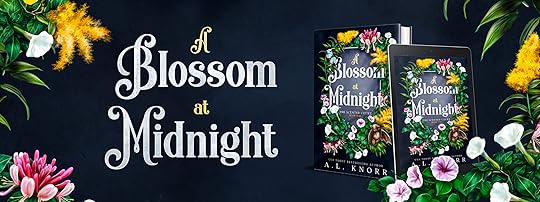
T-18 days until the launch of this brand new YA epic fantasy! A Blossom at Midnight is now up for preorder and drops on January 7, 2021. To whet your appetite, please enjoy another fresh excerpt from the story below.
One earns a coveted place among royalty. Another is imprisoned by her betrothed , while the third is exiled until he can prove his worth. Can these three fae prevent a war?
Rejection has left fae courtier Laec wallowing in wine and disdainful of what he sees in the mirror. When Queen Elphame offers him a foreign commission, he jumps at the chance for a fresh start, but soon learns that healing his heart may inflame the very trouble his queen sent him to prevent.
Beautiful and eligible Çifta believes in the importance of duty. Wishing to please her father, she agrees to marry a powerful unseelie prince. But when she discovers his cold heart and attempts to break the engagement, the princess-to-be quickly finds herself in chains. Alone and trapped in a damp fortress, she cannot see a way out.
Half-fae Jess longs to leave her rural life. She’s always obeyed her mother’s commands to keep her pointed ears and winged familiars a secret, but the repressed teen is on the verge of rebellion. When she attends a flower festival and her secrets are discovered, it triggers a cascade of opportunity she never thought possible. As her exciting new life—and magic—blossoms, she learns that her mother has been keeping a much more serious secret from her, one that changes everything.
When a visit to another realm sparks a dark turn of events, it sets these three fae on a collision course with disaster. Will they wilt under pressure or become a thorny threat to evil?
A Blossom at Midnight is the poetic first book in The Scented Court, a new YA noblebright fantasy series by an award-winning author. If you like feisty protagonists, a dark villain, flora and fauna magic, slow-burn romance, and epic fables steeped in the beauty of nature, then you’ll love A.L. Knorr’s dreamy otherworld. Perfect for fans of Holly Black, Elise Kova, and Jennifer L. Armentrout.
Excerpt from A Blossom at Midnight;
When Marion kicked Jessica out of the house the next morning for moping, she went straight to the cliffs. Perched on a level, grassy section in the cliff face with her back against the granite and her gaze roving the horizon, thick condensation gathered over Rahamlar. A teacher had once told Jessica that it was thanks to the two deep rivers that converged there.
Beazle flapped around the cliff, nosing into cracks and crevices for bugs. He was usually asleep at this time, but he could feel Jessica’s discontent. He flew away from her, ranging out over the forest.
Jess’s vision flashed as she received an overhead view from Beazle. Clair was coming down the winding path leading to the base of the cliff. Jess whistled and Beazle zipped straight to her shoulder, then crawled into her hair. Jess began to descend.
A few moments later, Clair appeared at the base of the cliff with two baskets. She looked up, blocking her eyes from the sun. She pointed at the baskets.
“Coming,” Jess called, though the wind tore the words from her mouth.
Rare and tasty pushrooms grew in the dark, damp undergrowth of prickly sheldie trees. There weren’t many who enjoyed harvesting them, though almost everyone enjoyed eating them. The girls had found a large patch of them years ago and had sworn its location to secrecy so they could be the only ones to sell pushrooms at the market. Fried in a hot skillet with salted butter and herbs, they tasted a lot like steak. Thanks to their little business, they almost never wanted for pocket money.
Jessica descended, barefoot, taking the well-worn goat track she’d used a thousand times. Clair kicked Jessica’s shoes over to her when she reached the bottom. She toed them on, brushing grass and dirt from her skirt.
“What’s wrong with you?” Clair handed her one of the baskets.
Jess hooked it over her arm. “What makes you think anything is wrong?”
The girls walked away from the cliff and into the forest. “Marion almost bit my head off when I asked where you were.”
Jessica grunted. “We fought. Kind of.”
Clair’s dark brows pinched. “About the festival?”
“How did you guess?” Jessica kicked a cone off the path.
Clair let out a long breath. “Is she going to take you to Oubel again?”
“Yes.” Jessica pulled a face. “It’s not fair.”
Clair hitched her basket to the other hip as they ducked under the long fronds of preekness bushes. It smelled like dirty stockings, so Jessica held her breath until they were past the fae species of shrubs.
“It’s not just unfair, it’s confusing,” said Clair. “I don’t understand why she would want you to miss it. Or miss it herself, for that matter.”
Jessica was in the pitch of a heated inner battle. She was so well trained to keep her secrets that she half wondered if it might bring some kind of curse down upon her head if she spilled what Marion had always warned her to keep to herself. But rebellion and anger warred from the other side. Children with familiars were of interest to the king and queen, so what opportunity had she missed thanks to her mother? Whatever it was, she was too old to take advantage of it now, so what was the harm in attending the upcoming festival? For that matter, what was the harm in telling her best friend why? She opened her mouth and then closed it again, unable to break her promise, even in anger. She reached up to make sure her ears were covered.
“It’s not for me to say…” Clair began, then stalled.
Jess shot a weary look at her friend. “You have to say it now, Clair. You can’t start and then clam up.”
Clair spoke slowly, uncertainly. “You’re just so risk-averse, such a good girl. You’ve always done what you’re told, your whole life.”
Jess’s brow wrinkled. “Not always. Marion doesn’t like it that I climb the cliffs.”
“But you waited until she finally caved and gave you permission before you did it. Remember? Because I do. We were ten. And there’s other examples. You never raced Apple at the midsummer carnival, even though she was fast enough to win when she was young, because Marion didn’t want you to fall and break your neck. But now Apple is too old and you’re too heavy, so you’ll never know if she’d have won because you never tried. And Marion never lets you come to the Rosebud Valley swimming hole with us. The hole is the best thing on a hot day, and you don’t even know it. I mean, is it because you don’t know how to swim? Or is Marion afraid you’ll drown or something?”
Jessica could swim, but she wouldn’t do it in public because it meant she could expose her ears. She might be able to keep her head out of the water, but Marion had warned her that kids tended to rough around. It was only a matter of time before someone dunked her. She would have loved to swim in the hole with the village kids her age.
“I just don’t like swimming that much,” Jess lied. “What are you driving at, Clair?”
“Just this: At a certain point, you should stand up for what you want. Take a risk. Go anyway.”
The idea made Jessica’s stomach turn over. “You mean, defy Marion outright?”
“Yes. At what age are you old enough to decide for yourself?”
Jessica was quiet. What Clair was suggesting was just not done in Dagevli families. Parents had ultimate authority until children were married off. Law and order in the home was the reason Dagevli was successful enough to win a festival. Did Jess have it in her to show such rebellion? How would Marion react if she did?
They reached the pushroom patch. The soft amber tops glowed in the dim light beneath the shade of the sheldies. Pushrooms were so called because as they grew, they traveled along the soil, pushing up tree droppings, needles and pebbles into little piles in front of their fat stems. Behind them they left little tails, like shooting stars. The girls knew to only harvest the pushrooms with tails longer than the length of their hand.
“Would you defy Hanna?” Jessica asked as the girls filled their baskets.
“Hanna isn’t Marion,” replied Clair. “My mother always explains why she disallows me to do things. Afterward, even if I don’t agree with it, at least I understand it. Marion is notoriously private. I mean, Hanna is her best friend, but Marion won’t even talk with her about her past, or why she came to Dagevli in the first place. She’s never told my mother anything about your father. I mean nothing, even though my parents were the first people to help Marion when she arrived here. They only want the best for you and your mother, and Marion knows that. It’s strange. It’s like…”
Jess straightened, dropping three pushrooms into her basket. “She doesn’t want to be known.”
“Exactly. But why? Some people are just private, and I respect that. But with Marion, it’s almost like she is ashamed of something.”
Jessica shot a startled look at Clair. Marion was a proud woman. She didn’t brag or swagger about town. She wasn’t like that. She was just confident, self-assured. She said things with authority and always held herself composed. It was one of the reasons Jessica was afraid to cross her mother; she instinctively felt that Marion knew so much more about the world than Jessica. No matter what, Marion always knew best.
“Maybe it’s me she’s ashamed of,” Jessica said, feeling Beazle squirm against her skull in reaction to Jess’s discomfort at the idea.
Clair scoffed and rolled her eyes. “That’s ridiculous. Why could she possibly be ashamed of you? You’re hard-working, obedient, kind. You have a green thumb unlike anyone I’ve ever met. I mean, squash is squash, it’s not that exciting, but you do grow the best-tasting gourds around. The village kids love you. Even the animals love you.”
“Yeah, yeah. Okay. Enough already.” Jessica dimpled and tossed a pushroom at Clair’s head.
But Jess’s smile faded as she returned to snapping off pushrooms. Clair only knew that Marion was reserved about herself and her past. She didn’t know that Marion had made Jessica keep her half-fae identity and her familiars under wraps her whole life.
Marion’s simple explanation had always been that Greta and Beazle were small and vulnerable, that they might come to harm if the village kids knew about them, that they’d constantly badger Jessica to play with Greta and Beazle. And regarding Jess’s fae ears, they would draw attention that Marion didn’t want on herself or her daughter, because it just wasn’t anyone’s business. But Jess knew the children in Dagevli would never harm her familiars, so that justification was thin at best. And while fae were uncommon in small villages of Solana like Dagevli, they were commonplace in Solana City. Not only that, some flora fae were greatly valued by the crown. So what was Marion really trying to protect Jessica from? Was it really a matter of shame? And if so, why?
End of Excerpt. Preorder your copy of A Blossom at Midnight here.


December 14, 2021
A Blossom at Midnight, Fresh Excerpt for December 14, 2021

The countdown has begun! A Blossom at Midnight drops on January 7, 2022. Until then, I’ll post a new excerpt every week!
Love,
Abby

Excerpt from A Blossom at Midnight:
Jessica was wrangling her hair into a loose confection of curls when a pebble sailed in through her open window and skittered across the hardwood floor of her bedroom loft. She went to the window to see Clair standing in the squash patch, squirming and dancing in place like she needed the outhouse, her dark eyes lit up with excitement.
“Come down! I have something to show you.”
Jessica descended the ladder to the single room which served as kitchen, dining room, firepit, and Marion’s bedroom. Beazle was asleep in the rafters and Greta was in the front yard where her favorite flowers grew. Marion was in the squash patch. Jessica called to tell her mother that she was with Clair. She heard a reply but it wasn’t anything she understood. Good enough.
Clair pulled her into a run toward the village centre. It appeared that at least half the town was milling around the vine-choked pavilion. People were talking and laughing, kids chased one another through the square, dogs nipped at their heels. A pair of oxen pulling a cart had been abandoned in a patch of wildflowers. A donkey brayed. Not until Clair pulled her through the crowd to read the notice nailed the pavilion’s post did Jessica understand the commotion.
There was to be a flower festival in Dagevli, hosted by a retinue from Solana City in eight days, including a parade, a banquet and a dance, all paid for by King Agir and Queen Esha as a reward for last season’s exceptional harvest. But what held Jessica’s attention to the announcement was the last part: All children between the ages of ten and fifteen, who have a familiar or who exhibit the traits of flora fae are invited to Discovery.
Discovery—whatever that was—was hosted at the palace, which was enough to give her goosebumps. She’d heard that the palace was so beautiful that more than one peasant had fainted at first sight of it. Even if that was an exaggeration, it was understood; the palace was worth seeing.
“The Calyx.” Clair grabbed Jessica’s hand and squeezed so tightly she could feel Clair’s fingernails biting into her skin. “We’ll get to see the Calyx!”
Jessica searched her memory. “The flora fae who work for the queen, right?”
Clair pulled Jessica aside so others could read the sign. “I forgot, you weren’t here for the last festival. Marion took you to Oubel, remember?”
Jess did remember, she had been eight when Marion woke her early and hustled her onto a loaded cart. She’d bundled supplies into cloth bags and filled the back of the cart with vegetables. They trundled along the dirt roads all morning to reach the neighboring village of Oubel, where they sold their produce at the market. Jessica hadn’t understood why they had to go to Oubel, they never had trouble selling at the market in Dagevli. She hadn’t questioned it at the time though, because to see another town was exciting.
Jessica replied. “I vaguely remember you saying there was a festival while we were away, but you didn’t say much about it.”
A look of guilt crossed Clair’s face. “My mum didn’t want me to go on about it, she was worried you’d be jealous. I remember wondering why your mother chose that day to leave.”
“Did they invite children with flora fae traits to the palace back then, too?”
“Yes. But there wasn’t anyone who qualified then, and there isn’t any now either. If there was, we’d know.” Clair sighed. “I can’t wait for you to see them.”
“Who?”
“The Calyx, of course; the flora fae.” Clair’s hands threaded together in front of her heart. “They are the most beautiful creatures you’ll ever meet. They smell like heaven. They can do all kinds of magic and they give away gold, too. You’ll see for yourself in eight days, you’ll love them.” She looked wistful. “They kind of break your heart, though. The worst part comes after they leave. Life seems so dull, but while they are here you’ll think you’ve been reborn in a storybook.”
As Jessica listened to the villagers describe the last festival to the children who were too young to remember or who hadn’t been born yet, she was only half present. Those who had seen a flower festival described the event with unbridled joy. It sounded so extravagant that Jessica couldn’t imagine it. If it was so wonderful and given free of charge as a reward for a successful harvest, then wouldn’t every villager who contributed want to be there? Marion would never willingly give up a chance at free gold.
No sane person would.
***
Jessica found Marion in the backyard, singing and pulling up weeds. Marion was bent at the waist and from the back looked like nothing more than a woman’s rump draped with green fabric. The bow of her apron perched on top of her waggling hips like a floppy bird. Her walking stick lay between the rows, just within reach. A small wooden cup in the shape of an acorn sat on a nearby stump between a pair of wicked looking gardening shears and a short-handled trowel. The sun was four-fingers distant from the hills, which meant that Marion’s acorn cup was not holding water. This could either work for or against Jessica. She contemplated her mother’s backside and chewed her cheek, wondering how to approach the topic of the festival.
Marion had been strong and vigorous when Jessica was younger, enthusiastic about hard work, but now she usually left the more demanding labor to Jessamine. If Marion was weeding, it was a sign she was feeling good. So maybe now was as good a time as any. Jess stepped forward and a twig snapped beneath her foot.
Marion straightened and turned, her cheeks flushed, her frizzy gray curls escaping from beneath her bonnet. She waved a cabbage moth away. “Hand me that trowel would you, dear?”
Jessica passed it and Marion took it, her hands covered in dirt and her nails black with soil. Aged though she was, Marion was a handsome woman, with large brown eyes and heavy eyelids that gave her a dreamy look. She had a wide mouth, was quick to laugh, and had a pleasant, deep voice. If she wasn’t drinking, she could hide her thoughts better than anyone else Jessica knew.
Greta fluttered to Jessica, landing on her cotton dress. The flowered pattern of her skirt was visible through the transparent panels in the butterfly’s wings. Jess put her hand down and Greta crawled on. She lifted Greta to her hair as she wandered to a pea patch and picked a few pods.
“There’s a notice at the pavilion.” She hoped she sounded nonchalant. She certainly didn’t feel it, her pulse felt thready.
“Oh?” Marion grunted as she won the battle with the thistle. She tossed it into the wheelbarrow. Marion would be sore tomorrow if she kept on.
“You should let me do that.”
“Just a few more minutes.” Marion stretched her back, searching the garden for her next victim.
“We had a record harvest last year, so there’s going to be a party.” Jessica watched her mother’s expression. There was a moment’s hesitation, brief as a finch’s chirp, but it was there.
“When?”
“In six days,” Jess lied.
Marion clucked, reaching for her cup. “We’re expected in Oubel in six days. Too bad we’ll miss it.”
Jessica played along. “We’ll be in Oubel for the night?”
“All day. You loved it last time. You remember? We went to that pony race in the afternoon.”
“But we’ll be back the same day?”
Marion squinted at her. “Of course. We don’t have gold for inns.”
“Good, then we’ll be here for the flower festival. It’s not six days hence, its eight days hence.”
Marion’s expression changed, moving into what Jessica thought of as her mulish face.
“We’re not going to the flower festival, Jessica.” Marion put down her acorn cup and attacked another weed.
Jessica’s pulse quickened. “Why not?”
Jessica never used to ask why or why not. She supposed all kids went through that stage, but Marion’s standard response of ‘you don’t need to worry about it’ had been intoned enough times that she hardly tried any more. But she was older now. She deserved to know things.
“It’s dangerous,” Marion said with a grunt. Another weed went flying toward the wheelbarrow, landing on the grass beside it.
“It’s a flower festival.” Jessica was incredulous. “Is it dangerous in the way it’s dangerous for people to see me with Beazle or Greta? Dangerous in the way it is for people to see my ears?”
Marion’s look silenced Jessica. “I am your mother, and I forbid it.”
Out of habit, Jessica picked up the weed and deposited it in the wheelbarrow. A breeze threw strands of hair into her face. She pawed them away, irritated. “But, why? And why did you take me away to Oubel when the last one happened? Everyone loves these festivals. Not only does everyone love them, they only happen when there’s a record crop, which is hardly ever. Clair will be there; Hanna and Tad will be there. The entire village. Everyone in Dagevli, except for us.”
Marion sniffed. “I don’t appreciate you playing tricks in order to get your way. We will have a nice time in Oubel. It will be a good day out. You’ll see.”
Jessica did not believe that her deceit was the reason for this. It had to have something to do with the announcement about children with familiars. “Is this about Discovery? Because if it is, only children aged ten to fifteen are invited.” Jessica put her hands on her hips. “If you just don’t want me to go because of that, then you’ve already succeeded, because I’m too old.”
Marion’s eyes widened fractionally, then she turned away, reaching for her cane. “That’s enough, miss impertinence. Light the stove please, Jess. It’s bath night.”
Jessica took the narrow path back to the cottage, resisting the temptation to kick the wheelbarrow over as she went.
End of Excerpt.
December 10, 2021
December 8, 2021
December 7, 2021
An Audio Excerpt of A Blossom at Midnight, and a Launch Date!
I’m excited to announce that A Blossom at Midnight is complete, and is now undergoing a copyedit. This title will release on January 7, 2022. It is the longest book I have ever written and is chock full of earth magic, insect and mammal characters, fae characters, adventure, mystery and also has a slow-burn romance. While this series contains unseelie and seelie fae, it has a fresh take on the old mythology that I hope readers enjoy. The world of Ivryndi is a mix of human and fae kingdoms, as well as a mix of courts and kingdoms that are a blend of the traditional seasonal courts, and medieval courts with limited magic. Readers who enjoyed my Earth Magic Rises series will also enjoy The Scented Court, and they’ll recognize familiar characters (Laec, Elphame, Fyfa) and some scenes which revisit the kingdom of Stavarjak.
I’ve recorded an audio clip of Chapter One for those who like to listen. I hope you enjoy!
Love, Abby
https://www.alknorrbooks.com/wp-content/uploads/2021/12/Blossom_ChapterOne.m4a
Excerpt (unedited) from Chapter One
Jessica
“That’ll be a penny for the berry bread and six farthings for the squash.” Marion held her hand out for the coins as Jessica gathered the order for the blacksmith’s wife, Shirri. She weighed the sweet squash on the scales and deposited them into the burlap sack Shirri provided. She put a loaf of her mother’s famous berry bread on top so it wouldn’t get crushed, wrapped in linen permeated with beeswax to keep the moisture out. As she did so, she felt Shirri’s eyes on her, considering, judging. Jessica was used to this. One villager or another made an observation about Jessica’s appearance every market day. She waited for the comments she knew were coming.
“How many summers have you passed now, Miss Jessica?” Shirri took the burlap sack from her and held her other hand out for the change.
“Sixteen, ma’am.” Jessica’s fingers flew to her hair, tucking and covering, making sure her ears were out of sight. She could feel Beazle—her tiny bat—as a warm lump inside her bun where her skull met the back of her neck.
“But she’s a young sixteen,” Marion replied before shuffling over to help another customer.
Jessica endured the sweep of Shirri’s gaze from her forehead to her hips. The rest of her wasn’t visible to Shirri because she was standing behind the market table, but Shirri didn’t need to see her legs to know that they were long. Jessica was getting tall. She hoped she was done growing, she was taller than many of the farm boys in Dagevli. Jessica knew what Shirri was thinking; Jessica looked older than sixteen, not younger.
“If you wore your hair down or in braids like the other girls, instead of like a widow, you might look closer to your age. You’re a pretty thing.” Shirri’s eyes crinkled at the corners. “More than pretty. Not beautiful, but different. Aye, there’s something different about you.”
Jessica had been called different so many times that she had to make real effort to keep from rolling her eyes. Yes, people knew she was different, covering her pointed ears was not enough to keep her fae’ness hidden. She held her breath, half hoping Shirri would ask her if she was half-fae so that her secret would finally be out in the open. But after another moment’s observation, the blacksmith’s wife only bid them good day and moved on through the market.
The shadows cast by the stalls and the shoppers had grown long, and the intense summer sun had lost its bite. A few of the vendors had sold out and were packing up their tables. Jessica and Marion had only a few small squash left and no berry bread except for a small bit Marion saved for a snack for their walk home. The crowd had thinned as the villagers thought about getting home to prepare dinner for their families.
Jessica waited in silent agony for her mother to signal that it was time for them to clean up too. Market days—which had been exciting in Jessica’s youth—were now so mundane that she’d come to dread them. Even the weighty sack of coins dangling from her mother’s belt wasn’t satisfying any more. Jessica went to fetch their mare from the market paddock.
“Come on, Apple.” She clicked through her teeth in the way Apple recognized and the small grey pony emerged from the herd, the shortest of all the village ponies. Apple walked to Jessica with her head low. She was twenty-six and aging but she belonged to the Fontana’s, and Jessica loved her, even if she wasn’t the brightest pony. She was willing, and Jessica found that endearing. She fixed Apple to their cart and walked back to where Marion rested under the awning with her walking stick across her lap. Jessica broke down their stall and loaded the cart with their scales, ledgers, and moneybox. They left the town centre with its pretty pavilion and took the high street, heading for home, trundling at a pace both Apple and Marion could manage.
“How did we do?” Jessica asked Marion from across Apple’s mane.
“Well enough, my girl. Well enough.” Marion’s walking stick tap-tapped in the hard-packed dirt of the road, her other hand stayed on Apple’s back for further stability.
They passed the Grein family who were also packing up their market stalls. It took the Grein’s a lot longer since they sold wheat, oats, barley, rye and other grains. They had many barrels and sacks to manage. Their oldest son, Haft, was a well-built lad with nice green eyes. Jessica and Haft had been in school together until Haft’s parents decided they needed him more at home. She smiled and he turned red to the roots of his hair. He made a gesture that might have been a wave. At a sharp word from his mother, he bent back to his work.
“Some girls are married by the age of eighteen,” Jessica observed as they left the Grein family behind.
Marion slid her a sideways look. “And?”
“Some are even married by seventeen, which is only a year away for me.”
“So?”
“So, how am I supposed to meet men my age if you keep me occupied all the time?”
“Jessica there is much wrong with what you just said.” Marion ran her fingers through Apple’s mane, untangling the knots. “First, there are no ‘men your age’. Sixteen-year-old males are not yet men. Second, who do you imagine I am preventing you from meeting? Is there someone you think might be a good match for you?”
Jessica didn’t even need to run her mind over all the boys she knew to answer that question. “No.”
“And I can’t keep you home long enough to learn how to bake berry bread properly, so I don’t know what you mean when you suggest that I never give you your own time.”
This wasn’t entirely true. The Fontana’s’ market business took a lot of work, work that Jessica had to do since Marion didn’t have the strength for it. Preparing the earth after the last frost, planting, tending, weeding, and harvesting. Jessica also foraged and made some coins that way, which meant she spent time in the woods and glades around Dagevli looking for wild edibles. The time Jessica spent foraging was her favorite but it wasn’t exactly free time. When she did have free time, she used it to climb the cliffs behind Dagevli for the thrill and for the view, but she wasn’t liberal with her mother regarding her whereabouts. Marion liked Jessica to err on the side of caution.
“Anyway, why do you complain? You have everything you need.” Marion produced a bit of wrapped beeswax cloth from her apron pocket and unfolded it. She offered her daughter a piece of berry bread but Jessica declined. She was sick to death of berry bread. In fact, she was sick to death of market days, sick to death of walking the stretch of high street between their cottage and the town centre, sick to death of squash, sick to death of farm boys who were afraid to talk to her, and sick to death of nothing exciting ever happening.
Yes, she had everything she needed if all that mattered was a roof over one’s head, clothing and food. But people had other needs, needs that were more difficult to define. Jessica chewed her lip, her fingers hooked in Apple’s bridle, the pony’s hooves clopping in a slow rhythm. While Marion waved to neighbors and greeted passing traffic, Jess became lost in her own thoughts. It wasn’t that she wanted a husband, although one day it might be nice to marry. She only complained about it because that was the next thing on life’s agenda for someone like Jessica, the next big event in the march of growing up.
But when Jessica scaled the cliffs, the ones Clair would never climb with her, she felt free. The desire to get as high as possible, to see as far as possible, drove her up and up and up, bare of foot and with her hair in a high bun on top of her head, her ears exposed to the world, though only the birds saw them. She climbed to get away from the cramps of her dying childhood. She yearned toward maturity as she yearned toward the sky, and adulthood. Independence. The horizon stretched out before her, seeming to go on forever, a hazy blur of color blending rolling field into forest. On clear days she could even see the clouds over Rahamlar, just a low smudge against the sky. In solitude she could no longer pretend that a future in Dagevli with a batch of children and a husband—loving though he might be—was enough for her. Need swelled in her bosom, an undefined desire for something more.
But for what?
She didn’t know. She only knew that she wouldn’t find it here, so close to home. She’d been to the borders of Dagevli, she knew every field, every tree, every rock. She’d even been to the neighboring village. What was beyond it? What was beyond the kingdom Solana’s border? What of the other kingdoms on the continent of Ivryndi? What were they like? What did the Vadivian sea look like, or the Ivryndian sea on the other side of the continent? She couldn’t imagine looking out upon endless water, a horizon that stretched out eternally. She would like to see that. She would like to climb higher mountains than the cliffs behind Dagevli. She could see the foothills of the Vargilath and had heard stories that it was a range of stunning blue mountains, very high and treacherous. She’d heard stories of herds of the giant horses of the Vargilath, with hooves like platters, whom no one could tame. She’d heard the older villagers talk of Solana City, its beautiful spires, marble streets, marvelous lights and university libraries. They said every Dagevlian should visit it once in their lifetime, but her mother had no plans to do any such thing. Marion was happy here where every day was the same and the longest journey they ever made was to the neighboring town. Jessica had heard about bustling port cities along the coasts of Boskaya, full of curiosities and danger. She’d heard of the far away fae lands of Stavarjak and Silverfall, whom no one she knew had ever seen other than marked on a map. She couldn’t see it all, but surely to see something foreign would do her good. Surely it would meet the need rising in her bosom that seemed only to grow day by day. She craved not just to know, but to experience, and it would be nice to meet someone else like her, someone else with fae ears and creatures for friends.
She glanced at her mother as they drew close to the cottage, noting the increase of grey in Marion’s hair. If Marion had her way, Jessica wouldn’t even think about marriage until she was twenty, and up until that time she would be expected to continue on with life as it was. Seasons. Squash. Sameness.
They drew to a stop and began to unload the cart, carrying the broken-down tables, the empty baskets, the tools of their trade and the leftover squash to be stored in their proper places. It took two to unhook the cart, and as they worked in tandem, Jessica’s glasswing butterfly came fluttering around the cottage from the rear garden. She zigzagged, touching on a few blossoms before landing on the top of Jessica’s head.
“Hello, Greta,” she greeted the insect.
Marion’s gaze lingered on the butterfly. Sometimes, her mother got a look in her eyes when she watched Greta floating around their property, a look Jess couldn’t define. She used to think her mother wanted to hold Greta. The butterfly was stunning to look at up close. But when she would offer the butterfly to her mother on the back of her hand—Greta was more than willing to be held and admired as long as no one touched her wings—Marion would smile but decline. Jessica had long ago given up trying to understand Marion’s reluctance to love either Beazle or Greta. She tolerated them because the familiars would never be separated from Jessica. Jess asked her mother once if she’d ever had a creature of her own. She got the idea that perhaps Marion had had an insect or animal friend and it had died, but Marion denied it, reminding Jessica that she didn’t get her fae-ness from her mother.
When they finished detaching the cart from the pony, Jessica caught her mother’s eye. “Before you met my father…”
Marion became still, as though bracing herself. She didn’t like this topic, though she’d never explain why she didn’t like it. She’d never told Jess his name. But Jessica wasn’t going to rehash that old argument, it clearly caused her mother pain.
“…did you ever go anywhere, or do anything…exciting or different?”
Marion took a moment to answer. Her eyes got that faraway look that used to frighten Jessica when she was younger, the look that made her feel forgotten. “My dear, I am in my sixty-fifth summer. When you came along, my miracle baby, I was forty-nine. Practically an old woman, even back then. I’ve seen more than I hope you ever see.”
The pain that momentarily cramped Marion’s face made Jessica suck in a breath, then it was gone. Her mother recovered the strength of her voice.
“The world beyond Dagevli will only disappoint you and put you in harm’s way. Put it out of your mind. You have everything you need. Here, under my roof, you are safe. Stay as long as possible. Read as many books as you want and be satisfied with that. Books can’t cut your throat while you sleep, steal your purse, or betray you. Books can’t break your heart.” Marion slapped Apple on the rump. “Now go on, take this one to the paddock.”
Jessica watched Marion’s back until she disappeared in the front door of their cottage, bemused. Throats being cut? Purses being stolen? Her mother was exaggerating. Many Dagevlians had gone abroad to visit family or to do business, to bring back interesting treasures so they could sell them at ridiculous prices. They always returned unharmed and often with enchanting stories.
Apple tossed her head and bumped Jessica with her nose as if to say, haven’t you forgotten something? Jessica fished a broken carrot from her apron pocket. As the mare munched the carrot and Jessica led her behind their cottage, she marvelled at how easy it was to make the pony happy.
As for herself, if all she ever did was stay in Dagevli and read books, broken hearted was precisely how she would end up.
Excerpt End.
December 5, 2021
December 4, 2021
Author Readings from Surfacing
by Abby Knorr
https://www.alknorrbooks.com/wp-content/uploads/2021/12/Surfacing-Prologue.m4a Surfacing - Chapter 2by Abby Knorr
https://www.alknorrbooks.com/wp-content/uploads/2021/12/Surfacing-Chapter-2.m4aDecember 3, 2021
Author Reading from The Kacy Chronicles
by Abby Knorr
https://www.alknorrbooks.com/wp-content/uploads/2021/12/Descendant-Prologue.m4a Descendant - Chapter 1by Abby Knorr
https://www.alknorrbooks.com/wp-content/uploads/2021/12/Descendant-Chapter-One.m4a Combatantby Abby Knorr
https://www.alknorrbooks.com/wp-content/uploads/2021/12/Combatant-Chapter-One-Read-by-A.L.-Knorr.m4a Transcendentby Abby Knorr
https://www.alknorrbooks.com/wp-content/uploads/2021/12/Transcendent-Chapter-1-Scene-1.m4aNovember 9, 2021
New Excerpt from A Blossom at Midnight
Enjoy this new excerpt from A Blossom at Midnight, The Scented Court book 1, from the desk of A.L. Knorr. (Subject to change.)
Çifta hauled the heavy wooden door of the manor closed behind her and slid the latch closed. The metallic clink echoed through the empty halls. The sounds of Kirkik became muffled; the cries of seagulls, the rattle of wheels on cobbles, the distant shouts of sailors and stevedores, the laughter and haggling of the crowded market a few streets away, it all softened into the background.
She stood with her back to the door, holding a basket full of fresh fruit and vegetables in front of her hips. She looked down. She’d bought too much again. When would she remember that the Unya household had dwindled from thirteen to four? She didn’t need to buy so much produce anymore. She didn’t need to buy produce at all, their cook would happily do it, but Çifta liked the busy market and it got her out of the house. She sighed and made her way toward the kitchen. Cook would just have to preserve the surplus… again.
Çifta stopped in the large empty dining room with its long wooden table and chairs to gaze at the Unya family’s most recent portrait. Her heart gave an ache of loneliness and loss. Her three older sisters looked down at her from the canvas, so similar to one another yet so different from her. Their father towered over all of them, his bushy black beard an entity of its own.
Kazery’s wife, Alana, had given him Una, Fetre, and Gemma before succumbing to the illness which had plagued her lungs for years. Kazery had visibly mourned, wearing the black for five months, even while he worked, but on a trading excursion which kept him abroad for eighteen months, he returned to Kirkik with another child, this one half-fae, though you couldn’t tell from looking at her. Çifta’s ears were no more pointed than many human’s ears and she had no magic to speak of. Çifta’s sisters had their father’s dark brown eyes but their mother’s strawberry curls. While Çifta’s hair was the deep blue-black of Kazery’s, her eyes were glacier-blue. Where her sisters were freckled and pink, Çifta was porcelain. Sometimes she thought she looked more like a ghost than flesh-and-blood. People had commented since she was small that she was both striking and strikingly different from her sisters. Kazery would only smile and say she was the love child of his widowerhood. Later, she learned to blush at this comment, but her father was never ashamed. Who could shame him? No one would dare reproach Kazery Unya, not even the king.
Çifta left the produce in the kitchens for Cook and made her way through the eerily silent halls to her suite. She was pouring water to wash her hands and her face when she heard the front door of the manor open.
“Çifta?”
She was surprised to hear her father’s bellow. He wasn’t due home until lunchtime.
“Here,” she called, splashing water into her face and soaping her hands. His footsteps thumped down the hall. She picked up a towel and patted her cheeks dry as she turned to the door. Kazery poked his head into his daughter’s room, an oak of a man with a chest as large as a barrel. He smiled through his thick, black beard.
“Forget something?” She hung the towel on the dowel below the ewer and basin.
He grinned. “I have news that can’t wait.” He put a small package wrapped in thin fabric in her hand. It was closed with a shiny black bow.
“What’s this?” She felt something small and solid inside, no larger than the palm of her hand.
“An image of your betrothed. It arrived this morning. That’s why I rushed home.”
She gaped. “My…”
Kazery chuckled. “Don’t look so surprised. You knew it was my priority.”
A tremor fluttered through her as she untied the ribbon. “Who is he?”
“Prince Faraçek, eldest son of King Osvitan and Queen Daryli.”
Çifta stared at the small portrait, her mouth unfetchingly agape. She remembered herself and closed her lips, looking up at her father, wide eyed. “But, he’s a prince?”
His dark eyes sparkled. “Are you pleased?”
Çifta dropped her gaze to the likeness of Prince Faraçek. He was very fae. This was made most apparent by the sweep of his pointed ears. They winged up and back from the sides of his head like the sails of the more exotic vessels in her father’s fleet. Prince Faraçek was unsmiling as he looked out from the painting no larger than the bowl of a soup spoon, but neither was he frowning. He looked…serious but content. He had a beard as dark as her father’s, only Faraçek’s was short and jagged around the mouth. Çifta had always had a fondness for beards since she’d never seen Kazery without one, but Prince Faraçek’s facial hair reminded her of a clawed hand grasping at the prince’s sharp chin. His brows were thick and angled. His skin had the slight grey tinge of some fae, but his cheeks were rosy. He was not unattractive but he looked nothing like the kind of man Çifta had always dreamed of marrying, and everything about him looked like it was carved from stone.
Çifta realized her father was studying her face intently.
The match had not likely been easy to make. Çifta was not a princess, she was not even noble. What she was, was extremely wealthy. Some said Kazery Unya, the famous merchant and owner of Unya Trading, was richer than the King of Boskaya himself. Çifta knew it to be true because Kazery sometimes boasted in private.
“Of course, I’m pleased.” Çifta stopped staring at the portrait long enough to throw her arms around her father’s neck. It was a stretch, Kazery was six and a half feet tall.
He picked her up and hugged her, then set her on her feet again, his eyes bright. “Think of it, my minnow. A Prince of Rahamlar!”
None of her three older sisters had such advantageous marriages. Una and Fetre would be happy for her, but Çifta expected Gemma would be jealous. Gemma wed into a wealthy family across the Saltless Sea, the family that controlled the majority of the ports on the northern coast. It had been an advantageous match for the Unya family, expanding their business considerably, but Gemma’s husband was almost thirty years her senior.
The Unya girls were raised with the motto ‘duty above all’, so Gemma never complained to Kazery or to any of her friends in Kirkik. But behind closed doors she cried to her sisters that she was doomed to become a nursemaid. Since then, and after bearing two sons, Gemma had exploited the freedom her aging husband gave her to take a lover. She was happy she did not have to hide it from her partner. Her husband knew he could not satisfy her and seemed willing to leave the task to someone else, but she still had to be careful. Her husband’s one stipulation was that she never allow herself to be discovered having an affair. If she was caught, he would vehemently deny ever having given her such liberty. She would be set aside and disgraced, possibly even sent back home, though Çifta doubted Gemma’s husband had the guts to do such a thing. It would anger Kazery, and his wrath was legendary.
“What did you agree to give them as a bride price?” Çifta asked her father. To catch a prince, Kazery must have offered an immense dowry.
“Gold of course. Access to part of my fleet, aid if they need it, and a treasure trove of rare valuables from across the great wet.” Kazery touched his youngest daughter’s cheek. “It is fair, and in return your new family will allow Unya Trading access to the twin rivers.”
Çifta better understood now why her father had made the match. She would be a member of the family which controlled the fastest and most direct trading access to the north, something Kazery had always wanted. The north-flowing Tamyrat and the south-flowing Tadylat were deep, fast-flowing and smooth for something like a thousand miles. Rahamlar controlled both the gates and the tolls. They could charge what they wished for the use of these convenient byways.
For his part, Kazery Unya had made himself into a kind of king. Many sailors and soldiers swore fealty to him. Unusual and greatly prized items from foreign lands could be got by Kazery and no other. He had conquered the life-threatening challenge of crossing the Ivryndian Sea, a body of water supposedly riddled with sea-monsters and so vast that it took months to cross. He’d been rewarded one-hundred-fold by what he’d found there and brought the foreign goods back to sell. When she thought of all he had done, maybe it did make sense that his daughter should wed a prince.
“What do you know of him? What is he like?”
Kazery’s bushy brows pinched. “People say he is quiet and serious, but respected. He is nothing like his brother, Ander. Faraçek is the oldest of four but he’ll never wear the crown. That’s part of why they agreed to a match with us.” He scratched his chin, his fingers disappearing into his beard.
Çifta closed the locket, moving to the next task. “When do I leave?”
“When can you be ready? They are eager to meet you.” Kazery moved toward the door, resting a hand the size of a dinner plate on the handle.
“A week should be plenty of time, but I’d like to stop and see Gemma on the way.” Çifta went to her writing desk to retrieve paper, ink, and a quill. She was a lover of list making and this list would be a long one. She had recently dismissed her personal maid after catching her gossiping and bragging about the Unya family wealth in the marketplace, and hadn’t yet hired a new one. Kazery could say what he liked in public, but the Unya family expected discretion from their employees. No point in hiring new help now. Çifta would pack her own things and acquire a maid after she arrived in Rahamlar. They might even have one for her by the time she arrived.
Kazery pinched her cheek between his forefinger and thumb, the way he’d done since she was little. “Excellent. I shall send a letter. Congratulations, my dear.”
She smiled. “Congratulations to you as well, Papa.”
Kazery left Çifta to her plans.
But Çifta could hardly keep her thinking organized enough to write the list. She kept returning to the portrait of the prince. Her thoughts went to the place that all young minds tread: the halls of hope.
Could she dare to dream of love?
She dug up old letters from her sisters. She kept them in the wooden chest at the end of her four-poster bed, wrapped in colored ribbons. Peach satin for Una, who was the luckiest in her match. She fell deeply in love with her lord almost immediately, and he with her. Soft lilac for Fetre, who married a courteous man with a stable full of racing horses whom she doted on. And lemon yellow for Gemma, who had not found happiness in her marriage, but whose extramarital lover kept her occupied in haylofts, deep closets, and quiet stairwells.
Çifta chose Una’s letters and rifled through them, plucking out her favorites. She’d read them so often that she knew at a glance which ones would lift her spirits with stories of new love. Reading of another’s good luck would help drum up strength for the adventure ahead.
October 19, 2021
A Sneak Peek From A Blossom at Midnight

A Sneak Peek from A Blossom at Midnight, The Scented Court, Book 1. Coming Soon!
A Blossom at Midnight is an epic YA fantasy that follows three strangers from three wildly different kingdoms as their lives and troubles converge…
Sixteen-year-old Jessamine Fontana of the Kingdom of Solana longs to leave her rural life. And though she’s always obeyed her mother’s commands to keep her pointed ears and winged familiars a secret, the half-fae teenager is on the verge of unleashing her rebellious streak. When she attends the local flower festival and her secrets are easily uncovered by a member of the Calyx, a prestigious retinue of flora fae, it triggers a cascade of opportunity she never dreamed possible. As she discovers her exciting new life, she learns that her own mother has been keeping a much more serious secret from her, one that changes everything.
Rejection has left fae courtier Laec wallowing in wine and disdainful of what he sees in the mirror. When Queen Elphame offers him a commission that will take him far from his homeland of Stavarjak, he jumps at the chance to make a fresh start. But Laec’s interesting new life is full of interesting new people, and he soon learns that healing his heart may also inflame the very trouble that his queen sent him to prevent.
Beautiful and eligible Çifta Unya of the Kingdom of Boskaya believes in the importance of duty. Wishing to please her ambitious father, she agrees to a betrothal to a powerful fae prince. But when she discovers his cold heart and attempts to break the engagement, the queen-to-be quickly finds herself in chains. Alone and trapped in a damp fortress and with all of her communications monitored, Çifta cannot see a way out.
Excerpt (unedited):
He dismounted to free his cloak from beneath the rear fender of Grex’s saddle. A cold wind blew through Laec’s tunic and drew a shiver, whipping his red locks around his head. He wrapped the cloak around his shoulders and fastened it at the throat, then tied his hair in a low tail at the nape of his neck. Putting a hand on Grex’s shoulder as the stallion nickered, he asked, “How about you? Do you need a blanket?”
But the climb had warmed Grex’s body and the heat of his muscles soaked into Laec’s palm. He put his arms around the tall horse and pressed his chest against Grex’s, letting the stallion’s heat bleed into his torso. Warmer, he swung back into the saddle. As Grex descended the winding road, Laec felt the last of the magic of Stavarjak ease away. There would be no access to earth from here on out, not that Laec needed to be able to visit the terrene realm, but knowing that he was that much further from Georjayna gave him mixed feelings. Laec had—in spite of his best attempts to keep his heart remote—fallen in love with her. Leaving Stavarjak was just what he needed. Queen Elphame knew it. Fyfa and Byrne knew it, and when he was sober, so did Laec.
Grex picked his way across the switchbacks, going east then west as they worked their way down. Laec had ridden Grex before and liked the stallion, not just for his smooth stride but for the pitch darkness of his coat. Not a hair in the stallion’s mane, tail, or coat was anything other than the softest black, which made Grex both handsome and difficult to see after sunset. If Laec found himself traveling at night, which could easily happen when treading new roads, he could guide Grex into the trees and become nearly invisible. If trouble found him on a barren landscape, then he could rely on Grex’s fleet and powerful legs. Failing that, and too far from Elphame for his magic to work, Laec was good with a sword, even if he’d not touched one lately. He shook off thoughts of being attacked in a foreign land and focused on the landscape. Laec couldn’t yet see the Saltless Sea, even from the heights of Okumak, but he expected to arrive at Ashtaraq by nightfall. He’d book passage across the Strait of Ashtaraq, then find a stable for Grex and accommodation for himself.
When the pair reached the bottom of Hair Hill, the road widened and improved. Traffic, while it could never be considered busy or crowded, increased as the forest terrain was broken up with patches of farmland and small villages. Crossroads became frequent. People were friendly, greeting those going in the opposite direction. When Grex passed a rumbling wagon full of brightly colored root vegetables with a young girl perched on top, she plucked a dirty carrot from the cart and held it out for Laec.
“For your pretty mare,” the girl said sweetly, with the strong accent of those who’d been raised speaking the old form of Ashtaraq. Laec didn’t correct the girl about Grex’s gender, only thanked her and took the carrot. He brushed off the dirt and tucked the vegetable into one of the pouches hanging over Grex’s withers.
By the time Ashtaraq came into view there was a covering of snow on the ground either side of the road, which had turned muddy. Thin layers of ice formed over shallow puddles, cracking loudly under Grex’s hooves, which he seemed to go out of his way to step on. Perhaps his way of alleviating boredom.
The small port city of Ashtaraq was quaint from a distance, and grubby close up. Steeply peaked roofs thrust crookedly into the sky like monster’s teeth, and the smell of fish and animal dung tainted the air. The roads had become slop. Laec didn’t dismount until he’d reached the shores of the Saltless Sea. Here a boardwalk kept things a little neater, but the place was a jumble of people and animals, fishmongers and ship makers, stevedores and women carrying baskets of vegetables or shellfish. There was a sense of urgency as the last of the day’s light drained away. The shipyards and markets were closing, merchants dumping buckets of water across their flooring to wash away fish guts or sawdust.
Laec asked a boy where he might book passage across the strait and the young man directed him to a pub called The Parrot. “The captains gather there for dinner most nights,” the boy told him in a voice that hadn’t broken into manhood yet. “It’s best avoid the billets office where they’ll charge ye twice as much.”
Laec produced a copper from his vest pocket and flipped it at the youth, who caught it in the air with a grin. Laec went to the pub and dismounted, tying Grex in front of a watering trough at a respectable distance from three other horses. He went inside The Parrot. The wooden plank floor sagged beneath Laec’s booted feet as he avoided the low-hanging lanterns strung along the soot-soaked ceiling. The smell of stale beer and salty meat washed over him as he combed the inhabitants for anyone who looked like a captain. Three respectable-looking fellows sporting impressive beards, and one vulturine, raw-boned and cleanshaven man sat at a corner table drinking watery-looking beer.
“Even’, Captains.” Laec offered a smile.
The three larger men mumbled a reply. The skinny man only took a sip from his mug.
“I seek passage across the Strait.”
“To which port?” The one with the copper tint to his hair bent his head back.
“I would prefer Montyra, but I’ll take any port along the western coast.”
The skinny man grunted. “I sail for Cardagenya in the morning. Ye’re welcome aboard but I’ve got no sleeping berths left.”
Laec’s heart fell. The passage to Cardagenya would take him further from Solana than he wanted, and the trip could take up to three days depending on the wind and the weather. He glanced at the other captains with a hopeful expression.
The copper haired one shrugged. “Sorry, lad. I sail for Rashampet in two days. No help to you, I’m afraid.”
The others grunted that passage to Cardagenya tomorrow morning was Laec’s best option.
“Do you have room for a horse?”
“Is he seaworthy? I’ve no patience for the flighty ones, they disturb the other animals.”
“Yes, sir. He’s been on a ship before.” In fact, Grex had been on several ships but Laec hadn’t been on anything bigger than a raft, a fact that Laec kept to himself. Volunteering his inexperience to these crusty old sailors wasn’t a wise idea. None of the captains asked, probably assuming that, like themselves, sailing was a regular part of Laec’s life.
The bony man said: “Then I’ve a stall for him and standing passage for you for five silvers. I’ll have one of the men find a place to string a hammock.”
Laec paid half the fare to the skinny one who introduced himself as Captain Dalel, who pocketed the coins and gave him a handwritten ticket. Laec tucked it into a pocket and asked where he might find lodging. They gave him confusing directions to a stable and boarding house several neighborhoods away called Pelargons Billeting, where he could also get dinner for himself, oats and hay for Grex as well as breakfast. Laec thanked them and left the pub, bumping his head on a lamp on his way out.
***
Twenty-four hours later and Laec was heaving into a grey, churning sea over a slimy railing. Hearty laughter from more than one sailor brought blood rushing into his cheeks, making his face feel like it was on fire in spite of the cold wind. Brackish seawater sprayed into his face and he squeezed his eyes shut as his stomach did another lazy roll. He wished he were dead. Laec had never felt worse and silently cursed Queen Elphame for suggesting the sea route. How he longed for sturdy, stable land beneath his feet, the smell of grass and trees and flowers. He opened his eyes and watched the churning waves, taking deep breaths. He wiped his mouth and straightened, feeling only slightly less like throwing himself overboard. His mouth tasted like poison. He wondered how Grex was faring below decks and prepared himself to stagger to the nearest hatch and then tackle the set of slippery, narrow stairs.
“So not a sea-faring fae, then?” came a friendly, feminine voice.
Laec turned his head slowly, hearing his own neck creak. Was this what it felt like to be old and disabled?
A young woman stood beside him holding a bucket with a ladle in it. Her feet were planted and her hips and knees moved like freshly oiled machinery as the ship rolled beneath her. She didn’t grip the banister and none of the water in her bucket sloshed over the edge. She scooped some and held it out to him.
Gratefully, he rinsed his mouth, spitting over the side and being careful to turn his head so his spittle was carried away by the wind. He took another rinse, spat and then swallowed the rest. He handed the ladle back. “Thank you.”
“Take another,” she replied with a smile. “Otherwise next time you vomit it’ll burn something awful.”
“The next time-” Laec put a hand on his mouth as his cheeks ballooned. He got himself under control, but only just. “I hit the burning point half an hour ago.”
The girl wrapped one arm around the widest part of the bucket and held it against her hip as the other hand disappeared into a pocket in the front of her apron. She produced a kerchief and handed it to him.
Laec took it, thinking she meant for him to clean his face, but felt a lump inside. Unwrapping it revealed half a green apple and a small white lump that looked suspiciously like sugar. Laec’s stomach reacted at the sight of food and he handed it back, wincing.
“Eat it. Even if you don’t feel like it. The salt and apple together will calm your belly.”
Laec gave her a doubtful look. “Truly?”
“Aye. Get it down and the worst will have passed.”
Laec gingerly took a small bite of the apple and a lick of the salt.
“I’m Tarrin.”
He swallowed down the first bite and took another. “Laec. Are you crew?”
Tarrin shook her head. “Captain Dalel would rather die than have a woman working on board. I make this crossing four times a year to visit my grandparents.”
“By yourself?”
“Not at first, but now that I’m older, yes. The crew know me well. I’m in no danger.”
Laec thought she couldn’t be much older than eighteen but didn’t say so. He was grateful for the water and the apple but he didn’t feel like socializing. “Thank you for the refreshment, Tarrin,” he said, politely but dismissively turning back to the sea.
To his chagrin, she moved closer and set the bucket on the railing, holding it so it wouldn’t fall over. She relaxed into an elbow like she was planning to stay a while. Tarrin’s brown eyes flicked over his form and features with an intensity that made him look away. Her gaze dropped to his mouth. Her lips parted softly.
Laec groaned inwardly and took another bite of apple and lick of salt. He had to admit that his stomach was feeling a little better. He was grateful, but he also felt annoyed. Before Georjie, flirting was one of his favorite sports. Somehow, he’d lost the stomach for it.
“Where are ye from?”
Laec took his time before answering. “Stavarjak.”
“I thought so. We don’t see many fae on this crossing but when we get them they’re from Stavarjak or Rahamlar, but you don’t have the look of the fae from Rahamlar. You’re a lovely pink color.”
Laec popped the rest of the apple into his mouth and kept his gaze on the horizon. The clouds of yesterday had not broken that morning nor all day and now cloaked the moon. There was nothing to see. How Laec longed for a glimpse of land, or the flash of a lighthouse, anything that signalled civilization.
“I was born in Ashtaraq, but I live in Cardagenya now.” She let out a dramatic sigh. Laec flashed a sideways at her and was horrified to see a dreamy expression on her features.
“What I really want to see-”
He closed his eyes. Please don’t start telling me your dreams. Please go away.
“-is Solana.”
He opened his eyes, almost telling her that was where he was headed, then clamped his mouth shut and looked away.
“I’ve seen paintings. They say it smells even better than it looks. The only reason I know that’s true is because my father was there once. He’s a map maker, you know, and a good one, too. He worked for King Armyn, that’s the present king’s father, to survey the gardens. He says he was only allowed to see half of what is there, the rest is kept secret.”
“I thank you for the water, miss,” interrupted Laec, intentionally not using her name, “but I find I’m not in the mood to talk. I’m sure you understand.” He put a hand over his stomach and made a pained face, though he was feeling much better.
Tarrin looked hurt, then angry. “See if I bring you water next time you’re hurling your intestines to the fish.” She lifted her nose and flounced away.
Laec marveled that she was able to cross the see-sawing deck with her nose so high in the air. He faced into the wind and closed his eyes. Peace at last.
His eyes popped open as a crew of rowdy passengers crossed the deck behind him. One of them stumbled into him as the boat lurched, smashing Laec’s tender stomach against the railing and bringing on a fresh wave of nausea. Laec used the railing to push back, sending the big man rebounding into his friends. “Oaf!”
With a smooth step sideways, Laec managed to dodge the worst of the shove the oaf gave back. The man’s friends hadn’t noticed, or if they had they didn’t care. They continued on up the deck. Laec and the oaf contemplated whether the energy required to exchange blows was worth it. Laec’s fist tightened and he didn’t look away, but when the man snarled at him but then left to catch up to his friends, he breathed a sigh of relief.
He made his way to the hatch to check on Grex. The stallion was munching hay and standing with a rear hoof tipped up on its edge like he was relaxing in a pasture rather than a damp stall on a heaving vessel. He paused in his chewing to blink at Laec with his big dark eyes, as if checking to see if his master was alright instead of the other way around.
Laec reached over the stall to stroke Grex’s ear. “I’m glad one of us is seaworthy.”
He didn’t stay long as the nausea returned with a vengeance now that he was below decks. He fought the urge to gag and said a sheepish goodbye to Grex before staggering his way back up the stairs and returning to his place by the railing. His only comfort was another passenger, this one a tall scrawny boy, bending over the railing and yelling like a dragon at the sea as he lost his dinner. Laec hung his head over the side, closed his eyes and took deep breaths. When the nausea passed he looked over at the boy, who looked back at him with a pitiful expression.
“I’d like to die now,” the boy said.
In spite of himself, Laec laughed and the boy joined in with a guffaw of miserable hilarity that was quickly overtaken by a loud retching sound, which only made the two of them laugh harder. What do you know, Laec thought as his stomach revolted, misery really does love company.
End of Excerpt.