Steve Austin's Blog, page 2
September 17, 2018
What to do When You Feel Like just the Shell of a Person
A couple of months ago, a friend shared this question on social media: Do you ever feel like just the shell of a person?
These are the questions I love: honest and vulnerable.
September 21st marks six years from the day I nearly died by suicide. Trust me, I get it. It’s why I appreciate people who don't dress up their experiences or use social media to only share cat videos. I need more people in my life who are willing to be raw about what they're living through.
Have you ever been exhausted by unrealistic expectations? Worn thin from performing for far too long, for people who care far too little? Have you ever experienced one of those days where a thousand tiny things compound, and before you know it, you need either a stiff drink or a straight jacket? We've all been there, friend. You don't have to pretend. You're safe here.

Most of us inherited the story of our over-worked parents who found their identity in their work. As much as we love and appreciate our parents, a culture of scarcity raised us. We bought into the lie that being overwhelmed and filled with shame is just a way of life.
Men, in particular, are likely to disengage and walk away instead of risking the shaky courage it takes to be vulnerable. Plenty of guys grew up in a world where boys didn’t cry. From a very early age, many of us had it ingrained in our psyche to be a “big boy,” or “dry it up.”
We live in a culture of toxic masculinity that says things like:Don't stop for directions! Just keep driving.
Vulnerability is weakness.
Get it together, bro.
Don't cry! Dry it up.
Stop whining! Don't be a little bitch.
Men are tough.
For the longest time, we have taken everyone else's story as our own, but it's time to reformat the lies that have been downloaded into our tired souls by fearful parents, partisan politics, and oppressive religion.
It's time we stop letting shame win. Refuse to back down. Don't be silent. If you secretly wish for a hero, be one. Stand up. Choose the hill you would gladly die on and be your own damn hero. It's time to start writing our own story.
We need a better narrative: one that reminds us that we are enough and empowers us to fight back. We need to affirm ourselves and shout into the fucking darkness, "I am here! I'm not backing down! I'm ready to do the hard work, and shame will not destroy me!"
The Power of AffirmationGod calls me beloved, and one tangible way I fight back against shame is through positive, personal affirmations. About a year ago, I started keeping a list of statements that reaffirm the truth of my being. They look something like this:
I am loved.
I am worthy.
I am capable.
I am healthy.
I am patient.
I am compassionate.
I am making a difference.
I am worthy of love and respect.
I remember what it's like to reach the end of the rope. I know exactly what hopelessness feels like. I remember the white noise of shame, whispering in my ears that I am worthless. I know what it's like to be labeled the underdog.
For me, it was the latching of the large metal door that locked me in the psych ward. If you've ever felt as overwhelmed as I did that September day, you know exactly what the end of the rope looks like.
Maybe you feel caught between secretly hoping the strands unravel so you can die, or wishing your feet could just touch solid ground again. I get it. When you are holding onto the end of the rope, there’s not an immediate magic formula. The goal isn’t to climb from chaos to calm overnight. Sometimes, it’s just surviving. And that is okay. But you are still here, still holding on.
Remember this one thing: you are the protagonist of your story, and every moment of your life happens on your watch. If you feel about as strong as an eggshell, you’ve got to set some clear boundaries with anyone and anything that doesn’t see or value you.
Hard days are a universal experience, and sometimes all we can do is endure the moment. When the chaos arrives, hold on. But remember there is an ebb and flow to all of life. So let the emotions wash in, and don’t give up. Sooner or later, they will recede, like a tide. And you will find that you are stronger than you think.
When we disconnect from outward chaos and reconnect to our inner-calm, things begin to shift. When we get quiet and begin to affirm ourselves, we slowly reconnect with the truth of who we are. This is when we start to realize that we are much more than just the shell of a person.
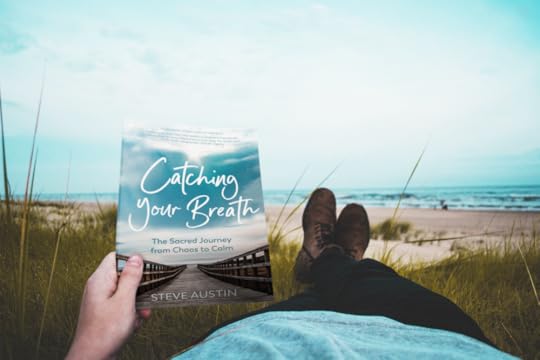
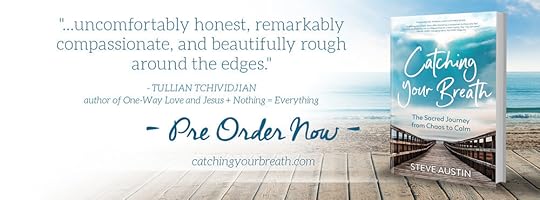
Pre-Order Catching Your Breath

Steve Austin
was a pastor when he nearly died by suicide. A second chance, a grueling recovery, and years of honest conversation allowed Steve to find healing and purpose. It’s evident in his writing, speaking, podcasting, and coaching: he helps overwhelmed people get their lives back.
Steve is also the author of the Amazon bestseller From Pastor to a Psych Ward. He lives in Birmingham, Alabama, with his wife, Lindsey, and their two children.


September 14, 2018
If You're Tired of Living, Listen to This Story First
I was a pastor when I nearly died by suicide. But wanting to die didn’t happen overnight.
In fact, I was first introduced to shame when I was just a preschooler. Recovery from childhood sexual abuse didn’t even begin until after I woke up in an ICU hospital room, after I tried to die by suicide.
It was my honor to share my story with a brand-new podcast, “Instructions for Living a Life.” If you’re tired of living, or love someone who struggles with their own mental health, I strongly encourage you to listen to my conversation with Chrisie and Adam.
Listen Now
September 13, 2018
The Truth about Quaking Aspen, Legacy, & Oneness
“There are aspens in southern Utah that spread over a hundred acres. What we see appears to be a massive grove, but in fact it is a single tree – genetically the same, sharing a single root system. All of what appear to be separate trees are in fact one organism. When any part of the organism needs nourishment, the other parts come to its aid.”

My grandfather (we all called him “Boss”) knew the land. He worked the land. He loved the land. For decades, he cultivated a large garden and took care of horses, goats, chickens, and pigs. Our eighty acres in rural Alabama was a magical place - Jamelabeda (named for his family: Jamie, Melissa, Lydia, Ben, & David).
As a child, I was a huge fan of Winnie the Pooh, and no one could convince me that my grandparents didn't live right in the middle of the Hundred Acre Woods. (Eat your heart out, A.A. Milne.)
One Fall (the very best season to be outdoors in Alabama), I had a leaf project for science class. Boss and I walked all over our “hundred acre woods,” identifying oak, pines, cedar, dogwood, and hickory. The list went on and on, and the old man became emotional at one point, telling me how his grandmother was the one to teach him about the trees. Through tears, he said, “I think we are more like these trees than we may ever realize, Stevie.”
As the sun began to set, and the crisp Alabama breeze tickled my ears, my grandfather paraphrased Psalm 1:
Blessed is the person who doesn’t stand in the way of sinners or sit in the seat of mockers, but delights in God - he is like a tree, planted by streams of water, which bears its fruit in season and whose leaf does not wither.
My old grandpappy didn’t darken the doors of a church for the last forty years of his life, but he taught me the importance of loving family, conserving the earth, and listening for God in the cool of the day.
Boss left us back in February, but each time the wind whispers through the pines, I know he’s still with me.
///
“Is it raining?”
Last week, I was relaxing in my cabin near the Pando grove in Central Utah. I hadn’t seen any clouds before supper. Somebody also mentioned a drought earlier in the day, so rain seemed highly unlikely. I bet they’d be thrilled to have some rain around here.
And then it hit me: quaking aspens. (“Quakies” as one local rancher affectionately called them.)
What a beautiful rumble - it nearly sounded like a waterfall.
The next day, I was standing on a narrow wooden bridge after lunch. I closed my eyes and drifted into a deeper space of intent awareness, the stream beneath my feet, lulling my worries away. I began to understand what John Muir meant when he said, “And into the forest I go, to lose my mind and find my soul.” All I could think about, between the percussive leaves and the siren song of the stream, was how the earth is continuously offering praise back to the Creator.
The sound of many waters cannot quench Your Love.
///
My son is always telling me he loves me. “Hey Dada, you know you’re my best buddy?” Like I could ever forget.
And whether it’s loving our family deeply, or being thankful for the earth around us, I think this whole thing is about legacy. What are we leaving for those who come after us? What impact will today’s decisions have on all our tomorrows?
We spent our days in our very own Hundred Acre Woods, and yet, it wasn’t about the trees. It was a reminder that we are all a piece of God (deep bows to Desmond Tutu). We are all connected.
There is only me.
There is only you.
There is no other.
There is only we.
And we all belong.
Ed Bacon said it best, “Each of those aspen trunks, living and growing together in one living, beautiful organism with one common 106-acre rootball, now represent the emblem for the hope of our relations with one another and with the Earth.”
The Pando clone is about much more than just 47,000 stems of the same plant. It’s about connection, conservation, and compassion. For me, the Pilgrimage to Pando was a returning home to self, and a returning home to each other. A reminder that everything we say - and every action we take - matters. Pando is a tangible reminder that I am connected to something much larger than myself. And isn’t that the very same lesson my great-grandmother began passing down to my grandfather all those years ago?
Listen to multiple reactions to Pando on the latest episode of the #AskSteveAustin Podcast. Just click here.Steve Austin was a pastor when he nearly died by suicide. A second chance, a grueling recovery, and years of honest conversation allowed Steve to find healing and purpose. It’s evident in his writing, speaking, podcasting, and coaching: he helps overwhelmed people get their lives back.
Steve is also the author of two Amazon bestsellers: From Pastor to a Psych Ward, and Catching Your Breath. He lives in Birmingham, Alabama, with his wife, Lindsey, and their two children.
September 12, 2018
What You Need to Know When Pastors Die by Suicide
“Andrew Stoecklein, pastor of the California megachurch Inland Hills, died by suicide Aug. 25.
The minister had returned to preaching two Sundays before, following a four-month involuntary sabbatical to address mental health concerns.
Before a packed church, a seemingly re-energized Stoecklein, 30, detailed his battle with depression and panic attacks.
Several life events triggered his mental illness, he said, the congregation offering "Amen" in support. His dad’s passing in 2015, followed by a stalking incident that forced his family to move, personal health issues and work stresses, proved too much. He became irrational and was taken to the emergency room. There, he began a road to recovery.
God still has great plans for our family, Stoecklein and wife, Kayla, told the church Aug. 12.
But the positive outlook didn’t save Stoecklein.
On Aug. 24, an unnamed person discovered the pastor unconscious at the church. Suffering from self-inflicted injuries, he died in a hospital the next morning.
"You were right all along, I truly didn’t understand the depths of your depression and anxiety," Kayla Stoecklein wrote in a blog post directed to her late husband.
Days later, the church began a fundraising campaign to benefit her and the couples’ three young children, raising more than $70,000 in 24 hours. Church members expressed their devastation and love for the family on social media. Fellow pastors offered condolences and opened a discussion regarding mental-health treatment within the Christian church.”
When I learned of Stoecklein’s death, I felt a familiar ache.
Click here to read my interview with the Tampa Bay Times.September 11, 2018
How to Join My Online Self Care Support Group
Life coaching is one the best investments we have made for our family. Steve has the ability to help you see that you hold most of the answers already. You just need a gentle (or sometimes straight forward) push in the right direction. Steve is that guiding force and knows what he is doing.
— Christy P. client
Are you the parent, partner, leader, or employee you'd like to be?
Could you use help with ways to better show up in your daily life? Would you like expert strategies to take back control of your life? If so, keep reading.
John Wesley famously asked, "How is it with your soul?"
I often ask, "How's your self-care?"
The two questions are intricately intertwined because with good self care, our lives, relationships, and spirits can thrive.
This is the reason I wrote, Self Care for the Wounded Soul, because self care continues to save my life, strengthen my marriage, and make me a better husband, employee, and creative.
Would you like to join a small group of people, committed to improving their self care? In this private, safe space we'll walk through my book, Self Care for the Wounded Soul together. This support group includes:
Daily group discussion in a private Facebook group (including lifetime access)
A copy of Self Care for the Wounded Soul
Weekly Zoom (video) call
A 1-on-1 self care coaching session with Steve Austin at the end of the course
...one of the most mobilized, energized, walking witnesses of New Life I have ever known...
— Rev. Ed Bacon, Author of 8 Habits of Love
sign up now
Steve is one of the most personable, understanding, speak-the-truth-in-love kind of individuals I have ever met. As a life coach, he is real, empathetic, and positive. Through coaching, Steve helped me break down shame, embrace the deconstruction process, and experience what messy grace is all about.
— Sara S., client
If you're ready to take your life back, I'd love to help.
The group is open to the first 12 registered participants and launches Sunday, September 23rd. We'll come together for a weekly group call on Sunday nights at 8pm CST. The investment is only $99 and can be conveniently split into 2 easy payments.
If you're ready for practical, actionable ways to be a better parent or partner, or for steps to continue to show up more in your daily life, this group will be transformative.
Steve came to our church to present a forum on self-care and the basics of suicide prevention. It was one of the best events I’ve been privileged to host in more than 20 years of local church ministry. Drawing from his personal experience, Steve takes his audience on a journey from despair to hope, from chaos to calm. Full of wit and wisdom, his 90 minute presentation left everyone wanting more. We look forward to having Steve back again in the near future.
— Jason Elam, Pastor, The Hope Center
Sign up now
If you have ever felt hopeless, if you have ever believed that all the bad things in your life were beyond redemption, if you have ever felt unworthy of being loved or accepted, if you have ever feared what would happen if people found out whatever it is that haunts you - I get it. I have been there, too.
Maybe you are recovering from abuse, addiction, or a suicide attempt like me. Maybe you are struggling with anxiety or depression and don’t know why yet. No matter what your starting point is, the tools in this journal will help you begin to answer the question, “Now what?”
You’re tired of living this way. You want to change your life, and you don’t know where to begin. This 30-day online self-care support group will help you answer that question. It’s time to take ownership of your life, and that begins with good self-care. It’s hard work, but you can do it. No more running, no more hiding, no more masks. No matter what your journey has looked like so far, recovery is possible. I am living proof.
Got questions? Email steve@iamsteveaustin.com today.
Registration ends September 16th at 8 pm CST.
CONVENIENT PAYMENT PLAN AVAILABLE. CLICK HERE.sign up now
September 10, 2018
When Your Brain is Lying to You, Read This.
Each year, as the calendar flips from August to September, I have some wrestling to do.
For some, September marks the time of year when the air begins to turn crisp, and the leaves slowly shift from vibrant greens to muted yellows.
September reminds me of the birth of my son - one of the best days of my life.
And sadly, September is my reminder that brains can break, the same as bones. Just like wet hands on slippery dishes, in an instant, a brain can shatter too. I know this unfortunate fact because I've lived through a couple of terrible Septembers.
September is when my wife spent nearly two weeks in the hospital for postpartum depression.
And I nearly died by suicide six Septembers ago; exactly one year after my little boy was born.

It would be easy to view September as a time when it felt like God abandoned my family and me. Shame sings her siren song, wooing my heart to live in constant dread, wondering when the darkness will return. Fear of what I cannot control and the guilt from past I am no longer subject to would love to prevent me from embracing the present day, but I refuse to buy their lies.
September is my yearly reminder that all of life is an ebb and flow. The sacred journey from chaos to calm is universal. Life is full of ups and downs. Good times, and excruciatingly painful seasons. Precious memories and horrific traumas. September gently nudges me to notice that life is always changing.
If you're in a rough patch and it feels like nothing is working, remember this: hard times come and go, just like the tides. Sometimes shitty days turn into shitty weeks and months, but they don’t last forever. When bad news arrives, take a deep breath and look back on all the bad news you've already lived through.
You are stronger than you think.So keep hoping. Keep holding on when life serves up a shit sandwich. Keep trusting that better days are coming. Keep looking for goodness and beauty. Keep your eyes peeled for Love to show up. Sooner or later, it will. Eventually, the tide will recede, the waters will calm, and you will have gained new strength and new wisdom for the journey.
Life isn’t always comfortable, but you have the tools to get through the pain.
Self Care Support Group
Much like the love notes taped along my wife's bathroom mirror, September reminds me to hold the ones I love most a little bit closer. I hope it reminds you to do the same thing.
September urges me not to become so consumed with busyness that I forget to slow down and allow myself space to breathe and just be. To treat everyone I meet with patience and grace, especially myself. To tell the truth, even when it's uncomfortable, and ask for help.
And celebrate every single victory.
The human experience is rarely ever comfortable, but it is definitely worth living. If you are reading this when your brain is lying to you, listen to me: I understand, and it's okay. It's okay to not always be okay. You are not alone. Keep on walking. One step at a time. Crawl if you have to. Because just around the bend, if you remain patient and determined, you'll notice the air is turning clear and crisp again.
I am grateful for every September.
Resources:Pastors and mental healthSelf Care Support GroupTheological B.S.
September 4, 2018
This is Why It's Our Fault When a Child Dies by Suicide
"Knowing that we can be loved exactly as we are gives us all the best opportunity for growing into the healthiest of people."
-Fred Rogers, The World According to Mr. Rogers
As a father of two young children, one thing I know is this: they tell it like it is. If my four-year-old doesn’t approve of my wife’s outfit, she voices her opinion boldly. Likewise, if my son needs to poop, he announces it to the whole world. No matter how rude it may seem at the time, my children feel comfortable saying exactly what's on their mind.
Part of our role as parents is a cultural mediator of sorts. We teach and model cultural and social norms for our children. We want them to know that it is not acceptable to wipe their nose (or anything else) with their palm before shaking someone’s hand. We are expected to teach our kids that it is neither appropriate nor kind to point out the fact that the librarian has a big fat tummy.
But as hard as we practice and model appropriate public behavior, and how to treat their friends, the thing that endears me to my children is also the thing that makes me cringe: they always tell the truth.
In many ways, that makes me thankful. I want my children to speak up about injustice. I want them to be brave enough to offer an unpopular opinion. I want my children to feel free enough to cause ripples when they feel passionate about something. I want them to be comfortable in their skin, to own their story, and to boldly speak the truth. I don't want my kids to always go with the flow, just because "this is the way it's always been."
It’s also the reason we all (hopefully) teach our kids, "If you can't say something nice, don't say anything at all."

When I saw the news of Jamel Myles, the 9-year-old boy who recently died by suicide after being relentlessly bullied at school, my heart did something more than break. The story pulverized my guts and pounded me into dust. No, I don't have a nine-year-old, but my son will be there before you know it. And my daughter isn't far from it.
I've seen several people ask, "How could this happen? How could a child even know about suicide? Children are supposed to be carefree! Reckless! How could a child feel such despair that they choose to die?!"
The answer is in the mirror.
Recently, my wife and I were watching a superhero movie with our son. During one particularly tense part of the film, Ben whispered under his breath, "Oh shit!" As shocked as I was, and as hard as I tried to conceal my laughter, the truth is that my son is only repeating what he has heard his daddy say.
Our children reflect the very best and the very worst in us. This is the uncomfortable truth. Our children notice our superficial relationships. They hear the angry ways we deal with people who seem unlike us. They feel the judgment and hatred we project on those with whom we interact.
Children are truth-tellers. The little parrots copy what they see and hear. When they learn that we won't take communion from the gay couple at our church, they make a mental note, "gay is not okay." When they hear our toxic theology about those with mental illness, they learn, "Don't show weakness." As we demonize those with whom we disagree, our children understand that they should never disagree with us, either.
Children learn from our example, and they strive to make us happy.
"My daddy says that God doesn't like when people are gay,” suddenly becomes, "I know gay people and I hate them, too." The real problem is that when our little ones mimic what we do, it is without our slick and hypocritical filters or self-control. While we criticize what we don't understand, children say things like, "You should just go ahead and kill yourself."
Our own closed-mindedness is what killed nine-year-old, Jamel Myles last week. Unless we speak up and invite future generations to see a world full of compassion and understanding, we are culpable in their hatred. Our mere closed-mindedness becomes their hate crime.
When a child hears you say that suicide is selfish, they follow your lead. When a little one hears a pastor refer to suicide as "self-murder," they remember.
If children are nasty to each other, it is only because we have shown them the way. When we don't remind those around us of their loveliness, when we refuse to make room for diversity, when we unwilling to change our perspective, it is our children who pay the price.
While I don't want to sentimentalize the tragic death of Jamel Myles, because this is someone's child, I do believe it is indicative of a much broader social and cultural problem.
I've heard horror stories about someone coming out and experiencing rejection, being shunned, and sometimes enduring outright violence, simply for being real about who they are. Is it any wonder people struggle to believe there is good in them, that they bear the image of the Divine?
And I can’t help but wonder why we do this to each other.
If people believe the lie that their lives don’t matter, it damages the soul and sometimes kills the body. People don’t want to live in a world (read: a family or a church) where they aren’t known, accepted, and loved. All people deserve love and justice. Perpetuating hate and fear through destructive theology or political ideology is damaging the collective soul of this worldwide community of humans.
When religious people stop expecting people to fit their mold, agree with their politics, or live up to their social expectations, they extend freedom and joy to all of God’s people. And isn’t belonging what we all want? Isn’t that what Christ offers us?
No matter how we were raised or if we cling to faith of any sort, genuine love doesn’t have prerequisites. Grace doesn’t have qualifying criteria. Compassion has no strings attached. It is more important to love my neighbors than to expect them to pass a litmus test on morality or religious fervor.
In the past, I’ve been a coward. I was more concerned with my own acceptance and belonging than standing up to help others receive them. I was wrong to hold back, and I am sorry. These days, I am learning to do better. I’m saying in no uncertain terms that it is wrong for any group of people to be demonized by any institution. I will not stay quiet any longer.
Please hear me: whoever you are, whatever you’ve done: you are not bad. If you’ve received that message, know it’s a nasty, hideous lie. Your dreams, your experiences - your joys and pains and sorrows and traumas and successes - are as unique as the stars in the sky, as varied as the number of hairs on your head. The vastness of that same beauty is contained in your soul, no matter where you’ve been or what you’ve been told.
When a nine-year-old dies by suicide, the truth is: I don't give a damn what you think about homosexuality. It is time to put our differences aside and care for one another with open hearts. It is time we come down off of our moral high horses, set our agendas aside, and begin to treat the world around us with love and empathy. It's time to quit making someone's humanity a religious or political issue, and instead, invite everyone we know to sit at the table of brotherhood. We must let those around us know that we are safe people. We must create a world where compassion and understanding are the cornerstones of our culture. And wouldn’t that be an example worth following?
Listen to This Week's Podcast
Steve Austin was a pastor when he nearly died by suicide. A second chance, a grueling recovery, and years of honest conversation allowed Steve to find healing and purpose. It’s evident in his writing, speaking, podcasting, and coaching: he helps overwhelmed people get their lives back.
Steve is also the author of two Amazon bestsellers: From Pastor to a Psych Ward and Catching Your Breath. He lives in Birmingham, Alabama, with his wife, Lindsey, and their two children.
September 2, 2018
Suicide, the Woman at the Well, & You
Owning our story can be hard but not nearly as difficult as spending our lives running from it. Embracing our vulnerabilities is risky but not nearly as dangerous as giving up on love and belonging and joy—the experiences that make us the most vulnerable. Only when we are brave enough to explore the darkness will we discover the infinite power of our light.
— Brene' Brown
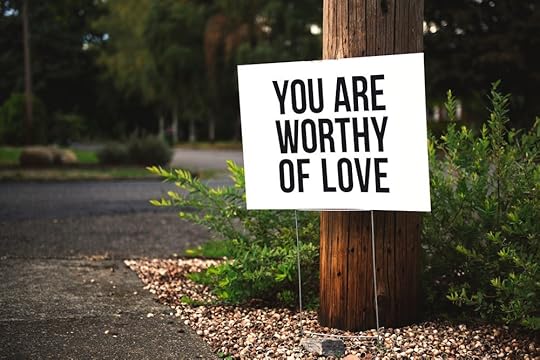
I have been on stage, in one role or another (acting, speaking, and singing) since I was five years old. I’m quite comfortable there. It’s one of the reasons many people said, “Steve Austin will either be a preacher or a politician.” I have no fear of the spotlight.
But all last week, as I was preparing to speak at my home church on suicide, I wanted to vomit. No, really. My stomach was in knots from the time I woke up Thursday morning. This was the first time I’d spoken in my hometown since I nearly died by suicide six years ago.
I was a nervous wreck. On-edge. Cranky. Distracted. Anxious. Ready to cry. If I didn’t respect my friend and pastor, I might have considered backing out. But I’ve come so far since those dark and terrible days, and I know my story matters. So I pushed through nausea and paranoia.
Are you familiar with the Bible story of the woman at the well? Here's my paraphrase:It was about noon when Jesus arrived at a town called Sychar. He was tired, sweaty, and thirsty. He sat down by the city well, and a local Samaritan woman showed up.
Jesus asked the lady for a drink, and she was shocked. Didn't he know that Jews and Samaritans didn’t mix? If this had been the 1960’s, they would have had separate water fountains and different schools.
But Jesus didn’t care. He was dehydrated, and she had the means to give him a drink of water.
Jesus goes into this bizarre little speech about something called, “Living Water,” and promises he can give her a life where she’ll never be thirsty again. Jesus was tapping into the woman’s need. She'd been trying to fill a void for years. He already knew her story.
In fact, everyone knew this lady’s story. And the townspeople never would have called her a "lady." Far from it. She’d been with five different men, and Jesus was quick to point out, “the man you have now is not your husband.” Like the town gossip, the woman at the well got around.
Hearing this story as a child, I pictured Jesus channeling his inner Mrs. Cleo ("Call me now!"), and harnessed some heavenly psychic power and reading this woman’s mail. But that’s not true at all.
That's not the miracle. They already knew her story.
After her encounter with Jesus, the woman is so stunned that she forgets her water jar and sprints back to town to invite others to come to meet the man who, “told me everything I ever did.” Her meeting with Jesus changed everything.
But why?
I think it’s because Jesus recognized this woman as a whole person, rather than limiting her by a few big mistakes. Instead of avoiding uncomfortable conversation, Jesus sat down next to her, ignored her scarlet letter, looked her in the eyes, and asked for a drink of water. Jesus was more focused on wholeness than holiness.
To paraphrase Mike Yaconelli and his book, Messy Spirituality, the real miracle here wasn’t that Jesus pulled out a crystal ball and told the woman her story. It’s that Jesus already knew her story, and chose to engage with her anyways. Jesus approached her with understanding and compassion. People in the town called her terrible things: slut, whore, and homewrecker. But along came a wild-eyed Rabbi who gave this lady permission to be human. He issued her an invitation to experience a better way of living.
The invitation of Jesus is always into a better way of living.As I spent time preparing for this Sunday’s sermon, I connected with the woman at the well more deeply than ever. I don’t think she feared people knowing her story: everyone makes mistakes. I think she avoided the crowds because of her fear of all the things they didn't know.
The woman at the well was drawing water in the middle of the day because all the other women went early in the morning when it was much cooler. Like a dog that's been abused, she tucked her tail, stayed low to the ground, and did her best to avoid anyone that seemed threatening. The sad news is that when you're full of shame, everyone looks like a threat.
I felt the same way on my ride home from the psych ward. The time leading up to my suicide attempt was the darkest season of my life. Not only was I in mental health crisis, I had made some poor life choices, too. I imagined I’d never feel welcome in a church again if people understood the gravity of my story.
The biggest reason I've spoken anywhere but my hometown until now is because I still fear the gossips. Those who would rather fill-in-the-blanks with their own assumptions, what-ifs, and slander, rather than reaching out to me personally. The slick church people who cloak their own twisted versions of my story in "prayer requests" are the people who have kept me shut up until now.
Maybe it’s true for you, too? Perhaps it isn’t a mental health diagnosis, but what is it? The divorce you’d rather not speak of? The affair? The fact that you’re about to file bankruptcy? There are a million different reasons you might be drowning beneath an ocean of shame, but we all know that terrible feeling.
In her book Rising Strong, Brene' Brown says, “Many of us will spend our entire lives trying to slog through the shame swampland to get to a place where we can give ourselves permission to both be imperfect and to believe we are enough.”
Brene' is right. For the longest time, I let my story hold power over me. But taking power back from my story is simple: I just have to show up and tell the truth. Each time I invite others into my story, I take power back.
I strongly identify with the woman at the well, because, like her, Jesus met me at my lowest point. I was lying in a hospital bed in an ICU room, when I felt the warm hand of God on my chest and heard an inaudible whisper in my soul, “I’m not finished with you yet.”
Jesus shows up and changes everything.Jesus always changes everything. And sometimes it isn't in a mud-on-the-eyes, dipping-seven-times-in-the-river kind of way. More often than not, it’s through the most ordinary of circumstances. Jesus comes to us as we confess our darkest secrets and biggest fears to the therapist. Jesus empowers us to own our story and guarantees us that the power of confession will bring healing.
For a woman who had been shunned and shamed for years, the miracle is that she found the courage to be vulnerable for possibly the first time in her life. Everyone else had been whispering what they knew about her (or what they didn't know), from behind closed doors. But Jesus shows up and blows the doors off of her guilt, shame, and secret-keeping.
He did the same for me. That's just how Divine love works.
The Power of ConversationThe call of Jesus is, “Come just as you are.” When the woman (or man) at the well shows up at our front door - or our church - we are charged with creating a safe space, where everyone feels welcome. We are called to create an affirming home environment, church community, and world, where hurting people feel compelled to tell the truth and ask for help. Jesus knew that (he was fully human, after all).
Whether you're a hurting person or a helper, the power of conversation saves us all. Admitting we need help, and listening to those in need is the first step in suicide prevention - because it helps us feel less alone. Jesus met the woman at the well and changed her life in the most ordinary way: through the power of conversation. The same is true for us: the only way to live fully free is by owning our stories and asking for help.
Steve Austin was a pastor when he nearly died by suicide. A second chance, a grueling recovery, and years of honest conversation allowed Steve to find healing and purpose. It’s evident in his writing, speaking, podcasting, and coaching: he helps overwhelmed people get their lives back.
Steve is also the author of two Amazon bestsellers: From Pastor to a Psych Ward and Catching Your Breath. He lives in Birmingham, Alabama, with his wife, Lindsey, and their two children.
August 28, 2018
Grief is Weird: Hosting a Birthday Party at the Graveyard
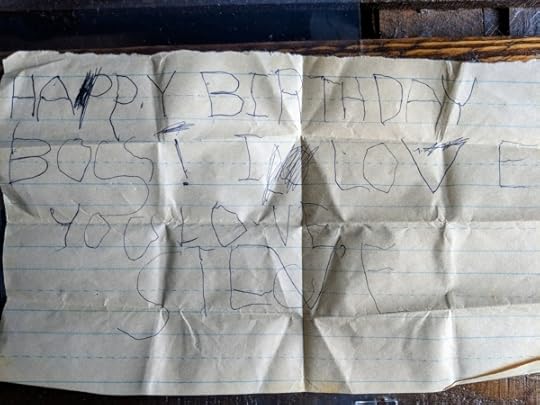
Dear Boss,
You were the best friend a guy could ask for. The fact that you were my grandfather made it even better. Just last night, I was helping Ben out of the shower, when he said, "Hey Dada? You're my best friend."
I'm so glad I get to pass that legacy along.
Speaking of legacy, you always told me how important it was to know the meaning of our names. I knew what "Stephen" meant since I was just a little boy. "Crowned one" or "royalty." You asked me quite often.
And I knew it was important to name my first-born after you: Benjamin, "son of the right hand." "Favored one."
He's your namesake. And he adored you, and you adored him.
He would see you sitting over in that old recliner, and his eyes would widen. You were such a force to be reckoned with. Sure, I knew how wise you were. But Ben got to see you as jovial, whimsical, and unpredictable. Much like a puppy being introduced to an old hound dog - Ben knew just how to get you all wound up. And it was wonderful.
My little buddy sure is missing you. Grief is so weird and complicated and painful and miserable and hard to control. And trying to understand death at six-years-old just plain sucks. I remember how you would weep over the loss of your grandmother each time you'd talk about her, even after all those decades had passed. Loss isn't easy on any of us.
I was driving Ben to school the other day, and he said something he says to me quite often, "Hey Dada, you know you're my best buddy?"
"Yea, bud. You're my best buddy, too. And guess what? Both of my best buddies are named Ben."
I was watching him in the rearview mirror. His eyebrows wrinkled a bit, and then those baby blues widened with understanding. "Bossy," he said with a toothless grin.
"Yea baby, Bossy."
I told him that your birthday is coming soon. "August 28th." His countenance immediately dropped, and he looked sad and confused.
"Are we going to have a birthday party at the graveyard?"
I nearly had to pull over on the side of the road to catch my breath.
I whispered to keep from crying, "Oh, no. No. No. No. No, we won't have a birthday party at the graveyard, buddy. No. We won't do that."
I wanted to vomit.
My Ben's birthday is in just a couple of weeks, too. And like his Daddy, Ben LOVES a birthday party. While he was apprehensive about the graveyard, he still wanted to recognize your birthday.
My God, we miss you so much. The hole that you left around here is much deeper than six measly feet. You were the strongest man I ever knew. The wisest. The funniest. The most approachable and unpredictable. Your crass humor has rubbed off on me, and every single day, I say at least one Boss-ism, and it almost takes my breath away. It's almost like you're still here.
Ben sobbed the other night again, because he misses his Bossy. He just doesn't get it. You were our hero, and all of Ben's heroes get to live forever. Stupid comic books.
"Hey Dada?" he asked from the back seat.
"Yea, pal?" (I was trying my best to hold it together.)
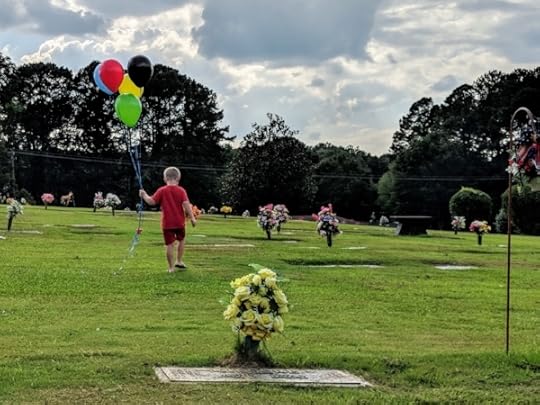
"Could we just take some balloons over to the graveyard for Bossy's birthday?"
He knocked the damn wind right out of my lungs. He wasn't going to let this go.
At the next stop light, I exhaled real big like you always used to do when we'd stump you.
"Sure, little buddy. We can take some balloons over there."
Happy birthday, you old cuss.
August 27, 2018
Love Jesus. (And Call Out Theological Bullshit.)
Six ways to fight when depression descends:
— Desiring God (@desiringGod) August 17, 2018
Find trusted spiritual friends.
Open your soul to them.
Ask them to pray with you.
Pour out your soul to the Father.
Rest in the sovereign wisdom of God.
Fix your eyes on the joy set before you in the precious promises of God.
A couple of days ago, someone in my Twitter feed retweeting a post by the Desiring God account. Admittedly, John Piper and I are probably about as far on opposite ends of the theological spectrum as you can get.
John Piper has a great big platform, lots of people follow him and subscribe to what he teaches (no matter how toxic it may be), and I feel the need to say something. Because depression has impacted my life on a daily basis for at least the past 18 years.
In the tweet about dealing with depression, they suggest things like talking to your trusted spiritual friends, trusting the wisdom of God, and prayer.
Look - all of those things are fine. You're more than welcome to try them when you're feeling depressed, but nowhere in that list did they say go to therapy or counseling or take your medication.
There were no practical steps to actually dealing with the mental illness someone is living with when they are depressed.
My point is this: that's some theological bullshit.
This kind of advice is coming from someone who apparently has no idea what they're talking about when it comes to mental illness. It doesn't tell the whole story.
Sure, talk to God, summon your support system, and also - go to freakin' therapy, take your meds, and listen to the doctor.
Sometimes, the most spiritual thing you can do is go to therapy.I think we've forgotten that Jesus was a human being. He took care of himself by eating and taking naps. He drew away from the crowd when he felt overwhelmed, and got down in the bottom of a damn boat and went to sleep when he was tired. Because Jesus was fully human.
Can we talk about miracles for a minute?
Look, I have no problem believing that someone could lay hands on you and pray for you and you be healed in an instant. But it's called a miracle for a reason: because it rarely ever happens. Ordinarily, God works ordinarily.
I believe God is present with us in our suffering. God sits with us on the couch at the therapist's office. God is present as we take our medication each morning.
I need a prescription every morning because my brain isn't wired like everyone else's. It's no different than the marathon runner who eats well, gets good rest, exercises daily, and still needs medication for his high cholesterol.
It's the same thing.
I need that little white pill every day to help me function as normally as possible. I take medication for my mental illness so that I can show up, rather than hiding under the covers. I take a prescription for anxiety so that I can be the best dad, husband, employee, and human I can possibly be.
So when I see tweets or hear comments by church people who say, "Just pray and talk to your spiritual friends," I have to say something.
My Christian friend, it is your job to call out this kind of toxic, theological bullshit.
You can absolutely love Jesus with all your heart, and love the church while calling out harmful, toxic theology. It's precisely what Jesus did. Jesus, who was fully human and fully God, loved his neighbor, embraced those around him, loved the church, and was not afraid to call out harmful, bullshit theology.
You should too.
And if you're depressed, go to therapy and follow the doctor's orders.
Jesus can save your soul. And the doctor just might save your life.
Steve Austin was a pastor when he nearly died by suicide. A second chance, a grueling recovery, and years of honest conversation allowed Steve to find healing and purpose. It’s evident in his writing, speaking, podcasting, and coaching: he helps overwhelmed people get their lives back.
Steve is also the author of two Amazon bestsellers: From Pastor to a Psych Ward, and Catching Your Breath. He lives in Birmingham, Alabama, with his wife, Lindsey, and their two children.