Shep Hyken's Blog, page 239
September 4, 2013
You Can Be a Customer Service Hero (Don’t Miss the Opportunity!)
 Opportunity to Shine
We were taking our 20 year old daughter to lunch before taking her to the airport to catch an international flight to the UK where she will be spending a semester abroad. On the way out the door she dropped her phone and shattered the screen.
We immediately went to the phone store where we knew they could replace the phone. We approached the manager and explained the situation. She told us a technician would have to look at the phone, but they wouldn’t be able to schedule us in until later in the day. By then it would be too late. We asked why a technician had to look at the phone, and suggested the manger look at the phone to see that the glass was shattered.
Either way, the phone had to be replaced. This seemed logical to us, but the manager insisted that the technician confirm the phone didn’t have any other damage. The manager suggested we go to another store where she made an appointment for us. The big problem was that we were cutting it a bit too close for comfort, but we had no choice. Frustrated, we left for the other store.
In between stores I called the customer service number and explained our problem. The gentleman on the phone was surprised the manager didn’t take care of my daughter. He called the store we were going to and spoke to the manager, who said to find him immediately and he would take care of my daughter. And, true to his word, she was. It took less than ten minutes and she had a new phone.
The manager at the first store blew it. She could have been a hero. Even though the manager at the other store came through for us, what will my experience be next time?
Inconsistency destroys confidence. Worse than that, the fact that the first manager dug her heals into the ground and refused to budge was truly a lost opportunity. She had no idea who she was dealing with, until I told her. She didn’t look up our account or she would have seen we have five phones we have bought from her company, not to mention the many phones we had bought over the years. My monthly bill, multiplied by twelve months might have made her realize that this was a higher level customer. Or multiply the bill by 24 months, which is how long our phones are under contract. We are worth thousands of dollars to the company, but she refused to take care of us, even though we had an emergency.
Here’s the lesson: Don’t blow the opportunity to be a hero. For example, we’ve had clients call us panicking because a speaker cancelled at the last minute, asking if I can fill in. I’ve always helped if I was available, or at least suggested someone else if I wasn’t. The last time this happened the client’s budget was much less than my fee, but it didn’t matter. I was available and the client needed help. That day I was a hero.
What are your opportunities to shine? They don’t always have to be centered on problems or emergencies. Sometimes, all it takes is giving someone a little extra time or giving a little extra effort to be that hero.
Look! Up in the air! It’s a bird! It’s a plane! No… It’s just you being a customer service hero, doing “right” by your customer!
Shep Hyken is a customer service expert, professional speaker and New York Times bestselling business author. For information contact (314)692-2200 or www.hyken.com. For information on The Customer Focus™ customer service training programs go to http://www.thecustomerfocus.com. Follow on Twitter: @Hyken
(Copyright ©MMXIII, Shep Hyken)
The post You Can Be a Customer Service Hero (Don’t Miss the Opportunity!) appeared first on Shep Hyken.


September 2, 2013
5 Top Customer Service Articles For the Week of September 2, 2013
Each week I read a number of customer service articles from various online resources. Here are my top five picks from last week. I have added my comment about each article and would like to hear what you think too.
The Link Between Social Media and Customer Service [Infographic] by Impact Learning Systems
(Impact Learning Systems) Social networks are the new battleground for customer satisfaction. As a result of these sites, the customer experience is no longer isolated – It is communal. Companies now have to engage with the customer in the public eye.
My Comment: While much has been written and implemented regarding social media and customer service, I believe we are reaching a tipping point. This infographic has some interesting data and information that makes the case for why social is currently having great impact on a company’s customer service strategy.
Four Core Principles of Retail Customer Loyalty and Retention by Jodi Beuder
(Desk.com) These are the managers that know that it costs companies so much more to gain one new customer than it does to keep three current customers. These are the managers that invest in their current customers’ satisfaction, their loyalty and retention. These are the managers that practice the following four core principles that will keep their customers’ coming back for more.
My Comment: Four simple, direct and time tested ideas to create loyalty. It doesn’t matter what type of business you are in, these are basics that should be part of every customer loyalty strategy.
Customer Service Pick Up Lines by Jenny Dempsey
(Communicate Better Blog) The way a company communicates to you is HUGE for business. Are their words powerful enough for you to take them home?
My Comment: This is such a fun article. It’s nice to receive a notice that a package has shipped or an order has been confirmed. With a little creativity it can become more than the routine notification. And the examples in the article made me start thinking about customer service lines we could use to have fun with our clients.
Why New Customer Rewards Stink For The Rest Of Us by Jeannie Walters
(360 Connext) Do we live in a throwaway culture? Probably. It feels that way to loyal customers sometimes, thanks to customer rewards reserved for those walking in the door.
My Comment: It drives me nuts when a company offers some great deals to new customers and won’t offer the same incentives to existing (loyal) customers. Shouldn’t a loyal customer get the better deal? Great article that makes a great point. And, I love the picture!
Top tips to give your business a customer service edge by Chris Tyrrell
(FT Adviser) With the business scene as competitive as ever, there is a number of top tips that businesses can use to achieve customer service excellence. Here are our top tips.
My Comment: This article starts with the comment that with an unpredictable economy and incredible competition, customer service is more important than ever to not only survive, but also thrive. Spot on. This article is filled with tips to make anyone think about how customer service can give any business a competitive edge.
Professional speaker and New York Times bestselling business author. For information contact (314) 692-2200 or www.hyken.com. For information on The Customer Focus™ customer service training programs go to http://www.thecustomerfocus.com. Follow on Twitter: @Hyken
(Copyright ©MMXIII, Shep Hyken)
The post 5 Top Customer Service Articles For the Week of September 2, 2013 appeared first on Shep Hyken.
August 30, 2013
Guest Blog: Bad Gas in a New Generator
I like this blog post from my friend Chip Bell for a couple of reasons. First, the lesson about focusing on the relationship, not just the product or system is strong. Second, he mentions one of my favorite companies, Ace Hardware, one of the most helpful retail stores on the planet. – Shep Hyken
[image error]Last year was an unusual season for tornadoes in the South—several records were set for most tornados in a day, longest on the ground, most deaths in some states, etc. It made me glad I bought a gasoline-powered generator three years ago.
The generator was uncrated, filled with gasoline, and parked in the garage under a customized cover. When a recent round of summer storms produced a power outage, the generator was uncovered for duty. The generator was still bright and shiny like the day it was purchased! But, it failed to crank. Fortunately, the power came back on before everything in the refrigerator was in jeopardy.
When later I mentioned to the local Ace Hardware guy that I could not get my generator to start, he gave me a two-word solution…”bad gas!” At first I thought it was a crude joke! However, I learned I was supposed to change the gas in the generator every few months. Even with a fuel system stabilizer added, gasoline can go bad in a year or so making the lawn mower, weed eater or generator hard to start…or, impossible to start.
Too often service providers put “bad gas in a new generator.” They focus on ways to make their service functionally efficient, but forget it is the pleasant emotional experience that their customers remember. They implement CRM but forget the middle letter stands for “relationship.” They put in high tech self-service delivery process without any access to a high touch person should the system fail to work.
But, worse they take away the freedom to be innovative (good gas) from the frontline leaving them tasked to just obediently follow procedures (bad gas). Remember when the gate attendant or hotel front desk clerk made the call on the upgrades? Now, the computer gets to do it…based on points in a frequent flyer or frequent stays program. What was formerly a delight has become a customer assumption and therefore no longer value-added. In fact, customers are disappointed when they are not upgraded.
Have you ever heard a customer compliment your amazing computer or awesome procedure? It is people who make magic for customers. Let’s bring back unexpected customer surprise by providing all employees the authority, capacity and encouragement to deliver innovative service!
Chip R. Bell is a customer loyalty consultant, keynote speaker and the author of several best-selling books. His newest book is The 9 ½ Principles of Innovative Service. The book can be purchased at www.simpletruths.com; Chip can be reached at www.chipbell.com.
The post Guest Blog: Bad Gas in a New Generator appeared first on Shep Hyken.
August 28, 2013
Customer Service Lesson: Helping vs. Selling
 Amaze Your Customers
It was 1987 and I’d just moved into my first house. Doing some weekend repairs, I noticed that a saloon type door was coming off of the wall. I took the bracket and hinge that connected the door to the wall and headed to my local Ace Hardware store.
I remember the nice gentleman that helped me. I showed him what I wanted. As we were walking down the aisle to get the replacement part he asked what I was using it for. I told him, and he stopped. He stated, “You need a different part. If I sell you this, you will be back in here sometime soon. Maybe a few months, maybe a year, but you will be back to replace it again.” We walked to a different area and he said, “This is what you want.” I would use the existing bracket, but only needed some inexpensive hardware to mount it. This was not only what I needed, it was even less expensive.
There are several lessons here:
First, the person helping me was doing more than taking an order. He simply asked an extra question to determine what I really needed.
What he sold me was less expensive than replacing the entire bracket. He wanted to give me exactly what I needed, regardless of price. He was more interested in taking care of his customer than the money .
But the big lesson here is that he didn’t try to sell me. Instead of selling me what I thought I needed, he sold me what I really needed and also saved me money. In other words, he helped me.
As a result of this experience, I went back. 25 years later I remember the experience and am still telling the story.
So, think of a time when you received an amazing customer service experience. How did it make you feel? Did you tell others? Did you go back?
Your answers are the same ones you want your customer’s answers to be if asked these same questions. So how do you go about getting those answers? The lessons just mentioned are a good start.
What’s really amazing about this Ace Hardware story is that I had no idea that I would end up writing a book that features them as a role model for amazing customer service. But I did. They were delivering that level of service 25 years ago, and they are still doing it today. They helped me. And that’s what they are known for; being helpful. It’s their brand promise. It’s how they amaze every customer, every time.
We could stop here, but I want to put in a plug for the just mentioned book, which is titled, Amaze Every Customer Every Time. My Ace story and dozens more just like it are examples that support the 52 customer service tools covered in this book. These tools will help you deliver better customer service, create a better employee culture, increase customer loyalty and much more. I urge you to at least visit the website, which is www.AmazeEveryCustomer.com and download the free chapters, which include five of the Tools and much more. Start delivering amazing customer service today!
Shep Hyken is a customer service expert, professional speaker and New York Times bestselling business author. For information contact (314)692-2200 or www.hyken.com. For information on The Customer Focus™ customer service training programs go to http://www.thecustomerfocus.com. Follow on Twitter: @Hyken
(Copyright ©MMXIII, Shep Hyken)
The post Customer Service Lesson: Helping vs. Selling appeared first on Shep Hyken.
August 26, 2013
5 Top Customer Service Articles For the Week of August 26, 2013
Each week I read a number of customer service articles from various online resources. Here are my top five picks from last week. I have added my comment about each article and would like to hear what you think too.
The Secret To Amazing Customer Experience: Know Thy Customer By Michael Brenner
(SAP) Retailers not only want their customers to buy things, but to be loyal advocates of their brand. But making this significant connection with the modern consumer is a challenge – to be not only at the top of a customer’s mind, but at the tips of their fingers, too.
My Comment: No doubt that you can give a better customer experience when you know your customer. And that means really knowing your customer. When you know their individual habits or preferences, you can customize an experience just for them. Big data helps you spot the trends of a group of customers. Little data is small, individual pieces of data about individual customers. Take advantage of Little Data and watch your customer loyalty grow.
Removing The ‘Grit’ From Your Customer Or Client Experience by Adrian Swinscoe
(Forbes) Is there ‘grit’ in your customer service or customer experience?
My Comment: Even the smallest piece of “grit” in your show can cause pain over a long period of time. I like the suggestion of asking the customer the question about anything annoying about the experience, presently or in the past. It is important to see if other customers answer the question in the same way. If you have a number of customers who are annoyed by the same thing, you know you have something to improve on.
Making the Most Of Customer Complaints By Stefan Michel, David Bowen & Robert Johnston
(WSJ) Dealing with service failures means a lot more than just fixing the immediate problem. Here’s how to do it right.
My Comment: When something goes wrong for the customer, the goal should not only be to fix the problem, but to also restore the customer’s confidence so they will do business with you again. This WSJ article takes a deep dive into the look of customer recovery with some excellent ideas.
Seven Simple Building Blocks for Amazing Customer Service by Tish Hummer
(Assured Success) To clarify…SIMPLE doesn’t mean easy. But this is a great place to start.
My Comment: I love a list of simple, yet powerful, customer service strategies and tactics. While I like all seven strategies that Tish Hummer offers up in this article, I’m especially partial to number two, which is to make each customer feel like they are the “only customer.” What would happen if this really was your only customer? How would you treat him/her?
What is Great Customer Experience? by Paige O’Neill
(B2Community) Marketers are struggling with a fundamental question right now “What is great customer experience?” Is it a marketing strategy? Is it just a fancy word for Customer Service? Does it really matter?
My Comment: While we might want to define our customers’ experience, we can’t. We can only hope that our customers’ perceptions of the experience they receive is the same as the one we want them to receive. This article is a very simple view of what to consider in creating a system to support the customer experience. Some things in the customer “journey map” are in your control, and some aren’t. And some are behind the scenes while others directly connect to the customer.
Professional speaker and New York Times bestselling business author. For information contact (314) 692-2200 or www.hyken.com. For information on The Customer Focus™ customer service training programs go to http://www.thecustomerfocus.com. Follow on Twitter: @Hyken
(Copyright ©MMXIII, Shep Hyken)
The post 5 Top Customer Service Articles For the Week of August 26, 2013 appeared first on Shep Hyken.
August 23, 2013
Guest Blog: Four Things to Stop Doing that Make the Customer Experience Better
This week on our Friends on Friday guest blog post my friend and colleague Lisa Ford shares some great advice. Instead of teaching us what we should start doing to create a better customer experience, she teaches us what to stop doing.
The customer experience is all about doing things that will be memorable and of value to the customer. Start with the basics and fundamentals. Once you’ve gotten them right, you will have earned the customer’s trust and repeat business. To keep them loyal, break out and be different. There are plenty of companies offering what you offer, so be decidedly different. With that being said, there are things you must STOP doing if you want to stand out.
Stop asking the customer to repeat information they’ve told you already. This includes asking them to repeat identifying information already keyed in while listening to prompts. Make certain transfers are smooth and seamless by sharing key information with the next team member. Repetition only increases the frustration factor.
Stop having all employees greet the customer when entering a bricks and mortar store. Let one do it and then stop. It is amazing how employees are being asked to look up from a current customer conversation or transaction to yell across the floor to the just arrived customer. It is rude to the current customer and feels odd to the one crossing the threshold.
Stop being oblivious and unaware. Get your team to recognize and learn current customers. Encourage them to check the database and acknowledge the customer specifically. If your team serves customers in person, show you know them. Learn names and make connections.
Stop being scripted. Customers want a real person delivering sincere service. Allow your team to build a relationship and use judgment. If you have hired and trained well, then trust them to deliver memorable experiences.
There are plenty of things all organizations need to start doing but get started by stopping certain irritating behaviors. It just gives the customer a chance to think about taking their business to the competition.
What would like for companies to stop doing?
Lisa Ford is known for her work on customer issues. Her ideas help companies create customer-focused cultures and keeping customers loyal. She is a speaker and author with over 20 years of experience presenting to businesses, associations and government. Lisa is the author of the videotape series How to Give Exceptional Customer Service, the #1 selling DVD series in the U.S. for over 3 years.
The post Guest Blog: Four Things to Stop Doing that Make the Customer Experience Better appeared first on Shep Hyken.
Guest Blog: The Four Things to Stop Doing to Make the Customer Experience Better
This week on our Friends on Friday guest blog post my friend and colleague Lisa Ford shares some great advice. Instead of teaching us what we should start doing to create a better customer experience, she teaches us what to stop doing.
The customer experience is all about doing things that will be memorable and of value to the customer. Start with the basics and fundamentals. Once you’ve gotten them right, you will have earned the customer’s trust and repeat business. To keep them loyal, break out and be different. There are plenty of companies offering what you offer, so be decidedly different. With that being said, there are things you must STOP doing if you want to stand out.
Stop asking the customer to repeat information they’ve told you already. This includes asking them to repeat identifying information already keyed in while listening to prompts. Make certain transfers are smooth and seamless by sharing key information with the next team member. Repetition only increases the frustration factor.
Stop having all employees greet the customer when entering a bricks and mortar store. Let one do it and then stop. It is amazing how employees are being asked to look up from a current customer conversation or transaction to yell across the floor to the just arrived customer. It is rude to the current customer and feels odd to the one crossing the threshold.
Stop being oblivious and unaware. Get your team to recognize and learn current customers. Encourage them to check the database and acknowledge the customer specifically. If your team serves customers in person, show you know them. Learn names and make connections.
Stop being scripted. Customers want a real person delivering sincere service. Allow your team to build a relationship and use judgment. If you have hired and trained well, then trust them to deliver memorable experiences.
There are plenty of things all organizations need to start doing but get started by stopping certain irritating behaviors. It just gives the customer a chance to think about taking their business to the competition.
What would like for companies to stop doing?
Lisa Ford is known for her work on customer issues. Her ideas help companies create customer-focused cultures and keeping customers loyal. She is a speaker and author with over 20 years of experience presenting to businesses, associations and government. Lisa is the author of the videotape series How to Give Exceptional Customer Service, the #1 selling DVD series in the U.S. for over 3 years.
The post Guest Blog: The Four Things to Stop Doing to Make the Customer Experience Better appeared first on Shep Hyken.
August 21, 2013
Customer Service – Start with the End in Mind
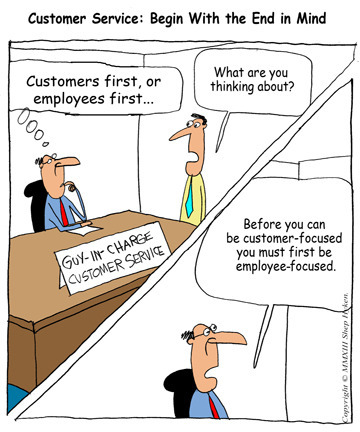 Become Customer Focused
I recently posted one of my articles in a great online publication, Customer Think, one of the top repositories for customer service articles on the Net. Bob Thompson, the editor in chief at Customer Think, and Michael Lowenstein, a fellow author, and I embarked in some interesting dialogue around the article, which was about being employee-focused before you are customer-focused.
If you have been following my articles and social media posts, you know that I believe that before you can become customer-focused, you must be employee-focused. Customer service starts with employees of an organization. And, that means all employees. From leadership to the most recently hired to the entry level positions. To become customer-focused you must practice internally what you want the customer to experience externally. All employees must treat each other, the way the customer should be treated. That is where it starts.
Well, Bob Thompson seemed to disagree. He believes you become customer-focused first. He had some very valid comments, and I think the concept is up for interpretation. Yes, there are companies that have both great customer service and also an incredible employee experience that have failed. The reason is that it also takes a great product, which is a very customer-focused concept. After all, without a product that customers are willing to buy, you won’t have a business regardless of how good the customer service is. Bob referenced the dot.com era where employees were in the most incredible, almost lavish, work environments, but in the end some of the companies still failed. In most cases it wasn’t because of the lack of customer or employee focus. It was because the product didn’t make enough money for the company.
Here is the bottom line. There is proof that top customer service companies are also employee focused. Look at the surveys that indicate the best companies to work for and you’ll find many of those companies on the lists that provide the best customer service. Yet, Bob Thompson’s point is valid and here’s my spin on it:
Yes, you must first decide to be customer-focused. The decision becomes your goal. The decision does not guarantee your outcome. And to achieve this outcome, you must create a process, which is put into place by the leadership of the organization. And while part of the process is about having the right systems and procedures in place, you still need people to act upon it. The right people must be hired, trained and empowered to support the vision of what the customer experience should be. And this vision, or outcome, will never happen unless the employees support it.
So, you start with the end in mind. And, begin with first focusing on your employees.
ALMOST HERE! Less than two weeks. Amaze Every Customer Every Time: 52 Tools to Create the Most Amazing Customer Service on the Planet will be released on September 3. But you don’t have to wait! There is still time to pre-order the book and get an immediate download of the book and a number of other bonuses. You can start to deliver amazing service today! Go to www.AmazeEveryCustomer.com.
Shep Hyken is a customer service expert, professional speaker and New York Times bestselling business author. For information contact (314)692-2200 or www.hyken.com. For information on The Customer Focus™ customer service training programs go to http://www.thecustomerfocus.com. Follow on Twitter: @Hyken
(Copyright ©MMXIII, Shep Hyken)
The post Customer Service – Start with the End in Mind appeared first on Shep Hyken.
August 19, 2013
5 Top Customer Service Articles For the Week of August 19, 2013
Each week I read a number of customer service articles from various online resources. Here are my top five picks from last week. I have added my comment about each article and would like to hear what you think too.
Achieving the Highest Level of Great Customer Service by Kattia Bolanos
(Win the Customer!) It’s not enough to just have the best talent, great customer service requires creating the right environment for talent to flourish. If you have room for improvement, here are five ways to get your organization working to deliver great customer service.
My Comment: As I read this list of five ways to deliver high levels of service, I can’t help but notice that there is an internal focus. If you don’t hire right, train, empower, etc. (all internal), you shouldn’t expect high levels of customer service. The best companies start working on internal customers, because that is the best way to impact the outside customers.
10 Smart Customer Service Tips from Small Businesses by Jason Boies
(Salesforce) Here are 10 takeaways from these small business success stories for delivering a world class customer experience.
My Comment: Great “Top Ten” list of customer service tips. Even though the title says these are for small business, I can see most, if not all, working for virtually any type of business.
A slice of absolute customer service perfection by Michael Hess
(CBS MoneyWatch) If I gave out a “Customer Service Moment of the Year” award, I’d have my 2013 winner already, and of all places, it’s an airport fast food joint.
My Comment: Great example of amazing customer service. This is the type of story that should be circulated through the entire chain of Wolfgang Puck restaurants. The employee demonstrates a great attitude, initiative and caring. There are opportunities like happening all of the time. We just have to be on the lookout for them – and then do something with them when they present themselves.
Have You Thanked Your Customers Today? by Annette Franz
(CX Journey) Do you thank your customers for their business? In a meaningful way? At every interaction?
My Comment: It is so important that we say “Thank you” to our customers! They want and expect to be appreciated for the business they give us. This is a nice reminder of how powerful a “thank you” can be.
7 Reasons the Customer Is Often Wrong by Geoffrey James
(Inc) One of the great maxims of selling is “The Customer is Always Right.” However, like many sales maxims, that statement is misleading. In fact, customers are frequently wrong and you’ll need to react appropriately when they are.
My Comment: I don’t know if the customer is “often” wrong, but I do know they aren’t always right. These seven reasons about why a customer might be wrong are on target. So, what do you do when a customer acts like this? There are some good answers in the article, but one overarching theme should be considered: Let them be wrong with dignity. No matter how wrong they are, don’t burn a bridge.
Professional speaker and New York Times bestselling business author. For information contact (314) 692-2200 or www.hyken.com. For information on The Customer Focus™ customer service training programs go to http://www.thecustomerfocus.com. Follow on Twitter: @Hyken
(Copyright ©MMXIII, Shep Hyken)
The post 5 Top Customer Service Articles For the Week of August 19, 2013 appeared first on Shep Hyken.
August 16, 2013
Guest Post: The Most Expensive Chairs in a Restaurant ? Empty Ones.
This week’s Friends on Friday guest blog post features Susan Solovic. She tells an entertaining story with a point. An employee was following the policy, but her lack of common sense caused a loss in business. As you read Susan’s short story, think about the rules and policies that are created and how they impact the customer. There is a time and a place to follow them, and a time to use common sense. By the way, that’s why I like the word guidelines.
Empty chairs are never good for a restaurant. You don’t make money unless people are sitting in them ordering food and drinks and enjoying themselves. But imagine if you had empty seats because you allowed customers to walk-out the door without being seated.
Let me explain. My husband and went to a small neighborhood Mexican restaurant. I’d been fighting a cold so I wanted to make sure we didn’t sit at a table near the door because it was bitterly cold.
A waitress approached us with menus, asked us how many were in our party, then offered to seat us at one of two empty tables for two – one next to the door and the other by the kitchen area. We asked if we could sit in one of the open booths instead. The waitress said, “We keep those open for parties of four, but you can have either one of the two-tops I pointed out.”
My husband and I just stood there looking at each other. Baffled he said, “Well, I guess we’ll go somewhere else then.”
The waitress replied, “Okay.” Then she turned and walked away, and so did we. We took our business right across the street.
I couldn’t believe it. Restaurants are boarding up all across the country, and here we were in this establishment, ready to spend money, and they wouldn’t allow us to sit where we wanted to sit. I could understand a little better if the restaurant was extremely busy and the table we selected was the only four-top open, but that wasn’t the case.
To survive and thrive in today’s difficult economy, we need to do everything we can to accommodate our customers. Letting customers walk out the door is just plain stupid.
What do you think? Should I give the restaurant another try? How about going back and speaking to the owner? Right now, I’m thinking there are plenty of other good Mexican restaurants so why waste the time and effort.
Susan Solovic, THE Small Business Expert, New York Times Bestselling author, media personality and keynote speaker. An award-winning entrepreneur, Solovic is an Internet pioneer founding one of the first video news websites and building it to a multi-million enterprise.
The post Guest Post: The Most Expensive Chairs in a Restaurant ? Empty Ones. appeared first on Shep Hyken.