
Gerry Adams's Blog, page 84
June 6, 2011
Vodafone Sackings - The unacceptable face of globalisation
The announcement by Vodafone that it plans to cut over 130 jobs from its workforce in the 26 counties and 'outsource' them to India and Egypt has outraged the Communications Workers Union and led to condemnation from Sinn Féin and others.
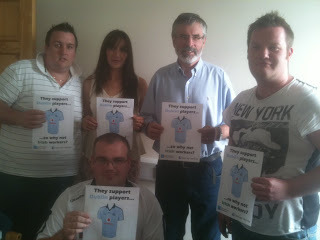
Meeting Vodafone workers in Dundalk
Most of the jobs are expected to go in Louth. The impact on those affected will be traumatic. The affect on the local economy, which is already reeling from the imposition of the Universal Social Charge and austerity cuts to government programmes and public services, will be incalculable.
Last week I met the Deputy General Secretary of the CWU Terry Delaney and on Friday four local workers from the call centre in Dundalk met me to explain their concerns and to express their determination to fight this decision by Vodafone.
The decision to axe these jobs is typical of the approach multi-national companies take toward local investments.
Multinationals primarily take decisions based on costs and profits. If they can produce the same service or product elsewhere in the world at a cheaper price and for a greater profit they will follow the money. It's called globalisation.
They have no loyalty to the local community. They have no loyalty to their workforce.
A good case in point is the Visteon Corporation which was set up by the Ford Motor Corporation to run a number of factories previously directly owned by the Ford company. In March 2009 the directors of Visteon UK put their company into administration.
That day, 210 men and women employed at the Belfast plant of Visteon were told that their jobs ceased to exist. That information came by letter from the management of Visteon UK.
The statutory 90 day consultation was not afforded to the workers. No information was given to them about their rights and entitlements. They were denied any right of reply.
Moreover, their right to Ford terms and conditions, including the lifetime protection of their discretionary pension in payment increases, contained in the 'Agreement governing the separation of the Ford Visteon organisation', was binned by Visteon.
This was unacceptable and contemptible behaviour by the management of these two companies.
In light of this the workers rightly and courageously took over the plant and refused to leave until Ford and Visteon negotiated a satisfactory agreement on redundancy and pensions.
They refused to be cowed or intimidated by threat of legal action and lobbied and fought for their rights. And their actions encouraged their union colleagues in Britain.
Like Ford, Vodafone is a huge multi-national. Through its investments in Ireland it controls over 40% of the mobile phone market and has almost two and half million subscribers.
Last year Vodafone made profit here of €122.3 million and paid an additional €125 million in a dividend back to its parent company. In total Vodafone in Ireland has contributed over €2.2 billion to the profits of this multi-national.
So, Vodafone receives grants and tax breaks to set up in the south of Ireland – I am currently waiting the Minister coming back to me with detail of this – they make huge profits but then arbitrarily sack 130 workers and move their jobs to a cheaper location.
No loyalty to the workers who contributed to those profits. No loyalty to the Irish people who subscribe to Vodafone.
This attitude emerges clearly in the minute of a meeting the CWU had with Vodafone Management. The Union representatives questioned Vodafone about the jobs it plans to axe directly from Vodafone and those that will be lost from Rigney Dolphin which supplies employees to Vodafone.
The Union asked:
Q Why is Vodafone offshoring these jobs?
A Cost and Quality
Q Does Vodafone accept that customers currently receive an excellent customer service from employees in the area?
A Yes
Q What will happen to Rigney Dolphin employees who are loosing their jobs – will they be redeployed in Vodafone?
A No
Q What will be the terms of redundancy for Rigney Dolphin employees?
A This is noting to do with Vodafone. It is a matter for Rigney Dolphin.
Q Does Vodafone accept that they have a responsibility to Rigney Dolphin employees working in Vodafone?
A Vodafone only has a responsibility to the business contract between Rigney Dolphin and Vodafone.
Q The Union requests that Vodafone postpone this decision to enable all parties to engage in discussions with a view to finding alternatives that will save jobs
A No
Q Can Vodafone guarantee the Union that further work/jobs will not be outsourced?
A No
Q What are the cost savings involved in off shoring these jobs?
A Don't know
This is the unacceptable face of globalisation. But it is not a new phenomena.
I'm sure readers can think of other businesses, for example, shipbuilding and breweries and shirt and clothes manufacturers and others which have over the years left this island and moved their base of production to other climes.
Those who support globalisation claim that this movement of capital and production benefits those poorer countries that can offer cheaper labour costs. But the facts suggest otherwise. The evidence thus far is of the income gap between the rich and poor countries widening in recent decades.
No state can grow economically without some measure of international investment. But every state has the right to ensure that such investment is responsible and that there are contractual agreements in place to ensure this.
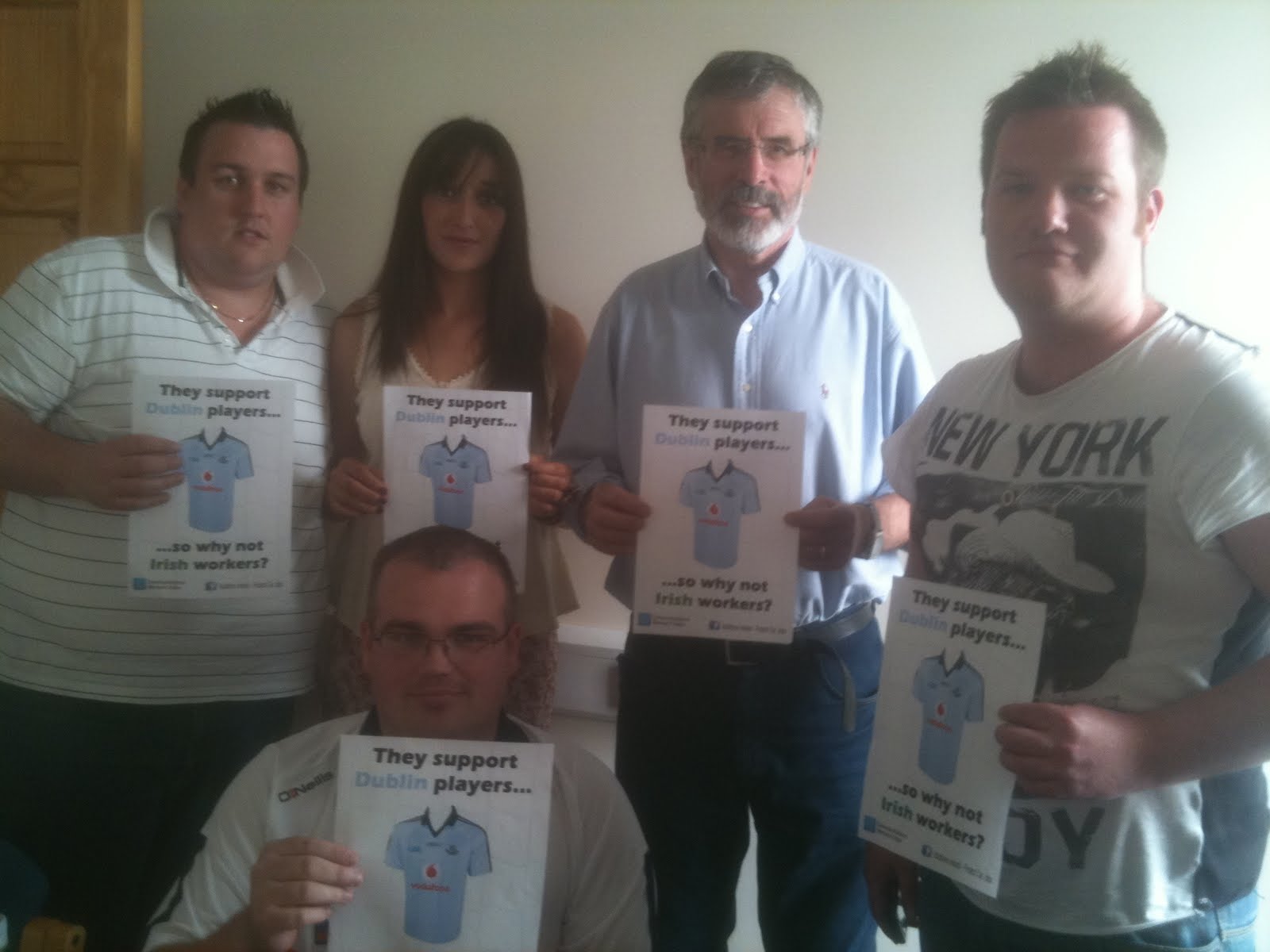
Meeting Vodafone workers in Dundalk
Most of the jobs are expected to go in Louth. The impact on those affected will be traumatic. The affect on the local economy, which is already reeling from the imposition of the Universal Social Charge and austerity cuts to government programmes and public services, will be incalculable.
Last week I met the Deputy General Secretary of the CWU Terry Delaney and on Friday four local workers from the call centre in Dundalk met me to explain their concerns and to express their determination to fight this decision by Vodafone.
The decision to axe these jobs is typical of the approach multi-national companies take toward local investments.
Multinationals primarily take decisions based on costs and profits. If they can produce the same service or product elsewhere in the world at a cheaper price and for a greater profit they will follow the money. It's called globalisation.
They have no loyalty to the local community. They have no loyalty to their workforce.
A good case in point is the Visteon Corporation which was set up by the Ford Motor Corporation to run a number of factories previously directly owned by the Ford company. In March 2009 the directors of Visteon UK put their company into administration.
That day, 210 men and women employed at the Belfast plant of Visteon were told that their jobs ceased to exist. That information came by letter from the management of Visteon UK.
The statutory 90 day consultation was not afforded to the workers. No information was given to them about their rights and entitlements. They were denied any right of reply.
Moreover, their right to Ford terms and conditions, including the lifetime protection of their discretionary pension in payment increases, contained in the 'Agreement governing the separation of the Ford Visteon organisation', was binned by Visteon.
This was unacceptable and contemptible behaviour by the management of these two companies.
In light of this the workers rightly and courageously took over the plant and refused to leave until Ford and Visteon negotiated a satisfactory agreement on redundancy and pensions.
They refused to be cowed or intimidated by threat of legal action and lobbied and fought for their rights. And their actions encouraged their union colleagues in Britain.
Like Ford, Vodafone is a huge multi-national. Through its investments in Ireland it controls over 40% of the mobile phone market and has almost two and half million subscribers.
Last year Vodafone made profit here of €122.3 million and paid an additional €125 million in a dividend back to its parent company. In total Vodafone in Ireland has contributed over €2.2 billion to the profits of this multi-national.
So, Vodafone receives grants and tax breaks to set up in the south of Ireland – I am currently waiting the Minister coming back to me with detail of this – they make huge profits but then arbitrarily sack 130 workers and move their jobs to a cheaper location.
No loyalty to the workers who contributed to those profits. No loyalty to the Irish people who subscribe to Vodafone.
This attitude emerges clearly in the minute of a meeting the CWU had with Vodafone Management. The Union representatives questioned Vodafone about the jobs it plans to axe directly from Vodafone and those that will be lost from Rigney Dolphin which supplies employees to Vodafone.
The Union asked:
Q Why is Vodafone offshoring these jobs?
A Cost and Quality
Q Does Vodafone accept that customers currently receive an excellent customer service from employees in the area?
A Yes
Q What will happen to Rigney Dolphin employees who are loosing their jobs – will they be redeployed in Vodafone?
A No
Q What will be the terms of redundancy for Rigney Dolphin employees?
A This is noting to do with Vodafone. It is a matter for Rigney Dolphin.
Q Does Vodafone accept that they have a responsibility to Rigney Dolphin employees working in Vodafone?
A Vodafone only has a responsibility to the business contract between Rigney Dolphin and Vodafone.
Q The Union requests that Vodafone postpone this decision to enable all parties to engage in discussions with a view to finding alternatives that will save jobs
A No
Q Can Vodafone guarantee the Union that further work/jobs will not be outsourced?
A No
Q What are the cost savings involved in off shoring these jobs?
A Don't know
This is the unacceptable face of globalisation. But it is not a new phenomena.
I'm sure readers can think of other businesses, for example, shipbuilding and breweries and shirt and clothes manufacturers and others which have over the years left this island and moved their base of production to other climes.
Those who support globalisation claim that this movement of capital and production benefits those poorer countries that can offer cheaper labour costs. But the facts suggest otherwise. The evidence thus far is of the income gap between the rich and poor countries widening in recent decades.
No state can grow economically without some measure of international investment. But every state has the right to ensure that such investment is responsible and that there are contractual agreements in place to ensure this.


June 1, 2011
Controlling the 'narrative'
It used to be all about 'spin'. That is getting the message out and influencing, to the point of controlling, how the media covered a particular story. Alaistair Campbell was credited with being the master of spin for the former Labour government in Britain. 'Spin' was the new word used in the 90's to describe a very old aspect of politics and business – sell the message to the public in a believable and attractive manner; hammer the opposition, and win support for your position. And if you make mistakes? Limit the damage through briefings and more 'spin', which if necessary means dumping on whoever is responsible for the problem. Governments have been spinning their way in and out of trouble for millennia. The British never claimed they were invading Ireland to steal the land and impoverish and exploit its people – in their own words they came to civilise the barbarians!The west claimed that it invaded Iraq to save us from Saddam's weapons of mass destruction. They didn't exist but the oil fields do. Today 'spin' has given way to a new description. According to one journalist I listened to on RTE it's now about 'controlling the narrative'. A nice turn of phrase but the goal is the same. This week Fine Gael is trying to limit the damage done to its credibility and economic strategy by the comments of Fine Gael Transport Minister Leo Varadkar. He spoke out of school and told the Sunday Times that the Irish state might not be able to return to the bond markets next year. And worse than that it may have to seek a second bailout.The Taoiseach, the Tánaiste and the Finance Minister all rushed to reject this position. Mr. Varadkar was contradicted and his remarks were described by his department as a 'hypothetical answer' to a 'hypothetical question'. But of the Minister himself there has been no sign.The importance of all this is that Fine Gael and Labour have spent all their short time in government claiming to know what they are doing, defending the EU/IMF deal and stating that the state is on target to meet the bailout requirements imposed by the EU and IMF and will be able to return to the bond markets next year. That's the narrative.Minister Varadkar's remarks undermine this position. Hence, the rush by his boss and more senior colleagues to publicly deny him and retake control of their 'spin' the narrative around the bailout. But this isn't the first time Varadkar has put his foot in it. During the election campaign he declared that not another red cent would be given to the banks.Within weeks of being in government the banks got more than a red cent – they got €24 billion.But to be fair to Leo he isn't the first coalition Minister to make a faux pas when it comes to the issue of the bailout. Two weeks ago Labour Minister Brendan Howlin spoke of the desirability of renegotiating the bailout loan and extending the period over which the state would pay it back. The Minister of Finance immediately stepped forward, rubbished the suggestion and firmly stated that the only item of the agenda in negotiations with the EU/IMF and ECB is a reduction in the interest rate.The 'narrative' for Fine Gael and Labour is to claim that the state is bound by the huge debts that have now been accumulated, and that it will pay all of these back.Any claim or suggestion to the contrary must be stamped on quickly and ruthlessly.The problem for the government is that the evidence of failure and of flawed economic policies is to be found in the daily experience and distress of citizens.RTE's Primetime on Monday night exposed the extent to which government cuts are driving carers further and further into debt and the enormous poverty that this is causing.It has also emerged that 4604 elderly citizens are waiting for approval for nursing home places but that the government refuses to release the funds.And to add to the misery of millions the Minister for the Environment has confirmed that an interim household charge – property tax – is to be introduced early next year, with water meters in place the following year.The 'narrative' is that the money raised by the household charge will be ring-fenced to provide money for local services. You would almost think that the Minister is doing householders a favour by ensuring that the provision of local services is protected.The truth is that the state is obliged under the EU/IMF deal to introduce both a property tax and water charges.Moreover, the money raised by these taxes will not be additional to the money currently spent on local services. The cuts will continue and the money saved will be used to pay off the EU/IMF bailout. So, in reality the property and water tax is being used to pay the EU/IMF bailout.But that's not the government's 'spin', 'line', 'narrative', 'story'.Yesterday when I challenged the Taoiseach on all of this I reminded him that 100 years ago exactly – on May 31st 1911 – the unsinkable Titanic was launched in Belfast. She too had a Captain who steered straight for the iceberg. He at least had some excuse. It wasn't spotted until the last minute. The bailout and debt mountain iceberg that this government has the state sailing straight for is clearly visible and the alarm has been sounded. But on the basis of the 'narrative' coming from Government Buildings this captain is not for turning.Finally, a brief note on the launch and sinking of the Titanic. Over 1500 people lost their lives in April 1912 when it sank. In the years since much has been written and there have been two successful movies made about the event. Next year a £97 million Titanic Belfast Building will be opened to co-incide with the sinking. But there is a part of the story that is rarely told and which it is important to remember. Harland and Wolff shipyard was a by-word for discrimination. Catholics were only ever employed in very small numbers. Frequently, during the frequent sectarian pogroms that afflicted Belfast they, and any progressive Protestant workers, were among the first to be forced from their jobs. The Titanic was a human tragedy. So is generational sectarian discrimination.
Controlling the 'narrative'
It used to be all about 'spin'. That is getting the message out and influencing, to the point of controlling, how the media covered a particular story.
Alaistair Campbell was credited with being the master of spin for the former Labour government in Britain.
'Spin' was the new word used in the 90's to describe a very old aspect of politics and business – sell the message to the public in a believable and attractive manner; hammer the opposition, and win support for your position. And if you make mistakes? Limit the damage through briefings and more 'spin', which if necessary means dumping on whoever is responsible for the problem.
Governments have been spinning their way in and out of trouble for millennia.
The British never claimed they were invading Ireland to steal the land and impoverish and exploit its people – in their own words they came to civilise the barbarians!
The west claimed that it invaded Iraq to save us from Saddam's weapons of mass destruction. They didn't exist but the oil fields do.
Today 'spin' has given way to a new description. According to one journalist I listened to on RTE it's now about 'controlling the narrative'. A nice turn of phrase but the goal is the same.
This week Fine Gael is trying to limit the damage done to its credibility and economic strategy by the comments of Fine Gael Transport Minister Leo Varadkar. He spoke out of school and told the Sunday Times that the Irish state might not be able to return to the bond markets next year. And worse than that it may have to seek a second bailout.
The Taoiseach, the Tánaiste and the Finance Minister all rushed to reject this position. Mr. Varadkar was contradicted and his remarks were described by his department as a 'hypothetical answer' to a 'hypothetical question'. But of the Minister himself there has been no sign.
The importance of all this is that Fine Gael and Labour have spent all their short time in government claiming to know what they are doing, defending the EU/IMF deal and stating that the state is on target to meet the bailout requirements imposed by the EU and IMF and will be able to return to the bond markets next year. That's the narrative.
Minister Varadkar's remarks undermine this position. Hence, the rush by his boss and more senior colleagues to publicly deny him and retake control of their 'spin' the narrative around the bailout.
But this isn't the first time Varadkar has put his foot in it. During the election campaign he declared that not another red cent would be given to the banks.
Within weeks of being in government the banks got more than a red cent – they got €24 billion.
But to be fair to Leo he isn't the first coalition Minister to make a faux pas when it comes to the issue of the bailout. Two weeks ago Labour Minister Brendan Howlin spoke of the desirability of renegotiating the bailout loan and extending the period over which the state would pay it back.
The Minister of Finance immediately stepped forward, rubbished the suggestion and firmly stated that the only item of the agenda in negotiations with the EU/IMF and ECB is a reduction in the interest rate.
The 'narrative' for Fine Gael and Labour is to claim that the state is bound by the huge debts that have now been accumulated, and that it will pay all of these back.
Any claim or suggestion to the contrary must be stamped on quickly and ruthlessly.
The problem for the government is that the evidence of failure and of flawed economic policies is to be found in the daily experience and distress of citizens.
RTE's Primetime on Monday night exposed the extent to which government cuts are driving carers further and further into debt and the enormous poverty that this is causing.
It has also emerged that 4604 elderly citizens are waiting for approval for nursing home places but that the government refuses to release the funds.
And to add to the misery of millions the Minister for the Environment has confirmed that an interim household charge – property tax – is to be introduced early next year, with water meters in place the following year.
The 'narrative' is that the money raised by the household charge will be ring-fenced to provide money for local services. You would almost think that the Minister is doing householders a favour by ensuring that the provision of local services is protected.
The truth is that the state is obliged under the EU/IMF deal to introduce both a property tax and water charges.
Moreover, the money raised by these taxes will not be additional to the money currently spent on local services.
The cuts will continue and the money saved will be used to pay off the EU/IMF bailout. So, in reality the property and water tax is being used to pay the EU/IMF bailout.
But that's not the government's 'spin', 'line', 'narrative', 'story'.
Yesterday when I challenged the Taoiseach on all of this I reminded him that 100 years ago exactly – on May 31st 1911 – the unsinkable Titanic was launched in Belfast. She too had a Captain who steered straight for the iceberg. He at least had some excuse. It wasn't spotted until the last minute. The bailout and debt mountain iceberg that this government has the state sailing straight for is clearly visible and the alarm has been sounded. But on the basis of the 'narrative' coming from Government Buildings this captain is not for turning.
Finally, a brief note on the launch and sinking of the Titanic. Over 1500 people lost their lives in April 1912 when it sank. In the years since much has been written and there have been two successful movies made about the event. Next year a £97 million Titanic Belfast Building will be opened to co-incide with the sinking.
But there is a part of the story that is rarely told and which it is important to remember. Harland and Wolff shipyard was a by-word for discrimination. Catholics were only ever employed in very small numbers. Frequently, during the frequent sectarian pogroms that afflicted Belfast they, and any progressive Protestant workers, were among the first to be forced from their jobs.
The Titanic was a human tragedy. So is generational sectarian discrimination.
Alaistair Campbell was credited with being the master of spin for the former Labour government in Britain.
'Spin' was the new word used in the 90's to describe a very old aspect of politics and business – sell the message to the public in a believable and attractive manner; hammer the opposition, and win support for your position. And if you make mistakes? Limit the damage through briefings and more 'spin', which if necessary means dumping on whoever is responsible for the problem.
Governments have been spinning their way in and out of trouble for millennia.
The British never claimed they were invading Ireland to steal the land and impoverish and exploit its people – in their own words they came to civilise the barbarians!
The west claimed that it invaded Iraq to save us from Saddam's weapons of mass destruction. They didn't exist but the oil fields do.
Today 'spin' has given way to a new description. According to one journalist I listened to on RTE it's now about 'controlling the narrative'. A nice turn of phrase but the goal is the same.
This week Fine Gael is trying to limit the damage done to its credibility and economic strategy by the comments of Fine Gael Transport Minister Leo Varadkar. He spoke out of school and told the Sunday Times that the Irish state might not be able to return to the bond markets next year. And worse than that it may have to seek a second bailout.
The Taoiseach, the Tánaiste and the Finance Minister all rushed to reject this position. Mr. Varadkar was contradicted and his remarks were described by his department as a 'hypothetical answer' to a 'hypothetical question'. But of the Minister himself there has been no sign.
The importance of all this is that Fine Gael and Labour have spent all their short time in government claiming to know what they are doing, defending the EU/IMF deal and stating that the state is on target to meet the bailout requirements imposed by the EU and IMF and will be able to return to the bond markets next year. That's the narrative.
Minister Varadkar's remarks undermine this position. Hence, the rush by his boss and more senior colleagues to publicly deny him and retake control of their 'spin' the narrative around the bailout.
But this isn't the first time Varadkar has put his foot in it. During the election campaign he declared that not another red cent would be given to the banks.
Within weeks of being in government the banks got more than a red cent – they got €24 billion.
But to be fair to Leo he isn't the first coalition Minister to make a faux pas when it comes to the issue of the bailout. Two weeks ago Labour Minister Brendan Howlin spoke of the desirability of renegotiating the bailout loan and extending the period over which the state would pay it back.
The Minister of Finance immediately stepped forward, rubbished the suggestion and firmly stated that the only item of the agenda in negotiations with the EU/IMF and ECB is a reduction in the interest rate.
The 'narrative' for Fine Gael and Labour is to claim that the state is bound by the huge debts that have now been accumulated, and that it will pay all of these back.
Any claim or suggestion to the contrary must be stamped on quickly and ruthlessly.
The problem for the government is that the evidence of failure and of flawed economic policies is to be found in the daily experience and distress of citizens.
RTE's Primetime on Monday night exposed the extent to which government cuts are driving carers further and further into debt and the enormous poverty that this is causing.
It has also emerged that 4604 elderly citizens are waiting for approval for nursing home places but that the government refuses to release the funds.
And to add to the misery of millions the Minister for the Environment has confirmed that an interim household charge – property tax – is to be introduced early next year, with water meters in place the following year.
The 'narrative' is that the money raised by the household charge will be ring-fenced to provide money for local services. You would almost think that the Minister is doing householders a favour by ensuring that the provision of local services is protected.
The truth is that the state is obliged under the EU/IMF deal to introduce both a property tax and water charges.
Moreover, the money raised by these taxes will not be additional to the money currently spent on local services.
The cuts will continue and the money saved will be used to pay off the EU/IMF bailout. So, in reality the property and water tax is being used to pay the EU/IMF bailout.
But that's not the government's 'spin', 'line', 'narrative', 'story'.
Yesterday when I challenged the Taoiseach on all of this I reminded him that 100 years ago exactly – on May 31st 1911 – the unsinkable Titanic was launched in Belfast. She too had a Captain who steered straight for the iceberg. He at least had some excuse. It wasn't spotted until the last minute. The bailout and debt mountain iceberg that this government has the state sailing straight for is clearly visible and the alarm has been sounded. But on the basis of the 'narrative' coming from Government Buildings this captain is not for turning.
Finally, a brief note on the launch and sinking of the Titanic. Over 1500 people lost their lives in April 1912 when it sank. In the years since much has been written and there have been two successful movies made about the event. Next year a £97 million Titanic Belfast Building will be opened to co-incide with the sinking.
But there is a part of the story that is rarely told and which it is important to remember. Harland and Wolff shipyard was a by-word for discrimination. Catholics were only ever employed in very small numbers. Frequently, during the frequent sectarian pogroms that afflicted Belfast they, and any progressive Protestant workers, were among the first to be forced from their jobs.
The Titanic was a human tragedy. So is generational sectarian discrimination.
May 28, 2011
Irish America - Is Féidir Linn – Yes, we can
President Obama's visit was even shorter than anticipated. The President touched down at 9.30 am last Monday morning and by 9.30 pm Airforce One was taking off from Dublin airport enroute to London.
A 24 hour visit became half that due to fears that dust and ash from the erupting Grimsvotn volcano in Iceland might ground all aircraft as happened last year, and delay the President's departure to Britain.
After first meeting President McAleese and then Taoiseach Enda Kenny, President Obama and his wife Michelle flew to Moneygall in County Offaly where an estimated 3,000 people lined its one main street.
The Obama's were given a tumultuous welcome. For most of the morning it had rained and as they arrived the sun came out.
The President met his distant relatives and spent a considerable amount of time meeting and greeting local people, signing bits of paper, shaking hands, and then into Ollie Hayes pub for a pint of Guinness.
Moneygall is like many small towns and villages across Ireland. It was from there in 1850 that President Obama's great, great, great, grandfather, Falmouth Kearney, a shoemaker, emigrated to the USA.
This was in the immediate aftermath of An Gorta Mór – the Great Hunger - just three years after Black 47 when hundreds of thousands died. This was a time when within a decade an estimated 2 million citizens fled Ireland as a result of starvation or eviction or hardship.
Later in Dublin, in front of a capacity crowd in College Green the US President referred to this period in Irish history and the impact it had on the USA: " But standing there in Moneygall, I couldn't help but think how heartbreaking it must have been for that great-great-great grandfather of mine, and so many others, to part. To watch Donegal coasts and Dingle cliffs recede. To leave behind all they knew in hopes that something better lay over the horizon."
Falmouth Kearney was one among millions. Today their descendents occupy pivotal positions in society in the USA. In both political parties, the Democrats and Republicans you will find Irish Americans in leadership; in the Boardrooms, in the news media and the entertainment business; in fact in every strata of US society there are Irish Americans.
President Obama is now one of these and around him is a group of Irish Americans including Vice President Joe Biden; his Chief of Staff Bill Daley; his National security Adviser Tom Donilon and many more. I have met Vice President Biden and Bill Daley. They are enormously proud of their Irish roots and of the contribution Irish America has made to the peace process in Ireland.
This contribution was evident on Monday when we were all reminded by President Obama that he was not the first US President to address thousands in College Green. It was there in December 1995 that President Bill Clinton received a huge welcome from an enthusiastic Dublin crowd. His reception was in large part due to the positive contribution he made at a critical point in the peace process.
And that's an important lesson for Irish America as we seek to move forward toward our goal of uniting Ireland. 16 years ago the strength of Irish America brought a US President to Ireland to help inject much needed momentum into a peace process that was faltering.
That strength is still evidenced in the decision of President Obama to make his lightning visit earlier this week.
And as Sinn Féin increases our efforts to right the historic wrong of partition and unite the people of this island we will need Irish America to use that strength again.
A 24 hour visit became half that due to fears that dust and ash from the erupting Grimsvotn volcano in Iceland might ground all aircraft as happened last year, and delay the President's departure to Britain.
After first meeting President McAleese and then Taoiseach Enda Kenny, President Obama and his wife Michelle flew to Moneygall in County Offaly where an estimated 3,000 people lined its one main street.
The Obama's were given a tumultuous welcome. For most of the morning it had rained and as they arrived the sun came out.
The President met his distant relatives and spent a considerable amount of time meeting and greeting local people, signing bits of paper, shaking hands, and then into Ollie Hayes pub for a pint of Guinness.
Moneygall is like many small towns and villages across Ireland. It was from there in 1850 that President Obama's great, great, great, grandfather, Falmouth Kearney, a shoemaker, emigrated to the USA.
This was in the immediate aftermath of An Gorta Mór – the Great Hunger - just three years after Black 47 when hundreds of thousands died. This was a time when within a decade an estimated 2 million citizens fled Ireland as a result of starvation or eviction or hardship.
Later in Dublin, in front of a capacity crowd in College Green the US President referred to this period in Irish history and the impact it had on the USA: " But standing there in Moneygall, I couldn't help but think how heartbreaking it must have been for that great-great-great grandfather of mine, and so many others, to part. To watch Donegal coasts and Dingle cliffs recede. To leave behind all they knew in hopes that something better lay over the horizon."
Falmouth Kearney was one among millions. Today their descendents occupy pivotal positions in society in the USA. In both political parties, the Democrats and Republicans you will find Irish Americans in leadership; in the Boardrooms, in the news media and the entertainment business; in fact in every strata of US society there are Irish Americans.
President Obama is now one of these and around him is a group of Irish Americans including Vice President Joe Biden; his Chief of Staff Bill Daley; his National security Adviser Tom Donilon and many more. I have met Vice President Biden and Bill Daley. They are enormously proud of their Irish roots and of the contribution Irish America has made to the peace process in Ireland.
This contribution was evident on Monday when we were all reminded by President Obama that he was not the first US President to address thousands in College Green. It was there in December 1995 that President Bill Clinton received a huge welcome from an enthusiastic Dublin crowd. His reception was in large part due to the positive contribution he made at a critical point in the peace process.
And that's an important lesson for Irish America as we seek to move forward toward our goal of uniting Ireland. 16 years ago the strength of Irish America brought a US President to Ireland to help inject much needed momentum into a peace process that was faltering.
That strength is still evidenced in the decision of President Obama to make his lightning visit earlier this week.
And as Sinn Féin increases our efforts to right the historic wrong of partition and unite the people of this island we will need Irish America to use that strength again.
Irish Language Debate in the Dáil
Thursday saw a debate in the Dáil, initiated by Sinn Féin, on the 20 year strategy for the Irish language.
There are aspects of Fine Gael policy that are totally contrary to the proposals contained in the 20 year strategy. For example they want to make Irish an optional subject for the leaving certificate, they want to end the 'Irish Speaker's Scheme' and change the rules in relation to the establishment of new Gaelscoileanna which will make it much more difficult for Gaelscoileanna to become established in the future.
These proposals fly in the face of everything contained in the 20 Year Strategy.
Unless the Government adopts a radically different attitude its policies will have a serious detrimental affect on the Irish language.
In my contribution to the debate I said:
"Cuirim fáilte roimh an díospóireacht seo. Tá sé tábhachtach go bhfuil sé ag dul ar aghaidh. Tá súil agam go mbeidh i bhfad níos mó plé anseo faoin Ghaeilge agus i bhfad níos mó gnó eile déanta trí Ghaeilge amach anseo. Sin an fís a bhí ag na daoine a bhunaigh an pharlaimint seo.
Tá súil agam go mbeidh an díospóireacht ina spreagadh do Ghaeilgeoirí, do fhoghlaimeoirí agus do dhaoine amuigh ansin atá báúil don Ghaeilge, thuaidh agus theas.
Ag tús an phróiséas síochána agus i rith na cainteanna roimh Comhaontú Aoine an Chéasta chuir Sinn Féin ceist na Gaeilge sa Tuaisceart, agus ar an oileán ar fad, ar an chlár. As sin tháinig aitheantas don Ghaeilge, agus Foras na Gaeilge, agus don chéad uair tacaíocht don Ghaeilge ins na Sé chondae. Tháinig feabhas mór ar stadas ár dteanga náisiúnta sna Sé Chontae ó shin.
Ní aithníonn an Ghaeilge aon teorann ar an oileán seo. Is teanga uile-Éireann í má ta muid chun í a athshlanú is ar bhonn uile-Éireann a dheantar é. Tá tábhachtach le Foras agus le tacaíocht leanúnach ón dá thaobh den teorann chun cuidiú lena chuid oibre.
Is linne uilig an teanga, pé creideamh ná dearcadh polaitiúil atá againn.
Caithfidh muid seo a chur ina luí ar Rialtas na Breataine agus go háirithe ar ár gcairde, na hAondactóirí. Tá gá le fís s'againne faoin Ghaeilge a mhíniú dóibh agus a leiriú nach bagairt dóibh forbairt na Gaeilge agus an cultúr Gaelaigh.
Ta muid ag iarraidh pobal na Gaeilge a thogail ins an Tuaisceart, pobal a bhfuil cainteoirí ann, scoilteacha lán-Ghaeilge, áiteacha sóisialta, clubanna óige, féidireachtaí gairme, mean cumarsáide agus dlithe chun na cearta sin a chosaint sna cúirteanna.
Tá Sinn Féin ag déanamh ár ndicheall sa Roinn Oideachais ó thuaidh chun an Ghaeloideachais a fhorbairt. Thiug Caitriona Ruane deontais do chlubanna óige Ghaeilge fríd an Tuaisceart. Leanfaidh muid ar aghaidh leis an obair sin.
Fuair Sinn Féin airgead ó Rialtas na Breataine i rith cainteanna Hillsborough i ndiaidh troid mór 's ag cuir a lan bru, fá choinne an Ciste Craoltóireachta agus fuair muid airgead chun Ciste Infheistíochta a bhunaigh a chuideodh le forbairt gréasán Cultúrlanna.
Tá Gaeilgeoirí ó thuaidh ag iarraidh Gaeltachtaí uirbeacha a chruthú agus an timpeallacht thart orainn a Ghaelú. Shin ceist. Bh'feidir ta nios mo daoine ag caint Gaeilge i Bheal Feirste achan la na in Bhaile Atha Cliath. Níl fhios agam. Taobh amuigh do Uachtaran Obama
Banrion na Shasana.
Faoi stiúradh Conor Murphy mar Áire Timpeallachta tá busanna ag gabháil suas Bóthar na bhFál le comharthaí Gaeilge orthu.
Tá gá leis na hiarrachtaí seo bheith á forbairt ar bhonn uile-Éireann agus comh-oibriú idir na hinstitiúdaí ar an dá chuid den oileán seo chun tuilleadh éifeacht bheith leis an obair seo.
Beidh Sinn Féin an sasta a bheith ag obair leis Áire Jimmy Dennihan. Go n'eirigh an t'adh leis. Agus leis Carál Ní Chuilín, Áire nua sns Thuaisceart fosta.Tá Acht na Gaeilge againn ó dheas. Caithfidh muid sin a úsáid agus a fhorbairt. Tá Acht a dhíth ó thuaidh.
Mar shampla, a penal law, The Administration of Justice (Language) Act Ireland of 1737 decrees that all proceedings within courts of justice (mar dhea) there shall be within the English language.
Tá an Ghaeilge mí-dleathach sna cuirteanna ó Thuaidh. Tá gá le deireadh a chur leis an dlí seo anois.
Agus mar a dúirt mé tá Acht na Gaeilge a dhíth ansin.
Acht atá bunaithe ar na Bunphrionsapail seo a leanas-
• Cearta Gaeilgeoirí ag croí an Achta
• Achmhainní oiriúnacha leis an Acht a chur i bhfeidhm
• Coimisinéir na Gaeilge leis an Acht a mhaoirsiú.
Ní cheart go mbeadh eagla chóiche ar duine ar bith roimh an Ghaeilge.
Is linne uilig an saibreas agus an dúchas atá taobh istigh den teanga Gaeilge agus is ansin a bfhaighfidh muid croí agus anam na tire seo.
There are aspects of Fine Gael policy that are totally contrary to the proposals contained in the 20 year strategy. For example they want to make Irish an optional subject for the leaving certificate, they want to end the 'Irish Speaker's Scheme' and change the rules in relation to the establishment of new Gaelscoileanna which will make it much more difficult for Gaelscoileanna to become established in the future.
These proposals fly in the face of everything contained in the 20 Year Strategy.
Unless the Government adopts a radically different attitude its policies will have a serious detrimental affect on the Irish language.
In my contribution to the debate I said:
"Cuirim fáilte roimh an díospóireacht seo. Tá sé tábhachtach go bhfuil sé ag dul ar aghaidh. Tá súil agam go mbeidh i bhfad níos mó plé anseo faoin Ghaeilge agus i bhfad níos mó gnó eile déanta trí Ghaeilge amach anseo. Sin an fís a bhí ag na daoine a bhunaigh an pharlaimint seo.
Tá súil agam go mbeidh an díospóireacht ina spreagadh do Ghaeilgeoirí, do fhoghlaimeoirí agus do dhaoine amuigh ansin atá báúil don Ghaeilge, thuaidh agus theas.
Ag tús an phróiséas síochána agus i rith na cainteanna roimh Comhaontú Aoine an Chéasta chuir Sinn Féin ceist na Gaeilge sa Tuaisceart, agus ar an oileán ar fad, ar an chlár. As sin tháinig aitheantas don Ghaeilge, agus Foras na Gaeilge, agus don chéad uair tacaíocht don Ghaeilge ins na Sé chondae. Tháinig feabhas mór ar stadas ár dteanga náisiúnta sna Sé Chontae ó shin.
Ní aithníonn an Ghaeilge aon teorann ar an oileán seo. Is teanga uile-Éireann í má ta muid chun í a athshlanú is ar bhonn uile-Éireann a dheantar é. Tá tábhachtach le Foras agus le tacaíocht leanúnach ón dá thaobh den teorann chun cuidiú lena chuid oibre.
Is linne uilig an teanga, pé creideamh ná dearcadh polaitiúil atá againn.
Caithfidh muid seo a chur ina luí ar Rialtas na Breataine agus go háirithe ar ár gcairde, na hAondactóirí. Tá gá le fís s'againne faoin Ghaeilge a mhíniú dóibh agus a leiriú nach bagairt dóibh forbairt na Gaeilge agus an cultúr Gaelaigh.
Ta muid ag iarraidh pobal na Gaeilge a thogail ins an Tuaisceart, pobal a bhfuil cainteoirí ann, scoilteacha lán-Ghaeilge, áiteacha sóisialta, clubanna óige, féidireachtaí gairme, mean cumarsáide agus dlithe chun na cearta sin a chosaint sna cúirteanna.
Tá Sinn Féin ag déanamh ár ndicheall sa Roinn Oideachais ó thuaidh chun an Ghaeloideachais a fhorbairt. Thiug Caitriona Ruane deontais do chlubanna óige Ghaeilge fríd an Tuaisceart. Leanfaidh muid ar aghaidh leis an obair sin.
Fuair Sinn Féin airgead ó Rialtas na Breataine i rith cainteanna Hillsborough i ndiaidh troid mór 's ag cuir a lan bru, fá choinne an Ciste Craoltóireachta agus fuair muid airgead chun Ciste Infheistíochta a bhunaigh a chuideodh le forbairt gréasán Cultúrlanna.
Tá Gaeilgeoirí ó thuaidh ag iarraidh Gaeltachtaí uirbeacha a chruthú agus an timpeallacht thart orainn a Ghaelú. Shin ceist. Bh'feidir ta nios mo daoine ag caint Gaeilge i Bheal Feirste achan la na in Bhaile Atha Cliath. Níl fhios agam. Taobh amuigh do Uachtaran Obama
Banrion na Shasana.
Faoi stiúradh Conor Murphy mar Áire Timpeallachta tá busanna ag gabháil suas Bóthar na bhFál le comharthaí Gaeilge orthu.
Tá gá leis na hiarrachtaí seo bheith á forbairt ar bhonn uile-Éireann agus comh-oibriú idir na hinstitiúdaí ar an dá chuid den oileán seo chun tuilleadh éifeacht bheith leis an obair seo.
Beidh Sinn Féin an sasta a bheith ag obair leis Áire Jimmy Dennihan. Go n'eirigh an t'adh leis. Agus leis Carál Ní Chuilín, Áire nua sns Thuaisceart fosta.Tá Acht na Gaeilge againn ó dheas. Caithfidh muid sin a úsáid agus a fhorbairt. Tá Acht a dhíth ó thuaidh.
Mar shampla, a penal law, The Administration of Justice (Language) Act Ireland of 1737 decrees that all proceedings within courts of justice (mar dhea) there shall be within the English language.
Tá an Ghaeilge mí-dleathach sna cuirteanna ó Thuaidh. Tá gá le deireadh a chur leis an dlí seo anois.
Agus mar a dúirt mé tá Acht na Gaeilge a dhíth ansin.
Acht atá bunaithe ar na Bunphrionsapail seo a leanas-
• Cearta Gaeilgeoirí ag croí an Achta
• Achmhainní oiriúnacha leis an Acht a chur i bhfeidhm
• Coimisinéir na Gaeilge leis an Acht a mhaoirsiú.
Ní cheart go mbeadh eagla chóiche ar duine ar bith roimh an Ghaeilge.
Is linne uilig an saibreas agus an dúchas atá taobh istigh den teanga Gaeilge agus is ansin a bfhaighfidh muid croí agus anam na tire seo.
May 24, 2011
A Champion for Human Rights
Rosemary Nelson was a human rights lawyer. She stood up for what she believed in and she sought to use the law – even one as corrupted as that of the north during the years of conflict – as a means of defending citizens from abuse and discrimination and as a way of achieving justice. Rosemary was killed in a car bomb attack by a unionist death squad on March 15th 1999. The family believe, and the nationalist people of Lurgan and Portadown believe, that she was the victim of collusion. They are right. Collusion took many forms in the north. Often it was formal and institutionalised. Sometimes it was informal, sectarian and the response of an individual or group of individuals within one or more of the British state's security system – the RUC; RUC Special Branch; the Ulster Defence Regiment; British Military Intelligence; the Force Reconnaissance Unit; the Security Services and others. Sometimes it was a British Minister – for example, Tory Minister Douglas Hogg - standing up in the British Parliament and accusing lawyers of working for the IRA and creating a context in which lawyers could be murdered. The first to die Pat Finucane was murdered within weeks of Hogg's remarks. Sometimes it was the provision by British intelligence agencies, directly through agents, of thousands of intelligence files, including names, addresses, car registrations and movements. Sometimes individual members of the RUC and UDR participated in sectarian attacks. Scores of UDR soldiers were convicted over the years of involvement in sectarian murders; of providing British intelligence information for unionist death squads; and of stealing weapons for use in killing Catholics. Sometimes those involved where members of the British Forces and killed under orders. Sometimes it involved British Forces providing the weapons to carry out murder. Sometimes it was the turning of a blind eye to actions which led to murder. Sometimes it was creating a belief that all Catholics were the enemy. Sometimes it was creating a climate in which an individual or a specific group of people were targeted by unionist death squads, as happened with Sinn Féin members, including family members. Judge Peter Cory was asked by the British and Irish governments to carry out an investigation into six cases where it was alleged collusion might have occurred and to recommend whether inquiries were necessary. He began by asking: "How should collusion be defined? Synonyms that are frequently given for the verb to collude include: to conspire; to connive; to collaborate; to plot; and to scheme. The verb connive is defined as to deliberately ignore; to overlook; to disregard; to pass over; to take no notice of; to turn a blind eye; to wink; to excuse; to condone; to look the other way; to let something ride; see for example the Oxford Compact Thesaurus Second Edition, 2001.4.29 Similarly the Webster dictionary defines the verb collude in this way: to connive with another: conspire, plot.4.30 It defines the verb connive1. to pretend ignorance or unawareness of something one ought morally, or officially or legally to oppose; to fail to take action against a known wrongdoing or misbehaviour – usually used with connive at the violation of a law.2. (a) to be indulgent, tolerant or secretly in favour or sympathy;"By this measure and by the report of the Inquiry, Rosemary Nelson was a victim of Collusion.The Nelson Inquiry itself admits that it could not "exclude the possibility of a rogue member or members of the RUC or army in some way assisting the murders to target Rosemary Nelson". In addition the report admits also that Rosemary Nelson was the victim of serious and repeated threats and that the RUC "negligently failed to intervene to prevent their officers from uttering abuse and threats to defence solicitors, including Rosemary Nelson".The report states that RUC members "publicly abused and assaulted Rosemary Nelson... having the effect of legitimising her as a target"; it acknowledges that members of the RUC Special Branch resented Mrs Nelson and were prepared to say so; and it added that there was "some leakage of intelligence which we believe found its way outside the RUC". This, the report states, "increased the danger to Rosemary Nelson's life".The report accuses the RUC of failing to properly analyse or evaluate intelligence information relating to Mrs Nelson; of not warning her and of not offering her advice on personal protection.The report also accuses the NIO of not demanding answers from the RUC concerning Mrs Nelson and of ignoring concerns expressed to it about the danger she was in from other human rights agencies.The Inquiry report says: "The combined effect of these omissions by the RUC and NIO was that the state failed to take reasonable and proportionate steps to safeguard the life of Rosemary Nelson".Peter Cory in defining Collusion also said that "members of the public must have confidence in the actions of government agencies whether they be the Northern Ireland Office (NIO), the Secretary of State or the police force. There cannot be public confidence in any government agency that is guilty of collusion or connivance with regard to serious crimes. Because of the necessity for public confidence in government agencies the definition of collusion must be reasonably broad when it is applied to such agencies."The reality is that Rosemary Nelson, like so many hundreds of others was a victim of collusion. The RUC not only failed to act to prevent threats to her life but contributed to these and created a context in which she became a target for loyalists.The actions of the RUC, its Special Branch and the NIO directly contributed to the murder of Rosemary Nelson. That is collusion. The inquiry reveals a pattern of behaviour that all of these agencies connived in her death. That is collusion.Moreover, knowing that she was at serious risk the state and its security agencies, did nothing to prevent attack or help Mrs Nelson protect herself. That is collusion.
A Champion for Human Rights
Rosemary Nelson was a human rights lawyer. She stood up for what she believed in and she sought to use the law – even one as corrupted as that of the north during the years of conflict – as a means of defending citizens from abuse and discrimination and as a way of achieving justice.
Rosemary was killed in a car bomb attack by a unionist death squad on March 15th 1999.
The family believe, and the nationalist people of Lurgan and Portadown believe, that she was the victim of collusion. They are right.
Collusion took many forms in the north. Often it was formal and institutionalised. Sometimes it was informal, sectarian and the response of an individual or group of individuals within one or more of the British state's security system – the RUC; RUC Special Branch; the Ulster Defence Regiment; British Military Intelligence; the Force Reconnaissance Unit; the Security Services and others.
Sometimes it was a British Minister – for example, Tory Minister Douglas Hogg - standing up in the British Parliament and accusing lawyers of working for the IRA and creating a context in which lawyers could be murdered. The first to die Pat Finucane was murdered within weeks of Hogg's remarks.
Sometimes it was the provision by British intelligence agencies, directly through agents, of thousands of intelligence files, including names, addresses, car registrations and movements.
Sometimes individual members of the RUC and UDR participated in sectarian attacks. Scores of UDR soldiers were convicted over the years of involvement in sectarian murders; of providing British intelligence information for unionist death squads; and of stealing weapons for use in killing Catholics.
Sometimes those involved where members of the British Forces and killed under orders.
Sometimes it involved British Forces providing the weapons to carry out murder.
Sometimes it was the turning of a blind eye to actions which led to murder.
Sometimes it was creating a belief that all Catholics were the enemy.
Sometimes it was creating a climate in which an individual or a specific group of people were targeted by unionist death squads, as happened with Sinn Féin members, including family members.
Judge Peter Cory was asked by the British and Irish governments to carry out an investigation into six cases where it was alleged collusion might have occurred and to recommend whether inquiries were necessary.
He began by asking: "How should collusion be defined? Synonyms that are frequently given for the verb to collude include: to conspire; to connive; to collaborate; to plot; and to scheme. The verb connive is defined as to deliberately ignore; to overlook; to disregard; to pass over; to take no notice of; to turn a blind eye; to wink; to excuse; to condone; to look the other way; to let something ride; see for example the Oxford Compact Thesaurus Second Edition, 2001.
4.29 Similarly the Webster dictionary defines the verb collude in this way: to connive with another: conspire, plot.
4.30 It defines the verb connive
1. to pretend ignorance or unawareness of something one ought morally, or officially or legally to oppose; to fail to take action against a known wrongdoing or misbehaviour – usually used with connive at the violation of a law.
2. (a) to be indulgent, tolerant or secretly in favour or sympathy;"
By this measure and by the report of the Inquiry, Rosemary Nelson was a victim of Collusion.
The Nelson Inquiry itself admits that it could not "exclude the possibility of a rogue member or members of the RUC or army in some way assisting the murders to target Rosemary Nelson".
In addition the report admits also that Rosemary Nelson was the victim of serious and repeated threats and that the RUC "negligently failed to intervene to prevent their officers from uttering abuse and threats to defence solicitors, including Rosemary Nelson".
The report states that RUC members "publicly abused and assaulted Rosemary Nelson... having the effect of legitimising her as a target"; it acknowledges that members of the RUC Special Branch resented Mrs Nelson and were prepared to say so; and it added that there was "some leakage of intelligence which we believe found its way outside the RUC". This, the report states, "increased the danger to Rosemary Nelson's life".
The report accuses the RUC of failing to properly analyse or evaluate intelligence information relating to Mrs Nelson; of not warning her and of not offering her advice on personal protection.
The report also accuses the NIO of not demanding answers from the RUC concerning Mrs Nelson and of ignoring concerns expressed to it about the danger she was in from other human rights agencies.
The Inquiry report says: "The combined effect of these omissions by the RUC and NIO was that the state failed to take reasonable and proportionate steps to safeguard the life of Rosemary Nelson".
Peter Cory in defining Collusion also said that "members of the public must have confidence in the actions of government agencies whether they be the Northern Ireland Office (NIO), the Secretary of State or the police force. There cannot be public confidence in any government agency that is guilty of collusion or connivance with regard to serious crimes. Because of the necessity for public confidence in government agencies the definition of collusion must be reasonably broad when it is applied to such agencies."
The reality is that Rosemary Nelson, like so many hundreds of others was a victim of collusion. The RUC not only failed to act to prevent threats to her life but contributed to these and created a context in which she became a target for loyalists.
The actions of the RUC, its Special Branch and the NIO directly contributed to the murder of Rosemary Nelson. That is collusion.
The inquiry reveals a pattern of behaviour that all of these agencies connived in her death. That is collusion.
Moreover, knowing that she was at serious risk the state and its security agencies, did nothing to prevent attack or help Mrs Nelson protect herself. That is collusion.
Rosemary was killed in a car bomb attack by a unionist death squad on March 15th 1999.
The family believe, and the nationalist people of Lurgan and Portadown believe, that she was the victim of collusion. They are right.
Collusion took many forms in the north. Often it was formal and institutionalised. Sometimes it was informal, sectarian and the response of an individual or group of individuals within one or more of the British state's security system – the RUC; RUC Special Branch; the Ulster Defence Regiment; British Military Intelligence; the Force Reconnaissance Unit; the Security Services and others.
Sometimes it was a British Minister – for example, Tory Minister Douglas Hogg - standing up in the British Parliament and accusing lawyers of working for the IRA and creating a context in which lawyers could be murdered. The first to die Pat Finucane was murdered within weeks of Hogg's remarks.
Sometimes it was the provision by British intelligence agencies, directly through agents, of thousands of intelligence files, including names, addresses, car registrations and movements.
Sometimes individual members of the RUC and UDR participated in sectarian attacks. Scores of UDR soldiers were convicted over the years of involvement in sectarian murders; of providing British intelligence information for unionist death squads; and of stealing weapons for use in killing Catholics.
Sometimes those involved where members of the British Forces and killed under orders.
Sometimes it involved British Forces providing the weapons to carry out murder.
Sometimes it was the turning of a blind eye to actions which led to murder.
Sometimes it was creating a belief that all Catholics were the enemy.
Sometimes it was creating a climate in which an individual or a specific group of people were targeted by unionist death squads, as happened with Sinn Féin members, including family members.
Judge Peter Cory was asked by the British and Irish governments to carry out an investigation into six cases where it was alleged collusion might have occurred and to recommend whether inquiries were necessary.
He began by asking: "How should collusion be defined? Synonyms that are frequently given for the verb to collude include: to conspire; to connive; to collaborate; to plot; and to scheme. The verb connive is defined as to deliberately ignore; to overlook; to disregard; to pass over; to take no notice of; to turn a blind eye; to wink; to excuse; to condone; to look the other way; to let something ride; see for example the Oxford Compact Thesaurus Second Edition, 2001.
4.29 Similarly the Webster dictionary defines the verb collude in this way: to connive with another: conspire, plot.
4.30 It defines the verb connive
1. to pretend ignorance or unawareness of something one ought morally, or officially or legally to oppose; to fail to take action against a known wrongdoing or misbehaviour – usually used with connive at the violation of a law.
2. (a) to be indulgent, tolerant or secretly in favour or sympathy;"
By this measure and by the report of the Inquiry, Rosemary Nelson was a victim of Collusion.
The Nelson Inquiry itself admits that it could not "exclude the possibility of a rogue member or members of the RUC or army in some way assisting the murders to target Rosemary Nelson".
In addition the report admits also that Rosemary Nelson was the victim of serious and repeated threats and that the RUC "negligently failed to intervene to prevent their officers from uttering abuse and threats to defence solicitors, including Rosemary Nelson".
The report states that RUC members "publicly abused and assaulted Rosemary Nelson... having the effect of legitimising her as a target"; it acknowledges that members of the RUC Special Branch resented Mrs Nelson and were prepared to say so; and it added that there was "some leakage of intelligence which we believe found its way outside the RUC". This, the report states, "increased the danger to Rosemary Nelson's life".
The report accuses the RUC of failing to properly analyse or evaluate intelligence information relating to Mrs Nelson; of not warning her and of not offering her advice on personal protection.
The report also accuses the NIO of not demanding answers from the RUC concerning Mrs Nelson and of ignoring concerns expressed to it about the danger she was in from other human rights agencies.
The Inquiry report says: "The combined effect of these omissions by the RUC and NIO was that the state failed to take reasonable and proportionate steps to safeguard the life of Rosemary Nelson".
Peter Cory in defining Collusion also said that "members of the public must have confidence in the actions of government agencies whether they be the Northern Ireland Office (NIO), the Secretary of State or the police force. There cannot be public confidence in any government agency that is guilty of collusion or connivance with regard to serious crimes. Because of the necessity for public confidence in government agencies the definition of collusion must be reasonably broad when it is applied to such agencies."
The reality is that Rosemary Nelson, like so many hundreds of others was a victim of collusion. The RUC not only failed to act to prevent threats to her life but contributed to these and created a context in which she became a target for loyalists.
The actions of the RUC, its Special Branch and the NIO directly contributed to the murder of Rosemary Nelson. That is collusion.
The inquiry reveals a pattern of behaviour that all of these agencies connived in her death. That is collusion.
Moreover, knowing that she was at serious risk the state and its security agencies, did nothing to prevent attack or help Mrs Nelson protect herself. That is collusion.
May 23, 2011
Comhdáil
 On Saturday last Sinn Féin Gaelgeoiri had a conference on the Irish language in Dublin.It was a busy day for republicans in the capital. Former blanket men were involved in a debate at the Irish Film Institute about the legacy of the 1981 hunger strikes, there was a commemoration at Glasnevin for Martin Doco Doherty, an IRA Volunteer who was killed by a unionist death squad when he intervened as they were set to attack oeople at the Widow Scanlon's pub.And there was the Comhdáil.And a very good Comhdáil it was too. This is what I said:"Ar dtús ba mhaith liom buíochas a ghabháil le Rósaí, le Gearóid is leis na daoine eile a chuir an chomhdháil seo le chéile agus na cainteoirí uilig a ghlac páirt anseo inniu.Tá cúpla ócáid tábhachtach eile ar siúl anseo i mBaile Átha Cliath inniu. Tá comóradh amuigh ag Reilg Glas Naíonn do Martin 'Doco' Doherty, óglach a maraíodh agus é ag cosaint cairde is comrádaithe ar 21 Bealtaine 1994. D'éag Raymond agus Patsy 30 bliain ó shin ar an Stailc Ocrais agus tá ócáid mhór ar siúl trasna na habhann san Ionad Scannánaíochta faoin Stailc Ocrais. Ach tá dhá dúshlán mhóra romhainn i Sinn Féin faoi láthair:obair taobh istigh den pháirtí – gaelú Sinn Féinobair taobh amuigh den pháirtí le gaeilgeoirí agus thar cheann gaeilgeoirí Ar dtús ba mhaith liom fáilte a chur roimh Pheadar Tóibín, roimh Sheán Ó Loingsigh agus roimh Chathal Ó hÓisín na feisirí nuathofa againn, agus tá Trevor anois ina sheanadóir nua againn - gaeilgeoirí breá ábalta iad uilig agus comhghairdeas dóibh.Ansin tá na seanfhonduirí ann – Críona, Tomás, mé féin, Bairbre, Caitríona is Gráinne. Lena chois seo, tá go leor gaeilgeoirí cumasacha eile sa pháirtí gan sain-ordú ar bith. Tá croífhoireann iontach againn ach caithfear i gcónaí barrchumas a bhaint amach. Sin dúshlán mór atá romhainn. Thaitin an díospóireacht sin liom inniu, tógadh a lán pointí maithe agus tá go leor ábhar machnaimh ansin dúinn. Ach caithfidh muid bheith réadúil agus cúramach faoin slí ina bhfuil muid ag leanúint leis na moltaí chun an páirtí a ghaelú. Mar shampla, bunaíodh cúpla cumann Gaeilge i mBéal Feirste is i mBaile Átha Cliath ach níl siad ag teacht le chéile nó ag feidhmiú mar is ceart. Rinne Bairbre agus cúpla duine eile ansin pointí faoi fhreagairt guthán in oifigí Sinn Féin agus gach duine ag úsáid cibé Gaeilge atá acu go háirithe leis an Ard Fheis ag teacht go Béal Feirste i mbliana, aontaím leo. Caithfear obair le chéile leis an chun an chothromaíocht inár gcur chuige a aimsiú. Caithfidh an Ghaeilge bheith i gcroílár obair s'againn i Sinn Féin. Caithfear í a phríomhshruthú. Mar sin de, tá struchtúr de dhíth orainn.
 Ar an taobh eile, tá sárobair déanta againn; i gcaibidle Chromghlinne, fuair muid £8 milliúin don Chiste Infheistíochta Gaeilge. Tá Cáral agus John Mór mar airí againn anois agus tá mo bhuíochas agus bualadh bos mór tuillte ag Caitríona as an ualach a d'iompair sí – tá 4 daoine againn ar an Fhoras, foireann láidir leis an obair a dhéanamh. Ní féidir linn leanúint ar aghaidh gan polasaí, gan straitéis, gan clár, gan struchtúr. Ghlac muid céim mhaith inniu leis an chomhdháil seo agus dréachtpholasaí scríofa. Beidh céim eile le glacadh againn leis an Ard Fheis nuair a bheidh díospóireacht teasaí ansin, is dócha. Tá a fhios ag daoine anseo go raibh muid ag tógáil Sinn Féin le tamall in achan chearn den tír. Tá sé de rún againn anois stiúrthóireachtaí a tharraingt le chéile, ceann acu ó thuaidh, ceann eile ó dheas seo agus mar aidhm againn nasc láidir a thógáil idir na hInstitiúidí agus an páirtí ar thalamh. Caithfidh an Ghaeilge bheith mar chloch lárnach sna hathruithe sin. Tá mé a rá sin mar Uachtarán ar Shinn Féin agus mar bhall ceannaireachta. Tá mé ag brú cúpla rud atá an-tábhachtach go deo – taobh leis na gnáthchúramaí a bhíonn orm – agus tá an Ghaeilge ina gceartlár siúd. Mar sin, beidh an dualgas ormsa agus ar Oifig an Uachtaráin chun obair libh chun cearta Gaeilge a fháil agus an obair seo a chur chun cinn. Ár mbuíochas daoibh a tháinig le chéile anseo inniu. Bhí díospóireacht fhiúntach againn. Bhí cruinniú an-mhaith againn agus tá an-obair romhainn. Leanaigí ar aghaidh.
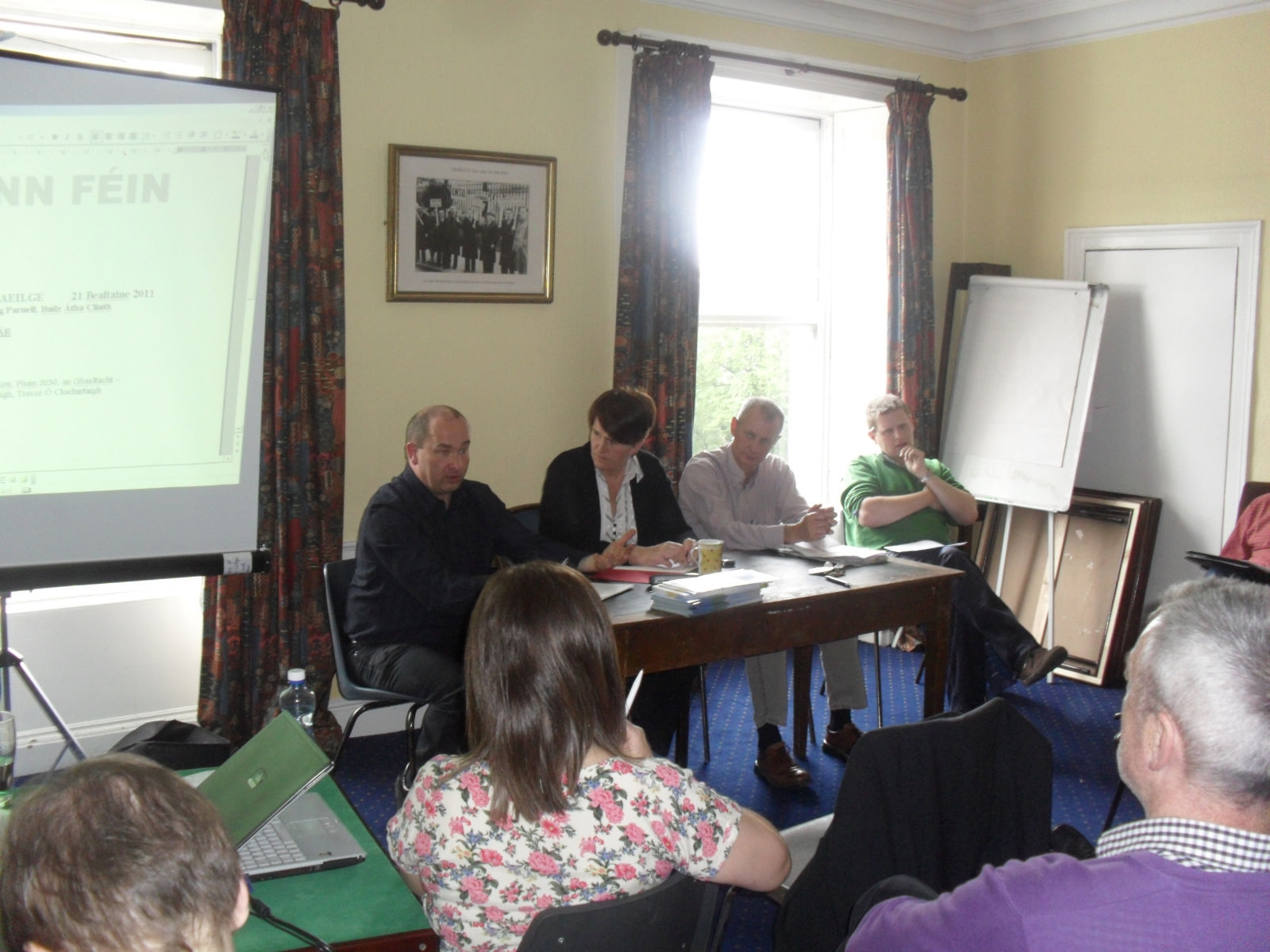

Comhdáil
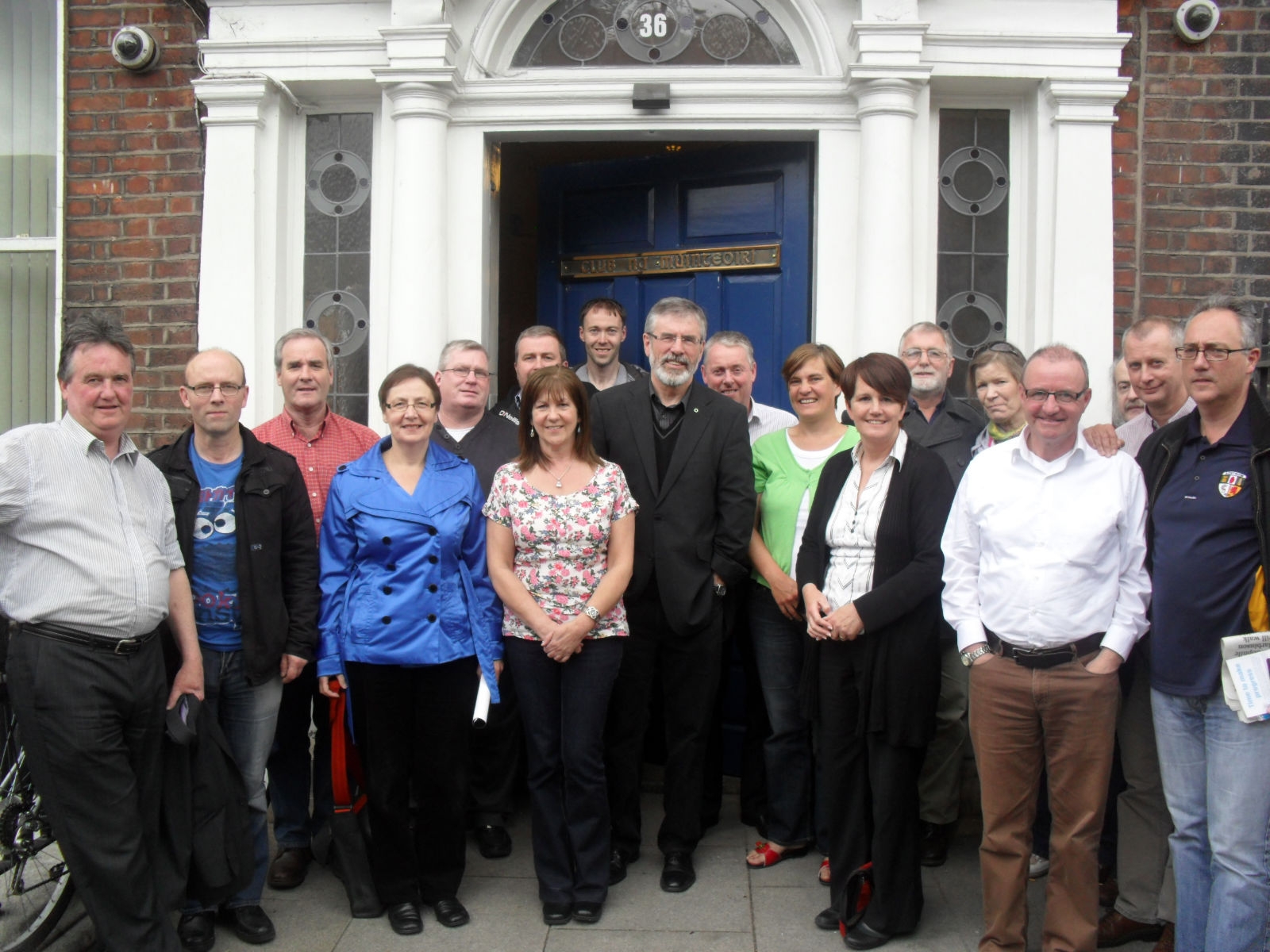
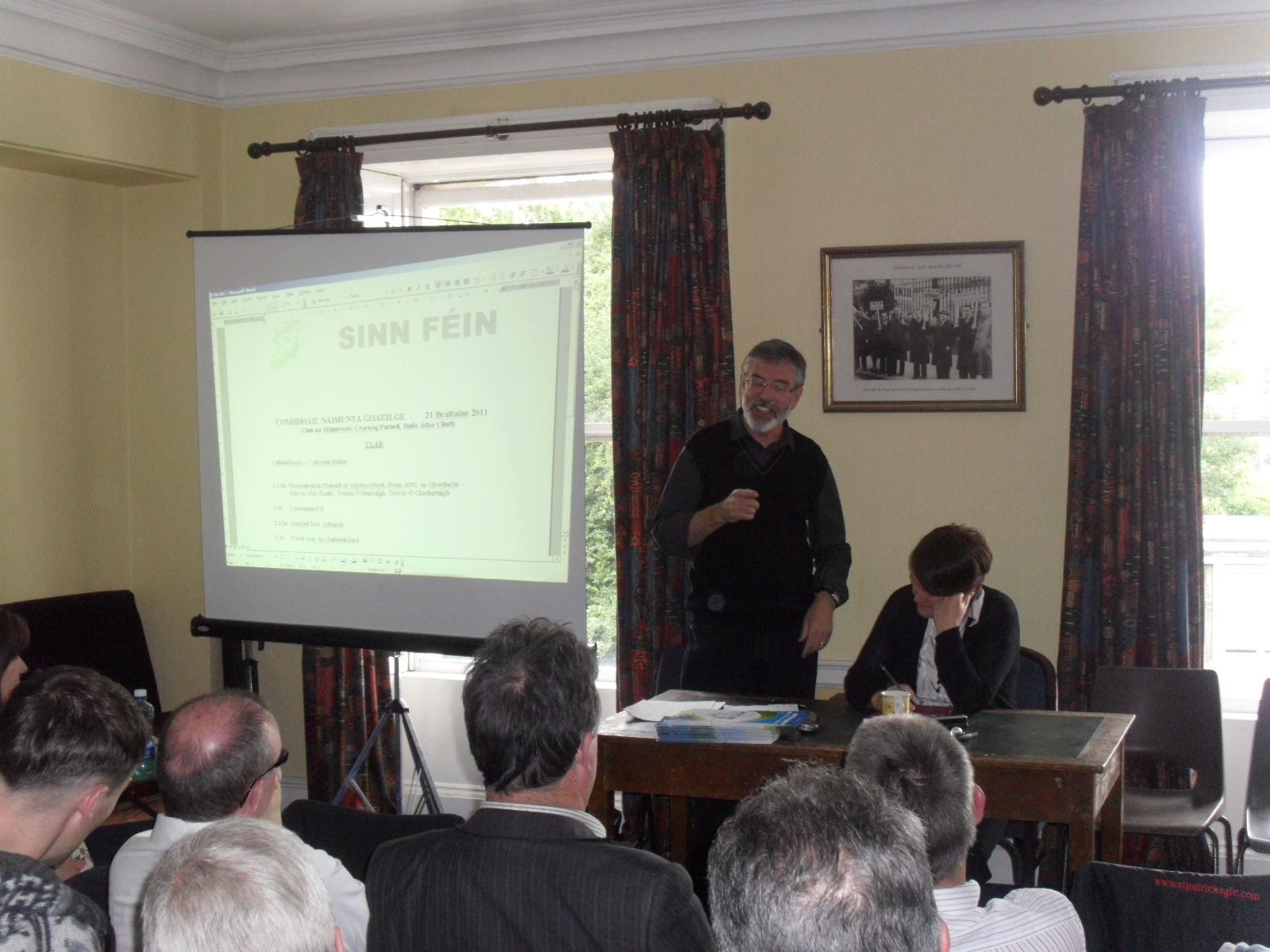
On Saturday last Sinn Féin Gaelgeoiri had a conference on the Irish language in Dublin.
It was a busy day for republicans in the capital. Former blanket men were involved in a debate at the Irish Film Institute about the legacy of the 1981 hunger strikes, there was a commemoration at Glasnevin for Martin Doco Doherty, an IRA Volunteer who was killed by a unionist death squad when he intervened as they were set to attack oeople at the Widow Scanlon's pub.And there was the Comhdáil.
And a very good Comhdáil it was too. This is what I said:
"Ar dtús ba mhaith liom buíochas a ghabháil le Rósaí, le Gearóid is leis na daoine eile a chuir an chomhdháil seo le chéile agus na cainteoirí uilig a ghlac páirt anseo inniu.
Tá cúpla ócáid tábhachtach eile ar siúl anseo i mBaile Átha Cliath inniu. Tá comóradh amuigh ag Reilg Glas Naíonn do Martin 'Doco' Doherty, óglach a maraíodh agus é ag cosaint cairde is comrádaithe ar 21 Bealtaine 1994. D'éag Raymond agus Patsy 30 bliain ó shin ar an Stailc Ocrais agus tá ócáid mhór ar siúl trasna na habhann san Ionad Scannánaíochta faoin Stailc Ocrais.
Ach tá dhá dúshlán mhóra romhainn i Sinn Féin faoi láthair:
obair taobh istigh den pháirtí – gaelú Sinn Féin
obair taobh amuigh den pháirtí le gaeilgeoirí agus thar cheann gaeilgeoirí
Ar dtús ba mhaith liom fáilte a chur roimh Pheadar Tóibín, roimh Sheán Ó Loingsigh agus roimh Chathal Ó hÓisín na feisirí nuathofa againn, agus tá Trevor anois ina sheanadóir nua againn - gaeilgeoirí breá ábalta iad uilig agus comhghairdeas dóibh.
Ansin tá na seanfhonduirí ann – Críona, Tomás, mé féin, Bairbre, Caitríona is Gráinne. Lena chois seo, tá go leor gaeilgeoirí cumasacha eile sa pháirtí gan sain-ordú ar bith.
Tá croífhoireann iontach againn ach caithfear i gcónaí barrchumas a bhaint amach. Sin dúshlán mór atá romhainn.
Thaitin an díospóireacht sin liom inniu, tógadh a lán pointí maithe agus tá go leor ábhar machnaimh ansin dúinn. Ach caithfidh muid bheith réadúil agus cúramach faoin slí ina bhfuil muid ag leanúint leis na moltaí chun an páirtí a ghaelú.
Mar shampla, bunaíodh cúpla cumann Gaeilge i mBéal Feirste is i mBaile Átha Cliath ach níl siad ag teacht le chéile nó ag feidhmiú mar is ceart.
Rinne Bairbre agus cúpla duine eile ansin pointí faoi fhreagairt guthán in oifigí Sinn Féin agus gach duine ag úsáid cibé Gaeilge atá acu go háirithe leis an Ard Fheis ag teacht go Béal Feirste i mbliana, aontaím leo.
Caithfear obair le chéile leis an chun an chothromaíocht inár gcur chuige a aimsiú. Caithfidh an Ghaeilge bheith i gcroílár obair s'againn i Sinn Féin. Caithfear í a phríomhshruthú. Mar sin de, tá struchtúr de dhíth orainn.
Ar an taobh eile, tá sárobair déanta againn; i gcaibidle Chromghlinne, fuair muid £8 milliúin don Chiste Infheistíochta Gaeilge. Tá Cáral agus John Mór mar airí againn anois agus tá mo bhuíochas agus bualadh bos mór tuillte ag Caitríona as an ualach a d'iompair sí – tá 4 daoine againn ar an Fhoras, foireann láidir leis an obair a dhéanamh.
Ní féidir linn leanúint ar aghaidh gan polasaí, gan straitéis, gan clár, gan struchtúr. Ghlac muid céim mhaith inniu leis an chomhdháil seo agus dréachtpholasaí scríofa.
Beidh céim eile le glacadh againn leis an Ard Fheis nuair a bheidh díospóireacht teasaí ansin, is dócha.
Tá a fhios ag daoine anseo go raibh muid ag tógáil Sinn Féin le tamall in achan chearn den tír. Tá sé de rún againn anois stiúrthóireachtaí a tharraingt le chéile, ceann acu ó thuaidh, ceann eile ó dheas seo agus mar aidhm againn nasc láidir a thógáil idir na hInstitiúidí agus an páirtí ar thalamh.
Caithfidh an Ghaeilge bheith mar chloch lárnach sna hathruithe sin. Tá mé a rá sin mar Uachtarán ar Shinn Féin agus mar bhall ceannaireachta.
Tá mé ag brú cúpla rud atá an-tábhachtach go deo – taobh leis na gnáthchúramaí a bhíonn orm – agus tá an Ghaeilge ina gceartlár siúd.
Mar sin, beidh an dualgas ormsa agus ar Oifig an Uachtaráin chun obair libh chun cearta Gaeilge a fháil agus an obair seo a chur chun cinn.
Ár mbuíochas daoibh a tháinig le chéile anseo inniu.
Bhí díospóireacht fhiúntach againn. Bhí cruinniú an-mhaith againn agus tá an-obair romhainn. Leanaigí ar aghaidh.
May 21, 2011
Building a better future
The peace process has created the space in which the possibility of a different kind of relationship between the people of this island, and between Ireland and Britain has been made possible.That relationship is still evolving. Nationalists and unionists in the north are engaged in a unique power sharing and partnership mode of governance – and all-Ireland political structures are established and beginning to work well.But our country and our people are still divided. The British still claim jurisdiction over the north, even though this is now in a conditional way, and there remain many legacy and justice issues that are unresolved.For all these reasons Sinn Féin set out our concerns about the visit of the English Queen at this time.Nonetheless, mindful that the people of this island are on a journey out of conflict, and that unionists have a close affinity with the British Monarchy, Irish republicans have sought to be constructive in how we responded to this event. I have also expressed my hope that some good will come from it.The political reality in Britain of course is that the legal and constitutional powers of the Queen rest with the British Prime Minister of the day. It is David Cameron who personally exercises all of the Crown Prerogatives and does so without recourse to the British Parliament.This includes approving Queen Elizabeth's speeches.Many people who I have spoken to, particularly people from the North, are disappointed that she did not apologise for Britain's role in Irish affairs in her remarks on Wednesday. This disappointment is understandable given the huge hype around the visit, the difficulties surrounding it and the expectations raised by it.For my part I believe that the expression by the Queen of England of sincere sympathy for those who have suffered as a result of the conflict is genuine, and I welcome that. Many victims and victims' families will expect her Government to now act on that as quickly as possible and to deal with legacy issues, particularly those involving British state forces and collusion in a forthright manner. As we have said many times, Sinn Féin wants to see a real, new and profoundly better relationship between the peoples of Ireland and Britain, one built on equality and respect.There were a number of important symbolic gestures during this visit. The laying of a wreath in the Garden of Remembrance at the memorial to the men and women who died for Irish freedom was one of these, not least because many of the heroes remembered there were executed by British crown forces. The laying of the wreath was a recognition that they fought in a just cause.The Irish Government and the other political parties in this state know that their sacrifices were not for a partitioned Ireland or a 26 County Republic, though they rarely admit it. Interestingly during the recent General election the Fine Gael party did say that, "In any Republic the people are supposed to be supreme. Judged by that standard Ireland today is a Republic in name only". They need to act on this and all the parties here need to act on the imperative of the Proclamation of the Republic.For her part President Mary McAleese and her husband Martin have shown an ability to reach out to others. That has been a mark of her office. I welcome the President's acknowledgement that 'inevitably where there are colonisers and the colonised, the past is a repository of sources of bitter division. The harsh facts cannot be altered nor grief erased.I also agree with her assertion 'that with time and generosity, interpretations and perspectives can soften and open up space for new accommodations'.This will not happen of its own accord.It will require ongoing work and a committed focus in the time ahead, particularly by the Irish Government.Building healthy, friendly 'normalised' relations with our nearest neighbour is in everyone's interest. The peace process creates a democratic, inclusive way to do this. All of us have come some way – the process has delivered. This week's events are evidence of that but there is still a journey to be completed. As the President remarked 'this may still be a work in progress' as well as 'a work of progress, of partnership and friendship' … 'an important sign – among a growing number of signs' of the fresh start envisaged in the Good Friday Agreement.The challenge is to ensure that this is built upon and that reconciliation gestures, though important in themselves, do not become substitutes for real political action and positive change.In practice that means there is an outstanding need for the Irish and British governments to honour their obligations and guarantee full implementation of all the terms of both the Good Friday and St Andrews Agreements.The Irish Government and the British Government have spoken a lot in recent days about new beginnings and that is welcome. However, the British Government has thus far steadfastly refused to release files on the Dublin and Monaghan bombings, and on other attacks which have involved their agents in this state. Mr Cameron needs to act on this issue on the terms outlined by the families of victims of these attacks.So the Royal visit will be judged by the actions that spring from it, particularly how Mr Cameron responds to the very modest and legitimate demand that we work together to find ways of dealing with the past.This is an opportune time for Irish Government to plan for the future in partnership with our unionist friends for a new Ireland, for genuine national reconciliation and healing across this island and for Irish Unity. This means having a real, inclusive national conversation about the future of our island including the need to bring all of our traditions together and building a better future for all the people of this island. This, along with building the peace, is the work of practical patriotism. It is work for us all to be getting on with.Sinn Féin is working with our unionist partners in the North and every day we are seeking to explore possibilities for the future based upon equality, respect and tolerance. Like all democrats we seek an end to partition and the reunification of our people and our island.So this week's visit by the Queen of England to this part of Ireland has to be seen as part of a journey.It is a page in a book – not the end of that book.We need to continue that journey and to write the next chapter of that book.Note to ReadersSinn Féin will be holding two conferences in June on the theme of 'Uniting Ireland'.The conferences are titled: Towards a New Republic – I dtreo an Poblacht Nua.They first will be held in Dublin on Saturday June 18th in the Rotunda Pillar Room Complex, Parnell Square, Dublin 1 beginning at 10am.The second conference will be on Saturday June 25th in Cork City Council Concert Hall beginning at 7.30pm. Details are available at www.unitingireland.ie
Gerry Adams's Blog
- Gerry Adams's profile
- 29 followers
Gerry Adams isn't a Goodreads Author
(yet),
but they
do have a blog,
so here are some recent posts imported from
their feed.

