Yashas Mahajan's Blog, page 33
July 17, 2018
Word of the Week #120:
What was the most important event of the 1940? What led the world where it stands today?
The answer can, obviously, vary according person to person.
Around here, the most popular answer would be the 15th of August, 1947, the day India earned independence from the Brutish Empire.
Oh, pardon me, I meant to say the British Empire. My auto-correct tends to malfunction at times, you know. Totally an honest mistake…
Some of the more learned of us might argue that the 26th of November, 1949, the day our constitution was ratified, went a long way forward in making us who we are today. However, the constitution did not actually come into effect for another two months, so… Different decade…
Further West, the 8th of May, 1945 holds a significant place, being the day the Germans surrendered in World War 2, although the war officially did not end till 2nd of September.
Regardless, it is safe to say that the end of the Second World War also marked the end of the old world order, and it shaped the world that our past generations have known. The subsequent decolonisation, the establishment of the United Nations, and the growth of modern powers was all a consequence of the same.
In my opinion, however, the day of the new beginning should be considered far more important. To wit, the 17th of July, 1945 marks the day Chairman Stalin of Russia, President Truman of the US, and Prime Minister Churchill of the UK met in Potsdam, and essentially laid the foundations for the world order that lasted for, one might estimate, 45 years. Perhaps we could discuss more about that, some other time.
Considering that, it seems ironic how, over the past week, the current POTUS has held successive meetings with the current heads of both the UK and Russia. And from what we know about the content and the nature of both the meetings, it would not be overly dramatic to believe that we have reached another of those interesting junctures in history where the entire fabric of the world is unwinded.
Let us take another couple of weeks to explore exactly what that might entail.
I do believe I must warn you in advance. These could get somewhat bleak.
After all, this may just be the beginning of an end.
Advertisements


July 10, 2018
Word of the Week #119:
When it rains, it pours.
We have all heard this, right?
Well, throughout the course of my life, I have always found it to be true, but rarely have I experienced it quite as literally as in the past week.
Last Saturday, we saw 265mm of rainfall in a span of 8 hours. In contrast, the average rainfall for the entire month of July is 317mm.
And according to meteorological experts, the worst is yet to come.
Sounds like a good time to jump off SS Sinking Ship, if you ask me…
The odd thing is that we have now come to expect and accept what are clearly major anomalies in the weather. Getting the entire month’s rainfall over a single weekend cannot be normal.
Just imagine it: Can you eat a month’s worth of food, and then not eat for the rest of the month?
Okay, “a month’s worth” is not very specific, I suppose.
Consider it this way… An average adult consumes roughly 2500 calories a day. That is 10 slices of a supreme pizza from Pizza Hut. So, roughly 300 slices a month. Now, does each pizza have 6 slices or 8? Let’s assume the latter. So, 37.5 pizzas.
Now, imagine trying to eat 37.5 pizza in two days. Will you eat yourself into the hospital or into bankruptcy, that is the question.
Wait… I forgot the point I wanted to make… And now I want pizza.
The point is, never try to get work done when you’re starving.
And maybe stock up on food and water and drinks and batteries, and get ready to stay indoors for a fair part of the week.
And for the love of God, turn off those ACs that are permanently cranked up to 22°C. You are only making it worse.
A storm is coming. And, by all accounts, it is only going to get worse.
Advertisements
July 3, 2018
Word of the Week #118:
It was only tonight that I realised that I had not really spoken much on the blog about the fact that I am left-handed.
I think it is rather odd… After all, being a lefty is an immutable part of my identity, but at the same time, it does not come up that often come up in the normal course of a conversation, right?
Think about the last time you heard someone say, “As a left-handed person, this is what I think about this issue.” It just does not happen.
However, as with any demographic minority, there is always some bias, intentional or otherwise, that we have to deal with growing up.
Things as basic as scissors are made with the assumption that the user will be right-handed. It may seem inconsequential to us as adults, but you cannot even begin to imagine how traumatic it can be to an eight-year-old sitting in art class trying to understand just why he cannot get the scissors to work.
Yeah, it took me half a decade to realise that I’d have to use it with my right hand to make it work, but to be honest, I no longer care…
Even pens and pencils are not designed for use, and let us not even talk about chalk boards and white boards and spiral-bound notebooks…
As a young adult in college, it did not take me as long to realise why the drafting equipment would not support me, and how to compensate. This was largely because I knew I could ask other lefty friends who had done it before.
Even now, most tables I use are asymmetrical. As a result, half of the space remains unused.
Such impedance is always annoying, but after several years of bumbling about, it can certainly be circumvented.
What is a much larger annoyance is the extreme stupidity of the people we meet all across the world.
If I could get an extra mark every time an invigilator asked me, “Oh, do you really write like that,” I might have actually made the cut-off for Delhi University.
“Yes, of course, I really do write like. What did you think, I’m doing a bit, here in the examination room? Moron…”
Of course, I never really said that, but I assume my glare would have sufficed.
I remember one morning, I must have been 10 or so, when a shopkeeper refused to take money from me because I offered it with my left hand. Give it with your right hand, he told me, and of course, when he said right, he meant correct. I did what was the natural thing to do in the situation: I left the cash midair, glaring into the man’s eyes till the coins clanged onto the floor, and just walked away.
When I look back now, I feel lucky to have had family and teachers who did understand what it meant to be left-handed. I have met others who have not been as lucky.
There are many who erroneously believe that being left-handed is a disease, and needs to be corrected. A forced change in the handedness of a person, particularly at an extremely young age, can have catastrophic repercussions. Since handiwork is controlled by the same part of the brain as speech, such a change is often accompanied by speech disorders. Learning disabilities are also a common side-effect.
And then, of course, are the morons who actually believe that lefties are unlucky or inauspicious or whatever. To quote Sheldon from The Big Bang Theory, “When I come to power, those people will be sterilised.”
I recently attended a Pride Carnival, and while I was generally quite, well, proud to be there, I could not stop this one thought from continually nagging at the back of my head.
For a society that still struggles with the idea of “left-handedness”, concepts like “sexual orientation” and “gender identity” might be far too advanced.
Now that I think about it, there is a simpler way to explain these things to the more moronic parts of our society:
Some people are different. That is all. It is not a disease. It is not a curse. It is not something to be outgrown or corrected.
Different is not wrong.
Advertisements
June 26, 2018
Word of the Week #117:
From the brilliant minds that brought you Demonetisation ’16, comes another blockbuster that will melt your brains: Plastic Ban ’18.
And in the few days since its implementation, it has already shown to be as imbecilic.
Now, I do not mean to be overly harsh. The industry and the people at large did have three months to prepare for the switch. And on the very face of it, banning plastics does seem like a good thing to do, with respect to the environment, sanitation and other such concerns.
Plastic is one of the few things that can be described as being ubiquitous. Replacing it from every single application may be possible, but is it actually viable? And how will this discarded plastic be disposed of? Surely you cannot just throw it in the dumpsters and forget about it. If that had worked, we wouldn’t need to worry about it in the first place, right?
However, the biggest problem with such a step is actually quite simple: We do not have a viable alternative.
You cannot possibly sell cookies in paper packages, especially in the monsoon. They won’t last a day.
And what if I order some hot soup from a restaurant nearby. Surely, paper cups cannot hold that for long. Will you use metal cans? Those are actually not the most eco-friendly of materials. Glass is too bulky and fairly fragile. Not to mention, both are significantly more expensive. That does make a difference in an economy like ours.
What about silicone, though? It has almost all the upsides of plastics, but that is just the beginning. It is safe and durable. It is expensive, but not prohibitively so. Being based on silicon and not carbon, it is significantly better for the environment if disposed of correctly.
But therein lies the problem: Silicone is not biodegradable either.
Sure, it can be recycled, but that is predicated on, surprise surprise, proper disposal. And, if you are anyway going to do that, might as well get your plastics recycled.
Yes, that’s right. Many plastic products can be recycled. It would not be nearly as big a nuisance if all of plastic waste could be reused or recycled, but no. We want to dump it in a landfill, right?
I am sure you must have encountered these labels, right? Usually on the bottom of a soda bottle or such… Ever wondered what they mean?
Well, this is the gist:
#2, #4 and #5 are the best. Use responsibly, and recycle. Plastic bags, which are primarily made from LDPE (#4) have been banned.
#1 is good enough, but try to avoid it. Interestingly enough, soda bottles made from PET (#1) have been exempt.
#3, #6 and #7 are bad. Avoid. However, thermocol decorations (#6) will be allowed till the end of a major religious festival in September. Because, priorities.
Unfortunately, our government seems to lack the nuance required to craft a thoughtful, thorough policy to implement waste disposal techniques that actually work. Instead they choose to harass local business owners and consumers for long-exsisting systemic failures.
It is quite clear that more thought and research goes into my weekly blog posts than in governmental policies.
Yes. Let that sink in.
Advertisements
June 19, 2018
Word of the Week #116:
Now, before you get your hopes too high, let me just clarify that this is not a Ross Geller appreciation post.
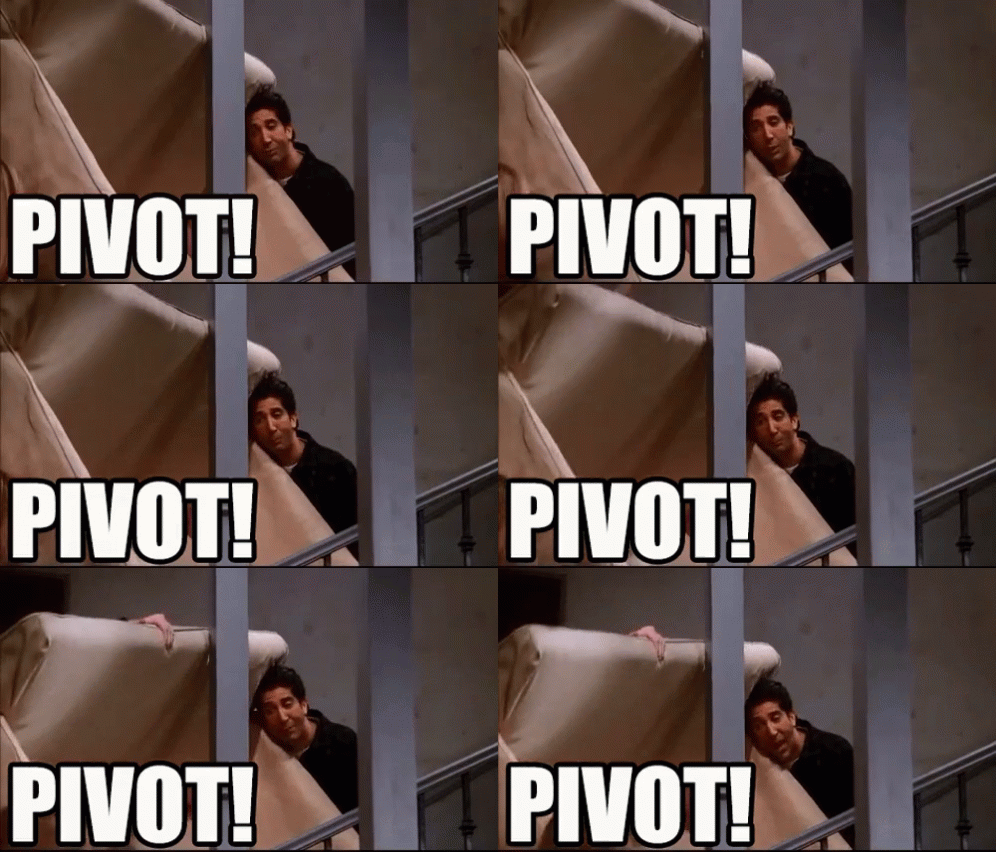
Although, now that I think about it, that too is long overdue…
No, today we talk about this one trick that politicians and their spokespersons use when asked a difficult question.
The truly inept ones will start by lying, and end up looking foolishly out of depth. Of course, for some individuals, this is their go-to move.
The skilled ones, however, will follow a simple routine to dance around the discussion until the interviewer and the audience are too confounded to carry on.
I could teach you how to do it, if you’d like…
Step #0: Catch the interviewer, or the camera, in a dead eye stare. Establish a position of benevolent dominance.
Step #1: Catch a keyword, or a phrase, from the question and shoot off into an unrelated tangent. This way, it looks like you have answered the question, but you have not.
Now, most interviewers, either trying to seem polite or adhering to a strict timeline, will let the question go. Some reporters, however, are more tenacious than others, and will keep repeating the question. What do you do now?
Step #1 (a): As a novice, you might try to dodge the specifics and continue to move farther and faster on the tangent. This may exasperated the interviewer enough to lose balance, or simply leave the audience too disinterested to care.
Step #1 (b): Once you are experienced enough, you will be able to take this chance to paint the interviewer as a biased, and rude, opponent, instead of being a neutral observer. This is meant to sow seeds of mistrust towards the media, and will usually polarise the audience.
Step #2: Blame it on the opposition. This is, of course, the most basic tactic but its efficacy is almost alarming. Irrespective of whether this blame is justified, the audience will be distracted from the facts.
Step #3: Equate the interviewer with the opposition. Firmly establish a bias against yourself. YOU are the real victim here.
Step #4: Counter. Since you have already established that the media is the opposition and the opposition is guilty, you can now force your interviewer on the defensive with some sharp questions and allegations of your own.
If he tries to dissociate himself from your allegations, he undercuts your opponents in the process.
If he tries to justify your opponents’ actions, he further consolidates the perception of bias.
If he tries to dodge the questions or deny the allegations, he seems evasive and unreliable.
In any of the above, you are the winner.
Step #5: Accept your victory, and assure the audience that things are better with you in charge of the situation.
See. Simple, right?
Of course, don’t blame me if you try this on your college professor and get into trouble, okay?
Class dismissed.
Advertisements
June 12, 2018
Word of the Week #115:
Did you watch the NBA Finals, last week? I did.
And if you did not watch the actual games, you might take a look at the results and assumed that what transpired was exactly what everyone expected, going into the series: The Warriors were far too superior, and the Cavs had no chance whatsoever
Well, of course, you can would be gravely mistaken.
The first thing to take away from this series was that th ere are no forgone conclusions in sports. Or even in life, for that matter.
But it was the second thing I learned that really resonated with me: Not every loss is the same.
See, it is one thing to play badly and lose. That happens to the best of us. Sometimes the opponent is just too strong, and sometimes we just have a bad day. It happens, and it is okay. You can still come back, play better, and hope to win.
But there are times when you clearly have a historically great game against a historically great team and you drag your historically mediocre crew to within inches of victory, and what happens?
You have one teammate missing a clutch free throw, another who has no idea of the score, and a head coach who does not know you have a time out left.
I believe this response sum up your feelings perfectly.
[image error]
No wonder it ended up being the meme of the week.
When you do everything you need to, in order to win, but you still fall short, what do you do? What can you do? How can you not break from a loss like this?
Cleveland did. They showed no fight for the rest of the series. And now that the season is over, and LeBron is, in all probability, going to walk away the first chance he gets, it is highly likely that they will never fully recover.
And LeBron? Well, he might take a moment, but I think he will be just fine.
Advertisements
June 5, 2018
Word of the Week #114:
Have you heard of Murphy’s law?
I have mentioned it once before on this blog, so I would expect that you have…
The precise wording still remains unclear, but the general interpretation is that everything that can go wrong, does.
Now, I generally stay as meticulous as I possibly can, and try to keep the margin for error so slim that the consequences do not pile up.
However, all it takes is one jolt to put everything way out of order.
I cannot quite trace where this sequence began, but I have been feeling that these days, whenever I try to do something, whatever can go wrong just does.
For instance, every afternoon, I go to play basketball at court significantly far from my home, and between the extreme heat all afternoon and the kids’ training all evening, I get precisely an hour to play.
Now, as it is, my margin for error is already not great. But what can go wrong? Well, apparently, quite a lot…
Sometimes, I will get dressed, put on my socks, and be half a dozen steps from the door, when splash! I step into a pool of fresh, warm pee.
Yeah, our kids are not entirely trained, yet. Have I talked about them earlier? I should.
Now, cleaning it up, then washing my foot, luckily not feet, and changing the socks takes up roughly a quarter of the hour. Significant.
Sometimes when I do not step into pee, my vehicle just refuses to start.
Of course, my vehicle is ancient, so I tend to include a buffer for that. But when it is so broken that I have to go to a mechanic, as I already have twice this week, that is more than 25 minutes easily.
If my vehicle does start after the first few tries, and I get to the court right on time, I should get an entire hour to play, right?
Well, not if it starts to rain with little to no warning. Not enough to actually cool down the scorching streets, of course. No, it will only rain enough to leave the court unplayable for just about an hour.
And, if I do not step in pee, manage to get there on time, and it does not rain, what happens?
Well, a guy manages to jump onto my leg, breaking my knee and leaving me bedridden for over a week.
Now, on the days that a guy does not break my knee, and of course also the day that he does, I will come home drenched in sweat, longing for a nice shower. That is not too much to ask, right?
Considering how often I have stood under the shower with not water raining down on me but the realisation that, well, the tanks are empty, apparently it is.
When the tanks are not empty, I go into the shower, let the water wash over my skin, and just as I am starting to work up a decent lather, the door bell rings. Repeatedly. Incessantly.
Having washed myself as much and as fast as I could have, I come running down the stairs, only to realise that my Dad is indeed home, and has answered it already.
And if this does not happen, my shower is completed without any incident, what happens?
I come out of the shower, a towel draped over my head, leisurely wiping my hair, when I suddenly realise that those are not droplets of water that I feel creeping down my shoulder.
I am, however, a moment too late, as I sense a dozen successive bites across my shoulders and back.
Freaking ants! Sounds ridiculous, right? I mean, what are even the odds?
Already a couple of days have passed since that particular incident, and I still have no clues how those ants ended up in my towel.
Now, in the face of such odds, it would be understandable if one were to grow dejected.
However, I have found that the uplifting words of a great man, one Dr. Ken Jeong, always get me up and running.
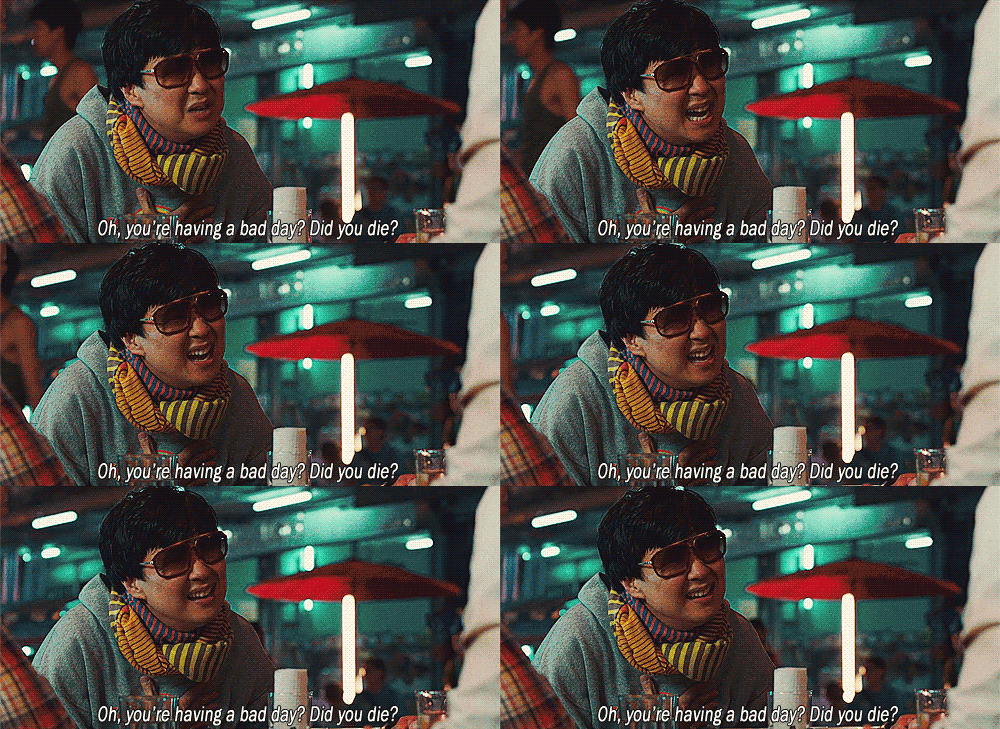
Not today, kind sir. Not today.
PS: I have been trying to take a shower for the past 4 hours. It would appear that the odds are against us, tonight…
Advertisements
May 29, 2018
Word of the Week #113:
I don’t often take vacations. The kind of work that I do and the kind of life that I live just does not afford me that kind of luxury.
Of course, one could argue that, given how flexible and balanced my life already is, I might not really need a vacation.
Well, there is some merit to that premise, but there are several more details to consider.
Firstly, balanced may be a term you can use to describe my work schedule now, but that was far from true till the last summer.
Secondly, no matter how much you love something, fatigue does eventually set in. Taking no real breaks for a span of four years can be strenuous for even the most tenacious of us.
So, when I hurt my knee while playing basketball last week—a severe strain to the lateral ligaments—and the orthopaedist asked me to rest, I decided to take a break from work as well. Just take a week to relax…
Seeing how I tend to overwork throughout the monsoon, as there is little else to do, the timing could not have been.
It is still a forced vacation, as each one I take tends to be, but it has been quite fun nonetheless.
I finally got to take my old PlayStation out of its box; the first time in several months. As it would turn out, NFS Most Wanted is still as fun as it was almost a decade ago, though the races somehow seems slightly more difficult than I can remember. Also, the way my shoulders and lower back start aching after just a couple of hours is an entirely new experience.
I often draw some flak for calling myself old, but the truth is, I do feel older. Things do change, as we grow older, and we often do not realise just how much.
One of the things I have noticed is that people seem to stop doing what they used to love doing as kids. I cannot think of any reasonable explanations for it, to be honest. Excuses, perhaps, but no explanations.
If you stop having fun, what is even the point of being alive, right? If you know something is fun, why postpone doing it? It is not like we have forever to wait…
So, this week, I plan to have some fun. Perhaps a little extra, just to compensate for the entire year.
Replaying NFS was fun, but now my thumbs feel weird, so I have to stop. Perhaps I will rewatch an old movie I love. Or perhaps I shall reread an old Agatha Christie that I have not touched for a few years.
There is just a different pleasure to redoing things you love, right?
My room is cosy and my heart is happy. This is going to be a good week.
Advertisements
May 22, 2018
Word of the Week #112:
People who know me would know that I don’t drive. Well, to be very honest, I can’t.
Of course, I’m talking about driving a car, or anything larger than that.
I’m quite fine with a moped, actually.
And on the basketball court? Just get the ball on the right wing, crossover to the left, drive and score!
Ain’t nobody that can guard me, Boy!
However, I cannot drive a car.
In our society, I hardly see the need for one, to be honest.
Sure, there are moments when I wish I had car. It would, in an ideal world, make things so much easier. But in the real world, it is just not worth the trouble.
For one, it just seems like a huge responsibility, you know. When you possess a car, you are responsible not just for your own safety, but also for all the people around you.
Not to mention, it is just not an easy thing to do. The driving courses are not nearly as thorough as you would hope, nor are the tests as stringent.
And, apart from just driving, maintenance is also a headache. A badly maintained car could, quite literally, blow up in your face with little to no warning.
There are very few things you can encounter on your way home that are as dangerous as an irresponsible, inept individual with a big, fast car.
And entrusting my life to a random stranger is the last thing I’d do. Literally…
Now, when I say this, I do not mean to undermine the role cars have played in making our society what it is today, nor how we continue to perceive them.
A cool spy with his favourite car, with some sort of an explosion in the background, is probably the first memory I have of Hollywood movies.
After all, I was just 3, when I watched Pierce Brosnan in Tomorrow Never Dies.
So, I do get it… Cars are cool. Cars are fun. Cars make you feel powerful. And all that is fine.
However, I don’t see why you should not have to answer a few simple questions to ensure my safety, and that of everyone else who may encounter you along the way.
Do you really need a car?
Do you really need that car? Surely something smaller and safer should do the job, right?
Are you capable of handling that car?
Do you have any history of substance abuse?
Mental health problems?
Neurological issues?
It is not unreasonable to have these questions about cars and the people who drive them, right?
It is a matter of personal and public safety, after all.
I don’t think anybody would really disapprove.
And yet, replace ‘car’ with ‘gun’, ‘drive’ with ‘shoot’ and ‘moped’ with ‘camera’, and suddenly you get a highly controversial political statement, right?
Feels like an attack on your Second Amendment Rights, little American Idiot with an AR-15 in each hand?
At least my attacks don’t leave dozens of innocent school kids dead.
Advertisements
May 15, 2018
Word of the Week #111:
Okay, consider the following situation:
A sports club has 3 coaches and 100 players, and they need to decide the colour of their uniforms.
Coach A wants it to be Yellow.
Coach B wants it to be Blue.
Coach C wants it to be Red.
Since they cannot decide it among themselves, they get the players to vote.
Such democracy… Much wow…
Coach A gets 44 votes.
Coach B gets 35 votes.
Coach C gets 19 votes.
The numbers do not add up? Well, there are always a couple of guys who chose to write in different responses. It happens.
Now, one would be tempted to jump on the phone and order 100 yellow uniforms, plus spares, perhaps? It seems to be the logical conclusion, does it not?
However, is it actually fair to override the wishes of 56 of the players, and force them to wear a uniform that they do not view as an apt representation? Is it the right way to inculcate team spirit?
What happens if Coach B and Coach C come together and suggest a jersey with Blue and Red stripes, which represent the wishes of a larger section of the players? Is that better?
On one hand, 54 is better than 44; on the other, nobody actually voted for that specific combination.
What if Coach C concedes defeat, since he clearly lacks support, and the players are then asked to vote for either A or B?
Apparently, this is what they do in France. And no, this is not a ‘France surrenders’ joke. Take a look at their Presidential Election, for context.
Now, with a possible swing of 21 votes, the results could vary significantly. One could say that these new results are a better representation of what the players want, but we have still not solved the concern about the dissatisfaction of the losing side…
To begin with, does a single vote truly and completely represent the wishes of an individual? Seems like an extreme case of oversimplification, to me.
What if a player X loves Blue, hates Yellow, and is somewhat fond of Red? His single vote for Blue does not capture the rest of his preference.
People are complex, you know.
Perhaps being able to assign a grade to each option would be a better representation?
I agree. Democracy is long, messy and annoying, and too many people seem it interpret it in their own ways.
But for now, it is the best we have.
And if it does not work for everyone, it does not work.
At the end of the day, we are all in the same team.
Advertisements