
Colin R. Turner's Blog, page 4
February 21, 2015
The six-part puzzle between you and the free world.
We would all be in a better, moneyless society tomorrow if everyone understood how and why it works, but the truth is that it's a very difficult idea to convince people of. So why is that? As someone who has been trying to sell this idea to people for about five years now, I've had plenty of time to think about this question, and this article is what I've come up with so far.
The solution is the easy part
Convincing someone about the potential of a money-free future is basically a two-part exercise. First, you have to convince them of the benefits, then you have to convince them of the feasibility. The benefits are many, and most reasonable people will have no trouble accepting them: better quality of life for all, less inequality, poverty, crime, greed, corruption, pollution and waste; greater health, education, trust, respect, awareness, sustainability, community values, technological advances, etc. Most people want these things, so our problem is not really about convincing them of the benefits – it's convincing them of the feasibility. How is a moneyless society possible?
I have come to realise that the reason it's so difficult to grasp is that it requires the simultaneous suspension and reevaluation of several beliefs that are fundamental to how we perceive the world.
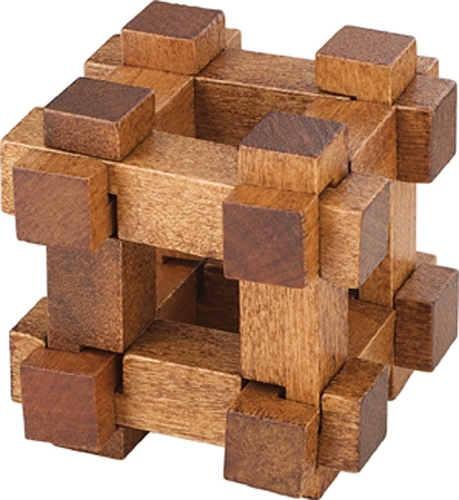
In order to convince someone, we have to first demonstrate the misconception of those beliefs, and then supplant them with ones closer to their true origins. Of course, it's a big ask of anyone in the bustle of their busy lives to devote time and energy to this kind of mental juggling, but if they apply themselves a little, then, like a wooden puzzle, the pieces will start to slot together.
And once they solve it, there's no going back.
The six parts of the puzzle
Imagining a world without money usually raises the following objections immediately, each of which is linked to a particular lifelong held belief (in brackets):
1. You need to have exchange (You can't get something for nothing)
2. No-one would do anything (money motivates people)
3. People would take advantage (greed is human nature)
4. I will lose everything I have (fear of loss, ownership)
5. Chaos and violence would ensue (society requires control)
6. Society would stagnate or regress (markets fuel progress)
The good news is that all of these objections can be overturned quite easily using just plain common sense and basic observations. There's no proof required, but before someone can arrive at the same conclusion as you – that a moneyless society is possible – they need to simultaneously suspend and reevaluate all those beliefs.
Here's a run down through all the main arguments and beliefs, and their (I believe) appropriate responses:
1. You need to have exchange (you can't get something for nothing)
Somehow, somewhere along the way the First Law of Thermodynamics (energy cannot be created or destroyed) got mixed up into the conversation on human society. Along with popular phrases like 'There's no such thing as a free lunch', these idioms have conspired to underpin the belief that nothing happens without some exchange of value, whether by money or barter.
You could be forgiven for thinking that certain groups would happily wish to continue to perpetuate this thinking, but the fact is that it is simply false, and not based on anything else we see in nature. In nature the closest thing we have is something called symbiosys where two species benefit each other (the bee taking nectar while helping the plant to pollinate is the most obvious example), but there is no intentional transaction taking place. Both species are ignorant of the desires of the other. It is purely an accident of evolution that has caused both species to survive and flourish. Nowhere else in nature do we see evidence that intentional exchanges are an essential ingredient to life or to community. We invented that idea to cope with scarcity in more primitive times, and with more complex needs.
The money / value system that we operate in has its origins in more primitive times, but which has now made us hell-bent on keeping score and accounting for everything in a numerical sense, and at the expense of common sense and sustainability. But nature doesn't keep score. We ourselves don't seek exchange in our families or in our circles of friends, so why do we seek exchange in others? Among our loved ones, we all tend to help each other out when we can and no-one keeps score.
If we allow ourselves to trust in others as we do those in our immediate circle, and trust that others, like us, will help each other once they find themselves in a society that meets their needs, then we will eventually be able to see the futility of exchange and keeping score, and that everything, by and large, evens out in the end.
2. No-one would do anything (money motivates people):
People are motivated by money, yes. It is perhaps the biggest motivator of people, but the only reason for that is because we need money to live. It's linked to survival – our most fundamental instinct. This is what gives it such power.
There are, of course, many other human motivators: the desire to love and be loved, to meet people, to have children, to help others, to improve ourselves and our surroundings, to look good, to feel good, to learn, to challenge ourselves, to express ourselves, to innovate, to demonstrate our skills, etc. Every person alive is motivated by these desires to some degree. Because, after survival, these desires are what give our lives value and meaning.
So if we didn't need money to survive, and society could be better without money, then it follows that any or all of these desires would become our primary motivators. Since technology can now make the basic business of survival incredibly easy for us, all we would have to do – rather than working and earning – is to spend just a little time serving our community to ensure that the system works for everybody, then spend the rest of our time doing whatever it is that makes us happy.
Of course, this doesn't mean we all have to go and live in the forest and eat berries! If technology was not limited by a market system, and peoples' desires to help, innovate and improve became their prime motivators, then our technology could be completely maximised to take in almost all jobs that no-one wants to do, and create a highly advanced culture.
3. People would take advantage (greed is human nature):
Greed is not human nature – it is simply the desire to stockpile something scarce which you need to live. Like a squirrel collecting nuts, greed makes good sense – because we don't know what the future will bring. In a monetary world, the greatest scarcity is money itself, so it makes sense to accumulate it, and, since there is no upper limit to the money and property you can have, there's no reason to stop accumulating it.
But if society can work better without money and everyone has access to everything they need, then there would be no point in stockpiling anything in large quantities. Who wants a basement full of coffee, cornflakes or tomatoes when all these things are freely available at any time?
For the first time in history, we have the technology to eradicate scarcity and create an abundance of necessities for all humans on Earth with minimal physical effort. The market system is the only thing that prevents this from happening, as it intrinsically requires scarcity to perpetuate itself.
4. I will lose everything I have (fear of loss, ownership)
Any marketing guru will tell you that the most influential factor of human decision-making is the fear of loss – even more so than the desire to gain. So arguing what someone will gain living in a moneyless society versus losing their exclusive property rights probably isn't going to convince them, as the fear of loss will be overriding. It is better to just tackle the whole notion of ownership altogether.
We all need privacy and a certain amount of exclusivity, right? Who wants to share their toothbrush, or have strangers walking around their home, for example? Our normalised belief tells us that we define who uses what through something called 'ownership'. Our laws define and protect ownership, with the threat of punishment to those who disobey (ie. stealing).
But where does this concept of ownership come from in the first place? Did we own nothing before someone wrote the law? Of course we did, but in our early egalitarian days it was more like moral or logical entitlement. Moral, as in, we implicitly deserved entitlement to an object, or logical, as in, it made logical sense for it to belong to us. The point is that most things in the community belonged to no-one. Whatever items within the community that were not morally or logically entitled to anyone were used and shared by all.
So without ownership, what stops people from stealing? What actually stops people from stealing from each other is that it is anti-social, disrespectful and invasive, and people who do so are liable to become deeply unpopular. This social incentive for certain behaviour is far stronger than any rule could ever be, as it is dictated by how we feel about ourselves and our position in society. Yet we commonly mistake the rule of law as being the only thing that governs this behaviour.
If we understand that respect, privacy and exclusivity are, in fact, already hard-wired into our social psyche – not dictated by external controlling forces – then we can begin to move beyond the traditional inefficient limits of ownership and with it, any fear of loss.
5. Chaos and violence would ensue (society requires control)
To address this belief, it's worth first pointing out that our world under its current system is already rife with crime and violence, so any argument for a moneyless society must be measured against that standard for comparison. Also, no-one is suggesting that a free world would be perfect – just a whole lot better.
Most crime and violence is driven by desperation through lack of basic requirements for living, ie. theft, armed robbery, burglary, etc. Almost all other crimes can be seen as the secondary effects of poor upbringing. ie. where parents are poor, over-worked, unemployed, frustrated, depressed or disillusioned, etc. – all factors that can contribute to an unstable and unloving environment for children, who may later turn to crime as a result of low self esteem or maladjustment.
If society can work better without money, then most of the reasons and contributing causes of antisocial behaviour will no longer exist. Society will automatically be more cooperative and inclusive, and everyone will have free access to good food, housing, education and technology. It won't be perfect or eliminate all crime, but if everyone has a good quality of life and free access, then crime will have little or no incentive.
6. Society would stagnate or regress (markets fuel progress)
Many economists or entrepreneurs cite economic incentive and competition as good for progress. But since the money system is everywhere, people who make this claim really have nothing to compare it with, so are drawing a false conclusion. Are we really to believe that all innovators, inventors and artists will down tools the moment someone calls time on money? Obviously not, since we all know so many creative people that never achieve financial success, it shows us that they are not driven by money, but rather by their passions and desire to innovate.
We have already seen the rise of the Open Source movement and how large scale innovative projects are becoming the optimum means of production without a monetary incentive. Many computer programs like Linux, Chrome and Android have been developed freely by enthusiasts in their spare time. The computer industry has led the way on this, but of course, there is no reason why 'open source thinking' cannot be applied in agriculture, crafts, construction or education, etc.
History has shown that, in general, our greatest innovators and artists have come from privileged backgrounds. Does that mean that they were smarter? Of course not. It means that they had a comfortable upbringing, access to good food and education, and had the luxury of time – not labouring for their keep – but spending it on developing their ideas and skills instead.
If society can work better without money, then all potential young Einsteins and Mozarts will have the optimal opportunity to exercise and advance their talents.
Now allow to simmer...
For most people, taking all this new information on board is quite a mental feat, and it usually takes some time for the information to filter through the subconscious and back into the conscious mind. The subconscious mind is like a giant calculater which is a lot smarter than the conscious mind, and reevaluating all these lifeling-held beliefs and experimenting with new ones takes more than a little mental gymnastics.
If you keep an open mind, eventually the lightbulb will come on and you'll see it. Good luck, and remember, even if you still have misgivings, we are not victims of culture or destiny - we can shape the world as we please. Let's make it better!
If you agree with a moneyless future, please show your support by reading and signing The Free World Charter. Thank you.


October 8, 2014
Give Free Live Free - an Open Source eBook
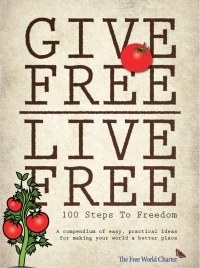
We are writing an open source ebook called GIVE FREE, LIVE FREE and we need your help! We are looking for your ideas for simple, practical things that anyone can do to start creating a free world today. Click on the public pad here, write your name on the right hand side, have a read through what's already there and start adding your own ideas. Keep it short and simple. Please write a one line idea summary first in bold, followed by a detailed description. There are a few ideas in there already to get you started. Please read through and make sure you are not repeating someone else's idea, but feel free to improve on what they have written.
When the book is complete, we will be offering it as a free download on the website, to help empower people to get themselves free! Happy writing!
https://etherpad.mozilla.org/hQbD5wWsHG
September 26, 2014
A Penny For Your Thoughts
 Imagine you are going out for the evening to meet three of your best friends - all going for a nice meal and a drink at your favourite restaurant. Throughout the night everyone is very relaxed, enjoying each others' company, having a good chat, sharing some memories and laughs, and talking about whatever's going on in their lives. Sounds like a pleasant way to spend an evening, right?
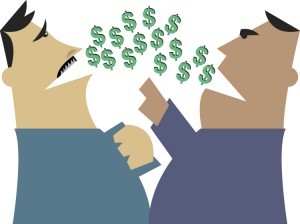
Now imagine the same night, the same people, in the same place but with one important difference: For every word you speak you earn six cents, and every word you hear will cost you two cents. The same rule goes for everybody. It sounds ridiculous of course, but what do you think would happen?
First, you will probably be thinking that you are going to have to talk more - but without making it too obvious of course. Secondly, you might be thinking about one of your friends in particular who usually talks a lot more than everyone else, and probably stands to gain considerably more than you. Maybe you'll even be trying to think of ways to stop them monopolizing the situation. Thirdly, if you are the quiet type, you will probably be starting to worry about how much this night is going to cost you listening to everyone else, and you'll more than likely start trying desperately to think of things to talk about.
Most people talk an average of about 120 words a minute. That means that just a minute's listening is going to cost you $2.40, while a minute's talking will earn you $7.20. Unless you're talking as much as everyone else, over the course of the night, you could start running up a huge bill very quickly.
So, in an effort to control the situtation, you decide to tackle the matter head on and, immediately on greeting your friends, you say, “Guys, I think for the sake of fairness we should all try to divide our talking and listening equally.” Your friends all shrug and generally nod in agreement.
“It's a fair solution,” one of your friends says. “In fact I thought the very same thing earlier and went out and bought this little digital verbometer.”
“Verbometer?” you ask, looking at the tiny black device. “Cool! How does it work?”
“Well it's a digital word counter with a built in voice recognition, so it remembers each voice and keeps a running total. All we have to do is switch it on at the beginning, then stop it at the end and work out who owes what.” Everyone looks impressed. “Anyway if we all keep an eye on the count and just keep the conversation even as you say, then no-one should owe anything, right?”
Everyone laughs as the new gadget is passed around, and all agree to use it. The verbometer is placed on the table, switched on and everyone settles down to look at the menu....
So what happened next? Well, there are really just five possible outcomes:
Everyone did as agreed, kept the conversation equal and paid nothing at the end.
Everyone forgot about the counter and the conversation continued normally, each person then paying their respective dues at the end.
Everyone was desperately clamouring to talk as much as possible, ending up in an exhausting evening, but a roughly equal bill for everyone.
Everyone was being over-polite, resulting in hardly any conversation and a pretty boring night, but roughly equal billing.
One or more people took advantage of the situation and earned a considerable amount for themselves from the others.
So which do you think is the optimal outcome here?
Of course, the answer is that none of the outcomes are optimal - if the object is just to have a good conversation. Even if everyone forgets the counter and talks as normal as in option #2, some people may end up being severely out of pocket at the end of the night and will probably want to avoid that situation again in future.
If everyone tries to keep the conversation equal, as in #1, the conversation can't flow. Maybe someone's exciting stories will be cut off halfway, while someone else desperately starts mumbling something completely uninteresting just to fill in the required number of words. Of course anyone deliberately monopolizing the situation in #5 is going to attract animosity, jealousy or bitterness from the others, and if everyone is speaking at the same time or are afraid to speak, like options #3 and #4, well, you might have been better off staying at home!
The point is that all conversation is free. Of course it is free. But when you take something that is already free and start imposing a value system to it that is directly linked to your own survival and prosperity, everything changes. What was once a self-organising, free flowing system immediately becomes distorted, unfair, and creates feelings of suspicion, doubt, greed and isolation for the people involved.
The same goes for all other aspects of life that come with a price tag. Food, water, energy and resources all come freely from the planet we inhabit, yet our value system renders access to them distorted and unfair. Human labour, ingenuity and ideas also come freely, yet access to them is hindered by the value system. We truly believe that our resources and work have a value and are subject to a market system, but this itself is actually just an idea perpetuated by our culture that has absolutely no basis in our physical reality.
Can you conceive of a world without any exchange? If not, that is only because you have never been taught any differently. Value and exchange are cultural notions that we have inherited from a time of primitive culture and crude technology, where finding resources and making things was incredibly more difficult than it is today.
The fact is, nowhere else on Earth or in the known universe do wilful trades and exchanges take place for anything. That's worth repeating. Nowhere else on Earth or in the known universe do wilful exchanges of any kind take place. We invented that. Now that invention, money, is wreaking havoc in all our personal lives, in our communities, in our animal kingdom, our climate, our planet. Our entire living ecosystem is now in peril, because of the artificial boundaries and limitations we have placed on ourselves.
You certainly wouldn't expect to start paying for talking. So why should you pay for your food, your home, energy or technology? Money doesn't give us these things. People give us these things. Life on Earth is for free. Really. It's time to start making everything free again.
http://www.freeworldcharter.org/en
September 22, 2014
The Transition Plan For A Free World
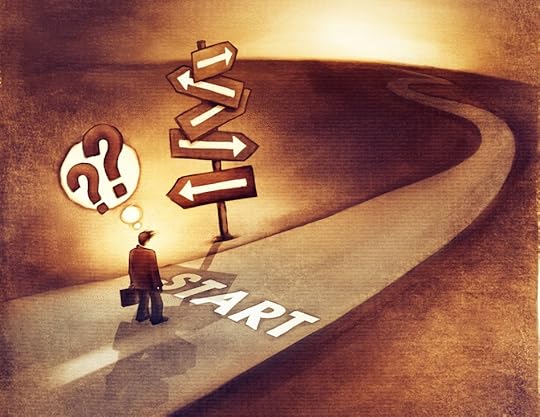 Many people ask for a transition plan to the new Free World, and the honest answer is that WE don't have one, nor should we. There are a few good reasons for this.
1. A transition plan is pure speculation and frankly a waste of time. No-one has any idea how and when the old system will collapse for a start, so we don't even know where to begin. Such conjecture is pointless guesswork. There are too many variables.
2. A transition plan (however pointless or inaccurate) would still require an immense amount of energy and effort - effort which will be far better put to use in spreading awareness of the basic idea. You have to remember 99.999% of the planet still cannot even conceive of these ideas.
3. A transition plan, or indeed a blueprint for a future society will immediately become an object of division and distraction. We will destroy the idea before we start by arguing over the colour of buildings or some such minutiae.
4. We don't even need a transition plan, because as support grows and grows, people will naturally find the transition path themselves. ie. They will find a way to make it happen. If you imagine 10,000 supporters of the idea, everyone wants to figure out how it's going to happen. If you imagine 100 million people, they are not looking for a plan, they are already making it happen.
The transition is already happening. Share groups and free food groups are popping up everywhere. These are the first signs of new thinking. There is no need to look for a transition plan - we are already IN transition.
August 9, 2014
Dear invisible friends
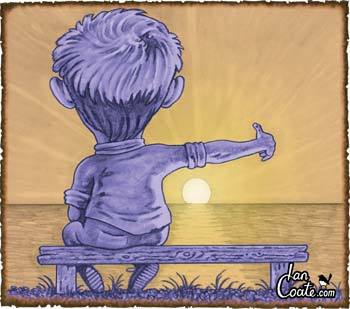 I'm breaking up with my invisible friends. Of course, it's always right and proper to do these things face-to-face, but unfortunately it's not possible in this case as they are all, well, invisible. Anyway here goes...
Dear God,
Sorry, but I'm breaking up with you. They told me all about you when I was young and you sounded like a really decent guy - and really smart too. All those amazing things you did? Wow! But when I grew older I couldn't see you anywhere. I couldn't find any evidence of you or your intervention anywhere. People I know who did everything you wanted had terrible lives, or even suffered cruel, untimely deaths.
The world you created was teeming with problems, yet all you wanted people to do was to adore and praise you. WTF? You could have sorted all this stuff out in seconds, but you didn't bother. So I reckon either you don't exist at all, or maybe you've just moved on to your next project and aren't interested in us any more. Either way, it's over for us, because I've found something much better.
Dear Country,
I was born here in this country and everyone I know makes out like it's the best place ever. They wave around coloured pieces of cloth, sing songs about it and say that the country beside us is no good, but I was there once and it looks just the same to me. In fact, I travelled around the world quite a bit and saw that everywhere is much the same. It's all just land with people who all pretty much want the same thing - to live happily and in peace.
Sometimes our country's leaders decide to go to war with another country and loads of their people and our people get killed and injured. Why? Because they wave a different colour cloth and sing different songs? Sorry, but that's fucking bullshit. What century are we living in? These leaders are picking fights in our country's name without even asking us, then sending some of us off to kill or be killed? I don't like that, so let's just drop the whole country thing, shall we - then they won't be able to do this to us any more. My country is just a piece of land, divided from some other piece of land by an imaginary line drawn by some dead guy. Sorry, this makes no sense to me any more, so no, it's over. I choose to be a free citizen of the world, thank you.
Dear Money,
I loved you all my life, yet you were always trying to get away from me. Was I too possessive? LOL. You were my light. The spark that drove me on to try and succeed. Then one day I noticed that you only seemed to have any value when people believed in you. The less people believed, the less you were worth. That's crazy. I thought. If money was real, its value would never change, right?
Then I heard about all the big problems in the world 'cos some people don't have enough money, or some have too much and it makes them all go a bit mad. They do crazy things like destroy forests and rivers to make more money, or they attack and hurt other people to steal it from them. But it's all just for a bunch of numbers written on a computer?? You know, like 4,235,987,520,987,859,876,530,948,755,349,875. People tell me that we all have to work and sacrifice our time to make these numbers. Why? People help each other all the time without exchanging numbers, so that's bullshit.
These numbers only mean something when we all believe in them. If we stop believing, they vanish. That means it's not real. Sorry, but I don't want to spend my life running after something that's not real. That's a total waste of my life. Anyway I found something much better...
Dear World,
You rock! Hey in fact, you are a rock! And that's what I love about you: you are REAL. You are big and blue and beautiful. Your animals are fantastic, the oceans are incredible, and your air so fresh and exhilarating. Your people are wonderful, peaceful beings with immense creativity, warmth, love and laughter. I love this place. I love it because it's real. It's solid, strong and full of amazing things.
When I was younger, we had some childish ideas about things that people told us mattered a lot - that our time in the world was just a test for another better world - but I never saw it and, to be honest, I don't want to. I love it here, now.
They told us we had to live in between certain lines and act differently within those lines, but I never saw any lines, nor could see any real difference between people on either side. All I could see were good people, land, sea and open skies.
They told us we had to use a numbering system and that everything had to have a value, including our time. That's so limiting I thought. Look at all the amazing things we could do if we didn't have to put a value on it? We've got all these incredible brains, only to be limited by a crude scale of scarce numbers? Haha, no thanks, I think we can do a hell of a lot better than that.
I loved my imaginary friends, for a while. But, well, it's time to move on now and get real. Goodnight. :)
[ Click here if you're ready to get real too! ]
August 8, 2014
The Living Tree - A Childrens' Charter
"The Living Tree" is a colour poster adaptation of the Free World Charter for young children. It is an illustration (70 x 50cm) that captures the essence of the Charter and presents the core ideas in a simple, attractive and stimulating way. Click on the image here to download it (3.7MB). Artwork by Lukarte. Text adapted from The Free World Charter.

July 30, 2014
FWC July 2014 digest: Latest blog and site news
Hello there, just getting in before July closes for business! :) I committed myself to starting a monthly e-news digest and blog, but got waylaid by a separate music project that sucked up pretty much all my time and energy for the last two months, but here we are - just at the eleventh hour..
First, I wrote a new blog called 'Seven Tips For Promoting 'Crazy' Solutions In A 'Sane' World. I wrote this in response to hearing peoples' (and knowing my own) difficulties in presenting free world ideas to loved ones. These tips might help some people frame their conversations better when discussing these 'crazy' things. We all know it ain't easy sometimes. :) You can read it here.
Second, we added some more social functionality to the FWC website, where each signatory entry actually now has its own 'page'. The purpose of this is so you can share your own signature and comments directly on Facebook or Twitter, and also create your own discussion through Facebook commenting. You can find your own signature page here. Please like, share or comment on your own signature to help spread the word.
Third, as some of you know, we have been talking about Iceland as having the potential to become a successful pioneering moneyless country. It's highly energy self-sufficient, reasonably high-tech and industrialised, and it has a low population with strong community values. We set up a Facebook group to garner support for the idea and we're not doing bad. We got over 5000 people in just a few weeks! If you can, and you agree with the idea, please put your name on their as well. If we got enough names on there, people will start to notice.. I'm trying to get some exposure on Iceland media at the moment, and the more people we have on the page, the better. It's at:
https://www.facebook.com/icelandfree
If you're a Tweeter, we are at:
@icelandfree and you can use the hashtags: #icelandfree and #icelandrbe
Finally - as I want to try and keep these mails brief – if you haven't joined the Freeworlder network yet, you really ought to check it out. It's getting very busy on the forum with lots of people coming in with new ideas and thoughts, and just recently we added a live chat facility and chatrooms so we can all interact in real time! Please sign up and join in. We need your voice and ideas in there. Lots of great people here already!
http://freeworlder.org/community
That's it for July. I hope you're having a great July wherever you are. We live in truly remarkable times and it's a great time to be alive.
Ciao,
Colin Turner
freeworldcharter.org


