
Colin R. Turner's Blog, page 2
November 5, 2016
Universal Basic Serfdom
I’m kind of amazed that I feel I have to write this, when surrounded by so many people already in agreement with a moneyless world, yet who, for some reason, seem to think that a Universal Basic Income will somehow get us there. Personally, I can’t think of anything that would bring us further from a moneyless world – to the point where I am even having ‘conspiratorial’ suspicions as to the origins and impetus of this idea.
So, what’s the idea of Universal Basic Income? Simple, the Government pays everyone a minimum ‘salary’ just for being alive, so no-one has to suffer poverty. Seems like a good idea on the face of it, yet I seem to be one of a small few who can see a huge potential danger here. And it’s not just supported by freeworlders. UBI has become the hot topic of all ‘left’ radical conversation, and it doesn’t look like it’s going away soon. So, what’s my beef with it?
Where to begin…
Firstly, if we believe that the future of human society is an Open / Resource Based Economy without money or trade, that means at some stage we have to stop using money, right? Apart from the fact that I’ve yet to hear any credible argument that free money somehow helps you get away from money, a UBI would without question prolong our indentured servitude to this fictional construct.
We can’t make an Open Economy happen unless we ‘visionaries’ have the support of the masses. It needs everyone to jump on board for it to work, in the same way money works: it’s a common agreement. Getting those masses on board will be a hell of a lot easier when they are themselves feeling the pinch of the market system (as they are now). However, if we keep plying them with money’s sugary pacifier to stop their minds ‘wandering’, then that will put paid to those ideas for maybe another hundred years or so. (Time we don’t actually have at current environmental / population trends)
As my good friend Rafi succinctly put it; “how does more money get you to no money?”
Secondly, UBI does precisely nothing to address major global issues outside of poverty. Rampant consumerism, pollution, irresponsible resource extraction, bad education, bad healthcare and personal detachment. For example, do you think UBI would move us further away from using oil? No, precisely the opposite would happen. Industry and travel would undoubtedly increase against a market system fundamentally incompatible with the environment. Consumerism – you know that thing that is currently chomping your planet – would increase dramatically if everyone suddenly had more disposable cash.
Thirdly, UBI would undoubtedly herald the arrival of a new super-elite. As we move away from the labour market system, the world would gradually become divided into ‘money-takers’ and ‘money-givers’. Think Hunger Games here. And please don’t think for a minute that your UBI is going to be financed by some super-tax on the rich. Please. They will just print more of the stuff like they always do.
The social effect will be to create a population even more indentured than now, as they feel ‘thankful’ to the masters that endow them, amid the subconscious threat that those masters can cut off their supply at any time. In such a ‘nannyocracy’, people would be even further disempowered and incentivized to find their own solutions.
Fourthly, if you think inflation won’t take up the slack when everyone starts getting one or two thousand Euros / Dollars a month, you are seriously kidding yourself. I’m not saying that price rises will negate it, but it will come close after not too long. Don’t forget the ‘invisible hand’ of the market – retailers will charge what people are prepared to pay.
It seems the only vague rational defence of UBI is: ‘it will lift some out of poverty’. Well maybe it will, but I don’t think that’s a good enough reason to further postpone the solution that can end poverty forever, while continuing to destroy our shared home, do you?
Finally, let me leave you with the slightly chilling question:
If you were a smart member of a global elite and you foresaw trouble ahead with the collapse of the labour market and the people getting restless, what solution would you devise that could completely defuse that situation yet still maintain your position of privilege?


October 28, 2016
Into The Open Economy [PRESS RELEASE]
“What’s amazing about this book is that it tackles difficult issues which the best minds have struggled with throughout history and exposes in about 100 pages a solution so simple, humane and intuitive that anybody can grasp it.” (Reader review on Amazon)
INTO THE OPEN ECONOMY, the second book published by Irish author and social activist Colin R. Turner in just three months, is a short ninety page analysis of how a moneyless, or open access economy, can work for every human being on the planet.
Especially relevant given the many social and environmental issues we currently face, Colin provides a host of practical ideas of how a moneyless society would operate, and why it would be a whole lot better that what we’re doing now.
The book builds on Colin’s previously published novel F-DAY: THE SECOND DAWN OF MAN (July 2016), a consistently five-star Amazon rated thriller and powerful visualisation of countdown to a moneyless world.
 Colin says: “If you just stop and consider for a moment the question, ‘what if money was optional?’, you will quickly see the myriad of world problems that would be solved overnight if that were the case.
“There would be no more poverty or social inequality for example. There would be no more reckless destruction of the environment in the name of profit. All the associated problems of greed, corruption and crime would become almost nonexistent.
“But even more importantly, we would each be able to live richer, happier and more connected lives, while reaching our fullest individual potential. There’s no doubt that the rewards of a money-free world would be immense, so let’s reconsider the question, is a world without money possible?
“Of course it is!” Colin states. “We can do anything we want to. And it’s not just possible, it’s actually really easy.”
In Into The Open Economy, Colin sets out in clear, simple terms the steps required to reach a money free world, painting a compelling picture of how such a society would operate and answering all the tough questions that naturally arise.
Colin continues, “We currently live in a blame culture and are slow to accept responsibility for our own lives and future – deferring instead to governments and corporations who may not have our best interests in mind. I think it’s time for new ideas now. To put away these tired old medieval power structures and embrace a truly inclusive, equal and enlightened society. Our very survival may now depend on it.”
No longer a futurist utopian dream, according to Colin, a money-free world of true abundance, peace and fulfillment is attainable today. Into the Open Economy reveals in less than a hundred pages why we need it, how it will work, why it will work and how we get there.
Colin R. Turner is a writer and founder of THE FREE WORLD CHARTER which has almost 60,000 member all over the world who have signed up to support ten basic principles for the future of human civilisation.
Into The Open Economy by Colin R. Turner is available exclusively on Amazon on paperback and Kindle, retailing at just €2.99 for the ebook version. Published by Applied Image, August 2016. ISBN 978-0-9560640-4-2
AVAILABLE NOW ON AMAZON – PRICE €2.99: Into The Open Economy: How Everything You Know About The World Is About To Change
Colin R. Turner is a writer, broadcaster and founder of The Free World Charter, an initiative which proposes an alternative society beyond the use of money.
INTO THE OPEN ECONOMY [PRESS RELEASE]
“What’s amazing about this book is that it tackles difficult issues which the best minds have struggled with throughout history and exposes in about 100 pages a solution so simple, humane and intuitive that anybody can grasp it.” (Reader review on Amazon)
INTO THE OPEN ECONOMY, the second book published by Irish author and social activist Colin R. Turner in just three months, is a short ninety page analysis of how a moneyless, or open access economy, can work for every human being on the planet.
Especially relevant given the many social and environmental issues we currently face, Colin provides a host of practical ideas of how a moneyless society would operate, and why it would be a whole lot better that what we’re doing now.
The book builds on Colin’s previously published novel F-DAY: THE SECOND DAWN OF MAN (July 2016), a consistently five-star Amazon rated thriller and powerful visualisation of countdown to a moneyless world.
Colin says: “If you just stop and consider for a moment the question, ‘what if money was optional?’, you will quickly see the myriad of world problems that would be solved overnight if that were the case.
“There would be no more poverty or social inequality for example. There would be no more reckless destruction of the environment in the name of profit. All the associated problems of greed, corruption and crime would become almost nonexistent.
“But even more importantly, we would each be able to live richer, happier and more connected lives, while reaching our fullest individual potential. There’s no doubt that the rewards of a money-free world would be immense, so let’s reconsider the question, is a world without money possible?
“Of course it is!” Colin states. “We can do anything we want to. And it’s not just possible, it’s actually really easy.”
In Into The Open Economy, Colin sets out in clear, simple terms the steps required to reach a money free world, painting a compelling picture of how such a society would operate and answering all the tough questions that naturally arise.
Colin continues, “We currently live in a blame culture and are slow to accept responsibility for our own lives and future – deferring instead to governments and corporations who may not have our best interests in mind. I think it’s time for new ideas now. To put away these tired old medieval power structures and embrace a truly inclusive, equal and enlightened society. Our very survival may now depend on it.”
No longer a futurist utopian dream, according to Colin, a money-free world of true abundance, peace and fulfillment is attainable today. Into the Open Economy reveals in less than a hundred pages why we need it, how it will work, why it will work and how we get there.
Colin R. Turner is a writer and founder of THE FREE WORLD CHARTER which has almost 60,000 member all over the world who have signed up to support ten basic principles for the future of human civilisation.
Into The Open Economy by Colin R. Turner is available exclusively on Amazon on paperback and Kindle, retailing at just 99c for the ebook version. Published by Applied Image, August 2016. ISBN 978-0-9560640-4-2
AVAILABLE NOW ON AMAZON – PRICE 99cInto The Open Economy: How Everything You Know About The World Is About To Change
October 26, 2016
The Many Paths to Transition
“What’s your transition plan?” has got to be the most common question that gets asked in the post-scarcity activist groups I’m in, with the implied suspicion that similar to Boris and Nigel’s Brexit plan, it simply doesn’t exist. Of course there are glaring differences between Brexit and giving up money (Mexit?), the most obvious being that there’s no referendum scheduled on it in the near future. Nevertheless, the transition plan, or more accurately, several potential transition plans to a post-scarcity society have already been set in motion. It’s just sometimes hard to see them as such, since it’s impossible to lay out these plans in full, owing to too many unpredictable variables. The plans are mostly guesswork, taking the first small steps through the darkness.
People in post-scarcity movements tend to fall broadly in two categories: a) those who believe it will happen through gradual changes b) those who believe something major will change rapidly once critical mass is reached. You can further divide into two more groups: a) working for change within the existing system (RBE-minded political parties and lobby groups) b) building a new society alongside the old one to make it obsolete (Buckminster “Bucky” Fuller, The Venus Project, eco-communities). Most of the time, these different groups go along doing their thing, but sometimes they clash in heated arguments, even blaming the other groups of either not doing enough or hindering progress. Maybe it’s time to look deeper into the logic behind each viewpoint to understand each other’s train of thought a bit better.
The Gradualists
The main idea here is that society has a lot of inertia and people change slowly, sometimes requiring several generations. For example being gay was considered wrong through most of society for a long time. Only recently did it become accepted and appreciated in progressive countries. Yet the work here is not complete: in many nations it’s still dangerous to be gay, and even where it’s not, there’s often more subtle discrimination happening. But the overall mindset is moving in the right direction, and hopefully one day this will be a non-issue everywhere.
Likewise, people have hopes high for gradual adoption of renewable energies and advances in electric motors and batteries.
The problem many people see here is that we don’t have much time to solve environmental issues. There’s the danger of resting on the laurels after small victories. Also, some changes are difficult to make if you’re the only one doing so – you often need large groups to agree to do the right thing together.
The Paradigm Shifters
This is what many groups are aiming for by running education campaigns to show that we’ve already got all the resources we need to provide a good standard of living for every person on this planet. The hope is that once enough people know this, and get the dialogue started on how to change it, we’ll reach a tipping point and can start working together to sort out this mess.
Cons: until the critical mass is reached, nothing changes in the physical world. So in a way, both gradual change and paradigm shift require time. The difference lies in these questions: if things improve by a little bit, do people stop their activism? Do some people even care at all until things get really bad? Will people be able to continue activism if things get really bad and they’re more worried about basic survival? Will people be able to cope with a sudden revolutionary change? Which route is quicker and which route has fewer casualties? I don’t think anyone can prove it either way, so we may see these two mindsets continue to clash. All I can suggest is for the gradualists to keep pushing for little improvements and for the paradigm shifters to keep sharing the big picture truth one person at a time, while appreciating the work the other camp is doing. Often by helping one cause, you’re helping the other anyway.
The Politicians
A topic of much contention these days is whether to engage with the existing political structure or ignore it. Money, connections, PR and control of mass media affect and corrupt all elections so much so why even bother? Many groups argue that it’s worth trying anyway – to get the message out there, to push for gradual changes, to offer a protest vote (and gauge the public’s interest in alternative models), and possibly once the critical mass is reached, to offer a peaceful way to transition within the existing structures. One factor that speaks in favour of engaging with politics is that many ideas that were previously not talked about have now become more mainstream, such as the fact that private banks create money as debt. While Bernie Sanders didn’t become the Democratic Party candidate, he got a lot of airtime and support.
Of course, candidates straying too far from status quo threaten the establishment and thus get subjected to a whole host of character assassinating smear campaigns. Politics is nasty and it’s understandable that many in the activist circles want nothing to do with it.
The Buckyists
Whether within or without cities, alternative systems of resource access have been popping up. From community energy, food shares and Freecycle to off-the-grid communities, people have taken matters to their own hands to provide for themselves and their community and starve the beast just that little bit. Third Industrial Revolution enthusiasts believe that the advance and cheapening of technology will make producer-consumers of everyone and capitalism will slowly fade away.
Critics here will point out that land and other means of production are still expensive, especially in cities, and though people in well-off countries can pool money and acquire their own, it’ll still be inaccessible for many many. Until a shift in either money creation and distribution, or reforms in ownership occur, this will not be an option to everyone. Not to mention that rural communities are lacking some of the comforts city life provides, so it’s not always ideal.
Clashes do occur on this spectrum as well, but there really isn’t much reason for it. Buckyists can ignore politics and go on with their business. Reformists can ignore Buckyists because they’re a small minority and focus on the low hanging fruit who still have faith in politics, just not the mainstream candidates.
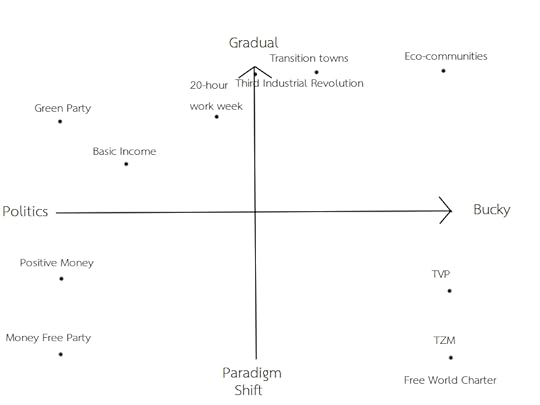
Ultimately, it’s unlikely that any of these avenues will be the One True Transition Plan. Each one has its shortcomings which often can be mitigated by work someone else is doing. So here’s a callout to celebrate each other’s efforts rather than trying to convince someone to switch to your team. Feel free to tell them what you’ve been doing. Feel free to ask them how they plan to overcome obstacle X in their plan. But let’s keep the debate civil, even if you’re dead certain their path leads to a dead end (maybe they know it already but haven’t come across a better plan). Ask, listen, share, but don’t belittle, patronise or boast. As long as we all have the end goal of post-scarcity in mind, every step is a step forward. A step towards greater understanding, better infrastructure and more clarity on what’s the best direction to go next, to finally reach the world we all desire.
October 24, 2016
Recruiting for the New Paradigm
Next year, FWC will be launching its brand new network site, The Free World Network. But it’s won’t just be a network, it will be a transaction point for people to begin sharing goods and services freely among other members. Think of it like an Ebay for Freeworlders, but that’s not all.
The new network site will also be a map-based skills and interest-matching database, so you can find and hook up with other Freeworlders in your area. This opens it up to enabling real world collaboration, creating local meet ups and activism groups – even for dating!
Needless to say, we are pretty excited about this, and we need your help. We are looking for people who have the time, skills and enthusiasm to help us build and promote this. We are looking for designers, coders, copywriters and people with publicity skills to help us build and promote this.
Would you like to join our new Network Team? If so, please drop an email to colin@freeworldcharter.org detailing your particular skills and location and let’s discuss?
October 19, 2016
Colin Turner – TV Interview with RTV Marbella [VIDEO]
Talking about F-Day: The Second Dawn Of Man with Nicole King of RTV Marbella, Spain. Recorded in August 2016
October 12, 2016
Open Economy vs. Resource-Based Economy
A few people have been asking about the difference between an Open Economy and a Resource-Based Economy, so I thought I’d make a post about it.
In a broad sense, the two concepts are the same – a more abundant, peaceful and sustainable world beyond money and borders. The difference is in the fundamental approach of arriving to this destination.
The Venus Project is the most prominent advocate of RBE, and that term is, to most peoples’ minds, synonymous with that organisation. They describe a resource-based economy as a system where:
…all goods and services are available to all people without the need for means of exchange such as money, credits, barter or any other means. For this to be achieved all resources must be declared as the common heritage of all Earth’s inhabitants. Equipped with the latest scientific and technological marvels mankind could reach extremely high productivity levels and create abundance of resources.
The term Open Economy as described in the book Into The Open Economy is defined thus:
An Open Economy is the application of an open, distributed model to the traditionally closed-loop economic system. In other words, rather than every individual seeking only to benefit themselves, a common understanding exists that enables everyone to benefit everyone, including themselves.
The notable difference is that a resource-based economy seeks to arrive at its destination mainly through the application of science and technology, whereas an open economy is primarily concerned with the cooperation of people by creating a common understanding of the benefits to the individual in acting for the best interests of all. An understanding that, once established, makes all manner of technological marvels possible.
The fact that an abundant and peaceful society can come about through the application of technology is, in fact, a theoretical certainty once we reach a level where scarcity is entirely eliminated. However, that may be quite some years away yet, and almost certainly will not come without major social conflicts or war in the intervening years as old and new ideologies collide. Also, we may have to tackle some serious and even irreversible climate crises along the way.
So, while an RBE is a theoretical certainty if we just wait, it may come too late, or at great cost. An Open Economy, on the other hand, is something that begins today. It begins with simple acts of unconditional sharing, collaboration and spreading of knowledge. It begins with each of us re-prioritising our lives, bringing our community and nature closer to our central purpose. These acts, multiplied in their billions will create – and already are creating – the new patterns of thinking that will ultimately create a better world for all of us.
The peaceful, abundant world of the future will be made possible – not by technology – but by the combined acts of people working to create it.
September 1, 2016
Freeworlder.org is Closed
The Freeworlder.org network, blog and forum site was closed on August 31st 2016. All the Freeworlder blogs have been moved here to our new site Freeworlder.com – a dedicated blogging and informational site. Browse our articles here.
We will be launching a brand new network for Free World Charter members in 2017.

Colin R. Turner is a writer, broadcaster and founder of The Free World Charter, an initiative which proposes an alternative society beyond the use of money.
August 30, 2016
Follow Your Heart
Elizabeth from England who now lives in the Spanish countryside builds a dreamy, bohemian home all by herself, having had no previous experience in building or architecture. They say that when you make a decision to follow your dream, your calling, your true path, the universe conspires to make it happen. After being given an old van base by a stranger, Elizabeth knew it was time to begin building her dream.
 The wooden, sustainable house on wheels is off grid and is equipped with everything she needs to live a beautiful life. This free spirit’s 5m by 2.20m tiny home includes a full size shower and composting toilet, a rustic kitchen with a gas oven and hob, a double bedroom situated on a mezzanine level and a sofa with storage that pulls out into a day bed on the ground floor. The exterior includes a yoga terrace, overlooking the mountains, that runs the entire length of the side of the house. The terrace folds up on hinges for transportation or can be hooked off completely. There is a small front terrace with steps up to the stable door and a covered and shaded back terrace for alfresco dining.
“To learn how to build a movable house from nothing, with a very small budget and no previous experience was so much harder than I thought both mentally and physically,” Elizabeth states. There were so many times when she wanted to give up! She says she battled difficulties, opposition, discouragement, loneliness and pure fatigue but is so happy she made it! For the first time in her life she owns her very own home. She never thought she would be able to say that at 33 years old. The house is kind to the environment, low cost to run and created mostly from second hand, recycled, found or made objects and is more beautiful than she could have dared to imagine.
 Elizabeth says, “I want to encourage you whatever you are facing, however hard it seems, however crazy people think you are…you are stronger, braver and more courageous than you realise and if you have hope, you can achieve whatever you set your mind to. It is okay to follow your heart and not the way of the world. Life is short, don’t be afraid to be you.”
Elizabeth documented her journey from day 1 with a photo diary which is published on Instagram daily. Follow the story: @edenwhispers
August 18, 2016
The 3 Obstacles to Reason – A PR Guide for Activists
 The biggest conundrum facing many Free World advocates, and indeed any activists, is how to convince people of the necessity of the changes we’d like to see. Too often we’re faced with people clutching on to the old paradigm, giving reasons such as “it’s the best we have” or “your idea will never work”. While we may have an arsenal of science and logical points to launch a counter, this often seems to fall on deaf ears. Seems like there’s something more in play beyond plain reasoning, doesn’t it?
That’s right, it’s not only about good arguments. In fact, it’s basically got nothing to do with good arguments and all to do with psychology. Human psychology is a funny thing that often gets in the way of reason. Grab a copy of Dan Ariely’s witty Predictably Irrational and you’ll soon see why. Our prehistorically evolved mental toolbox leaves us stuck with ways of thinking that can’t grasp the amount of data we have and the general vastness of a global interconnected world woven through with mass media, social media, computers and clever but greedy people taking advantage of all of that. We need to learn how those in control have done so, to undo it.
There’re three main aspects of how people are influenced to make certain decisions in life. The first of these is identity.
1. Identity
 We like to belong, and thus we like to identify with something. And this identity is then hard to shake. Try telling a car lover to switch to public transport and you might as well be trying to coax a fish to come live on the land! A person’s identity can be formed of many things, they could be interested in sport, they could have strong family values, perhaps have strong roots in their local community. Often they’ve been fed an identity by the mass media which makes it “cool” to be something. You need to understand this identity and realise you can’t dismantle it overnight. Sometimes you don’t even have to. You can advocate your ideas in an angle that is compatible with, and supports their values. Then you don’t have to convince them of anything. You’re only building on what’s already there.
If you want to be sneaky, there’s a little trick you can use called foot-in-the-door. This means you start out with small requests which are easy to do, but get the other person to make your idea a part of their identity. Later you can make larger requests and they might just be happy to help now!
2. Other People
The second main influence is other people. Again, people’s desire to belong to the herd overrides reason a lot of the time. In an experiment comparing four types of leaflet, even appealing to people’s money-saving self-interest wasn’t as effective as appealing to the herd mentality – people were most likely to conserve energy when they were told other people are doing it. This is of course difficult if you’re supporting a minority viewpoint, so take care to avoid painting it as such. Try instead to look for statistics showing support for your cause is on the rise, or target areas where it’s more widespread. Go for the low-hanging fruit, so to say. And also lead by example. Preach by example – but without being preachy – or you might come to odds with someone’s identity!
3. Emotions
Finally, we’re also easily influenced by emotions. Despite building a hefty layer of neocortex on our brains through evolution, we still possess the more primordial “lizard brain”. We like happy things, we don’t like sad things. Ugg. Environmentalists have long suspected that the doom ‘n’ gloom stories have not been working very well, and we’re also quite aware of how seeing extreme poverty is unpleasant and makes us want to turn off the telly. The good news is that the world we’re advocating *is* a hell of a lot happier than what we have now. And aspects of that world are already present in today’s world. You see amazing acts done by volunteers to help people in need, you see people taking initiative to improve their worlds, plant trees, green the deserts.
Stop following mainstream news and look for the positive stories. Give people a flavour of what the whole world could be like, if already within our current system you can see such pockets of awesomeness. Get them to visualise that ideal and never let it go. Maybe they’ll also make it part of their identity, and surround themselves with people who feel the same way. Now that would be a cocktail of motivation one couldn’t ignore!
What is one small thing you could change in your approach today? Let us know in the comments!
Further reading/watching:
“Change of Heart” by Nick Cooney – pretty much an activist’s Bible
“Predictably Irrational” – as mentioned, it’s a nice introduction into just how unbelievably irrational we are!
Mel’s ZDay talk on the topic
Lecture by the author of “Change of Heart”


