Ellis Shuman's Blog, page 14
October 14, 2022
And Then My Sukkah Collapsed
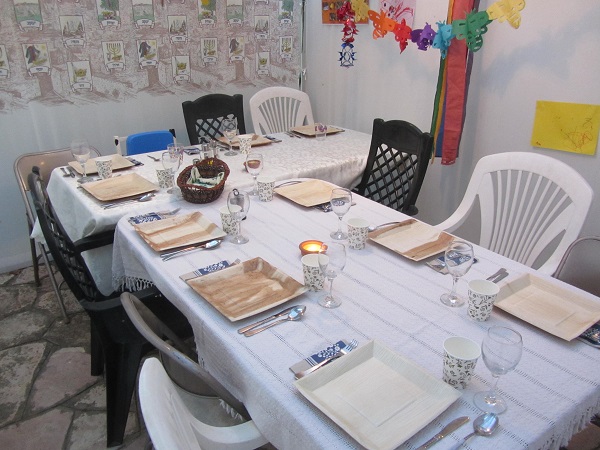
I was full of enthusiasm and good intentions as I unpacked the pieces of the pre-fab sukkah I had purchased especially for the holiday. It should be a simple matter of fitting together the metallic poles and the do-it-yourself sukkah would be standing.
A sukkah is a temporary dwelling in which Jews "dwell" - or at least eat their meals - during the week-long festival of Sukkot. The temporary status is reminiscent of the years of wandering that the Children of Israel endured on their way to the Promised Land.
Two hours after beginning to build our sukkah, the sukkah collapsed. Poles, and connecting pieces, plastic and metal, all lying on my patio at my feet.
That was on the eve of the holiday of Sukkot, twenty years ago. What I wrote at the time makes me laugh today but back then, I nearly cried with frustration. Here is what I wrote in 1999, many holidays ago.
Not prepared for the holiday rush
I saw an advertisement for pre-fab sukkot at a reasonable price. The company had a Jerusalem location, so I went there one morning before the holiday. It appeared that many others had the same sukkah-buying plans and I had to park a distance from the shop.
The company was not prepared for the holiday rush. There were more customers than salesmen, and the employed workers were quite inexperienced. Chalk it up to the fact that sukkot are only sold once a year, in the period before the holiday. Even so, the staff should have been trained for their job.
When I finally cornered a young salesman, I told him that I was looking for a 2-meter by 3-meter sukkah. My main concern, I said, was to make sure the 3-meter poles would fit in my car. "No problem," the salesman assured me. But he gave no clues how I would transport the poles.
I asked if the company made deliveries. "We'll come Saturday night, but very late," I was told What time was late? I asked. "We'll call you after midnight and let you know what time." I preferred to skip the all-night vigil and decided to try my luck elsewhere.
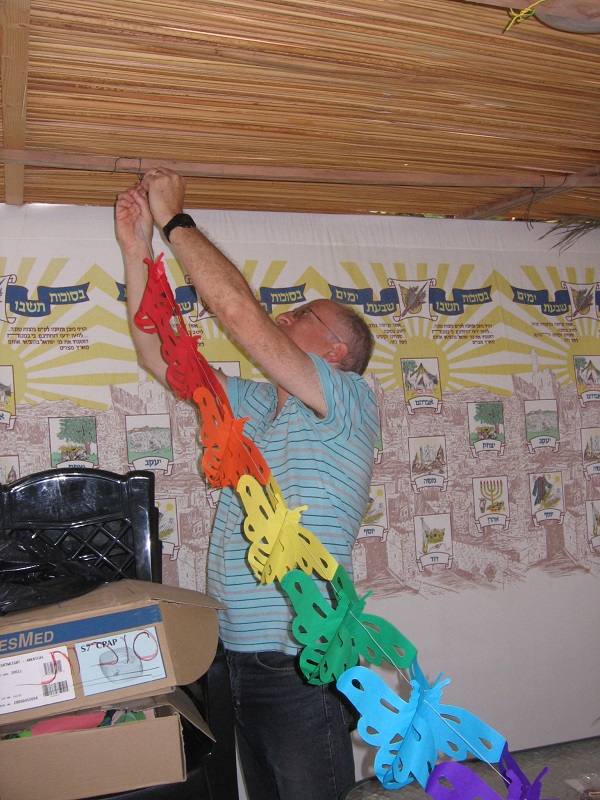
Anyone can do it
I saw an advertisement, for a competitor in the pre-fab sukkah business. This company claimed that its sukkah poles were no longer than 1 meter in length and were conveniently packed in carrying cases.
I approached a sales agent who turned out to be someone who ran an auto supply shop. He had never previously dealt with pre-fab sukkot. Even so, he assured me that the sukkah's construction was very simple and anyone could do it. The poles were attractively packaged in heavy-duty carry bags, which would have done a golf caddy proud. I paid for the sukkah. It easily fit it into the trunk of my car.
At home, connecting the black plastic pieces was not as easy as it sounded. There were four bags of different-shaped plastic, pieces quite similar to Lego. I looked for instructions, but there were none. Then I remembered the salesman's words. "It is very simple. Anyone can do it."
Logic dictated that a sukkah should be built from its corners. I took my hammer and began forcing the poles into connecting, angular pieces. Amazingly, the poles fit into place. The construction began to take shape, one frame of plastic after another. I enlisted my family to help, holding up one side as I worked on the other. This should do it, I thought, but the end results appeared lopsided and illogical. I told everyone to let go, and that is when the flimsy construction collapsed.
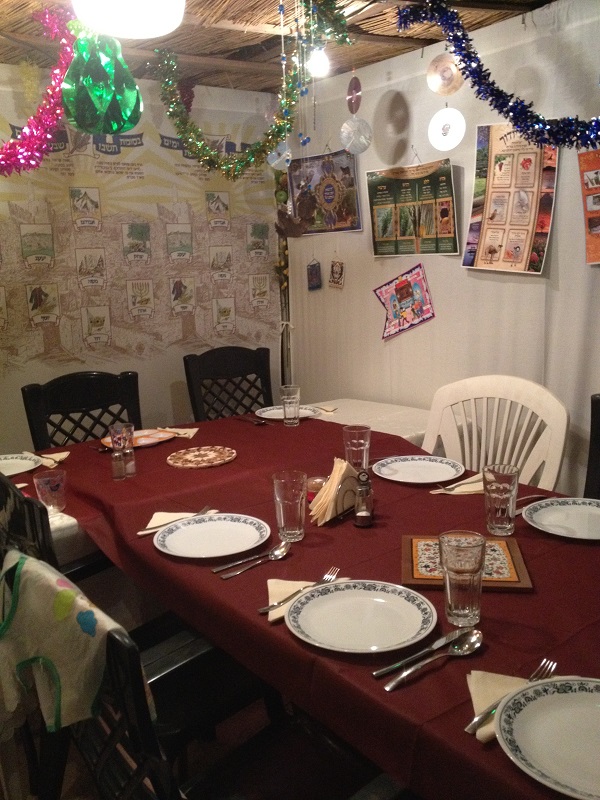
I want my money back!
"Didn't you follow the instructions?" the auto supply salesman asked me the next day. "What instructions?" I shouted. “I demand a refund!” There was only one problem. My sukkah had been taken out of its packaging and there was no money back guarantee.
The salesman gave me two pages of instructions. ‘Put pole A into black piece B’. If I couldn’t do it myself, the salesman promised me that he would personally come to my house and build the sukkah.
I decided to give the construction one more chance. This time I had instructions. I dutifully followed them, step by step. Within a short time, and without the help of my family, I had a formidable construction standing, one that would surely withstand the week-long holiday without collapsing on the dwellers within.
Of course, a sukkah is more than just the poles which form its sides. There are the sheets which serve as the walls and the schach which makes up the sukkah's roof. These are minor matters, compared to the struggles of getting the sukkah to stand in the first place.
Sukkot is a joyous holiday, one when families get together for festive meals in the luxury of flimsy constructions that stand for a week on patios, balconies and in backyards. After the frustrations and sweat that went into the building of my family's sukkah, I anxiously looked forward to sitting back and enjoying the fruits of my labor.

Originally published September 26, 1999 on About.com
Related article:
I Built My Sukkah Upside Down!


October 9, 2022
I Built My Sukkah Upside Down!
 When you purchase a sukkah in Israel it's supposed to be a lifetime investment. The so-called sukkah l'netzach is easily constructed and then stored away after the holiday for future use. How is it, then, that I've gone through four or five of the contraptions over the years?
The first "ever-lasting" sukkah I bought was nothing more than a set of irrigation pipes. The end of each pipe had to be screwed onto the next pipe's connecting threads with the help of a monkey wrench. This sukkah swayed dangerously in the slightest breeze. After one or two holidays, the end of the pipes broke off, effectively shortening its shelf life.
The second sukkah I purchased, also designed for eternal use, was a marketer's mad concept of an Erector Set. It constituted two golf bags filled with a multitude of bars, angles, connecting joints and support pieces. There were diagrams included but construction was worse than finishing a 2,000-piece jigsaw puzzle. The sukkah stood in place at last, and then it collapsed.
Of course, sukkot are more than just the corner poles and support beams. If you do manage to get the skeleton structure upright and standing, there is also the matter of the walls. Tradition calls for the use of shipment container wood, the real reason anyone makes aliyah or sends a lift of goods to Israel. This usage traces back to the containers carried on the backs of the Israelites' camels during their exodus from Egypt. Lacking this wood, sheets can be tied to the poles and then reused as bedding covers after the holiday.
It is important to remember that a sukkah is a temporary hut or booth only for use during the holiday itself. Therefore, pouring a concrete roof is unsuitable. Instead, software developers invented schach l'netzach, the beach thatch that is imported specially from the bungalows of Sinai. Over the years, the schach tears in enough places to allow for ample starlight to filter through to the guests inside the sukkah as they merrily shake palm fronds left and right.
With the sukkah fully assembled and the schachamply sheltering everyone from the seasonal rains that fall every year during the holiday, it's time to decorate. In the United States this is a simple task. There you just stock up on Christmas decorations in December and use them in your sukkah the following autumn. Luckily in Israel there is no shortage of frilly, metallic-colored streamers and crepe paper pomegranates available and people flock to the Sukkot fairs to purchase them along with the funny-shaped etrog that also plays a part in holiday traditions.
 Back to me. This year's construction of our latest sukkah l'netzach took the usual amount of blood, sweat and frustration. Soon our sukkahwas standing proudly on our back patio, covered with a new carpet of bamboo schach. It's time to decorate. But wait! Going into the house I feel that something is inherently wrong with my booth.
The sukkah is upside down! No, I don't mean that the schachis actually at my feet with the sky totally exposed. I have mistakenly placed our sukkah poles upside down. As a result, there is a ledge of two inches that one must step over to come inside. How could this have happened? Admittedly, there was no diagram or construction manual for this most recently acquired sukkah model but I assumed it could be assembled by instinct alone.
Okay, we'll watch where we walk when we enter our sukkahfor tonight's festive meal. Upside down or not, we're ready to celebrate.
Originally published on The Times of Israel in September 2012.
September 25, 2022
Return to Lifta

A hike through the abandoned Palestinian village showed me not much has changed since I graduated from high school there nearly 50 years ago.
The Jerusalem Experimental HighSchool had its first permanent facility in a renovated abandoned house in Lifta on the outskirts of Jerusalem and I studied there for two years in the 1970s. The school later relocated to the center of Jerusalem, but my memories of walking along a scenic path through Lifta on my way to classes are still crystal clear.
 My high school was in this buildingJust last month, the Jerusalem Municipality and the Israel Lands Authority agreed to shelve and “rethink”plans to turn Lifta into a boutique neighborhood for the rich, complete with luxury housing, a hotel, and an upscale commercial and business center. Recently, however, the Lifta Boutique Hotel opened its doors with 6 luxuriously furnished suites, an infinity pool, jacuzzi, and sauna, overlooking the valley.
 According to media reports, Jerusalem Mayor Moshe Lion wants to preserve the village and turn it into a World Heritage Site. It is not clear to me, what that would mean.

Driving into Jerusalem, the abandoned buildings of Lifta are quite an eyesore. They stand in sharp contrast to the recently constructed railway bridge that towers over the valley. The houses are a remnant of a vibrant Palestinian Arab community that was forcibly evacuated in 1948, before the establishment of the State of Israel.
A misleading statement issued by the Jerusalem Municipality states that the "village dates back to the days of the Second Temple and continued to exist in various ways until the War of Independence."
Following the war, Israel settled hundreds of immigrants from Yemen and Kurdistan in Lifta, but because of the poor conditions, including lack of electricity and other infrastructure, they were asked to leave and compensated, and holes were drilled in the roofs of their homes to discourage squatters.

One of the buildings was used in 1984 as the base of the so-called "Lifta Gang", a Jewish terrorist group that plotted to blow up the mosques on the Temple Mount. Gang members were stopped at the last minute with 250 pounds of explosives, hand grenades, and other weapons.
The school where I studied became a drug abuse rehabilitation center for adolescents, but this shut down in 2014.
 Inside one of the abandoned buildings in Lifta
Today, the village is part of the Mei Neftoach nature reserve, and efforts are being made to improve access to the spring at its center. The village attracts ultra-Orthodox youths from the nearby Romema neighborhood, wayward youths seeking solitude, and Jerusalem's Arab residents looking for ways to reconnect with their national heritage.
 Mei Neftoach springWhat should be done in Lifta? Should it serve as a neighborhood for the rich? Should the former Palestinian owners be compensated, or allowed to return? Should the abandoned buildings be left as is, for future generations to decide their fate?
 In the meantime, Lifta is a unique and colorful hiking destination in Jerusalem. Walking along its pathways and peering into its collapsed homes is a step into the past, an exploration that raises questions about the village's future.
September 9, 2022
A Short Story Writer's Favorite Words

What a great way to start the weekend, or any day for that matter. An email pops up in my Inbox with a short sentence that brings a smile to my face:
"Thank you for this story, which we are delighted to accept."
This mail comes just three weeks after I received a similar mail:
"We'd love to run this story. Thank you for submitting it."
Two stories accepted in three weeks' time! Reading these mails, I feel a sense of accomplishment. They're a sign that all my efforts have been worthwhile. I have been writing short stories these past four years and my creative efforts have been appreciated.
You would think that becoming a successful short story writer is something easy to achieve. Well, it's not.
This mail arrived just two days ago:
"Thank you for your recent submission. Regrettably, we are unable to find a place for it in our next issue, and we're going to have to pass at this time."
And this one last week:
"Thank you for sending us your story. We appreciate the chance to read it. Unfortunately, the piece is not for us."
And another:
"... Unfortunately, this piece isn't the right fit for us."
And another:
"We appreciated the chance to read it. Although there was a lot to like here, it didn't quite come together for us in the end, and we regret to pass."
Rejection after rejection, all of them impersonal form rejections, outnumbering accepted pieces by a wide margin.
My statistics for 2022 so far: 126 submissions, 8 acceptances. That is actually a very high success rate, and I'm quite proud of myself.
(Note: Nearly all of these were simultaneous submissions. I did not write 126 short stories.)
Five of my stories have already been published this year, and three more will be published soon.
In the meantime, I'll keep writing and submitting, and hoping for the next email that says, "We'd love to run this story."
Photo by Kaitlyn Baker on Unsplash
August 29, 2022
Book Review: "Time Shelter" by Georgi Gospodinov

The protagonist of the novel Time Shelter by Georgi Gospodinov, translated by Angela Rodel (Liveright May, 2022), call him Ishmael if you will, reads a newspaper article describing a geriatrics doctor who “decked out his office in the style of the ’60s,” complete with a gramophone and a poster of the famous Sgt. Pepper's Lonely Hearts Club Band album cover. The doctor noted, the article said, that when visiting his office, patients with memory issues "became more talkative, in other words, they felt at home."
“That was my idea,” claims the protagonist, a writer of fiction. “I’ve had it in my head for years, but clearly somebody beat me to it.” He envisions a story in which he meets a fictional geriatrics doctor named Gaustine, creating with him a “clinic for the past” for patients suffering from memory loss. Rooms are prepared with scents and settings from different decades providing relief for the varied memory ailments from which the patients suffered.
The author takes this concept to a larger scale. As detailed in the next part of the novel, memories of better times lead European citizens across the continent to hold referendums in which they vote to which past they should return in order to solve their nation’s particular woes in the present day.
After considering the results of these national referendums, the protagonist returns to the homeland of his own past, Bulgaria. Seeing a giant Bulgarian flag pulled by 300 drones across the sky; watching a thundering horodance; and smelling the scent of roasted peppers at dusk; all provide him with an opportunity to place his visions of fictitious Gaustine into perspective.
At times satirical, at others philosophical, the novel Time Shelter is written in Gospodinov’s unique “anarchic and experimental” style, as The New Yorker described his debut book, Natural Novel. Time Shelter is not as fragmented as the author’s second novel, The Physics of Sorrow, but its non-linear plot may not appeal to all readers.
The underlying theme in Time Shelter is whether our memories of the past, real or imagined, can protect us from the temporal chaos outside our daily lives. In real life, memories may not shield us from that chaos, but in the imagination of Georgi Gospodinov, anything is possible.
Originally published in World Literature Today.
Related article:
August 12, 2022
Men of North Country - Live!

"Where did you first hear about Men of North Country?" my wife and son asked, before joining me to see the band in a life performance at the Ozen Sub Culture Center on Tel Aviv's King George Street.
I couldn't give them an exact answer but I first listened to their music—described on their Facebook page as "soul music, kinda…"—in 2016 and wrote this review: "Northern Soul Music from Tel Aviv".
At the time, I was so enthralled by their unique sound—catchy English lyrics and a talented vocalist, powerful guitars, strong drum beats, and a horn section that gives the band its signature sound—that I made a special trip to buy their CD "The North".
My connection to the band, also known by their acronym MONC, came full circle when I returned to the music store where I bought that CD—Haozen Hashlishit (The Third Ear)—because the show was in an adjacent hall. With its massive collection of vinyl records, the store is a step back in time to how my wife and I listened to music when we were young.
Speaking of being young, or rather not being young, we were nearly the oldest people in the club. The only person older was the mother-in-law of MONC's lead singer. I had bought tickets in advance and learning that the hall's doors open at 19:30, that's exactly when we arrived, only to be the first ones there. Luckily our early arrival enabled us to find a seat at one of the hall's three tables.
We have never previously visited a small club like this to hear a live performance, so this was a first for us. For our son, it was quite a different experience after having just attended a Coldplay concert in Belgium.
Our seats were a few meters from the stage. The opening act was a funk guitarist who was so incredibly bad, that we couldn't stop laughing. And then MONC took the stage—the lead singer, two guitars, the drummer, two trombone players, and a saxophonist.
MONC's music, according to the group's website, is "basically soul with influences of mod 79 sounds and punk 77 music," whatever that means. The band played several of their new songs and a few I recognized from the CD I purchased six years ago.
We enjoyed the band's performance, although the music blaring from the speakers just above our heads was very, very loud. More than that, we enjoyed the experience—following an indie band's career until seeing them perform live at a 'hip' club.
MONC is about to leave on a mini-tour of clubs in Germany. We were glad we had a chance to hear them in Tel Aviv.
Image taken from MONC's Facebook feed.
August 5, 2022
Scandinavian Politics, Scandinavian Crime

What do you know about the Danish government? Or about Swedish police procedures? We knew absolutely nothing until we started streaming “Borgen” and binging on “The Bridge”.
We really enjoy both Scandinavian television shows!
Part one of two
The best political show from any country
“Borgen” is a Danish political drama about a prime minister’s rise to power, and how power changes her. In the wake of back-stabbing coalition negotiations, the leader of a small minority party becomes prime minister in a compromise. This scenario is very familiar to an Israeli audience! The show also portrays how the country’s leading television news station covers the political turmoil.
Sidse Babett Knudsen plays Prime Minister Birgitte Nyborg, and she is a very believable character. Not only does she need to deal with her political partners and enemies, but also with family dramas and the eventual break-up of her marriage. We later saw Knudsen in a very unflattering role in the independent film “Limbo”, but here she is excellent, her face very expressive as she deals with one setback after another.
In the first three seasons of the show, which ran between 2010-2013, and was first aired by the BBC in 2012, each episode saw the government handle a specific problem. The fourth season, which dropped on Netflix in 2022 with the subtitle ‘Power & Glory’, is much darker.
A single plot line runs through season four – mining rights in Greenland. Birgitte Nyborg returns, this time as Denmark’s foreign minister. Knudsen continues to shine in the role, even if she no longer smiles and worry lines have appeared on her face. Set against a backdrop of the Danish government’s internal and external battles, “Borgen” is truly an enjoyable series.
Next: "The Bridge"
July 19, 2022
"Night Shift" - short story
Sheldon has been on the night shift in the hotel for over thirty five years. It is after midnight when he passes through the deserted lobby and nears the front desk. Rose is the clerk on duty; she frequently works the 11pm to 7am shift. Whenever she isn’t busy greeting guests arriving for a late check in, Rose stares at her computer screen. She types frantically on her keyboard, as if she’s working to meet a deadline, and doesn’t look up as he continues on his rounds.
Sheldon started in the hotel when he was in college and looking for a way to make ends meet. It was a part-time job, standing at the main entrance to greet guests upon their arrival. The pay wasn’t good, but there were tips. Not enough to pay for tuition — he had a student loan for that — but certainly enough to allow him the occasional poker game with classmates. He would join them at the popular bars near campus, where he quickly discovered he couldn’t hold his alcohol. He enjoyed wearing a doorman’s uniform and didn’t mind the long hours or the weekend shifts. When offered a permanent position after graduation, Sheldon accepted.
At the entrance doors where Sheldon had been stationed decades before, Steve, the recently hired doorman, is smoking a cigarette. Before Sheldon gets close, Steve stamps his cigarette out in the white sand atop a trash can. A trash can that would need to be emptied and cleaned by Housekeeping later in the night. Steve shouldn’t be smoking while on duty — the doorman knows this is an offense which could cost him his job —but at this late hour, with no real duties to perform, he assumes no one is paying attention. Sheldon remembers well the boredom of the after-midnight shift. He approaches Steve, but a noise on the far side of the lobby leads him to the bank of elevators instead.
Read the rest of this story on Across the Margin.
July 11, 2022
"Nocturnal Animals" - short story

“They were here last night!”
“After all the work you’ve done. What did they do this time?”
“They dug up the grass! Again!”
I led my wife to the backyard where the damage was plain to see. Mounds of overturned soil, piles of kicked-up earth where a lawn of thick green grass used to be.
“It’s worse than last time,” she noted.
“Much worse.”
What more could I do? I had installed a chain-link fence around the perimeter, but this hadn’t served as a strong enough barrier. I had reinforced the fence, added additional metal stakes at regular intervals. This did not stop them. I weighted down the fencing and secured the stakes with solid bases. This effort had failed as well.
Boars. Wild boars determined to go on a rampage in my garden.
“Strange that they’re only trampling the grass. They never eat the flowers or the bushes.”
“They’re going for water,” I explained. The upturned earth ran in nearly parallel lines above the buried irrigation tubing. Grass destroyed in a surprisingly neat pattern.
“How many are there?” she asked.
“I don’t know. I have never actually seen them.”
We were newcomers to the quiet suburban community west of Jerusalem and had invested a lot of money in our garden. Professional gardeners had cleared the backyard, hooked up the watering system, and planted the greenery. The expense was worth it, we told ourselves. We envisioned sitting under a gazebo, watching the children we would raise run and play on an expansive lawn.
Everything had been going well since we made the move. I didn’t mind my daily commute and my wife worked three days a week as a cashier in a minimarket. She was three months pregnant the morning she found me staring out the window, my mouth open, and my eyes wide with terror.
“What is it?” she asked, and I pointed at the garden.
That was the first time. I wasn’t aware that wild boars could cause so much damage. The animals roamed the nearby hills and forests, I had heard, with no natural predators to keep their population in check. In Israel, boars are a protected species. It is illegal to hunt or kill them. Their middle-of-the-night raids on garbage bins and gardens were becoming much more than just a nuisance. It was driving me crazy!
Months later, with my wife at the beginning of her third trimester, I was at wits’ end. Another night of boars, another night of extensive damage. The beasts were circumventing the fence; they were forcing their way through the wire; and they were digging under it. All to get to my well-tended, regularly watered, perfectly green lawn.
“Maybe we should have artificial grass instead,” my wife suggested.
“No! I don’t want my children to grow up on fake grass!” I wasn’t going to let a pack of savage animals take my dream away from me.
That morning, as I worked up a sweat packing the grass into place, setting the ground flat and hoping a few extra hours of watering would be enough to get the lawn back in shape, I made my plan. The municipal council wouldn’t help me, the neighbors didn’t care less, and the fencing didn’t stop the beasts. I would have to do this on my own.
Shortly after midnight, I settled onto my lawn chair near the patio. A light breeze gently swayed the bushes and the night was pleasantly cool. The garden was dark, the wire fence at the end of my property hidden from view. In my hands I held a flashlight, duly tested, and my revered slingshot, the very same slingshot I had used as a young boy to ward off the bullies who ridiculed me in school. The same slingshot I had kept all these years and rediscovered when we unpacked boxes after our move. The slingshot I would use to protect my house, my family, and my green grass.
I must have dozed off because I awoke with a start, strange noises coming from the lawn. I bolted from the chair and dropped my flashlight as I would need both hands free to handle my weapon. My eyes were not yet accustomed to the dark but without thinking I approached the beasts and their frightful sounds. Grunting, squealing, clawing at the earth, brushing heavily through the bushes. I heard them to the left of me, and then to my right. I couldn’t see them, only their quickly moving shadows, barely sensed at the edge of my peripheral vision. And then, before I knew what was happening, they had completely surrounded me.
I stood paralyzed in the middle of my lawn amidst a team of snorting boars, adults and piglets, kicking at my legs, thrusting their way past me. Their body heat was intense; their warm, earthy odor was overpowering. Clouds of dust filled my nostrils and my eyes began to water. I raised my slingshot, but there was no visible target at which to aim. One by one, the animals plowed into me as they searched for an escape from the fenced-off garden. I tried to get out of their way but there was nowhere to go. As the boars circled me in their frenzied stampede, I spun round and round until I fell to the ground and passed out.
# # #
Originally published on Across the Margin.
Stuffed boar as seen at the Steinhardt Museum of Natural History.
June 30, 2022
"Jupiter Aligned With Mars" - short story

Last month, Mercury, Venus, Mars, Jupiter and Saturn aligned in a rare planetary order, the first time this had occurred since 2004. While I didn't manage to see these 5 planets in the sky together, the phenomenon did provide inspiration for my latest story. A very, very short story - exactly 50 words long.
According to the 50-Word Stories website, "A 50-word story is a piece of fiction written in exactly 50 words. That doesn’t mean 'roughly' 50 words; it doesn’t mean 'as close to 50 words as possible'; it doesn’t mean 50 words or fewer. It means exactly 50 words." Title not included.
So, after an introduction that is longer than the story itself, here is my micro fiction:
Jupiter Aligned With Mars
A multitude of stars and their constellations. A fleeting meteorite or two. A moon larger than life. Time stretching to the edge of the visible universe and beyond. Wonders unknown. I fondly recall growing up in the country, and how my walks in the fields after dark enlightened me.
Originally published on 50-Word Stories.
Photo by Alexis Antonio on Unsplash