Ellis Shuman's Blog, page 13
January 4, 2023
"Seven Blessings" - short story

I felt terribly uncomfortable at the wedding, standing to the side as exuberant yeshiva students danced around the hall in frenzied circles, while black-suited rabbis looked on with pride. I remained rigidly in place, finding no opportunity to approach and congratulate the bride and groom.
The wedding customs were foreign to me. There was little tradition in my secular lifestyle. That was why I had yet to find a bride for myself, my sister often lectured me. She became ultra-Orthodox after she married. Maybe she expected the same of me. Before I left, she invited me for Sheva B’rachot the next day.
Read the rest of the story on the The Jewish Literary Journal.
Photo by Aaron Ovadia on Unsplash


December 31, 2022
2022 - My Writing Year in Review

It's seven in the morning at an Aroma coffee shop in Tel Aviv. There I am, typing on my laptop while drinking my cappuccino. Ignoring the other customers, the grinding of coffee beans, and the hiss of milk being steamed, I concentrate on my writing. Short stories. That's what I'm writing these days.
My three mornings a week at Aroma are when I'm the most productive. Ideas stream onto my screen and I write, revise, edit, improve. 2022 was quite a successful year for me. Eleven of my stories were published. Another 3 are scheduled to be published in early 2023.
Looking ahead into the new year I am very excited, very optimistic. I hope each of my stories will find a good place to be published, but more than that, I am hopeful that Rakiya, my collection of short stories set in Bulgaria, will be published in 2023.
I'm proud of what I accomplished in 2022. Here are my writing statistics for the year:
Short stories written
17
Story submissions (including simultaneous submissions)
201
Withdrawals
42
Acceptances
14
Published
11
Stories currently on submission
10
Active Submissions
43
Thank you for taking the time to read my stories and share my writing career!
Short stories published in 2022:
The Tiger - JewThink, January 5, 2022
Have a Nice Day - Written Tales Magazine, May 3, 2022
Heterochromia - Otherwise Engaged Journal, May 30, 2022
Jupiter Aligned With Mars - 50 Word Stories, June 30, 2022
Night Shift - Across the Margin, July 19, 2022
Time Shelter by Georgi Gospodinov (book review) - World Literature Today, August 29, 2022
Running in Time - On the Run, October 28, 2022
A Stand-Up Comedian Walks Into a Bar - Esoterica, November 7, 2022
The Last Tweet - The Chamber Magazine, December 4, 2022
Mrs. Levinsky’s Old Fiat - Verdad Magazine, December 9, 2022
Musala - Ariel Chart, December 21, 2022
Stay tuned for my writing progress in 2023!
Related article:
December 22, 2022
"Musala" - short story

Mt. Musala is the highest mountain not only in Bulgaria but in the entire Balkan Peninsula. At an elevation of 2,925 meters above sea level, its peak is 10 meters higher than Mt. Olympus in Greece. The saying goes that whenever a Greek citizen climbs to the top of Olympus, they bring with them a stone. Enough stones and one day, Olympus would rise higher than Musala. Bulgarians would not be pleased if this happened.
“Hurry up! We’ll make it up there in no time.”
“Let me catch my breath!” I am not a mountain climber and in fact, the only time I get any exercise is by joining an occasional pickup game on the basketball courts. Yet here I am, attempting the ascent to Musala’s peak at the insistence of Angel, my companion on the summer hike. Angel, with a hard ‘g’ like angle, only spelled differently. Angel, my host on a whirlwind one-week visit to Bulgaria.
“You must climb Musala if you want to really know Bulgaria,” he told me when we set off on the two-hour drive south from Sofia to the mountain.
“I thought we were going to the Rila Lakes,” I replied, remembering reading about the seven glacial lakes.
“Too many people there on the weekends. I knew you would prefer something more challenging. Mount Musala.”
Read the rest of the story on Ariel Chart.
December 9, 2022
"Mrs. Levinsky’s Old Fiat" - short story

I can’t remember when I last saw Mrs. Levinsky. She lives across the hall from me and I pass by her door every morning on my way to work, and again when I return home in the evenings, but I never see her. Not even on weekends.
I have occasionally wondered whether Mrs. Levinsky still lives in that apartment. Maybe she passed away in her sleep. After all, she is quite elderly. Perhaps she suffered a fatal fall? No, she is definitely alive. When I walk in the hall, I hear the sound of a chair scraping across the floor. A kettle coming to a boil. A radio news broadcast. She’s alive, and she’s inside. But her door never opens.
I distinctly remember seeing her the day I moved into my third-floor apartment on Matta Street. That was four years ago. I had just moved to Tel Aviv from the kibbutz where I grew up. Finding available apartments in Tel Aviv is nearly impossible, but I got lucky. My good friend Shira was moving to a new place and I took over her rental contract.
“Who are you?”
I stopped for breath after struggling up the steep stairs, dragging two heavy suitcases filled with all the clothes I owned. I smiled at the frail, slightly stooped, gray-haired woman with large round glasses. Mrs. Levinsky. She took a step back and clutched her apartment door.
“Rami Harel. I’m moving into Shira’s place.”
“Shira? Who is that?”
“Shira used to live here. She’s getting married.”
“Who are you?” my neighbor asked again, as if I hadn’t previously introduced myself.
I nodded at her and went into my new home.
Read the rest of the story on Verdad Magazine.
Photo by Ramiro Mendes on Unsplash
December 4, 2022
"The Last Tweet" - short story

He was a middle-aged businessman from London; she introduced herself as a hospital nurse who lived in Nairobi. They met by chance, in a virtual way, because they were both enthralled by the fiction of Haruki Murakami. It wasn't clear if he followed her first, or if she was the one to initiate the conversation, but soon they were chatting regularly, in 280 characters or less.
And then their tweets went private, becoming direct message exchanges that were far more personal and far more intimate than what was permissible in an open Twitter feed. He told her of his marital frustrations and she said she was a single mother, working long shifts to make ends meet. Then, on a drunken impulse, he revealed that he had never had sex with a black woman. This was something about which he often fantasized. She tweeted back that she had never slept with a white man. She admitted that thoughts of this type of relationship turned her on.
Read the rest of the story on The Chamber Magazine.
November 25, 2022
Good Morning Venice!
The moment I'll remember most from my recent visit to Venice was when I emerged from a dark alley onto a wide sidewalk on the banks of a busy canal. It was very early and the canal was alive. Water taxis and vaporettos, delivery boats and cargo barges. The sounds of motors blaring from boats going to and fro, their captains calling out to each other. The hurried pace of locals and tourists, on my side of the canal and on the far bank, scurrying up the stairs to the Santa Lucia Train Station.

I hadn't expected this wondrous moment. 'Good morning, Venice!' I almost said aloud. I couldn't believe that I had arrived in this marvelous city, crisscrossed with canals instead of streets. The sun had yet to rise and here I was, witnessing the dawn while strolling along the Grand Canal.
We stayed three nights in the Albergo Marin, a small hotel just a short walk from the Piazzale Roma bus terminal. Albergo Marin advertises itself as a 'charming, sanitized one-star boutique hotel—it was a really pleasant place to stay. Except possibly for the very steep, narrow steps we needed to climb to our second-floor room.
We took a vaporetto to St. Mark's Square and made our way through the throngs of tourists, but didn't bother to stand in the long line leading into St Mark's Basilica. We took the elevator to the top of Campanile di San Marco, the bell tower with an observation platform offering a panoramic view over the Square, the city's orange rooftops, the canals, and the islands.
Some highlights of our Venetian stay:
Doges Palace (Palazzo Ducale) - the residence and the seat of Venetian government, symbol of Venice and a masterpiece of Gothic architecture, has incredible interiors including intricately gilded and painting-covered ceilings, but we did something extra special. We took the Secret Itinerary tour, a small guided tour of palace rooms "where the delicate work of some of the most important bodies in the Venetian administration was carried out." Climbing up one steep darkened staircase after another, we saw the palace's jail cells, including the one where Casanova was held prisoner and from which he later escaped. We visited the complex's torture chamber and the Chamber of the Council of Ten, seat of the administrative body that worked with the Doge and his counselors to rule the Venetian state. By taking this tour, we also had the chance to walk inside the famous Bridge of Sighs!
 Inside the Doges Palace
 The view from inside the Bridge of Sighs
Burano– we rode the vaporetto past Murano, the island famous for Venetian glass production (much of which has shut down following the pandemic and the rise in natural gas prices) and arrived on the island of Burano. We strolled along its canals, fascinated by the colorful houses along their banks and amused by the island's leaning bell tower. We sat down for espresso and essi (Burano's traditional s-shaped biscuits) and admired the view. For lunch, we had pasta in a restaurant alongside a canal. Overall, a wonderful relaxful morning – highly recommended!


Vivaldi Concert - The Italian composer Vivaldi (1678 – 1741) was born in Venice and it is said that he composed many of his works in the Santa Maria della Visitazione church, also known as the Vivaldi Church. What an amazing place to hear a performance of Vivaldi's 'The Four Seasons' (composed around 1720, the modern church was built three decades later)! The performance was by a string ensemble conducted by master violinist Alberto Martini. With the church's excellent acoustics, this was a concert to remember!

What else will I remember from our short stay in Venice? Eating bite-size Venetian cicchetti while drinking Campari; wandering through the streets and over canal bridges without getting lost (thanks to Google Maps, although I was disappointed by the lack of fog); the good food; our visit to colorful Burano; and the grandeur of the Doges Palace. But more than anything else, I will always cherish my memory of seeing the early morning hubbub of Venice's busy canals for the first time.

November 14, 2022
"How Sweet It Is…" to See "Sweet Baby James"

When I told my colleagues that I had traveled to Florence, Italy, to see a concert of James Taylor, they asked, "Who is James Taylor?"
I could respond by simply telling them that James Taylor is an American singer-songwriter and guitarist, but for my wife and me, he is something much more than that. We grew up listening to, and singing along with Taylor's songs, as well as to the other pop and folk music performers of our generation. We never imagined that one day we would attend one of his performances.
When dates were announced for Taylor's 2022 international tour, we hurried to purchase tickets for his concert in Florence. We were very optimistic, with hopes that COVID-19 travel restrictions would no longer be in place, and planned our Italian vacation around the concert.
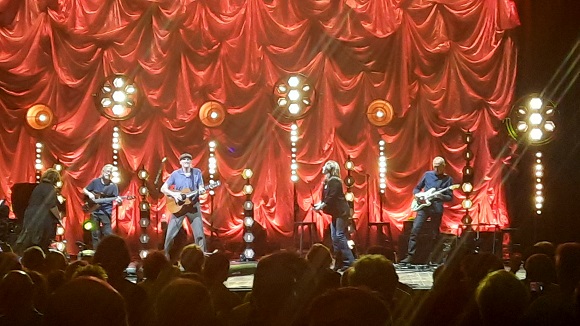
The concert was held in Teatro Verdi, a theater located in the very heart of historic Florence, and we booked a hotel within walking distance. We were impressed by the grandeur of the theater, which was built in 1854 and seats 806, especially by the six tiers of theater boxes that seemingly reached up to the ceiling.
James Taylor and his All-Star Band took the stage and opened with "Something in the Way She Moves" and "Country Road". We were immediately enraptured by the songs we knew so well. At the age of 74, Taylor is still an excellent singer, although his voice has mellowed over the years. We especially enjoyed the fact that he spoke to the audience between songs, speaking of their origins and occasionally sharing jokes, some of which the mostly Italian-speaking audience didn't fully understand.
We sang along, snapping photos that couldn't do justice to the heartwarming concert. Taylor's renditions of favorites "Sweet Baby James", "Fire and Rain" and "You've Got a Friend" and all the other songs stayed true to the studio-versions that have played background to our lives for decades. We rose to our feet and joined the audience singing "How Sweet It Is (To Be Loved by You)", saddened with the realization that the concert was nearing its end.
A wonderful experience that will remain in our memories for years to come!

The full playlist of the Florence concert:
Something in the Way She Moves Country Road That's Why I'm Here Walking Man Never Die Young (I've Got to) Stop Thinkin' 'Bout That Sweet Baby James Steamroller Copperline Long Ago and Far Away Up on the Roof Teach Me Tonight The Frozen Man Bittersweet Don't Let Me Be Lonely Tonight Fire and Rain Carolina in My Mind Shower the People Your Smiling Face You've Got a Friend How Sweet It Is (To Be Loved by You) You Can Close Your Eyes
Postscript: A few days after the Florence concert, several members of the All-Star Band tested positive for COVID-19 and shows in Zurich and Frankfurt were postponed or canceled. And then, Taylor himself began suffering from symptoms of COVID-19 as well (although the latest social media posts report that he is on his way to a full recovery).
We are so very lucky to have attended the concert, especially having bought our tickets a year in advance. We will always cherish our memories of seeing James Taylor perform live in Florence.
November 7, 2022
"A Stand-Up Comedian Walks Into a Bar" - short story

"Tough crowd tonight."
"You can't win them all," Mac said, slumping into a chair at the side of the club.
"Some of your jokes are quite funny."
"Nah, no one's laughing."
Mac picked up a bottle of water and guzzled half of it before coming up for air. Upon hearing the roar of laughter greeting the next comedian performing on Open Mic night, he rubbed his eyes. "I need new material." When he realized that he was talking to himself, he brushed off his clothes and left.
Mac had dreamed of becoming a stand-up comedian his entire life. He could make a career of it, he imagined, but his wife was not supportive of the idea. "Stand-up doesn't pay the bills," she complained. He would moonlight as a comedian, he vowed, until he achieved the recognition he felt he deserved.
Read the rest of the story on Esoterica Magazine.
November 5, 2022
"Running in Time" - short story

“Are you going running tomorrow?”
“Tomorrow? Maybe.”
I didn’t run every day, but there were days when I needed to. It wasn’t only about getting back in shape; it was also about getting back in time.
As my wife turned off the bedroom light and kissed me goodnight, I closed my eyes and smiled to myself, remembering how wonderful a day it had been.
I had gone on my morning run—3 miles in the park, which was pretty good for a 60-year-old man, especially after what had happened—and came back to find breakfast laid out on the table for me. I hopped into the shower and then joined her at the table, a cup of steaming hot coffee already placed at the side of my plate.
Read the rest of the story at On the Run. Photo by Nourdine Diouane on Unsplash
October 25, 2022
Taxi Politics - short story

Israel held elections in April 2019; September 2019; March 2020; and March 2021. The 5th elections in our political drama will be held on November 1, 2022. The short story "Taxi Politics" is as relevant today as it was when it was first written in January 2020.
“So, what do you say about our country? Staging elections for the third time this year! Where else in the world do you have a country like this? And we call ourselves a democracy! Is it a democracy when we can’t elect a stable government? What do you say about that?”
The man in the backseat looked up from his phone, surprised that the driver had spoken to him.
“What?”
“Elections! They’re coming around the corner again and I wondered what is your opinion?”
“My opinion?”
“Yes, your opinion. Every citizen is entitled to have an opinion. I meet many people every day and let me tell you. Everyone has an opinion. What’s yours?”
The driver adjusted his rearview mirror and glanced at his passenger. The man must be in his mid-thirties, the driver assumed, and sported a pointed, curly beard, just like Herzl in the famous balcony photograph. There was no kippah on the man’s head but the driver immediately classified him as an observant Sephardic Jew, the kind who upheld tradition but would never miss the Friday night television news.
“We need to keep this government in power. Vote for them again.”
“But what about the prime minister?” the driver asked, returning his eyes to the traffic. “They say he’s corrupt. Indictments on three charges, no less!”
“The media and the Left indicted him. The left-wing judges, too.”
“So, you don’t think he’s guilty?”
“No, how could he be guilty?”
“With all those indictments, will you vote for his party?”
“Of course, I’ll vote for his party. I always do.”
“And if he goes to jail?”
“He won’t go to jail. Sorry, this is my stop.” The man glanced at the meter, handed the driver two twenties, and stepped out of the car without bothering to ask for change.
The driver smiled, always pleased to engage with his passengers. He never knew, when starting his shift, whether they would be pleasant, willing to talk. Some were so absorbed in their personal lives that they didn’t want to discuss the country’s drawn-out political deadlock at all. The situation. It affected all of them, the driver included. How could you not talk about it?
Someone flagged him down around the next corner. The driver classified the man as an Ashkenazic Jew. A university student most likely, judging from the backpack. When the passenger asked to be driven to the Mount Scopus campus, the driver’s assumption turned out to be correct.
“So, what do you say about our country? Staging elections for the third time this year! Where else in the world do you have a country like this?”
The student looked up from his phone with a quizzical look on his face. “We wouldn’t be having elections again if the prime minister would resign. He should be held accountable for what he’s done.”
“You don’t think the media is biased against him? And the courts?”
“He is corrupt. Several of the ministers are corrupt. They’re all corrupt! They should all go on trial so that we can return to a sense of normalcy.”
“And the opposition – they should form the next government?”
“Anyone but the prime minister,” the student replied without skipping a beat.
“What do you think about a unity government?”
“I’m in favor. As long as the prime minister is not part of it.” And with that, the student got out of the car and hurried to his classes.
The driver had never gone to university. It had been three years of service in the Armored Corps and then straight into the job market. First there had been a stint as a night guard at an insurance agency, and then he flipped burgers in a fast food joint on Ben Yehuda Street. Next, he worked in a pizza restaurant for several months before leaving it for early morning deliveries of fruits and vegetable for a chain of supermarkets. During those years of moving from job to job, he had married his high school sweetheart. Fortunately for the two of them, her parents had provided a three-room apartment on French Hill. At least they didn’t have a mortgage hanging over their heads! Two years into the marriage, and with their first child on the way, he found steady employment at last. He didn’t mind the day shifts and only worked nights and on Shabbat when he found it difficult to make ends meet. This was happening more and more lately.
A young, religious couple was waiting near the hospital. The husband held open the door politely for his wife. The driver smiled when he saw her head cover, a raised turban-like mark of modesty that would make a Sikh proud! When the husband closed the door behind him, the driver asked their destination.
“Romema,” the man replied before whispering something to his wife. She ignored him and stared out the window. She was upset, the driver saw. Maybe she had visited a sick relative at the hospital. The husband adjusted his black kippah and looked away.
“So, what do you say about our country? Staging elections for the third time this year! Where else in the world do you have a country like this?”
The husband met his eyes in the mirror and smiled. “God willing, this will be the last time we have elections.”
“And if God is not willing?”
“God willing, we will have a Torah-loving, tradition-respecting, Jewish government.”
“Who will you be voting for?” the driver asked.
“For our party, as the rabbis determined. This is the only way to safeguard Israel and to protect our faith.”
The driver considered asking the husband why he voted blindly according to the rabbis’ directives but raising the question could lead to an argument. Looking back in the mirror he saw the man trying to comfort his wife. Perhaps the relative they had visited was very sick. The driver felt sorry for them.
The driver and his wife were only religious on Shabbat and holidays. They kept a kosher kitchen but didn’t adhere to dietary restrictions when they ate out. Not that they ate out. With three children now, and their challenging financial situation, they couldn’t afford the luxury of dining in restaurants. Still, he did go to tefillot when he could. His father and three religious brothers were always pleased when he joined their minyan. He hoped they understood his need to work on Shabbat and holidays in order to support the family.
A young woman at the bus station waved for him to stop. She had very dark skin and was quite attractive, although he would never admit to his wife that he looked at other women from time to time. Only window shopping, he told himself. Never following up on anything. He stopped the car and the good-looking woman got in.
“So, what do you say about our country?” the driver asked.
“Are you talking to me?” she asked, keeping her eyes focused on her phone.
“Yes, I wanted to know what you think about the fact that we are staging elections for the third time this year. Where else in the world do you have a country like this?”
“I don’t know,” she replied.
“Yes, to both of those.”
“Do you have an opinion about the situation? Everyone has an opinion.”
“The government is not the greatest,” she said with a sigh. “We are not represented.”
Who was not represented? the driver wondered. Ethiopians? Women? New immigrants? The young? But before he had a chance to ask, they had reached her stop. “How much?” she asked before handing him the exact change for the fare.
Near the Mahane Yehuda market he stopped for a tall, thin man who announced his destination before even closing the door.
“Beit Safafa. You do go there, don’t you?” The passenger spoke Hebrew with a thick Arab accent.
“I go everywhere in Jerusalem,” the driver replied. He had nothing against Arabs. Arabs, Haredim, Habadnikim, religious Zionists, secular leftniks—Jerusalem had all types. As long as his customers paid for their ride, he was fine with it.
“So, what do you say about our country? Staging elections for the third time this year. I assume you’ll be voting in the elections?”
“Yes, of course. This is our country, too, you know. Even though you don’t relate to us as equals.”
“You are equals!” He wanted to say that if Israeli Arabs wanted to be regarded as true equals, they should serve the country in some way. National service, if not service in the military. But stating this could lead to an argument and there wouldn’t be enough time to have a civil argument before they reached Beit Safafa.
“What do you think about our prime minister?” the driver asked instead.
“Racist,” was the one-word response. “The government is racist. It’s an apartheid state, you know.”
Oh, no, the driver sighed. We’re going down that road after all. “How do you propose to solve the situation?” he asked, glancing again at the mirror. His passenger avoided his eyes, as if somewhat embarrassed to be having a civil conversation with a Jew.
“If you would treat us as equals, it would solve the problem. All of us—the Palestinians who live on this side of the Green Line and the Palestinians who live on the other side of the Green Line.”
“One state?”
“One state. Equality for all.”
That would be the end of the Jewish state, the driver thought, but what did he know? He listened to the television news and read Yediot Aharonot every day. The situation wasn’t good; he knew that much for sure. But he loved Israel just the same.
An elderly couple was waiting near the Malha Mall and they seemed quite relieved when he stopped for them. Tourists! The driver spoke some English but at times he found it a challenge to find the most appropriate words to use in his speech.
“What do you say about Israel?” he asked the couple. “You know, we’re having elections again this year. It’s the third time! For sure, in America things are better!”
“Ha!” the grey-haired tourist said with a laugh. “You think you have tsuris? We have tsuris! We have a real schmuck as president but at least he’s a mensch who supports Israel. That’s all that’s important!”
The driver didn’t know any Yiddish and he wasn’t fully aware of American politics, so he didn’t know how to reply. The tourists were nice enough and left a big tip. At noon, the driver enjoyed grilled chicken steak and fries instead of his usual falafel.
“Why do you always talk to your passengers?” his wife had asked him once.
“I love talking,” he admitted. Maybe he viewed his travels as therapy, a way to voice what concerned him. Despite her feigned interest in what he did at work, his wife couldn’t bother with meaningful conversations, and certainly not discussions of Israeli politics. Talking with the total strangers traveling with him, on the other hand, not only offered a fascinating glimpse into their lives but also helped relieve the monotony of long hours parked on Jerusalem’s streets waiting for a fare. His wife never understood any of this. But he loved her just the same.
Later, he stopped for his last passenger of the day. The driver asked what he thought about the upcoming elections but the passenger barely acknowledged him. From a quick glance in the mirror, the driver assumed that the man with a closely-shaved head was relatively well-off, someone who would never consider traveling on the city’s crowded buses.
“Who will you be voting for in the elections?” the driver repeated. He expected the question to be ignored but a minute later, the passenger spoke up.
“I won’t be voting.”
“What do you mean you won’t be voting?”
“I’ve voted in elections twice this year already. Why should I vote again? It won’t make a difference.”
“It will make a difference!” the driver argued. “You have an opinion, and that opinion counts.”
“No, whatever happens, whoever wins, nothing will change.”
“How can you say that? As an Israeli citizen, you have a right to vote. No, you have an obligation to vote! Everyone must vote!”
The passenger didn’t argue with him because he was too busy getting out at his stop. The driver wasn’t surprised when he didn’t receive a tip.
He parked in the lot near his building. Election posters marked with the letters of the different parties hung from the balconies. Discarded propaganda pamphlets littered the pavement. He hoped his wife had prepared schnitzel for dinner. That was his favorite and it didn’t matter that he had eaten chicken steak for lunch. But he knew that his wife had probably been too busy all day with the children to even think about cooking. No matter. He would whip up some shakshuka and that would be a great meal, anyway.
What do you say about our country? he asked himself. Staging elections for the third time this year! Where else in the world do you have a country like this?
He didn’t have the answers. After all, he was just a taxi driver.
Originally posted on The Times of Israel.
Taxis on Jerusalem streets - image by Yoninah, shared on Wikimedia Commons.