David Trawinski's Blog, page 2
September 1, 2020
First to Fight, September 1, 1939
On August the 25th, 1939, the German Battleship HMS Schleswig-Holstein entired the Danzig (today’s Gdansk) harbor on a goodwill visit. This was not unusual as Danzig was a heavily German populated city. It was declared a free city by the Treaty of Versailles ending World War I, belonging to neither Germany or Poland. What was unusual was that in her belly that vessel held assault troops for Hitler’s planned invasion of Poland on the next day. All civilian visits aboard ship, as was the custom from its earlier visits, were cancelled.
When Britain declared they would come to Poland’s aid if Germany attacked her, Hitler delayed the invasion to September 1. The ship’s delayed departure was attributed its needing routine repairs.
I have visited Gdansk, and the harbor there is very tight. In fact, the cruise line I was on tied up just down river from one of the two Polish entities that were allowed by the Treaty of Versailles – The Westerplatte. This was a small outpost of less than 200 soldiers along the peninsula that separates the mouth of the Vistula River from the Baltic Sea. Everyone there was expecting war, but was certainly still hopeful of it never coming to Poland’s soil.
[image error]Westerplatte Memorial
In thee predawn hours of September 1, 1939, the HMS Schleswig-Holstein slipped away from its berth in Danzig and headed to the open sea, it trained its massive guns on the Westerplatte complex. At 4:47 Am, the firing of its shells sounded the opening salvo of World War II from essential point blank range. The Westerplatte was only expected to hold out for 12 hours. Thanks to the bravery and selfless actions of the Poles stationed there, it held out for seven days outnumbered by attacking forces 10 to 1, and facing an even more lopsided disparity in firepower. They held out as a symbol of resistance to the Polish nation. They held out long enough to hear Britain and France declare war on Nazi Germny, but nowhere near long enough to benefit from their aide. That aide would take months in coming, and never reach Poland itself. Today a monument on the hill above the Westerplatte marks the heroics of these souls.
[image error]Defenders of the Polish Post Office Monument in Gdansk
The other Polish soil permitted in Gdansk was the Polish Post Office. It came under brutal attack from SS forces, who saw it as a visage of Poland’s independence to be wiped away. Despite the civilians there being armed only with machine guns and a few grenades, they also fought valiantly. As the building came under increasingly heavy mortar fire, the civilians retreated to its basement. Then the SS brought in a truck filled with gasoline, pumped it into the basement through the shattered windows and threw in grenades to light it aflame. The Poles surrendered after holding off the SS for 15 hours. The first two Poles to emerge under a white flag of surrender were shot and killed in cold blood. A 10 year old girl was also among those killed that day.
There is, is some quarters, a rewriting of history that wishes to place blame on the Poles for the onset of World War II. There are also those who want the world to believe that Poland collaborated with Nazi Germany. Nothing could be further from the truth. Poland was the first to fight the Nazi’s, and they continued to fight them all throughout the war.
Polish soldiers fought in the snowy mountains around Narvik in Norway. They fought in the sands of North Africa near Tobruk. Their pilots fought in the air during the Battle of Britain. Their II Corp fought at Monte Cassino after walking across Russia to regroup in Persia. They fought on the beaches of D-day, and they fought on a bridge too far in Arnhem.
But they also fought at home, in the forests of their homeland, risking lives to bring the first notice of the Holocaust to the West, and in the 63 days of the August Uprising of 1944 that would leave Warsaw in rubble. The Poles never stopped fighting, and for that I am most proud to be a Polish American.
Of course, the Poles greatest contribution to the war effort was in just over a month before the invasion, sharing with the French and British how they, the Poles, had cracked the ENIGMA CODE six years earlier. I shudder to think what might have transpired had they not.
The soul of Poland is indestructible… she will rise again as a rock, which may for a spell be submerged by a tidal wave, but which remains a rock. Winston Churchill, in the House of Commons, 1 October 1939.


July 18, 2020
The Real Story of Breaking the German Enigma Code
[image error]
I am doing some deep research for an upcoming WWII novel, and I really came across a gem of a resource. It is entitled “X Y& Z”, after the codenames of the alliance of the French, British and Polish Intelligence Services that broke the German Enigma Code. It is what I would call a historical prequel to the the movie, “The Imitation Game” which seemed to suggest Alan Turing, the computer science trailblazer and the great mathematician, nearly single-handedly broke the German Code.
What the movie failed to tell its audience was that the Poles had broke the German Military Enigma Code as early as 1932. After the Germans had added two addition Enigma rotors to the machine’s rotation of 3 internally wired discs, the Poles knew what was coming and shared their secret with the French and English in a top secret bunker in the woods outside Warsaw. This meeting took place only six weeks before the Germans invaded Poland on September first.
Both the French and English were “gobsmacked” (to use the Brit’s phrase) to learn that the Poles had not only mathematically “reverse engineered” the Enigma device (including the internal wiring of its rotors) years earlier, but also had built a mechanical device to work through its possible 17 thousand plus daily settings. That machine was the Bomba, Polish for bomb, because of the ticking noise it made while working through the permutations. Sound familiar? All their efforts were openly shared with the French and British, effectively, as the author describes, handing off the Baton to the “boffins of Bletchley Park”.
The three Polish mathematicians who broke the code – Marian Rejewski, Jerzy Rozycki, and Henryk Zygalski would escape Poland during the war, relocate outside of Paris, before having to move again to the south of France. Eventually, their continued codebreaking was honed in on by the Nazis’s, forcing them to escape to Spain, to Gibraltar and eventually on to London. Except for Rozycki who drowned in a mysterious accident in the Mediterrean Sea.
The Polish cryptologists Rejewski and Zygalski never did make it to Bletchley Park. But thanks to their story finally being realized, Bletchley did unveil a monument to the Polish efforts which I took a photo in front of earlier this year during my visit.
[image error]
And perhaps the best part of this story is that the author of “X Y & Z” is none other than Sir Dermot Turing, who just happens to be the nephew of Alan Turing. An excellent read, I recommend it fully.
June 9, 2020
America and Poland 100 Years Ago
Poland emerged from the desolate eastern battlefields of World War I, recreated 123 years after the criminal injustice of its partitions by Russia, Austria, and Prussia. All three empires had themselves been decimated in the Great War, and Poland was rightfully reconstituted on November 11, 1918.
Yet, its lands were still smoldering, its people starving, and its military vulnerability laid bared for all to see. Thanks to the American Food Relief program under Herbert Hoover, some much needed relief was provided. One such relief mission was provided to the besieged city of Lwów in then eastern Poland. Those providing the direly needed foodstuffs included a young American airman named Merian C. Cooper. His thoughts of the Polish people had been molded since childhood , as his great-great-grandfather John Cooper had not only ridden with Casimir Pulaski in the American Revolutionary War, but had actually carried the Pole’s lifeless body from the field of battle after Pulaski was struck by British Grapeshot at the Charge of Savannah. The resilience and fortitude of the Poles that Merian Cooper witnessed at Lwów inspired him, to not only further assist this re-newed republic, but to risk his very life in doing so.
After returning to Paris, Captain Cooper met with his friend Major Cedric Fauntleroy. As they sat in a sidewalk cafe, they envisioned a crew of American airmen flying for the Polish nation as it had become embroiled in a war with Lenin’s Bolshevik Red Army over the border between the two countries.
The two men, along with several other American airmen they recruited, had established what would become the Polish 7th Air Escadrille or the Kościuszko Squadron of 1920. In Poland’s war against the Bolsheviks there were no air-to-air battles, but the dozen or so Americans piloting the Polish Fokker D-III Albatross (and later the Italian Ansaldo A.1 Ballilla) bi-planes proved invaluable in aerial reconnaissance and air-to-ground attacks. They developed low altitude strafing tactics that helped to turn the tide against the Russians. They flew over 400 combat missions, and were instrumental in Poland’s victory which prevented the Bolshevik Red Army from spreading its Communist grip into Western Europe. Their “eyes in the skies” so greatly contributed to the Pole’s situational awareness of the Russian forces, that when Josef Stalin refused to release troops under his command at Lwów, as ordered by Vladimir Lenin, to assist in the attack on Warsaw, the Poles recognized the gap in the Bolshevik battle lines and took advantage of this tactical error. Josef Pilsudski, the Polish head of state and supreme military commander, who himself had once been an anarchist against Tsarist Russia with Lenin’s own brother, took action. He released all remaining troops in the city of Warsaw, every last soldier, to slip through the gap and join with reserves from the Wieprz River region, who then encircled and destroyed the Bolsheviks. This stunning defeat for the Red Army is remembered in Poland to this day as the “Miracle at the Vistula”.
Likewise, when Stalin eventually did release his Cossack Cavalry, the Americans aloft in the Kościuszko Squadron were instrumental in the Poles intercepting them near the town of Zamość at the Battle of Komarów, (alternately know as the Zamość Ring), The Russian Cossack cavalry was destroyed by the Poles in what proved to be the last great cavalry battle of the 20th century.
So what became of the man who conceptualized this air unit in the first place? Merian C. Cooper was shot down and taken to a Russian POW camp near Moscow. He was able to convince the Russians that he was a mere Corporal by using an alias, and not the famed American responsible for the Kościuszko Squadron. Eventually he was able to escape to Riga in Latvia, where he stayed until the war was over. He returned to America to publish a book of his exploits, “Things Men Die For”, and then got into the movie making business in Hollywood. Working for RKO Studios, he conceptualized and produced the adventure classic, “King Kong” in 1933. He was then awarded a star on the Hollywood Walk of Fame.
Of course, the Polish airmen displaced from their country in the Second World War would reform in England as the 303 Kościuszko Squadron, and would go on to shoot down more Luftwaffe aircraft than any other squadron in the Battle of Britain, but that is another story for another day…
[image error]The Kościuszko Squadron emblem designed by American Airman Lt. Elliot C. Chess featuring the Rogatywka Military Cap and Crossed Scythes of the Kościuszko Uprising as well as the 13 Stars and Stripes of the Revolutionary War of America
May 5, 2020
Announcing “The Life Of Marek Zaczek Volume I: Under the Wings of Eagles”
[image error]
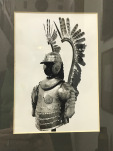
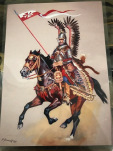
Those of you who have followed my blog postings may recognize some elements from my latest novel’s cover, “The Life of Marek Zaczek Volume I: Under the Wings of Eagles”. I tend to blog about topics I am currently researching. So the images on the cover of Casimir Pulaski, Tadeusz Kosciuszko, the Winged Hussar Armor (courtesy of the Polish Institute and Sikorski Museum of London), and even the Benedictine Monastery at Tyniec near Krakow may seem familiar.
So what is the storyline? It begins with the birth of Marek Zaczek (what else?) to a peasant mother on the folwark (estate) of a Szlachta Duke in 1772. The Duke controls the sprawling land holdings and manages the Salt Mines of Wieliczka. Marek’s mother serves the Duke’s desires in his opulent manor house while his father toils in the mines below. But everything is not always as it appears…
The King of Poland is suspected of being a puppet of Russia (Sound familiar?). In fact, the monarch is an ex-lover of Catherine the Great. The Polish nobles, at least many of them, have confederated at the south-eastern town of Bar to fight both the Russian interference in their own country’s governance, as well as the indecisive nature of their own king. A civil war rages for four years before Russia’s overpowering dominance isolates the outgunned rebels in few monasteries (including the cliffside abbey at Tyniec).
Marek is born, in fact, on the very day that the empires of Austria, Russia and Prussia sign the accord to partition large tracts of borderlands from Poland. The Duke is forced to navigate the rapidly changing political landscape, as his holdings are transferred from Poland to Maria Theresa’s Austria in the region known as Galicia.
Over the 25 year’s covered in this novel (1772-1797), not only do the three Partitions of Poland take place, but also the American War for Independence, The French Revolution (including the Reign of Terror), The War in Defense of Poland’s 3 May 1991 Constitution, and the Kosciusko Uprising of 1794. It is amazing how interconnected all these events were, and all come to have great bearing on Marek’s journey to adulthood.
The Life of Marek Zaczek Vol. I is now available on Amazon as well as Barnes and Noble in paperback and dust-jacketed hardbacks. It will also be available soon on Kindle. Of course, autographed copies are available, as always, on my website
The Books of David Trawinski at DavidTrawinski.com.
I hope you’ll enjoy Marek’s and his mother Magda’s tale, and come along for the ride.
March 3, 2020
Polish Literacy, Literature and Laureates
[image error]
OK, so I am working my way through the novel above by the Polish Author Olga Tokarczuk. It was part of my clutch of Polish titles that my wife gave me as part of my Christmas present. “Flights” is not so much a novel as a collection of disjointed stories all having to do with personal sojourns in one way or the other. I am enjoying it, but must admit its non-conformities (No Chapter Structure, just seemingly unending sections sewn together) are very foreign to me. As are its acerbic insights into human nature and social discourse.
However, it did get my mind thinking about the ability of the world’s people to enjoy the written word. According to the World Bank, the average literacy rate is climbing. It was only 12% in 1820 just after Walter Scott’s Ivanhoe was published, but had already grown to 65% in 1976. This past year year it has broken through 90%. So what is the literacy rate in Poland?
In Poland, the adult literacy rate is 98.6%. Even more encouraging, the youth literacy rate is 99.2%. I attribute these high rates as being associated with the historical importance of keeping the written Polish language alive, given the coerced attempts of Russia and Prussia to forcibly eradicate Polish as a language and culture during in the 123 years of the non-existence of the Polish state (1795-1918). If you read Lev Tolstoy’s “Anna Karenina” (1877), there is a scene where the Russia elite are having a parlor discussion as to how difficult it is to “Russify” the Poles. The Prussians were even worse in forcing their tongue upon the Poles. Thus, not only speaking Polish, but properly writing and reading of the language was of the highest importance, such that their culture would never perish.
I once had a young person with whom I worked ask me about Polish literature. Funny, I thought, you never hear people ask about Polish Literature. I referred her to Joseph Conrad, but even though he was Polish by birth, he chose to write in English (his fourth language after Polish, Russian, and French).
In actuality, there is a tremendous wealth of Polish literature, as well as a highly cherished Polish cinematic industry based upon these tales.
Consider that since the Nobel Prizes came into existence at the start of the 20th century, there have been 19 Polish Nobel laureates. These include the physical sciences with Marie Skłodowska having 2 (better known as Madame Curie). Her daughter Irene would go on to gain a Nobel of her own, but she is considered French. Other Polish Nobel Prizes went to contributors in the categories of Physics (3), Peace (4), Medicine (2), Chemistry (1) and Economics (1).
Now, consider the Nobel Prize for Literature, of which Poland claims 6. Only 5 countries have more – France (15), United States and Great Britain (10), and Sweden and Germany with 8 each. What a rich tradition of the written word!
1905 – Henryk Sienkiewicz (My personal favorite) – epic tales of Polish Historical Fiction
1924 – Władysław Reymont – for his great national epic, “The Peasants”
1978 – Isaac Bashevis Singer – impassioned narratives rooted in Polish-Jewish culture
1980 – Czesław Miłosz – works that voice man’s condition as exposed in severe conflict
1996 – Wisława Anna Szymborska – poetry allowing historical context to come to light
2018 – Olga Tokarczuk – for narrative passion crossing the boundaries of life
Of course this excludes the aforementioned Joseph Conrad (who did not win a Nobel) and Adam Mickiewicz, the national poet of Poland in the years before the Nobel Prizes.
This amounts to a rich legacy for a country that has endured so much throughout history.
[image error]
January 24, 2020
Lights in the Winter Night
[image error]
Marie and I returned last night from a most illuminating trip – to see the NordLys, or Northern Lights. So what has this got to do with Poland? Allow me to make the connection.
Our travels started out in London, with two side trips of very significant connection to Polish culture and heritage. First, we visited the Polish Institute and Sikorski Museum that has been open ever since May 2, 1945. As many are likely to know, General Władysław Sikorski was the head of state of the Polish Government-In-Exile based in London during World War II. He died mysteriously when his aircraft plunged into the Mediterranean Sea after taking off from the airfield at Gibraltar on July 4th, 1943. The General and his adult daughter were killed, but the pilot survived. Interestingly, the famous Communist Spy within the British Government, Kim Philby, was stationed on The Rock at that time.
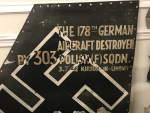
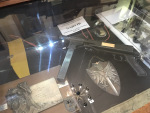
The Sikorsky Institute is so much more than simply a World War II or General Sikorski Museum. It is an incredible collection of artifacts preserved from throughout the history of Poland. It is worthy of adding to your next trip to London. Its three floors of fascinating historical keepsakes is like none other than a trip to Warsaw itself. And if your interest lies in the Battle of Britain, the famed 303 Kościuszko Squadron (credited with more Luftwaffe kills than any other Battle of Britain fighter unit) and the other Polish flyers are well remembered within this Institute.
And Magda, our guide was as charming as she was informative…
The next day, Marie and I caught an early train out of London to visit Bletchley Park. Many of you that are interested in World War II, or simply fans of the film The Imitation Game, will know this as the site where the Allies cracked the Nazi Enigma Code. With all due respect to Alan Turing, there is a Polish connection here that is greatly downplayed in the movie, and even in the tours of the facility itself.
You see, just before the war started, and I do mean just, the Poles invited members of the French and British Intelligence communities to their homeland to share their breakthrough. Bletchley Park Commander Alastair Denniston and Project Leader Dilly Knox travelled to a secret facility in the Pyry Forest near Warsaw, along with their French counterparts. This clandestine meeting of cypher “spooks” took place in August 1939, only weeks before the Nazi onslaught commenced on the first of September.
The Poles were the first to realize that breaking the Enigma code with linguists was a futile undertaking. Instead, they attacked it with mathematicians. namely Jerzy Rozycki, Henryk Zygalski, and Marian Rejewski. The team led by these men not only cracked the code, but were able to build replicas of the device and electro-mechanical computers, known as “bombes” that could solve for the daily code settings. At the time of this meeting, it was reported that Poland was reading some 75% of all German military communication. Thus, they knew what was coming, and as such decided to share their findings with the British and French who were stunned at their achievement.
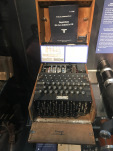
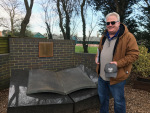
Shown here is an actual Enigma device (from the War Museum in Narvik, Norway – more on that below) and a photo of me at the Polish Memorial at Bletchley Park.
As an aside, two of the Polish mathematicians eventually made it to London (the third was killed trying to escape from Vichy France), but once there, they sat on their hands. The British would not allow them even knowledge of what was ongoing at Bletchley Park for security reasons. And there was a lot going on, for at the same time as the Polish were sharing their secrets, the Nazis were greatly increasing the complexity of the Enigma devices by adding rotors and other features. However, thanks to the Poles, Alan Turing and team had an understanding of the devices workings, and even went on to build their own “Bomb” device. The breaking of the Enigma Code is credited with shortening the war by two years. One has to wonder if the entire outcome of the war might not have been altered save for the work of these three Polish mathematicians.
[image error]
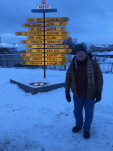
The main bulk of our wandering was spent exploring the coast and fjords of Norway. After crossing the North Sea in January (generally not recommended), we had stops in Bergen, Stavanger, Tromso, Alta and Narvik. The last stop was the the most fascinating to me, as Narvik was the scene of the first real engagement between the Brits and the Nazi’s in World War II. In April 1940, Hitler ordered an invasion of neutral Norway to insure the supply of Swedish Iron Ore to Germany was uninterrupted. A series of incredible naval battles took place in the Ofotfjord – the fjord upon which Narvik is situated. While the Allied mountaineering forces, including the Poles, were successful in driving the Nazi troops from Narvik and the mountains surrounding the town and all the way back to Bjornfell near the Swedish border, ultimately Narvik was evacuated in early June as Britain withdrew its forces given the fall of France. Thus, Hitler’s first strategic defeat was erased, and the port town stayed in German hands throughout the rest of the war.
There was a silver lining, however, in that the disproportionately high losses of Die Kriegsmarine in the Norwegian waters deprived that German Navy of the ships needed to secure an invasion of England. Thus, Operation Sea Lion was never launched. So, the heroics of the dominant British Navy, along with the bravery of the Royal Air Force, prevented the island nation from being invaded. And on both fronts the soldiers and airmen, not to mention the academicians, of Poland played pivotal roles in stopping the advances of the Nazi War Machine.

November 11, 2019
Reflections on a True Polish-American Patriot
[image error]
All over the world, today is either Veteran’s Day, Remembrance Day, or Armistice Day. My most profound admiration goes out to all those who have served and sacrificed for their nations, and of course the United States in particular. Like so many of us who did not serve, we have dearly loved relatives who did, like my own father. God bless you all, you veterans of past and present.
As this is a Polish history themed blog, I wanted to focus today on one particular veteran, For when the First World War ended on the eleventh hour of the eleventh day of the eleventh month in 1918, not only did it return peace to Europe, but also the nation-state of Poland. Poland had been wiped from her map since 1795 by the illegal and indecent partitions of her lands by Russia, Austria and Prussia. Gone for 123 years, the proud state returned, her language and culture kept alive for over a century by the flame in the hearts of the resilient Polish people.
The first Partition of Poland in 1772 was preceded by a rebel uprising against Poland’s last King (Stanislaw Poniatowski). It was known as the Confederation of Bar (Bar was a city and fortress then in Southern Poland, now Ukraine). A civil war within Poland with Russian intervention on behalf of the King ensued for four years (1768-72). Although he did not participate in the rebel uprising (his family did), a young Pole named Tadeusz Kościuszko was greatly affected by it. It’s attempted grasp at liberty would shape Kościuszko‘s entire life.
Kościuszko went to Paris where he was trained in the arts and engineering. When he returned home to Poland, he was hired to tutor the daughters of the Hetman, or Grand Military Commander of Poland. He fell in love and asked for the hand of one of the girls in marriage, only to be rudely rebuked by the Hetman. When Kościuszko eloped anyway with the girl, he was found and thrashed within inches of his life by the Hetman’s troops.
Kościuszko then left Poland for Paris, where he met Benjamin Franklin in 1776. Franklin had heard of the young man’s abilities as a engineer, and convinced him to join those fighting for liberty in the American Colonies. There he made great contributions, and his defenses were critical to the outcomes at Ticonderoga and Saratoga. He also planned the defenses at West Point, and it was his plans that Benedict Arnold stole for the British.
Tadeusz Kościuszko was critical to America becoming an independent nation. If you think this is a hyperbolic statement, consider that his statue still stands in LaFayette square outside the White House. He was awarded with an appointment as a Brigadier General, and was awarded land as a result of his deeds. He was personally lauded by George Washington, even though the future first president had great difficulty pronouncing the man’s name (Kosh SHUZ Ko). Maybe it was the wood teeth, who knows?
However, Kościuszko’s real adventure started upon his return to his beloved Poland in 1784. He was influential in the development of Europe’s first constitution of 3 May 1791, only the second democratic Constitution in the world to that point. It was heavily influenced by that of the US. It’s liberties to the peasants (or serfs) so inflamed Mother Russia under Catherine the Great that she invaded Poland in 1792. Kościuszko, then a general in the Polish Army, bravely led the defense of his country, especially in the south near Krakow. Then, King Poniatowski unexpectedly sued for peace with Russia and Prussia who had joined the war. This enraged Kościuszko, and only brought about the Second Partition of Poland in 1793 at the hands of Russia and Prussia (Austria missed out on this one, but they would be back for the Third Act).
In 1794, Kościuszko began his famous peasants’ uprising in Krakow. Determined to take control of his homeland in a raising of scythes and pikes, he led early victories over the Russians. However, he was severely wounded at the Battle of Maciejowice. He was taken to St. Petersburg and imprisoned. In his absence, the Russians attacked the eastern Praga suburb of Warsaw, massacring some 20,000 Poles. This effectively put an end to Kościuszko‘s Uprising. The following year, the three empires concluded their evil dissection of Poland with the third Partition of Poland, wiping the country that proudly stood for nearly two millennia from the face of Europe.
Kościuszko was released from prison in 1796 upon the death of Catherine the Great, and returned to the United States to live in Philadelphia and recover further from his wounds. He left behind a will to free all the slaves of his lands, which were to be sold and the monies going to the freed slaves. Although this was never carried out upon his death, it tells of the true depths of his heart for the concepts of liberty and freedom.
Kościuszko would return one last time to Europe in 1898, to warn of the rise of Napoleon, before dying in exile in Switzerland in 1817 from a stroke at the age of 71. He lived to see, unfortunately, his warnings of Napoleon’s aggression come all too true, but also lived to know of the dictator-emperor’s final defeat.
And so today, upon Veteran’s day and the day of Polish Independence, we honor Tadeusz Kościuszko. No less than Thomas Jefferson called him “the purest Son of Liberty” that the world has ever known.
[image error]
October 6, 2019
My Take on Writing A Historical Fiction…
[image error]
I have been asked to give a “Speed Presentation” (15 minutes) on writing historical fiction at the upcoming writers conference (November 1) hosted jointly by the Calhoun Area Writers’ and Rome Area Writers’ Groups. So, here is my perspective, focusing on the structure of a historical fiction trilogy.
At many book-signings or other events, I am occasionally asked if I write Alternate History. A good example for those unfamiliar with the genre would be Phillip K. Dick’s “Man in the High Castle”, whose story is set upon the premise that Nazi Germany won World War II.
This is exactly what I do not do. I tend to be a history purist. The way I see it, if writing is “spinning a yarn”, then in historical fiction that yarn must be woven through the loom of history. Every one of the loom’s endpoints is a detail of history that must be revered and held sacrosanct.
In my case, I chose to write a trilogy of books that were set in Poland in World War II and the Cold War. The initial novel, “The Willow’s Bend”, is a fairly simply story which is both a mystery/thriller in the present day and also, in alternating chapters, a tale of survival in the historical setting of World War II Poland. The two storylines intertwine in the novel’s conclusion to show how the acts one generation can reverberate and even shape those of another. This book is set in the Fall, and symbolically represents the fall from grace of the protagonist, retired CIA Agent Stanley Wisniewski.
The second book in the trilogy, “Chasing The Winter’s Wind” is more expansive. It has again the same present day thriller alternately foreshadowed by revelations of Stanley’s past during his active days of running spies in Communist Poland during the Cold War. However, new characters and storylines are introduced, exposing the motivations of Stanley throughout his career. This story is set in the Winter, and as such is a story of survival, just as Poland had to survive the 44 years after World War II living under the yoke of Communism. That dark history of Soviet domination, set against a faux white purity of the CIA’s role, is explored. The novel also details the workers’ strikes which eventually led to the Solidarity political movement, which began the sequence of events that spelled the end for Communism in Eastern Europe.
Finally, the third volume, “War of the Nocturne’s Widow”, is set in the Spring. It is a tale of renaissance and redemption. It also has an modern day thriller storyline alternating with the historical backstory of the fall of the East German Stasi regime. The final event, the fall of the Berlin Wall, represents a rebirth, and a time of great joy and optimism for the future. However, things do not always have a way of acting out the way we initially expect them to, do they?
So, if you are like the writer in me, research your historical facts diligently and with great respect. Then, just before you weave your tale through them, size the yarn with symbolism, premonition, sarcasm, greed, regret and romantic elements. And make sure there is plenty of opposing motivations of key characters to keep the tension ripping tight.
David Trawinski
August 18, 2019
The Courage of Casimir Pulaski
[image error] I was raised in the shadow of this monument. It is prominently featured in the entrance to Baltimore City’s Patterson Park. The statue is of the Polish patriot Casimir Pulaski leading a cavalry charge in the American Revolutionary War. In fact, in many quarters he is still considered to be the father of the American Cavalry. And yes, those are fully grown trees on each side of it. The monument is both impressive and imposing.
Born Kazimierz Michał Władysław Wiktor Pułaski near Warsaw, Pułaski came to prominence long before his travels to North America. In a period where the last king of Poland was nothing more than a puppet of the Russian Tsar Catherine II, Pułaski and other noblemen of Poland formed a rebellion against the King and the Russian forces he allowed on Polish soil. The Confederation of Bar waged a civil war in Poland from 1768 to 1772. Pułaski personally defended one of its last strongholds at the monastery of Jasna Góra, home of Poland’s most revered Black Madonna, in the town of Częstochowa. Pułaski even participated in an attempt to capture and kidnap KingStanisław August Poniatowski. While this attempt was initially successful in capturing the King, he escaped and the plot ultimately failed. In 1772, the civil war ended, and the first Partition of Poland ceded Polish borderlands to Russia, Austria and Prussia.
After the Confederation of Bar was put down by the Russian army by use of an overpowering force advantage, Casimir Pulaski made his way to Paris. There, he caught the attention of Benjamin Franklin after an introduction by the Marquis de LaFayette. Upon Franklin’s recommendation, Pulaski then travelled to North America to fight on behalf of the Colonists. At the Battle of Brandywine, Pulaski is given credit for saving the life of George Washington, who was in retreat and headed directly for British Troops before Pulaski interceded and led him to safety.
In the Baltimore Area, Pulaski formed the famous Pulaski Legion by training local horsemen on the strategy and tactics of cavalry engagements. Ultimately, Pulaski gave his live to the Revolution during the Battle of Savannah, while attempting to rally fleeing forces, he was riddled by grapeshot from British cannons.
There has been wild speculation recently that Pulaski may have been an intersex person, and I am not qualified to render an opinion, other than my personal thought that Casimir Pulaski was more man than most of his time, and certainly had the heart of a lion.
July 19, 2019
Crime of the Millenium ? The Partitions of Poland
[image error]
Above is the bust of one of my favorite authors, Victor Hugo. He was, perhaps, France’s greatest master of prose. Most of our generation reveres his historical fiction, “The Hunchback of Notre Dame” (actual title is “Notre Dame de Paris”), and thought of it as we sadly watched the roof of that Parisian landmark, which has been called the soul of France, go up in a pyre of flames.
I have recently undertaken two marathon acts of love among my bibliophilic quests. The first is to complete “Quo Vadis” by the Polish Noble Literature Award winning author, Henryk Sienkiewicz. The second quest is to finish the Hugo masterpiece “Les Miserables”. Both classic novels are up there with Tolstoy’s “War and Peace” in page count, and I am happy to say I am at the halfway point of both novels.
While Sienkiewicz is the Polish author, I was greatly surprised to find the following discourse within the “Les Miserables” volume entitle “Marius”
“All contemporary social crimes have their origin in the partition of Poland. The partition of Poland is a theorem of which all present political outrages are the corollaries. There has not been a despot, nor a traitor for nearly a century back, who has not signed, approved, counter-signed and copied, ne variatur, the partition of Poland.”
OK, that part did not make it into the broadway musical, or any of the movies. but why did Hugo find this political maneuvering so offensive. Simply put, it was because it was the first time in European history when three mighty empires, themselves at war with each other over the centuries, jointly agreed to dissect and consume another sovereign state. Or as Prussia’s Frederick the Great, one of the initiators of this injustice declared, we will consume the lands of Poland “like an artichoke, leaf-by-leaf”.
The sequence of events began when in 1763 Poland’s King died. Unlike most of the other monarchies of Europe, Poland’s Kings were elected by the Szlachta, their ruling class of Nobles. Russia’s Catherine the Great utilized all means possible to influence the election of this free and sovereign state, including bribery and military threats of intervention, to have her ex-lover, Stanislaus Poniatowski, elected King. When that new king was introducing reforms to strengthen the monarchy, a subset of the Polish nobles rebelled, forming the Confederation of Bar (Bar being a town in then Southeast Poland, what is today the Ukraine}.
The Confederation of Bar uprisings were put down with massive Russian assistance. Poniatowski stayed on the throne, but Russia and Prussia declared Poland to be a failed political state. They convinced a reluctant Austrian Empress, Maria Theresa, to join them in the first partition in 1772. Russia took a bite out of the East, Prussia the North, and Austria the South, although Maria Theresa was to have said what right did Austria have to take lands from the country they once vowed to protect? Frederick the great was quoted as having said of the Austrian Empress, “The more she cries, the more she takes.”
Poland later enacted the first constitution in Europe on May 3, 1791, designed after that of the United States, with the intent to improve the governance of the Polish-Lithuanian Commonwealth, as it was then formally known. This only initiated a second partition in 1793. After an subsequent uprising against Russia was spearheaded by Poland’s General Kosciusko, who himself had aided the American Revolutionaries, Russia, Prussia and Austria divided what remained of the Commonwealth in the third Partition. Poland disappeared formally from the maps of Europe for the next 123 years, until it was reconstituted by Woodrow Wilson’s 13th of his famous 14 points at the end of World War one.
So, it is refreshing to read a passage of my favorite author, albeit buried deep amidst his classic recognizing the criminality of this act. Yes it was to recur in September of 1939, with yet another partition between Hitler’s Nazi’s and The Soviet Union’s Josef Stalin. But at least no one calls those dictators “Great”, as they still do today of Austria’s Maria Theresa, Prussia’s Frederick II, and Russia’s Catherine II.
: