Anna Chant's Blog, page 17
October 24, 2016
A Dark Night in the Dark Ages – Part One
With just one week until Halloween it is time for a spooky tale! I originally wrote this as a sketch for a Facebook writer’s group, but have added some more details for this. Cinaed and Domnall are both historical figures. Baena too must have been a real person, although her true name was not recorded. However this story is pure fiction! It is not necessary to know anything further about these characters to enjoy this story, but for those of you who have read Kenneth’s Queen , this story is set soon after the clan has left Dunadd for Cinaed’s first test of leadership.
A Dark night in the Dark Ages
It had taken several days riding to come close to the Pict border. As the sun hung low in the sky, the clan emerged from the woods to find a ruined castle beside a loch. The hall was open to the sky, showing charred black rafters, but a few surrounding chambers remained intact.
“We shall overnight here,” Cinaed declared, peering into the chambers.
“Here?” Domnall asked, sounding surprised. “Are you sure, Brother?”
“Of course. Look, this chamber even has the bed still in it. You’ll be glad not to sleep on the ground this night, won’t you, Baena?” Cinaed said to his wife.
Baena smiled and nodded, although in truth she had enjoyed snuggling up with Cinaed in the confines of a tent. She peered into the chamber. It was dark and cold. Baena shivered. “Are we sleeping in there?”
“Of course.” Cinaed turned away, shouting orders for fires to be lit and food unpacked.
Baena noticed that Domnall was watching her. “Is something wrong, Sister?” he asked.
“Of course not. Should there be?”
Domnall shrugged and went after Cinaed. Baena glanced back into the chamber, wondering whether to start preparing it with the furs and blankets from their packs. Her candle threw up strange shadows against the wall and the thought of a cosy tent under the stars seemed more appealing than ever. She took a step into the room. The sounds of the clan unpacking barely penetrated the stillness of the air. It was as if everyone was a huge distance away. She glanced back to see men close by in the hall and shook her head at her foolishness. Although she had felt no breeze a sudden smell of smoke hit her and the flame from her candle danced wildly in all directions. She was staring at the yellow light, puzzled by what was moving it, when the flame died as suddenly as if it had been snuffed. Although she was barely a step into the room and the setting sun was shining into the hall behind her, the darkness of the chamber seemed to thicken. Quickly she backed away, her heart thudding and her hands clutching at the silver cross that hung around her neck.
Out in the hall the bustle of the clan was continuing. The cheerful voices and snorts of the horses quickly calmed her and she joined the other women in their preparations for their meal. The evening was as enjoyable as always. With hot food and hotter ale, the clan grew merry. Strangely Domnall, usually the loudest of the clan, seemed subdued and she noticed that even as the meal advanced, he was still on his first cup of ale. He glanced often away from the fires, into the darkness where their chambers lay. Reminded of her earlier fear, Baena was glad at the evening’s end to sit in Cinaed’s arms, listening to the tales of the men. As so often, with the ale running low, the tales began to take a bawdy turn.
“The women have retired,” Cinaed said, planting a kiss on her cheek. “Go now.” He gestured to their chamber. “I shall be in presently.”
Baena looked into the blackness of the chamber’s doorway, scarcely visible now through the shadows. She shuddered. “I shall wait for you.”
Cinaed shook his head. “I shall not be long.”
“There’s no harm in her waiting for you, Cinaed,” Domnall said.
Cinaed frowned. “She is not staying up with this lot.” He pointed at the raucous men of the clan. “That would not be appropriate. Go.”
“I don’t want to be in there in my own.” Baena clung to him, but he shook her impatiently away.
“Do not be foolish, Baena. Do as I have ordered.”
to be continued…


October 14, 2016
Dark Ages vs Middle Ages
Many historians now prefer not to use the term Dark Ages to describe that period of Europe from the 5th – 10th or 11th centuries, preferring instead to use the term Middle Ages to cover a period from around 500 – 1500 AD.
Originally the term Dark Ages was used to cover that period as it referred to the ‘dark’ days between the glorious Roman Empire and the Renaissance. Of course we now know better. That period had its own culture, it had sophisticated legal systems, records and significantly less bloodshed than the Roman era. It was also quite forward thinking. It was the people of these ‘Dark’ Ages who abolished slavery, unlike the ‘civilised’ Romans.
But while there are good arguments for abandoning the term dark, I think there are problems with putting the whole period together. There are significant differences between the 500-1000 AD and the 1000 – 1500 AD period.
The earlier period marks the spread of Christianity across Europe, while for the later the Church of Rome was well established.
The later period mostly used a system of primogeniture to decide the rulers. In the earlier period this was not the case. Kingship might be decided by conquest. It might be inherited from a brother, uncle or cousin rather than a father. Cinaed Mac Alpin’s heir was his brother, not his oldest son. Alfred the Great inherited from his brother, even though Ethelred had two sons. Or kingdoms might be divided up among sons, as in the Frankish empire.
By 1000 records and annals were well maintained, but this was not the case in 500. Again the period 500 – 1000 saw the gradual spread of literacy.
So to me it makes sense to not lump the two periods together. Doing that would almost definitely be to the detriment of the earlier period.
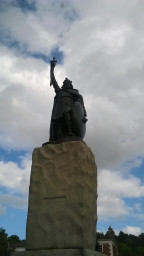
So, what should the earlier period be called? Is Dark really the wrong word? Dark can mean many different things. It might mean bad or dangerous, but it can also just mean mysterious. And that is not a bad description at all. 500 – 1000 is a time where history and mythology collide. At the beginning of the period, we have figures like King Arthur who are far more mythological than historical. Gradually the historical figures become more substantial, but even towards the end they keep their mystery. Cinaed (Kenneth) Mac Alpin is very much a historical figure, yet he is not completely. His place as Scotland’s founding father owes as much to legend as fact.
And if the men of that period are often insubstantial, the women are even more so. Lives, dates, and even names of the women who were the wives, sisters and daughters of those warrior kings were very often not recorded.
They lived thorough some of the most fascinating times in history. They must have left their mark on the people and the times. They filled many different roles. They were wives and mothers, nuns and saints, warriors and leaders, yet they have left little mark on the recorded history. They remain mysterious.
It is hard enough to find these women, even without losing them among the (for example) well recorded Norman and Plantagenet queens. Making them Women of the Middle Ages would do them a grave disservice. Mysterious and insubstantial, offering us mere glimpses of their lives, these are truly Women of the Dark Ages.
The Women of the Dark Ages novels are available on Amazon
 Kenneth’s Queen
  The Girl from Brittia


October 7, 2016
Author Interview
Read it here! http://wilseymc.blogspot.co.uk/2016/1...
September 28, 2016
Countdown deal on Kenneth’s Queen
Kenneth’s Queen is on a Countdown deal from 29th September – 6th October. Buy the ebook for just 99p or $0.99.
The Blurb
She was present at the birth of a nation.
Her descendants sit on the British throne to this day.
But history does not even record her name…
In ninth century Britain, the Picts and the Gaels are fighting for supremacy over the North. In one of their rare truces Baena, a young Pict woman is reluctantly married to a Gael warrior, son of one of the great Chiefs of Dal Riata.
Leaving behind her family and the Pict lord she had hoped to marry she travels west to the household of Alpin, where she is viewed with suspicion by many of her new kin. But it is the collapse of the truce and the indifference of her husband that leaves her position in her new land increasingly vulnerable, as war breaks out once again. Forced to forget her Pict heritage, she fears the day when she will have to make an agonising choice between the victory of her husband or her father.
Her journey will take her from the splendours of the Fortress of Dunadd to the tranquillity of the sacred Isle of Iona, where even greater danger lurks as the terrifying Norsemen plan their own attacks. However it seems that her hardest battle will be to win the heart of her husband, the brave, cunning and often ruthless Cinaed as he fights his way towards a destiny that could be greater than anyone imagines…
The man known to history as Kenneth Mac Alpin
Available on Amazon


September 23, 2016
The celebrity divorce
I take a certain amount of pride in having no interest in the Brangelina divorce or that of any other celebrity, but I question whether today’s current obsession with celebrities is really that different to my own obsession with the love lives of people who lived over a thousand years ago! The ruling classes of the Dark Ages were the celebrities of their day and no doubt there was plenty of gossip surrounding their marriages and divorces.
We often think that marriages in the past were forever and divorces were a rarity. But divorce was not uncommon in the Dark Ages. The Anglo-Saxons had detailed laws surrounding them to guide the people through the process. But when the divorce involved ruling class it became a matter of national or even international importance.
Theudebert/Wisigard/Deuteria
Theudebert I of Austrasia is the ambitious Frankish king in The Girl from Brittia. In this story he is busy meddling in his sister’s marriage, but his own marital life could be a story of its own! He was betrothed to a Lombard princess called Wisigard, but while on campaign he fell in love with a married woman named Deuteria. As soon as he became King he broke off his betrothal to Wisigard and Deuteria left her husband. Theudebert and Deuteria were probably married at this point, but Theudebert’s subjects were angered by his treatment of Wisigard and put pressure on him to send Deuteria away. Theudebert was forced to abide by his original promise. He married Wisigard, but she did not live long after the wedding. Theudebert and Deuteria were not reconciled and Theudebert married for a third time!
Lothair/Teutburga/Waldrada
This 9th century celebrity love triangle took up a lot of the time of three kings, numerous bishops, one emperor and two popes! The political marriage of Lothair II of Middle Francia and Teutburga was arranged by Lothair’s father, who died the following year. Teutburga was unable to have children and Lothair fell in love with Waldrada. From that point his reign was dominated by his need for a divorce. His uncle, Charles the Bald of West Francia was opposed to the divorce, while his other uncle Louis the German of East Francia was more supportive.
Lothair accused Teutburga of incest with her brother and rid himself of her. But she proved her innocence and to avoid conflict with her brother, Lothair was compelled to take her back.
Four years later, with the support of his brother, the Emperor Louis and the Frankish bishops, Lothair obtained an annulment and married Waldrada. But this decision was overturned by Pope Nicholas I and even an attack on Rome by the Emperor could not change his mind. Lothair was again forced to take Teutburga back.
In a strange twist – and who can blame her – Teutburga had by this time changed her mind about the marriage. Lothair travelled to Rome and at last obtained his divorce from Pope Adrian. But he did not get to enjoy it. He and his men died on their way back from Rome, his children by Waldrada were declared illegitimate and his kingdom was seized by his two uncles. The annals of the time considered this a judgement on him.
Today’s celebrity divorces seem rather tame by comparison!


September 15, 2016
Murder most Dark Age
This week is the birthday of the most famous crime writer in the world – Agatha Christie. Like many millions of others, I have loved her books and tried, usually in vain, to solve the crimes before Hercule Poirot! There are many tales of murder in the Dark Ages, so as a tribute to Agatha Christie, let’s take a look at a few!
I shall start with my favourite dynasty – the Mac Alpins. I have already described Cinaed’s (Kenneth I) crimes in gruesome detail in Kenneth’s Queen  ,but it seems his son Causantin (Constantine I) was very much a chip off the old block! The victim was King Artgal of Strathclyde. Causantin ordered or perhaps bribed the Viking chief Olaf to kill him. Artgal was Causantin’s sister’s father-in-law, so the murder paved the way to Causantin’s brother-in-law, Rhun, becoming King of Strathclyde! What Rhun thought of this is not known! And Olaf? He didn’t long survive his crime. He was killed – by Causantin!
In his biography of King Alfred, Asser describes a woman who could rival Agatha Christie for her title Queen of Crime. Offa’s daughter Eadburh was married to King Beorhtric of Wessex. It seems she dominated the court, bitterly resenting any who had influence over the King. If their influence grew too great, she poisoned them. In 802 the King had a particular favourite and whatever Eadburh’s demands he would not get rid of him. So Eadburh resorted to her old tricks. But something went wrong and the King took the poison himself! This is why, according to Asser, there were no more queens in Wessex for a long time – a woman simply could not be trusted with the title!
In 613 was the very brutal death of a Frankish queen, Brunhilda. She was a woman aged around seventy years old and she was killed by being tied to the feet of four wild horses, who tore her apart. This hideous death was the culmination of around forty years of murder and feud. Brunhilda was married to Sigebert of Austrasia, while her sister, Galswintha married Sigebert’s brother, Chilperic of Neustria. Galswintha tried to improve the morals of Chilperic’s court, but Chilperic, no doubt seeing an end to his fun, conspired with his mistress Fredegund to murder her. After the death he married Fredegund. Brunhilda never forgave Fredegund for the death of her sister. The rivalry between the two queens sparked war between the brothers and their kingdoms. Sigebert was eventually killed by poisoned daggers on the orders of Queen Fredegund. Brunhilda’s response was to marry Fredegund’s step-son, Merovech, even though she was his aunt by marriage! The marriage was later annulled and Merovech retired to a monastery. He later killed himself, or rather he ordered a servant to carry out the deed. Brunhilda ruled as regent for several generations, but was eventually captured by Fredegund’s son, who ordered her brutal execution. She was charged with the murder of no less than ten kings!
Fredegund had died some years before of natural causes. Among the crimes to her name was the attempted murder of her own daughter, who she thought would rival her for power.
An unsolved crime is the murder of Alfred the Great’s sixteen-year-old grandson, Edward the Martyr at Corfe Castle. He was the eldest son of Edward the Elder. He became King upon his father’s death, but the succession was disputed, with many favouring his younger half-brother Aethelred. He was visiting Aethelred and his step-mother Aelfthryth when the murder took place. The suspects are
Nobles in Aethelred’s service who wanted their master on the throne.
Aelfhere, a leading figure in King Edward’s (the elder) reign. A powerful man, who favoured Aethelred’s succession. He was later responsible for the reburial of Edward the Martyr.
Edward’s step-mother, Queen Aelfthryth, who considered her own son Aethelred to be the rightful heir to the throne.
Where was Hercule Poirot when they needed him?


September 9, 2016
Heroes and villains
In The trouble with Dark Age heroes I wrote about the difficulties in making warlike Dark Age leaders and in particular, Cinaed (Kenneth) Mac Alpin into the heroes that a modern audience will appreciate without avoiding the brutality in their nature and therefore rewriting history. While reading the proof of the print copy of The Girl from Brittia (hopefully out soon!) I realised that there is a character in that book who is very similar to Cinaed.
This character is not Radigis, the hero of the story. In fact I can’t imagine a character less like Cinaed, than the gentle and sensitive Radigis! There are more similarities with Wehha, the devoted warrior brother, but even here there are significant differences. Wehha lacks Cinaed’s easy command of every situation and has far more of an ability to put others before himself.
No, it seems to me that the character most like Cinaed is Theudebert, the Frankish king and dark puppet master of the story. In The Girl from Brittia he is very much the villain. Trickster, domineering, commanding, ruthless, happy to play people off against each other – I’m not even sure which of them I’m describing here! It would be very easy to write a story from the point of view of one of Cinaed’s enemies and paint him, not as the romantic hero, but as the evil villain.
In history there are very few true heroes or villains. Motives often have to be guessed at. Historical sources tend to have their bias and history is written by the winners. But in the historical novel there needs to be a point of view, a character we’re cheering on and perhaps also one we’d like to get their comeuppance. The same character can very easily be both. Think how differently the character of Anne Boleyn can appear, depending on whether the story is from her point of view or Katherine of Aragorn’s.
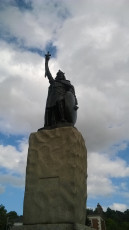 King Alfred the Great is rightly considered one of the Dark Ages’ great Kings, but he was a lot more brutal and a lot less god-fearing than the common perception.
This bias is as true for current events as it is for historical ones. When I check my phone’s news feed I can often see one article stating how well Britain is doing since Brexit (ie all Bremainers were scaremongering over nothing) while the one underneath it is about how reluctant another country is to do trade deals with us (ie we’ve got a lot of hard work to do. who know’s which side was right) and the next one is about the post-Brexit surge in hate crime (ie Bremainers were right to be worried – it’s a disaster).
So even as our own story is being written, it seems easy enough to make one event either a triumph or a disaster, depending on your source and influence people accordingly. For the historical novelists with all the pieces already in place, it’s even easier. I will never write that book from the point of view of Cinaed’s enemies. Cinaed remains the hero. But Theudebert is another matter. The Girl from Brittia is the story of Edlin and Radigis. Theudebert is in it, but it is not his story. His story remains to be told and if I were to ever tell it his role would vary depending on which of his wives featured. He could very easily go either way.
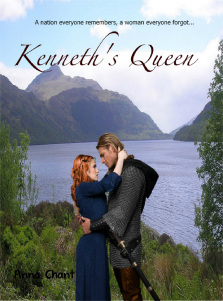 Kenneth’s Queen is available on Amazon
 The Girl from Brittia is available on Amazon


September 3, 2016
A new era – how will we cope?
Last week scientists declared that we are living in a new geological era – the Anthropocene. In fact anyone born after 1950 has always lived in it. This era is characterised by the changes on the planet wrought by one species – us.
In geological terms sixty years is tiny, so it is far too early to tell exactly how this era will go, but the early signs are not good. Climate change is already resulting in polar ice melting and rising sea levels, although not everyone agrees. There are those who deny climate change, but perhaps once dinosaurs denied the existence of asteroids. The 1950 start date of the Anthropocene was chosen to coincide with the start of nuclear tests and we still have no idea of what that could mean for our age, but it could be disaster. It is also too early to say how we architects of the Anthropocene will cope with the environmental catastrophes that may well characterise this era.
‘The Girl from Brittia’ is mostly set during the great environmental disaster of 535-6, which I described in In search of The Waste Land and in this story we see how the different characters and peoples respond to this disaster. These can be summed up in the following ways:-
Good management. Careful rationing of food allows everyone to eat.
Greed. Wealth decides who lives and who dies.
Self-sacrifice. Rations are given up to those who need them most.
Theft. Desperate people attack their more fortunate neighbours.
Blame. A superstitious people decide on a scapegoat.
Human nature has not changed much since the Dark Ages and we are undoubtedly capable of all these reactions to the environmental disasters we cause. But we still have an option that was not open to the Angles, Varni and the other people of the sixth century. There was nothing they could do about a super-volcano. We are more fortunate. We still have this option.
Prevention. The people of the 21st century recognise the potential disaster that looms. They switch to clean energy, they redistribute wealth to create a more equal society and broker peace deals to usher in a new era of co-operation.
I truly hope the historical novelists of a thousand years from now can tell that story. If not we risk the Anthropocene turning into an age even more brutal than the Dark Ages. Our species and many others are depending on us to make the right decision.
The Girl from Brittia is available on Amazon.com and Amazon.co.uk 


August 28, 2016
August 27, 2016
Edlin’s land today
Throughout my life I have been fortunate enough to regularly stay at Dunwich on the Suffolk coast. It is a village that has inspired many paintings and poems and is one of the key locations in ‘The Girl from Brittia’. Edlin, the Girl from Brittia, was very likely from Suffolk, but placing her at Dunwich is simply my way of realising a long-held ambition to set a novel there. This story is set in the sixth century in a Dunwich (Dunmoc) that had not yet seen its heyday or its decline.
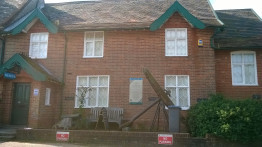 Dunwich Museum – learn about the lost city here!
I recently made my first visit to Dunwich since the completion of ‘The Girl from Brittia’ and it was a fascinating experience walking around the village and imagining how different things were for Edlin and how they have remained the same.
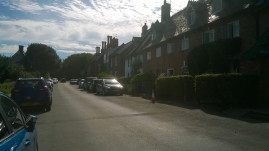 No huts now! Dunwich today.
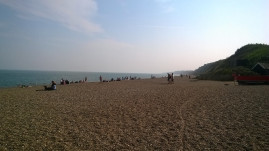 Wilhelm’s fictional burial place has long since crumbled into the sea, but the sandy cliffs are still there. The views of the grey sea from Dunwich beach are not so different for us as they were for Edlin – particularly on a hazy day when Sizewell Nuclear Powerstation is obscured!
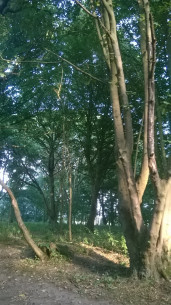 You can still walk in the woods nearby, just as Edlin and Radigis do.
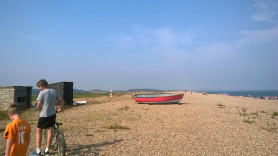 The great harbour that Edlin rowed from was destroyed in medieval times, but fishing boats still go from this coast and you can enjoy the freshly caught fish just as Edlin did.
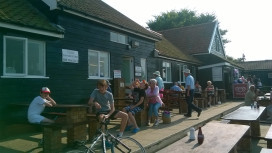 Although you can enjoy yours with chips at Dunwich Beach cafe!
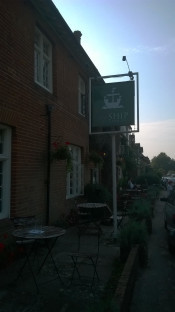 Edlin’s staple drink was the local ale. You too can drink the local ale at the Dunwich pub, The Ship.
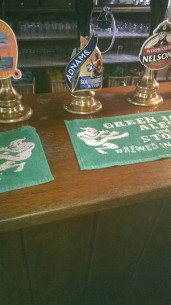 Although this is stronger and tastier than the watery ale she would have drunk.
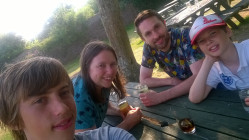 Just as in Edlin’s day, Dunwich is a fabulous place to celebrate with family and friends!
The Girl from Brittia is available on Amazon.co.uk and Amazon.com