Anna Chant's Blog, page 16
January 20, 2017
How to become a Dark Age leader
Today sees the inauguration of Donald Trump, the new president of the US and much of the world is still mystified how that came about. The process in the Dark Ages was often equally mystifying with many different methods of gaining control.
Be the son of a king: This wasn’t a reliable way to be a Dark Ages leader, as mostly the people of the Dark Ages had more sense than to choose a leader just because his father was a king, but being born into a royal family definitely helped. Example: Athelwulf of Wessex. In 839 he was the first Wessex king in generations to succeed from his father. Even then it took a special synod for King Egbert to arrange it and Athelwulf already had leadership experience as King of Kent.
Be the brother of a king: This was quite a common method. The brother of the previous king was more likely than his son to be a grown man with experience in battle and administration. Examples: Alfred the Great and Domnall Mac Alpin (Donald I) both inherited from their older brothers, even though their brothers left sons.
[image error] Alfred the Great is not normally considered a wicked uncle figure, but his accession ended any ambitions of his nephews!
Be the widow of a king: The USA may not be ready for a woman leader yet, but places in Europe accepted it over 1000 years ago! Examples: Aethelflaed the Lady of the Mercians, led armies and ruled Mercia after the death of her husband. Adelaide of Italy, regent of the Empire briefly for her son and again for her grandson.
[image error]
Help the pope: If the Pope was in trouble, helping him was a good way to gain a position of power. You might even get to be emperor! Examples: Charles the Great (Charlemagne) defended the Pope from having his tongue cut out. Otto the Great came to the Pope’s aid when the papal states were under attack.
[image error]
Elope with or abduct a princess: Probably a risky strategy, but it worked for the first Margrave of Flanders who stole away the daughter of Charles the Bald.
[image error]
Take advantage of a national disaster, make a few dodgy alliances, murder all your opponents and get everyone drunk!: Yes, that’s the method favoured by Dark Age poster boy Cinaed Mac Alpin.
I can’t help wondering if that last method played a part in some of the political decisions of the last year or maybe it’s just what will get us through the next ones!
[image error]



December 28, 2016
2016 – the year I lost a continent but gained a whole world
2016 has been a peculiar year, a year of loss. There has been an unusually high record of celebrity deaths this year and the world has lost some bright talents. I have been saddened in the last few days to hear of the deaths of George Michael, Richard Adams and Carrie Fisher – people who helped create the musical, literary and fantasy world of my childhood.
[image error]
But sad as these losses are, for me the biggest loss of the year was Brexit. Losing that sense of European identity is one I am finding very hard to get over. The debate rumbles on as to what it’s going to do for issues such as the economy, jobs and immigration. But these were not the issues which motivated me. For me Brexit is about the loss of a dream. The idea that a continent could work together to tackle common problems was an inspiring one. The EU is far from a perfect organisation, but then so are the countries including the UK which formed it. However it was a massive step in the right direction and the issues facing the world today such as climate change, cybercrime and extremism seemed more manageable when countries were in a position to work together. World peace now seems a little further away.
However 2016 was also the year I gained a whole world, by which I mean that mysterious Dark Age world I escape to whenever I have the chance. It is strange to think that this time last year Kenneth’s Queen was still in its early stages with no real sign of how it was to draw me into its world. This world of course no longer exists. Perhaps it never really existed, as the world I visit is created from my interpretation of the facts, rather than the facts themselves. But while I am glad of the escape from the 21st century, I wonder what would those women and men think of the year 2016? How would Edlin, the Island Girl, react to Brexit as a first generation immigrant, proud of her European roots yet still every inch a girl from East Anglia? I can imagine only too clearly what Cinaed and Domnall would have to say about Scottish independence after being cheated of their glorious European alliance by the perfidious Angles! And as for Judith, Athelwulf and Alfred, they would surely be agog at us throwing away the sort of European alliance they could only dream of.
[image error]
That is not to say I want to hold my Dark Age world up as any sort of ideal. It was not. Child and maternal mortality were very high, simple infections could and did kill and women were often treated as possessions rather than people. Yet for much of the world little has changed and even though we now have the knowledge and skills to change it, we do not seem to have the will. I could argue that in a way that makes our world more backwards than theirs.
[image error]
So what will 2o17 bring? For me I hope there will be at least two new books. Their timelines are already taking shape and I hope to break ground on the first one soon. The first big event of 2017 for the world will presumably be the inauguration of Donald Trump. At that point the world will hold its breath and hope for best. Can any hope be gained from my Dark Age world? They lived through some dangerous and uncertain times. Terrorism, incompetent or thuggish leaders, and extremism are nothing new. But they adapted and survived. In the winter of 878, the future must have seemed bleak for Dark Age Wessex. The Vikings were victorious and their king was skulking around the Somerset marshes, powerless. There seemed no hope, but the Battle of Edington and years of relative peace and innovation under their remarkable leader King Alfred were just around the corner. Perhaps 2017 will bring for us just such a turning of the tide.
[image error]
For anyone wanting to join me in a touch of Dark Ages escapism the Women of theDark Ages series is available on Amazon.
[image error] Kenneth’s Queen [image error] The Girl from Brittia
[image error] Three Times the Lady
T


December 17, 2016
A star-studded cast
If Three Times the Lady was a film, it would be described as having a star-studded cast, set in spectacular locations. From the early scenes in the Frankish splendour of Verberie, before moving on to the Wessex capital – Winchester, this book takes in some of the greatest power centres of the Dark Ages.
[image error]
The supporting cast includes the great ecclesiastical figures of the age: Pope Nicholas I, Archbishop Hincmar of Rheims and Saint Swithun – yes, the man who ruins the British summer every year! Although to Judith and her Wessex family he was not yet a saint but a friend, teacher, advisor and Bishop of Winchester.
[image error]
But centre stage are the regal figures, including Charles the Bald, Louis the Stammerer and a host of Wessex kings. And in his first major role a young Prince Alfred of Wessex. (There’s a GREAT future for this young man!)
[image error]
Among these super-stars of the Dark Ages, is the elusive figure of the heroine of the story. Somehow in this male-dominated world, she not only keeps herself firmly at the heart of the action, but also introduces a new figure onto the tumultuous stage of Dark Age politics. She truly is the star of the show. Lay out the red carpet for this remarkable Wessex queen – Judith of West Francia – Three Times the Lady!
[image error]
Three Times the Lady is available on Amazon


December 8, 2016
Did Alfred’s parents love him the most?
According to Asser in his biography of King Alfred, Alfred’s father and mother loved him above his brothers and sister. Now, in all honesty, Asser probably did not mean very much by that. It was probably just his way of saying how amazing his patron was, that even as a young boy he appeared better than everyone else. It would never have occured to him that over a thousand years later anyone would judge Athelwulf and Osburh for their supposed favouritism!
But is there any possibility Asser based that statement on something Alfred had said? Alfred’s father, Athelwulf, died when Alfred was eight or nine. However it did seem that the two were close. It was Alfred who accompanied Athelwulf on his year long pilgrimage to Rome. Three of Alfred’s brothers were considerbly older than him – fully grown or almost when Alfred was born. Inevitably their relationship with their father would seem very different. His sister was married to a Mercian king and so would have seen little of her family. In many ways to Alfred it must have seemed that the only rival for his father’s affections was his brother Ethelred, who was just a year or two older.
Alfred’s mother, Osburh, probably died when Alfred was no more than five or six. At that age, Alfred had already spent some time in Rome. I would question how clearly Alfred even remembered his mother. The story where Osburh rewards Alfred with a precious book of Saxon tales is, to me, all the more poignant as I wonder if this is one of the few clear memories he has of his mother. I doubt very much if he would remember her clearly enough to be able to judge which son she favoured. So Asser’s statement seems unlikely.
But Alfred had another parent – his young stepmother, the Frankish princess, Judith of West Francia. Is it possible that she loved Alfred more than his brothers and sister? There are reasons why this could be the case.
Alfred was present at the Frank court where Judith and Athelwulf were betrothed and then married three months later. Judith, therefore, got to know Alfred before her other stepchildren.
During that time Athelwulf may have accompanied the Frank king on a campaign against the Vikings. Presumably seven-year-old Alfred did not go with them and may have been left in the care of his future stepmother.
The language barrier which must have initially existed between Judith and her stepchildren, may not have been as acute with Alfred. Alfred had travelled extensively through Frankish lands and we know Alfred was good at languages.
A year is a long time in the life of a seven-year-old. Wessex may have seemed almost as unfamiliar to Alfred as it did to Judith.
By the time Judith came to Wessex, Athelwulf’s daughter was married, Athelstan, his eldest son was dead and Athelbald and Ethelbert were ruling elsewhere in Wessex and Kent. It is likely that only Alfred and Ethelred were frequently at the same residence as Judith.
Alfred did not enjoy good health. It is possible that this kept him tied to the court and perhaps the care of his stepmother.
the age gap between Judith and Alfred was between five and seven years. As a parent of a seven-year-old and a fourteen-year-old, I know that sort of age gap is just big enough for the older to covet a more parental role. If Judith felt like a mother to any of her stepchildren, it would have been to Alfred.
So I think I could make a good case for saying that Judith did indeed love Alfred above his brothers and sister. However later events suggest that even if Judith was fond of Alfred, he may not have been the one she loved most. But that is another story!
And you can read Judith’s story here: Three Times the Lady 


December 5, 2016
Three Times the Lady
A Frankish princess, a Wessex queen. Discover the remarkable true story of Judith of West Francia!
As a daughter of King Charles of West Francia, Judith has always known that her destiny lies in a nunnery. But Judith longs for a very different life. She dreams of fine clothes, a household of her own, children and a handsome husband.
Athelwulf the ageing, but kindly King of Wessex is far from the romantic figure she has dreamed of, but when he proposes marriage, Judith seizes her chance to escape the religious life. She takes her place at his side as Queen of Wessex, a role she is certain she will fulfil to perfection.
At the Court of Winchester Judith’s life is dominated by her stepsons. She quickly forms a bond with the youngest, the engaging Prince Alfred, but finds very different emotions are stirred by his older brother, the rebellious and cynical Athelbald.
However, while marriage to a man nearly four times her age may not be exactly what she wanted, she discovers it has its advantages. He is both generous and indulgent. He also leaves her with the prospect of a long and often scandalous widowhood, as the determined young woman battles heartbreak and imprisonment, while never giving up hope of finding happiness – no matter how far she has to travel to find it…
Three Times the Lady is available on Amazon


November 29, 2016
Scotland’s patron saint
In England’s patron saint I considered whether Saint George was the best patron saint for England and in many ways I could make a similar argument for Scotland. Like Saint George, Saint Andrew never came to Scotland and like England, Scotland has other options – Saint Columba and Saint Margaret are two examples that immediately spring to mind. Yet somehow, Saint Andrew feels like he belongs to Scotland. Perhaps because his association originates from a time when the nation of Scotland was in its gestation.
There are a number of legends, but the most popular one is that the Picts and the Scots had come together to raid the Angles, but were chased away, finally having to face their foes at Athelstaneford. When all seemed hopeless Saint Andrew appeared to the Pict king, Angus, promising him victory and when the Picts and the Scots faced the Angles the next day the cross of Saint Andrew appeared in the sky uniting the two groups in their victory. The traditional date for this battle is in the 830s and among the combatants was said to be the Scot king of Dal Riata, Eochaidh the Venomous and his more famous grandson Cinaed (Kenneth) mac Alpin.
I described this battle in flashback in Kenneth’s Queen from the point of view of Cinaed’s father-in-law. Later in the book Cinaed too mentions it and it is clear that this battle has caused the far-sighted young man to realise how much more could be achieved if the Picts and Scots stopped squabbling with each other and instead united as they did on the day the cross of Saint Andrew floated above them in the sky. Like so much of Scottish history at that time it is hard to know where the legends end and the history begins. But if Cinaed was there, what was it like for him?
 Battle of Athalstaneford – Cinaed’s story
The chase had gone on all day. None of them could understand it. Their victory should have been assured, but the Angles had mustered more men than they believed possible to mount a vicious fight back. The Picts had blamed the Gaels. If King Eochaidh of Dal Riata had not attacked that last settlement, they could have returned victorious. The Gaels had blamed the Picts. If Oengus, Rex Pictorum, had not laden his men with so much plunder, they might have moved faster.
But whoever was to blame it had ended here at the stone ford, surrounded by the Angle forces and outnumbered many times over.
Eochaidh’s three grandsons Cinaed, Graunt and Domnall were firm in blaming the Picts for their plight as they holed up in an abbey by the ford.
“Be silent, lads,” Cinaed’s father Alpin snapped. “This does not help us now.”
“What will help us?” Cinaed asked. “We are trapped. Tomorrow we die.”
“We may be able to defend this abbey,” Alpin said.
Graunt shook his head, knowing his uncle was just trying to put heart into them. “This abbey was not built for defence.”
“We should attack, Father,” Domnall put in. “If we die, at least we die in a fight not like rats in a trap.”
“That is what King Oengus has said,” Alpin replied. “But your grandfather is not so sure. He thinks defending the abbey may give us a chance.”
Normally Cinaed and Graunt would have teased Domnall for siding with the Picts, but that night they had no heart for it. They ate a simple meal, wrapped themselves in their cloaks and tried to sleep.
Next morning the three awoke early to a fine day. It seemed wrong that such a glorious dawn was heralding the day they would die. They stood close to where Eochaidh and Alpin were gathering the Gael troops.
“We must try to stay together in the fight,” Domnall said to the others.
“Agreed,” said Cinaed. “If I die this day, at least I die with my brothers by my side.”
Graunt embraced his two cousins. They had been raised together and were brothers to him.
“Eochaidh! Eochaidh!” came an excited voice, as Oengus burst onto the Gael lines. “We must attack. I have had a sign. The blessed Saint Andrew appeared in my dreams. He has promised us a victory if we all attack.”
“What nonsense,” snorted Alpin. “Save those tales for the gullible young lads like those three.” He gestured at Cinaed. “It is wasted on us.”
“No Alpin, look!” Eochaidh cried, pointing to the sky.
The sky was of the clearest blue, cloudless except for one. And that one had made a perfect cross, startlingly white against the blue background. Its arms stretched over both Gaels and Picts alike. “It’s the sign,” Oengus cried.
“Attack!” Eochaidh and Oengus shouted together.
There was no time for the lines to form. Picts and Gaels charged together towards the advancing Angle troops. Cinaed quickly lost Domnall and Graunt. He found himself next to a Pict man, considerably older than himself. The fighting was as fierce as they had expected and many men fell. But although greatly outnumbered, they slowly drove back the Angle forces. Cinaed received several cuts to his arm, but somehow escaped serious injury. So intent was he on fighting, that he had not even realised the Angles had turned.
“You can stop now, lad,” the Pict man said. “The Angles are finished. See them run!”
Cinaed removed his helmet, a grin of pride spreading across his face. The Pict man was a stranger, but they embraced as if they were old friends.
“I am Lord Causantin,” the man said. “Leader of one of the Pict royal houses. You are a fine warrior. I do not know when I have seen finer.”
“I am Cinaed Mac Alpin. It was an honour to fight alongside you and your people. It seems we do better when we stand together.”
“So you are Alpin’s son. The ties between our people should be strengthened. Tell me, Cinaed, are you wed yet? I have a daughter.”
 To find out the implications of this marriage, both for the couple and for Scotland, Kenneth’s Queen is available on Amazon


November 20, 2016
England’s patron saint
Today is the feast of Saint Edmund, England’s original patron saint. In many ways he has more to offer than Saint George. He was a King of East Anglia, who fought alongside Alfred the Great, unlike Saint George who never came here. Saint George is also rather a busy patron saint, with many other places to consider. George became the patron saint of England on the order of Edward III, but his unfortunate links with the crusaders (he was said to have appeared to the crusader army at Antioch in 1098) makes him a difficult saint for all English to get behind.
While Saint Edmund, a man who died rather than betray his country, is an excellent possibility for a new patron saint, he is not the only candidate. Others could include
Saint Alban – The first recorded British martyr, predating Saint Edmund the Marty by (possibly) over 600 years
Saint Augustine – As the head of the church of England is the Archbishop of Canterbury, surely Saint Augustine, the first Archbishop would be a good choice. A friend of Pope Gregory the Great, he is styled Apostle to the English.
Saint Felix – Another saint associated with East Anglia and the man credited with bringing Christianity to East Anglia. I am biased here as his see was (probably) at my favourite place – Dunwich. Dunwich today
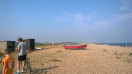
Saint Petroc – A saint which takes into account England’s Celtic heritage and one of the best candidates from the West Country.
Saint Hilda – Representing both women and the North, this wise woman was consulted by Kings and was the founding abbess of Whitby Abbey.
Saint Swithun – My personal favourite. Advisor to the Wessex Kings, Egbert and Athelwulf and a teacher to Alfred the Great.
 A humble man, who gave us the English summer – if it rains on his feast day it will rain for the next forty days! Given almost everyone in England has moaned about the weather at some point, Saint Swithun is surely one saint who can truly be for all the English!
So, Saint George, Saint Edmund or someone else. What do you think?


October 31, 2016
Ghosts of the Dark Age
It’s the 31st of October, so what better time to tell of some peculiar goings-on from more than 1000 years ago! Back in the Dark Ages people too must have told stories at this time of year, as the harvest was completed, travel became harder and the nights became darker…
The Battle of the Catalaunian Plains in AD 451 was a bloody and brutal one by anyone’s standards. Attila and the Huns fought against the combined Roman and Visigothic forces under the command of the Roman general Flavius Aetius and the Visigothic King Theoderic. The result of the battle was uncertain, as although Attila was defeated he escaped and continued his campaigns against Rome. It is also not known how many fought and died, but casualties may well have gone into the thousands or even tens of thousands. The battle was fought in the evening and so it was not until the next day that the true extent of the slaughter was apparent with the battlefield piled high with bodies. The blood is said to have swelled the river, so the survivors when quenching their thirst drank the blood of their comrades. Perhaps it is not surprising in so terrible a battle that the ghosts of the fallen were said to have fought on for three days after the battle ended, the clash of weapons and screams of pain heard by all…
In January 897 Pope Formosus stood trial for various crimes including usurping the papacy. There is nothing particularly strange about that, except Pope Formosus had died the year before! This trial is known as the Cadaver Synod or Synodus Horrenda and a horrendous spectacle it must have been! On the orders of Pope Stephen, the rotting corpse of Formosus was removed from his tomb, dressed in papal robes and propped up on a chair to stand trial. He was found guilty on all counts and as a punishment was stripped of his papal regalia and had three fingers chopped off. He was initially reburied, but then in a final indignity he was brought out again and thrown into the River Tiber. After washing up on the banks, this rotting corpse was said to have performed miracles. Public opinion swung against Pope Stephen – he was thrown into prison and strangled. The new pope overturned the verdict of the Cadaver Synod, reburied Formosus in Saint Peters in his papal robes and, sensibly, passed a ban on future trials of the dead!

The Frankish annals of St Bertin mention on several occasions what seem to be UFOs. For example this comment from 859 ‘In August, September and October, armies were seen in the sky at night: a brightness like that of daylight shone out unbroken from the east right to the north and bloody columns came streaming out from it.’ and this in 860 ‘On the night following 4 April, when the ninth moon had begun, a sort of horned darkness – the very same shape as the shining moon is said to have – appeared across the middle of the moon causing it to shine on at either end but be obscured in the middle.’ and this in 855 ‘That same month, two shooting stars, one larger, one smaller, were seen travelling from the western part of the sky to the eastern. This happened ten times with them appearing alternately: while the larger star stayed, the smaller was sometimes quite invisible.’ Could these be Dark Age descriptions of spacecraft? Odd times, it seems, for the ninth century Franks!

Happy Halloween! Sleep well!


October 30, 2016
A Dark Night in the Dark Ages – Part three
See here for Part One and Part two
Baena and Domnall exchanged glances. “It’s not like you to be frightened,” Baena commented. She was not particularly fond of her brother-in-law, but on that night she was glad of the company.
“Did you know that a little more than a year ago, it was Cinaed who led the assault on tis castle.”
“Where you there as well?” she asked.
“Of course. You know Cinaed and I always fight together.”
“Did many die that day?”
Domnall shook his head. “They were not prepared for a fight. All fled, except for an Old Norse woman. I think she was the widow of the man who had once owned the castle. She refused to leave. She even challenged Cinaed to a fight for the castle.”
“What did Cinaed do?”
“What do you think he did? You know he won’t hurt women. And this woman was old and lame. She walked with a stick which she scraped along the floor after each step.”
“A scrape?” Baena’s face drained of colour. “I heard a scraping sound in the bedchamber. What happened to the old woman?”
“Cinaed ignored her, looted the castle for what treasures it had and ordered the men to set fire to the place.”
“Was she trapped in the fire?”
“She shouldn’t have been. None of us would have stopped her escaping, but she didn’t. As the fire built up she screamed an old Norse at us before throwing herself into the flames. I’ve never seen a death like it. We tried to get her out, but none of us could get close enough. It was like a furnace. You know I have Norse blood in me. I cannot dismiss the curse as Cinaed does.”
Baena shuddered, pulling a blanket around her shoulders. “What does it mean?” she whispered.
“I don’t know. You are right, Sister. Very little frightens me. But the instant I stepped into that chamber, the one next to yours, I felt a fear such as I have never felt before. I was certain that if I blew out my candle, I would never see light again.”
“Are we safe? Is Cinaed safe?”
“I feel safe enough out here,” Domnall replied. “As for Cinaed… I don’t know. He does not seem to feel the fear I felt.” Domnall gave a sudden smile. “Perhaps he is a braver man than I after all, but do not tell him I said that.”
Relieved at the flicker of humour, Baena said no more but did her best to make herself comfortable. Both she and Domnall fell into an uneasy doze by the fire. They were quickly woken again. “Everyone awake, now,” Cinaed shouted. “We are marching on.”
“It’s still dark,” Domnall protested. “How can we march now?”
“We’ll not go far,” Cinaed said. “But move, now.” Everyone stared at him. “I mean now. Everyone do as you’re ordered.”
There was much grumbling from the sleepy clansmen and women. But Cinaed yelled at them until they moved.
“You’re in a bad mood, Cinaed. What happened in that chamber?” Domnall asked, as they assembled by their horses.
Cinaed gave a fearful glance back. He pulled Baena into his arms and kissed the top of her head. “God be praised you were not in there.”
“What did you see, Cinaed?” Baena asked softly, as Cinaed helped her onto her horse.
Cinaed looked back at the ruins of the castle gleaming in the moonlight. “It is best if you never know.”
To hear more about the lives of Baena, Cinaed and Domnall and the tumultuous events of 9th century Scotland Kenneth’s Queen is available on Amazon 


October 27, 2016
A Dark Night in the Dark Ages – Part two
Click here for Part one of this spooky tale! 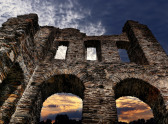
Carefully shielding her candle, Baena went towards the chamber. At the door she glanced back at the men. The firelight seemed to be far away. She fought the urge to run back to Cinaed and entered the chamber. To her relief the flame remained steady, although it barely pierced the darkness. Slowly she walked towards the bed. It reeked of smoke. Her candle cast a pool of light over the blankets that usually seemed so inviting. The noise of the men by the fire barely filtered into the room. She looked at the doorway, which stood like a bright beacon beyond the chasm of darkness that filled the room. Baena did not undress, but sat uneasily staring at her candle.
As she tried to take comfort from the occasional burst of laughter from the hall, there came a much closer sound that made her start. A faint rustle, as if a cloak was trailing along the ground, came from the corner. Terrified that she was not alone, Baena squeezed her eyes shut and began muttering prayers. The sound seemed to come closer, and then from another direction she caught the sound of faint breathing. Suddenly a hand touched her shoulder and she screamed.
“What is the matter with you this night?” Cinaed demanded. He looked annoyed, but Baena didn’t care. She flung herself into his arms, her body trembling. Somewhat impatiently he stroked her hair.
“I don’t like this place. It frightens me.”
“What is wrong with it? It’s the most comfort we’ve had since leaving Dunadd.”
“I don’t want to stay here.”
“It’s just one night. You’re tired and it’s making you imagine terrors where there are none. Come, lie down.” The frown faded as he met her frightened eyes. “You know I’ll defend you against anything.”
Baena refused to undress and lay very tensely in his arms that night, flinching at every sound. It was obvious that Cinaed was getting more annoyed. He moved across the bed, but Baena followed him, burying her face in his hair, her panic increasing. The flame of the candle flickered again.
“Just lie still,” Cinaed ordered. “We’re neither of us getting any rest.”
Another sound came from the dark corner. It was a scraping sound, as if something was dragging along the cold stones of the floor. Slowly it edged closer to the bed. The flame of the candle flickered more than ever. It was obvious that whatever was scraping along the floor, would soon be right next to them.
“What was that?” she cried, clinging tighter to Cinaed and not daring to turn over.
“Nothing. There’s probably rats in here. Just go to sleep.”
“I can’t. Please, Cinaed, I can’t stay in here.”
With an angry sigh, Cinaed flung on his tunic. Without a word he took her back to the open hall, looking thoroughly fed up. For once Baena did not care that she had annoyed him. She almost cried with the relief as they emerged from the chamber. Outside, in the roofless hall, it was cold, but Baena pulled a blanket tightly around her shoulders and moved even further away from the dark chamber. Never had the twinkle of stars peeking through the rafters, been so welcome. To their surprise Domnall was sat by the remains of the fire.
“Why are you still up, Brother?” Cinaed called. “I thought I ordered everyone to their rest an age ago.”
“I am not sleeping in those chambers,” Domnall said. “There’s something not right.”
“Not you as well,” Cinaed sighed. “I am tired. I am going to bed. Baena, you can stay here with Domnall. Domnall, if you so much as touch Baena I will kill you. Good night to you both.”
Baena bit her lip as Cinaed headed into the shadows. “Cinaed, please stay here with me.”
But an angry snort was the only reply she got as the dark doorway of the chamber enveloped him…
To be continued…