Skye Lansing's Blog, page 8
March 21, 2016
Better: Enemy of Good Enough
There are a number of little tidbits of advice I got when I was young that either didn’t make sense at the time, or I never realized I had been given until later. One that sticks out in my mind was a saying I heard an old, retired engineer relate a story about how the designers at the shipyard he worked at were always given a deadline by the Navy, after which they could no longer make improvements to the ship plans unless definite safety concerns were raised. Apparently this was necessary because the engineers were always tinkering with the plans, trying to squeeze out every drop of efficiency possible.
“Better is the enemy of Good Enough,” he said.
The saying stuck with me because it was so different from everything else I’d heard while growing up. They tell you to always try your best. That it is important to learn to do things right. Practice makes perfect—or rather perfect practice makes perfect! If you enter an undergraduate science program the need for accuracy and precision gets hammered in even harder. Experiencing all of that makes it easy to conclude that something that is simply “good enough” is unacceptable.
But the saying continued to stick in my head, and ultimately my experiences writing saved me I think. It feels strange to say that, because I doubt there will ever be a story I’ve worked on that I will feel was good enough (or even acceptable) when looking back on it. This holds true no matter how happy I was with the story when I finally set it aside. In fact, it seems the happier I was with something when I finished working on it the more I will find at fault later on.
Such is the way of things.
However, for all that I eventually learned there are different standards of “good enough” depending on what you are working on, or even what stage of work you are at. For the longest time I had trouble finishing any writing project longer than perhaps 10,000 words. I would come back, look at what was already down, and just begin to improve or fix or tweak things until I was satisfied before I could stand to write anything new. Often I would change the same parts over and over. By the time I started to make progress again I might only write a couple hundred words for the day.
Here’s the thing: while working on In Honor’s Shadow I eventually realized doing that was killing my motivation because I simply couldn’t make progress. I was stuck on the same parts for literal months because I wasn’t satisfied. That is frustrating.
Eventually I threw my hands in the air and just started writing and ignored the many problems I knew existed in my story. Just finishing was “good enough” for right then. After I could go through and find the biggest problems that needed fixing. I learned that often any effort put in after reaching the point of “good enough” is wasted, because you might not even know where the effort needs to go.
This became a lifesaver when I got serious about editing as well. At first I tried to fix everything at once, but that was driving me insane. My solution was to pick a few types of problems every pass and focus on them. That was good enough for that pass, and I would do another to fix other problems later. And then another for still other problems.
The main lesson is that “Good Enough” isn’t a rule to excuse half-assed effort. You still apply yourself fully, still do the best you can. Instead it is a rule about how to expend that effort.
You decide to tell a story, so you sit down and write the very best rough draft you can so the basic story is in place. Good enough. You decide the story needs better pacing and structure, so you buckle down and fix those to the best of your ability. Good enough. Time to dig in a bit more and make sure the language and flow of your sentences and paragraphs work to your advantage. Good enough. Each step brings you closer to the finish, but if you tried to tackle them all at once it would overwhelm you easily.


March 14, 2016
Childhood Stories
When I was younger I spent a lot of time camping with the Boy Scouts. We went roughly once a month, and during the trips I would listen to the adults share stories they’d gathered over their lives. Of course, being a young teenage boy the ones about stuff that happened in the military always caught my attention.
I cannot say for sure if any of this actually happened, and if it did I have almost certainly gotten details wrong. Because of that I’m calling this a work of fiction, but I hope you enjoy the story. I have tried to write exactly as I remember it being told.
This’ll Be Cool
Before I retired I had this buddy that served in the military who had a story about working the radios for an artillery unit. He’d been assigned to a 105mm howitzer that was engaging in target practice on some island in the pacific.
Their target was this concrete bunker that had been set up on a hill, and they’d been shooting at it for some time. They were getting plenty of hits, but the engineers that had built the thing had done a great job. Even though they could see their shells landing direct hits on the bunker there were no visible signs that it had been damaged. It certainly hadn’t been destroyed.
It was about then that he heard a call come over the radio: “This is the USS Missouri operating fifteen miles off the coast. Looks like you’re having a little trouble there. Want some help?”
A few thoughts should have gone through his mind at this point. For example, should he ask the commander first? Was this against regulation? Was this even safe?
Instead, being a young 20-something, the only thought to go through his head was this: Gosh, this’ll be cool.
He immediately radioed back to say that sounded great, and was promptly asked for map coordinates to the target, which he gladly provided. From there he just sat back and eagerly awaited the show.
After perhaps 10 minutes he heard a sound like a freight train flying through the air, and before anyone had a chance to wonder what it was the entire hilltop exploded as it was hammered by 16-inch shells. When the dust finally cleared the target was gone along with the rest of the hilltop.
And the commander was pissed. This was dangerous, stupid, against regulation, and worse of all had made the 105 look like a child’s toy off of nothing no more solid than a set of map coordinates.
March 7, 2016
The Emotion Cycle
As I’ve just recently started work on the sequel to In Honor’s Shadow and the second book in my new Honor’s Path series there’s been something on my mind about the emotional changes that dominate the different stages of a project (at least for me). I’m not sure if this is something unique to myself, though by talking to others I get the impression that most people doing creative work undergo something similar.
Perhaps this will be useful to someone, somewhere. If not, perhaps it will give a bit of insight into my personal creative process.
Fear of Starting
This is something that tends to set in just as I’m getting ready to start working on a new project. It isn’t a gripping, immediate fear. Rather, it subtly whispers in my ear to make me second guess myself.
I’ve seen this take many forms. Usually it is simply my being discouraged by the sheer scope of a project, looking at the mountain of work I’m about to commit to until I begin to wonder “Is this really something I want to do?” Oddly this often manifests as a worry that I’ll simply abandon the project half-done, urging me to drop it now before I get my hands dirty. After all, at least then I wouldn’t have wasted my time, right?
There are plenty of other forms as well, however. It isn’t unusual for me to wonder if the concept is any good to start with. Or if my skills are up to the task. Or worry over if anybody will even care about what I’ve created. The thing is these are all rational things to be concerned over, but simply accepting them is just giving in. There’s only one way to find out, to improve, and that is to force myself to work.
One of the sneakiest types of fear I’ve encountered involved doubts about my research. I started to question if I really knew enough about my setting, and felt the urge to run back to the library and Google to find more information. I very nearly did just that, only to realize it was the same fear looking for an excuse to put things off a little longer. I can always go back to look up information if I find there is something I don’t know, but time spent not writing is time lost.
Believe me when I say it is always worst right before I begin. I’ll feel it grip my heart and refuse to let go. My friends can attest that I’ll begin to question my ability, coming to them and confessing how frightened I am to start, asking for assurances that I can do it. That I am ready. But then, inevitably, it is time to push forward.
Relief of Beginning
I don’t always know where to start writing on a new project, but without fail the moment I begin putting words to paper there is a profound sense of relief. The words are coming now, and even if I’m not 100% confident of where I’m headed at least I can say I’m making progress.
The feeling is all the more profound because of having just shouldered past the very worst of the fear. Oh it is still there, but now it is easy for me to see just how badly I was allowing it to deceive me. Even if I need to make several attempts to find the right way to open the story there is such a contrast to the oppression I was languishing under that I hardly mind.
## The Grind of Work
I’m not sure when the transition to this phase happens. After the first several pages? The first five thousand words? The first two chapters? It doesn’t matter, though. The shift is inevitable, such happiness and joy is just impossible to hold on to for too long.
Perhaps I should say here that I don’t mean to say I find the grind depressing, although at first it might seem this way. Like all work that is worth doing I find it rewarding. There is a sense of achievement that comes with watching the story gradually grow and take form. Every tiny goal passed brings me that much closer to a complete project.
So no, I do not find the work depressing; it doesn’t drag me down. It does, however, need discipline. Every day I need to sit down and put in my time. Some days I’m tired. Some days I would rather do something else. Some days I might even have to go out of my way to avoid things I would enjoy, because at the end of the day I need to write. Those little sacrifices can hurt.
It can also be a very lonely experience. There is this idea in my brain that I am trying to give form, and no matter how close I am to someone it is difficult to really make them see. Often I find myself wondering if even the product will do it justice.
In the end I cling to the promise of what I’m doing, and from that find the strength to continue.
Getting Lost
Here is an area that I rarely fall into these days, but despite that it is one I know well. Some call it writer’s block, I call it bad planning. At some point I’ll just encounter a place in the story and realize I’m not sure how to proceed.
It is very easy to let this fall back into fear, giving in to the feeling that I am not worthy to work on this tale, but over time I’ve come to believe that is just the liar inside me trying to draw me back. Inevitably one of two things has happened:
1. I failed to properly plan this section of the story and am seeing that reflected by my inability to move forward.
2. Somewhere along the line I have gone awry and the characters’ actions no longer make sense.
In either case the solution is the same. Sit down and put in the work. It doesn’t matter if I have to rewrite a page, or a chapter, or try idea after idea while only managing to churn out a single sentence. If left alone a “writer’s block” can kill a story. I’ve experienced that more times than I care to admit.
Unacceptable. So I sit down and put in the work, attacking it from every angle I can devise. When that doesn’t work, I imagine other solutions. Then, inevitably, the block falls away and the momentum can begin again. Back to the grind of work.
Editing, Revision, and Doubt
Once the rough draft is finished, and once I have some distance from it, it is time to begin evaluating what I have. Back when I was starting out this was my least favorite moment because I didn’t like to see the flaws in my work. Now I love it, love to see how each change improves my stories step by step even if it is subtle. Still, these moments come with a lot of baggage.
I am convinced it is impossible to properly revise a work without someone else looking over the piece. Oh, I can get very close on my own; I like to believe I’m a pretty good self-editor. Even so, I am constantly surprised by what others find in my work that I completely missed. After a certain number of hours I am just too close to the work. I know how it is supposed to be, so that is what I see, and it makes me blind to what is actually on the page.
However this doesn’t mean I believe it is perfect. In fact, there comes a point where I lose any ability to tell if it is good or bad. By the time I was finished with In Honor’s Shadow I completely stopped making my own edits because I realized, to my dismay, that I simply couldn’t tell if the changes I wanted were good for the story or not. Again, I was too close and had looked at it too long (I’m sure setting it aside for a month or two would have fixed the problem).
On top of all this is the fear that I only think it is good because I wrote it. Maybe others will feel the work is unfinished. Maybe they will think I took it in a bad direction. Maybe they will object to plot details or the conclusion. Maybe they will think the writing itself is shit. All rational, real fears. Guess it is best to curl up and hide, never to release the story.
All lies.
The project needs to be finished and it needs to be released. Maybe it will be well received. Maybe not. Maybe it will fail outright. Doesn’t matter.
Anxiety of Launch
But of course the decision to pull the trigger on a release doesn’t remove the anxiety of doing so. By this point the project is baby in a way. I know I shouldn’t be emotionally invested in it, but that is very difficult to do. After all the work it is impossible not to care.
The trick is to put those emotions into a constructive place. The work will fail or not on its merits, and regardless I can love it for what I see inside it. Yes, if people shit on my work it hurts, but even though I poured myself into the work it isn’t me.
That doesn’t mean I can’t show it the respect I believe it deserves during the release. I believe a sloppy release is the worst thing a writer can do, even if it is just posting the story freely for anyone to read. It shows a lack of respect, both for yourself and for the work done. If the writer doesn’t care about his story why should anyone else?
So I take care to make sure the formatting isn’t terrible. Try to give things good titles and descriptions. For web releases a major challenge is to make sure proper spacing so the text is easy to read. They are small, easy details. You would be surprised how easy they are to ignore or get wrong.
Joy
When I finish a project there is always this sense of joy. It doesn’t matter how small or large the task was, the joy is always there. Yes, maybe it will be more pronounced for a large project (no doubt the launch of In Honor’s Shadow was the best I’d ever felt with regards to releasing my work), but it is always there.
I think that is because the project is done. It is out. In a way that is liberating, because I am free. Good comments of course only serve to stoke the joy even higher, but even if things go completely unnoticed or are roundly criticized I feel happy. Because I’m done.
This is also a trap in a way. It is tempting to just bask in the accomplishment, especially if it is getting a lot of positive feedback. It feels so good I just never want to leave, and that is the trap. There is always another story idea in the wings, ideas are cheap after all, and if I rest on my laurels all that I will do is stagnate. That cannot be allowed to happen.
Not that I cannot enjoy the accomplishment, but I am wary of allowing it to consume me. Pause for a moment, enjoy the fresh breath of air that comes with work well done and seen through to the end. Pat myself on the back. Then it is time to feel where my heart wants to take me next and begin laying the groundwork for the next project.
Because that is what makes a writer. At the end of a day a writer writes. When I’m not writing I can’t call myself a writer. It’s a simple equation. You’d think I would have figured it out sooner than I did.
February 29, 2016
Starting on a New Book
Been about a month since I talked about what I’m doing, so seems a good time for an update on that end. Never expected it to take this long for me to get back to a normal blog post, but then I guess things sometimes just happen. With how focused I was on getting In Honor’s Shadow out the door perhaps that is to be expected.
I suppose that would make it seem like my table is clear now, but in fact I’ve already built up a brand new to-do list. If anyone’s interested in that sort of thing, here’s what I have planned going forward:
Compile Lessons Learned
First off, I’m going to be compiling a list of things I learned from the publishing process and try to come up with a system that I can use to guide myself in the future. A lot of this is going to deal with how long things take and how I want to run book launches going forward. Since this was my first time doing this there was no way to avoid stress and some measure of confusion, but now that I’ve done it once I have some clue of what I’m getting into next time.
Mostly I want to have notes on how long I should expect different phases to take. Come up with a checklist to guide myself and make sure I don’t miss steps. Have notes and reminders on tricks I learned or areas where I noticed I could have done things better. Completely getting rid of the stress is probably impossible, however it would be nice to feel like I have a road map going forward. Better still, I’ll probably learn/notice new things with every book so over time this’ll be something I can refine and improve.
Book 2
I haven’t actually come up with a title for the book yet, that seems to be getting ahead of myself. Mostly I’m just eager to really get to work on it. To some degree I was already ready to dive in earlier, but I stopped work because I decided it was best to focus on getting my first book out and really pay attention to the process so I could learn.
Compared to In Honor’s Shadow I expect this will go more smoothly (haha! let me dream), though there are some details I need to work out with how the story’s going to head. Thankfully I’ve got the major points and goals already laid out, as well as the early chapters, so on some level I’m expecting things to clarify a bit as I begin writing. Not sure how long this book will be, but I do know it is longer than In Honor’s Shadow, and my gut tells me it should be around 120k words or maybe even longer.
Regardless, as much as I want to rest on my laurels now just doesn’t seem to be the time. Now that my hat is officially in the ring I can’t afford to slack off.
Newsletter
Starting March I will begin sending out monthly newsletters. I’ll be trying to have them land on the first week of every month.
This is a small thing at present, but I consider it a critical part of what I’m doing. Right now what I can do with the newsletter is limited. My subscriber base is minuscule (single digits), but I consider the people who joined to be my strongest supporters. That is a thing I want to build on and reward as much as possible. As time goes on I hope to be able to do that more and more. Just how much I can do, and how often, depends on how many books I have out and what my success with them is. Regardless I like to believe that I can push this angle more strongly as time goes on.
Webpage Facelift
No, this isn’t going to be some huge redesign. There are a few tweaks to look into though. Mostly stuff like widgets and the like. At some point I’m sure a major site redesign will be necessary, but for now I’m QUITE happy with the layout. Even if I do end up updating stuff it will likely be restricted to art assets and a redesign of how pages are handled.
February 24, 2016
In Honor’s Shadow: Official Release!
I’ve been waiting to make this post since January, especially considering my resolution to get this done before March rolls around. To be honest there have been several times that I worried I’d miss the mark, but at last the time is here: In Honor’s Shadow is officially out.
To start with I want to thank Johanna Tarkela for this amazing cover art she made for the book. I actually spent the better part of several months coming up with the idea for the cover, but she was able to take my confused ramblings and turn them into something far better than I thought possible. Now, with that out-of-the-way:
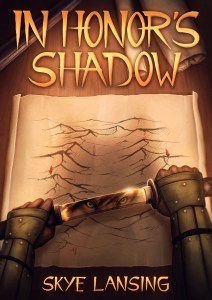
What use is honor without victory?
The Wolf Clan stands divided amid a bitter civil war. For years the noble Hayashi Family has struggled to wrest control of the clan from their rivals, the Hitomi, but one disastrous battle has exhausted their power. Now every warrior within Hayashi territory must decide what role they shall play in the upcoming conflict.
Shiro, the magistrate of an unimportant village, is tasked with a dangerous mission to stop the Hitomi Family’s army. Lacking supplies, troops, and support, he knows any direct confrontation is doomed to failure. Only through guile does he stand a chance against the forces arrayed before him.
Meanwhile, Hayashi Seiko seeks to throw off the oppressive mantle of courtly life by joining her brother in the field as a proper onna-bugeisha. She leapt at the chance to prove her worth as a soldier upon hearing that the war had turned against her family, but can she really escape the politics of a society that reveres duty and honor?
EBook: Amazon, iBooks, Kobo, Barnes and Noble, Smashwords
Available for $2.99 until March 16th, after which the price increases to $4.99.
February 22, 2016
100 Word Story: Prove
Pick a skill—any skill. Now imagine you want to get better at it, so you go to some club dedicated to those who enjoy whatever it is you have in mind. Who do you ask for help?
Is it the loud, obnoxious guy bragging about his natural talent? Probably not. Someone like that often belittles those seeking help. More likely you’ll find the best help form one of the older members. They tend to be quieter, more reserved, and willing to help anyone who asks.
The loud mouths are rarely the most skilled. Insecurity is loud. Competence? That’s quiet.
February 15, 2016
Character Notes: Shiro
This post will be the same deal as my last one on Hayashi Seiko. For those that aren’t interested in looking at the last post, here are the rules I’ve set for myself.
The point of this post isn’t to talk about the character as they currently exist in the story, but rather to touch on how my concept of the character changed over time as a result of the setting switch and other decisions I made over the course of writing. No plot details about In Honor’s Shadow will be revealed, so you don’t have to worry about spoilers, however I will mention story points from earlier conceptions of the story that were ultimately cut for various reasons.
 Shiro, courtesy of Jotun
This is Shiro in his modern incarnation in the book. His evolution was quite different from Hayashi Seiko’s. Her character is radically different on a personal level from her original incarnation, but retains the same general background as nobility of some influence. By contrast, Shiro’s character and background are remarkably different from the original concept.
Originally named Albin (a name that now seems so bad to me it almost makes me cringe), this character was born a peasant in a rural medieval village. In his backstory, he and a number of his friends joined a crusade to retake the holy land, during which he managed to distinguish himself enough to be knighted. Eventually, he and his friends became disillusioned with the crusade and returned home only to discover their village had been wiped out during their absence.
At his core, Albin is a grim character. He joined the crusade for adventure, but instead of finding glory he became sickened by the methods employed by some of the crusading nobles. He was knighted, then found himself shut out of noble circles because of his low birth. He returns home to find out that everything he knew while growing up was no more, and without any support network he and his friends are forced to become mercenaries to support themselves.
By the beginning of the book, Albin would have a very pessimistic outlook on the world, and on how he expects others to treat him. The few friends who survived the crusade with him are the only ones he truly cares about, having taken the perspective that they are the only ones he can trust when the rest of the world is doing its best to destroy them. This made him a character who is rabidly loyal to those he personally cares about, but also makes him willing to take questionable actions to make sure those he cares for are given their due.
This is probably where I should say that Albin was intended to be a bad person, but one who is sympathetic and not beyond redemption. His distrust for the world makes him willing to do terrible things to others, but his experience has been that everyone is merely trying to exploit him and his friends. But this has also made him very protective of those he feels responsible for, which would ultimately be a path he could take to growing to a better person.
 Early Shiro concept art, courtesy of Jotun
A large part of Albin’s character involved the entourage he’d gathered during the crusades, including a couple of friends that had survived the fighting with him and a “heathen” that had become one of his followers due to circumstance. While this concept stuck with his character when I made the switch to Shiro, I altered it to having the those that follow him be something he gathers after the story begins (within the first third of his story) to help make him more of an independent person.
Major changes to his background include making him a noble from birth as he was born into the samurai caste (although he was born very low ranking in the caste). While both Shiro and Albin have suffered loss during their lives, Shiro borders closer to a broken ace than someone who is outright antagonistic to most of the world. This isn’t to say he lack any bitterness, but rather by the time the book has started he’s reached a sort of reluctant acceptance.
This creates a sharp difference from Albin’s character. Although they are both outcasts, Albin is looking to lay claim to what he can in any way possible (at least initially), because that is how he’s come to believe the world works. Shiro, however, is more passive as he views his status as more akin to a penance that—even if undeserved—once complete could lead to his reintegration to society.
February 8, 2016
Character Notes: Hayashi Seiko
As my book, In Honor’s Shadow, gets closer to being complete I find I want to talk about it more and more. This is obviously something of a minefield since saying too much could easily spoil the story. After some thought I’ve decided that there isn’t anything wrong with me talking about the main characters of the story, provided I give myself some basic guidelines before doing so.
In this instance, I think the best course is to talk about how the characters evolved from their earlier conception to today. Considering how much the story changed, from the overall conflict and a jump to a new setting completely, it isn’t too surprising that the characters have changed radically.
Hayashi Seiko
 Hayashi Seiko, courtesy of Jotun
To the right is some early concept art for the female lead of In Honor’s Shadow. Although there are some details I would change (most notably her armor lacks the Hayashi family mon, and I doubt it would be red), I feel this is an accurate depiction of who she is in the story. The way she turned out now feels so right to me that sometimes I forget just how different her character was originally.
Seiko started out as a princess named Katherine Flemming, and the name alone gives away just how much I revised her character over time. She and her brother were twins, with her being born first. Unlike Seiko, who yerns to be a warrior, Katherine Flemming was happy to stay firmly in the world of politics and considered warfare a distasteful business for men.
This isn’t to say that I changed the character to be more martial in some misguided attempt to make her stronger; I’ve never liked the implication that a female character must embrace traditionally masculine traits to be considered strong. Personally I consider both Seiko and Katherine Flemming strong, but in very different ways. These differences are, largely, driven by the setting itself and changes I made to the story to remove characters I felt were extraneous.
In the original story, Katherine Flemming’s main source of conflict was a succession dispute with her brother as their father neared the end of his life. Although Katherine was born first, the succession laws stated that the throne would pass to the eldest surviving male child first and only fall to a female child if there were no surviving male children. Katherine believed this was unfair and pressed her father to change the law before he died, but he was reluctant because changing succession law is a huge deal with the potential to destabilize the kingdom. Naturally, her brother views her efforts as an attempt to usurp his rightful inheritance, setting him up as her primary antagonist.
My plan was to have her father come up with a compromise before his death: rather than inherit based on gender or who was born first it would be done through an election where every noble had a vote. In the event of a tie, a vote cast by the King before he died would act as the tie breaker. As a result of this new election compromise Katherine would set out to show herself as the superior leader and politician, while her brother would attempt to impress the other nobles with his strength and capacity as a military leader.
I loved this concept so much that it was very difficult to abandon (in fact, I still have it tucked away to try again in its own story). The first reason I decided to make changes was my combining Katherine Flemming with a secondary character that was serving as her bodyguard. As a princess with aspirations to become queen, Katherine naturally needed protection and had a loyal knight that both ensured she remained safe while also acting as a combination confidant and agent. When I decided it was necessary to cut the number of characters in my book he was removed, and since everything he did was at Katherine’s bidding anyway some of his character got folded into hers.
Another major change was that her father is already dead at the start of In Honor’s Shadow and she never had aspirations to rule anyway. This greatly changed the nature of her relationship with her brother. Because of the jump in setting, with the cultural importance of bushido and the existence of the onna-bugeisha tradition, she feels the need to prove her worth in the eyes of her culture. Her motivation comes from the same place, namely the way she is disregarded due to her gender, but it ends up expressed in a completely different way.
February 3, 2016
100 Word Story: Hazy
In the last, long minutes before morning, Jeremiah noticed the first hints of an orange glow on the horizon. He turned north, confused, and strained his eyes against the murkiness of night. Then, to his left, the sky grew lighter with the coming sunrise.
Now he could see the thick plumes of smoke rising in the distance, billowing out from their source in a sooty haze. In a panic, he rushed to break camp as the sun finally began its slow climb into the sky. Questions bombarded him, but he ignored them. There wasn’t any time.
The city was burning.
February 1, 2016
100 Word Story: Gridlocked
Brooke stared at the chess board, trying to make sense of the position while he searched for the right move. He wasn’t familiar with this line which was never a good sign. He knew it was unlikely that he’d be able to solve his problems over the board, but in this instance his opponent seemed just as confused as he was.
Both sides had to deal with pinned pieces, and most others were too busy protecting vital squares to be moved anyway. Something would have to give soon, it was simply a matter of who ran out of moves first.