
Cindy Rinaman Marsch's Blog: The ROSETTE Journal Blog, page 4
October 27, 2015
October 14, 1856 - Abolitionist Campaign
Tuesday 14th. . . . Father, mother & Sol went to Ionia to a Republican mass
meeting. They had a great meeting. They thought there were about three thousand people. They had badges to wear, which consisted of white watered ribbon & red satin to, 10 inches long, with
first at the top an eagle, then Freemont & Dayton, then the portrait of Freemont, then, free speech & free men, then Slavery shall not travel into Kansas by our votes. Thirty-two ladies,
representing the states went from Lyons. The one representing Kansas wore a black cape.
_____
The presidential election of 1856 saw sharp divisions among the American people. Rosette records her family's alignment with
the new Republican party, which nominated John C. Frémont as candidate. He won 1.3 million votes, ultimately,
but only 1200 votes in slave states, and Democrat James Buchanan defeated him with 1.8 million votes. Frémont was not deterred from politics, though, and ran on the "Radical Democracy Party" ticket against Abraham Lincoln in 1864.
In 1856, though, Frémont enjoyed the support
of lawyer Abraham Lincoln in the only political campaign speech Lincoln ever made in Michigan--in Kalamazoo August 27, just a few days before
Rosette's journal opens. Did Rosette's father Jacob or her brother Solomon, both of whom voted with the abolitionist Republican party, hear that speech? It is interesting that the Kalamazoo
attorney who invited Lincoln was also the previous (investment) owner of Jacob Ramsdell's farm in Ionia County. They may well have been acquainted, if not friends, when the Ramsdells lived in
Kalamazoo the previous decade. Jacob Ramsdell was a prominent early citizen of that city--he laid out the plan of its
streets and was elected county judge before moving to Ionia County in 1845.
The journal recounts a couple of political meetings beyond this one in Ionia County, and in one Jacob Ramsdell made a speech
in lieu of the no-show speaker, and was with another man elected delegate to the county convention. One nearby county was so thoroughly in harmony with the abolition sentiment that 90% of its men
voted for Frémont. This 1856
election was important enough to Solomon that it is mentioned in his 1900 biography in The City of Grand Rapids
and Kent County, Michigan.
For a fascinating additional note about campaigns and fashion, something Rosette might well have been excited about, given her
loving detail of the "badges" from the mass meeting, please subscribe to
the email list.
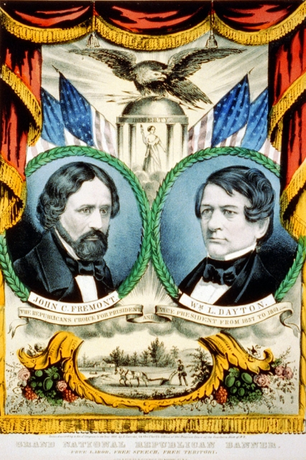 Frémont and Dayton Campaign Poster
John C. Frémont was a handsome fellow, as can be seen in this stock image style popular for many campaigns in his
era.
 Frémont Campaign Ribbon
Here is something of the slogan Rosette records in her journal:
Frémont & Dayton
Pathfinder
Free Soil
Free Speech Free Press
Frémont


October 8, 2015
January 15-16, 1858 - Spiritual Manifestations
Friday 15th. . . . Otis & I & DeWit went to father's P.M. to see Cyrus Packard
& his wife. The latter is a speaking medium. Miss Mary Dodge, this winter's teacher; & Ellen Badger were there to supper. Mother invited in several. Uncle [Myron King's] family with
exception of himself & Mr. [Henry] Garter [Sr.], Colonel [McKelvey] & wife, Mrs. Kinney, Anne & Ellen, the Mousehunt boys, J. Utter, J. Jackson, Mr. & Mrs. Howe &c. were there
to witness spiritual manifestations. Rained a little.
Saturday 16th. Cloudy. Mother & Mrs. Packard called P.M. Mrs. P. was influenced to
pray, sing, & speak as she was the night before. She is a very smart woman, & good.
_____
This spooky and fascinating excerpt from the journal cried out for some expansion in the novel, so I have included some
"Cousin Betsy" episodes. Note that at least two of the older men who might have attended this gathering chose not to. Rosette reports a mixing of Christian and spiritualist elements here -
praying and singing. The Ramsdells were church-going people - "meeting" is mentioned many times through the journal, with "Elder Gown" or "Elder Lee" preaching, presumably in the school
house.
A descendant of the Packard family, Mary E. Packard, has told me that Betsy was later a member of the Woman's Christian Temperance Union (founded 1873). Cyrus was a part-time Universalist minister.* One of his sisters married
a Ramsdell, and another sister married into the Watson family, becoming the mother of Rosette's brother Solomon's two wives - Jennette and, after Jennette's death, Calista.
What was the spiritual climate of the time?
During the decade before the Civil War, a growing number of Americans gathered around tables in dimly lit rooms, joined hands,
and sought enlightening contact with spirits. The result was Spiritualism, a distinctly colorful religious ideology centered on spirit communication and spirit activity. Spiritualism in Antebellum America [by Bret E. Carroll] analyzes the attempt by spiritually restless Americans of the 1840s
and 1850s to negotiate a satisfying combination of freedom and authority as they sought a sense of harmony with the universe.
--From the book description at Indiana University Press
Rosette herself uses generic, distant terminology for God, referring to the "Allseeing Eye" and "the help of God" when she is particularly introspective one day. She includes in the journal
some copied poems/songs that have mention of Heaven.
*Consider this article on spiritualism created by the Unitarian Universalists.
Use the link in the footer of this page to sign up for email updates and learn more
about Cyrus and Betsy Packard.
October 3, 2015
March 19-20, 1857 - Maple Sugar Production
Thursday 19th. Our folks sugared off 90 lbs. & Otis sugared off, but it has not been
weighed yet, for we could not bring it up it was so dark. I went there in the afternoon . . . & we did not get home till 25 minutes past 10. I took along something to eat, & we ate our
supper in the woods. We had to see by firelight as we had no candle. And that is the first supper we ate & the first evening we passed at our own home.
Friday 20th. . . . An Indian called & bought a pound of sugar. I went to Fathers
sugar-bush to see if Sol wanted me to help drain the sirup. He did not. . . . I went to Otis' bush toward night to help bring up the sugar that was left the night before. He boiled till eleven.
He got the big chair up in front of the fire, which is made of the end of an old stove-trough. There was one hole in the back, but he put a board on it & it makes a nice warm chair, &
there I sat & dozed as easily as a kitten.
_____
My own family began making maple syrup when we moved to Pennsylvania a decade ago, and I learned the history of the process
through the Jennings Environmental Center in Slippery Rock. Since we can buy sugar at
the store, we store our maple syrup instead of processing it further to a big loaf of sugar as Rosette's family did. But maple sugar, honey, and perhaps beet sugar were the only real sources of
sweetener for the pioneers in Michigan, continued from the craft learned from the Indians in New York and New England in previous generations. Maple sugar was also very popular among the abolitionists, as a way of boycotting the slave-dependent cane sugar trade. (See "Sugaring Off," on the
Greene, New York website, for more details)
"Sugaring-off," as Rosette calls it, is the process of collecting sap from maple trees--a good stand of trees being called a "sugar-bush"--and then boiling it down
over an open fire in wide, flat pans. It takes 40 gallons of sap to make one gallon of syrup, and that is then cooked down a bit further to crystallize into dry sugar. The Ramsdells and
Churchills made a good part of their living from this enterprise over several weeks each February-March--Rosette reports that she and Otis netted over 200 pounds of sugar their first season and
her parents 700 pounds (representing well over 3000 gallons of sap!). Later lower-quality sap was used to make vinegar, with the help of a "mother" or "starter" from another batch of
vinegar.
One of my favorite scenes in the journal is Rosette's account of the rest of the night recorded here--they stayed late to finish the sugaring-off (getting just the
right consistency) and then lost their way when they tried to go home! You'll have to read the novel to learn that story . . .
Use the link in the footer of this page to sign up for email updates and learn more
about maple sugar and candy.
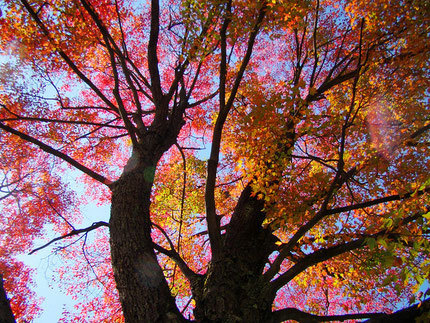 Red maples also produce syrup, but about 25% less than sugar maples.
"The maples, silent keepers of their secret among all the green trees, flame out their place in fall that we might find them." --Rosette (the
novel)
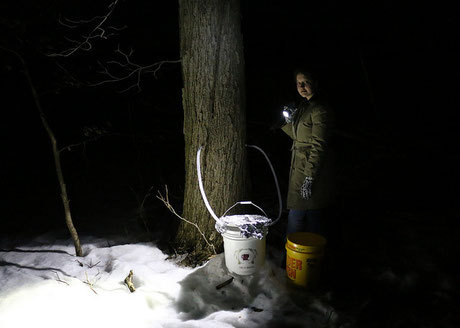 Betsy Marsch tapping a maple tree
The modern way of tapping maple trees is much the same as in Rosette's time. Betsy Marsch, artist for the cover of Rosette, collecting the sap from a day or two in March, 2015.
October 2, 2015
January 5, 1857 - Honeymoon Song
Tuesday 5th. Started for Uncle Clinton Garter's, [west of Grand Rapids]. Rather a cold
day to ride, but Otis heat a brick & put to my feet & I was quite comfortable. . . . We passed through a wee village named Berlin. . . . Aunt Harriet is a lively, good little woman, the
three little ones, Thomas, George & Sarah, are full of life & mischief, & Uncle is what I call a model of a handsome man, & moreover he looks very much like Otis. Uncles folks
have a great deal of company I should think. . . . Mr. Birdsall, Mr. Perkins, who is a good singer, & Alonzo Van Gordon a brother of Aunts & who was here to supper; called. Uncle has a
fiddle & plays better than any man I have heard in this center portion of the state.
[In large script]
Down on the Mississippi floting
Long time I trabled on the way
All knight the cottonwood a toting
Sing for my trulub all the day
Nell was a lady
Last night she died
Tole the bell for lubly nel
My dark virginny bride
When I saw my nelly in the morning
Smile till she opened up her eyes
I carried like the light ob day a doning
Jis before the sun begins to rize
Now I am unhappy and am weeping
Can't tote the cotton wood no more
Last night while Nelly was a sleeping
Deth came knocking at the door
Close by de margin ob de water
Where de lone weeping willow grows
There libed Virginny's lubly daughter
There she in deth may find repose
Down in the meadow mong de clober
Walked with my Nelly by my side
Now all dem happy daze are ober
Farewell my dark Virginny bride
Henry Garter Jr.
_____
Of course we may know this song as "Nelly Was a Lady," by Stephen Foster, published in 1849. It
seems Rosette was so taken with her new Uncle Henry she assumed he'd written this very popular song.
Otis and Rosette Churchill took their wedding journey by horse-drawn sleigh, a "cutter" that the menfolk constructed the month
before and had "ironed" - fitted with runners - in Portland. Others rode with them for short jaunts of several miles, so it was presumably not the smallest size. On their journey they headed west
beyond Grand Rapids, then came back through the city for, among other things, the opportunity for Otis to have an "ambrotype" photograph made of Rosette.
The people they visited included Otis's aunts and uncles on his mother Betsey Garter Churchill's side - her brother Henry,
named for their father, and one of three sisters who married three brothers of the King family. Back in Orange Township, where they settled, another of these sisters - Lucinda - and her husband
Myron King became very important to the newlyweds. Details of the extended Garter family come from the journal and from the beautifully detailed work of William Robert Brittenham (deceased
2008), The
Garter Family of New York and Michigan.
Enjoy listening to this version of
"Nelly Was a Lady"
by Tom Roush,
edited for modern sensibilities.
Imagine how captivating this tune must have been in the cordial company of a family celebrating a new marriage,
with good singers and a good fiddle to lead them all.
For links to more information on Stephen Foster, cultural sensitivity, and music,
please subscribe to the email list with the link in the footer of this page.
September 26, 2015
September 2-6, 1856 - The Teachers' Institute
Tuesday 2nd. . . . Order of exercises for the day. 1st Grammar, 2nd Composition, 3rd
Government. Lecture in the evening on American Taste, and it was excellent. Proffesser [Welch] directs us to write an essay to be read at our last meeting. And what shall poor me do. I never
wrote a composition in my life. But I suppose I must try, nolens volens [whether willing or unwilling]. . . . The motto of the Union School here is, We aim to excel.
Wednesday 3rd. Order of exercises. Grammar, singing taught by E. Daily, & general discussions on the mode of
teaching. Father was there & took part in speaking. . . . Mrs A. has nine canaries.
Thursday 4th. The exercises were grammar, reading, & singing. . . . Discussion in the evening.
Friday 5th. Exercises of the day were reading, grammar, music, & arithmetic by Mr. Gracy of Ohio. Proffesser Mayhew
arrived in the afternoon, & delivered a lecture in the evening, to a large audience, on Education, generally & specially.
Saturday 6th. Rained in the night. . . . We had our attention directed in the forenoon to Grammar, mode of
managing schools &c. & in the afternoon to Music, reading & arithmetic. Proffers Welch & Mayhew, have gone home, & two more gentlemen have come. One is Gregory & the
other’s name I did not learn. I am reading Alone. There has been 49 teachers attending the institute so far. . . . Went to hear a lecture delivered by Mr. Gregory. He took a list, which he
thought was to be found somewhere in Psalms. It was this as nearly as I can recollect. Children are an inheritance of Heaven. It was very good.
_____
This agenda of a week-long Teachers' Institute gives a glimpse into educational practices of the day. Rosette's father
Jacob Ramsdell was a supervisor of schools in their area and well-respected as a mathematician. He had formed the plan for
the layout of streets in Kalamazoo when they lived there in earlier years. Read more about Jacob and about Rosette's distinguished brother Solomon here:
The City of Grand Rapids and Kent County, Mich., Up to Date, Containing Biographical Sketches of Prominent and Representative Citizens, Illustrated (1900) .
Professor Gregory mentioned here is John Milton Gregory, at that time the founder of a classics school in the
Detroit area and later president of the University of Illinois, and an advocate for the education of women. His book The Seven Laws of Teaching is a classic on the
subject, still popular especially in the classical education movement.
At this time Rosette was 26 years old and had been teaching school for years, and later entries refer to students in a school
reading their compositions. Isn't it curious that she has not, at this time, ever written a composition herself? I would note, though, that her journal, the fourteenth of her life, is about
22,000 words, some passages quite lyrical. Her language in this section is more hurried, with more errors, typical of jotting things down at the end of busy days in town, boarding in a strange
home, with much lecture material in mind.
September 16, 2015
September 1, 1856 - The Beginning
Rosette Cordelia Ramsdell Journal No. 14 1856
Lyons, Ionia Co. Mich.
Sept.
Then I went to Mr. Crampton’s, I engaged him to varnish my maps. & as I wished to
attend the Teacher’s’ Institute, I, after calling on Mrs. Loyed went to Mrs. Hall’s to see Miss Gower, the principal of the Union school here. I was told to go to the Pacific Hotel, & she
would see me there. I accordingly directed my steps thither I found several ladies in the sitting room, on the same errand as myself. I learned the names of some. Miss Newman, Miss Thomas, Miss
Grey, Miss Babcock, & Miss Cold, a sister of Sarah C. who I saw last winter at Mr. Lee Pattey’s
_____
This is the opening entry of Rosette's journal, after a few notes on the end papers. It is typical of the cataloging
throughout the journal, offering names that sometimes appear again and sometimes do not. She notes "Lyons" because she is there for the Institute, though she lives about seven miles southwest, in
Orange Township. Note that this is her fourteenth journal - how young did she start?
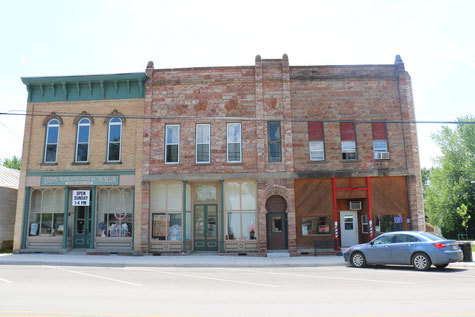 Three historic buildings in Lyons, Michigan, 6/2015. Photo courtesy Glenn Marsch
I do not know the dates for this group of buildings in what is today tiny Lyons, Michigan. At the left is the Lyons-Muir Historical Museum. A later entry in Rosette's journal tells of several stores in
this town burning down, though the owners were insured for $1000 each.
The ROSETTE Journal Blog

- Cindy Rinaman Marsch's profile
- 58 followers

