Brett Ann Stanciu's Blog, page 9
February 20, 2025
Survivors.
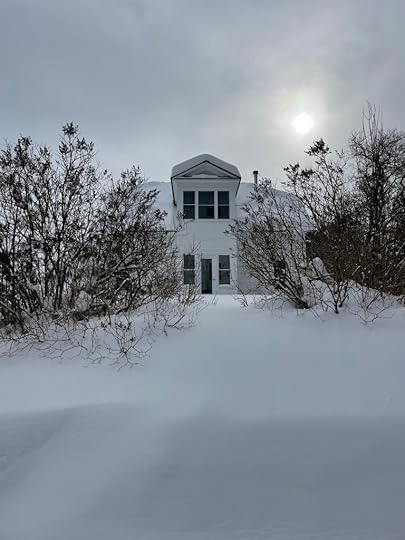
Friends appear at my kitchen door with a rose and gossip. Midwinter, and I’m happy to keep my cats sprawled belly up before the glowing wood stove. The creatures sleep on the hot metal floor guard, their fur gathering ashes and birch bark curls. The snow bends down my thorny rose bushes. My daughter texts with news of a robin sighting. We talk about the usual — town meeting day approaching, the strangeness of an administration determined to chop apart the country. In Vermont, we do our usual thing: heads together, we strategize how to endure, how to keep our hearts open.
The snow is no fresh news. The unbroken cold (and hardly that awful — I’ve seen 40 below, albeit just once and that was enough 40 below for this lifetime) is no news, either. The sun begins to return, the days spreading out at either end, although the icicles remain icy, dripless daggers.
For me, this winter is the most profound of my life, surely the most sacred. I’ve had my own lovely share of winters with my newborns nestled against my chest, of small children delighted with swirling snowflakes, of long skis through woods. On the night before the Presidential election, an ER doctor gently told me I had cancer. Months later, I’ve immersed myself in the mundaneness of insurance and how to navigate the multi-levered medical system. Beyond that, my life slowed, often to simply enduring an afternoon, a night….
I’m adding to my draft of this post, a day later, now hospitalized again. Let there be no mistaking one of the world’s realities: infection is a mighty (and frequently fatal) force. Now, my daughter and I have this down: fluids and pain meds, with the curve now of puzzling out with the oncologist why I’m back. I contracted Giardia last summer from swimming in unclean water. Although I’ve been treated, the question lingers… has this bizarrely lingered?
But I wanted to return to the beginning of this short piece, about the kindness of friends and strangers. Lymphoma is my disease to bear, my bone marrow and veins and intestines and organs. But now, I — who so long saw myself as a lone running wolf — have been humbled to realize I’ve never been apart from the world, all this time. All around me, strangers and loved ones alike hold me together.
From my friend Jo, who sends me an audio poem every night:
“Survivor”
Adele Kenny
A jay on the fence preaches to a
squirrel. I watch the squirrel quiver,
the way squirrels do – its whole
body flickers. I’m not sure why this
reminds me of when I was five and
something died in our drain spout.
Feather or fur, I watched my father
dig it out, knowing (as a child knows)
how much life matters. I have seen how
easily autumn shakes the yellow leaves,
how winter razes the shoals of heaven.
I have felt love’s thunder and moan, and
had my night on the wild river. I have
heard the cancer diagnosis with my name
in it. I know what mercy is and isn’t.
Morning breaks from sparrows’ wings
(life’s breezy business), and I’m still here,
still in love with the sorrows, the joys –
days like this, measured by memory, the
ticking crickets, the pulse in my wrist.


February 15, 2025
Unsurpassable February.
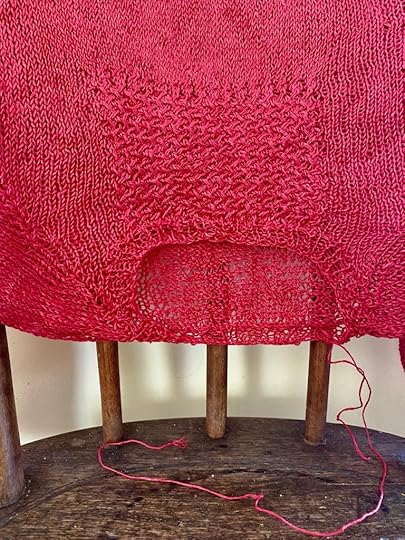
For days, the forecast has trumpeted news of impending snow this weekend; still, sunlight floods into our kitchen this morning. Sure, it’s a few degrees above zero, nothing to sneeze at, but the icicles gleam, skinny stalactites, proof of this week’s warming. A crimson cardinal perches on the feeder.
We are in deep midwinter, the annual mark of collective cabin fever, of generalized bitching, of snow pile comparisons and, in precise detail, what is now hidden from view. It’s the season for skiing, for chocolate, for mooning over seed catalogs.
In my own cancer world, I mark the merge of days and nights in my own way, writing my thousand words a day (sometimes more, sometimes not at all), as my own shepherd’s crook to right my crooked self. In the afternoons, spent, I read and read, returning to that great pleasure of my youth. Around me, my family shifts and jostles, their own lives crammed full with their living, with jobs and classes and loves or longed-for loves. My daughters call me with stories about a grapefruit drink that I vow to drink this July and August, over smashed ice, my bare feet on the grass or maybe a sandy shore of Lake Champlain. It’s the time of year when we long for rain drops on our cheeks and clotting in our eyelashes. But February rain holds ice and sleet, not the green wash of spring, the scent of soaked earth, the tang of emerging garlic.
Every day, I talk with my old father in New Mexico. He asks, Are you sticking to the plan?
I am, I assure him, holding to the course of what the medical realm prescribes, meds and applesauce and so much water — but the here’s the refreshing, liberating, unbelievable thing: there’s no bones with anyone at all in the cancer world that this is a hard dirty blow. So seize this opportunity, turn your life inside out, remake it anew. Make no excuses. Take.
Driving, again driving in the dark to Dartmouth, the full moon hung over our shoulders the entire journey, a creamy light, brilliant on new snow, unsurpassable.
And here’s a poem from Ginger Andrews I used to read in my shut-in mothering-toddler days….
The Cure
Lying around all day
with some strange new deep blue
weekend funk, I’m not really asleep
when my sister calls
to say she’s just hung up
from talking with Aunt Bertha
who is 89 and ill but managing
to take care of Uncle Frank
who is completely bed ridden.
Aunt Bert says
it’s snowing there in Arkansas,
on Catfish Lane, and she hasn’t been
able to walk out to their mailbox.
She’s been suffering
from a bad case of the mulleygrubs.
The cure for the mulleygrubs,
she tells my sister,
is to get up and bake a cake.
If that doesn’t do it, put on a red dress.
February 11, 2025
The contours of your heart…
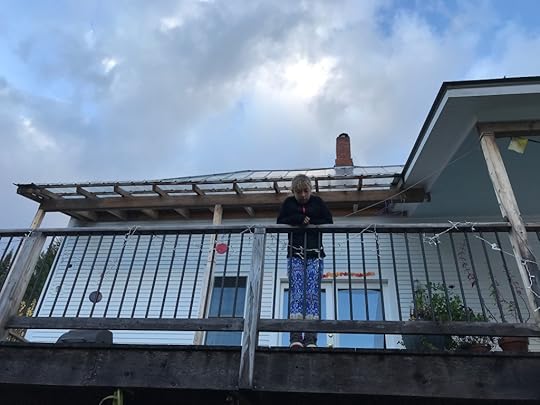 Not February, a long time ago, at our house…
Prying an aluminum safety-seal off a bottle, I remember drinking a tiny plastic bottle of cherry-red juice as a girl when a soft piece of aluminum was the top: once you peeled it back, you were committed to drinking the whole thing. In our sugar-free house, we rarely drank sweet things. This was somewhere in that vast expanse of the Midwest, land of a long-ago sea. In our parents’ green Jeep, we hurtled along I-80, two kids in the back and another up front in the middle between my parents. The Jeep had no radio. In a fit of enthusiasm, my mother had bought a transistor radio that she insisted would work. My dad insisted it would not, despite my mother unrollling the window and jamming the antenna into the wind. (The radio did not, although she did play music at a campground picnic table. We insisted she turn it off: too suburban, mom…)
In the floor of the Jeep’s backseat compartment was a hole where a screw must have fallen out and disappeared. In these pre-seatbelt years, we sometimes lay on the hot floor and stared down through the hole at the interstate whizzing beneath the wheels. A steady blow of hot air blew upwards.
Midwinter now in Vermont, that eternal season of accumulating snow and intermittent dazzling sunlight. My parents, bickering or laughing in their front seat domain where the three of us kids were clearly only intermittent visitors, were enmeshed in their crazy lives, scooping us along in their journey. As for us kids, the void of that quarter-sized hole in our family car and the pleasure of those unexpected sweet drinks, the promise, perhaps, of a swim in a campground pool later that evening, defined those summer days.
Now, decades beyond that cherry drink, I see my own rugged journey spanning decades, my daughters always along and still along, as we’ve come together and parted and reunited with so many people over these years…. In the end, perhaps, what remains with a child might simply be that special drink, not the mighty panorama of ancient geology or the American landscape of truck stops and diesel fumes and KOAs, not even my parents’ own struggles to figure out their lives — where are we going? what are we doing? — that, in my parenting turn, I’m hammering out, too.
From the inimitable essayist Leslie Jamison: “Don’t assume the contours of another person’s heart. Don’t assume its desires.”
February 9, 2025
What’s at the heart of a story?
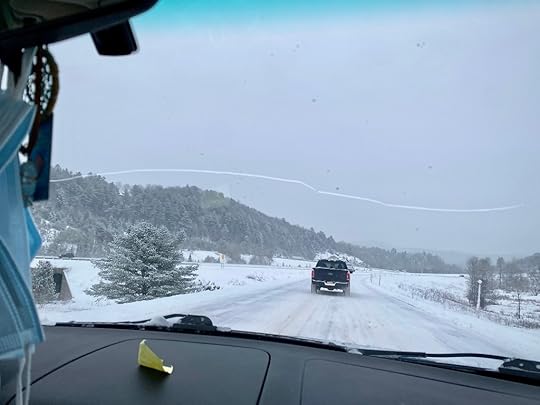
Crack in the windshield, the snowy interstate, the winter metaphor for this cancer journey.
25 hours. Here’s a smattering of highlights… A hard-knuckled drive on unplowed and marginally plowed roads, a side stop to avoid a collision on the exit ramp. Who knew these things gathered such snow? The town lights dimmed by snowfall. On a hotel’s second floor, I lay in bed talking to my siblings while my daughter ate chicken curry. In the bleach-smelling night, I limped up and turned off the heat, stood at the wide window looking out at the neon lights across the midnight-empty highway. The storm had ceased; the neon gleamed GARDEN, so brilliantly red and commercial that, in my sleep-addled mind, I couldn’t pair that word with loamy soil, coiled earthworms, the promising nub of May sugarsnap peas. Unable to sleep, I lay awake, parsing together a story: hook, conflict, and what does resolution mean, anyway? What’s at the heart of a story?
In the early morning, two full lanes of traffic streamed towards Dartmouth Medical Center. On the short cold drive, we drank hot coffee. From here, the story unfolds into the parking garage, blue paper masks, the complexity of so many stories, with so many words. The words alone are brand-new to me — Doxorubicin, Methotrexate— and I labor to learn these, to put pieces of what I can know of my story together. The wide halls in this building soar high, softening voices as the daylight falls down. Always, I hold in my body this conflicted and twisted sense of how much I do not want to be here and how immeasurably grateful I am to be here — but more, too, the profound and sacred sense of so many people, patients and families and the immense staff, each with their own mighty stories, living these stories, in pain and in joy.
In the infusion room, where I sleep and sleep, this time no longer needing small talk, I wake and watch the juncos and chickadees, the nuthatches, flitter in and out of the hydrangea bushes with their brown last-year’s blossoms, perch on the feeders the nurses fill and tend.
The interstate home is clear. The cats yowl for dinner. My house is warm, the dishes washed, the hearth fed. February. The story spins on.
February 4, 2025
Born in 1933…
William Maxwell writes in his riveting short novel So Long, See you Tomorrow: “The reason life is so strange is that so often people have no choice.”
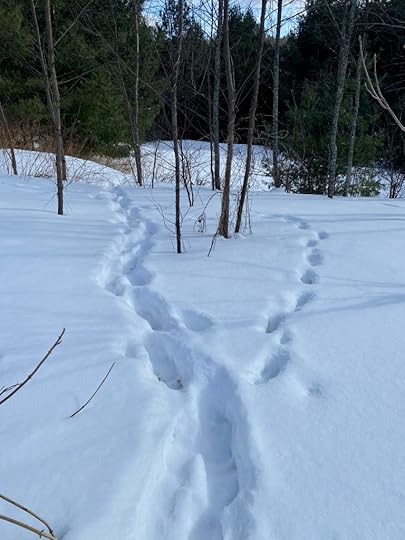
This strange world, indeed. My daughter drives us up Vermont’s long loneliness of I-91, the interstate running above the river. Villages are tucked into the blue and snow-sprinkled mountains, these tiny clusters dominated by spires of white clapboard churches. This has been a week of in-and-out of ERs and hospital rooms, of resurgence in energy and a low so low I’m unable to bother to speak. Now, the ride home, the passing through of this winter country, where the new snow (so pure white) piles high on tree branches. This northern land in midwinter is territory I know with a familiarity akin to the veins on the backs of my hands. A haven of cold, often slow-going, a muted palette of pale blue, sooty gray, evergreen nearly black.
We talk until we’re spun out from chatter. I lean my head against the cold Subaru window. In the last room where I stayed, my companion was a woman born in 1933. 1933 marked the end of Prohibition, the year stenciled on the green-glass-bottled Rolling Rock beer we drank in college. 1933, the year of Roosevelt’s New Deal. The woman’s voice was clear as a spring stream, often studded with small wry jokes. When she saw me, her face glowed in a smile. Of all the things I’ve learned from this week and scribbled into my notebook, this woman’s radiant smile and easy language sticks with me. A few times, I wandered her way, hoping to have some of her joy rub my way.
January 30, 2025
Picking at the salty remains of roast beef…
Shortly before the November election, I’d heard word of a friend’s illness, and I determined to fly West and see this couple. At that time, I thought I was poisoned by mold and struggling myself, but I really wanted to visit. I decided to hold off buying the ticket for a few days until just after the election, because, well, what if? What if the grid crashed or something? I’ve lost money on airline tickets before.
What happened, instead, is I ended up in the ER the night before the election and discovered the mold was a red herring. I had cancer — although I hold, yet, that the mold was an element of a complicated equation that may, or may not, have added to turning on that cancer gene. By then, flying was impossible for me. Now, news comes to me of her final passage from this life. My friend has lived a long, loving — a good, very good — life, and yet…
All afternoon, another friend and I text back and forth. Remember the nights we ate in their dining room where the walls were painted light blue above a cream headboard? On the wall thermometer, we watched the January temps dip to 20, 21, 25 below zero, laughing at what would be a cold drive home. We never wanted to leave early. Instead, we kept drinking wine, eating chocolate cake, picking at the salty remains of roast beef.
Sorrowful, indeed. We are all now far enough along in life to know that no one dodges the Reaper, that the cut of illness or injury might fall swiftly at any moment. That, in the end, we leave as we entered. While my daughter drove me home the other twilight, I watched the stars ignite in the burnished blue along the horizon, one by one, these ancient untouchable illuminations. She followed the highway home; my eyes fastened on those seed pearls, the slender thread that thickened just the merest width as the night flushed in.
Here’s a line from Niall Williams that, by stroke of coincidence, I read today.
“… you could stop at, not all, but most of the moments of your life, stop for one heartbeat and, no matter what the state of your head or heart, say This is happiness, because of the simple truth that you were alive to say it.”
January 25, 2025
Mirth in the mirthless. A great mercy.
Mirth in messiness… another night drive to the ER, so cold, what were we leaning into? Five degrees, maybe six? The stars above the river ice a mockery of light. Kindness and Dilaudid, another scan, a hurry-up-and-wait, the three of us talking about nothing in particular save for a hike we once took in a thunderstorm and an orange water bottle confiscated (gone, forever) at the Albuquerque airport.
It’s the small hospital not far from our house, not the cancer complex with its soaring blue-green glass. On this zero-degree night, my daughter presses her feet against the room’s wall heater. There’s hardly any patients, save for a man we never see who insists that he must be heard. In the night of dim small lamps, I sleep and wake, talk with a woman from the high plateau country of the upper midwest. She remarks wistfully that Vermont is too tiny and cramped for the sweep of the midwestern sky. Maybe it’s just the Dilaudid, but when sleep folds over me, I dream of those childhood summers my siblings and cousins and I chased fireflies while the grownups drank bourbon and ate our leftover birthday cake and kept at their two-week conversation. The dew washed our bare feet.
The hospital morning flicks on before the sun has dulled the night’s darkness. Mirthless, indeed, I become, crabby with human lack and inhuman fate. Words, words, mine and others’, in a repeating loop. I text my nurse friend. On her lunch break, she appears, and then there’s laughter from nurses in my room. People come and go. I sign for more billing. (How much is this going to cost me, anyway?) The chaplain appears who’s read my book and wants to talk Flannery O’Connor and death. I’m not about to be funeral planning for myself anytime soon, but I plunge right into that death question. Indeed, this wretched cancer, my uninvited guest, perhaps the truest teacher of my life.
He asks, To know to savor every day?
Oh sure. But the disease has whittled me down to a glittering core, to ignore the petty fluff that not so long ago stung my eyes, and certainly my heart, too. What remains is real, both beautiful as those fireflies winking in the sultry midwest night, and ineffably, unbearably sorrowful.
I intend to live a long life; I’ll at least go on for some while, which is all any of us can say. In the meantime, this rarefied illness journey? Not lacking for writing material.
From Flannery O’Connor, The Habit of Being (1988):
In a sense sickness is a place, more instructive than a long trip to Europe, and it’s always a place where there’s no company, where nobody can follow. Sickness before death is a very appropriate thing and I think those who don’t have it miss one of God’s mercies.
January 23, 2025
What the living do.
I’ve written about the strange and often terrifying world of cancer here over the past few months. In the past week, my eyelashes have thinned. At first, my eyelashes looked as though I had walked through a rainstorm. I’m not at all adverse to rain and lousy about remembering a jacket, so I often end up in a deluge. Last July, I explored trails on a friend’s property. Over the past years, she’d designed and cut narrow trails. I walked through what seemed like enchanting forests of moss, stands of cedar so dense the light darkened, around a former beaver pond filled in as swamp, and finally discovered great white pines. She had unearthed pieces of white quartz and marked the edges of the trail. Walking back, rain fell, hard. By the time I reached my Subaru, I was drenched. I wiped my face on a sweater I’d left on the passenger seat. In the rearview mirror, my eyelashes held crystals of raindrops, diminutive pieces of that forest’s quartz.
January, temperature hovering around ten degrees, rainfall is in no immediate forecast.
As an andidote to the national clamor, here’s a few lines poet Marie Howe wrote for her brother from “What the Living Do.”
Johnny, the kitchen sink has been clogged for days, some utensil probably fell down there.
And the Drano won’t work but smells dangerous, and the crusty dishes have piled up
waiting for the plumber I still haven’t called. This is the everyday we spoke of.
It’s winter again: the sky’s a deep, headstrong blue, and the sunlight pours through
the open living-room windows because the heat’s on too high in here and I can’t turn it off.
For weeks now, driving, or dropping a bag of groceries in the street, the bag breaking,
I’ve been thinking: This is what the living do….
January 19, 2025
Inauguration Eve. Cold. And me, the mad mutterer.
On this Sunday inauguration eve, all day long, intermittently, as I go about the things I do, I’ve been thinking of a Mary Oliver poem. As I’ve written before, a friend has been sending me a poem each day that she reads aloud in her voice as clear as winter wind. Mid-January, Vermont, is the season both of winter settling in for the long haul and, conversely, as life often is, of lengthening days. We seek the merest brightening of the light as proof of spring’s promise. In her recording, my friend mentions seeing the division of seed packets in farm store, solid evidence of spring’s inevitability.
Later, just before twilight filters in, I walk out alone, tromping the short path through the woods and cemetery to the upper edge of the village. A few flakes of snow twirl. Otherwise, no one. My boots crunch over hard, packed snow. My mind is jammed with its usual monologue, when suddenly I realize my euphoria at walking along this wide road, flanked by white pines with broken branches, a single crow winging its way over the snowy Little League field. Yes, yes. I’ve forgotten my mittens, and my hands knotted in my coat pockets throb with cold, and yet I keep chortling like a mad woman, Yes and yes and yes.
Like any writer, I’m quite capable of running wildly with words, but as for the politics and national people, I’ll simply leave Mary Oliver’s words from her poem “Work, Sometimes.”
… What are we sure of? Happiness isn’t a town on a map,
or an early arrival, or a job well done, but good work
ongoing. Which is not likely to be the trifling around
with a poem.
Then it began raining hard, and the flowers in the yard
were full of lively fragrance.
You have had days like this, no doubt…. Ah, what a
moment!
As for myself, I swung the door open. And there was
the wordless, singing world. And I ran for my life.
January 16, 2025
Tiny flames, ice.
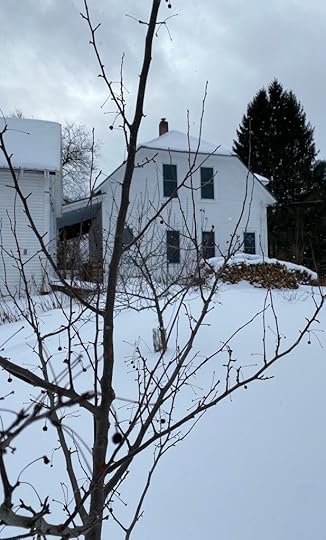
Bootstep by bootstep, my strength begins to return. It’s cold, darn darn cold, slicing at my eyes and cheeks. The cold and I are no strangers. I made maple syrup for years in an unheated outbuilding, raised my daughters in a house with scant heat, have spent decades of my life tromping beneath snowy trees in search of…. what? The usual things I suppose, by which I mean the unexpected. Or maybe just the sheer loveliness of a fresh snowfall.
Here’s my barometer for how I know I am improving, the cancer lessening. A long ago college friend appears at my house with the flu, explaining away his symptoms. At first, I don’t understand; what is he asking me? My old moxie rears up, fueled perhaps by the Red Devil chemo drugs. I’m taking in a poison to save my life, after all. As if it’s not enough to have cancer, I had to send him away, banish him from our hearth, point that what, whatever he thought he might be doing had nothing to do with me at all. It was all him. At this precise moment, there’s no space here for that, or for the flu.
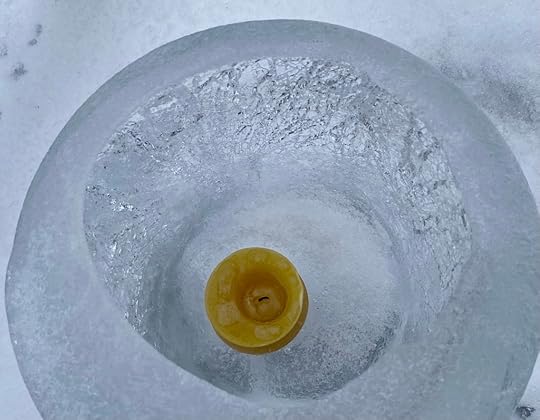
Later that night, neighbors appeared with ice lanterns made from five-gallon buckets. I grabbed my coat and stood outside, talking, while they lit beeswax candles and shared news of town. When they left, the tiny flames glowed brightly in the starless night, sure evidence that fire can burn even surrounded by fat ice.