Brett Ann Stanciu's Blog, page 5
July 6, 2025
Mad World, Abundant Wildflowers.
For no particular reason, I walk on the path along the river which leads to the road where I once lived. In the meadows and beside the trail, the wildflowers blossom abundantly: yellow toadflax and pink asters, bluets and Black-eyed Susans, cinquefoil.
I dawdle at the dirt road. At a turnout, long ago I had a carpool meeting spot. Over the years, my daughters and I passed hours there. In the afternoons, I lingered with my friend, the girls lingered with their friends. The girls played in a brook. The fields have been used for hay, vegetables, seeds, THC. In the past few years, the flooding river dumped sand in these acres. Burdock and thistle claim this terrain now. These fields are for sale again.
A few pickups zoom by. When my ex and I were splitting up, we’d meet here, too. I’d run down the mountain road and leave the girls at home, baking cookies or riding bikes. In my then-husband’s truck, we’d argue about our lives. That autumn as an early dusk washed in, I leaned my head against the truck window and watched two coyotes running across the field. He kept talking and talking and I kept thinking about our daughters who would be hungry for dinner. Someone else lives in that house now. Our lives have long ago moved on.
A friend pulls up, and I get in her car. We talk about kids and aging parents, about money and oranges. The world around us is falling apart. What we see now might be just the cracks of a shifting society. Yet, our lives spin on. My friend and I keep talking and talking. Children grow up. The fields’ bounty changes. I no longer live a few stones’ throws down an empty road from this friend, but how I love her.
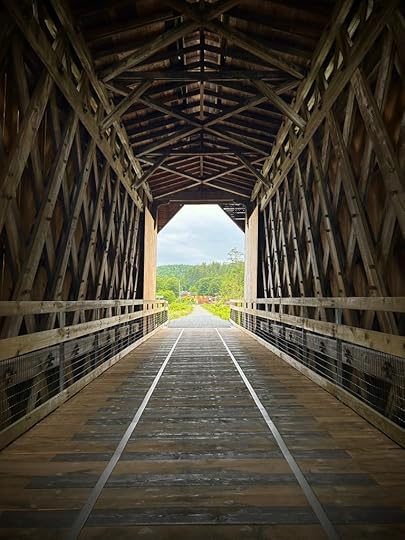
I walk back slowly on that trail, under the cool shading trees. Chicory, knapweed, Canada lily. In the covered railroad bridge, I pause in its interior dimness, light at either end. There’s no one around at all. I soak it in.
The heart’s actions
are neither the sentence nor its reprieve.
Salt hay and thistles, above the cold granite.
One bird singing back to another because it can’t not.
~ Jane Hirshfield


July 3, 2025
“… hard wind and the rain that unsettled the creek…”
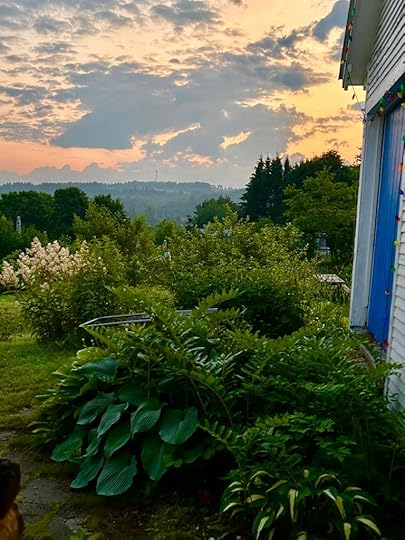
Evening, I linger on the porch swing, talking with my siblings as the long July day ebbs down to twilight. My neighbor texts me that a bear’s been seen in our neighborhood. As the gloaming, like a tide, washes in, I water the tomato plants. The white hydrangeas hover like magical pompoms in the dusk.
July, Vermont’s growing month. Walking with my neighbor, she points out the height of the wild grasses and flowers around her house. Already, this summer, taller than she’s ever seen. The heat and the rain have propelled immense growth. The box elders rub my house; I’ll need to ask another favor from someone with a saw.
I have not forgotten this winter when I drifted from one variation of cold to another, my body and mind fiercely bent to the intertwined goal of finishing cancer treatments and remaining alive. On the other side, what remains is what plagued me before, my own variation of hard wind and rain. And yet, a whole July hangs like a promise: sunshine all day, pink cottage roses, laughter with my neighbor about the burgeoning woodchucks.
In the late afternoon, I take a long walk in the town forest to the reservoir’s edge. Deer prints press into the mud. On this walk, I don’t see a soul. In the distance, children call to each other.
“Kitchen Sink”
Today she would change nothing,
not even the wallpaper peeling,
like dead bark. Nor, outside, the shadows
approaching the yard where ants
toil like women in their houses of sand.
Never mind that the sun will be setting.
When she was young she felt afraid
of hard wind and the rain that unsettled the creek.
But the earth never left her,
not once did the floods reach her feet.
The reward of a long life is faith
in what’s left. Dishes stacked on a strong table,
Jars of dried beans. Scraps of cloth,
And the ten thousand things of her own thoughts,
Incessant as creek water. She has been able
to lay up her treasures on earth,
as if heaven were here, worth believing.
In the water her hands reach
like roots grown accustomed to living,the roots of the cat-briar that hold to the hillside
and can never be torn free of this earth completely.
~ Kathryn Stripling Byer
June 29, 2025
Hunger.
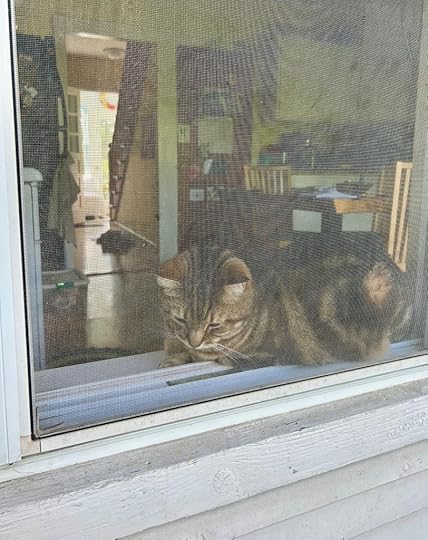 Curious cat named Acer
A few years back when my youngest was doing odd jobs, she came home with four strawberry plants someone had given her from a garden she weeded. Naturally, I planted these in our garden. The plants spread and have produced beautifully this year. I crouch beside these weedy plants and devour red berries. The crop is so small no berries ever make it into the house. Since it’s usually just me here these days, I eat in the garden. I’m famished for this sweet food. I devour the strawberries, juice dripping down my chin.
I’m ravenous for the sharp June sun, for this morning’s cold dumping rain, for my daily midday reading break, for the purring cats who clamor across my keyboard. Healing from cancer, I’m supposed to sleep (get seven to nine hours!) but, come that glimmer of gold at the horizon, I’m finished with bed, hungry for coffee, oatmeal, maple syrup. Eager to finish my novel revisions.
In those months of chemo, I’d worried my mind and imagination might dull, my fierceness lessen. Six weeks out from surgery, I’m diminished in body but a peculiar power blooms in me. A determination to do what I want. An impatience with artifice. Don’t waste my time.
And yet, the old haste that plagued my days and nights has quelled. Stopping by my neighbor’s, I sink into her armchair, set my feet on her footstool, listen, let the day’s exhaustion drape around me. That fatigue is now familiar to me as the blanket a stranger gifted me at the beginning of this cancer journey. We talk and talk, then wander outside and keep on with these conversational matters, the color of paint she’s considering for her house’s clapboards, how to encourage Columbine to grow among the phlox.
This time, I really want to listen…. I’ve spent my life mistaking instinct for fact, subjective experience for reality. What a waste of time here on earth to spend it as a slave to one story, how boring and repetitive, how many of our days are spent in chains.
From Sarah Gilmartin’s Service.
June 25, 2025
Small Kindnesses.
Writing a novel, you pay attention to action. What are the characters doing? And why? At the midpoint, the action often switches; the protagonist ceases to react and, instead, acts — and not without mishap, without complications.
I’ve long thought of labor as a metaphor. The mother’s cervix dilates (helped, sure, by walking, by receptivity), followed by the uncertainty of transition just before the mother engages in the pushing phase, the brief or lengthy or sometimes stigmied phase of bringing this child into the world.
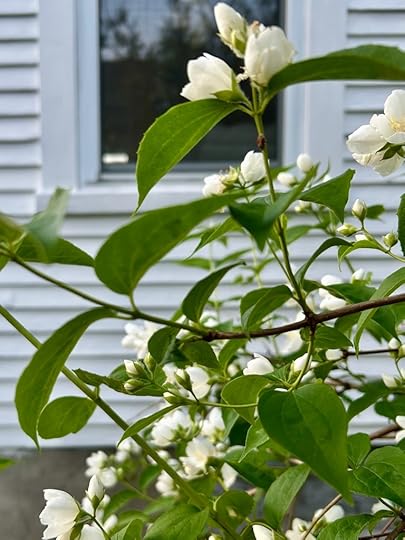
I’m in the transition phase again in my life, beneficiary of cancer treatments and so much medical care. Mornings this winter when I woke, I began each day with a survival mindset; I would endure my body’s illness. Now, June, the birds wake me, the feathered creatures intend on nest-building, procreation, survival, maybe the joy of communal singing. In the garden, the tithonia abruptly deepen their green, expand their leaves. The hydrangeas sprawl into a fortress.
At my desk, I lean into my day’s work, hours and hours unspooling.
Late afternoon, my friend arrives with her little girl, and the three of us walk in the cool town forest. The child removes her shoes and runs over the pine-needle-spread paths. She buries her bare feet in the shallow stream’s mucky mud. Yes, June…
Mostly, we don’t want to harm each other.
We want to be handed our cup of coffee hot,
and to say thank you to the person handing it…
We have so little of each other, now. So far
from tribe and fire. Only these brief moments of exchange.
What if they are the true dwelling of the holy, these
fleeting temples we make together when we say, “Here,
have my seat,” “Go ahead — you first,” “I like your hat.”
~ from “Small Kindnesses” by Danusha Laméris
June 23, 2025
“Quite Serious”
My neighbor runs out his back door, shouting and waving his arms. I’m working on my upstairs glassed-in porch. He cranks up the volume on VPR’s Morning Edition. I’m guessing he hopes the young woodchucks burrowing beneath his deck aren’t NPR fans.
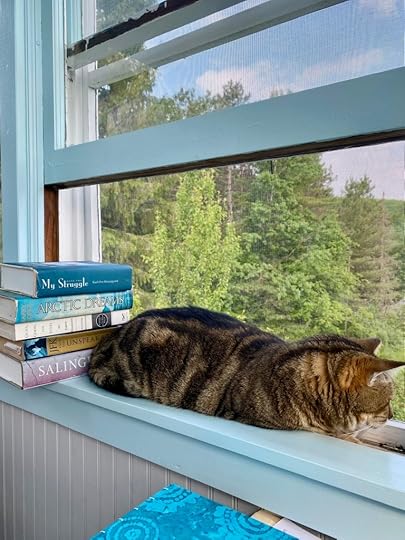
Like my neighbor, I am a VPR fan. This morning, news of Iran dominates the air. As I labor to join noun to verb, I notice my heart beating at Steve Inskeep’s words. Eventually, I leave my cat sprawled on the windowsill and head downstairs to wash the dishes. I’ve listened to NPR my entire life. Heck, the radio was probably playing when my parents brought newborn me home from Presbyterian Hospital in Abuquerque. Little these days is good news.
This winter, I’ve written in this space about my obsessive struggle to remain among the living on this planet. Only now—two surgeries, six rounds of chemo, 11 hospitalizations later—do I realize the diciness of my determination to live. A few weeks ago, driving with my daughter, she showed me a lawn where she cried on a bench because I believed my mother would die. Every day now, as I begin by feeding my two cats and drinking coffee, I carry this winter, those months of spitting distance from my grave, within me. As at the beginning, my greatest worry was/is my daughters. So many months later, I understand how my life is connected intrinsically to so many others. That what lies before my eyes are the twig tips of stories.
In my younger, brasher years, I might have written about politics and conflict, but the Mideast is a place I’ve never been, with people I’ve never met, for whom I will never speak. Too, I’ve knocked around this planet long enough to know that violence changes the world, irredeemably. That the combination of deceit and anger and hubris wrecks destruction. And that cruelty wrought can never be undone. We hurtle onward. I keep listening.
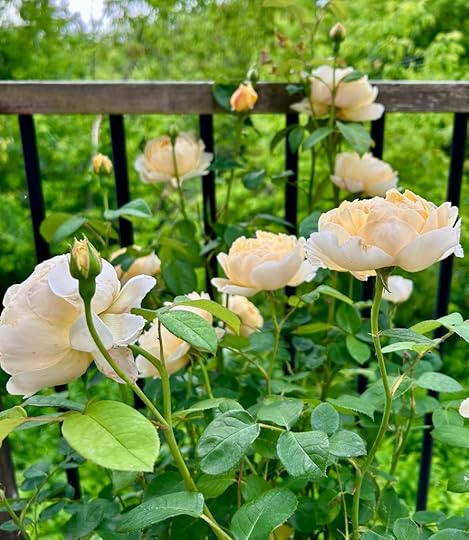
June, and pink roses bloom against my house, planted by someone I never knew, perhaps the woman known as Grandma Bea buried in the adjacent cemetery’s crest. My daughters climb a mountain with a view of Vermont’s shimmering Lake Champlain and the emerald patchwork of farms stitched together. They return with a gift for me, a thorny rosebush with fragrant blossoms that fill my cupped hand. In the evening, shortly before dark, I walk in my bare feet, the long grass already cool with dew. High heat is predicted, the planet is surely burning up, but this ruby-and-gold sunset drags in a coolness. Lush, so lush this month. The butternut tree I planted stretches towards the apple someone else carefully cultivated and noted in pencil on the barn’s bottom wall. A record someone held dear.
In 1956, Allen Ginsburg wrote: “America this is quite serious.”
June 20, 2025
“Everything blooming bows down in the rain…”
We make the trek again to Dartmouth for a surgical consult, the sign-off after surgery. I’ve met numerous members of this team, but not this kind NP, who’s read my history and says, What an ordeal. I’m not expecting these words, and I pause. Last November, when was I first admitted to Dartmouth, I had unplanned surgery. That snowy November night, the surgeon spent so much time with me. Then her Fellow returned and answered my endless questions. In May, I had surgery again. Two bookends – that November night and this sultry summer day. I’ll be treated here for years, but my hope – and none of know squat about the future – is that I’ll never need a surgeon again.
I thank her and the surgical team and student entourage who appeared in all those ER and hospital floor rooms where I stayed – me, the reluctant patient, who tried to negotiate some other outcome than surgery. To my surprise, she’s grateful for my words, too. We try our best but it’s hard to know how we come across to patients. The surgeons who operated on me are trauma surgeons. My surgery was routine, but routine surgeries go south. Mine did not.
Afterwards, my daughter and I stop at Dartmouth College’s Hood Museum. There’s a Georgia O’Keefe painting we want to see and two Monets. The current exhibit has mesmerizing photographs. This is a good day and a good visit. We eat sandwiches in King Arthur Flour’s patio, where so many families have pudgy babies tucked into a parent’s arm. We linger, talking about my mother who would have loved eating here.
So many of those drives on the interstate home, I slept, nodding in and out of conversation. My weak days are long passed, and we keep talking, the interstate edging near the Connecticut River and up on the ridge again. In June’s green, the drive no longer seems so desolate. Traffic here is always sparse. We pass a trailer of hay bales, a pickup with three wheelbarrows.
Enduring cancer turned my world (and my family’s world) inside out. In the first five-day continuous course of chemo, I forced myself to wash every morning. In those days, my hair had not yet fallen out. I was too weak to brush my hair, so I tied it at the nape of my neck. That month, my daughter cut what snarled hair remained. Those miserable uncertain November mornings, how grateful I was for hot water and soap, to have access to a brutal but hugely effective treatment, in a sterile hospital in one of the richest states in a phenomenally country. I made my choices, but I had choices.
In the inside-out world where I am now, I’m ticking through my list: profusely thank my oncologists and surgeons for saving my sometimes-surly life, tend my garden, figure out my youngest’s college bill, finish my book, accept the ravenous roaming woodchucks….. my domestic realm.
In our little end-of-the-road neighborhood, visitors come and go on my back deck, gardens on three sides, the wild pressing in on the fourth. My own nexus.
Everything blooming bows down in the rain:
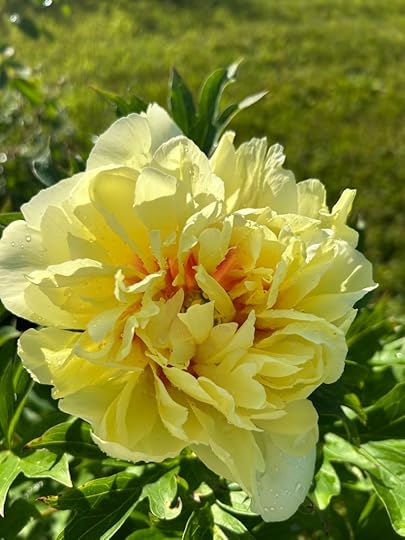
white irises, red peonies; and the poppies
with their black and secret centers
lie shattered on the lawn.
~ Jane Kenyon
June 17, 2025
Inoculation, Fallacy, and the Sacred.
A few years back, I did a joint reading with a woman who claimed she had discovered an inoculation for kids to prevent drug and alcohol addiction. She’s way more famous than me – and has made far more money – but the premise seemed prideful to me. There’s no shot against addiction, no simple fix.
For no particular reason, I was thinking of this on a recent walk. As part of my healing, I’m determined to walk every day, through rain, shine, or wildfire smoke from Canada. Sometimes with friends, sometimes alone. Late afternoon, I was on the wooded trails behind the local high school. Hermit thrush sang their endearing notes. I spent my childhood in the New Hampshire woods. As an adult, I backpacked. My former husband and I sugared for two decades and knew our maple acres in every variation of weather.
Not so many weeks ago, exhausted from chemo and surgery, I walked crooked over. Now, my boots confident on the path, I remembered those winter visits to the ER, more out of my mind than not with pain. A frequent visitor, I requested IV Zofran, Dilaudid, fluids, in that order. The scent of saline washing through the IV tubing became synonymous for me with the near promise of breathing easily again, the temporary ability to inhabit my body.
Dilaudid promises to make whole what’s broken. How well I know this enchantment. For anyone who judges this, I reply, you endure chemotherapy, you endure the way the lymphoma choked my innards, more brutal than childbirth labor. The narcotics pulled me back from pain into the world. There was that subzero night when we drove to the ER, and my daughter and her partner kept leaning against the ER’s wall heater, while the nurses buried me under heated blankets. And the balmy midnight I sat outside the ER entrance, high as hell again, listening to the heat shield rattle on my Subaru as my sister drove around the hospital. Those nights, the dilaudid nights, are all done. May they be finished, forever, for me.
These mornings, I take vitamins, mundane, boring. There’s that trite phrase that we’re all on a journey, but so much of our lives we simply click along. The lymphoma broke that clicking-along for me, the regularity of waking up and going about the day. Now, on these daily walks, I hold to this sacredness, this euphoria.
“One morning in April, I woke up a little sick. I lay there looking at shadows on the white plaster ceiling. I remembered a long time ago, when I lay in bed beside my mother, watching lights from the street move across the ceiling and down the walls. I felt the sharp nostalgia of train whistles, piano music down a city street, burning leaves. A mild degree of junk sickness always brought me the magic of childhood. It never fails, I thought, just like a shot; I wonder if all junkies score for this wonderful stuff.”
~ William S. Burroughs, Junky
June 14, 2025
“Where are you going?”
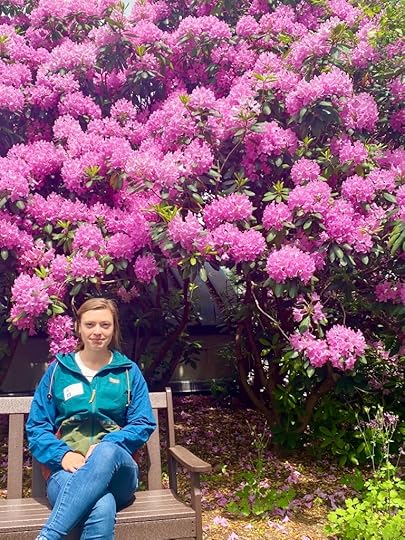
Photo above taken in a courtyard garden at Dartmouth-Hitchcock. Inside the building, there’s a short flight of stairs to a sunroom. Glass doors lead to the garden. Much of this winter, I couldn’t walk those half-dozen steps. When I finally could, I proofread my daughter’s college essays in the sunroom. We stared out at the blowing snow and wondered what grew in the spring garden.
Today, mid-June, an appointment of good news. The Good Doctor reminds me that I’ve finished treatments, that I’m in remission. Go on and live your life. Gain weight and muscle.
I’ve been so far out of the everyday world that, after this appointment, waiting in a gas line, seems like a small event. For some reason, I remembered the gas station a few miles from my father’s house in Santa Fe, New Mexico. On a random summer morning, I pumped gas and then stood for a moment, breathing in the spiciness from the station’s kitchen vent and staring up at the flawlessly blue sky. The desert’s hot breath touched my cheeks, my hands, my bare knees – at once so familiar to me (my birthplace the New Mexican desert) and enchantingly unknown. The day lay before us like a pie that could be cut any which way, and the result would be enjoyable.
That’s how I felt, leaving the cancer center, walking up the stairs in the parking garage – light – as if I had shed that caul of cancer and pain. I mean nothing easy or innocent about this lightness. One afternoon when I could barely walk around the high school, I sat in a friend’s car and imagined myself as gray – my face ashen, my bones crumpling to cinders. I wondered how I would survive. In December, wandering the halls of yet another hospital, I turned around and couldn’t recognize the only other person in the hallway, my friend Jo who was even calling my name. “Brett, where are you going?”
Living with cancer taught me that we are not creatures of the mind; we live in our bodies. Cancer may return in my flesh this summer, two years from now, or never. I may perish falling down stairs, or expire as an old woman in my bed beneath a quilt my mother sewed. Any hubris I once had about eating organic brown rice and my garden’s bounty vanished this winter; mortality’s blade is ubiquitous, final.
Nonetheless, this day…
Driving home on the interstate, my daughter and I mused about hurried drives through snow to the ER, the repeated treks, northward, home, where we scrutinized roadside trees for the faintest blush of spring green. This time, my daughter pointed out patches of lupines, purple and pink and white, sure sign of summer.
You must do something to make the world more beautiful.
~ Barbara Cooney, Miss Rumphius
June 11, 2025
Do Two Things at Once.
Walking on a trail beside the Lamoille River, my daughter points out a snapping turtle, a giant creature, its head tucked in, watchful. Her partner reminds us that he grew up in a village where snappers took over the elementary school playground to plant their spring eggs. An inherent element of that school’s curriculum was try to get along with other beings.
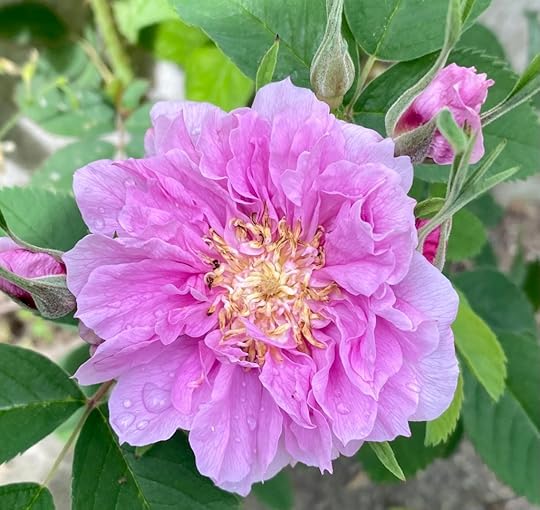
The irises and rhododendron bloom profusely. Rain falls, chilly, for much of the day. In the late afternoon, the sun emerges. I cut back the hostas alongside my house to stave off the wet and rot. By late afternoon, I’m finished with my work and chores. I hang out on the porch, read, drink my cocktails of ice water and lemon. Listen to Nina Totenberg.
A month out from surgery, six weeks from chemo, I met a friend for coffee. We talk cancer and community, about the joys of traveling overseas and shifting perspective. Myself, I will be traveling near to home this summer, most of it by foot. Each day, I walk more and more, reclaiming my strength. As next year’s woodpile is transported into my barn (thank you, thank you, kind wood mover), I imagine planting a garden on that emptied place. As a younger woman, I believed vegetable gardening would change my world. I wasn’t wrong; Red Russian kale and bull’s blood beets fed my growing children for years. But blossoms and bushes and trees nourish the wild (and me, too).
I live on a hillside where hungry young woodchucks run rampart. Not so long ago, I considered the chucks my enemies. Now, having endured the scorched-earth transformation of chemo and cancer, I worry far less about these sleek-furred creatures. By summer’s end, I know the foxes thin this population. In the meantime, I slowly go about that repetitive work of weeding and mulching, and the visioning research of transforming lawn into wildflowers.
My coffee companion reminds me to take my time and take risks. Who wants to take risks after surviving cancer treatments? Answer: why not, why not? Dig more gardens. Contemplate the woodchucks. Plant coreopsis to replace the hollyhocks holes from the woodchucks’ foraging… Do two things at once: go with the flow and keep paddling.
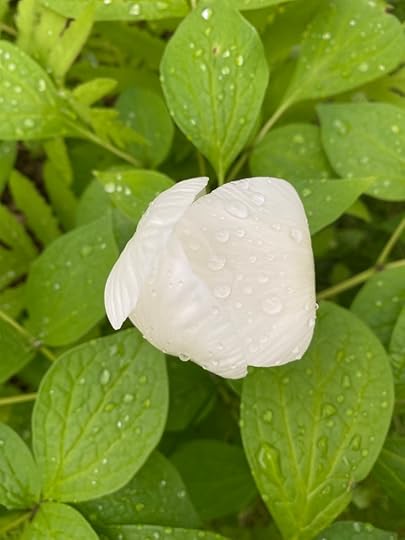
White peonies blooming along the porch
send out light
while the rest of the yard grows dim.
Outrageous flowers as big as human
heads! They’re staggered
by their own luxuriance: I had
to prop them up with stakes and twine.
The moist air intensifies their scent,
and the moon moves around the barn
to find out what it’s coming from.
In the darkening June evening
I draw a blossom near, and bending close
search it as a woman searches
a loved one’s face.
~ Jane Kenyon, “Peonies at Dusk”
June 7, 2025
Seeking the Something New.
A friend arrives with a box of seedlings, including tithonia, AKA Mexican sunflowers, a tall, brilliantly orange, hopeful plant. A few mornings later, more friends appear with seedlings and a pitchfork. Lucky, lucky me.
I am a gardener who allows the Johnny-jump-ups and forget-me-nots to spread where they like, pulling back a few and nestling in basil, scallions, poppies. Why unroot a flower? Eventually, I weed diligently, ruthlessly. The garden mirrors my approach to novel writing. My friends leave with their boxes filled with forget-me-nots as a gentle rain falls on the tender seedlings.
Every day is a further day from surgery and chemo, the days and night accumulating like pages read in a book. I put away the narcotics, the Tylenol, the ibuprofen. Mornings, I drink a single cup of café au lait. I sauté mushrooms, bake a quiche. I ask for a ride to drop off my car at the garage, worrying about walking up my hill, but picking it up is mostly downhill. I walk.
For a little bit yet, I’m a person of interest in this small town. The postmistress asks me, no, really, how are you? For months, the PO staff has stuffed my box with cards and books and sheaves of medical bills from two hospitals. I’m there to pick up a book of essays (a gift which quickens my heartbeat). I tell her I’m in remission, that word still awkward as it emerges from my throat. I want to add that remission does not mean cured, does not mean that this strange and uninvited cancer beast has left my body – and certainly not my soul. I don’t know this woman at all well, but she looks steadily at me, as if she understands what I’m thinking.
Here’s the thing: how afraid I was of cancer eight months ago; honestly, I’m still fearful of it. Yet, cancer rooted in me, infested my family, my friends, a great wide circle of people around me, including my readers here. This is not unique. In its myriad forms, cancer spreads widely. I lived for years with the putrifying secrets of addiction. I refuse to repeat that with cancer.
Last November, I thought I wouldn’t live to see spring. I did. If jaywalking doesn’t do me in, cancer certainly might. Or I might die as a scrawny old woman from a stroke or heart attack. In this rainy late spring/early summer, I’m grateful for the possibly random dice throw, for plants and gardeners, for an infinitude of people. Among these are the people who’ve shared their stories with me, of decades-ago cancer diagnoses, almost always offered sotte voce, as if not to tempt the fates. Their stories ring clearly: I endured, I transformed, I thrived. This possibility can be mine (maybe yours, too).
From Suleika Jaoad’s The Book of Alchemy:
But there are also moments when our internal compasses tell us it’s time to change course–to leave something behind and build something new…. Rebuilding is not easy…. But to me, rebuilding unfolds alongside becoming. It is crucial, if we want to keep evolving and flourishing, to get rid of things that are no longer serving us and make space for something new to grow.