Brett Ann Stanciu's Blog, page 19
March 22, 2024
Dazzling light.
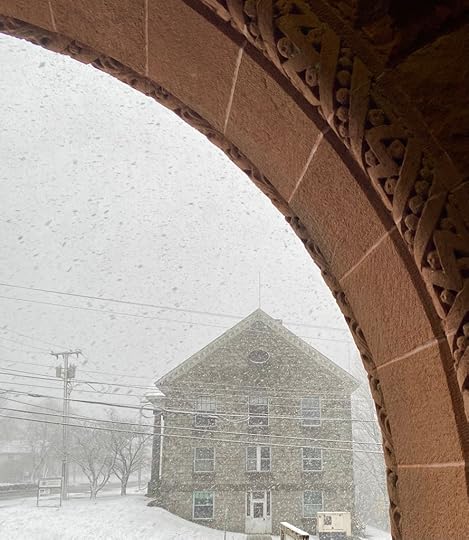
Here’s the weird thing about this March: cabin fever is not a thing. March has always marked the time of year when snow and cold has piled unrelentingly on us for veritable months. Not so, this warm year. But climate change does squat for the dearth of light, and certainly nothing for the dissatisfaction that’s creeping into our social consciousness. I am a woman who craves the planetary might of blooming crocuses, the radiant headiness of a forest strewn with spring beauties, the serene hover of a bee tucked into a downy apple blossom. Patience, patience.
Walking home from the library, a sudden snowfall drenches my eyelashes.
On this early morning, poetry:
StrewnIt’d been a long winter, rags of snow hanging on; then, at the end
of April, an icy nor’easter, powerful as a hurricane. But now
I’ve landed on the coast of Maine, visiting a friend who lives
two blocks from the ocean, and I can’t believe my luck,
out this mild morning, race-walking along the strand.
Every dog within fifty miles is off-leash, running
for the sheer dopey joy of it. No one’s in the water,
but walkers and shellers leave their tracks on the hardpack.
The flat sand shines as if varnished in a painting. Underfoot,
strewn, are broken bits and pieces, deep indigo mussels, whorls
of whelk, chips of purple and white wampum, hinges of quahog,
fragments of sand dollars. Nothing whole, everything
broken, washed up here, stranded. The light pours down, a rinse
of lemon on a cold plate. All of us, broken, some way
or other. All of us dazzling in the brilliant slanting light.
— Barbara Crocker


March 19, 2024
Necessary Birdsongs.
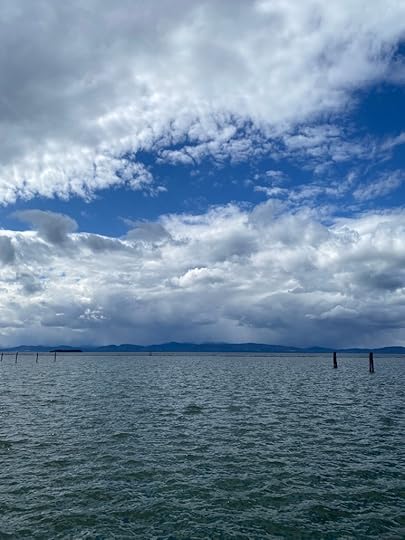 Lake Champlain
Mid-March, the unlovely muddy Vermont: I bend beneath the snarled rose bushes, seeking green nubs pushing through the wet earth. By June, this world will be verdant, lush, those old roses a tangle of green, tiny blossoms each a delicate bouquet of pale pink. These roses, planted by someone doubtlessly long passed over into the other world, ruggedly fence my house, their flowers such a dear sweet fragrance.
In this brown world, I wander to the places where, in springs past, I’ve heard the early songs of redwing blackbirds. Yesterday, I hear these birds, not the full chorus yet, but the warm-up crew. We are well before the yard clean-up and gardening season. The town roads are rutted, hard to travel, and the summer folks have not yet returned. Hidden in this clump of cedars, the blackbirds steadily, without any fuss, go about their blackbird lives. Not so many weeks away, marsh marigolds will blanket these wetlands — dazzling yellow, killer green — but for now, the dun palette of silvery cedar, umber earth, the birdsong melodies yanking us along to spring.
March 16, 2024
Like the creation of the cosmos out of chaos…
I stopped in a wood stove/chimney sweep shop in Montpelier, looking for a replacement length of insulation for my stove.
I’d bought the stove in 2020, in that strange period when some businesses had reopened; Vermont’s mask mandate was brand-new. I was looking to install a metal asbestos chimney in my 100-year-old house, determined to heat this house with wood and not rely on oil. I was new to wearing a mask. My teenager waited in the car.
Four years later, on a rainy morning, I stop in and two men are warming themselves at glowing stoves. I ask my question about the catalytic combustors and insulation wrap. One man reaches in a stove and pulls out a honeycomb piece. He asks me if I’ve taken my stove apart. Yes, I answer, and I’ve put it back together — not once or twice, but regularly.
The store is on the retail strip between Montpelier and Barre, and the greasy scent of the never-closed McDonald’s pumps through the damp air. On that same 2020 trip, I texted a staff member of the state’s Department of Libraries about hand sanitizer. The department was closed, of course, and I never met this woman, who left me sanitizer and children’s books. We wrote back and forth to each other, and then she vanished elsewhere into a job, or so I guessed, a different phase of her life.
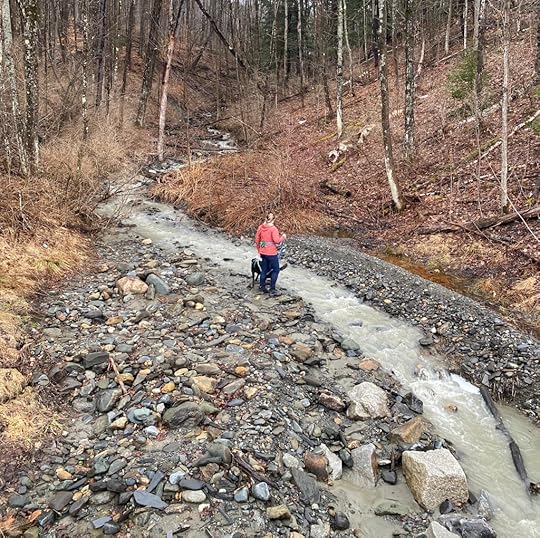
This morning, my daughters and I park at the edge of town and follow the running water: tracking uphill from river to streams. The mushy snow melts in the rain. Three geese fly overhead, clamoring. There’s that famous line from ol’ Henry David Thoreau: the coming in of spring is like the creation of Cosmos out of Chaos and the realization of the Golden Age. On this March morning, the silty waters running high and fierce, Thoreau’s chaos line returns to me. My old familiar, chaos, the companion sometimes in my pocket, sometimes in my face.
Then, this: the evenings are beginning to stretch with light, rich with the scent of wet earth. Last night, my daughter and I pull on our jackets again and head out into the damp world, in hopes of red-winged blackbirds. A no go, yet. But halfway through, I interrupt her and say, “Robin.”
And again, “Robin.”
March 13, 2024
“Dear March—Come in—”
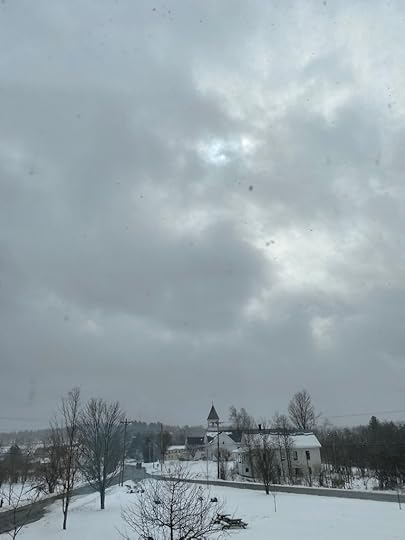
I stand outside eating a cheese sandwich stuffed with a handful of the lettuce I bought for my cat Acer. The trees across the road shake furiously in a wind as if outraged. What’s your complaint, I wonder.
Such a strange winter: a handful of skiing days, no ice skating, the hard cold a distant memory. The yuck of this winter has been the lack of sunlight, the sodden clouds that have lingered from last year’s rainy summer through January’s gloom. We kvetch. My own antidote is the early morning, my insistence that writing, that order and beauty, are a transformative might. There’s nothing new in that approach; it’s the ancient path of seeking luminosity, of Rumi’s words that the wound is where the light comes in.
In March, of course, sudden sunlight in your living room is apt to reveal the dirty cat hair clusters balled beneath your couch, the cobwebs trailing from the ceiling corner, drenched in dust. Make of it what you will.
Oh March, my long-time friend, giver of fine weather, betrayer with your miserable cold snowstorms. In the lengthening days, the sun returns like a long-ago lover. My friend the sun and I take long walks, my sunny friend whispering in my ear that brighter lovelier days are already here.
A few lines from Emily Dickinson:
Dear March—Come in—
How glad I am—
I hoped for you before—
Put down your Hat—
You must have walked—
How out of Breath you are—
Dear March, how are you, and the Rest—
Did you leave Nature well—
Oh March, Come right upstairs with me—
I have so much to tell—
March 10, 2024
Song against Reductionism.
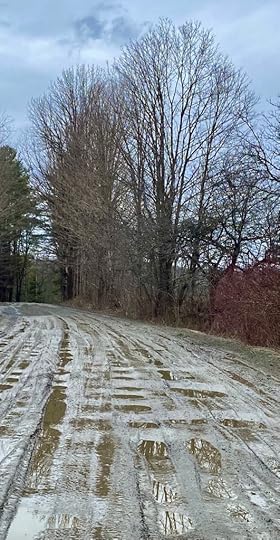
A pretty wet snow covers our muddy world — temporarily, for sure, a grace of sugar snow in a long mud season. Early March, and I’m already hanging the laundry out to dry, the pale green nubs of perennial bulbs pushing up through matted debris of last year’s leaves, broken twigs.
On a warm afternoon, I put the snow shovel away — my usual blind enthusiasm about spring! I’m the woman who rails against reduction, that the world can be defined as this or that. This world is nothing but gray, an unending smear of thaw and freeze. And yet, I’m wrong about that, too. Daily, the bird chorus gains, the winged creatures flocking in the box elders in the ravine behind my house, feasting at the feeder in the mock orange.
A poem from the late David Budbill:
“What Issa Heard”
Two hundred years ago Issa heard the morning birds
singing sutras to this suffering world.
I heard them too, this morning, which must mean,
since we will always have a suffering world,
we must also always have a song.
March 7, 2024
Birthday Cake.
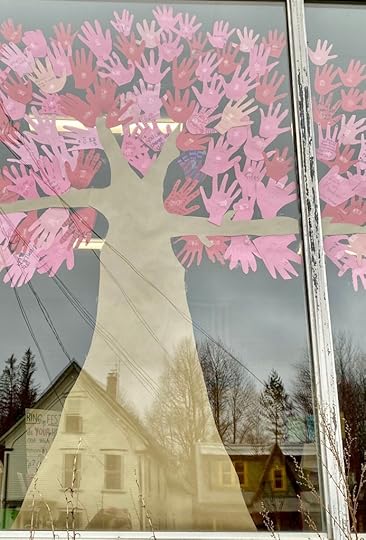
March 7 is my father’s 87th birthday. My daughter, the oldest grandchild, visited my parents a few days ago and asked what to do for my parents’ birthdays. Cake and flowers. And be sure to eat the whole cake.
At town meeting, on the fly, I had to add a few numbers, tally a total. Writing with my pencil, the 100 or so audience members looking at me, I thought of those childhood evenings when I handed my dad an algebra or calculus problem and asked for help. He always made me sharpen my pencil, align the numbers so the problem made sense, and exhibit some respect for mathematics, please. These three things have stuck with me my entire life.
Every year on my father’s birthday, I think of this Hayden Carruth poem. My father — a man who taught his kids about Arkhipov Day and Ancient Greek philosophy, and spent so many nights in the desert, playing cards with his kids at a picnic table lit by a battery lamp….
Birthday CakeFor breakfast I have eaten the last of your birthday cake that you
had left uneaten for five days
and would have left five more before throwing it away.
It is early March now. The winter of illness
is ending. Across the valley
patches of remaining snow make patterns among the hill farms,
among fields and knolls and woodlots,
like forms in a painting, as sure and significant as forms
in a painting. The cake was stale.
But I like stale cake, I even prefer it, which you don’t
understand, as I don’t understand how you can open
a new box of cereal when the old one is still unfinished.
So many differences. You a woman, I a man,
you still young at forty-two and I growing old at seventy.
Yet how much we love one another.
It seems a miracle. Not mystical, nothing occult,
just the ordinary improbability that occurs
over and over, the stupendousness
of life. Out on the highway on the pavement wet
with snow-melt, cars go whistling past.
And our poetry, yours short-lined and sounding
beautifully vulgar and bluesy
in your woman’s bitterness, and mine almost
anything, unpredictable, though people say
too ready a harkening back
to the useless expressiveness and ardor of another
era. But how lovely it was, that time
in my restless memory.
This is the season of mud and thrash, broken limbs and crushed briers
from the winter storms, wetness and rust,
the season of differences, articulable differences that signify
deeper and inarticulable and almost paleolithic
perplexities in our lives, and still
we love one another. We love this house
and this hillside by the highway in upstate New York.
I am too old to write love songs now. I no longer
assert that I love you, but that you love me,
confident in my amazement. The spring
will come soon. We will have more birthdays
with cakes and wine. This valley
will be full of flowers and birds.
March 5, 2024
Vermont Town Meeting Day.
Here’s Vermont Town Meeting Day in a nutshell: lousy coffee for a buck, the cash box in the hands of sweet kids who are raising money for field trips the school board quit funding years ago.
My father calls Town Meeting Day the purest form of democracy. And democracy, hoo boy, what a fascinating creature this is.
On this Town Meeting Day in Greensboro, the moderator drank water from a Daffy Duck glass that he said he’d used for the past thirty town meetings (not a tall tale). Knitting and side conversations, Presidential primary voting, school budget voting, knitting and more knitting, talk about housing and logging and, inevitably, taxes and delinquent taxes.
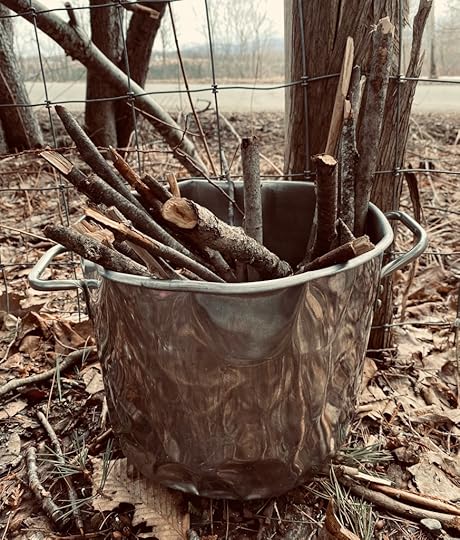
Late afternoon, a cold drizzle fell. On the playground, the kids had left a bucket of stick stew. I had about a hundred things yet to do that afternoon, but I squatted beneath the white pine and checked out the lean-to the kids had built from branches that had fallen in a winter storm. As we head into this election year, let’s remember the kids keep the world real. Savor some spring stick stew.
Democracy is not something you believe in or a place to hang your hat, but it’s something you do. You participate. If you stop doing it, democracy crumbles.
— Abbie Hoffman
March 3, 2024
Vermont’s fifth season: mud.
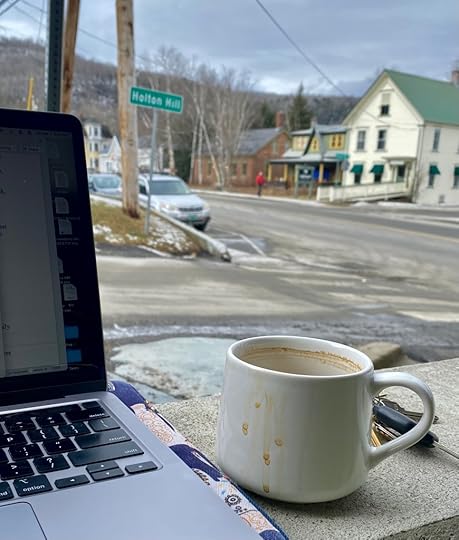
I carry my laptop out the backdoor of Hardwick’s coffee shop. A couple I know pulls up on their fat tire bikes and rave about the biking. There’s an adage in Vermont that the state’s fifth season is mud season. The first week of March is way early for the back roads to break up. Most towns post their roads around March 15, prohibiting heavy trucks, like log or delivery trucks, from destroying already soft roads. Now, towns have already posted these warnings, ribboned with orange survey tape, a sure sign that winter is on the wane.
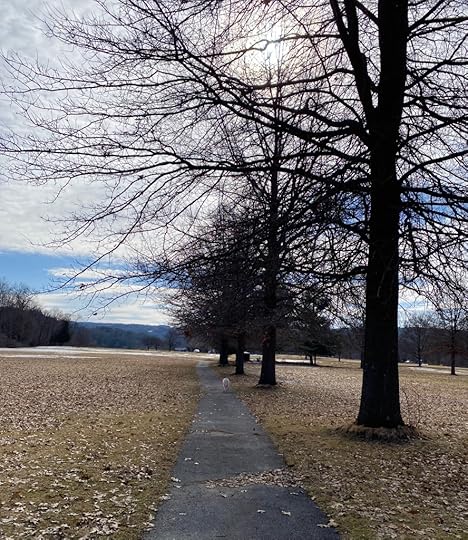
I meet a friend at a former golf course now owned by the city of Montpelier where people let their dogs run. The course is last year’s brown grass, but when I squint I can see emerging green beginning shimmer, pushing back the dull amber. How much the world leans into living.
My oldest daughter calls from New Mexico, on her journey to visit the grandparents. Through our phones, her face glows with desert light. I think of her driving around Santa Fe, this old adobe city and the stunning landscape an infinitely complex story that stretches so far back. Within that human history, my own family story lodges in with its numerous plot points. Ah, family… never a straight line.
T. S. Eliot wrote of that April is the cruellest month, breeding/Lilacs out of the dead land, mixing/Memory and desire, stirring/Dull roots with spring rain. Winter kept us warm… Mud season may be the least loved. But in my mind, it’s the sweetest. Sap runs. The softening ground sucks our boots into its stickiness. Tender green unfurls, strengthens. We move, onward.
March 1, 2024
March 1: Cabin Fever, the Impossibility of Spring.
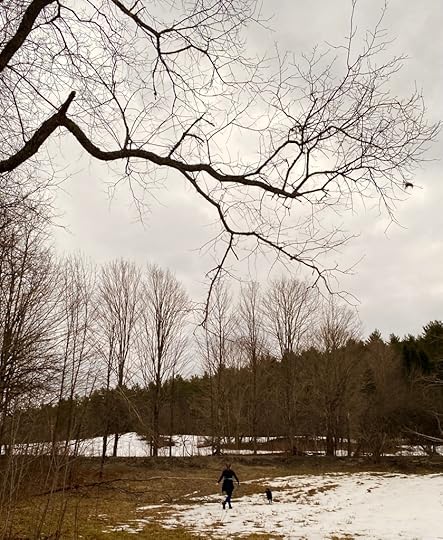
March: a day of singing chickadees, mushy ice, all the little paths running with thaw, twinkling in the sunlight with the promise of what I cheerily call early spring! The next morning, the temperature pegs itself solidly at 15 degrees and refuses to budge. I walk down to the post office, the wind scraping my cheeks. What grit of sandpaper is this? 80? 60?
Vermont late winter/spring is the season of vehement vacillating, of freeze and melt, sun, snow, rain. It’s the season of cold hands, flushed cheeks.
Late into the night I lie on the floor reading Leslie Jamison: “It’s what fairy tales have been trying to tell us for centuries. Don’t be afraid of never getting what you want. Be afraid of what you’ll do with it.”
March: the lurching season of cabin fever, of Where are those crocuses, anyway? Will flowers ever bloom again? I bake a cheesecake, fill bird feeders, have one, two, three essays picked up by little mags. The waning moon shines up the rutted mud, the dregs of snow. Early morning, the birds are at it, singing for dear life, tugging in spring.
February 27, 2024
‘Soon it will be the sky of early spring…’
Wild February!
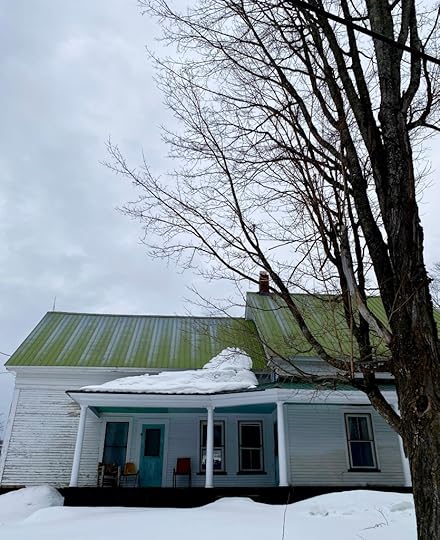
At noon, I stand talking to the road crew in a sparkling snowfall. I wax on about the prettiness of snow on the emerging earth. The crew, who’s endured the strange vagaries of mud season in December, the fickleness of Vermont’s winter weather made weirder by climate change, humor me with a nod.
Fifty degrees and rain forecasted for today, followed by more, followed by bitter cold, then rain and wind, the sun I lean towards…. Late winter, again, and I remember when I could distinguish the years: the spring we boiled sap from March 1 to the 31st. The year we made 540 hard-earned gallons, two of us and a five-year-old, and I wore through three pairs of gloves carrying in wood and feeding the arch.
Walking around my snow-scattered garden, I envision where I will plant the bare root Japanese lilac I’ve ordered, for me or someone else to admire and love. The path down to my compost is both icy and soft mud, the conundrum of winter reluctantly losing its teeth to spring. The true joy is the inevitability, the earth’s order to proceed from twinkling snowflake to downy crocus, the planet’s sheer opinionlessness regarding skunks and black flies.
The road crew and I kick around a few more pithy remarks about government corruption, and then we head along….
From my one of my favorite Louise Glück poems, March:
The sea doesn’t change as the earth changes;
it doesn’t lie.
You ask the sea, what can you promise me
and it speaks the truth; it says erasure.
Finally the dog goes in.
We watch the crescent moon,
very faint at first, then clearer and clearer
as the night grows dark.
Soon it will be the sky of early spring, stretching above the stubborn ferns and
violets.