
Carole Marsh's Blog, page 2
August 8, 2013
105 Newly Alive
A few months ago I wrote a blog about trafficking, and I didn't mean cars. The issue of the trafficking of women, girls, and even children, was brought to my attention by Kristin Hauch Melton, Gallopade's marketing manager. Of course, I'd been aware of the situation, but she expressed concerned about how prevalent it was in our nearby city of Atlanta.
I attended a Methodist Women's meeting Sunday...and the subject was this very same thing. A lovely young woman passionate about the subject came to speak to us. The very next day, I saw (as I'm sure you did) the news that a nationwide operation had rescued 105 children and netted 150 arrests.
The big news seems to be that there is just a more determination by law enforcement, and others, to put an end to such illegal and awful activities. The other big deal is that such victims are now treated as that—victims, and not criminals; makes sense to me.
I won't recount all the details, but the operation freed children ranging from 13! to 17 years old. The youngest victim was being offered up, so to speak, by her own father. Many of the children had been "recruited" from foster care or group homes. They were being "sold" over the Internet, at truck stops, casinos, motels/hotels, and on street corners. Victims came from all across America, including cities such as Jackson, Mississippi and Springfield, Illinois. The most arrests were in larger cities; Denver, Milwaukee, and Knoxville, Tennessee having some of the larger numbers of arrests.
Our speaker emphasized how the "perpetrators" know how to find these vulnerable children...in malls, in neighborhoods, in schools...as well as in the places noted above: in other words, out our own backdoors! I also won't go into how these children are coerced, and why they are certain that they can never speak up, nor escape.
Our speaker also gave us some tips:
• This may be happening to people you see all the time—friends of your children, domestic workers, people you see around your town, no matter how small.
• Signals may be a child who is alone, avoids people, will not answer questions you may ask (because they fear to), or who say, "I can't go home" or other such "absolutely can't" sounding statements—they may be trying to tell you something. Once a woman kept insisting to me that she could NOT leave her "job." I think she was trying to tell me something, but I did not really know her and I did not suspect anything.
• Speak up! Ask questions. If you feel or sense something about a child, investigate.
• There are many resources you can report to and this is how law enforcement is putting together information to make such arrests, and more importantly, the "freeing" of such children.
I'm no expert, but I am now more aware. You be so, too. Thanks.


July 29, 2013
Something to Think About, Something to Do
This is a short blog but a severe one.
Our nearby town of Palmetto, Georgia, had a police report, and confirmation, of a rape of a three-year-old girl by a 17-year-old, the son of the girl's babysitter. Needless to say, the media was all over this story. Also, as you might imagine, vicious tweets toward the boy/man were rampant.
More than 15 years ago, I was invited to speak to the Planned Parenthood Council of Buffalo, New York. I thought I was going to speak about sex education, my new book, Smart Sex Stuff for Kids 7-17, and, defend my position that you need to teach young children the facts of life in a simple, straight-forward way. I had no idea that what they really wanted to ask me about (a writer, not a sex ed expert, as I felt they were) their local problems with older boys (older often being as young as age 9) raping younger girls, yes, say as young as age three. Often, these were younger siblings.
Now, I'm not asking you to wrap your head around that, but I am suggesting that:
a. In this day and time, it is long overdue for even conservative, sex education-resistant or -reluctant
Americans, whether teachers, parents, or religious institutions, to "get over it," and realize that even young children need to know about sex. No, not ALL about sex, but respect the young child! Even they know they have "private parts" (or all those funny names you might use), but it isn't funny. Help even young children learn the accurate words for their genitals. There is no shame in this; actually, it's more shameful to have some poor kid made fun of later because they walk around talking about their peenie-weenie. Young kids don't need a lot of info, but they do need what they need at the appropriate ages.
Unfortunately, much younger than ever, they need more awareness to speak up if someone bothers them in certain ways.
b. In this day and time, we should not stick our head in the sand; we are aware that such things happen, perhaps rarely?, but what difference does that make when your resistance or reluctance could leave a small child at risk? Statistics prove that such sexual assaults occur in fairly predictable patterns: older brother to younger sister, alas, or in this instance, an older teen to an "opportunity" victim, let's call it. Vicious emails after the fact are not nearly as effective as keeping an eye out for younger children, whoever, and wherever, they may be. While we may never expect this in our home, in the next room, on our playground, in our group of friends, relatives, or acquaintances, we know better.
c. In that day and time, back in Buffalo, I had no answers to the poor counselors and others' questions. I still have none, but hope that they do. I do think they would sound a lot like a and b above.
I have to ask:
1. When is the last time you talked to your child about sexual matters, appropriate to their age?
2. When is the last time you had the urge or inkling to explain something (even the correct name of a body part or to "Let me know if you ever feel uncomfortable around Uncle Joe"), but just didn't speak up, because you felt uncomfortable?
3. When is the last time you checked to be sure that your schools, libraries, even religious institutions had appropriate and quality sex education materials available for children? (After all, if they are not available in school, at home, at the local library (and not hidden behind the counter!), or in church, just where do we expect kids to find informational materials on this important subject?
When my sex ed book came out (the first of many that I wrote), a young mother of a young child bought a copy from me. She sat there and read it and began to weep.
"If I had had this information when I was younger, my life would have been so different," she said. When next I looked, she had her young daughter beside her, and they were reading the book together. We can, as we say, be part of the problem or part of the solution.
I wrote this book about 20 years ago and there was a brief flurry of interest and acceptance because we were all in a kerfuffle over AIDS. Once we found out that AIDS mostly affected gay men (that's what we thought at that time), the curiosity died down. However, as you well know, the sexual images, videos, music lyrics, and more, have ramped up super-significantly in the last 20 years.
"In this day and time" IS the time to get serious about sex education for everyone. Otherwise, well, otherwise, we just see more heart-breaking headlines, and the answering OMG tweets that are a "sound and fury signifying nothing," instead of anything that really helps a child be educated, prepared, protected.
And if you just think this is only a guy-on-girl thing, you are mistaken. Or that it can't happen to you and yours, or in your own backyard (literally, or neighborhood), you are also mistaken.
Sex is fascinating, funny, a fact of life, and kids (even young kids) love to learn about it, especially silly sex stuff animals and insects do. If it "takes a village" to educate children on the facts of life, our village is way too small, and often, way too late. As the 18-year-old boy told his mother when she asked, "Can we talk about sex?"..."Sure, Mom, what do you want to know?"
Go to www.gallopade.com or amazon.com or your local bookstore or library and get something (not old and outdated, please!), read it, share it.
While you're at it, buy a second copy for someone else, such as a child, friend, teacher, librarian, or other person who works with children of all ages.
This is the day. You know what to do.—Carole Marsh
Review By: James Cox, Wisconsin Bookwatch: April 2008 - April 5, 2008
Just as children must become literate in reading and capable in mathematics if they are to succeed in today's complex and rapidly evolving world, so they must also become knowledgeable about matters of sex well beyond the simple rudiments of human 'plumbing'. Once the isolated province of parental responsibility, sex education for children ages seven to seventeen is now recognized as requiring the joint and cooperative participation of parents, teachers, and the children themselves. An expert and an author in the field of sex education for children, Carole Marsh has now written "Smart Sex Stuff For Kids 7-17: Practical Information & Ideas For Kids, Parents & Teachers", a compendium of information, advice, suggestions, and commentary that will prove invaluable in developing sex education curriculums, as well as parent-child discussions on this sensitive but necessary subject. The text is particularly 'reader friendly' and illustrated with cartoon-like artwork as everything from 'Recipe for a Baby', to 'Master Bation', to 'The Dating Game', to Sex Abuse/Rape, to the issues of pregnancy, abstinence, safe sex practices, love, morality and ethics. From the basic 'facts of life', to the emotional and social ramifications of being sexually active, to 'smart strategies' for boys and girls from puberty through adolescence, "Smart Sex Stuff For Kids 7-17" is an invaluable and strongly recommended resource and reference. Two other titles from Gallopade International on this topic by Carol Marsh which are also very highly recommended include: "A Period Is More Than A Punctuation Mark!: Smart Sex Stuff For Girls" and "Sperm, Squirm & Other Squiggly Stuff!: Smart Sex Stuff For Boys".
June 10, 2013
You're Invited...
Please come visit me at my "summer home," a.k.a. my summer blog, at http://carolemarshblog.typepad.com/onesummerwriting/

June 5, 2013
Ben Tucker
May 29, 2013
Memorial Day Follow Up...
 If you saw USA Today's weekend edition, you saw a rather mind-shattering article on four boys who were ages eight or nine when "9/11" came along. Believe-it-or-not, it's been enough time for them to grow up and go to war...and die. Wasn't 9/11 just yesterday? They were inspired to serve their country, and they did. Not sure how many more, but getting to peace can have many ramifications; I hope we get there soon.
Downsizing Redux
(or in the South, Re-do)
I downsized from two homes to one last year, and learned a lot. First, don’t upsize and you won’t have to downsize. Nothing makes you lament that trail of past paid American Express bills for the must-have lamp or the new color sofa or the kickiest of knickknacks more than the fact that you are now piling much of all that "stuff" in the stack marked Yard Sale. Read the great book "Seven" by Jan Hatmaker for a new view of such things; better yet, give it to a 20- or 30-something to read!
May 22, 2013
Teachers
God love em! We always say that and mean it. Who else will wipe your kid's nose, and bottom if they have to, teach them to tie their shoes (and actually enjoy doing it), wrangle cafeteria duty with love, teach their hearts out, even if against all odds and standards, and so much more...?
Like throw their bodies over their students' bodies to save their lives in a tornado...while they can't be sure, for sure, where their own kids are and if they are safe.
Teachers are first responders, are heroes, and knew "Leave No Child Behind" long before it was a buzzterm.
Hug a teacher, kiss a teacher, buy a teacher a useful school tool present, or maybe just a lovely beach towel. She (or he) will probably just wrap a wet kid in it or wipe a nose. It's what they do. We should appreciate it more.
May 15, 2013
Have Hope Not Fear, Common Core May Have Silver Lining, Teachers!
Yeah, I understand that Common Core is one more in a long long long list of "perfect" ways to teach.
And, that they probably didn't ask you, did they?
But I don't believe that Common Core has to be scary, intimidating, boring, or restricting! This just may be (fingers so crossed!) your chance, teachers, to regain some control and a chance to use your brilliant creativity again—finally!
I want to tell you a curious story: My favorite time in school was back in 10th grade in the 1960s. Now that might be the dark ages to you young teachers, but it was a real heyday of teaching. Why? Because teachers seemed to get to do what THEY wanted to do—imagine that!
I remember loving school, my classes, my teachers, and most especially, the creativity and challenges I encountered. It was FUN to learn Latin while lolling around in togas! It was HARD to read every word of every article of what then was a 70+page Newsweek Magazine...and be tested on it—each week! But I loved that too because I got to learn about art and culture and war and mummies and all kinds of things.
And guess what? Without it being A STANDARD, we compared and contrasted things, we debated and discussed (often loud and long), and all the other "new????" good, oldfangled teaching things that are now being rolled out as DA DA DA DUM: NEW!
My point is that, of your own teaching skill, intuition, and volition, you probably used to do these things au natural, I mean naturally. I have read Common Core and do indeed see your challenge. But it does not seem nearly as restrictive as "teaching to the you-know-what test."
I can only hope that you and your fellow teachers take the boring bull by the horn and "show em" that you can not only Common Core with the best of them, but that you can do it best when you reestablish your personal touch, creativity, and passion. It just has to be that way!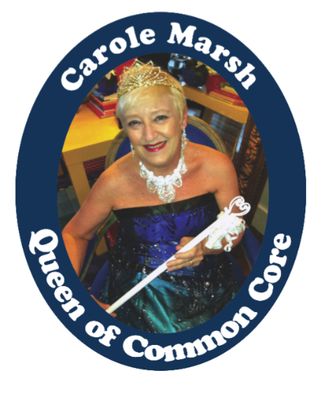
Honestly, I hope there are not so many rules? If not, then do you really have to be dictated to how you Compare and Contrast, Use Original Resource Material, etc. etc. etc.? Can't YOU get to decide how best to implement some of these Common Core ways and means? I certainly hope so!
I do think educational publishers plan to help you. We almost barfed (yeah, queens can do that too!) when we read the endless CCSS.
But it does seem like this is a chance to get back out of the box! At Gallopade, we translated the writing standards into some colorful and fun Writer's Blocks that kids can use to go from side to side to side to do any kind of writing the CCSS dictates, and actually have fun in the process! Why not?
Having fun learning is what I sincerely believe that teachers can bring to the CCSS, if they will just let you. (Fingers and toes crossed.)
I believe that what kids can choose, they use! So I created a pack of signs ('cause creating pointers was too hard!) where your students can actually choose whether to now compare and contrast or debate and discuss—why not?! I hope there is a lot of "WHY NOT?!" in your dialogue over how to implement CCSS in your classroom.
If you, the teacher (after all!), have an idea of how to implement Common Core in your classroom, isn't that okay? Isn't it better than okay? Isn't it great, your job, your perogative? We can only hope so! If it saves time...engages students...creates a passionate learning experience, well, isn't that what Common Core should be all about?
And no boring...NOOOO BORRRRING!
(See my new Wake Em Up cards that are all CC but all fast and furious and fun learning. Why not?)
Teachers, KEEP CALM AND CARRY ON!
YOU are the Queens (and Kings!) of Common Core!
May 8, 2013
The Mystery of History
History’s a mystery to me;
Sometimes I wonder how things came to be.
Could what happened to them…happen to me?
Oh, history’s a mystery to me.
I wrote this little ditty long ago, in reference to Sir Walter Raleigh’s lost colonists of North Carolina. They vanished. No trace.
I thought about this recently when archaeologists at Jamestown, Virginia discovered “Jane”—their name for a fourteen-year-old girl whose “butchered” (their word) skull pretty much proved what they had long suspected (ie, known?)—that during the starving years of the colony, some of the colonists resorted to cannibalism.
I have always enjoyed—relished, really—teaching history to young people via my books. A strong believer in “taking the course opposite to custom,” I tried to engage young readers (mostly 3rd-6th graders) with facts, drama, charm, humor, respect for what they think (at Gallopade we call it the Carole Marsh question, as in “What do YOU think?” meaning not your mom, dad, teacher or know-it-all friend or older sibling, but you)…but most of all with that most dangerous of things: The Truth.
That’s not so easy to do since historical truth is often elusive and subjective. Sometimes I even wonder if some state educational standards have been written by their departments of travel and tourism. I don’t want to force my truth down anyone’s throat, but I do like to share the facts, and the likelihoods (often defined by me as the things we should tell kids but don’t, thus overriding and undermining the truth.) And then, I prefer they draw their own conclusions, again, and again, as they learn more, compare, contrast, debate, discuss, mature, and often, accept what they wish were not the truth. We each struggle with that.
When I was in high school, at Henry Grady in Atlanta, back in the sixties, we were immersed in historical truth. It was hard to hide the skeletal prisoners of German concentration camps when they paraded thirty feet tall in newscasts on the giant screen of the Fox Theater before our Saturday afternoon matinee movies.
It was impossible not to notice the numbers tattooed on the inside forearms of my Jewish friend’s parents and know what that meant. Nor could I ignore their lack of grandparents. History and its consequences were all around us.
None more so than on that day in November when our political science teacher came into class with news that President Kennedy had been shot in Dallas. We sat in silence waiting for history to happen and wept when the news came that he had died.
Yes, the bad history was somewhat ameliorated by Elvis, the Beatles, and others, and yet, as history and the “truth” spun on, not all that history turned out so well after all.
Could what happened to them, happen to me? Oh history’s a mystery to me.
Today, I struggle with teaching the facts, the truth, the who/what/when/where/how, and most especially “Why? of history such as “9/11”…the slaughter of a classroom of children…the bombing of innocent bystanders at a parade. I do not want to teach this history.
Why? Because over time, between war after war after war, Aurora movie theaters, terrorism, the stuck-in-the-mud sticks-in-the-mud we call Congress, and more, I just despise the idea that what children will really learn if I tell the facts, the “truth,” is that adults are pretty stupid. Yes, yes, indeed, all this is countered by people who do good, those who run to, not away from, the disaster, may it be forest fire or a fast food outlet filled with families and a guy with a gun.
I feel that we should learn history so that we don’t repeat the mistakes, but I’m not really sure I can see that being the “truth.” Is the destruction of the rain forest really any different that the ripping up of the American grasslands that produced the Dust Bowl? Just one example.
Could what happen to them, happen to me? Oh, history’s a mystery to me.
Children, I feel, need to learn about history (including current events, which are just history as it happens) because more, I hope, than despairing over the poor choices often made by adults, they will find their way to choosing to become part of the solution for a better future, and not a part of the perpetuated problems we often seem to not have enough imagination to fix/cure/prevent.
Thank goodness for space, immunizations, good dads, and more, much more. But in the equation, how many Taylor Swifts does it take to trump a __________________________? (You fill in the bad blank.)
I do have faith that if I keep writing, and kids keep reading, that they will not turn into the foolish and foolhardy adults, the stubborn and greedy, the long list of where-we-go-wrongs, but instead, be the ones that finally turn history on its ear because they believe war is obsolete, that late abortions should not be, that nuclear is a word that should never enjoy a 72-point headline above the fold, and more, much more.
Last evening I went to a local program by a paleontologist on megalodon teeth fossils. He showed a lot of great graphics that took us through geologic time (and dinner) and eventually bumped right back into…well, I’ll let the person who asked the question say it:
“Hey, that graph you just showed…it looks like we’re at about the peak of the nth climate cycle that leads back to an ice age…is that true?”
The greenhouse effect folks crossed their arms, as the bright, young man answered: “Oh, yes! About every 500,000 years you can expect that.”
“And then what?” a woman asked.
The paleontologist smiled. “Remember that graphic we started out with—the one with Pangaea where the continents were all one big blob?”
We all nodded.
“It will all return to that and the cycle will start over!”
He seemed so excited.
As we silently pondered that truth, the paleontologist’s young son moved among us proudly showing off a very large megalodon shark tooth.
“Just think,” the paleo-dude said, “back then, those sharks were humongous! They had about five rows of teeth with about a hundred teeth in each row and they molted them so many times that they produced about 100,000 teeth per shark in a lifetime—that’s why shark teeth are so easy to find!” He rattled a soup can full of smaller shark teeth.
History ain’t purty, but it sure is fascinating. The facts are often flabbergasting. The “truth” is often painful to share and bewildering to accept. But I guess kids have to lose their baby teeth sometime. After all, they are the only hope we have. Maybe they can get it right…before the next ice age and the slouching toward Pangaea II.
And so, I will continue teaching and writing, and when a kid asks, “Ms. Marsh, could what happened to them happen to me?!” I can answer in all truthfulness, “Oh, history’s a mystery to me.”
March 6, 2013
It Can Happen!
On Friday, I did four school classroom "Skype" visits, in four time zones, in four hours...It can happen!
Once, when we had to go to western Iowa, I cried because I really wanted to go to northern Vermont. About two weeks, 2,000 miles, and two countries later, we (truly) "accidentally" wandered into Vermont, and not just that, to the town of Stowe and the exact inn that had made me want to go there so desperately in the first place. It can happen!
 If you've seen the current Atlanta Magazine, you might have seen the story of a young Tibetan teenage monk, Sherub Tenzin, who always prayed he would meet the Dalai Lama. Considering all the horrid things that happened to him trying to escape from persecution to safety; imagine walking across a large gorge on a swinging bridge—with no sides—in the dark, with armed guards at each end, and worrying his squishy-sounding shoes would give him away (they were filled with blood from the leeches stuck to his soles), and did I say there was a raging river beneath him?...He was probably more likely to meet western cowboy bootmaker Tony Lama! But he finally got where he was going, actually met the Dalai Lama, and ended up coming to Emory University in Atlanta where he studies science so he can return to his country to teach. He would be the first to say, "Hey, it can happen!"
On a less dramatic note, I attended a recent lifetime achievement award ceremony for famed American sculptress Glenna Goodacre. If you think you don't know her, well, you know her work: among hundreds of other things, she created and carved the Women's Vietnam Memorial on the Mall in Washington, DC, and out of about 125 professional entries, was selected to create and sculpt the lovely Sacajewea coin. In college, she got a D in sculpture from a professor who advised her to find something else to do. Discouraged, she drew for ten years before turning back to sculpture. Still in the years when women were second class citizens, she had a hard time getting gallery showings of just her work. (She could exhibit if a male artist also exhibited.) Did I say she just won a lifetime achievement award? If you could see her work, much of it enormous and elaborate and always exquisite, well, you'd just know: It can happen!
And don't forget it!


