
Adrian Collins's Blog, page 144
February 26, 2022
REVIEW: Rush #3 by Simon Spurrier
The tension gets seriously cranked up in The Rush #3 from Simon Spurrier and team. Things are going all kinds of crazy in the boomtown of Brokehoof for the intrepid Nettie as the search for her missing son heats up. After the major cliffhanger ending of the previous issue, where we were left with a heinous, spectacularly gory murder at the talons of an unspeakable and inhuman horror I couldn’t wait to crack the cover on this next chapter. And it seriously delivered. Within the mad, frozen, bloody pages of The Rush there is no shortage of danger that’s for certain and right out the gate Nettie must stare insanity square in the face—faces, actually. We find that the gold lust that sinks its claws into the treasure seekers of the north can drive them to violence at the blink of an eye, and Nettie is forced to flee for her life when it comes to light the claim her son had been working might be profitable.
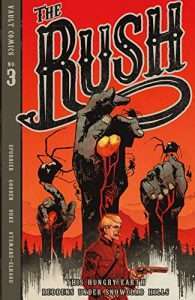 This is where things in The Rush take what could generously be considered a turn for the worse, which is saying something given how fraught with danger, violence, and madness everything has already been. But this is also the first issue of The Rush where, I suppose you could say, things stop hiding. We’ve been treated to the occasional taste of the terrible hidden things preying on the poor bastards seeking their fortune in the snow, but it’s not until here in issue three that we’re treated to some seriously stunning shots of what kinds of nightmares we’re dealing with. In particular, there’s a certain splash page near the midway point of the book that’s absolutely mind blowing.
I’ve lauded the art team of The Rush before, how they’re able to convey so much emotion. How the blood and action pops off the page. But this particular splash, it’s…I stared at it for a few minutes. It’s gripping. Beautiful, even, and maybe even a little bit unsettling. For all that, in particular here there’s a narrative device that’s been threaded throughout the previous issues but which comes to add a serious gravity to the story of The Rush here and that’s the snippets of letters Nettie is writing to her missing son Caleb. Through them her grief and heartbreak is made tangible, along with her single-minded desperation to find her child.
Combined with Simon Spurrier’s natural ability to string dialogue along, it creates a compelling read that has thoroughly sunk its hooks into me. I’ve caught the glittering gold fever for The Rush and cannot wait for the next installment, with issue three earning itself four stars like the previous—verging very close to five. Time will tell. This is shaping up to be an unforgettable story.
Read Rush #3 by Simon Spurrier
The post REVIEW: Rush #3 by Simon Spurrier appeared first on Grimdark Magazine.


February 25, 2022
REVIEW: All the White Spaces by Ally Wilkes
All the White Spaces by Ally Wilkes is a survivalist horror novel set in Antarctica around the time of the First World War. After the death of his two brothers on the front, Jonathan Morgan is drawn to join the expedition of the great explorer James Australis Randall to the South Pole – though things start going awry rather quickly. It is situated squarely in the middle between historical thriller, focussed on keeping the main characters alive until the end of the story, and supernatural horror story, concerned with the strange and uncanny events that occur as part of the ordeal. This means All the White Spaces is likely to appeal to both a traditional horror/SFF audience and one that may come to this through other avenues.
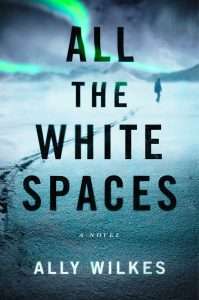 Apart from the many other things I liked about this book, my favourite element was how casually queer it is in a time where this was much less commonplace than it is today. Jonathan Morgan, the main character, is a trans man. He is generally not out to the rest of the crew, and spends much of his energy worried about discovery – but being trans is only one aspect of his character, far from being his whole story. Oh, and he also happens to be gay. Which is just as much a taboo in the context of the book’s setting, so there’s that. This is handled really well, and made All the White Spaces a very positive reading experience for me.
However, the book as a whole is far slower paced than I expected from where it fits in terms of genre, and I felt that it dragged a bit in the middle parts. The story ultimately focusses more on character and the space where survival, grief and madness might interact than driving the mystery forward in a systematic way, and that is a strong factor in how well this story will work for you. The characters are well-developed and shine, especially as they are put in situations where they can only rely on themselves and their own wits for survival – which always brings out the true depths of someone’s personality. As this is set in a military and exploratory environment, the story features only male characters, which is quite unusual these days, but makes for interesting dynamics between the individual characters. And these dynamics and interactions are the strongest feature of All the White Spaces. So all in all, not a perfect book, but a very interesting one that I think will appeal to a lot of readers!
Read All the White Spaces by Ally Wilkes
The post REVIEW: All the White Spaces by Ally Wilkes appeared first on Grimdark Magazine.
REVIEW: The Spine of Night
I’ve just come back from a trip. It wasn’t entirely long, but it was certainly very strange, and I won’t be forgetting it any time soon. The Spine of Night is a surreal, blood-soaked fever dream of epic proportions that recalls esoteric animated classics like 1981’s Heavy Metal Ralph Bakshi’s animated adaptation of Lord of the Rings. It unfolds a fantastical and outrageously violent saga throughout the course of its runtime, a story that touches on at times deeply philosophical themes of truth, knowledge, and the futility of existence. At times, The Spine of Night is even profoundly nihilistic—but also beautiful, and thoughtful.
Ultimately, though, The Spine of Night is a series of stories interwoven together to create a larger narrative with a certain element as its central theme, or the core which all the players and other elements revolve. We are shown the stories of multiple characters, their tragedies and tribulations, as they suffer and survive in a magical, yet grim, world over the course of centuries. Most all of the individual stories are tragic in nature, with the struggles of the characters oftentimes feeling like they amount to nothing. They fight and scrape and often succumb to awful, violent ends. Perhaps, though, their struggle is a metaphor for something greater—an observation of the bigger picture of existence, universal existence, examined through the lens of intimate conflicts. Because that is a strong theme which runs throughout the The Spine of Night, the ultimate point of existence. What purpose our lives serve in the grand scheme of things in a reality where colossal gods and unbelievable magic exists. What value does a single human life hold in such a world? Or even a city full of humans, toiling away the days of their lives? It’s heady stuff, to be sure.
Beyond the sometimes heavy message woven through The Spine of Night, the movie itself is a joy to behold with lushly painted scenery and backgrounds as well as fantastic character and concept design. The art, all around, is simply excellent. So too is the voice acting, with The Spine of Night featuring a number of serious names in the voice acting department such as Lucy Lawless, Patton Oswald, and a number of others. Everyone is delivering a solid performance as well, fully investing themselves in their characters and bringing them to life. It all comes together to create an immensely enjoyable experience. There’s honestly not enough well-crafted, well thought out animation coming from western studios these days, which makes The Spine of Night all the more exceptional. We need more like this, more stories told through the unique lens of animation with its limitless potential. If you’re a fan of animation, of fantasy, of thoughtful stories that might leave you wondering at your place in existence, I cannot recommend The Spine of Night enough and feel very confident giving it a solid four out of five stars.
Watch The Spine of Night
The post REVIEW: The Spine of Night appeared first on Grimdark Magazine.
February 23, 2022
REVIEW: Scorpica by G.R. Macallister
Scorpica is the Kirkus starred epic fantasy debut novel from G.R. Macallister, although readers may have come across her before writing historical fiction as Greer Macallister. The first novel in The Five Queendoms trilogy it is a gritty matriarchal world that I had a great time reading, so thank you very much to Titan and Ms Macallister for the opportunity to read and review Scorpica.
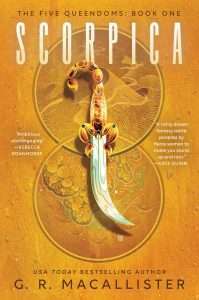 I will say from the outset that I loved Scorpica, it is dark, unflinchingly violent, full of political scheming, sorcery, and swordplay so it was instantly appealing to me. But it also had some wonderful representations of love, loyalty, friendship, and family. Also as a matriarchal fantasy world it is something I have not come across in adult fantasy fiction before. Scorpica has characters that I loved and that I loathed. I was never entirely sure who to trust, and it was fantastic that all these characters women. As a fan of fantasy I know there are some great characterisations of women out there, but with a few exceptions female characters are the minority. It was so refreshing to have a novel where this was not the case and there were moments in it where I paused reading and thought “I absolutely relate to that and I’ve had that from a fantasy book before”. Scorpica is not a typical grimdark novel, but it definitely ticks a lot of the grimdark boxes, and I thought it was brilliant.
Macallister maintains a relentlessly fast pace in Scorpica and the plot moves very swiftly. It has an ensemble cast representing each of the five Queendoms in this world. Just over half of the gripping narrative is focussed on Scorpica, the titular military Queendom, but there are also the agricultural Sestia, academic Bastian, mercantile Paxim, and the magical Arcan which form the rest of the world. The main event that Scorpica focuses on is ‘the Drought of Girls’ a mysterious curse that has made all the children born into the Five Queendoms male. This ‘drought’ is the catalyst of political turmoil, destabilising the world and threatening all of the queens.
Macallister’s style was sometimes a little abrupt, it is not particularly lyrical and there are no vast swathes of descriptive prose or unnecessary dialogue. Everything that is written in Scorpica is purposeful and sharp, so close attention should be paid as even key information will not be repeated. Each of the Queendoms were clearly defined, and the characters were engaging. It is a completely unpredictable novel and Macallister held my attention to the very last page. The novel has created a strong foundation for the rest of the trilogy and I am excited to learn more about the Queendoms that have not featured so prominently in this debut.
My only criticism of Scorpica is that I wish it had been longer. Not just because I loved the world, but because at points it felt like the fast pace sacrificed some of the depth. The narrative covers fifteen years of action, alludes to five hundred years of peacetime history, the turmoil before that, and has a pantheon of new gods to explore. Although all this is explored in some way in Scorpica, at just over four hundred pages long, Macallister has not been able to cover it in as close detail as I would have liked. I am hopeful that the future installments will go into greater detail. Scorpica has certainly whetted my appetite to learn more and in it Macallister has created a world that I am excited to return to. Scorpica is a unique creation that is both beautiful and brutal and I was invested from the first chapter. I genuinely cannot predict what will happen next in the trilogy but I look forward to finding out. 4/5.
Read Scorpica by G.R. Macallister
The post REVIEW: Scorpica by G.R. Macallister appeared first on Grimdark Magazine.
REVIEW: Scorch by Jesse Teller
A fresh new series by Jesse Teller, Scorch tells a story from two distinct perspectives. While we see shadows of his great epic The Madness Wars, this story is much smaller in scale and scope, but no less entertaining.
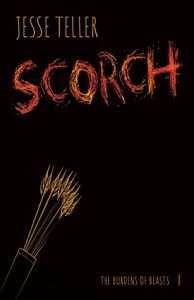 Our story takes place after The Madness Wars, but one doesn’t need to have read that series to fully enjoy this tale. It occurs in a separate part of the continent, and the references back to the larger series are subtle enough to serve as Easter eggs for the returning reader.
Tack is a young man that hasn’t found his place in the world, though he seems to be moving constantly in its pursuit. He’s an expert with the bow, or so he thinks until he starts training with the Ramblers, a small group of mercenaries that have taken on the duty of protecting the Queen of Syphere from all dangers, including the King. The training program he’s put through by the commander of the Ramblers, Xaxamire FyFy, proves to be much more than he bargains for.
“’At this point, the punishment I have thought up scares even me.’” – Xaxamire
Trap is the warlord sent to the city of Scorch to reclaim the Queen by order of the King himself, Ambush. He has a personal vendetta and rivalry with Xaxamire, as the mage had come close to killing him, leaving Trap stuck with a bronze hand (the spell had been intended to transform Trap entirely).
Fast-paced and much quicker in plot movement than previous works, Scorch moves along through the trials of Tack and frustrations of Trap. Along the way we meet some interesting characters, most notably the Ramblers, each of whom has a unique animal familiar or mount bonded with them that increases their battle abilities manyfold. Kelleck rides a huge hyena, and Sarc rides a giant fire ant, and then there is Tyson and his rather unexpected mount:
“’The most loyal of horse will carry you until the day it dies. The most well-trained horse will carry you until the moment it dies. But the greatest of the loyal, the greatest of the trained, will carry you when it has died and refuse to leave you no matter its decay, no matter its bones, and when those bones crumble to powder, the highest of loyal will serve you as a ghost.’” – Tyson
Scorch is a lot of fun, and is a promising first book of a new series set in the world of Perilisc., The Burden of Beasts. Jesse Teller has done it again with his unique take on the fantasy genre, delivering one gut punch after another as the players move through the scenes.
Read Scorch by Jesse Teller
The post REVIEW: Scorch by Jesse Teller appeared first on Grimdark Magazine.
February 21, 2022
REVIEW: The Circus Infinite by Khan Wong
Have you ever thought about running away from everything and joining the circus? Would it have affected your decision if the circus was on an alien moon in another solar system? If this creates visions of four-armed, alien acrobats and insectoid psychics in your mind, then you have a good idea of the fascinating universe that Khan Wong creates in The Circus Infinite.
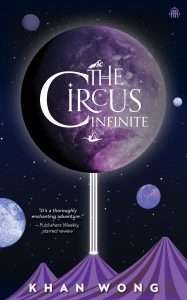 This is the situation in which we find Jes, the empathic protagonist, who is superstitious on a spiritual level. He has just escaped from a high-security research laboratory called The Institute, and is trying to hide amongst the denizens of the 9-Star Congress of Conscious Worlds. Specifically, the pleasure moon Persephone-9.
This is where Jes finds the Cirque Kosmiqa, a sci-fi version of Cirque du Soleil, filled with folks who take an immediate interest in Jes’s unique powers. In a universe where it is quite common for folks to have telepathy, accurate fortune telling, and all sorts of natural abilities, Jes is unique. He can alter gravity, an ability that sets him apart. This is a both a gift and a detriment, because it is the same thing that drives the Institute to hunt him down and lock him up for experimentation and vivisection.
Khan weaves a masterful tale in The Circus Infinite. He presents the story in the present tense, and intermixes numbered chapters with named chapters that are all flashbacks to Jes’s youth. His world building extends to nine different alien races who inhabit a galaxy that is brought together socially by a sentient star. He addresses the social dynamics of the different races and how they interact with each other. All the while tackling issues like the life of mixed breeds, various aspects of xenophobia, and a society that is both open and accepting while being close minded at the flip of a coin.
The Circus Infinite is at it’s basest nature a coming of age story that focuses on Jes while he discovers just who he is and what makes him tick. He comes to terms with several aspects of himself, and discovers how far he can be pushed when the wrong people learn of his abilities and take every chance to use him in nefarious ways.
Wong’s debut novel isn’t the type of story you can sum up in one word. It is fascinating and thought provoking. The Circus Infinite is beautifully written, the characters are both exotic and familiar, and the story is the sort that glues the book to your hands.
Read The Circus Infinite by Khan Wong
The post REVIEW: The Circus Infinite by Khan Wong appeared first on Grimdark Magazine.
An interview with John Birmingham
Over the years, John Birmingham has had his finger in many pies. He is an author that has penned over 30 books that run the gamut from humor to military science fiction. Recently he has released his second novel, The Shattered Skies, in his wild sci-fi space opera The Cruel Stars trilogy. In The Cruel Stars, a group of ragtag fighters come together and battle against fascists in space.
John was kind enough to sit down with me and discuss his writing career and his newest series, The Cruel Stars.
 [GdM] You have a degree in International Relations; if you had decided not to be a writer, what would you have done with that education?
Nothing good, I’m afraid. I started my working life as a researcher for the defence department. One of my flatmates and good friends from that time is now the secretary of the department. His fingerprints are all over that recent nuclear submarine deal. I imagine if I had stayed in my original lane that’s the sort of shenanigans I would’ve been up to.
[GdM] When you were first published in the Semper Floreat at the University of Queensland in Brisbane, was that the moment you got the writing bug?
Oh no, I had it years before. I think I had it almost as soon as I learned to write in primary school, but I remember applying myself to the work of writing when I was in high school. I’d sit up late, like really late, on school nights, copying out huge slabs of text from books that I really liked. I was trying to reverse engineer them, to see how they worked. I learned later that Hunter S Thompson did the same thing with William Faulkner. So maybe I shouldn’t be too embarrassed by it.
[GdM] You have stated that you started as a horror writer and were heavily influenced by Stephen King, and reading your catalog, you can see a lot of that in the Dave Hooper series. I have to ask about your first horror novel. What was the premise, and is your first horror book still located at the State Library of New South Wales?
Hahahaha. I can’t remember the exact premise of the book, but I do know it was a terrible and embarrassing homage to Stephen King’s The Stand. An end of the world novel with demons. I guess, given how the Dave Hooper series turned out, the rotten apple didn’t fall too far from the tree. But God, that handwritten first high school novel was hot, shameful garbage. Anybody who’s in Sydney can feel free to drop into the state library and read it in it’s original hand written form. Especially young writers. They would see then that there is nothing magical about being a published novelist.
[GdM] Tell me a bit about your site Cheeseburger Gothic. I would love to know how it got its name and the story of how it started.
The origins of the name are lost to time, I’m afraid. But I wouldn’t be surprised if they had something to do with that old TV series, American Gothic. I quite liked it. And I really like cheeseburgers. So, you know…
It started as a diary on an old blog site called journalspace, and I do remember I started writing there because a guy called Steve Murphy had written a review of Weapons of Choice on his journalspace blog. He picked me up on a couple of egregious technical errors, which was fair enough. But otherwise the review was really nice. I guess it drew me into that community.
 [GdM] I have a friend from Sydney who introduced me to Falafel, the play, and the movie. Could you talk a bit about He Died with a Felafel in His Hand and how that came about?
I was working at a magazine called The Independent Monthly, and we were quickly going out of business. The deputy editor took me aside one day and said he had this plan to spin up a publishing company. He wondered if I could write him a funny book as a stocking stuffer for the Christmas market. I shrugged and told him that I had a few flatmate stories, and we were off to the races. It was weird, really. I took it on like a magazine commission, rather than a book. And it totally died in the arse when it came out. Nobody bought that fucking thing for about six months, but there was this one guy an independent book distributor, who really liked it and who kept a box in the back of his car, forcing it onto bookstores everywhere he went. After six months it took off. I reckon that guy was the reason.
[GdM] How has your writing changed from the days of Falafel to now? Is it the same process?
My process has been, er … refined. It had to be. I had no process when I started. I wrote Felafel in five weeks, mostly after midnight, on cheap red wine, hot chips and amphetamines. It sounds cool, but it wasn’t. It was stupid and unsustainable. I’m all about the time management now. Pomodoro technique, Cal Newport’s deep focus, all of that shit. I try to write, and I mean write, not ditz about on Twitter, for at least four hours a day, every day. I track my time. I block my access to social media. I try to know what I’m going to write before I write it, and I execute on that plan like a motherfucker.
[GdM] Reading Falafel and Stranger Thingies, you seem like a man who can find the funny in every situation—even dark ones. How do you approach comedic writing? How do you take something dark and see the humor in it?
To be honest, I don’t know. I don’t know why I see the humour in things, or maybe that I can simply extract the humour in things and put it on the page or the screen, when others can’t. When I realised that I could do something that would earn a bit of money I even tried studying it, buying how-to books by comedians and comic authors. I can tell you mechanically why something is funny, but not why some people are able to engineer those lulz on the screen or onstage and others aren’t.
[GdM] Is it true that you wrote your David Hooper series because the Movie Reign of Fire pissed you off so much?
Yes. Yes it is. I was promised helicopter gunships versus dragons, and I was really looking forward to seeing some dragons get their asses kicked. I was gravely disappointed.
 [GdM] How many years have you practiced Jujitsu? Has that helped you create and choreograph your fight scenes?
I first started training in my early 20s, for a very sad reason. A friend of mine was murdered. I felt bad I hadn’t been there for her, but I also knew that if I had, I probably would have been killed too. I’ve been training on and off, ever since, whenever I can find a good Dojo. I went about 12 years in Sydney without training at all because the nearest Dojo was four hours away. I got back into it when my kids were old enough to train, about 4 and 6 respectively.
And yes, it really does help with writing fight scenes. A lot of the training we do in our school is scenario based. Fights in stairwells. Attacks in train carriages. That sort of thing. It’s nice being able to understand how the angles work. Although, to be honest, most fights in real life are over within two seconds. And they’re not particularly pretty to look at. But that’s not the sort of thing which sells books or movies.
[GdM] You have many strong female characters in the Cruel Stars. Women who kick-ass, have swagger, and lead teams of warriors. I also read you have a daughter you are training to be “an unstoppable killing machine of death when she leaves home.” In science fiction, women used to be portrayed as insipid and weak. They would rather scream than beat the monster. Are there any female characters you thought were watershed moments for science fiction? For me, it was Ripley’s “get away from her, you Bitch.”
Yeah, Ripley is acknowledged as occupying an inflection point in popular culture. She is hugely significant. But there were female characters before her, and obviously there have been plenty since. It’s almost a whole genre now. I think the Doctor Who companion Leela was really important in her own way. And obviously Buffy the Vampire Slayer wrote a whole new rulebook. Pity about Joss Whedon, though, innit.
[GdM] The second book in the Cruel Stars series drops this month called Shattered Skies. Can you explain a bit about the series for the uninitiated and some things we get to look forward to in Shattered Skies?
Hmm, lets see. There are space Nazis, space zombies, which the space Nazis created, to overthrow the ruthless corporate space empires. There’s space lesbians, space marines, angry robots, a Princess, a 700 year old foulmouthed Scotsman, and a young woman called Lucinda who’s in over her head. Until she starts shooting people, and then she’s way more chill. The space Nazis turned up in The Cruel Stars, and they broke a lot of things and hurt a lot of people, but the lesbians, the Princess, the Scotsman, the angry robot and Lucinda opened a whole can of whoopass on them. There’s more whoopass in book two. And consequences. So many consequences.
[GdM] Was it a unique challenge to write The Cruel Stars with characters who lived such long lives due to recorded consciousness? A character now might not have been the same person 400 years ago.
That was less the challenge than a provocation. This particular trope has been worked over a couple of times now by authors as good as Peter F Hamilton. So I didn’t have to reinvent the wheel, I just wanted to gaffer tape some really wicked blades to it.
 [GdM] You do highly detailed research in your books. What are some technology rabbit holes you went down in researching Cruel Skies?
Machine intelligence and neural nets. Like, actual wiring in the brain. Elon Musk is deep into that shit, and with good reason. He’s worried about the machine singularity. At one point I found myself reading, re-reading and taking notes on this insane 45,000 word essay deep diving into Musk’s Neuralink project. And then I would remind myself, dude, just write the book.
[GdM] What are you writing or have going on at the moment?
The third and final book in the series, natch. The Forever Dead. And some screenwriting, which I can’t talk about, because screen guys are really uptight. But for my own amusement, I have been playing with a TV adaptation of The Cruel Stars. I’ve also been working on a new Axis Of Time series, over on my Patreon page. That should start coming out on Audible sometime in the next six months. And I have an idea for some crime novels. It’s enough to be getting on with.
Read The Shattered Skies by John Birmingham
The post An interview with John Birmingham appeared first on Grimdark Magazine.
February 20, 2022
REVIEW: Valour by John Gwynne
Valour is the second of four novels in John Gwynne’s The Faithful and The Fallen series. Valour was preceded in the series by Malice and is followed by Ruin and Wrath. It was first published in 2014 and the great thing about reading a completed series is that I do not have to wait years in between each novel. Which is amazing because The Faithful and the Fallen is turning out to be one of the best series I have ever read.
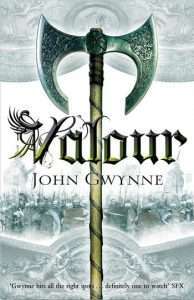 The series continues in the same style, Gwynne is writing an epic grimdark fantasy with numerous perspectives. Around half of the points of view are continuations from Malice, some of the new ones used to be minor characters which we get to learn more about, and others are brand new to Valour. One of the really handy additions to the novel is the ‘cast of characters’ list at the beginning which lists everyone and sorts them under their allegiances. So, if like me, all of the names starting with C can get a little muddled or you forget whether someone is from Tarbesh or Tenebral you can refer back to it. I think this would be very useful if there has been a long gap between finishing the first novel and starting the second.
Gwynne kicks off Valour almost immediately after the ending of Malice. The characters with uncertain fates are quickly resolved for good or ill and the journey continues. There is less world or character building required here and so the plot moves more quickly than it did before. I found Valour to be a significantly more dark and gritty novel than Malice. If Malice was the calm before the storm with light, happy moments such as weddings, feasts, and training in the Rowan Field, then Valour is the dark sky and growling thunder right before a storm hits. There are more perspectives in this novel that belong to the dark forces of Asroth so more time spent in the company of malicious characters and as such it is significantly more violent and bloody. There are grizzly battles, wolven fights, torture scenes, and sexual violence. Though that was hauntingly implicit rather than a graphically detailed scene.
However Valour is not completely and unrelentingly bleak. The camaraderie of Corban’s band of outcasts, who love and support each other through all the challenges they face, is one of the loveliest parts of the novel. There are some laughter inducing moments from the haphazard flirting of the now late teenaged men and the animals in their cohort often induced a smile. I also find myself hopeful for the futures of some the characters who seem to be undecided on where their allegiance lies in the God War, and hope is a powerful tool in a grimdark novel.
I am in awe of Gwynne’s skill as an author. In this series he is successfully weaving more key perspectives than I have ever seen before, whilst traveling across the continent of the Banish Land, in and out of different countries, trailing different factions, simultaneously moving the plot forward in a relentlessly entertaining and entirely unpredictable way. I genuinely care about the fate of the characters and there is one death in particular that made me cry, which is something a book rarely makes me do. Even with twelve points of view to manage, Gwynne’s characters are three dimensional and equally interesting. I did not sigh or skim read when it changed to certain viewpoints because all of the narratives are engaging. It is consistently well written and the ending has left me satisfied with the conclusion of Valour but also desperate to find out what happens next with Ruin.
I know the themes of Valour are tried and tested fantasy favourites but this feels fresh and new. Gwynne has taken the things I love from authors like George R R Martin and David Gemmell and made something utterly fantastic. I highly recommend it and the only reason I am not giving Valour five stars is because I think Ruin will be even better. 4.5/5.
Read Valour by John Gwynne
The post REVIEW: Valour by John Gwynne appeared first on Grimdark Magazine.
February 19, 2022
An Interview with Scott Drakeford
Scott Drakeford’s highly anticipated release of Rise of the Mages has many fantasy lovers buzzing about the intricate storytelling, revenge plot, and gripping fight scenes. Scott was kind enough to sit down with us and tell us a bit about Rise of the Mages and the path he took to get the story released.
 [GdM] First, thank you so much for taking some time and answering these questions for us! Rise of the Mages is a fantastic book, and I am happy we get a chance to talk a bit about it with you.
Thank you! I’m honored by your interest in my work. Thank you for giving me and Rise of the Mages a shot.
[GdM] You have a degree in mechanical engineering, which uses a different kind of logic and creativity than writing and story creation. Do you feel like your experiences in mechanical engineering complement your ability to write and put scenes together?
Honestly, engineering was extremely boring for me. I thought I’d get to solve problems and build awesome machines, but it was so much more mundane than that. Like, imagine studying advanced math and science for years and years just to end up on a team of people designing screws or fancy zip-ties as wiring harnesses. And that’s your life. You spend years calculating the best material, size, thread count and pitch. Then you pray to whatever god you believe in that when the rocket/car/plane/whatever blows up, it was something else that failed, not your screws. God, I hated it.
I did, however, learn to pay great attention to detail. I learned to value extreme consistency, continuity, and logic. Engineers have great use for creativity in solving problems or applying technology but have no use for the implausible. I think that heavily influenced my brand of writing, and certainly it affected how I write. With everything from my fictional magic system and characters to my plot and prose, logic and details matter. Maybe a little too much.
[GdM] What is a significant way Rise of the Mages changed since the first draft? Did the story organically evolve as you worked on it?
This book changed a lot over the years. I learned to write with the first ten or so drafts of this story that only I ever saw. I learned to edit and rewrite when I let my wife, dad, and brothers read it to tell me what worked and didn’t. That probably resulted in another draft or five. I then did another three or four drafts with my awesome agent Matt Bialer and his talented assistants (one of whom is now a bestselling author). Then I did another two or three drafts with my editor Jen and her awesome team (thanks Molly!). It has been a long journey, a ton of work, and I’ve had a lot of help.
Another big factor in the evolution of the story was my own evolution as a person. I changed a ton over those ten years. I completely switched careers, had a child, left a religion, and changed my entire worldview. We moved across the country, and I quit my job two years ago to be my child’s primary caretaker during the pandemic (poor kid) so my wife could take her dream job.
So… yeah. Rise of the Mages evolved A TON as I evolved both as a writer and as a person. I would guess that every single word in the book has been rewritten at least two or three times. I even threw away the middle 50% or so and completely replaced it with a new story at one point. Just about the only constants from beginning to end of the process were Emrael, Ban, and Jaina’s roles as core characters.
[Gdm] Did you have to do any research for the story? If so, did you go down any interesting rabbit holes?
I did some research on earth’s magnetic field, what we think causes it, and why ours is far too weak to use as an energy source. I learned how radios in particular work on a theoretical level, which is neat. Human discovery of electromagnetic energy and subsequently using it to create technology like radios, televisions, the internet, etc, is just crazy when you take time to consider all the different discoveries that had to happen. For all the current reasons to doubt the merits of humanity in general, our history of progress is amazing. I hope to see many more breakthroughs in my lifetime. I just hope we can continue to stay ahead of our mistakes.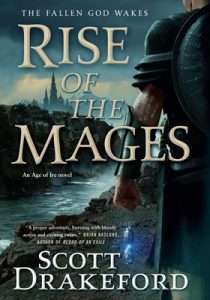
[GdM] What was your writing schedule like when writing Rise of the Mages?
Well, it has changed a lot depending on my life circumstances. I started writing in the early evenings when I didn’t have a child. In the thick of raising a child and working long hours at a corporate job, I wrote a lot at lunch when I had time to take lunch off-site. Basically, anytime a normal person would be relaxing or socializing, I tend to be writing, editing, or similar.
[GdM] Scott Drakeford is a nom de plume and an ode to your father. How did he influence you and turn you into a reader?
Well, my dad reads more than just about anybody I know, and certainly faster than anyone I know. A 400-page book probably takes him a few hours at most. When I was about eleven years old, he convinced me to read The Belgariad. Ever since, we’ve shared a love of reading, fantasy in particular. We still share books and recommendations often.
[GdM] The Rise of the Mages reads like the classic fantasy I read and was excited about growing up. Books like The Belgariad and the Wheel of Time had a significant impact on me as a reader. What classic book influenced you as a writer?
I have to tell you, I’m ecstatic to hear that Rise of the Mages evoked some of the same feelings as The Belgariad and The Wheel of Time. Those two series were really key in my formative adolescent years. I’m pretty open about this, but the Wheel of Time in particular became my happy place. I was very, very into that series and I still love it.
L.E. Modesitt’s Recluce series is another that I consider “classic” that I’ve been reading for decades. He’s very, very good at crafting an entire life for his characters, and at showing the everyday details that go into even figures who end up changing their world. One of the best authors out there.
[GdM] I read that Rise of the Mages took a total of ten years from start to finish. Can you tell me about the beginning? What was the impetus of the series?
There are many catalysts that resulted in different characters, storylines, and themes in Rise of the Mages. But the thing that got me to put pen to paper in the first place was simply feeling stuck in a career I didn’t love (see: engineering discussion above). I needed an outlet for creative expression. I needed to feel like I was creating something that mattered. And few things have mattered more to me than the wonderful stories that have inspired and influenced me throughout my life. So shortly after I graduated from college in 2012, I started writing the story that would become Rise of the Mages.
[GdM] What did you do to celebrate finishing the final draft of Rise of the Mages after a decade of hard work?
Well, in publishing it’s really difficult to ever really feel like anything is truly done, I think. When my editor told me I couldn’t change things anymore, it was honestly kind of painful. I did buy a bottle of Glenlivet 18 that I opened that night, but it didn’t feel as celebratory as I would have liked. I’m hoping launch day will be more fun.
[GdM] Can you tell us a bit about the plot of Rise of the Mages?
Two brothers attend a school for engineers and military leaders. A powerful political leader from a neighboring province seizes the school in order to use their technology to bolster his own international war efforts against a technologically advanced nation, Ordena. One brother, an engineer, is captured and enslaved. The other brother, a student of military arts, sets out to rescue him.
It’s a story about relatively powerless individuals banding together to fight against the injustices of the current power structure. Of course, there are political, social, and personal complexities involved, but that’s the primary purpose of the plot. Rage against the machine, as it were.
[GdM] Rise of the mages has an elaborate magic system. Can you talk a bit about its creation and how it works?
The magic system in Rise of the Mages is very closely related to the primary energy source, called infusori, that powers most of the world’s technology. I’m far from being an expert on biology, chemistry, or physics, but the roles of chemical energy and electromagnetic energy (and even the processes that convert one into the other) were something I wanted to explore.
In Rise of the Mages, the core idea is: what if humans evolved to be able to metabolize electromechanical energy in a similar fashion to our chemical metabolism? And further, electromagnetism being inherently less contained in nature, what if humans could use said energy to affect the world around them?
I think the basic laws of physics as we currently understand them in our world play very well here with what makes an interesting magic system in second-world fantasy, and that just felt right to me. I had to take some further liberties, of course, but I like that the tech and magic are at least somewhat close to obeying the natural laws that govern our current reality.
[GdM] Along with an intricate magic system, you also have political machinations and upheaval of warring factions and cultures. I found the Ordenan culture fascinating. Did you model it after any known cultures or histories?
The Ordenans are probably my favorite culture as well, and they feature more and more heavily as the series goes into books two and three. I’ll try not to spoil too much for you, but where this first book is very solidly an action/adventure quest, the following books expand to incorporate more political intrigue and larger-scale conflicts.
The inspiration for Ordena wasn’t so much any single culture in our own world as much as it is a symbol of imperialism and the cultures throughout our world’s history that have propagated such philosophies and policies. You could point at Britain, ‘Merica, Spain, Portugal, Germany, Rome, the Crusaders, Japan, China, the Soviet Union, France, the Ottomans, the Egyptians, even ancient American societies; really any civilization that reached a point where they had the power to take advantage of another population, or eradicate them to take what they had, or even those who engaged in such conquest for religious reasons. Ordena is a little bit of all of those: their religion is centered on preserving and furthering ancient knowledge that they believe to be from their two Deities, the Silent Sisters. A big part of that is a holy war against another civilization they believe to be evil, and to some extent they are right. But I hope to explore how such stark beliefs and “justified” conflicts often turn out to be not so purely motivated after all, and why much of such conflict is due to a willful misconstruction of “the enemy” – optics, as it were – to hide the true motives.
Or are their gods really behind all of this mess? Read and find out, I guess. 
[GdM] Have you worked out how many books will be in Age of Ire?
For now, it will be three books. Book two has been written and is in revisions – it doesn’t have a firm pub date just yet, but will likely be out sometime in 2023. Book three should close this phase of the story, and in a relatively timely manner.
[GdM] One of the most compelling characters in the story for me was Jaina. She was both a master of fighting and war and a teacher and a devout believer; she had a significant depth of character. Was she modeled after anyone specifically? How did her character come about?
I try very hard not to project myself too much on any one character, and I similarly try not to model any given character after a particular person in my life.
That said: I can’t speak for other authors, but I believe that each of my primary characters logically must come from somewhere inside me, or at least from somewhere inside my conscious (or unconscious) experienced reality. At the very least, it’s easier for me to write convincingly when I understand motivations and personalities on some level.
As for Jaina’s character? I can be a very stupid person on occasion, and particularly in my younger years, I was prone to strong (often incorrect) opinions and brash actions. Intelligent, strong, amazing women in my life have always been there to show me a better way, to provide an example of leadership, accomplishment, and relationships done right. My mother and my wife, in particular, are just unreasonably good at life and I am so lucky to have both of them in mine. But I’ve had incredible grandmothers, aunts, female cousins, bosses, mentors, just so many women that have been anchors at various stages of my life. Jaina is all of them, and none in particular.
She is my hero, and so are the women in my life.
[GdM] Finally, what exciting things are you currently working on?
Book two revisions! I really love how the second book turned out, but now it’s time to make sure that my editor, agent, and all of my beta readers can connect with it as well. I find it best to edit myself to at least the point that grammar is correct, the prose flows well at all levels, and at least the core elements of character and plot are in place and work for me. Then Kailey (my wife), Matt (my agent), Jen (my editor), my dad, my three brothers, and a small group of other superb beta readers all get their turns tearing my soul to shreds. Then I rebuild myself and my book, and hopefully, neither process takes too long.
Read Rise of the Mages by Scott Drakeford
The post An Interview with Scott Drakeford appeared first on Grimdark Magazine.
February 18, 2022
Lose yourself in the new TTRPG Red Giant from Rookie Jet Studio
If there are two things I truly (madly, deeply) love it’s anime and roleplaying games. Particularly when either or both of them happen to have a dark, fantastic edge to them. When they view a world or a story through a grim, benighted patina. As far as anime goes, one of my all time favorites is Vampire Hunter D, so when I heard about a new TTRPG that directly stated it as one of its primary influences, I knew I had to check it out. And I’m damn glad I did. Red Giant, written by Cory Burns and released by Rookie Jet Studio is a grim, dark, fantastical game that takes for its inspiration anime classics like the aforementioned Vampire Hunter D, as well as others including Berserk and Claymore. But even more than that you can see shades of H.P. Lovecraft’s cosmic horror lurking around the edges, and Robert E. Howard’s brutal swords and sorcery flavoring the world, but it has a lot of other influences that become readily apparent as you read through the core.
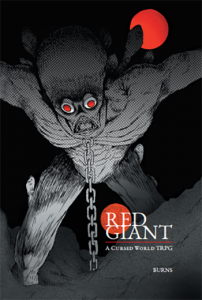 Red Giant is a game that puts its players into a harsh, unforgiving world—a cursed world. One that, perhaps, isn’t just dying but dead. The characters inhabit the corpse of a world, crawl upon it like flies as they fight and scrape out a living beneath the glaring eye of a bloated red sun. You’re told right out that a game of Red Giant is meant to test you and your character, meant to be grueling. Every confrontation is a battle to the death, and you are at almost every turn outclassed and outmatched. Your wits and your party are the only thing keeping you from certain death, and insanity as well. For not only is it a world consumed by death, Red Giant presents a world overrun by unspeakable horrors from the depths of man’s darkest nightmares. Creatures that have no right existing, yet they stalk humanity and slaughter them like cattle. There’s an incredible breadth of terrible horrors awaiting the players brave enough to roll up a character and adventure through Red Giant, and while much of the game is highly reminiscent of the anime and stories mentioned above I also can’t shake the feeling that some inspiration was also pulled from popular video games like Dark Souls and Bloodborne. Not just in the aesthetics, but in the way the game itself is presented and how the characters traverse it.
Red Giant is very mission based, with the GM (game master) putting together a story that leads the characters around a desolate landscape undertaking one quest after another, fighting for their lives and their sanity every step of the way. The game focuses strongly on the storytelling over the mechanics, and that’s something I truly appreciate. Too many TTRPGs these days are simply combat simulators, where you slap together a character, hack’n’slash your way through encounters, collect experience and loot then rinse and repeat. Red Giant offers more than that, by stripping away all of the dross and presenting you with an incredibly streamlined character creation process and system of conflict resolution mechanics. It leaves you with a lot of breathing room, and options to reward the player for actually playing. Red Giant wants you to immerse yourself in its world, to tell a story, and ultimately to lose yourself in it and have fun—or a harrowing nightmare experience. But sometimes that can be fun, too.
As far as world building itself goes, the Red Giant core goes pretty light on any kind of specifics, leaving it up to the GM and the players to define things which can certainly be a double-edged sword. By providing and citing a list of influences for the game itself, you do get a pretty good idea of what kind of environment you’re playing in, and there is a decent amount of “set dressing” that’s front-loaded into it. We know Red Giant takes place on a cursed, blighted planet where humanity fights against the landscape itself as well as the nightmares that haunt it. We know magic is real, and that the setting is steeped in the dark fantastic. I cannot emphasize enough that you should do yourself a favor and check out the Vampire Hunter D animated features if you’re going to jump into a session or two of Red Giant. Most of the world building, though, the bulk of it, is given to us in the chapters dealing with monsters and magic. While character creation and conflict resolution are refreshingly light, there is a robust and highly adaptive magic system revolving around three types, or styles, of magic that give players tons of options. The kinds of monsters loaded into the book also give us a solid idea about the world of Red Giant, as many of them are hideous monsters pulled from folklore and mythology, or sanity-bending Lovecraftian abominations that warp the minds of those who encounter them.
Some of the best examples of world building, though, come at the tail end of the Red Giant core in the pre-made scenarios which are quite interesting and give players and GMs a great start as well as good ideas as to what kinds of games they can run and develop on their own. All in all, if you’re a roleplayer who’s interested in checking out something a little bit off the beaten path and have more interest in telling a story than just rolling some dice, and you’ve got an itch only bloody, dark fantasy can itch I cannot recommend Red Giant enough. As a new core for a new setting, I’m giving Red Giant from Rookie Jet Studio a solid four stars and can’t wait to craft my own game and start my own misadventure in the grim red light of its cursed world.
Red Giant is available now in both print and digital formats on DriveThruRPG.
The post Lose yourself in the new TTRPG Red Giant from Rookie Jet Studio appeared first on Grimdark Magazine.


