
Adrian Collins's Blog, page 143
March 8, 2022
REVIEW: Red Sonja by Gail Simone
Red Sonja is one of the archetypical fantasy characters and a fountain for which hundreds of copycats have been created. She’s also a character younger than most people realize as it was not Robert E. Howard who created her (though he created her inspiration, Red Sonya of Rogatino) but comic book legend Roy Thomas in 1973. The character became immensely popular with her own series, “so bad it’s good” movie, and novels.
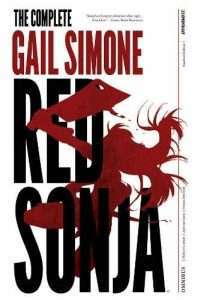 Unfortunately, the character is as infamous as she is famous due to the Esteban Maroto created chainmail bikini that became emblematic of sexism in fantasy. Terry Pratchett would even famously create a parody of her in Herrena the Henna-Haired Harridan where she would be described as famously wearing a sensible chainmail with boots. Despite this, Red Sonja has always had a massive female fanbase as well as male.
One of the early fans of the She-Devil with a Sword is Gail Simone, who loved the character as a teenager, metal swimswear and all. It was the “Women in Refrigerators” and Birds of Prey author who was asked by Dynamite Comics to reimagine the character for the 21st century and create an entirely new take on her. Red Sonja had been doing quite well since being reintroduced in 2010 but they wanted to try something new with her.
The result in her three graphic novel run is one of the best set of fantasy comics written in decades, at least in my opinion. My praise is not 100% without criticism to go along with it but presents my all-time favorite incarnation of the Hyrkanian heroine. Certainly, if you want to jump on the character then it is an excellent place to start if you don’t want to read the original Roy Thomas comics.
The changes to Red Sonja aren’t in her costume–though Sonja wears more clothes–but her backstory. The original story had our heroine sexually assaulted with her family slaughtered by mercs. Gail Simone removes that element from her backstory as well as the connection to the goddess Scathach that Sonja swore her “I will bed no man unless he first defeats me in battle” oath to. Indeed, this element gets mocked rather soundly throughout the story.
In simple terms, this version of Sonja is significantly hornier and spends a good chunk of the second novel wanting to get laid but being unable to do so despite looking like Jessica Chastain with better hair. Apparently, Red Sonja really needs a bath but it’s a running gag I found to be incredibly amusing. Sonja is also now openly bisexual, which is an interesting change given the character’s somewhat spotty history with representation.
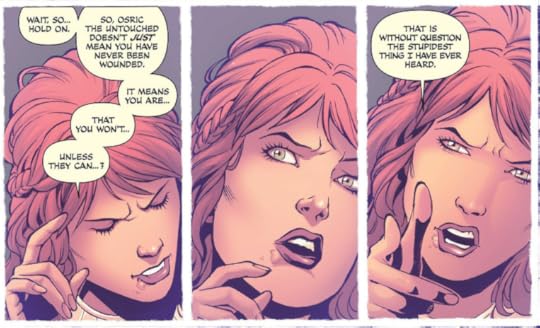
Some of the few complaints I have about the book is the removal of Scathach as well as the fact Sonja is less noble versus more of a lumbering barbarian. Still, I think the removal of the “best her to bed her” oath is one of the better decisions of the book. Roy Thomas himself has stated that he’s received literally decades of fans complaining about it from both sides of the gender divide. Apparently, a lot of female fans (and of course male ones) thought she should be allowed to fool around.
The humor, action, and art of the book is spectacular as well as the characterization. Sonja is a bit of a lunkhead at times, doing stupid things like loudly announcing she has no money in a brothel, but still recognizable as her avenging angel of the Bronze Age self. This is a truly fantastic book and perfect for fans of fantasy comics.
Read Red Sonja by Gail Simone
The post REVIEW: Red Sonja by Gail Simone appeared first on Grimdark Magazine.


March 7, 2022
REVIEW: The Batman
Two years since first putting on the cowl and dark eye shadow, The Batman finds our young caped crusader facing a serial killer with an intellect that may be greater than The World’s Greatest Detective. It’s Matt Reeves (War for the Planet of the Apes, Let Me In) who takes on directing duties for DC Comics’ brooding Dark Knight this time as Robert Pattinson puts on the Batsuit. With countless films, TV series, books, and games starring the character of Batman, it was always going to be a tough task to create something fresh and new for a modern audience but I am pleased to say that the excellent cast and film crew solved that riddle with ease and have created one of the best versions of the infamous character.
 The Batman is aware that the audience is familiar with the childhood tragedy that haunts Bruce Wayne and leads to him creating a violent alter-ego intent on cleaning up the filthy streets of Gotham. It dives into Batman’s journey two years into his mission where The Riddler is killing corrupt cops and politicians in the name of justice whilst leaving clues for The Batman. The Riddler in The Batman is written with clear similarities to the Zodiac Killer who terrorised California in the 1960’s. His clues are designed to mess with those intent on his capture and this adds a layer to the character of Batman that has never been seen in live action before. The Batman gives Robert Pattinson a chance to display why the character is known as the World’s Greatest Detective. The Riddler is the perfect villain for this stage of Batman’s career. He is menacing with heavy breathing like Darth Vader and his work in the shadows added an element of horror to the film that has been missing from previous Batman films. The fact that this is a villain that Batman can’t just beat up makes it all the more terrifying.
This is a serious film with only brief moments of levity. The Batman is narrated (in a style reminiscent of Rorschach in the brilliant Watchmen) and feels like a modern hardboiled noir detective thriller. Pattinson plays the role to perfection, a young, moody billionaire out for vengeance on the criminals who took his parents. He stomps and swoops through a stunningly realised Gotham City (filmed in Glasgow) that seems to have a life of its own and is the best version of the city since Tim Burton’s Batman Returns or even Batman: The Animated Series. There is a lot going on in the film with many characters but the almost 3-hour runtime allows them to stretch and breathe without it becoming too cluttered. Zoe Kravitz as Selina Kyle, Jeffrey Wright as Jim Gordon, and an unrecognisable Colin Farrell as The Penguin all stand out amongst the excellent cast and create something fresh in the crowded comic-book film market.
The Batman is a dark, brutal tale of a young man caught up in a dark cloud of vengeance with only glimmers of light shining through. Reeves has managed to bring together some of the best moments and moods from the long history of the Dark Knight (including the brilliant run by Scott Snyder) to prove once again that when DC and Warner Bros. get things right they really can create films of stunning quality that rival anything else on the big screen. Some people may be starting to feel Batman fatigue (Batigue?) but The Batman is arguably one of the best takes on arguably the most popular comic book character of all time.
The post REVIEW: The Batman appeared first on Grimdark Magazine.
March 6, 2022
REVIEW: The Crimson Queen by Alec Hutson
There’s a certain class of movies I like to refer to as “popcorn movies,” by which I mean they are just fun. You sit there shoveling popcorn into your mouth, wide-eyed and glued to the screen, totally sucked into the action and before you know it the credits are rolling and you’re scraping the bottom of the bucket wondering where the time and the popcorn all went. The Crimson Queen by Alec Hutson is very much the literary equivalent of a popcorn movie, and I mean that in the absolute best possible way.
 It’s immensely fun, entirely engrossing, and the absolute definition of a real page-turner. Once I cracked the cover on The Crimson Queen and started in on it, I found myself having a hard time putting it down and the pages and chapters flew by. It’s not just that it’s that good (it is, though), it’s that the pacing is phenomenal and the world itself is so lush and full of life, so clearly defined and believable.
Hutson does something with The Crimson Queen that I greatly appreciate, and it’s something that I feel not enough fantasy authors are willing to do: he trusts the reader. He doesn’t waste time on endless exposition or walls of description. Instead, Hutson presents the world and its history and inhabitants for us, the reader, to interpret through the course of the action and the story itself. And it pays off, big time.
The Crimson Queen takes place in a living world, brimming with fascinating history and characters that you want to spend time with. Right out the gate things are actually happening, there’s no waiting around for the story to gain momentum, it happens right in the first few pages and a lot of that has to do with not only Hutson’s lovely prose but how clear and distinctly written his characters are. Each one is clearly defined and developed, and even the villains and antagonists are people you want to spend time reading about.
As a matter of fact if I had any chief complaint about The Crimson Queen it’s that I wanted more out of it. I don’t usually complain about a book not being long enough, and when I do it’s usually because the writer needed to take more time developing things. Here, the inverse is true. Hutson has developed the world in which The Crimson Queen takes place in so well I just desperately want to spend more time there going on adventures with the characters who populate it. Which, in regards to the characters and the story itself, as I mentioned previously is utterly engrossing.
While not being totally original and definitely playing with some well-known fantasy tropes, Hutson wields those tropes effectively. Even the Chosen One Farm Boy (he’s a fisherman’s son, actually) here is interesting and has a fun spin. There’s a conspiracy that spans millennia, monsters and gods and demons, hair-raising sword fights and magical battles. The Crimson Queen has everything you could possibly want or need out of an epic fantasy. Then, before you know it, it’s over and there are no more pages left. Thankfully, it’s only the first part of a trilogy so there’s more adventure and excitement ahead and I cannot wait to dig into it. I’m very happy to give The Crimson Queen by Alec Hutson an enthusiastic four stars, and have already added the next two books to my TBR pile.
Read The Crimson Queen by Alec HutsonThe post REVIEW: The Crimson Queen by Alec Hutson appeared first on Grimdark Magazine.
March 5, 2022
REVIEW: Stars and Bones by Gareth Powell
Gareth Powell has built a reputation for delivering well crafted and emotionally investing space opera with a fair share of humour, from Embers of War to Ack-Ack Macaque and his latest offering, Stars and Bones maintains that high standard.
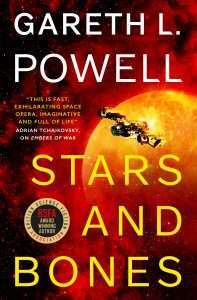 The story kicks off with a terrifying first contact situation with a malevolent lifeform that results in a ship & crew being lost and sets up the search & rescue effort that introduces us to our core character, Eryn – who’s sister Shay was on the ship that’s gone missing
Stars and Bones then skips back in time to explain how humanity made it to the stars and it’s one of the bleakest, most cosmic horror inducing but weirdly hopeful versions of that trope I’ve found. It also includes a pretty direct criticism of the current UK government which is extra chilling given current world events.
Suffice to say that humanity – or ‘the Continuance’ now travel the stars in a fleet of sentient and characterful ark ships having been simultaneously saved from self destruction, then evicted from Earth by a higher power. The only problem is that now their scouts have encountered a hostile alien grey goo and the whole human race is in danger.
That’s a pretty epic set up and an interesting setting with humanity evicted but comfortable, space faring but not really deserving to be and under threat because we poked under the wrong rock.
So far, so space opera for Stars and Bones, with extra grimdark points for the visceral terror of the alien threat that Powell describes so eloquently that there were a few times I really should have put the book down to get some sleep, but couldn’t because I needed to get to the end to make sure these things weren’t still out there.
As with most quality space opera, the core of Stars and Bones is more human-scale, with Eryn looking to first find her niece Maddison and then keep her safe, while dealing with a potential romantic relationship amidst this end-of-the-world scenario. Eryn’s grief for her sister and determination to protect her family are the bedrock of this story and it really anchors the high concept elements.
Maddison is a well realised, feisty yet traumatised teen; Li Chen is a nuanced romantic interest and most of the other characters fill their roles adequately but are really stage dressing for the antics of the core. It’s also worth paying credit to the Furious Ocelot, Eryn’s sentient ship that she’s dream-linked to as it’s navigator. The Ocelot, via it’s blue-skinned avatar is a constant companion and protector throughout Stars and Bones and shows genuine humour and character. I don’t love it quite as much as I loved Trouble Dog from the Embers of War series, but it’s close.
Powell is an eloquent and engaging writer who manages to balance epic exposition, jaw dropping action (or horror) and introspective personal moments without ever losing control of the pace. Stars and Bones never drags, I found myself always caring about the outcome – even more for Eryn and company than the notional destruction of the human race.
All in all, Stars and Bones is a grand read, full of action and emotion and if you’ve liked Powell’s previous work, you’ll like this. Fans of Iain M. Banks and Stephen Baxter or stuff like Alien or The Expanse will enjoy it too.
Read Stars & Bones by Gareth Powell
The post REVIEW: Stars and Bones by Gareth Powell appeared first on Grimdark Magazine.
March 4, 2022
REVIEW: Horizon: Zero Dawn – Liberation
Horizon: Zero Dawn – Liberation from Titan Comics, written by Anne Toole and drawn by Elmer Tamaso, is an exciting slice of science fantasy set in the world of the record breaking and award winning video game of the same name. That’s something of a double-edged sword, though, because while Horizon: Zero Dawn – Liberation is very lovely to look at and a lot of fun to read, it assumes the reader has some kind of prior knowledge with the game world going into it. It’s not a total deal breaker, not by a long shot, but to truly appreciate the story being told and understand the world it’s taking place in it certainly helps to have some kind of functional grasp of the game. That beings aid, Horizon: Zero Dawn – Liberation is a great miniseries that tells an exciting tale within a tale, following along a pair of characters in pursuit of a criminal while one relates a story of their past as they go.
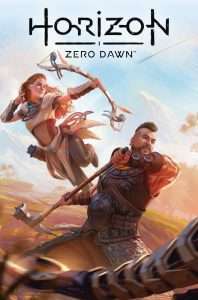 It’s a fun narrative device and makes sure that the action is always moving throughout the course of the story, and there’s never a dull moment during Horizon: Zero Dawn – Liberation. In regards to the action, it’s a joy to look at and flows remarkably well thanks to the very animated art style used by Elmer Tamaso. More than once I found myself wishing and hoping someone would option Horizon: Zero Dawn – Liberation for an animated feature. It’s highly reminiscent of a quality anime movie, in regards to the action sequences and character design, which facilitates the story Anne Toole is weaving to move along at a breezy pace. Despite its overall length, it makes Horizon: Zero Dawn – Liberation an easy read and something that can be comfortably consumed in a single sitting. I know I practically ran through it once I started it.
Horizon: Zero Dawn – Liberation is an easy, fun, and fantastic companion piece to the video game that inspired it which is, perhaps, the comic’s only downfall. I would have been happy with more insight into the world itself, but that lack of information didn’t stop me in the least from enjoying myself. If anything, it left me wanting more comics exploring and fleshing out the world of Horizon. As a standalone story, I’ll give you Horizon: Zero Dawn – Liberation a solid three stars and hold out hope for more in the future.
Read Horizon: Zero Dawn – Liberation
The post REVIEW: Horizon: Zero Dawn – Liberation appeared first on Grimdark Magazine.
March 3, 2022
REVIEW: The Warrior Prophet by R. Scott Bakker
R. Scott Bakker’s The Warrior Prophet is the second book in The Prince of Nothing Trilogy. The novel continues directly onward from where The Darkness That Comes Before leaves off, heightening the conflict and tension along the way.
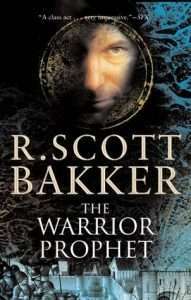 In The Warrior Prophet, the Holy War ventures further south, and its leaders find themselves embroiled in violence from all sides. Suspicion and doubt mix with political advantage to threaten the timid truce amongst the Men of the Tusk. When their greatest enemy shifts from the heathen foe they’ve always loathed to their own inner sanctum, trust, unity, and faith are questioned, demanding answers of fatality. As the crusade paves its way in blood, everyone becomes equal parts victim and villain, especially those caught at its very center.
Bakker builds on the foundation of what he created in The Darkness That Comes Before throughout The Warrior Prophet. The novel pushes the limits of the crusade’s motivations, but also those of each individual character. The overarching narrative walks in tandem with each character arc: as the complications for survival mount, they trickle like water down to very specific defining moments for our main cast of characters. Bakker shines in his execution of epic action sequences to include the fallout and consequences, something not all stories take the time to focus on. Regardless of how traumatic or heroic, Bakker pulls the curtain back, revealing all to his readers. This is especially true for a horrifying sequence of events that occurs in the desert: war affects everyone in the most unknown and overlooked ways.
The agency of all his characters grows over the course of the story. This is particularly significant for the female characters as the choices they make directly impact the plot. The magical element of the world also increases in its usage and importance, making for some of the most visually interesting and immersive scenes in the book. As for how the novel compares to its predecessor, The Warrior Prophet has grand moments of epic proportion both for the plot and characters, but The Darkness That Comes Before is more well-rounded holistically.
The Warrior Prophet firmly earns its place under the grimdark label. Bakker lures you further and further into the darkness without you actively realizing it until it’s too late. While the first book acts as the moment between who you were before and who you are now, the sequel holds up a mirror to reflect all of those changes: “Your past remains your past…Who you once were, remains who you once were. Forgiveness between strangers takes time” (442). We’ll see how Bakker stages his final act in The Thousandfold Thought.
Read The Warrior Prophet by R. Scott Bakker
The post REVIEW: The Warrior Prophet by R. Scott Bakker appeared first on Grimdark Magazine.
March 2, 2022
REVIEW: Blade Runner: Black Lotus
Blade Runner remains one of my all time favorite science fiction settings. However, in spite of its continued existence over the course of decades, it has very little expanded universe material. Part of this is due to the fact Phillip K. Dick died in 1982 and wasn’t that fond of what he saw in Blade Runner’s movie adaptation to begin with. That seems to be changing with the Blade Runner 2049 movie and subsequent work by Ridely Scott to expand on his properties.
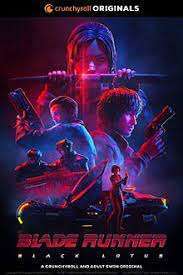 Blade Runner: Black Lotus is the attempt to expand the universe into the world of animation. The series was directed by Shinji Aramaki (Appleseed, Ghost in the Shell: Stand Alone Complex) and written by Kenji Kamiyama (Ghost in the Shell: Stand Alone Complex). Sinichiro Watanabe (Cowboy Bebop, Blade Runner: Black Out 2022) was the creative producer. With that kind of pedigree, it was something many fans were looking forward to immensely. So, how was it?
Okay. It was okay.
Blade Runner: Black Lotus is one of those series that feels like they didn’t aim very high and managed to clear the bar. Unfortunately, the lack of ambition in its storytelling is something that severely undercuts anything positive to say about it. It has a stellar voice cast with Jessica Henwick, Will Yun Lee, Brian Cox, and Wes Bentley. There’s numerous excellent action sequences. However, the writing is somewhat iffy and the graphics deserve a whole paragraph to discuss.
The premise is a young woman, Elle (Henwick), wakes up with amnesia in the desert outside of Los Angeles. Stowing away in a delivery truck, she ends up in the cyberpunk dystopia of the Blade Runner setting. This is set before the events of 2049 and Replicants are still officially banned on Earth. After discovering she has super martial arts skills and superhuman speed, strength, as well as agility, there’s no points for guessing that she’s not amnesiac but a newly created Replicant.
We discover Elle and a number of other Replicants were made the subject of a “Doll Hunt” that had a number of them murdered by the ultra-wealthy. Because of how traumatizing it was and possibly for a deeper, darker reason, Elle decides to hunt down everyone involved. She gets the help of a man named Joseph (Will Yun Lee), who seems awfully comfortable with violence as well as possesses unusual objects like a Voight-Kampff Machine. No points for guessing what he used to do in this series.
Slowly but surely, Elle manages to deal with her vengeance targets but finds herself getting increasingly in trouble with the law that doesn’t take kindly to revenge murder. Especially of the ultra-wealthy. We also discover Niander Wallace (Brian Cox) and his son, Niander Wallace Junior (Wes Bentley), are somehow involved in all this. It is a conspiracy that, sadly, is pretty obvious from the beginning and doesn’t really develop any twists that aren’t seen from a mile off even by animated television standards.
In conclusion, Black Lotus is an okay series but underwhelming at the same time. The series could have shot for deeper characterization, questions of existence, and storytelling. Only a few episodes really touch on this and I feel they underestimated their audience.
The post REVIEW: Blade Runner: Black Lotus appeared first on Grimdark Magazine.
March 1, 2022
REVIEW: The Shadow Glass by Josh Winning
If you ever danced with the Goblin King, if you cried when Artax died, if you were a little bit scared of skesis when you were young – then The Shadow Glass will have you pumping your fist and grinning like an idiot. This book was a love story to the wonderful, imaginative things I grew up with, and I enjoyed every moment of it.
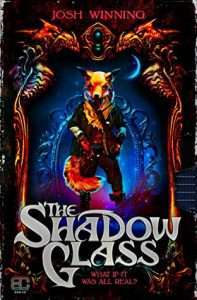 Jack is the son of Bob Corman, an eccentric who made a cult classic fantasy movie called The Shadow Glass. As an adult Jack has been estranged from his father, who wasn’t the most present of parents. He hates Bob’s movie, as in his mind it represents everything that is wrong in his relationship with his dad. When Bob dies, Jack decides to sell the memorabilia from the cult classic film but plans abruptly come crashing down as he learns that the fantasy puppets are no longer only puppets. Somehow, they’ve become flesh and blood heroes and villains in a war that has spilled from fantasy into reality.
Jack is a very real, relatable character. The justified anger and bitterness he feels toward his dad is juxtaposed by a sense of responsibility and a fondness for his dad’s movie that he has pushed down over the years. He both loves and resents his dad’s creation, much as he both loves and resents his dad. The characters he interacts with showcase different aspects of his character and allow for development and change. The no-longer-puppets Zavanna and Brol bring so much to the book (I loved Brol in particular), and the superfans are a blast.
There are subtle nods to 80s pop culture throughout The Shadow Glass, which is just awesome. Far from distracting from the story, these little details brought that amazing sense of nostalgia to the fore, putting a smile on my face. The sense of excitement I got from seeing the name “Toby” is hard to explain (if you know, you know). I would love to chat with the author, to see if I caught all the references.
From the characters to the storyline, every word was perfectly placed. The Shadow Glass was a delightful smorgasbord of nostalgia and fun, while at the same time exploring themes of loss, love, grief, and self-discovery. I know- I didn’t think it was possible to cram all of that into one book, but author Josh Winning did it beautifully. The balance between fantasy action and extremely well-written character development is perfect. The battles and madcap adventures are a brilliant backdrop for a profound look at how broken relationships can affect every part of a person. Parts of the book had me on the edge of my seat and I actually teared up at one point.
The Shadow Glass is sheer perfection. Read it.
Read The Shadow Glass by Josh Winning
The post REVIEW: The Shadow Glass by Josh Winning appeared first on Grimdark Magazine.
February 28, 2022
REVIEW: Blood Reaver by Aaron Dembski-Bowden
In Blood Reaver the Night Lords traitor legion is starving. Ammunition is almost non-existent, stalling their ability to persecute the Long War against the Imperium. They hunger for the hunt, but lack the tools to do so. That is, until Talos and First Claw finally torture the right person who knows the location of Ganges, where the Mechanicus and Marines Errant store a treasure trove of munitions that will keep the hunt full for a long, long time.
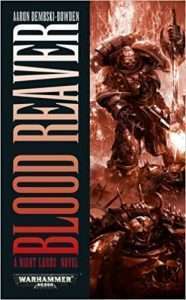 Blood Reaver continues the enthralling story of Talos and his First Claw, of their squad’s inner struggle against the Exalted and those losing their humanity to the denizens of the Warp, of the humans who live and work enslaved beside them. Centuries of war with little or no replenishment, mixed with vicious infighting has also left their ranks leaner than ever before. But the Exalted has a plan, and it requires a momentary truce between Talos and what he hates most about what his legion is becoming.
The introduction to Blood Reaver just brings out that cool AF factor that Dembski-Bowden is so good at. Over ten thousand Night Lords gathered in one place—members of a Legion known for going it alone in smaller war bands—together in one location, just grants so much scope to the story we left behind in Soul Hunter. And that’s just the opening.
Blood Reaver is a slower book than its predecessor, but provides a heavier focus on character and character development, and for that this book is stronger. It has what feels like less action, but far more emotional involvement in far more people. And somehow, Dembski-Bowden has jammed in even more awesomeness into this book than the last one.
In Blood Reaver we are introduced to Huron Blackheart, a Chaos warlord leading the traitor chapter (not to be mistaken for a far larger and older traitor Legion) the Astral Claws. Huron is all kinds of bad arse awesome, and is kicking off a crusade, and the stealth hunting tactics of First Claw and the other Night Lords are key to his plan. Only, he has something Talos wants, and is unlikely to want to give it. Huron is an excellent character, and serves both as the immovable force driving the overarching story forwards, and one of the many big bads of the Warhammer 40K universe. This book is worth a read for Huron, alone.
The other members of First Claw and the supporting staff, however, are the anti-heros of this book. Their inner hate, old rivalries, misunderstood ugliness, punishments, callousness, and sometimes–yes sometimes–their heroics and self sacrifice are what makes this book, and this story, unputdownable. From the lowliest human hound to the loftiest, angriest traitor space marine, these characters are well worth investing in.
Blood Reaver is a study in anti-heroes, in being caught up in the unstoppable wave, in backstabbing and treachary, and in sacrifice for others. A magnificent extension of this dark military space opera that will have you scrabbling for book three before you’ve even finished.
Read Blood Reaver by Aaron Dembski-Bowden
The post REVIEW: Blood Reaver by Aaron Dembski-Bowden appeared first on Grimdark Magazine.
February 27, 2022
An interview with S.A. Barnes
Also writing under Stacey Kade, S.A. Barnes is a published author across multiple genres. She was kind to chat with GdM about her life and writing. Her latest Dead Silence from Nightfire Books released on February 8, 2022. A tale of “psychological horror and hallucinogenic madness,” you can read our complete review of Dead Silence here.
Dead Silence" target="_blank" rel="noopener">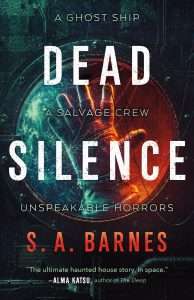 [GdM] Your previous written books published under Stacey Kade feature contemporary and YA elements. What inspired you to branch out into horror?
[SAB] I didn’t set out to write horror, believe it or not. I thought I was writing a (very tense and creepy) science fiction thriller! That being said, I love horror. It is one of the first genres I discovered as a kid when I was allowed to wander into the adult section of the library—Stephen King, VC Andrews, Dean Koontz, etc.
So, it doesn’t surprise me that those influences seeped into my brain and shaped my efforts to write this book.
[GdM] What aspects of horror fascinate you the most?
[SAB] For me, it’s always about the people. No matter what creature/killer/unknown evil force is chasing the characters, it’s always about their human weaknesses and flaws and trying to overcome them in the face of absolute danger. That struggle to be the better version of themselves.
And, on the flip side, my favorite horror stories are about how we—humans—are our own worst enemies. For example, in Aliens (LOVE that movie), it’s not the aliens I was most angry with but Paul Reiser’s character, Burke, for being all about the money. He was willing to sacrifice Ripley and Newt because of greed, and that just feels so much worse.
[GdM] Did any of your childhood fears find its way into Dead Silence?
[SAB] Oh, definitely. I have to be careful here because of spoilers, but the scene where Claire falls asleep in the cabin is drawn directly from a childhood fear. Actually, if I’m being honest, a fear that still exists today!
[GdM] Is there a horror author you’re specifically inspired by?
[SAB] Stephen King has been a huge influence my whole life, even before I knew I wanted to be a writer. But specifically, I loved his book, On Writing, as I was trying to figure out what I was doing as a writer. I still refer back to it regularly. (Though I would imagine he would be dismayed to hear this, given my continuing use and love of adverbs!)
[GdM] You work in a high school library, have there been any noticeable changes in what people are reading now?
[SAB] It’s interesting, people like to complain about kids being on their phones all the time, but I see students reading books—actual paper books—daily. They definitely prefer print, even if it means waiting on hold for a physical copy of a book instead of an immediately available e-book.
Book Tok has been a big influence on what titles students are requesting, which is cool because we’re seeing some authors/books that students may not have otherwise known about or been interested in.
I also see the effects of what’s being called a horror renaissance, in that when we were trying to put together a display, our supernatural/horror section was practically empty. All checked out!
[GdM] In Dead Silence, six hundred and fifty people had vanished on the once luxury spaceliner, the Aurora. The ship lost for more than twenty years until Claire and her team stumble up on it. Why choose space as the setting?
[SAB] I find space absolutely fascinating, along with our endeavors to live in/work in/explore it. It’s been interesting to watch all the strides made as space exploration shifts to private industry endeavors. For better or worse. (I have strong feelings on this, which is probably fairly obvious in the book!)
But from a purely practical standpoint, space is just an excellent setting for amping up tension and making the situation more difficult for our characters. If there’s a serial killer or evil clown in your basement, you can at least try to run, but in space? On a ship? There’s nowhere to go. Plus, there are all these restrictions we have to work around (zero-grav) and ways in which space can kill you without help from any outside force (faulty life support systems, etc.)
[GdM] The magnificence of the ship Aurora now turned graveyard creates a chilling ambience even before Claire ventures inside. Was creating such a strong atmospheric presence your original intention?
[SAB] Oh, heck yes! That was the part of the story I knew first. They find this ship and end up wandering through it, the rooms frozen in time. There’s something so eerie and compelling about places that have every sign of human habitation, but no humans. Abandoned amusement parks, Pompeii, Pripyat (near Chernobyl).
They feel haunted, even without a supernatural presence.
[GdM] You took particular care in not only detailing Claire and her team, but also the lost passengers from the Aurora. Were any lost passengers inspired by real events?
 [SAB] I’m obsessed with the Titanic. I drew heavily on the idea that the Aurora would similarly be populated by the wealthy and famous. I had some fun with determining who would be famous and why, so you’ve got influencers on the ship, athletes, movie stars, and royalty. I particularly enjoyed writing the Dunleavys.
[GdM] Were there any characters either from Claire’s team or from the lost Aurora cut from the final version?
[SAB] Actually, no. Claire’s team and the passengers on the Aurora remained mostly the same. If anything, I added more passengers to the Aurora to give a broader sense of who was on board and the scale of the wealth and fame involved.
[GdM] Claire has a well-documented history of psychosis. Throughout the novel, she struggles to distinguish between actual events and her hallucinations. I love how we are never sure how much we can trust her. What inspired you to write such an unreliable narrator?
[SAB] Hmm. Is it psychosis or does she really see ghosts? That is the angle I was looking to play up. Because I’m very interested in the nature of our shared reality. In other words, reality is a mutually agreed upon decision. We point at something and call it “red,” for example, but I have no idea what you’re seeing versus what I’m seeing.
And how we treat someone who perceives reality outside that “norm” seems to depend on our own comfort level. We believe someone who talks to people who aren’t there is likely a person in need of treatment for mental illness. But someone who claims to see the future or talk to the dead can offer those services for payment, and we don’t bat an eye. (Clearly, the level at which these things disrupt a person’s life and make treatment necessary is a factor; I’m just interested in why some out-of-the-norm experiences are deemed acceptable, and some aren’t.)
Also, from a reader standpoint, I was curious why, if mediums exist now, why are they not represented in the future? Where are all the ghosts in the future?
But yes, I absolutely wanted people to be uncertain about what’s actually happening in Claire’s mind. Because Claire herself feels that way and I think the most terrifying thing of all is not being able to trust your own judgement, your own perceptions of what’s happening around you. I think our collective grasp on reality is far more tenuous than any of us would like to believe.
[GdM] Mental illness can be so easily misrepresented in media. What preparations were involved or how did you approach this aspect of Claire’s character?
[SAB] I did some research on PTSD, but I also drew heavily on my own experiences with clinical anxiety. I have Generalized Anxiety Disorder with OCD, and I spent years fighting it, trying to manage it myself before I realized I needed help. It was only when my anxiety was on the verge of taking over was I able to see that I couldn’t do it on my own, that if I didn’t get some help anxiety/OCD would become my whole life. (Years of therapy and, more recently, meds have made an enormous difference.)
I think Claire wrestles with some of the same issues I did—not being sure if she can trust her own judgment, not wanting people to treat her differently because of her mental health struggles, working to accept that this is part of who she is but not her entire identity.
[GdM] Where there any parts that were difficult to write?
[SAB] The beginning. I wrote the opening chapters a half a dozen times even before official revisions with my editor. At one point, it opened with a POV chapter from Reed Darrow. I scrapped that pretty quickly, but I learned from it, so it wasn’t a completely wasted effort.
For me, writing a book always feels like a complicated dance, and you have to start on the right foot or the whole thing is off.
[GdM] What are your future writing projects?
[SAB] I have a couple ideas in process right now. The first is another science fiction horror story, set on a planet where isolation, perpetual darkness, and proximity to eerie ancient ruins start to affect our characters…or maybe it’s something more.
The other is a more straight-forward horror story involving middle school friendships, backstabbing, and, you know, demons. It’s about the trauma we inflict on each other at that particular age and how it follows us—literally sometimes—into adulthood.
Read Dead Silence by S.A. Barnes
The post An interview with S.A. Barnes appeared first on Grimdark Magazine.


