
Ikram Hawramani's Blog, page 21
September 1, 2019
No strong hadith prohibits paintings and drawings of living things
The issue of whether making pictures or paintings of living things (taṣwīr) is permitted in Islam has led to a great amount of controversy. Mainstream scholars (such as those of al-Azhar University) have chosen to permit it due to considering the evidence for the prohibition not strong enough, while those who consider themselves true followers of hadith have chosen to accept the prohibition. There are also important exceptions, such as the Syrian Shaykh Muhammad b. Amin, a follower of Ibn Tamiyya, who also considers the evidence for the prohibition unsatisfactory and contradictory. See my translation of an important article by him: A Traditionalist Critique of the Islamic Prohibition on Taṣwīr (Making Drawings and Statues of Humans and Animals).
I decided to conduct a study of the existing hadith evidence to find out its strength using the probabilistic hadith criticism method. The result, as I expected, is that none of the hadiths are strong enough to establish the prohibition, and there is one hadith among them that demolishes the rest. Unfortunately this hadith too is not very strong, although this can be explained by hadith scholars choosing to ignore it and not transmit it due to conflicting with their own views. But the hadith’s content happens to be the most believable compared to the rest due to the way it mentions a very realistic scenario. The quality of the hadith’s content is very similar to the strongest hadiths we have.
I ignored hadiths that merely mention that al-muṣawwirūn are punished by God due to the fact that these hadiths could simply be referring to those who make icons and statues meant for worship. The hadiths I included are those that seem to clearly imply that all picture-making is prohibited regardless of the intention behind making them.
Hadith 1
Narrated Ibn Umar:
Allah's Messenger (ﷺ) said, "Those who make these pictures will be punished on the Day of Resurrection, and it will be said to them. 'Make alive what you have created.'
Sahih al-Bukhari 5951, also in Musnad
Below is a diagram of the hadith’s chains:

The hadith receives an authenticity score of 16%, which is far below the 30% needed for ruling it ṣaḥīḥ (authentic) according to the probabilistic verification methodology.
Hadith 2
I heard [Prophet] Muhammad saying, "Whoever makes a picture in this world will be asked to put life into it on the Day of Resurrection, but he will not be able to do so."
Sahih al-Bukhari 5963, also in Muslim, Musnad, al-Tabarni, Musnad Abi Ya`la, al-Bayhaqi and al-Nasa'i.
Below is the diagram of its chains:
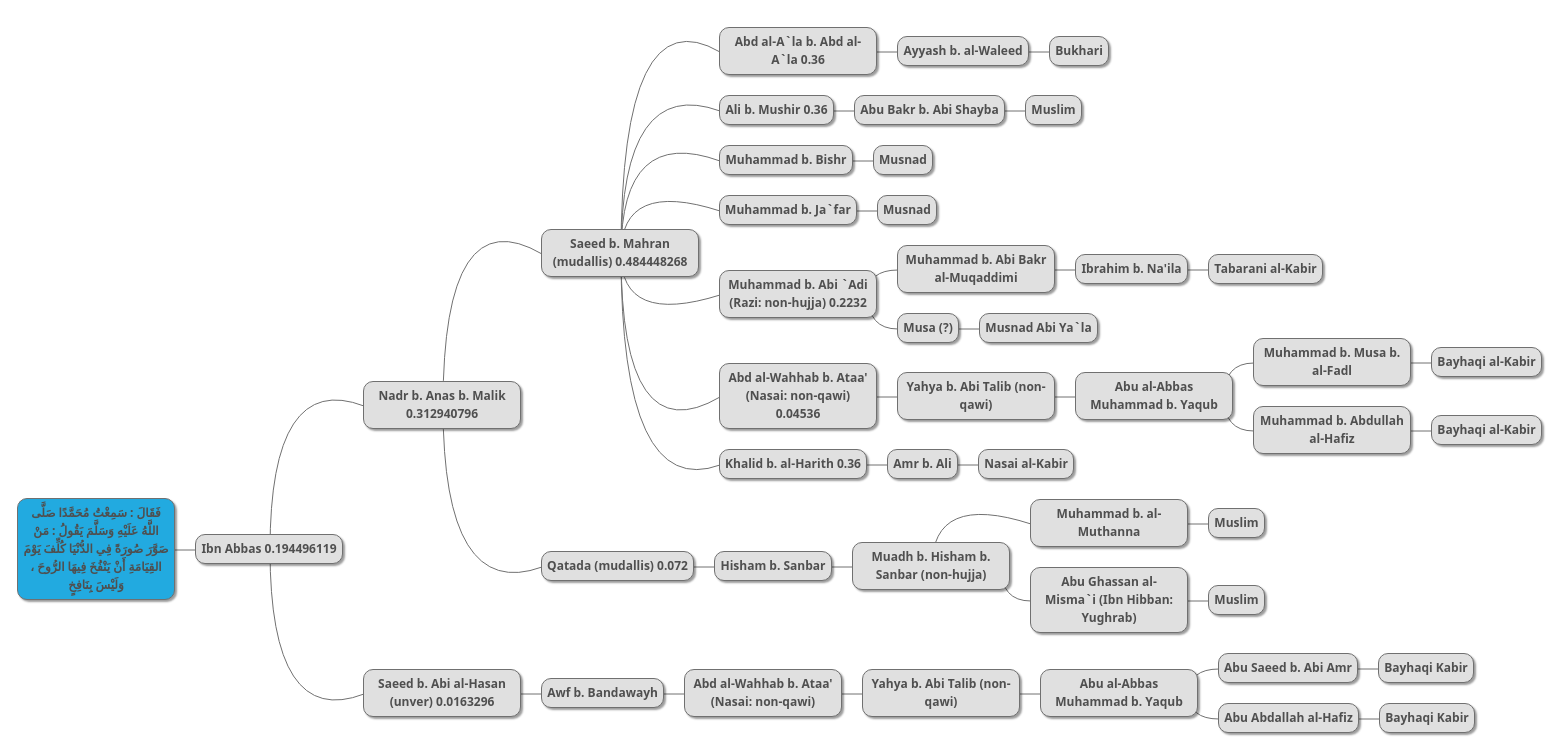
This hadith, despite its convoluted chains, receives an authenticity score of 19.44%.
Hadith 3
I heard from Allah's Messenger (ﷺ). I heard him say: All the painters who make pictures would be in the fire of Hell. The soul will be breathed in every picture prepared by him and it shall punish him in Hell ...
Sahih Muslim 2109 c, 2110 a, Musnad
Below is the chain diagram:

This hadith has a score of 8.6%, making it rather weak.
Hadith 4
Narrated `Aisha:
I purchased a cushion with pictures on it. The Prophet (came and) stood at the door but did not enter. I said (to him), "I repent to Allah for what (the guilt) I have done." He said, "What is this cushion?" I said, "It is for you to sit on and recline on." He said, "The makers of these pictures will be punished on the Day of Resurrection and it will be said to them, 'Make alive what you have created.' Moreover, the angels do not enter a house where there are pictures.'"
Sahih al-Bukhari 5957, the strongest chain is in al-Muwatta
Chain diagram:
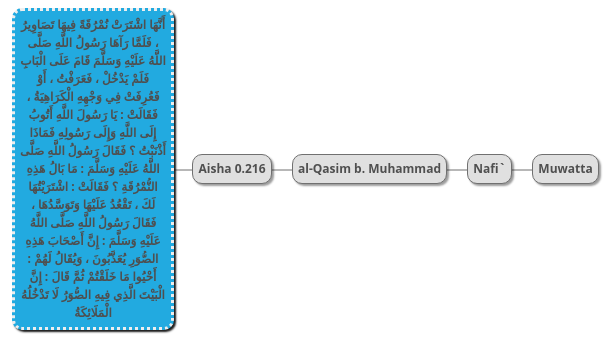
This hadith has a score of 21.6%, again below 30%.
Hadith 5
Narrated `Aisha:
Allah's Messenger (ﷺ) returned from a journey when I had placed a curtain of mine having pictures over (the door of) a chamber of mine. When Allah's Messenger (ﷺ) saw it, he tore it and said, "The people who will receive the severest punishment on the Day of Resurrection will be those who try to make the like of Allah's creations." So we turned it (i.e., the curtain) into one or two cushions.
Sahih al-Bukhari 5954, also in Muslim
Chain diagram:

This hadith gets a score of 10.1%.
Hadith 6
Narrated Abu Zur'a:
l entered a house in Medina with Abu Huraira, and he saw a man making pictures at the top of the house. Abu Huraira said, "I heard Allah's Messenger (ﷺ) saying that Allah said, 'Who would be more unjust than the one who tries to create the like of My creatures? Let them create a grain: let them create a gnat.' "Abu Huraira then asked for a water container and washed his arms up to his armpits. I said, "Abu Huraira! Is this something you have heard I from Allah's Messenger (ﷺ)?" He said, "The limit for ablution is up to the place where the ornaments will reach on the Day of Resurrection.'
Sahih al-Bukhari 5953, also in Musnad Ishaq b. Rahawayh
Chain diagram:

This hadith gets a score of 11.5%.
Hadith 7
This is the hadith that refutes the others, in which Aisha (may God be pleased with her) denies having said that angels do not enter a house in which there is a picture (Hadith 4 above).
Abu Talha Ansari reported Allah's Messenger (ﷺ) as saying:
Angels do not enter the house in which there is a picture or portraits. I came to 'A'isha and said to her: This is a news that I have received that Allah's Apostle (ﷺ) had said: Angels do not enter the house in which there is a picture or a dog, (and further added) whether she had heard Allah's Messenger (ﷺ) making a mention of it. She said: No (I did not hear this myself), but I narrate to you what I saw him doing. I bear testimony to the fact that he (the Holy Prophet) set out for an expedition. I took a carpet and screened the door with it. When he (the Holy Prophet) came back he saw that carpet and I perceived signs of disapproval on his face. He pulled it until it was torn or it was cut (into pieces) and he said: God has not commanded us to clothe stones and clay. We cut it (the curtain) and prepared two pillows out of it by stuffing them with the fibre of date-palms and he (the Holy Prophet) did not find fault with it.
Sahih Muslim 2106 f, 2107 a
Chain diagram:

This hadith gets a score of only 3.25% due to the lack of supporting chains, although the first three transmitters are all Companions. If we assume that all three transmitted the hadith with complete authenticity, the hadith’s score rises to 9.03%, which still not very good.
Hadith 8
We also have the following hadith (considered authentic by al-Albani) in which we find Aisha had toy horses that had wings.
Narrated Aisha:
When the Messenger of Allah (ﷺ) arrived after the expedition to Tabuk or Khaybar (the narrator is doubtful), the draught raised an end of a curtain which was hung in front of her store-room, revealing some dolls which belonged to her.
He asked: What is this? She replied: My dolls. Among them he saw a horse with wings made of rags, and asked: What is this I see among them? She replied: A horse. He asked: What is this that it has on it? She replied: Two wings. He asked: A horse with two wings? She replied: Have you not heard that Solomon had horses with wings? She said: Thereupon the Messenger of Allah (ﷺ) laughed so heartily that I could see his molar teeth.
Sunan Abi Dawud 4932
Chain diagram:

This chain gets a score of 1.4%, again due to the lack of supporting chains. But again its contents seem extremely realistic. My heart is much happier with this kind of hadith that mention a lot of contextual and seemingly unnecessary details than with hadiths that merely transmit a statement of the Prophet PBUH.
Combining the scores
We can do a final step to combine all of the scores using the following calculation (which assumes that Hadith 7 cancels out Hadith 4):
1-((1−0.16÷2)×(1−0.1944÷2)×(1−0.086÷2)×(1−0.101÷2)×(1−0.115÷2))
The result is a combined score of 28.86% for the hadiths that prohibit picture-making, which is still below the 30% needed.
What we can conclude
It looks like the instinct of the Azhar scholars is correct in not taking the prohibitory hadiths too seriously. Real prohibitions in Islam have extremely strong support behind them, with hadiths easily reaching 80% or 90% authenticity. The strongest prohibitory hadith only reaches a score of 21.6%.
The question is to ask why the Prophet PBUH failed to impart this prohibition to his followers like normal prohibitions. Why did it have to come to us through isolated and rather low-quality hadiths? The most likely answer is that because he never taught such a prohibition. It seems very like that the culture of the generation of Imam Malik began to confuse the hadiths in which the Prophet spoke strongly against picture-making meant for worship (i.e. idol-making), so that the context was lost and only the part where mentioned picture-making survived. A prohibition on making religious idols became generalized in people’s minds to a prohibition on all picture-making.
Shaykh Ibn Amin’s study (that I linked earlier) adds further support to this theory. The Companions seem to have had a very casual attitude toward pictures and statues. We also know that Prophet Sulayman had statues built for him as the Quran tells us. The evidence of the Quran is always much stronger than hadith (due to the Quran’s far better transmission process), so the Quranic verse can be taken as strong evidence for the permissibility of picture-making (and even statues). The hadiths mentioned above are rather low-quality to be able to override what the Quran tells us.
We also know that one of the most respected early scholars of Islam (from the generation before Imam Malik) approved of picture-making (al-Qasim b. Muhammad).
The two hadiths of Aisha are also highly suggestive. In both of them the Prophet PBUH does not criticize the pictures/statues. In the first one he criticizes using cloth to cover walls, and in the second one he laughs at the toy horse without criticizing it.
There is also a place for human reason in this debate. It seems ridiculous to consider paintings of birds and animals as some sort of insult against God when in our daily lives we feel absolutely no compunction about things like children’s picture books filled with such paintings and drawings. All of Islam’s prohibitions seem to have some sense behind them, or they have very strong Quranic evidence. But in this case the evidence for the prohibition is rather weak and contradictory, and our own reason and conscience finds no good justification for it.
Unfortunately we are stuck in this position where we have many low-quality hadiths creating a taboo against paintings and statues, and some (also weak) evidence going against the taboo. We also have the Quranic statement approving of Prophet Sulayman’s statues. So it seems that Muslims will forever have to deal with the ambiguities and uncertainty surrounding the issue, with mainstream scholars taking a tolerant attitude and a minority taking an extreme position in support of the taboo.
My conclusion
My own stance is to fully approve of drawings and paintings of living things, and as for statues, I consider them at worst to be in a gray area. I see no strong Islamic justification for speaking against those who make them.


August 31, 2019
Is it haram to have a boyfriend or girlfriend?
Is having a boyfriend haram? But you don't do anything haram with him. You just label each other as boyfriend/girlfriend but treat each other as best friends without doing anything haram
The right question to ask is: “Does it please God and my family to have a boyfriend/girlfriend, is it beneficial to my own soul, and is it good for my future?” If you read the Quran and the books of hadith, you will not find anything that explicitly forbids such a relationship. But there is a lot more to it than that.
First, note that I would be willing to accept the excuses of a person who involves themselves with such relationships. But that is the problem; such relationships have to be excused. They are not noble and admirable things to participate in, and all pious and self-respecting Muslims would do their best to avoid them except under the most extreme circumstances.
By calling someone your boyfriend/girlfriend, you mean that you have an exclusive romantic relationship with them. It is like pretending to be married without actually marrying and without intending to do the physical acts associated with marriage. The intention is to get the companionship and sense of being loved and supported that we get from a romantic partner without going through the difficult process of finding out if your life circumstances will enable you to be together, and finding out whether your family approves of the person and whether their family approves of you. You cut out their involvement, and the involvement of the rest of reality in order to jump right into the romance part.
It is almost needless to say how foolish and dangerous that is. If you are a woman, a husband is forced to be nice, kind and considerate toward you even when he does not feel like it, even when you do not deserve it, because he is not only responsible to you but to your family and his family. He has to live up to the image of a husband. But a random male with whom you develop a romantic relationship is not answerable to anyone but himself. Many people in the West who enjoy the freedom of being able to jump into romantic relationship after relationship end up being scarred for life by the extreme maltreatment (I do not mean physical abuse, but emotional abuse and negligence) of their partners, or end up being the abuser themselves without intending it, because there is nothing to humanize their relationship and control it as it happens in marriage.
Marriage is meant to be an election. You need to appreciate the purpose of marriage before you are able to realize what is so wrong with boyfriend/girlfriend relationships. See my essay: The Point of Marriage in Islam (and the Problem with Romantic Relationships Outside of Marriage)
An intelligent, self-respecting and wise Muslim woman will consider it extremely beneath her to grant her love to a man who has not gone through the process of proving himself to be a worthy husband. She would be giving something away for free that is meant to be extremely valuable and precious; a foolish decision that shows her lack of understanding. It is a sign that there is a serious problem with her that is making her desperate. Sometimes, maybe often, the blame is with her family. By depriving her of love and sense of having an honored status in her family, she is forced to seek that in men outside her family. But even in such cases part of the blame is on her; a better woman would put up with her family’s failings and lack of love and endure patiently until God enables her to have something better.
The same of course applies to some men who seek such romance.
I know such relationships can be a great temptation. But our task is to resist them the way we resist all other temptations until God changes our situation and we are able to enjoy the pleasures of romance in the normal way through marriage.
August 29, 2019
Is ghusl necessary if there is no ejaculation?
I sometimes masturbate my self and something like urine comes out is that the mani or Madi and most I perform guhsul jazakallah kairan
If it is manī then this requires ghusl. Manī (semen) is ejaculated in spurts and there is usually a feeling of pleasure when it happens. But if it is madhī then this requires no ghusl. Madhī is a mucus-like fluid that comes out slowly and continuously during sexual arousal.
Note that both manī and madhī are pure, so if they fall on clothing, one can still pray in those clothes without washing them, according to the scholarly opinion I prefer. But like I said, even though manī is pure, its ejaculation necessitates ghusl.
August 28, 2019
Should we advise others to avoid sin if it may bother them?
Sir, mostly sins make me feel disturbed but what influences me most is the relationship between boys n girls outside marriage. I feel disgusted hearing the terms 'boyfriend/girlfriend'. I'm part of certain Facebook groups where sometimes posts about one's relationship comes up… Sometimes they talk about their boyfriends. It makes me sad and angry. I consider it self harm and desire to advise them, but sometimes stop myself because they might not want it. I want to leave those groups, but I think I might help or guide them somehow by commenting. Can you please guide me what is better to do? Should I leave them and feel easy or should I keep striving? Can we advise someone if they are not asking for it?
There are countless ways to serve God. Advising others to avoid sinful behaviors is just one kind. I believe that it is far more beneficial to try to call people to be better in ways that pleases them and is likely to succeed rather than intentionally going into circles where the advice is disliked or laughed at. So I recommend that you do not waste your time with such groups. Advice generally works once a loving relationship has been built between you and the person. Giving advice on the Internet to a random audience that does not like you and admire you seems to be a waste of time. You would do much better to develop a talent that attracts people to you, then once relationships have been built, you can use them to try to influence them to be better. You can do that by becoming a novelist, artist, teacher, instructor, blogger, video maker, and so on. You should do something that benefits people and makes them like you. Do anything that makes the world a better place for people and you will get countless opportunities to influence them to be better. Giving advice without first working to be an admirable and lovable person is not going to do much good.
Can you continue praying tahajjud if you forget it sometimes?
Salam I just wanted to know if you forget to pray tahujaad namaz Can you still continue reading them..Because I was told that you have to constantly read them…
Alaikumassalam wa rahmatullah,
The tahajjud prayer is a voluntary prayer that you can do whenever you are able. There is no requirement to do them constantly, and if you do not do it for a while you are always free to start again.
Why is shirk greatest sin?
Why is shirk greatest sin?
Because it goes entirely against the purpose of our creation. See this previous answer for more on that purpose.
Why did God create humans?
What’s the point of life? I can’t seem to find any meaning in it.
The universe is a factory for creating true friends of God. Think of what “true friend” means. A true friend is someone who loves you and trusts you even though they have no mathematical proof that you love them.
God throws us into a universe where we have no hard evidence of His existence. We get to know Him through the signs He shows us in our souls, in the universe and in scripture. We eventually develop an attachment to Him, while always being free to disobey Him, ignore Him, and pretend that He does not exist. Those of us who maintain His remembrance and serve Him like good servants, even though the Master seems “absent”, even though the Master is never there to force us to serve Him, prove by this that there is something to our relationship with Him that is more than mere forced slavery.
And it is this “more than slavery” aspect that justifies the universe. God could have created a world where He showed Himself and His angels to us and forced us to serve Him without choice. But He wanted more from us humans. He wants our relationship with Him to be a true love affair, filled with doubt, uncertainty, feelings of abandonment, pain, and always the choice of disloyalty. Those who make it through all of this while maintaining the purity of their heart and the innocence of their soul prove by this that they are more than slaves. And it is such people that God wants close to Him in Paradise; people who have proven that they are not mere robots serving Him, but people who could have disobeyed Him yet chose to serve Him.
If you were a powerful king, would you want to be surrounded by ministers and servants who served you because they had no choice regardless of their loyalty to you, or who served you because they loved you and because they proved their loyalty to you in the most difficult times when they had the choice to be disloyal? A wise king would only choose the second type of person to be his close companions.
Your lifetime is therefore an opportunity given to you for promotion; to be promoted into a close companion of the greatest king. As I have said elsewhere, even if the universe managed to create a single true friend of God, then that would justify the whole of creation.
August 27, 2019
The Islamic ruling on bowing to show respect
Salam. In Japanese culture, it’s normal to bow down to someone out of respect. As a Muslim surrounded by Japanese society, most of the times I did this too, but then u know, the feeling of guilt triggered. I know in Islam we’re ordered not to bow down to anyone other than Allah. How to deal with this?
Alaikumassalam wa rahmatullah,
The only hadith we have that prohibits bowing when greeting others is found in al-Tirmidhi, Ibn Maja and the Musnad, but it comes through Hanzala b. Abdullah who is considered weak by many scholars. So there is no strong prohibition on bowing. Shaykh Faysal Mawlawi (from the European Fatwa and Research Council) permits bowing in sports like Judo as long as it is merely a form of greeting / showing respect.
References
Fatwa from IslamOnline that mentions Shaykh Faysal's opinion (Arabic PDF)
On my not answering questions
How come you’re not answering any questions?
Unfortunately I have had a bad episode of chronic fatigue that has disabled me from doing most kinds of work. Alhamdulillah it seems to be passing now. Sorry for the inconvenience.
Will a married couple be punished if they had premarital sexual intimacy?
if a man and a woman have sex before marriage and still marry eachother is allah still going to punish them
If they repent then there will be no punishment inshaAllah. Please see: How to repent from zina (sex outside of marriage)


