
C. Litka's Blog, page 45
May 14, 2021
Rejection
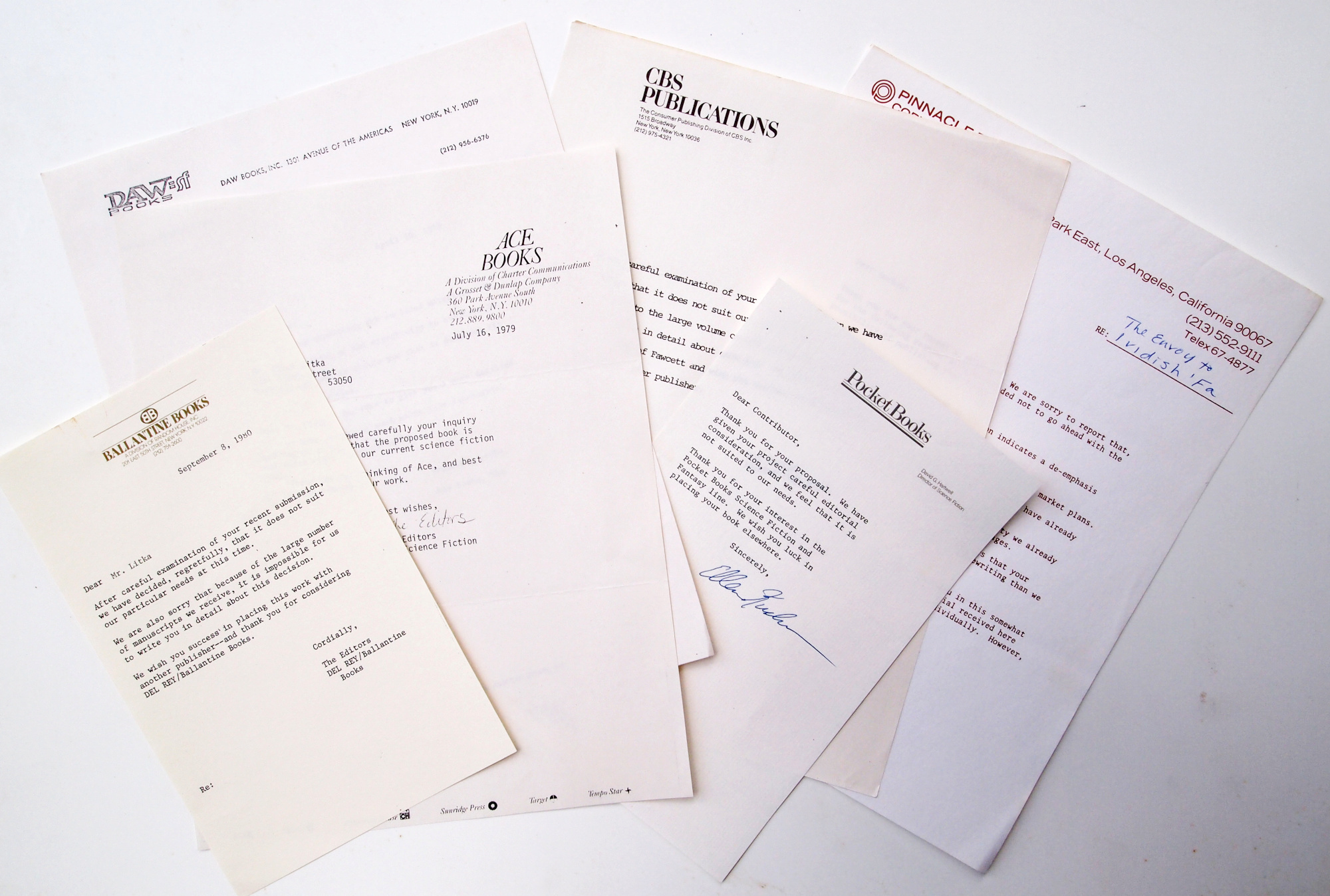 Rejection letters from Ballantine, DAW, Ace, CBS (Fawcett), Pinnacle and Pocket Books
I’ve known rejection. In 1979-80 I submitted one fantasy novel, The Envoy to Ividish'fa alternate title: The Brigand Sea Prince (72,000 words) one science fiction novella, The Hybrid-Worlder, (29,000 words, revised down to 21,900 words) and one science fiction short story, Death on Glou'ay (4,500 words). They were one and all declined by the paperback and SFF magazines of the day. Still, I though it might be interesting to share my modest collection of rejection slips with you. I should point out that my collection is modest because I did not have the persistence you need to get published. I gave up too easily. And when, some 35 years later I once again had complete stories to publish, I didn’t even bother to submit them to traditional publishers. I’d either publish them myself, or bury them myself.
Above and below are my collection of form letter rejection slips for the major mass market publishers of science fiction and fantasy of the time for the Envoy to Ividish'fa/The Brigand Sea Prince.
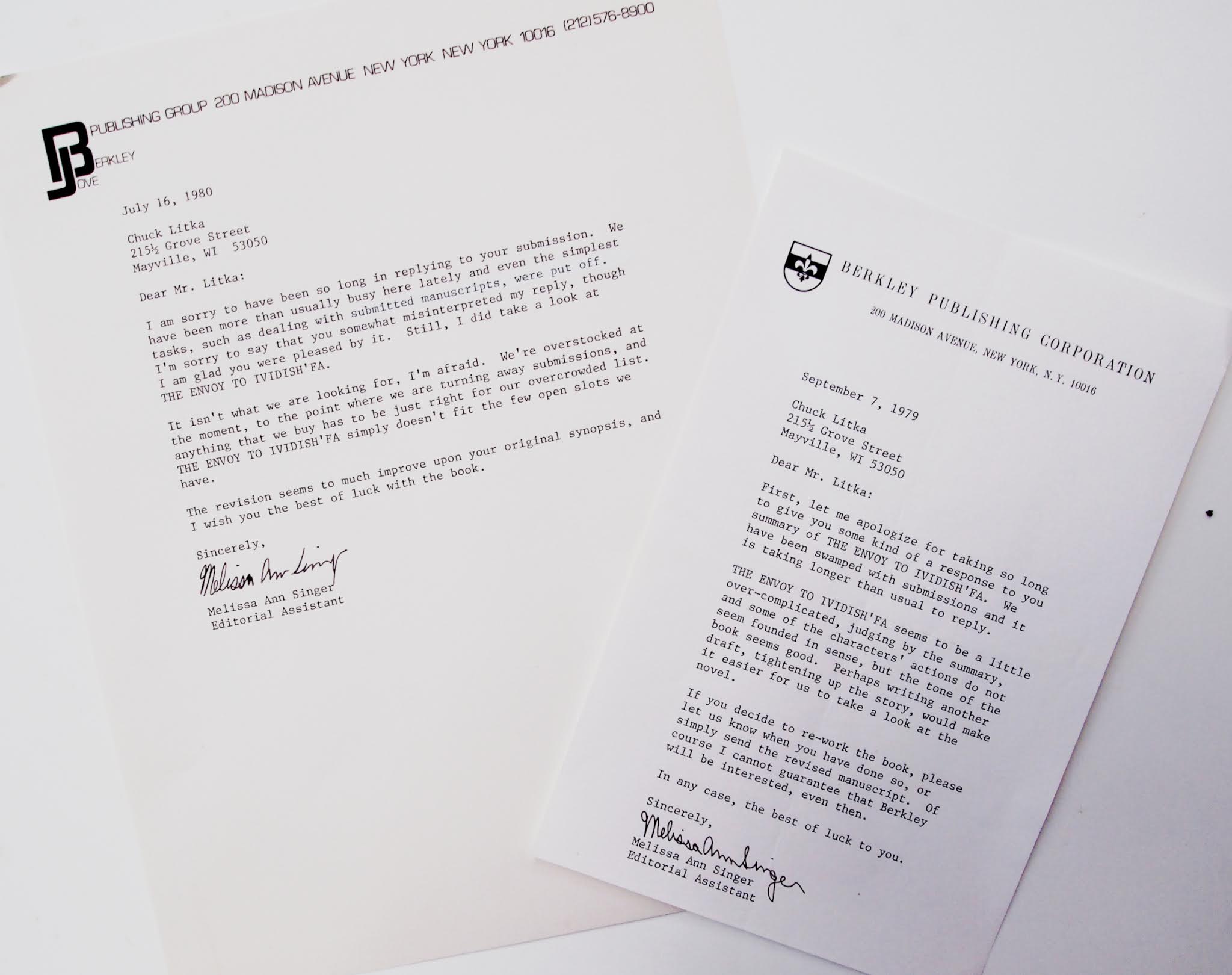 Rejection Letters from Berkley-- personal responses from Melissa Ann
Singer
The lower right letter dated Sept 7, 1979 from Melissa Ann Singer, Editorial Assistant said that the story seemed " a little over-complicated," and that "some of the character's actions did not seem founded in sense." She did say that the tone of the book "seems good," and suggested another draft, tightening up the story. The upper letter left letter dated July 16 1980 is again from Melissa. In it she said that she did take a look at it, but that it isn't what they are look for. She kindly said that the revision (apparently I revised it, hence the two titles) "seems to much improve upon your original synopsis."
Below are three more rejection letters for the fantasy novel, The Envoy to Ividish'fa, including a xeroxed letter with Lester de Ray's signature, apologizing for having to resort to a form letter. He reports that a series of personal and business emergencies made it impossible to keep up with his normal schedule. And that he insists on reading and considering every fantasy submission personally. He had no "first reader" to expedite these reports, hence the need for the form letter.
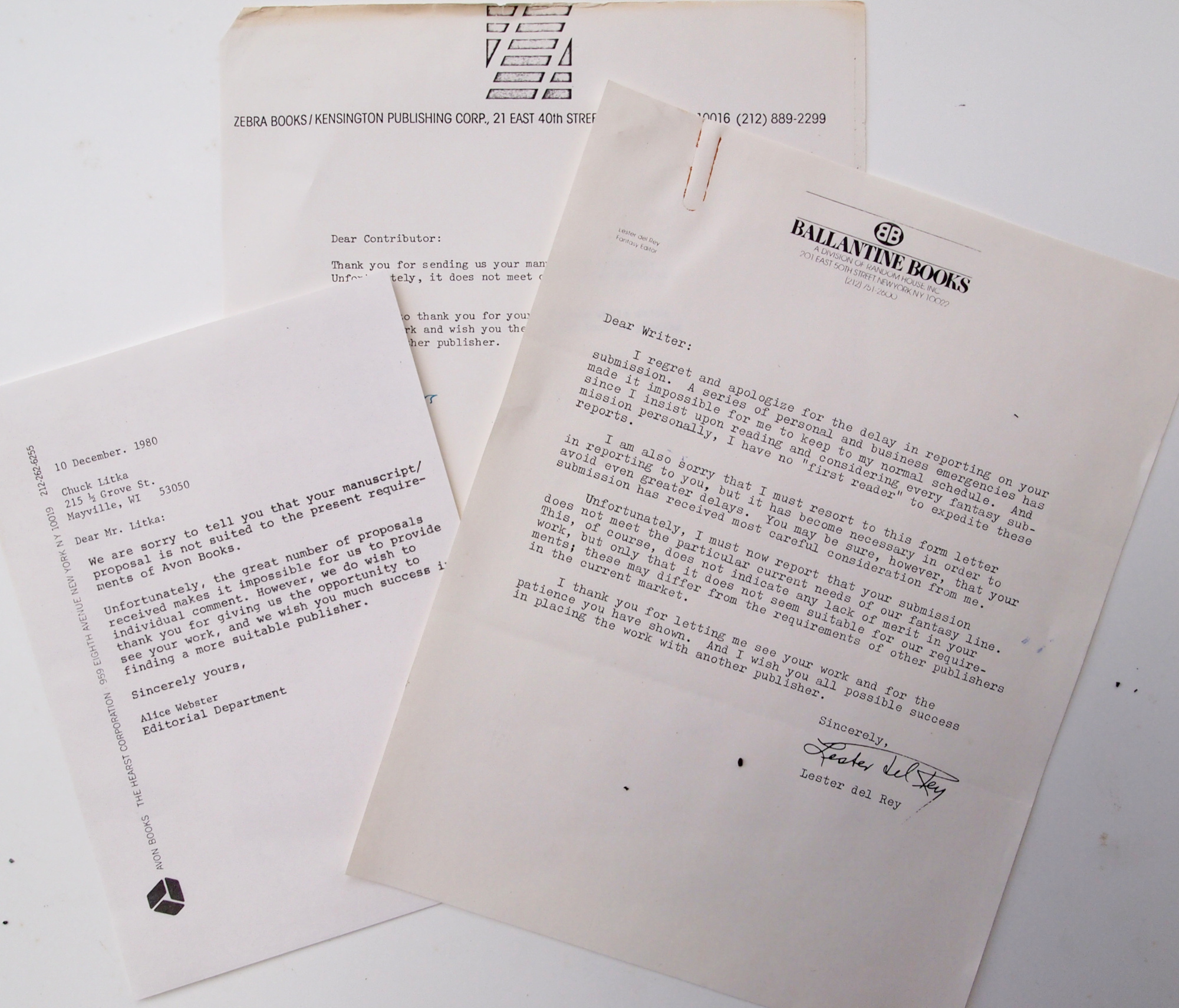 Rejection letters from Avalon, Zebra Books, and Ballantine again, with Lester de Ray's signature (not original -- a xerox copy
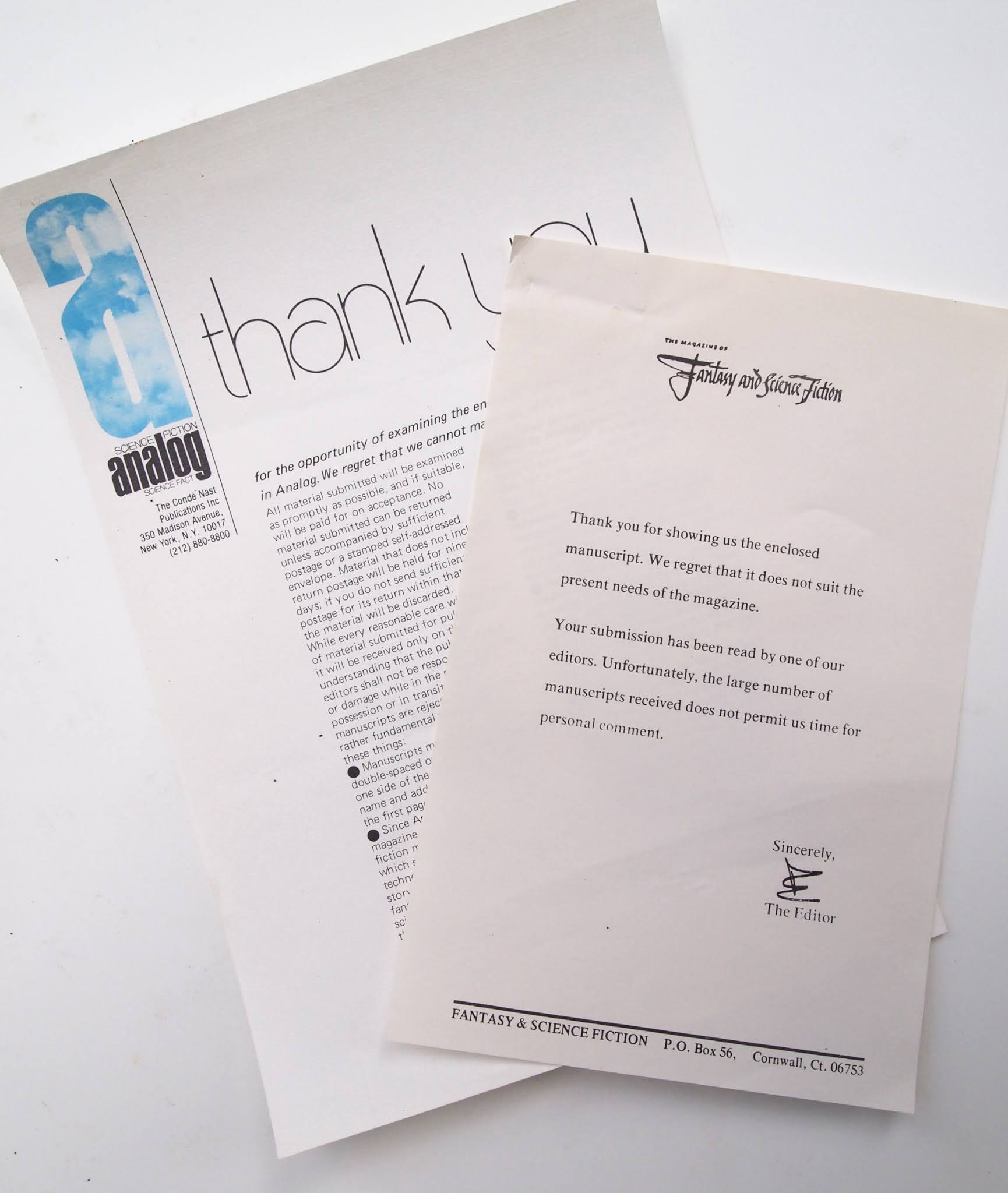
Below are rejection letters from Analog and the Magazine of Fantasy and Science Fiction.
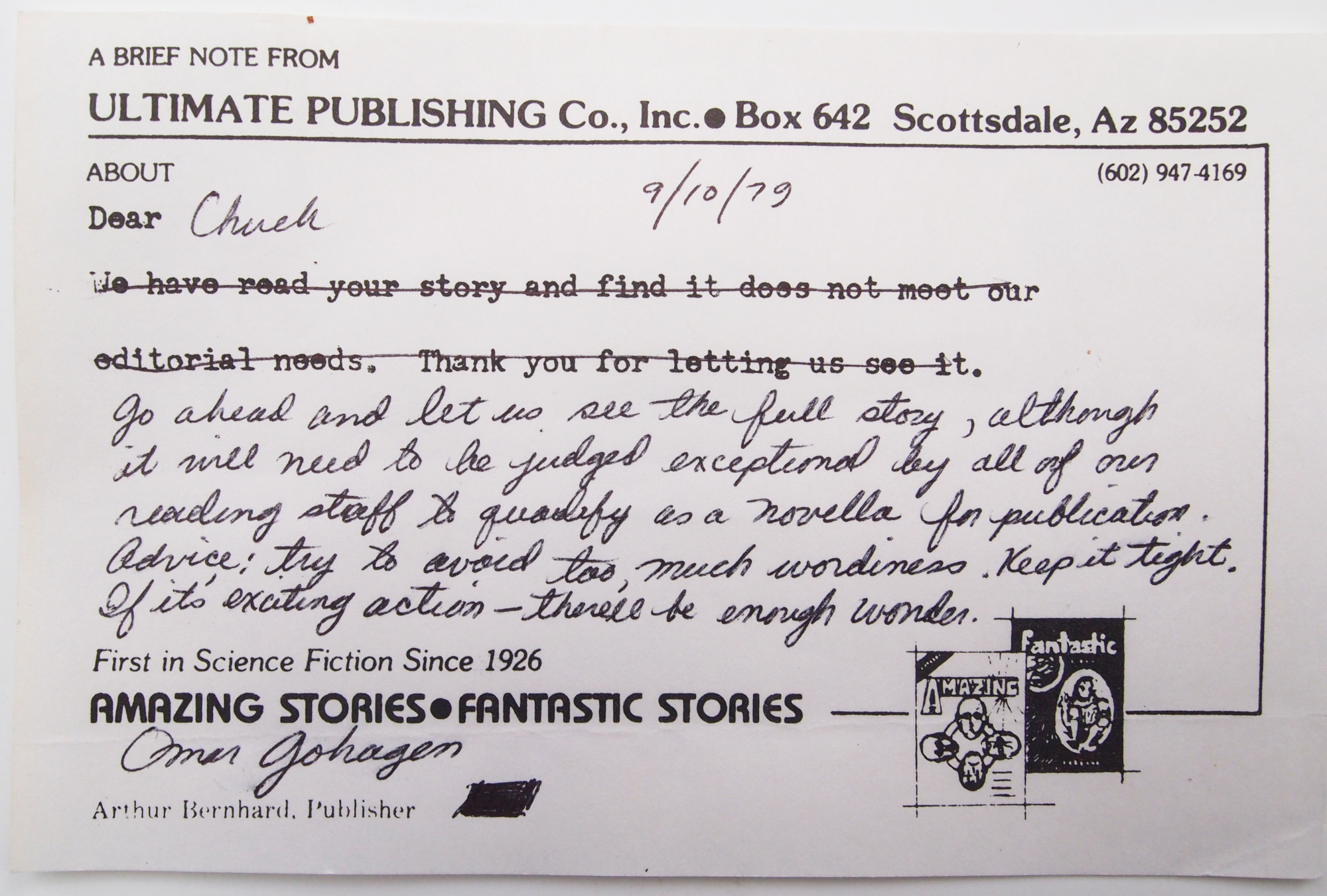
Below is a note from Amazing Stories/ Fantastic Stories concerning my sf novella, The Hybrid-Worlder. The fist one is dated 9/10/79 from Omar Gohagen, telling me to send along the novella. "although it will need to be judged exceptional by all of our reading staff to qualify as a novella for publication. Advice: try to avoid too much wordiness. Keep it tight. If it's exciting action -- there will be enough wonder."
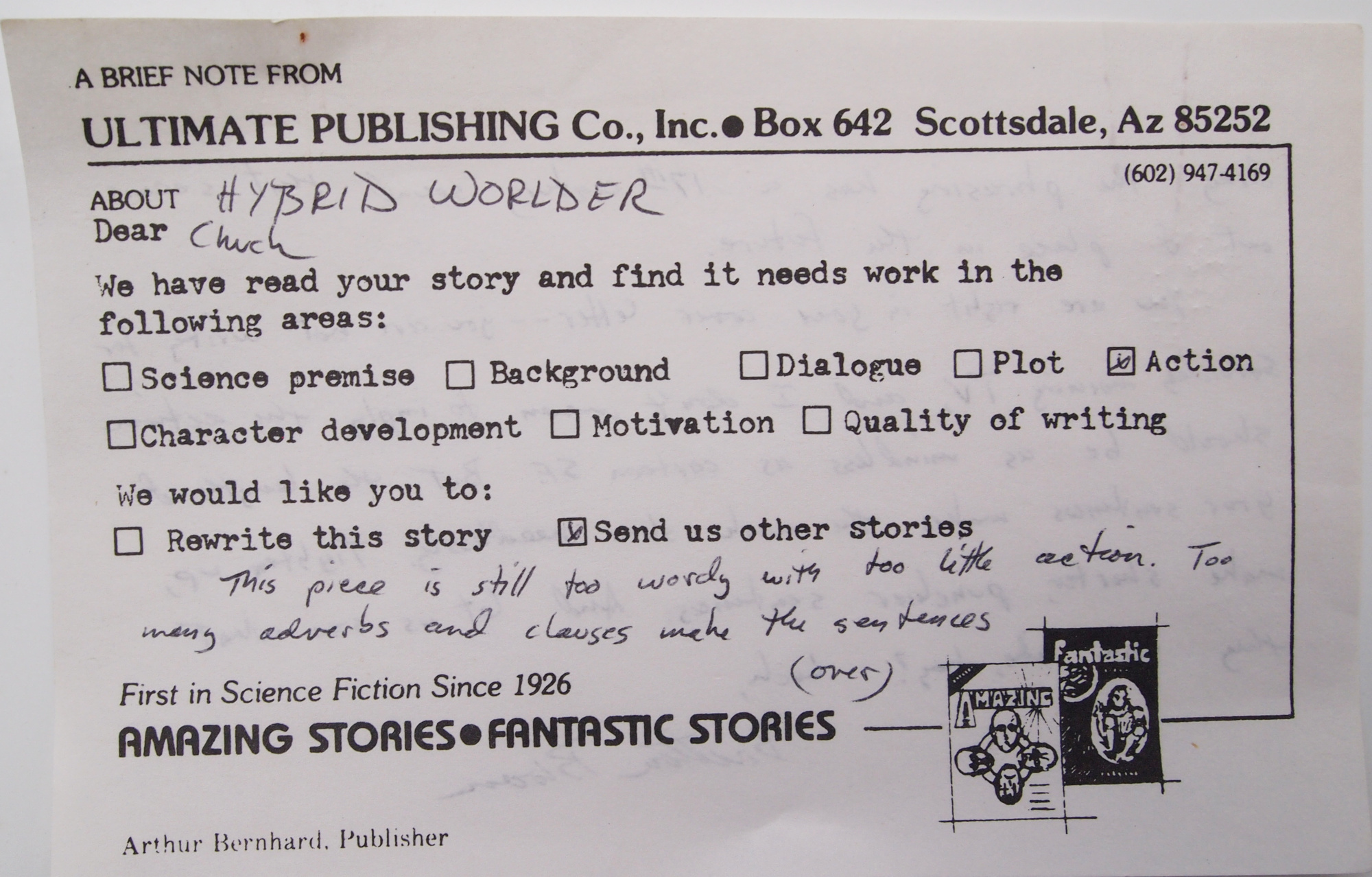
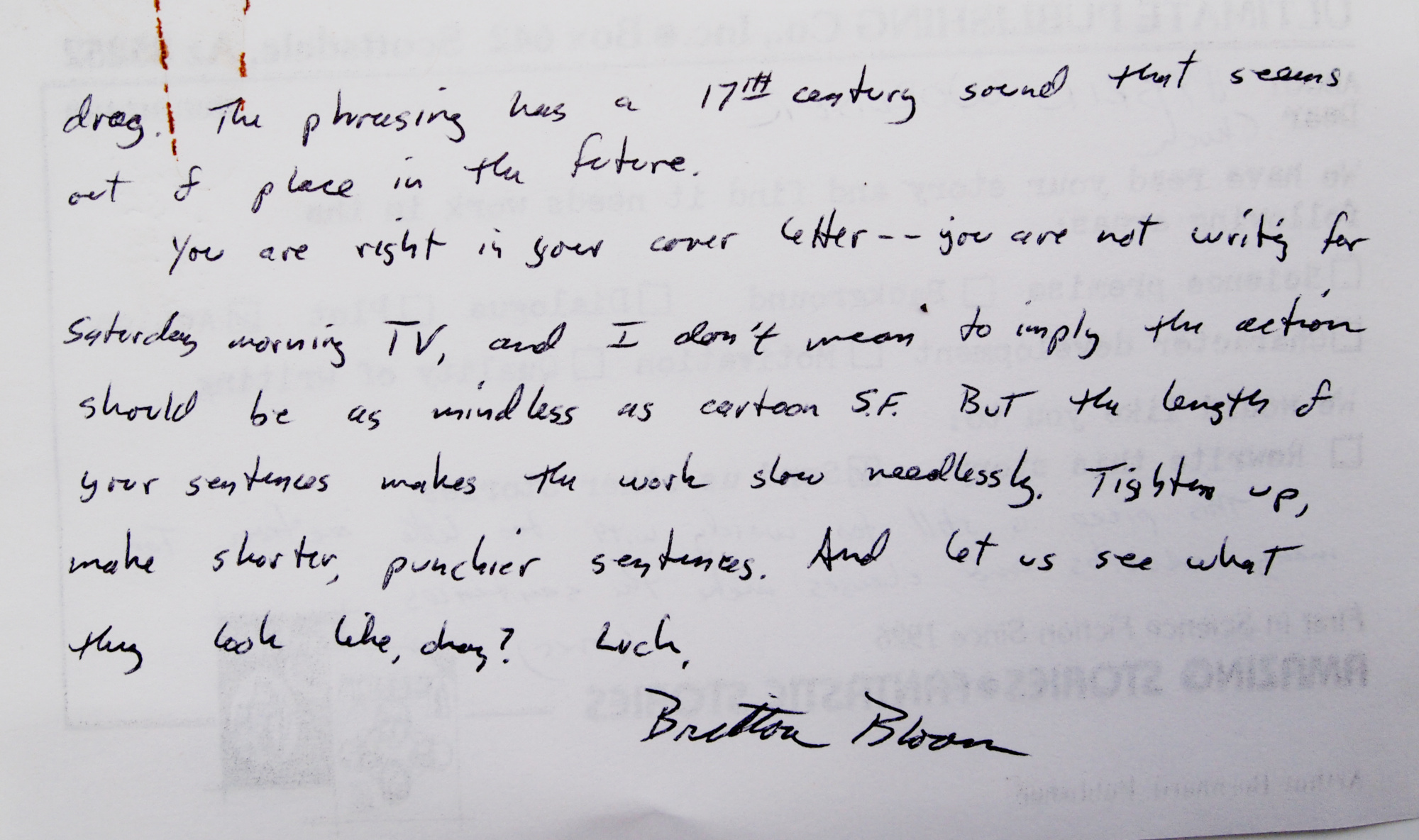
I apparently sent a revised version of the story, tightening it up from 29,900 to 21,900 words to them and here is their response (two sides), this time from Britton Bloom: You can read what Britton Bloom says, but note that under what needs work, only the "action" box is "x"-ed. Then, under the "We would like you to:" section, the "Send us other stories" box is "x"ed. Which actually is pretty encouraging... Though I don't know how encouraging it was for me at the time, since, well, I didn't ever follow up on it...
Anyway, what I found interesting on the back side was the line "The phrasing has a 17th century sound that seems out of place in the future." The sf author Nathan Lowell talked about The Bright Black Sea that he was reading in several of this "talking while walking" podcasts, and in one he talked about how old-fashioned my writing sounded. It seems that some things never change. I don't do it deliberately, I guess I just like the old fashioned way of writing -- though I don't think it's 17th century. Late 19th -- early 20th century. Britton goes on to say that "the length of your sentences makes the work slow needlessly. Tighten up, make shorter punchier sentences.' Good advice, I've been making a point to do exactly that, these last couple of books. The note ends with "And let us see what they look like, (something-- hey -- maybe)?" Looking back 40 years, that was a pretty positive response. I should've tried harder and written more stories.
And finally two rejection slips for Asimov's SF Magazines, one initialed by George Scithers, the other signed by Darrel Schweitzer, assistant editor. These are rejecting my short story Death on Glou'Ay.
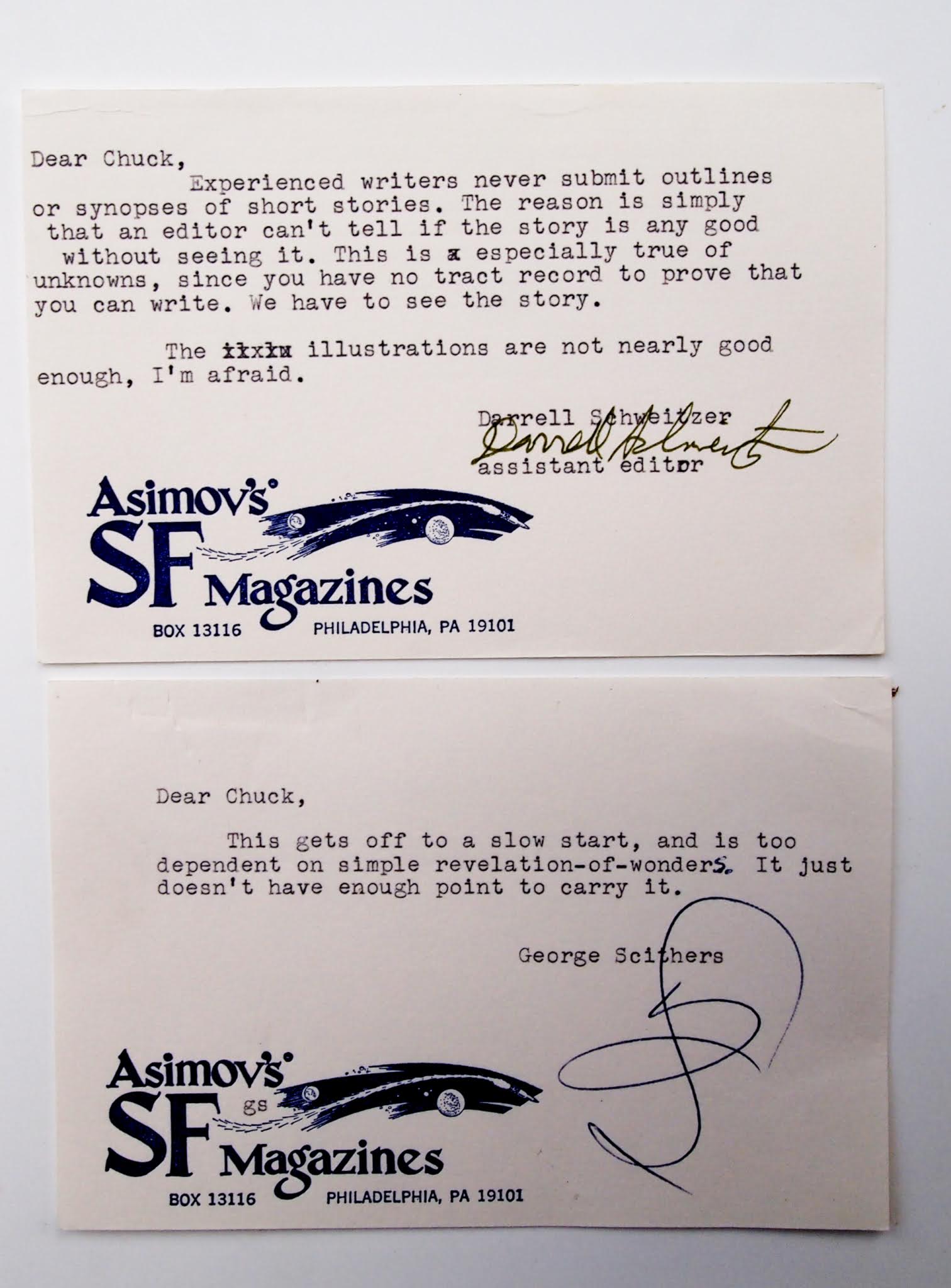 Rejection slips from Asimov's SF
I have a terrible memory about my life, so that looking over these rejection slips brings back no memories. Even so, I find them interesting in that in many ways, they could still be written about the stories I've written and am writing today. I'm probably still to wordy. While I'm trying to eliminate long, run on sentences, I find that I'm constantly having to go back and break them apart. Still, while I haven't the courage to actually go back and read these things, I'd like to think that I've gotten better with age and practice. They say that you should shove your first novel in the drawer and keep it there. I've given you pretty much all of my late life writing, so I guess these stories will have to count as my novels in the drawer.


May 7, 2021
First Draft of My Next Book Done!
 Probably not the cover -- but the mood.
As always, I’m delighted and relieved to report that I finished the first draft of my next novel. I’m a person who never likes anything, good or bad, hanging over my head, and that includes an unfinished story. This is especially true when I don’t have a clear picture of the story details when I start. So it is always a relief to know that a story well over half done, with only the part that I really enjoy -- tinkering with the words -- in my second and third draft. So even though there's still a couple of weeks worth of work ahead, the heavy lifting is done.
My first file for this book is dated 20 January – four lines, just to break the ice, so to speak. Between 21 February and 22 February I wrote two pages. I got seriously down to business on 4 March. I wrote for a total of 21 days in March. I devote 1 ½ to 2 hours each morning to writing with an occasional evening session as well. I don’t have a daily word count goal – I never have trouble typing words if I know what I want to say. In the middle of March, I took a few days off, as I had overrun my imagination, and had to stop and think about where I was going. I even spent a day typing out a outline of the remaining story -- something I never do. A chronology, yes, so I know the time line, but a two page written outline. Nope. Until now. I had to pause several times in the process of writing this story. On those days, I'd go back and start my revision process until I figured out how to push ahead. I wrote every day in April and finished the first draft on 2 May, missing my target date by those two days in May. All in all, it took me two months to write a relatively short, 67K novel.
Ideally I have the story in my head in its entirety before I sit down to write it. Usually I’ve gone over key scenes in my mind time and time again. These days that hasn’t been the case. Part of it is that I’m writing more, but shorter stories these days, starting the next one within days of finishing the last one. It’s a case of making hay while the sun shines. I have some story ideas, and I want to keep the creative juices flowing. I’m afraid that if I get out of the habit of daily writing, it will be hard to get back into it again. I’ve seen my spring of inspiration dry up when it comes to painting, and I have to believe that the same thing can, and someday will, happen with my writing as well. As I said, making hay while the sun shines.
So what’s this next book about, you ask. Well, I think I’ll save most of the details for a future post. I’ll only say that it is the third and, for now, last Nine Star Nebula Mystery/Adventure novel in this set. And it should be ready to be released in early July 2021.
May 1, 2021
Six Years in Self-Publishing
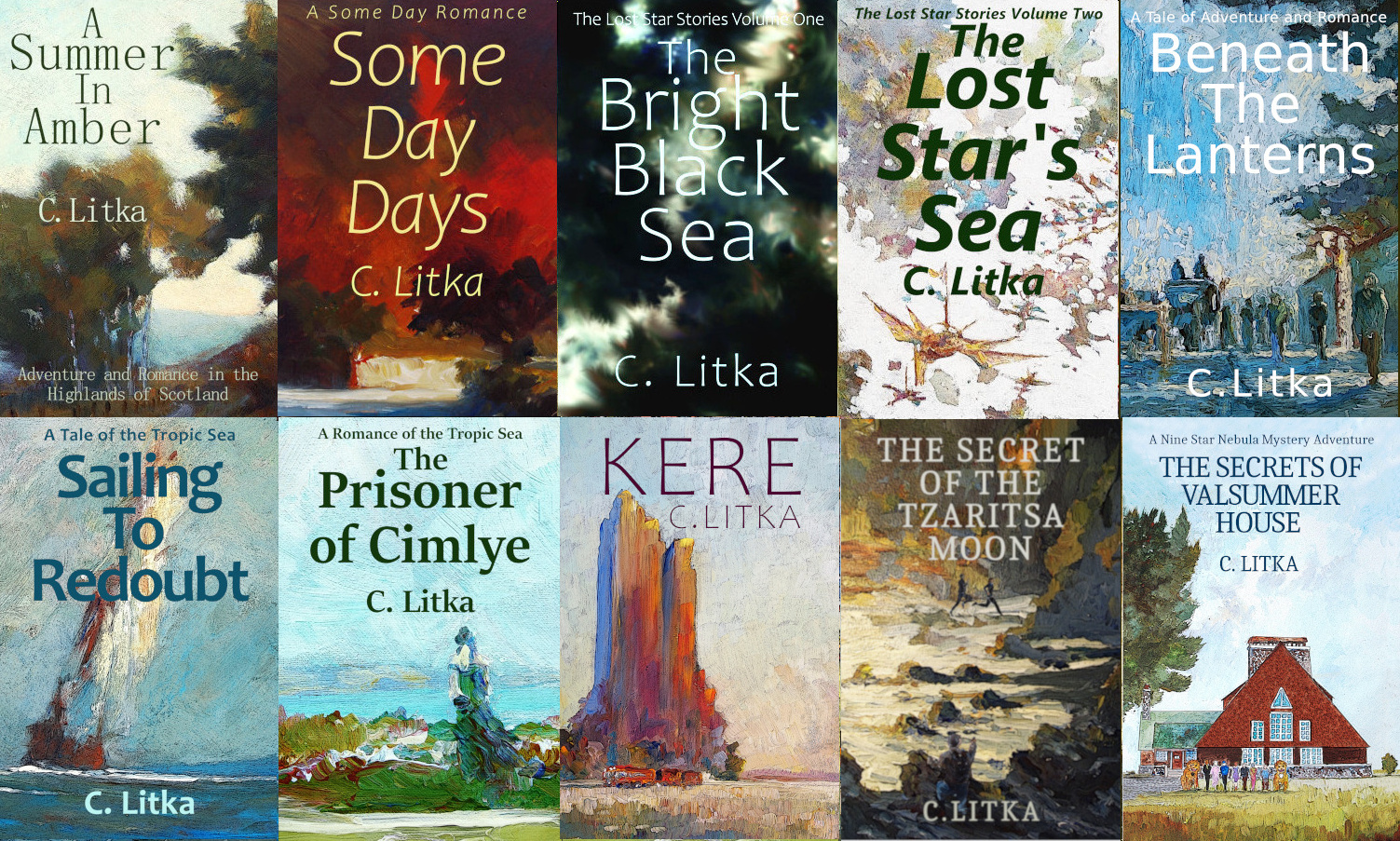
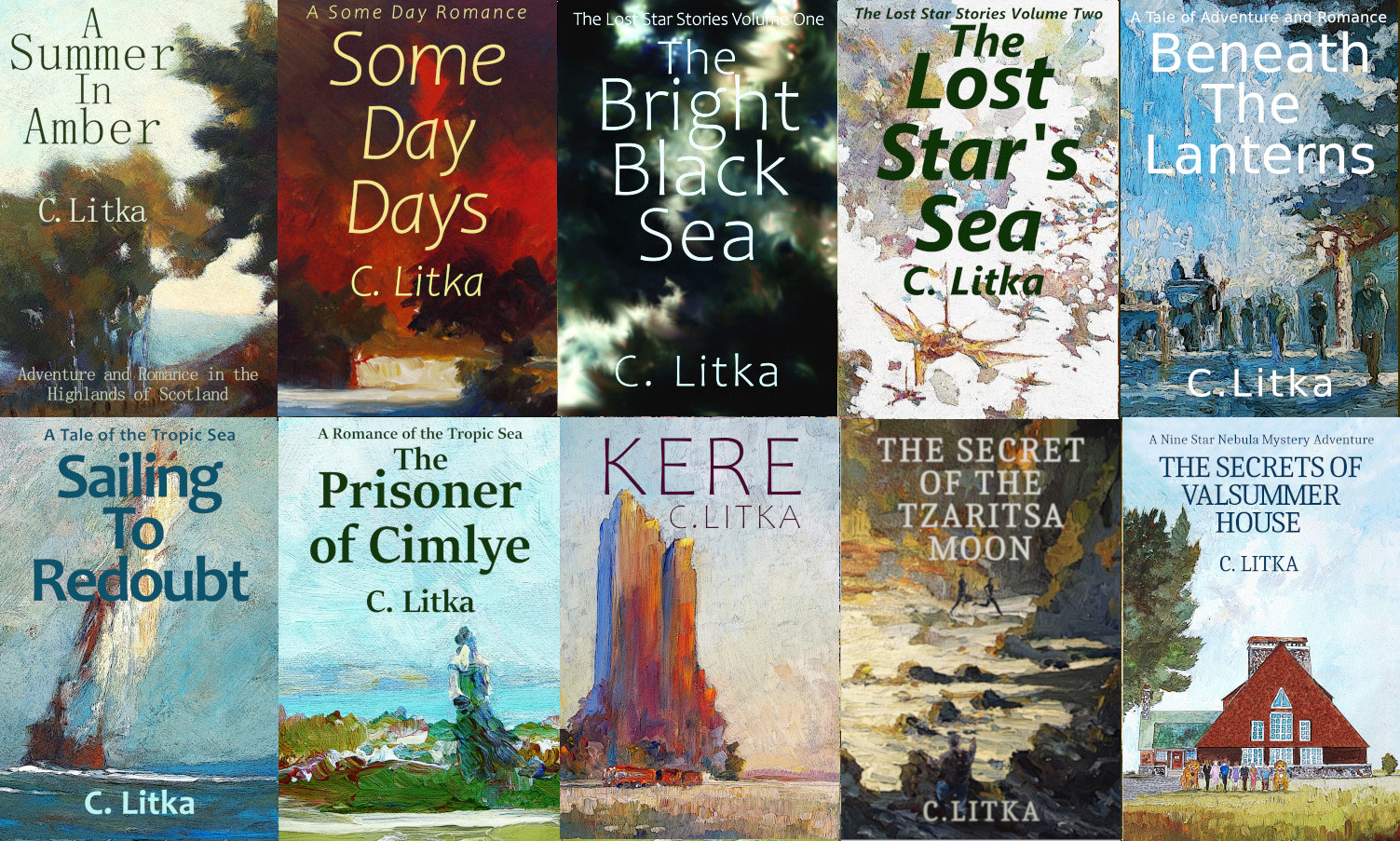
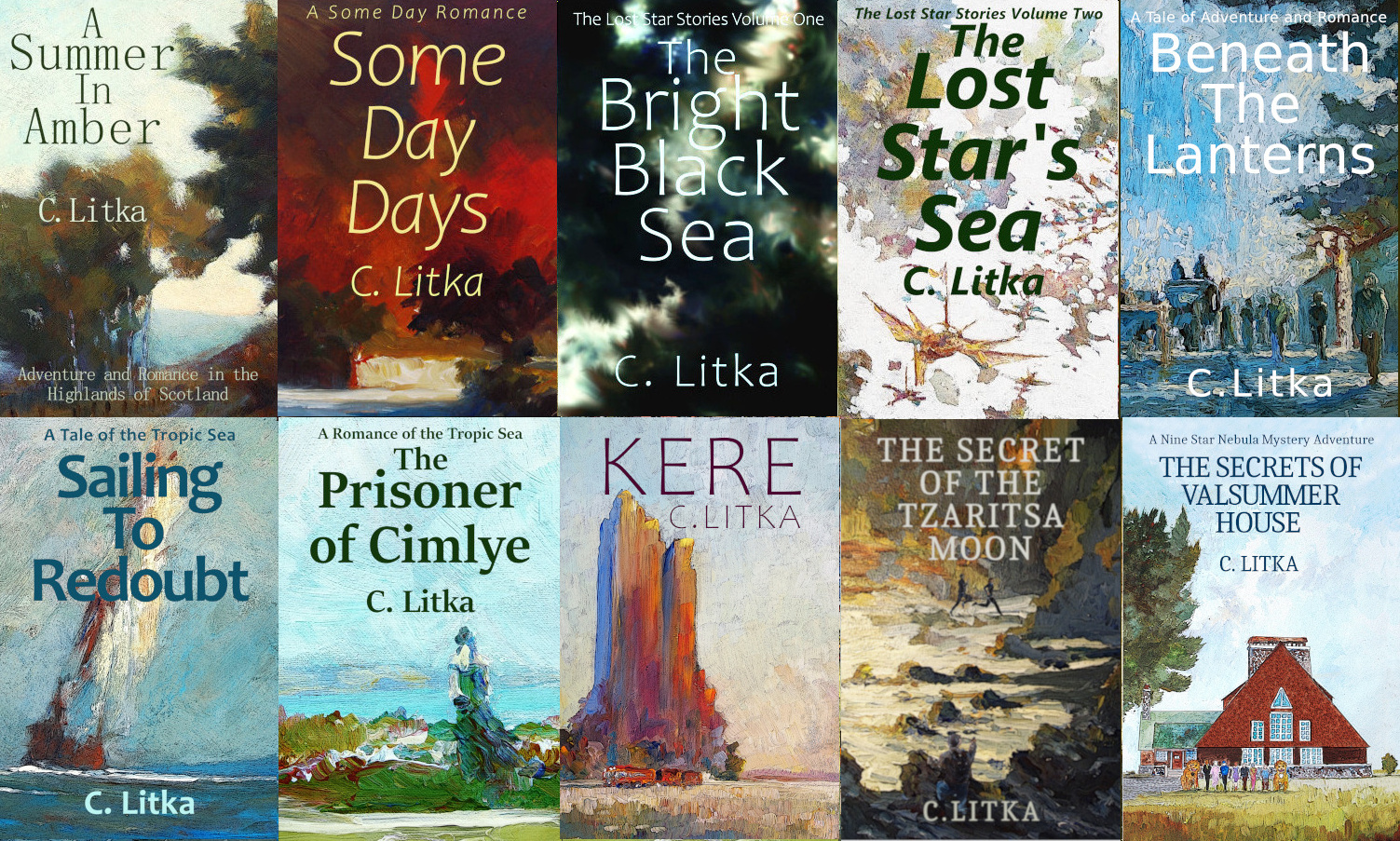
Well, well, here we are, six years after I self-published my first novel, A Summer in Amber. So where in the blazes are we? We're not in Kansas anymore. And it ain’t 2015 anymore either. Looking around, self-publishing is very different industry from the one I started out in 2015.
In 2015, self-publishing was in the final stages of its gold rush era. I released three very different books for free, and without any effort or money spent promoting them,I gave away more than 6,000 of them between Amazon, Smashwords, Apple, Barnes & Noble, and Kobo. Customers of those stores were still happening upon one's books back then.
Fast forward to 2021. Those days are long gone. Big entrepreneur/writer/publishers, some who even employ ghost writers to write the actual stories, now dominate Amazon. Today they need to spend thousands, if not tens of thousands of dollars on ads and crank out books every couple of months just to maintain their readership. Beyond Amazon, Smashwords has changed their format to one that seems to favor best sellers. B & N's ebook store has faded, as have my sales on Apple. Kobo -- who knows? They don't report free sales. The bright spot these last two years is that readers are finding my books on Google Play Books -- somehow I sold more books on Google than I did on Smashwords/Apple by a long shot, this past month.
Long story short, I'm quite certain that if I did today, what I did six years ago, I'd count myself lucky if I did 10% of the business I did back in 2015.
Luckily, over the past six years I've managed to built a modest readership, one that I'm quite happy and thankful for. To be honest, I don’t think I’d enjoy being wildly successful – what with all the demands on your time that comes with the territory. I have just the sort of readership that I’m comfortable with. A good readership. I like’em.
Year Six Results
So how did I do in my sixth year as a self-published author? The numbers are below, so you can judge for yourself.
Year five was my best year ever, though I didn't expect it to continue, given the way the ebook market was evolving. This year my four to six year old books did half the business they did last year, though my space opera, The Bright Black Sea remained my bestseller.. However, I released two novels and a novella this year, and while none were breakout hits, they shored up my sales, so that year six turned out to be better than I had anticipated.
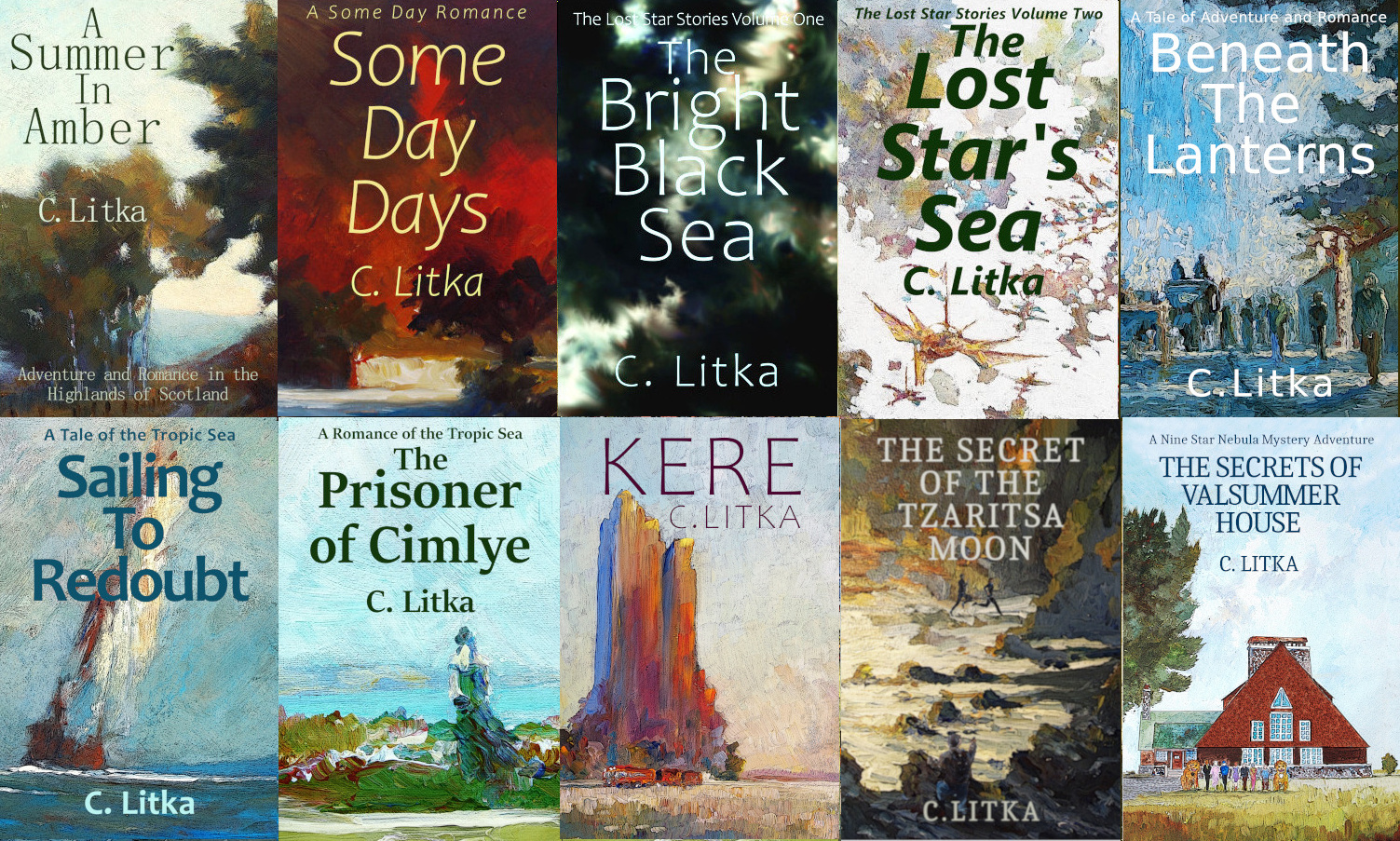
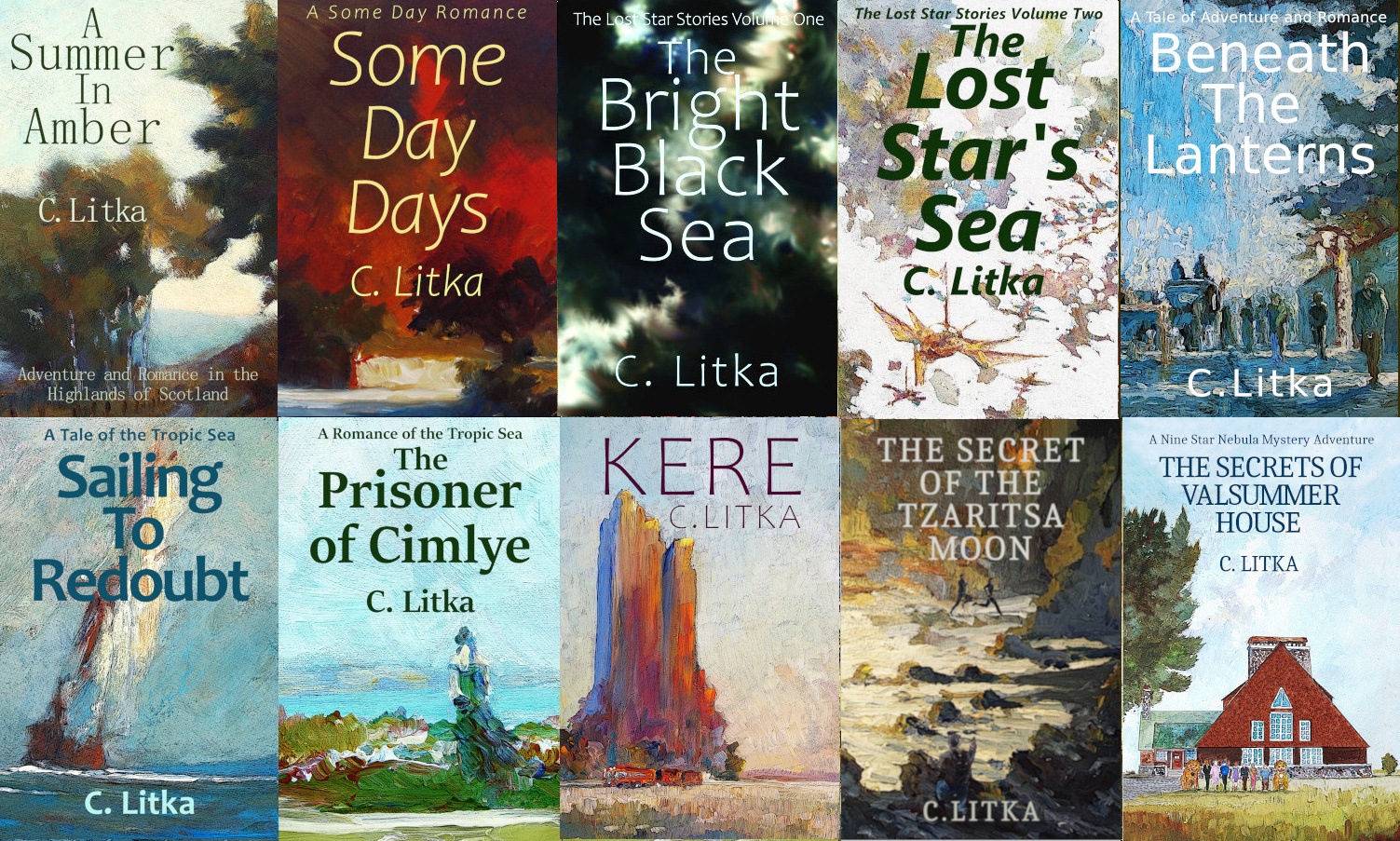
The three new books this year were my Mars novella, Keiree, and two Nine Star Nebula Mystery/Adventures, The Secret of the Tzarista Moon, and the Secrets of Valsummer House, plus one children's short story, that I had laying about for a decade: Lines in the Lawn, (on Smashwords only). I’m writing shorter stories these days, as I find them much easier to dream up and write down.
I also revamped my covers this year. I never see any difference, but it keeps me amused.
And, as usual, my odd, mostly foreign Amazon store sales pretty much cover my expenses (paper books for my beta readers) so that if I'm in the red, it's pocket change. Being a self-published author is an inexpensive hobby for me.
Year Seven Expectations
Next year? I’m going to go out on a limb and say, it will be pretty much like this year -- and almost every other of the last six years. It will depend on how many stories I can write and release. I'm currently within a day or two of finishing the first draft of my next and last Nine Star Nebula Mystery/Adventure book for this set of books. I should release it in early July 2021, at the latest.
My next project will be to try writing a 30-35K word novella in 60 short episodes for a new venture by Amazon called Vella. Vella will be an iOS only Amazon app designed specifically for serial stories in the 600-5,000 word per episode range to be read primarily on iPhones. My idea is to use this format as a vehicle for reaching readers who never bother searching beyond their Kindle Unlimited selection, which my books are not enrolled in. It remains to be seen if I like writing in this format and whether or not I pursue it beyond experimenting with it. Other than that, I've not settled on any definite next story. After producing four books in twelve months, I think that I can take the summer off to come up with some new story ideas. We'll see.
Six Year Numbers.
As usual, "sales" are mostly free downloads. Numbers are approximate, likely due to quantum fluctuations. i.e. I'm 11 books off from last year's total.
Book Title / Release Date
Year Six Sales
(#) Year five Sales
Total Sale To date
A Summer in Amber
23 April 2015
598
(818)
7.816
Some Day Days
9 July 2015
358
(726)
4,211
The Bright Black Sea
17 Sept 2015
1,320
(2,656)
13,816
Castaways of the Lost Star
--
2,176
The Lost Star’s Sea
13 July 2017
986
(1,962)
6,969
Beneath the Lanterns
13 Sept 2018
551
(1,087)
2,792
Sailing to Redoubt
15 March 2019
728
(1,043)
2,332
The Prisoner of Cimlye
2 April 2020
632
(244)
877
Lines in the Lawn
1 July 2020
83
83
Keiree
17 Sept 2020
853
853
Secret of the
Tzarista Moon
19 November 2020
1,110
1,110
Secrets of Valsummer House
18 March 2021
265
265
Total 6th Year Sales
7,484
43,300
Yearly Sales History:
Year One, 2015/16: 6,537 (3 novels released)
Year Two, 2016/17: 6,137 (1 novel released)
Year Three, 2017/18: 6,385 (1 novel released)
Year Four, 2018/19: 8,225* (2 novels released) * includes a strange 1950 book one day sale on Amazon that they say is correct. (6,275 w/o)
Year Five, 2019/20: 8,530 (1 novel released)
Year Six, 2020/21: 7,484 (2 novels released, 1 novella, 1 children's short story)
Past Yearly reports can be found here:
Year 1: https://clitkabooks.blogspot.com/2016/05/a-window-to-self-publishing.htmlYear 2: https://clitkabooks.blogspot.com/2017/05/two-years-of-free-books.htmlYear 3: https://clitkabooks.blogspot.com/2018/05/3-years-in-self-publishing.htmlYear 4: https://clitkabooks.blogspot.com/2019/05/four-years-in-self-publishing.htmlYear 5: https://clitkabooks.blogspot.com/2020/05/five-years-in-self-publishing.htmlYear Six Sales by Outlets
Over the last year my sales by digital storefronts were: 40% from Amazon, 40% from Smashwords (+ Apple & B&N) and 20% from Google.
Note: Kobo does not report free sales to Smashwords. Barnes & Noble's numbers no longer appear on my daily sales record. However elsewhere I find that I sold 128 books in 2020, and 40 in 2021 to date on B & N.
The trend here is that both Smashwords and Amazon are fading, while Google is stepping up to fill in. Amazon is up and down. I've had a good couple of months in 2021 on Amazon. In March, not only did I have a new release, but The Bright Black Sea received a nice writeup on the blog of Nathan Lowell, a popular SF author, which together produced a near record month for free books, and a record month for actual mioney sales of some 120 copies. That trend faded a bit in April, but it was still a solid month. The other bright spot in 2021 are my sales on the Google Play Store. They have been rising all year. In March they essentially matched my Smaswords sales, and in April 2021 they almost doubled my Smashwords sales. This increase in Google sales has helped keep my yearly sales in my usual range.
Summing Up Six Years of Self-publishing
I've done exactly what I wanted to do. Write. I've gotten to know some of my readers, some of whom have kindly volunteered to be my beta readers. And they have made a appreciable difference in the quality of my books. I have made an effort to write better in little ways, and I'd like to think that I've had some success. Covers have become a pain to paint, but other than that, I've got the whole process of self-publishing down pat. And I'm still having fun doing it all. I'm looking forward to my seventh year report.
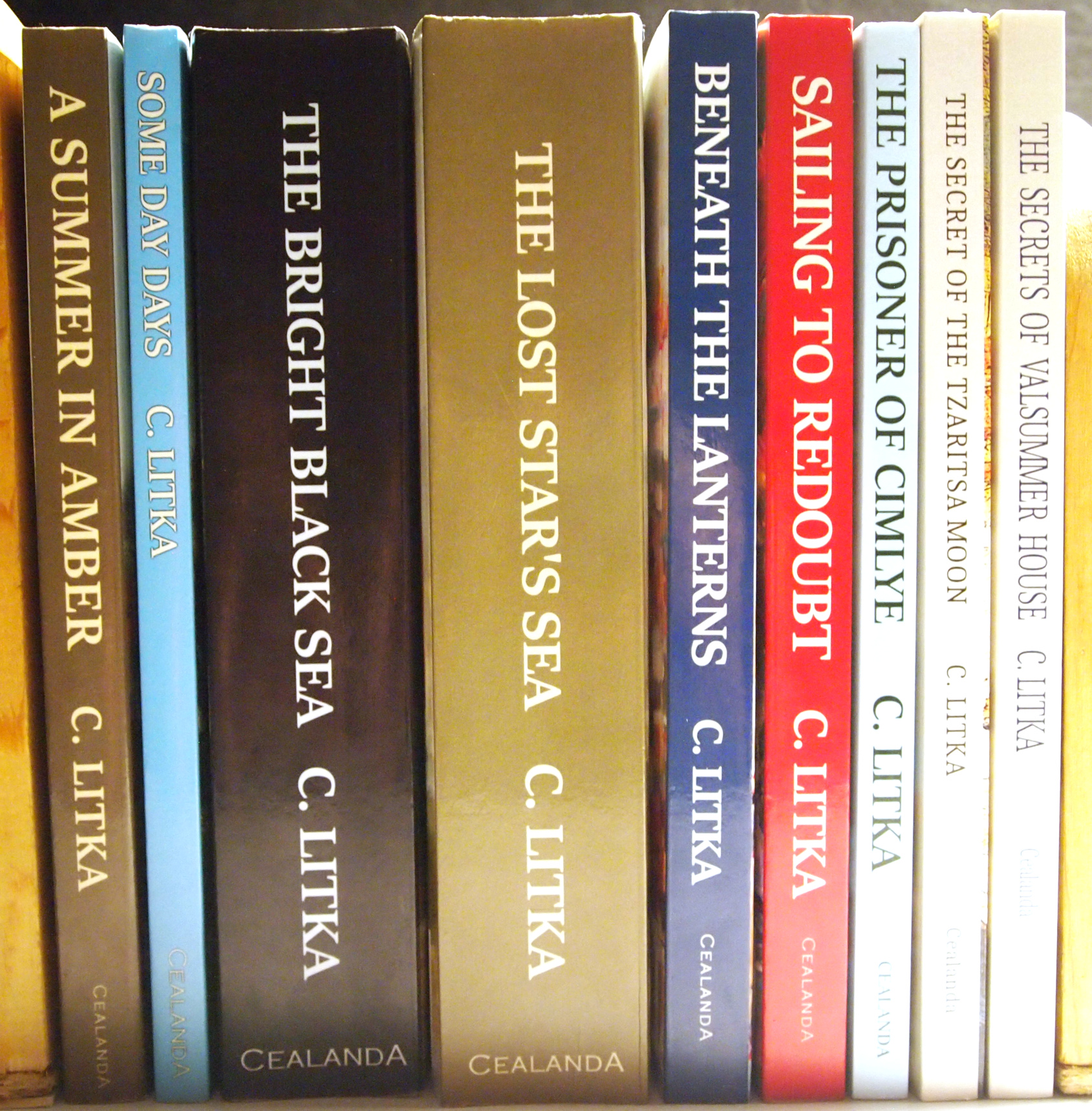
April 25, 2021
My Library -- Old Comic Strips
[image error]
I was not into comic books in any big way as a kid. I can only recall one that I bought for a train trip. I did read a friend’s more extensive collection of comics, but comic books weren’t something I spend my allowance on. As an adult there was perhaps half a decade when I collected comics, because of a friend of mine who was into them. We got to drawing our own. I’ve posted several pages of my work on a SF story this blog a few years ago. You can find them here:Sarfeer Page 1
Though I collected several superhero comics in this period, I also collected and enjoyed the classic Bark’s Scrooge and Donald Duck comics a lot more. I found that superhero comic basically consisted of a recap of the last issue, followed by a bar fight, with nothing ever resolved. And like soap operas, no one ever really dies in comics.
I suspect that around this time I either purchases or received as a gift the book pictured at the beginning of this post, the Smithsonian Collection of Newspaper Comics. It offers over 300 pages of comics from the turn of the last century into the 1060’s. Given my interest in drawing comics at the time, this offered s a treasure house of ideas and techniques to draw on. But more than that, it brought back memories of the Sunday comics I always looked for each Sunday while growing up – and the memory of the strange comics that I’d come across when we were visiting relatives.
As it turned out, people have gone back and collected many of those old comics and offered them in nice big books, that I’ve collected over the years – more for the art than the stories. Though I must admit, never a complete set, save one.
Gasoline Ally was an early comic centered around a single man raising an orphan, along with the early years of automobiles, hence the title. The Sunday spreads were often very creative, as you can see from the sample from the Smithsonian book above.
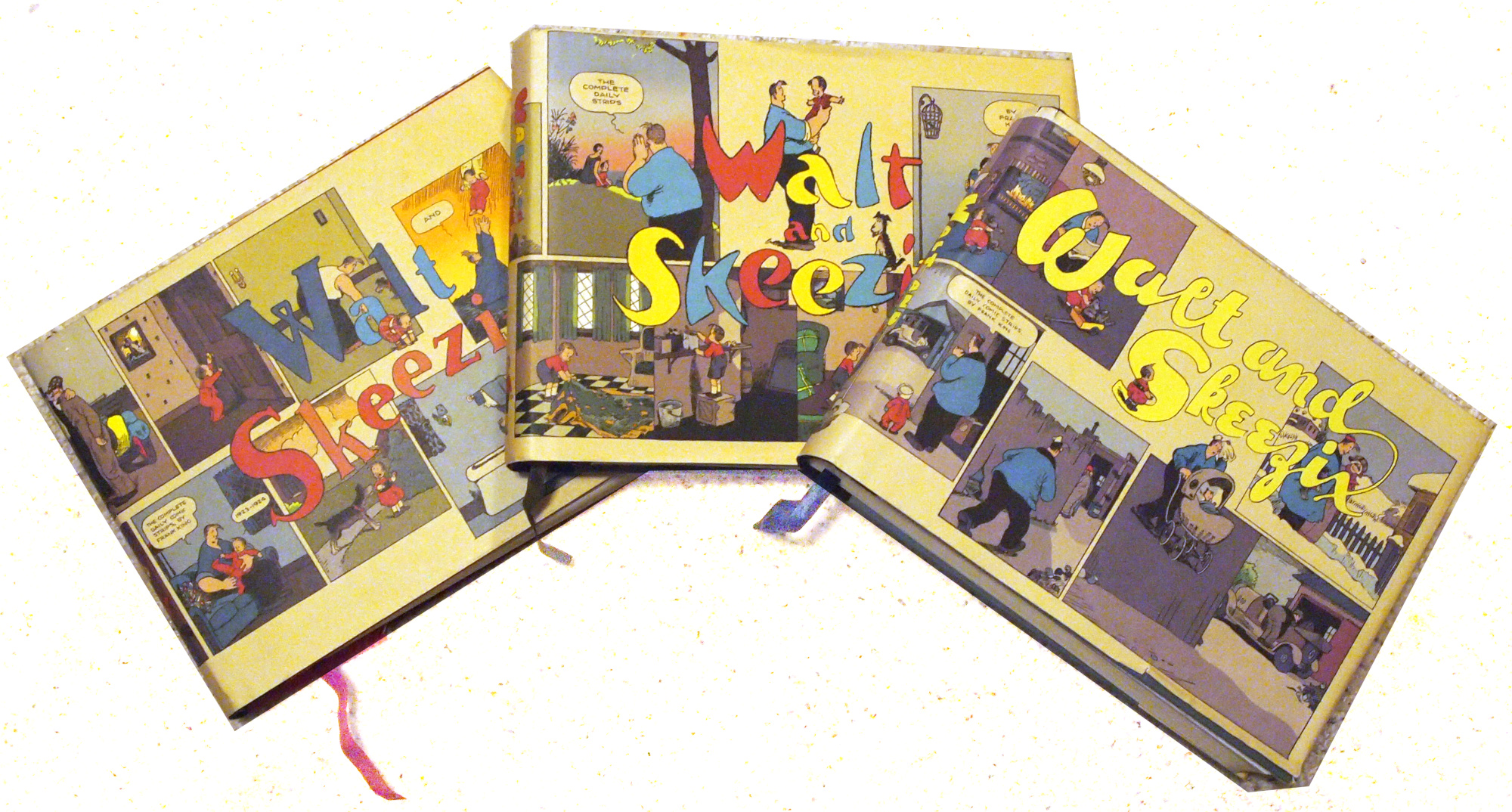
While there is a volume devoted to a sampling of the Sunday color strips, it’s a little too expensive for my taste. I did, however, invest in the first three volumes devoted to the first several years of the daily B&W strips. What I found interesting about them is the parallel between the early automobile enthusiasts, as depicted in the strip, and the early computer enthusiasts. Pioneering car owners of the 1920’s and computer owners of the 1970’s and early 80’s seemed much alike, forming clubs to celebrate their new enthusiasm, exchange knowledge, and to debate the merits of their favorite car or computer.
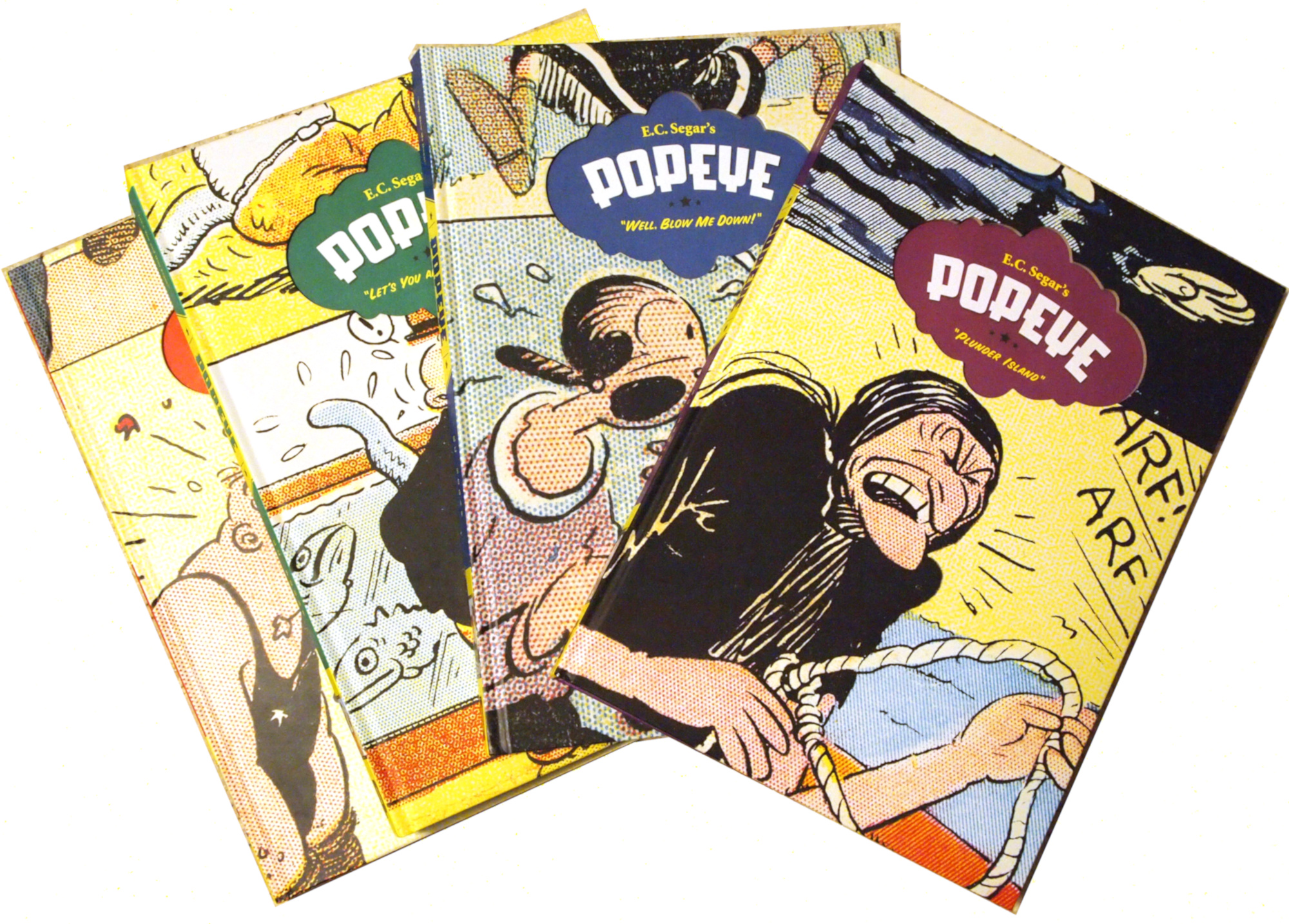
I was, and likely still am, a big fan of the original Popeye cartoons. I loved the gritty art of those Max Fleischer cartoons. The comic Popeye was somewhat of a different character, and the stories much more involved. Indeed, one of the Popeye stories served as an inspiration for a scene in A Summer in Amber. As before, I don’t have the complete Segar collection of Popeye strips, but a good sample of the early stories
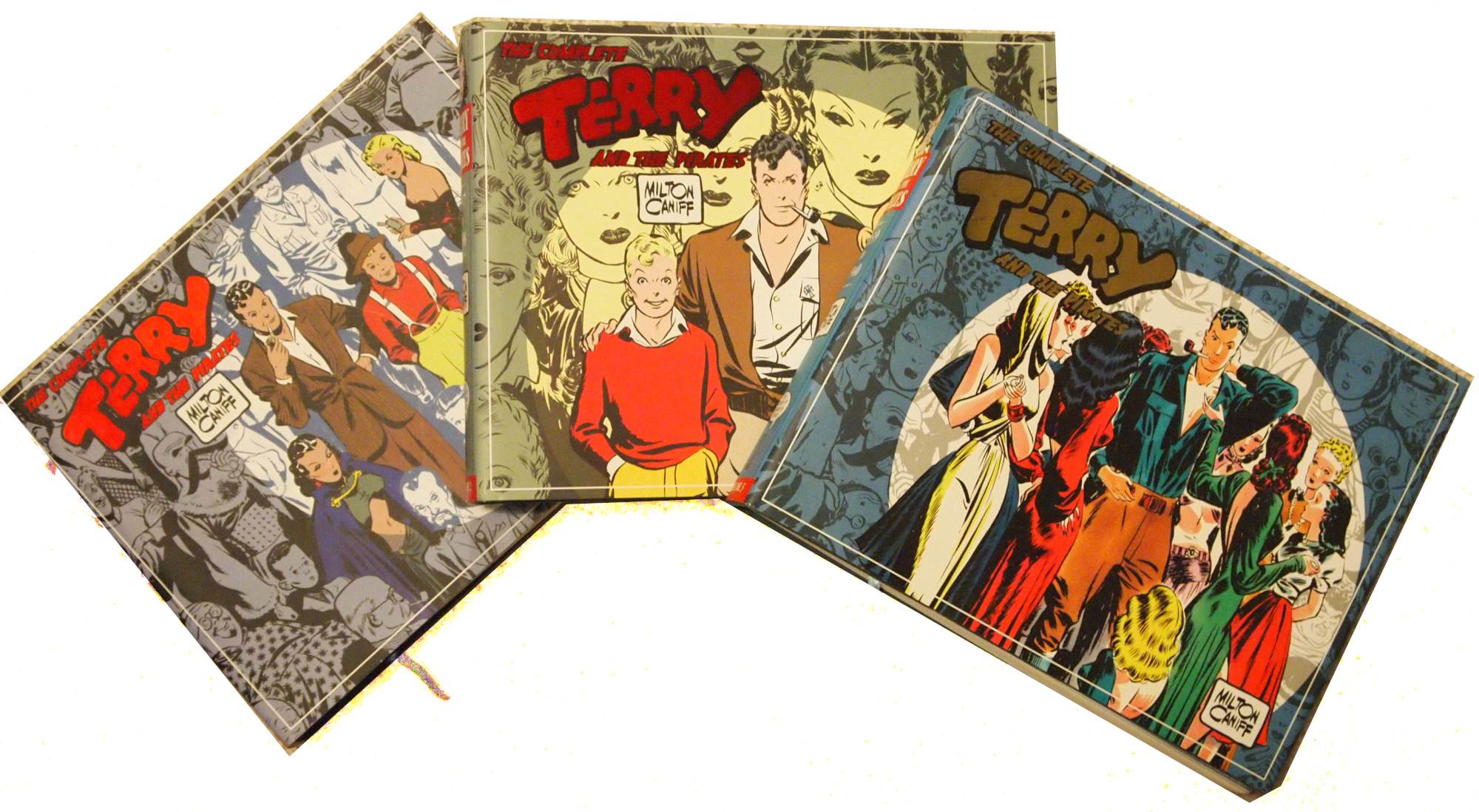
I was too young to ever read Terry and the Pirates, but I’d come across enough references to the strip, and seen samples, so that I picked up the first three volumes. In the war years everyone was fighting the Japanese or Germans, so the stories were all war stories, which doesn’t interest me, so I stopped once the series got into the 1940’s.
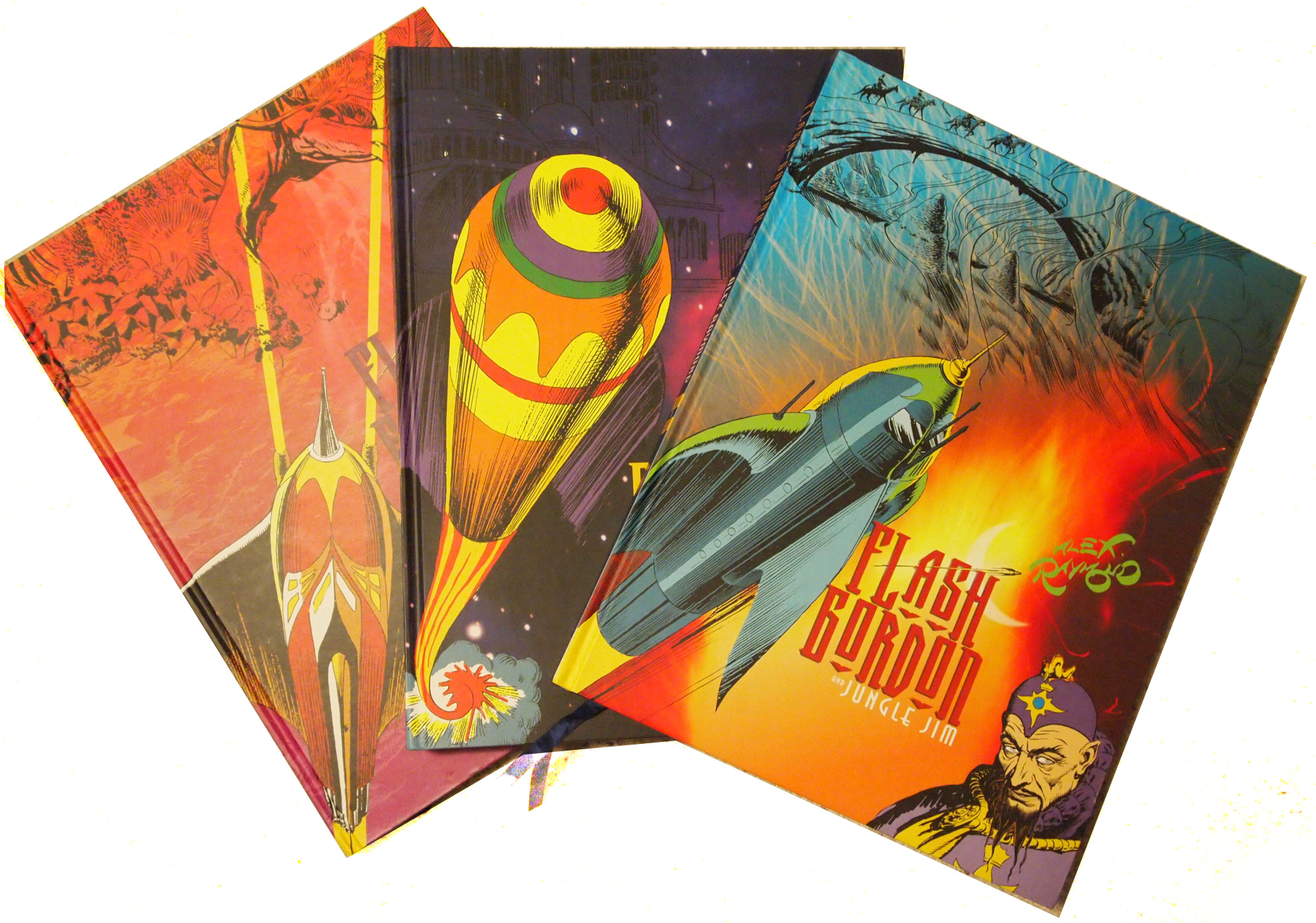
Flash Gordon was another series that I read – growing up. Indeed, I used to clip out the strips in the daily version (and threw them away a couple of years ago.) However, I these Alex Raymond original were released long before my time. Again, I stopped at the war years. It is interesting to see how Raymond’s art became more and more polished as the strip went on. I also have comic book versions of this Jungle Jim series and his style is perhaps my favorite of all the comic book artists – spare, and yet atmospheric.
Prince Valiant was one of the Sunday Comics that our local newspaper carried when growing up. I can’t say that I was ever entranced by the story when I was growing up, but as an adult, and as an artist, I really appreciate the fine art of the series.
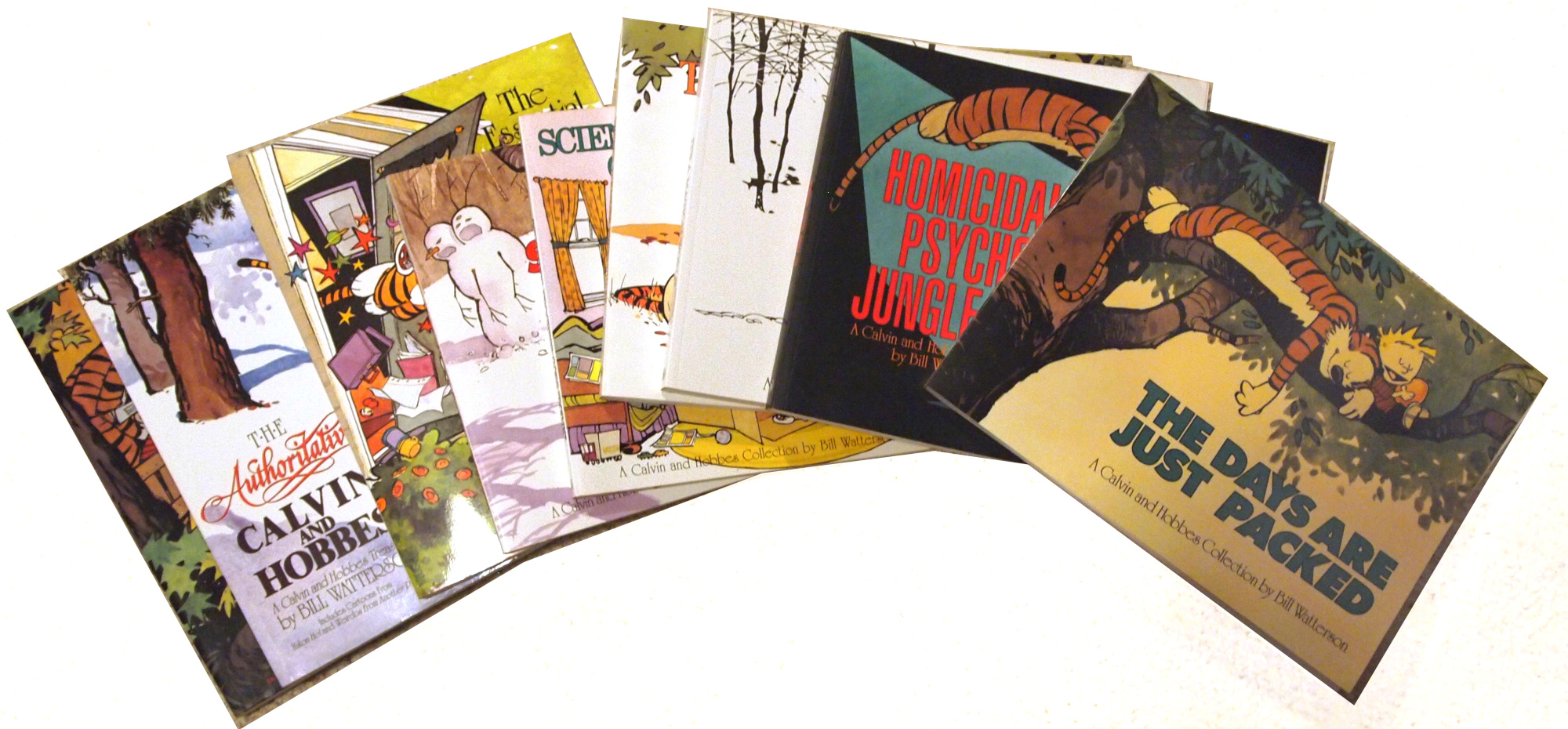
Last, but not least, I have all the Calvin and Hobbs strips – in their various book releases rather than the big two volume set. This collection is for everything about them. It was the best comic strip ever written. Period. And that’s all that need be said.
April 21, 2021
Om Adams Kon Illustration
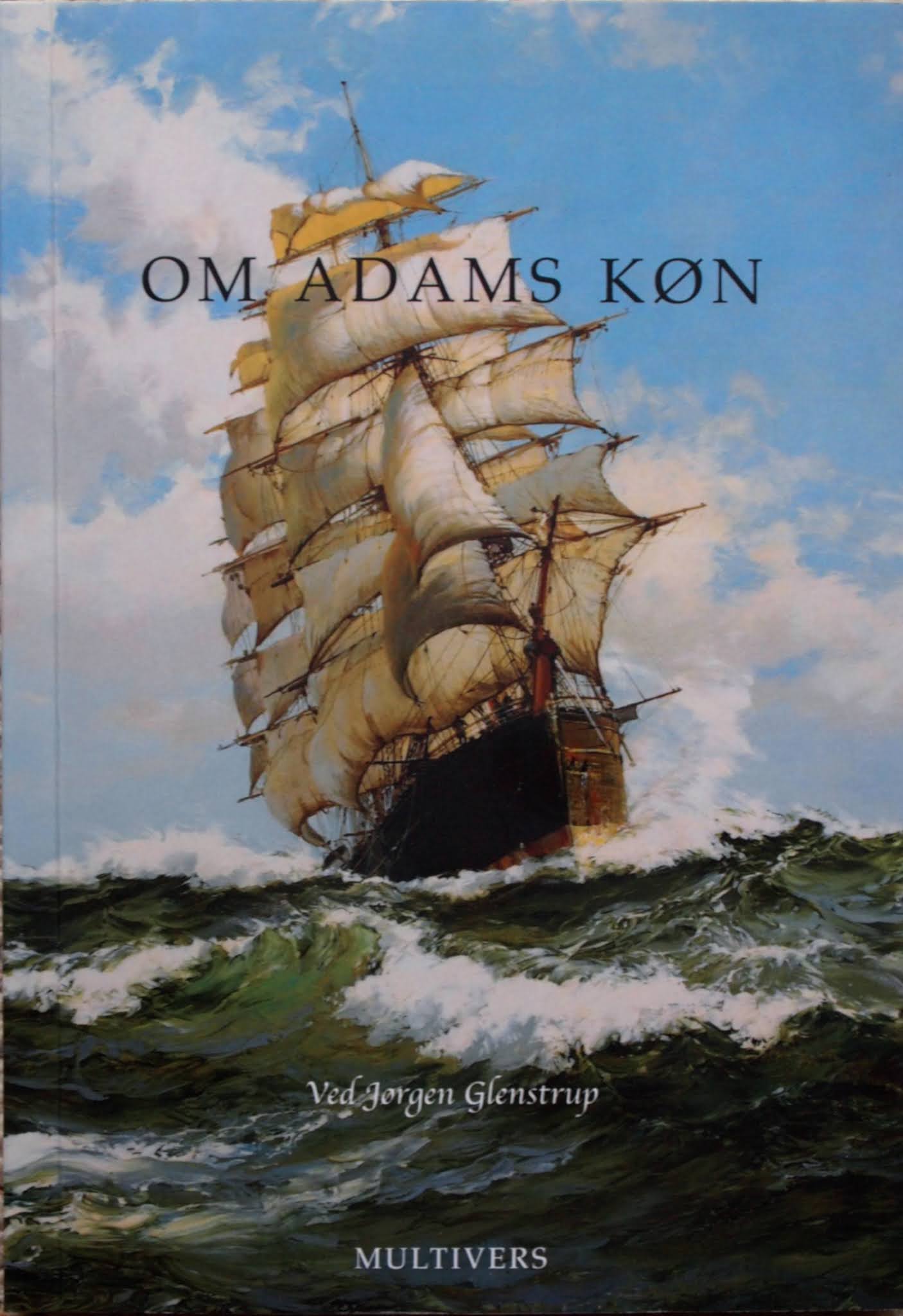 Front Cover -- Not my artwork
Just a quick post today to send a “heads up” to all my Danish readers, and readers of Danish. (That’s a joke, son.) Multivers has release a new book with the title of Om Adams Køn, Den Klassiske Fortaeller, edited by Ved Jergen Glenstrup. (About Adam’s Sex, The Classic Narrator)
It is a collection of short stories by the likes of Thomas Mann, Joseph Conrad, and others along with essays. The Google lens translation of the introduction is rather cryptic, so I can’s say much about it. But what makes it noteworthy is that if you turn it over and view the back of the book, you will find one of my early tea clipper ink drawings, no doubt tied in with the Joseph Conrad story, The Secret Sharer or The Double as it is titled in this book. The drawing is also used in the interior.
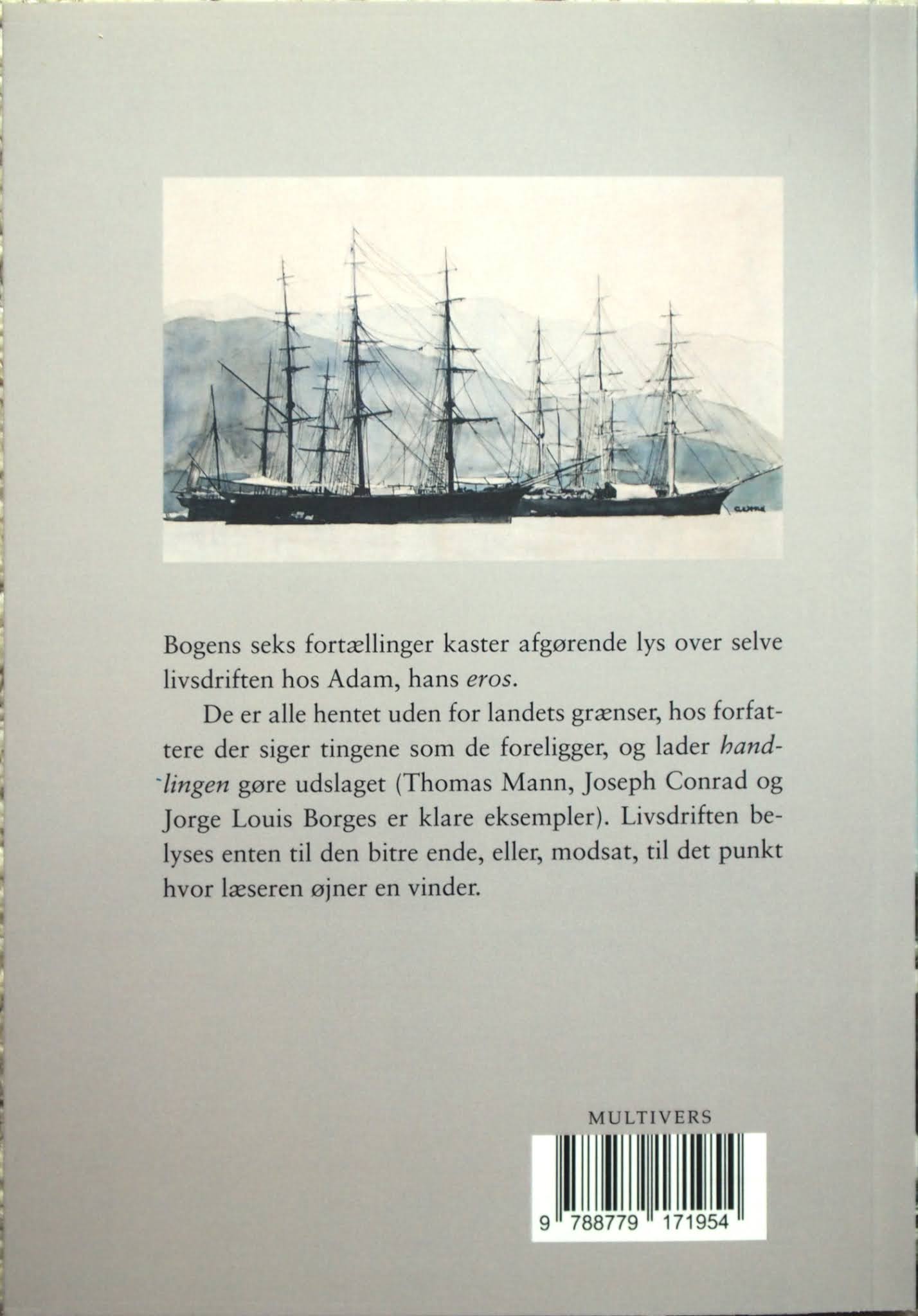 My Ink Drawing of Tea Clippers at Foochow Anchorage, from a Photo
The publishers contacted me after seeing the drawing on my Deviant Art Gallery https://www.deviantart.com/litka and asked if I would be willing to let them use it for the book, and for how much. I agreed, of course, for a copy of the book, which I now have.
Ah, such dizzying success so late in life! I’m lucky, in a way. It would have no doubt gone to my head if it all happened sooner. Anyway, pick up your copy today, its a handsome book and they’re very nice people.
April 17, 2021
My Library -- The Sea Books (Part 2)
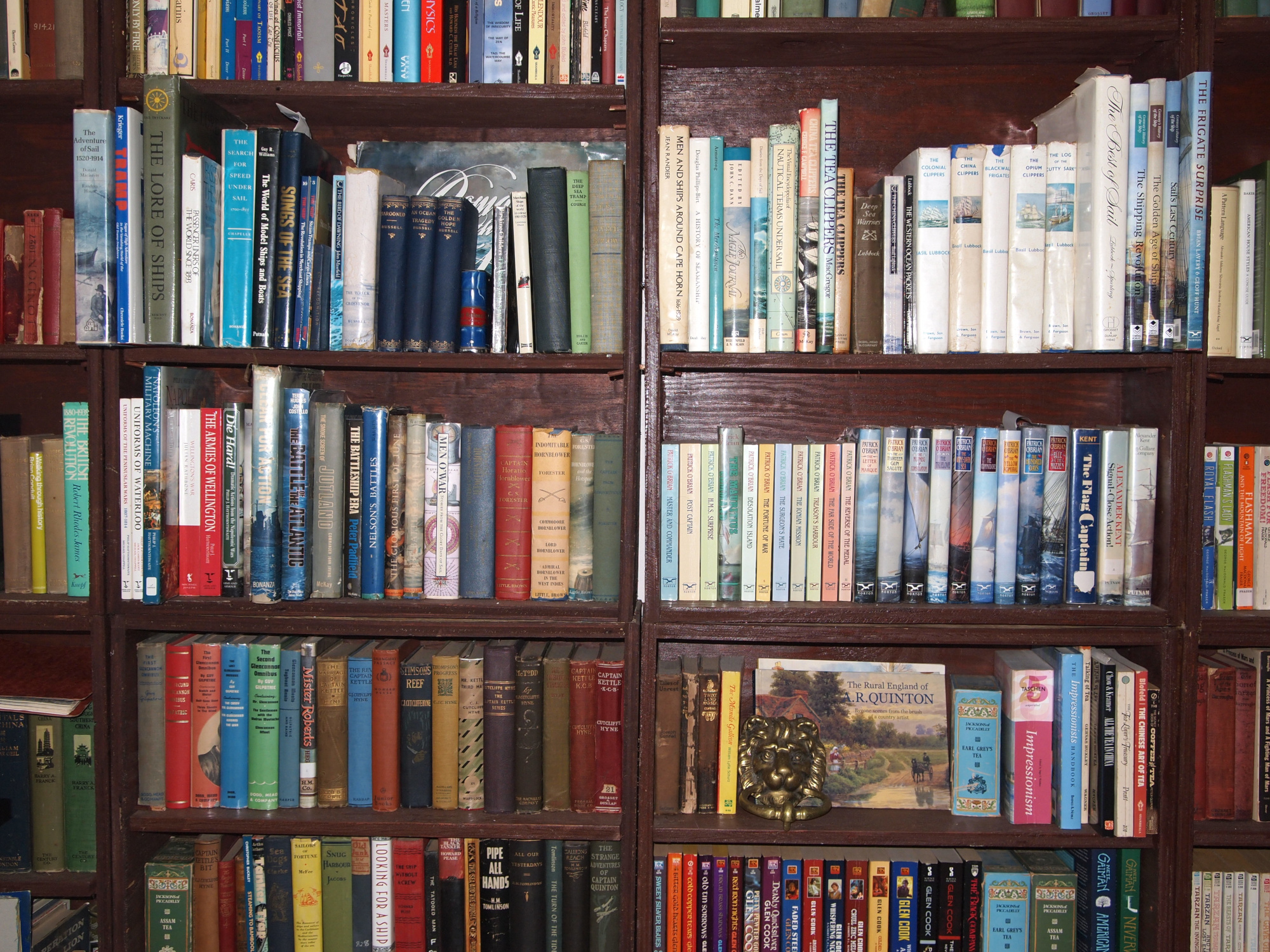
Back again to the shelves of my little library, and to my small nautical book collection. This time, featuring my tramp steamer books.
Tea clippers and tramp steamers have played their roles in my stories. My early, 1970’s unpublished novella featured starships with a story setting that paralleled tea clippers and their annual race from China to the London docks. Plus, those noses of many of my unfinished stories until I set out to write what became The Bright Black Sea, also featured sailing ships in space – though the sails were energy fields, not actual sails.
With The Bright Black Sea I challenged myself to write an old fashioned, Tom Corbett Space Cadet rocket ship story. And for it, I made it into a tramp steamer in space story. Not having served on a tramp steamer, or ever gone to sea, I relied on the books – my preferred method of travel. The books that I drew on for my stories are shown below.
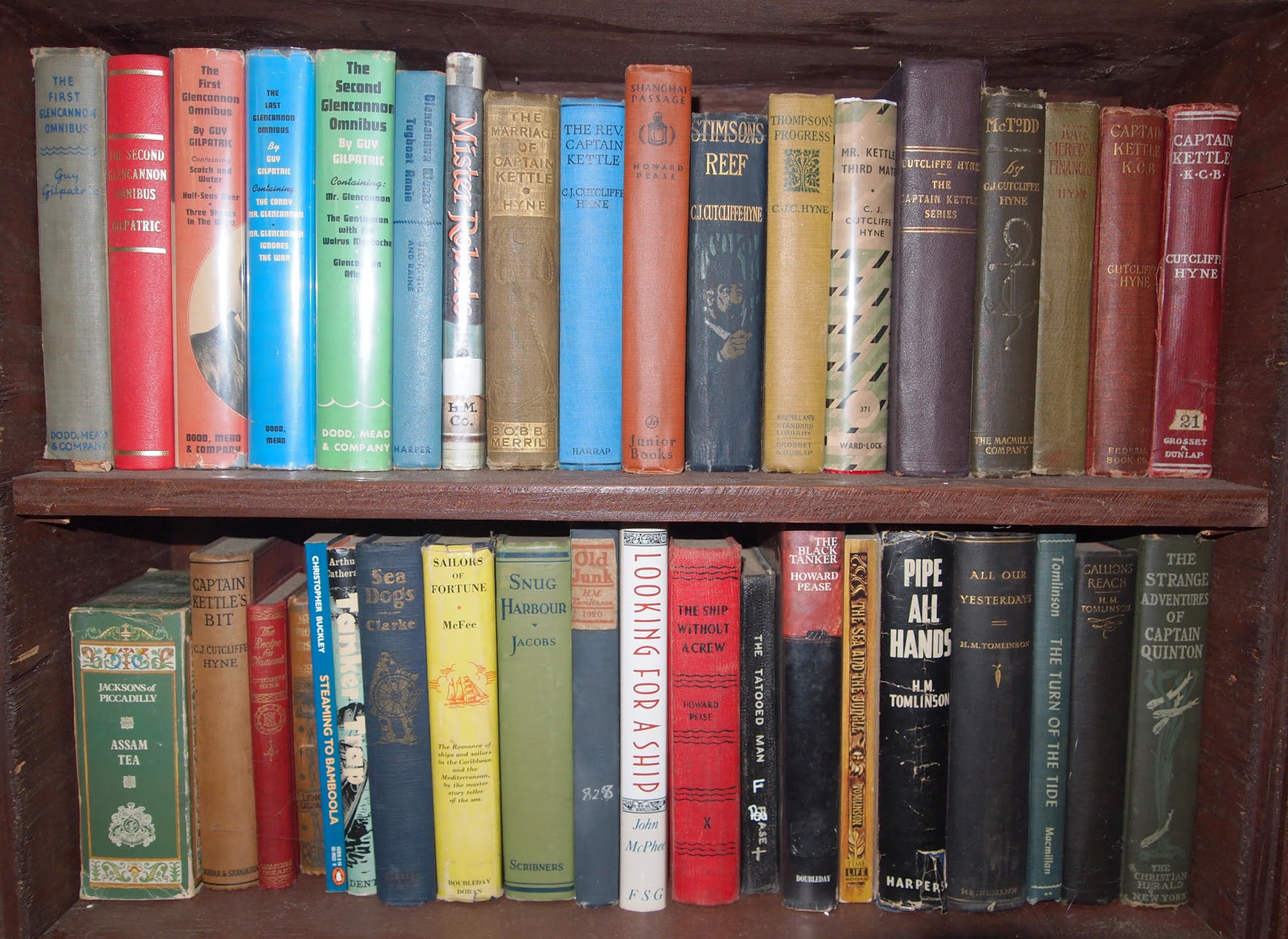
First off are the three Glencannon Omnibus books (I have several duplicates) that contain all the short stories of the chief engineer of the tramp steamer SS Inchcliffe Castle by Guy Gilpatric. Gilpatric wrote these stories from 1929 thru 1941 for the Saturday Evening Post, and then collected them into books, which were later collected into the omnibus versions I have. There was even a TV series made from these books in 1959, which I haven’t been able to track down. The Glencannon stories are humorous short stories which served as a model for the serial that I had originally planned to release my Lost Star stories as. However, since I can not write a short story to save my soul, mine were novellas rather than short stories. And I didn’t even try to write humorous stories. However, a Glencannon like figure does appear in my story as the Lost Star’s former chief engineer, Glen Colin.
Going even further back in my reading history we find the Howard Pease YA books that feature Tod Morgan. I distinctly recall (for some odd reason) seeing these books on the shelf of the Greendale Public Library, back when I was looking for the Heinlein juvenile SF books, and others. I didn’t read them then, but picked them up years later, when I found them at rummage sales. I can’t say much about them – basically they are sea adventure books, featuring Tod Morgan climb up through the merchant officer ranks as the series progressed.
The third major influence on my writing is the works of C J Cutcliffe Hyne, and his flagship character, Captain Kettle. These were very popular back in the first decades of the 20th century, but are definitely not politically correct in this day of age. Captain Kettle is a rough and tumble seaman, who has nothing good to say about any race or nationality other than the English, and he uses all the derogatory words and typically derogatory stereotypes, be one black, Italian, German, Slavic… you name it. If there’s a derogatory term, he uses it. So you’ve been warned. However, if you can see this in the context of the time, and the character, he writes fast moving, entertaining adventure stories and sea stories with a lot authenticity and humor. Over the years I tracked down many, but not all of his Captain Kettle books, as well as his other characters, such as McTodd, his Scottish engineer, and Mr Horrocks, his purser character. Hyne was a Cambridge graduate and a world traveler who brought his travel experience to the stories he wrote. He wrote these stories for the English magazine Pearson’s. He also wrote detective stories under the name Weatherby Chesney, and is known in science fiction circles as the author of The Lost Continent: The Story of Atlantis.
In addition to these fiction books, I collected a number of non-fiction books describing the life of a tramp steamer and shipping in general, like The Deep Sea Tramp by Captain A G Course, ca 1960 and more recently, Steaming to Bamboola, by Christopher Buckley, 1982… Wait, that isn’t all that recent is it? Time flies. I also have a small collection of larger format books on ships and shipping, pictured below.
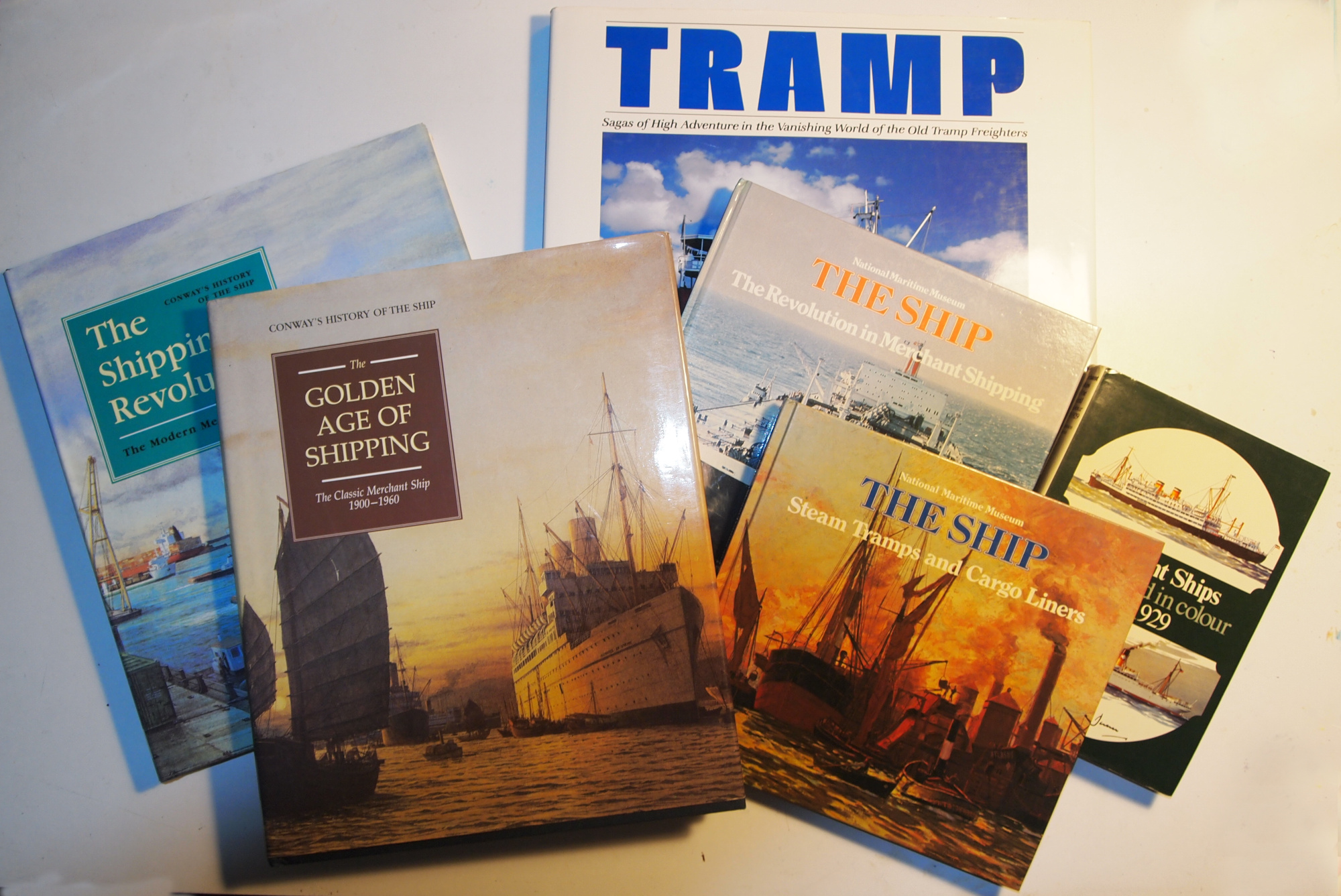
Thankfully, I’ve lived a quiet, uneventful life, living my adventures inside the pages of books. As a result, the adventure stories I write owe a lot to the books I’ve read in my quiet, uneventful life. The Bright Black Sea owes much to these tramp steamer stories and books.
Well, I have several more shelves of nautical books to talk about, but will save those for a later blog.
April 10, 2021
Other Approaches to Writing
 source: https://www.seanpcarlin.com/the-write...
A few posts ago I began to discuss how I and other writers construct stories. However I got sidetracked and never got around to the “other writers'” approach to storytelling. Here’s that second part of the discussion.
Many writers take a systematic approach to writing stories, not only outlining their story before they begin to write it, but think of the story as a word-structure to build. And they use a blueprint to construct their stories. So let’s look at a few of those blueprints.
The first one is the classic “Hero’s Journey” as described by Joseph Campbell.
In the illustration above, we see a graphic representation of the story structure. In its most simplest form, the hero is called to some sort of adventure. This leads the hero into unexplored territory, where they encounter many tribulations, until they reach a point where it’s either do or die, and in doing, become better people, returning home transformed. The basic idea, which will be repeated in the following blueprints is that the hero leaves their old lives, faces a test of fire, and comes out better for it. (Or not, if one wishes to make a tragedy.)
The next most common blueprint is the three act structure, as pictured below.
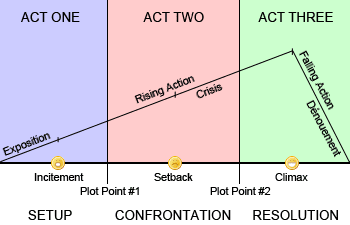 source: https://allthetropes.org/wiki/Three-A...
The three-act structure dates back to the Greeks and is widely used in plays and screenplays as well as books
The Setup is the opening act. The main character and setting are introduced. This act includes the inciting incident that gets the hero to act on something that leads to the second act.
The second act, the Confrontation, involves a series of increasingly complex challenges that lead to the final, high stakes reckoning that drives the story it its third act, the Resolution, along with the events that follow from the climax, the falling action and denouement, as shown in the graphic above.
James Scott Bell describes this structure as beginning with a disturbance that upends the protagonist’s ordinary life. The protagonist then goes through the one-way doorway one, to the middle of the story with no way back. Ahead is doorway two, which leads to the final resolution of the disturbance, again, with no way back.
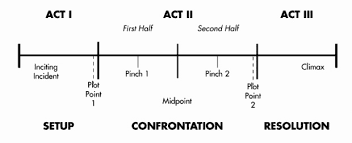 https://www.critiquecircle.com/blog.a...
And then there is the Seven Points structure. It begins with a Hook or Inciting Incident, the story’s starting point. Then Plot Turn 1 or Plot Point 1 , which introduces the conflict that moves the story. This is followed by Pinch Point 1, when the protagonist faces increasing resistance to achieving his or her goals. At the Midpoint, the protagonist responds to this resistance with action. However, then comes Pinch Point 2, where the protagonist faces increased resistance. This leads to Plot Turn 2 or Plot Point 2, which is like the break from act two to act three – the protagonist acts to achieve his or her goals at the climax, which leads to the Resolution– the conflict resolved, the characters changed as a result of their experiences.
There are several more approaches to story telling. The blueprints can get a lot more detailed. One of the most famous one is by Lester Dent, who wrote most of the Doc Savage stories. He had a master plot planned out for a 6,000 word story divided into four 1,500 word sections in which he details what the writer should consider and happen in each section. The complete outline can be found here: https://www.paper-dragon.com/1939/dent.html
A somewhat expanded version of this, originally conceived for screen plays is Blake Snyder’s “Save the Cat!” beat sheet, but is used by novelist as well. It outlines a three act structure down to word count.
In this structure, the first act, represents 25% of the total word count, the second act, 50%, and the third, 25% of the total word count. You then divide these acts into scenes that run between 1,000 and 2,000 words each.
After that, he breaks the story down into 15 story beats, and goes into detail about the relative number of scenes each of these story beats should contain. Act one includes the Opening Image and Theme Stated, Catalyst and Debate and the Break into (Act) Two, where the protagonist decides to accept the call to adventure. Act two starts with the introduction of new characters, the B Story, and then Fun and Games, where the protagonist finds themselves in the new world, either loving it or hating it. At the Midpoint, the protagonist experiences either a false victory or defeat – a game changing plot twist, and the ante is upped significantly. This is followed at the midpoint of the story by the Bad Guys Close In, things get hotter. At about the ¾ mark of the story we get to All is Lost, which in one scene the protagonist is at their lowest point. This is followed by Dark Night of the Soul, where the protagonist reviews what has happened, and learns from it. The Break into (Act) Three is the single scene where the protagonist realizes what he or she must do to save the situation, and change as well. Act three is the Finale, where the protagonist acts on the plan he or she has come up with, Gathers the Team, Executes the Plan, only to face a new twist in the High Tower Surprise that presents an unexpected challenge, and Digs Deep Down to overcome it by Execution of New Plan that either succeeds or fails, depending on what outcome you want. This is followed by a Final Image, the “And they lived…. Or not” scene.
There is absolutely nothing wrong with any of these approaches. I don't use them, in part because I'm not very detail orientated. I simply don't think stories as needing to be "constructed." Apparently, I didn’t inherit my engineer father’s mindset. Instead, I live with the story in my head, and when I know the story, as if I had lived it, I sit down and tell it. That, at least, is the ideal. The reality is I often start a story these days before I’ve completely daydreamed the story up, and then have to pause my writing until I’ve dreamed up the rest of the story.
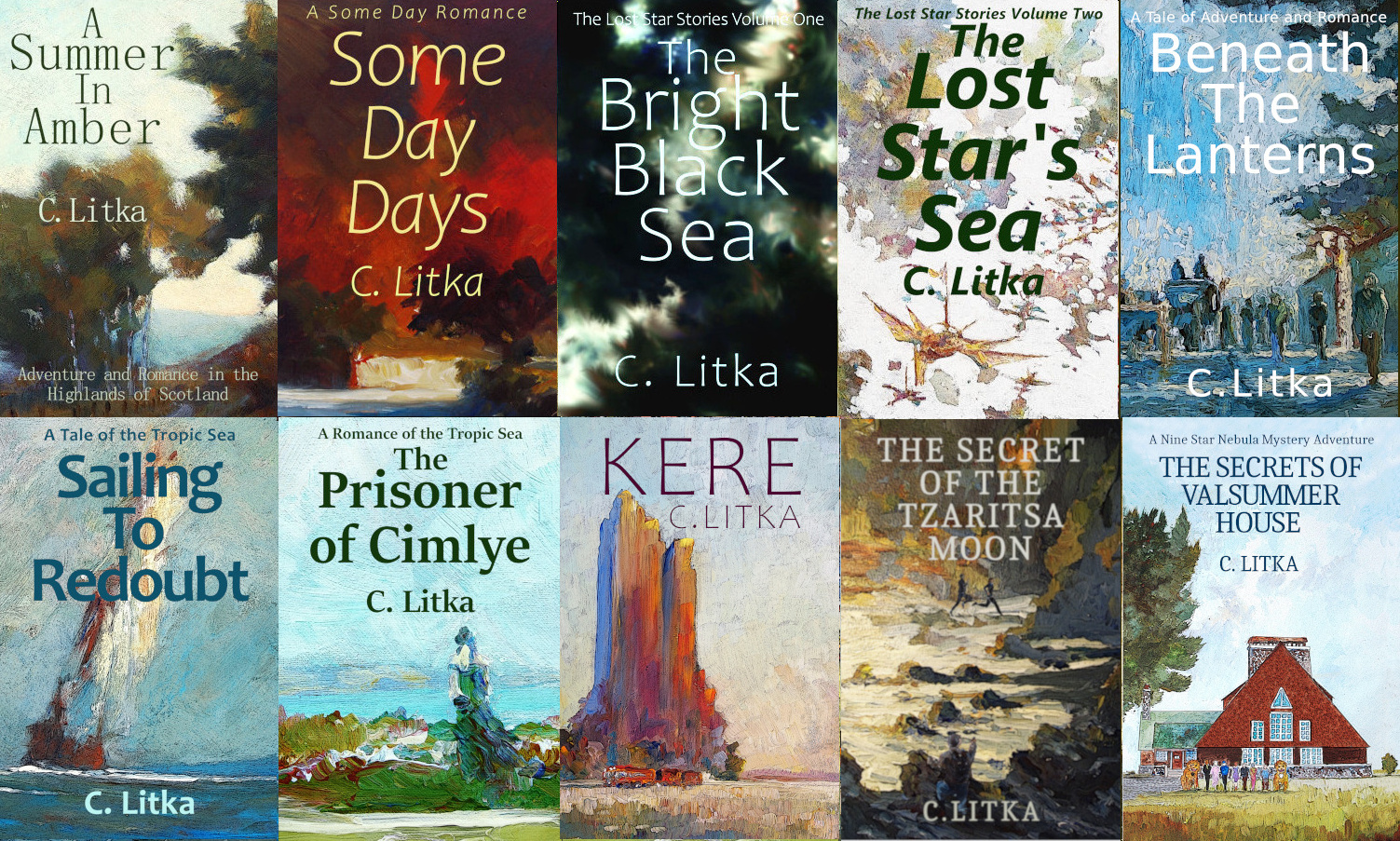
April 5, 2021
Mystery Solved

It is very satisfying to find an answer to what I had supposed was a forever mystery. But, thanks to a nice email from a reader – which I very much appreciated – I can offer an explanation for my hitherto unexplained jump in my March 2021 sales.
It wasn’t the mysterious working of the gods of Amazon that caused the jump after all. It was a blog post by Nathan Lowell, which can be found here:https://nathanlowell.com/forward-march/
Nathan Lowell is a full time, self-published author of over 20 novels, plus short stories and a novella including the popular Golden Age of the Solar Clipper series -- the Trader's Tales, Smuggler's Tales, and Seeker's Tales, as well as several other series and books. If you’ve ever browsed Amazon’s science fiction collection, you'll at least seen his books, and more than likely have bought and enjoyed them as well. His Amazon author page can be found here: https://www.amazon.com/Nathan-Lowell/e/B003D54RY4/ref=dp_byline_cont_pop_ebooks_1
I really appreciate his mention and kind words about The Bright Black Sea. I must say that is is very cool that an established pro enjoyed my book. And I’m glad that one of my readers took the time to tell me about this blog post, so that I could thank him for it -- and clear up a mystery. It made my day.
April 1, 2021
The Gods of Amazon...
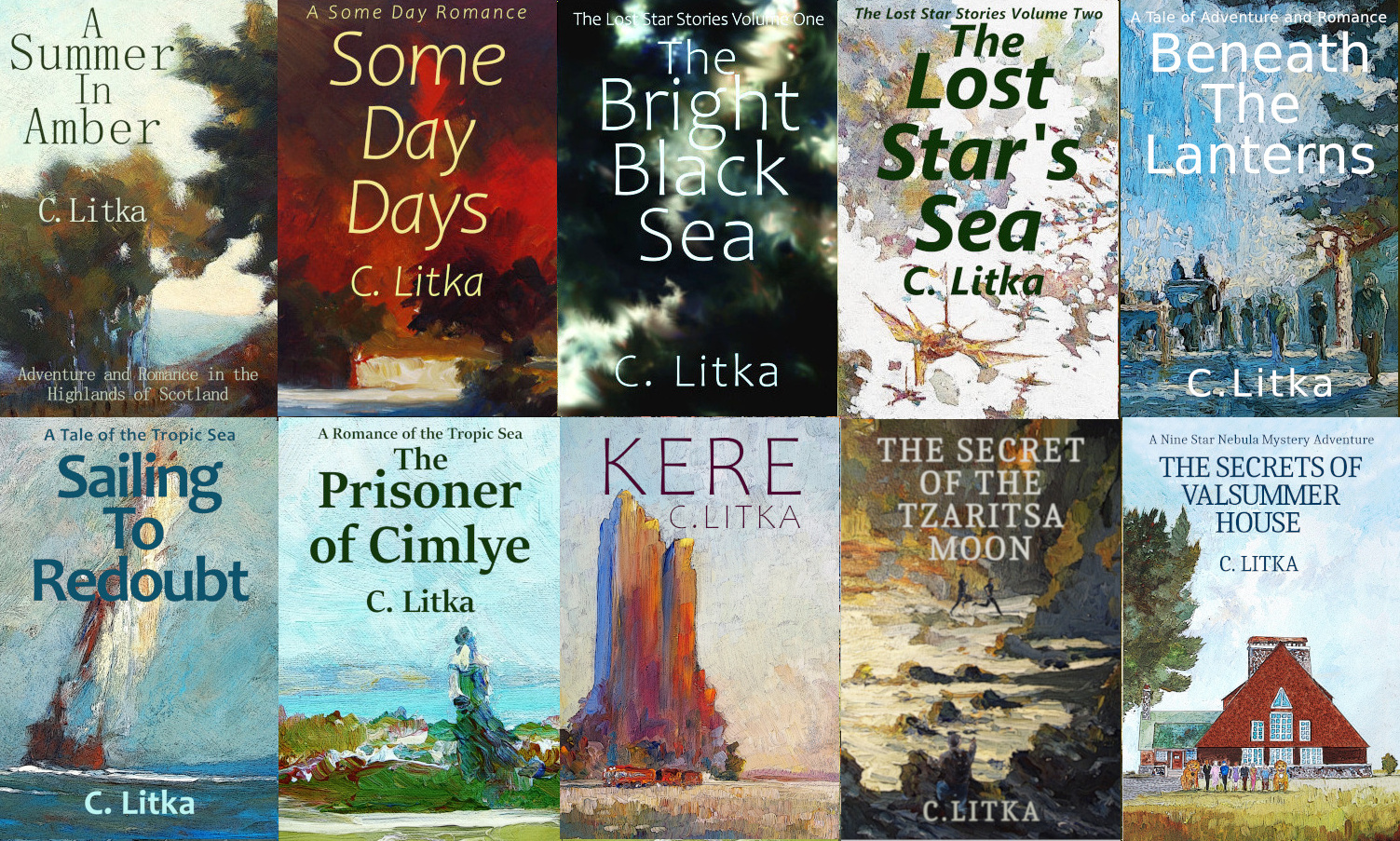
...Are fickle beings. They’re as unpredictable as they are mysterious. While I'll be reporting my sales for my sixth year in self publishing next month, I thought I might share my results for March 2021. It was a weird month.
My base line is that I write the story, paint the cover, format the paperback book. And after my wife and my generous beta readers proofread the story, I publish it via Smashwords, Google Play, and Amazon. It then sinks or swims on its merits and word of mouth.
Each month I move between 300 and 1,000 copies. The highest numbers are for the month of and just after the release of a new book. The numbers then fall into the 500 to 300 copies per month range. Of all those copies, I actually sell at retail price between 5 to 10 copies on Amazon around the world, with maybe 20 during the month of a new release. I made $70 in royalties in 2020.
March 2021, as I mentioned, has proven to be a very strange month. First off, I moved 1,041 books, which puts it as my second highest sales month in my six years of self-publishing. The Secrets of Valsummer House was released on the 18th, which explains some of those sales. I moved 195 copies on the Google Play store, a venue that I’ve only been using for the last two years or so, and has proven to rival Smashwords (including Apple , though B & N and Kobo don’t report free sales to Smashwords, so I don’t know the full total of my sales via Smashwords.) But there’s more to this strange month than a new release and increased sales on Google.
Every once in a while The Bright Black Sea will rise into the Top 100 Free Space Opera Best Seller List. For no discernible reason. I can only guess that somewhere on Amazon they 're promoting it in some way. In any event, it rose to at least #29 on that chart this month, and I moved 223 free copies, plus, and this is strange, 21 paid copies mostly from British and Australian sales.
What is even more weird is that this month I sold at $.99 a total of 112 copies of my various books, including 35 copies of The Lost Star's Sea (when it wasn’t free) and 41 copies of The Secrets of Valsummer House. I think I earned $49.50 in royalties this month. In all of 2020 I made around $70. I can’t explain this jump in sales. I don’t expect it to last. I believe it to be a result of some sort of quantum fluctuation of Amazon’s algorithms. Still, it makes life interesting.
I’ll have my full six-year report in self-publishing next month. It looks to be a typical year again, with sales somewhat north of 6,000 copies, which is pretty much what it is every year. The only difference is that it now takes 10 books to deliver that level of sales, compared to three when I began in 2015. But more of that next month.
..
March 26, 2021
Essays for Writers
Just a note to mention that I have written two essays for the blog site Writers Supporting Writers. The first essay is about mixing and matching the conventions of the various versions of English in one's writing. It can be found here Using the World of Englishes
The second essay asks this question of writers; could you recognize your characters if you ran into them on the street? In short, how clear of a picture do you have of the characters you create, or for that matter, you read, as well as my approach to characters. It can be found here: Would You Recognize your Characters



![[image error]](https://1.bp.blogspot.com/-ypRhW9480Ts/YIXUkmwwIII/AAAAAAAAHgc/1BMW2I9KIU0h1Qq1pvkHvs85upSRmjfGQCLcBGAsYHQ/s1500/Newspaper%2Bcomics%2Bbook.JPG)
![[image error]](https://1.bp.blogspot.com/-38tdRT_hKEY/YIXVQBB9XMI/AAAAAAAAHgk/uVLzx353nMUANHhTAfz3-80whJ76g119wCLcBGAsYHQ/s2000/gasooline%2Balley%2Bcolor.JPG)
![[image error]](https://1.bp.blogspot.com/-KNIDC1iMxW8/YIXV9hca-AI/AAAAAAAAHhA/faEDudoBs2kPVIua9M6s2FBrj6U86aNMgCLcBGAsYHQ/s2000/Prince%2BValiant.JPG)