
Sarah Angleton's Blog, page 4
June 6, 2024
Slathered in BBQ Sauce
In 1698, a Dominican missionary known as Pére Labat did what all good cooks throughout history have done—he wrote down the tips and tricks he learned from better cooks. Labat was in the French West Indies when he observed the use of a mixture of lime juice and chili peppers to season meat slowly cooking outdoors over indirect heat. When he wrote about it he possibly became the first person to record the use of an early kind of barbecue sauce, and I’m guessing, made a lot of people a little bit hungry just reading about it.
 We had barely started at this point.
Barbecue had been around at least a couple centuries before that, originating with the barbacoa of the Taíno People of the Caribbean, and introduced to the Western world by Columbus’s voyages. Because whether you found the part of the world you were looking for or not, when you smell the roasty deliciousness of barbecuing meat, you want to share the experience.
Over the next several hundred years, the love of barbecue spread and was embraced most enthusiastically by the Southern United States where it became particularly a part of Black American culture. That’s when a broader variety of rubs and sauces really began taking it to the next level. Barbecuing became the quintessential American thing to do, making its way into political campaigns and into backyards across the country.
 Ok, technically not barbecue, but I’m not going to turn my nose up at it.
Today, barbecue is pretty much synonymous with summer in the United States, and this year, at the Angleton household summer has arrived. Now, I will admit that like many careless Americans, I’m a little loosely goosey with the term barbecue. I am well aware that the term applies specifically to meat that is cooked with indirect heat and not on a grill, and that some of you are probably pretty persnickety about that definition. It might even make you a little mad that I’m about to use the term barbecue interchangeably with grilling out, which is apparently not the same at all.
But here’s the thing. This year we had a record crop of sweet cherries, largely because the birds we would normally fight for them were stuffed full already of a million cicadas. So we had to get a little creative. We jammed and pied and dried and salsa-ed.
 Mmm. Tastes like summer.
Then we made sweet cherry barbecue sauce. And it is really, really good.
So now that the late spring days are starting to feel an awful lot like summer, we are cooking outside a lot more. At some point I’m sure we will legitimately barbecue in a smoker or in a pit. Most of the time we grill and call it good, because it doesn’t take as long to grill up a St. Louis pork steak as it does to smoke a Boston butt.
And whether I’m using the word right or not, both taste amazing slathered in barbecue sauce.
Happy (almost) summer!


May 23, 2024
Song of the Cicadas
On April 15, 1791, the first of four stones marking the corners of the Federal District in Washington DC was laid by surveyor George Ellicott and his team, which included brilliant mathematician, astronomer, tobacco farmer, and free-born Black man Benjamin Banneker.
 A representation of Benjamin Banneker, who for the next few weeks will be known primarily as the naturalist who documented the seventeen-year brood cycle.
PBS: http://www.pbs.org/
wgbh/aia/part2/2h68b.html, Public domain, via Wikimedia Commons
Banneker is known in the history books not only for his role in the laying out of Washington DC, but also as the man who compiled one of the earliest American almanacs. He provided a copy to then Secretary of State Thomas Jefferson as a counter to Jefferson’s assessment that Black men did not possess the mental capacity of white men. Throughout Banneker’s life he did what he could to fight this unjust assumption and advocate for freedom.
There’s a lot of big and important stuff Banneker should be remembered and celebrated for, but today I find myself only wanting to really talk about one of them—a topic that is at the forefront of the thoughts and conversations of millions of people in my corner of the world. Because according to Morgan State University researchers Asamoah Nkwanta and Janet Barber, Banneker is also one of the first people to have calculated and recorded the seventeen-year life cycle of the periodic cicada.
I admit that among insects that I give regular thought to, cicadas usually rank pretty low, somewhere way behind mosquitoes, ticks, and the carpenter bees that try to eat my deck every year. Recently, though, cicadas have claimed the top spot. I’m not alone, either, because the most frequent Google search topic over the last week in Missouri has been cicadas.
That’s because we make up part of the map covering two large broods of periodic cicadas. To give some context to that, there are some different varieties of this particular insect. One lives out its mating ritual for a few weeks every summer, molting and abandoning its creepy exoskeletons on tree trunks so that big brothers can stick them to the tee shirt backs of unsuspecting little sisters throughout the Midwest.
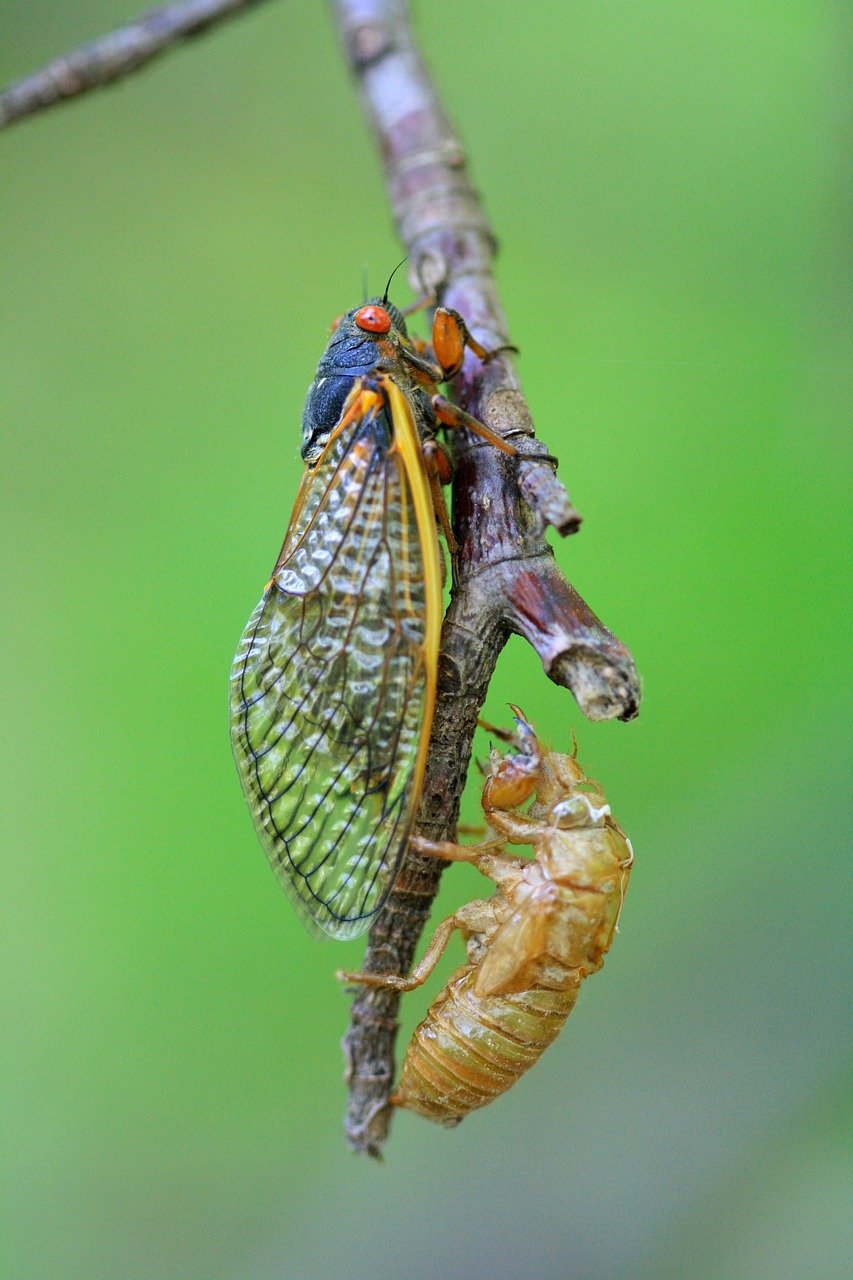 Top Google searches make great blog topics. Image by Ashlee Marie from Pixabay
Then there are the periodic variety that emerge from the ground to spend a few weeks molting and singing and mating every thirteen or seventeen years. This year, there are two large broods of periodic cicadas singing their way through Missouri’s trees. These particular broods have not been seen at the same time since 1803 and it will be another 221 years before it happens again. There are allegedly billions of them in the state right now. I believe it.
Their high pitched buzz, which peaks between 10 AM and 6 PM every day, was kind of pleasant at first, but has grown into an ever-present eerie drone still audible over the car radio and in every corner of my house. They drop onto sidewalks, hurl themselves into innocent passers by, cling to every rough surface they can find, and people on my social media feeds keep sharing cicada recipes as if I am going to start eating them. I assure you I am not.
Benjamin Banneker didn’t quite know what to make of the periodic cicadas the first time he encountered them either, and didn’t have the luxury of Googling for information. When he was seventeen, a large brood emerged in his corner of the world in rural Maryland. He initially thought they were locusts that would destroy the family’s tobacco harvest. He waged a fruitless war against them before coming to the conclusion that not only was he fighting a losing battle, but that the insects really weren’t doing much harm. And then, because he was a much better observer and record keeper than I am, he eventually mapped out their extremely extended life-cycle.
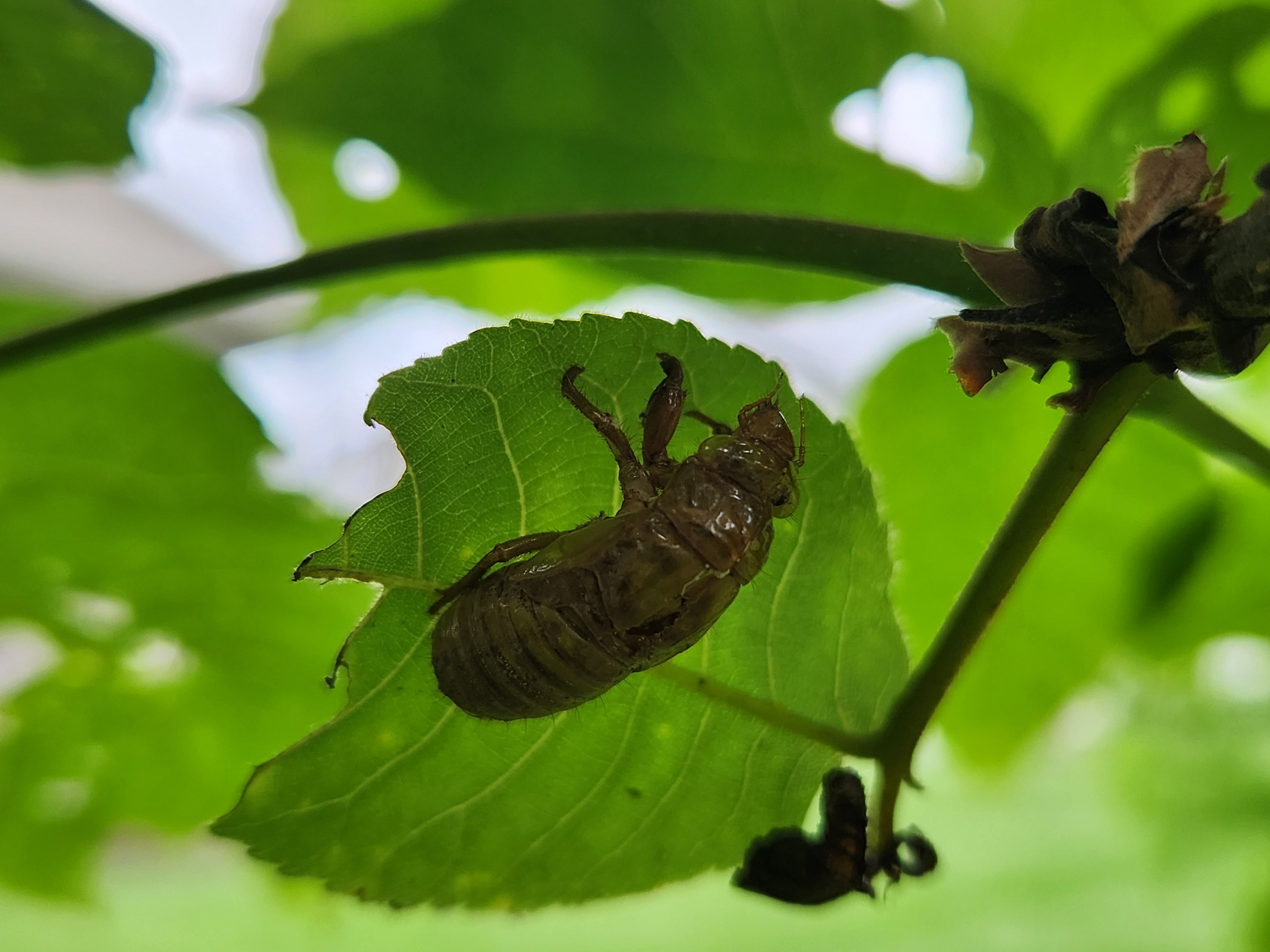 This is pretty much what the underside of every leaf in my yard looks like right now.
Our cicadas aren’t much of a problem this year, either. They may cause a little damage to trees while feeding on sap and laying their eggs in slits they make in the trunks, but unless the trees are young, it’s not a big deal. And the cicadas have been great for our cherry harvest because the birds have been so busy eating the big loud bugs they have more or less ignored our fruit.
Despite my best efforts, my dog eats the cicadas too, even without including them in a stir fry or dipping them in chocolate as so many of my disgusting friends have suggested. It’s given him a little bit of a belly ache, which kind of serves him right, I think.
I am looking forward to a few weeks from now when the billions of periodic cicadas will be gone, their eggs safely deposited for the next thirteen or seventeen years, and we can all go back to thinking about and discussing all of the many other much more important things going on in the world.
In the meantime, I’m trying to appreciate them the way Banneker came to. In his journal, he wrote “that if their lives are short they are merry, they begin to sing or make a noise from the first they come out of the Earth till they die.” Okay, I guess their singing isn’t THAT irritating. But I’m still not eating them.
May 16, 2024
Lobsters, Lemons, and Plain Ol’ Meatloaf
The countdown to summer is in full swing here in the Angleton household with one son already finished with classes and moved back home, mini-fridge and all, and the other heading into final exams and ticking off the the hours until the end of the semester.
 I mean if I cooked that, I’d probably take a picture. Image by Mogens Petersen from Pixabay
The brothers have already been busy making plans to earn money, spend time with mutual friends, get fit, and learn to cook more. I’m not sure what exactly inspired this last goal, but they each mentioned it to me separately and I couldn’t be more delighted, not only because I am happy to turn over the task to them, but also because I would like them to be able to feed themselves when they get out into the real world.
Both of my boys do have some cooking skills. They just might lack a little confidence in the kitchen. My youngest took a culinary class at school and has a good base of knowledge. His older brother spent the school year living in a frat house as the low freshman on the totem pole who got stuck with cooking for the house when an ice storm cancelled classes and prevented their cook from reaching them. And then there are a few favorite recipes they each have learned over the years.
 Okay, yeah, it’s not beautiful, but it makes for a pretty good family dinner. Image by Wolfgang Eckert from Pixabay
So they aren’t starting entirely from scratch, but they also don’t necessarily want to learn to prepare the typical meals that have graced our dinner table since they were small. My sons are, after all, part of the Instagram Era, and if it’s not worthy of a picture, it probably isn’t worth making in the first place. #foodstagram
Sharing a picture of one’s food isn’t unique to the age of social media of course. For centuries food has been depicted in works of art, and about eight years ago, it even inspired a study from Cornell University that looked at whether food depictions in art can tell us anything about what people ate during the corresponding eras.
The short answer to this question is no. We know this for four reasons:
Historians do have a pretty good idea, from many other sources, of the kinds of foods people frequently ate in the time periods and regions studied, and it doesn’t really match up.By far the most common meat gracing tables in paintings is fish and shellfish, and the percentage increases in nations with relatively little coastline. #crablife #GettinMyLobsterOnArtist’s runaway favorite fruit over the five hundred year period looked at is lemons, which for much of the times studied, was a pretty uppity, expensive fruit that wouldn’t have been widely available to just anyone. #making lemonadeNo one painted pictures of plain ol’ meatloaf. #JustLikeMamaUsedToMakeIt turns out that the artists of the previous five centuries weren’t all that different than the social media #foodies of today. Paintings depicting family meals from the Era of European Exploration through the Industrial and Post-Industrial years don’t typically showcase the everyday fare of most families.
 I do draw the line at some ingredients. Now that we are inundated with cicadas, the boys have mentioned trying out some of the recipes floating around the internet. #NOPE Image by Noël BEGUERIE from Pixabay
Instead, paintings feature celebration meals, status dishes, symbolic foods, and fancy choices that might best highlight the skill of the artist, like textured lemon skins and bug-eyed lobsters. They were the kinds of food that could be labeled with #foodie #yummy #foodporn #eatwell #dinnerinspiration or #foodgasm, and that might inspire numerous likes and shares.
Such paintings are definitely not representations of the meatloaf recipe your mama’s been making since since you were old enough to stuff crumbled bits of it into your mouth with a slobbery toddler fist.
Whether they will be taking photos or not, my sons are not looking to make mama’s meatloaf. They’d prefer less familiar ingredients and Instagram-worthy results. This doesn’t really bother me. I’m just glad they’re excited about cooking and I get to spend a summer learning new recipes along with them. But sometimes we’ll probably still eat plain ol’ meatloaf.
May 9, 2024
Eggs, Months, Disciples, and Blog Years
Earlier this week I received a congratulatory notice from WordPress that I had been at this blogging thing for twelve years, which feels like a pretty significant milestone. As I reflected back on the winding road of ridiculousness that this space has taken over the years, I recalled that not many months into the adventure I wrote about another significant anniversary in my life when my husband and I celebrated twelve years of marriage.
 Good things come in twelves. Image by Jean Christophe Baux from Pixabay
In that post, I lamented that between kids’ schedules, work schedules, and the generally tiring pace of life, we put off actually celebrating. We were in a busy time of life then, and twelve years, I suggested, didn’t really feel like a special number. Then I argued that it really should.
So, twelve years after I posted for the first time in this space, a few months before my husband and I will celebrate twenty-four years of marriage, I’m revisiting the case for year number twelve, bloggiversary style.
Because great things come in twelves, things like eggs, months, and disciples, hours on the analog clock, signs of the zodiac, tribes of Israel, drummers drumming, and years of the Practical Historian blog: your guide to practically true history. We regularly bake cookies, cupcakes, and muffins in multiples of twelve, and twelve even has its own special nickname, placing it on par with other rock star numbers like 3.14… and 6.02 x 10²³.
 Image by profivideos from Pixabay
The word dozen comes from the French douzaine, which is a derivation of douze, the Latin word for twelve with a collective suffix tacked onto the end. Of course it’s perfectly possible to tack the same suffix onto the end of other numbers and get, for example, quinzaine (a group of fifteen) or centaine (a group of one hundred), but at least in English, we typically don’t.
Because twelve is particularly special.
Speaking mathematically (and if one feels so compelled) there’s a pretty good argument for counting in a base twelve system, rather than the base ten system in which we normally operate. We do it already when we tell time, measure in inches, or order a gross of cocktail umbrellas. In the field of finance where calendar months are often an important part of the calculation a duodecimal or dozenal system (that’s what math nerds who actually do feel compelled to argue about this kind of thing call base twelve) could make sense.

And if we think in terms of factors, which are the kind of things math nerds really geek out about, Twelve is a lot more versatile than ten. Ten factors to 2 x 5, whereas twelve factors to 6 x 2, 4 x 3, and 2 x 2 x 3.
So, thank you WordPress for the heads up, because twelve really is a thing worth celebrating:
6 posts about aliens x 2 Gravitar photo updates = 4 novel launches x 3 posts about vampires = 3 anti-censorship soapboxes x 2 summer blog breaks when my kids were young x 2 more posts about my dog than any history blog has a right to post = 12 years of spilling history and nonsense into this little corner of the blogosphere.
Here’s to another twelve years. And maybe another twelve years after that. I might even suggest that I’ll still be at this twelve times twelve years from now. But that would just be gross.
Thanks for coming along for the ride!
May 2, 2024
Literary Daydream and Introvert Nightmare
In 1936, Eleanor Roosevelt wrote in her nationally syndicated news column, My Day: “I wonder if anyone else glories in cold and snow without, an open fire within, and the luxury of a tray of food all by oneself in one’s own room? I realize it sounds extremely selfish and a little odd to look upon this as a festive occasion. Nevertheless, last night was a festive occasion for I spent it in this way!”
 Eleanor Roosevelt, Public Domain via Wikimedia Commons
This from a woman who gave more than three hundred press conferences in her role as First Lady, served as a delegate in the United Nations, and averaged more than a hundred speaking engagements a year throughout her life in public service. In her own words, she was an “ugly duckling” who was a “shy, solemn child,” who eventually grew into the woman who insisted you should “do one thing every day that scares you.”
But even though Mrs. Roosevelt clearly conquered her shyness, she still enjoyed a quiet evening by herself from time to time, indicating that this first lady was probably a pretty good example of an introvert.
That’s not the same thing as shy, of course, though the two may go hand in hand. Introversion is a personality trait that demands moments of quiet introspection. The introvert may actually enjoy a good party or press conference as much as her buddy the extrovert. The difference is that after the speech has been given, the crowd has dispersed, and the extrovert is all keyed up and on the lookout for the next party, the introvert is feeling the need for a festive night in with a tray.
 I’ll take it!
I totally feel Eleanor on this one. I am not a particularly shy person. Maybe I was when I was younger, though I’m happy to say I never really considered myself an ugly duckling. I generally enjoy getting to know others and I’m sure I could manage a good press conference if I ever had to. But after that’s all done, I tend to be pretty exhausted. And boy am I tired right now.
If you’ve been reading this blog for the last few weeks, then you already know I’m in the throws of a book launch. It’s going well. Compared to previous book launches I’ve done, it’s actually going really well. By that I mean there seem to be actual real people that I don’t personally know, buying and reading my book.
I’m sure it helps that this is the fifth book I’ve sent out into the world. and maybe just maybe I’m getting better at it. For this one especially, I spent a minute or two over the past several months lining up promotional opportunities, most of which have been more or less panning out now that the time is finally here. Because the book has a timely and local connection, I’ve lucked into a few opportunities as well. And then there’s my wonderful launch team that has been enthusiastically and generously hyping the novel all over social media.
I am truly grateful that because of these efforts, this book is off to a good start, winding its way into the hands of a wider audience than I’ve ever reached before. In many ways, I am living in a lovely literary daydream. I’m also fairly overwhelmed at all the attention coming at me and my book, which is kind of my introvert nightmare.
 I just need like one minute and then we can talk about the book again. Image by Hans Kretzmann from Pixabay
There’s a part of me (a big part, if I’m being honest) that might rather everyone just go back to their previously scheduled lives and ignore me and my book as we curl up to enjoy a festive night in.
Of course I don’t really want that. I do want people to read the book. It’s just that because I have strong introvert tendencies, I’m tired and also totally excited to know readers are discovering the book and engaging with it and with me, and I’m tired and I’m enthusiastic and I’m tired and I’m grateful, and I’m tired.
Yeah, it’s been a long couple of weeks. If you’d like to see me doing one thing that scares me, you can hop over to the Paradise on the Pike book page and check out my first ever live radio interview on local station NewsTalkSTL, which didn’t end up being as scary as I thought it might be. You go on ahead without me. I’m just going to take a minute to sit with a tray in my room.
April 25, 2024
Making a Big Splash
In 1882, owner of the Rock Island and Milan Steam and Horse Railway Company, Bailey Davenport took on a new business venture to drive more business. What he created was Watchtower Park, a leisure destination at the end of the line on the bluffs overlooking the Rock River at Rock Island, Illinois.
This recreational park, admission to which was included with the price of a trolley ticket, opened with groomed hiking trails, a grand pavilion with picnic tables, and what Davenport advertised as a healing spring. Eventually, it would expand to include live theater, vaudeville, tennis courts, and billiards tables.
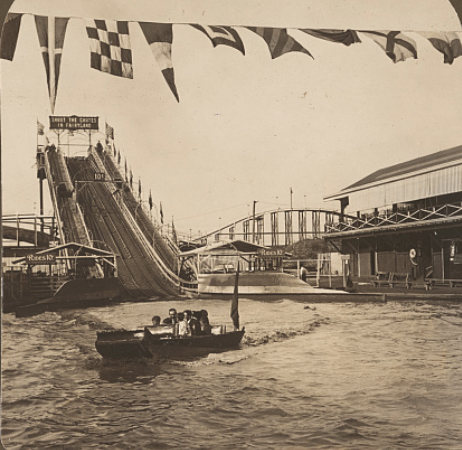 Shoot the Chute on the Pike at the 1904 World’s Fair.
But the biggest attraction, built in 1884 by J. P. Newburg, was a five hundred foot greased wooden track built into a hill down which a wide flat-bottomed boat zoom toward the river where it created a satisfying splash and glided across the surface of the water. An attendant then used a pulley system to drag the boat back up the hill for another go.
Watchtowers “Shoot the Chute” ride was the first of its kind, but the design quickly took off, becoming a frequent feature of amusement parks throughout the United States and the world. It’s probably no surprise then that a Shoot the Chute ride popped up in 1904 in the entertainment section, known as the Pike, on the grounds of the World’s Fair in St. Louis.
What might be more surprising is that there were actually two such rides on the Pike—one for the fairgoers, and one for the elephants at Hagenbeck’s Zoological Paradise and Trained Animal Circus. And just as a visitor standing nearby the Shoot the Chute could expect to enjoy a cool splash on a hot, sticky St. Louis summer day, a visitor to Hagenbeck’s could get showered by the kerplunk of an 8,000 pound pachyderm.
The elephant slide sure did make a splash, and appears frequently as a highlight in fairgoer written accounts. One biographer of Hagenbeck elephant trainer Reuben Castang even recounts a shared story in which Castang took an accidental plunge with the giant animals, and lived to play it off as if it had been a planned stunt.
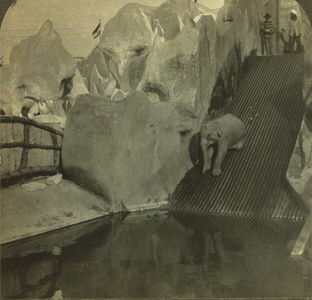 Now that’s how you make a splash.
A fictionalized version of this scene appears in my new historical mystery, Paradise on the Pike, which came sliding onto the market this past week. With any luck, and with a lot of help from wonderful people spreading the word and building the buzz, it’s making a big enough splash that readers will notice and take a chance on it.
Hagenbeck’s Zoological Paradise and Trained Animal Circus is central to the novel, which is populated by elephants and many other animals that were fun characters to write. And of course sometimes when researching, you come across something that you just can’t leave out. Because everyone loves a good Shoot the Chute ride and some stories just make a big splash.
If you’d like to read more about the real Hagenbeck elephant antics that appear in the book, check out my guest post featured by writer and very gracious host Roberta Eaton Cheadle on her blog Roberta Writes.
April 18, 2024
Meet Me at the Fair
On November 22, 1944 after schedule delays, numerous script rewrites, budget woes, and a leading lady still unhappy with her role, a new Christmas musical debuted on the big screen in St. Louis, the city at the film’s heart.
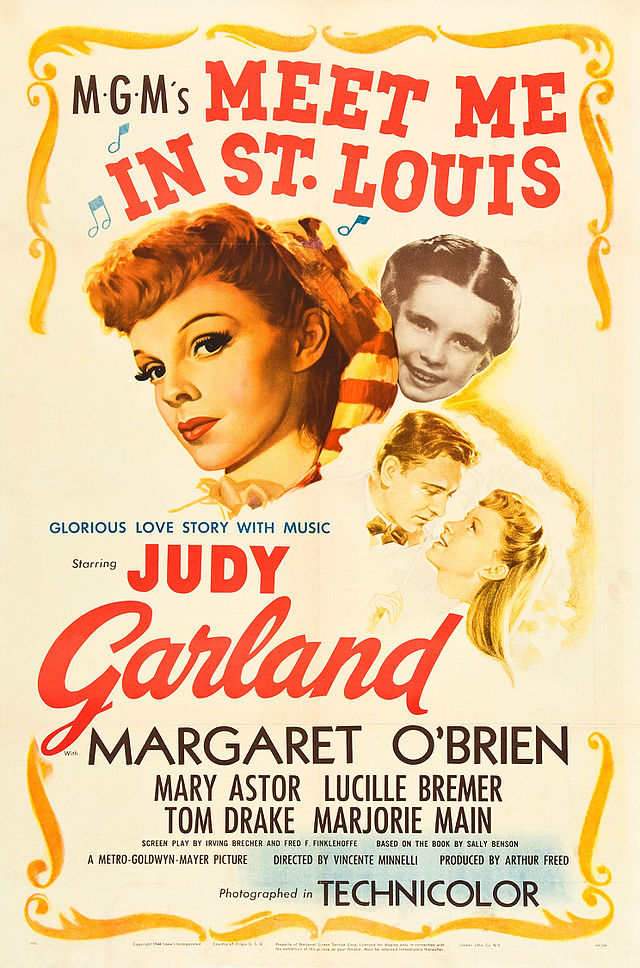 The song “Meet Me in St. Louis,” well known today because of the musical, is actually from 1904 and was written specifically for the World’s Fair. Public Domain, via Wikimedia Commons
Despite the mess of getting to that moment, Meet Me in St. Louis enjoyed immediate success, becoming Metro-Goldwyn-Mayer’s second highest grossing film up to that point, coming in only behind Gone With the Wind. After the premiere, Judy Garland even decided she liked it after all and commented to the producer, “Remind me not to tell you what kinds of pictures to make.”
The screenplay is based on a series of semi-autobiographical short stories by St. Louis native Sally Benson who wrote of an upper middle-class family that lived at 5135 Kensington Avenue during the construction of the 1904 World’s Fair on the grounds of Forest Park in St. Louis.
I confess, I saw the movie for the first time later in life than I should have, having grown up within easy reach of St. Louis. My childhood summers included trips to downtown to watch the Cardinals play at Busch Stadium where the musical’s title song is still played by the organist at every game and the crowd sings along as the words scroll across the jumbotron.
I’ve been many times to the wonderful outdoor Muny theater in Forest Park where the stage adaptation of Meet Me in St. Louis, originally produced in 1989, is performed every few years. I even got engaged in that park on the very grounds of the actual 1904 World’s Fair.
 I was lucky enough to get a sneak peek at the new exhibit, open to the public on April 27th. It contains a scale model of the entire fairgrounds. And it’s spectacular.
Officially known as the Louisiana Purchase Exposition, the Fair is a big deal in St. Louis history. It transformed the city, launching it for about seven months into the center of the world’s attention.
And it’s still a big deal, today. One-hundred and twenty years later the World’s Fair looms large in the community memory carried now by not a single living person who was there to see it, sparking excitement whenever it comes up in conversation, which is kind of weirdly a lot.
It’s especially on everyone’s minds right now because at the end of this month, just in time to celebrate the 120th anniversary of the opening of the Fair, the Missouri History Museum will reveal a newly re-imagined permanent World’s Fair exhibit.
Equally exciting for everyone who either lives in my house or happens to be my mother, is the release of my new historical mystery set on the grounds of the 1904 World’s Fair in St. Louis.
Paradise on the Pike is available for the first time today. The story takes place in the enchanting world of Hagenbeck’s Zoological Paradise and Trained Animal Circus on the Pike, which is the entertainment strip within the Fair. It’s not a light, sentimental sort of story like Sally Benson’s, but it does contain elephants and lions and a pair of cantankerous goats. It also allowed me, and will hopefully allow you, to spend some time strolling through the Fair, which was almost entirely constructed of temporary buildings meant to disappear.
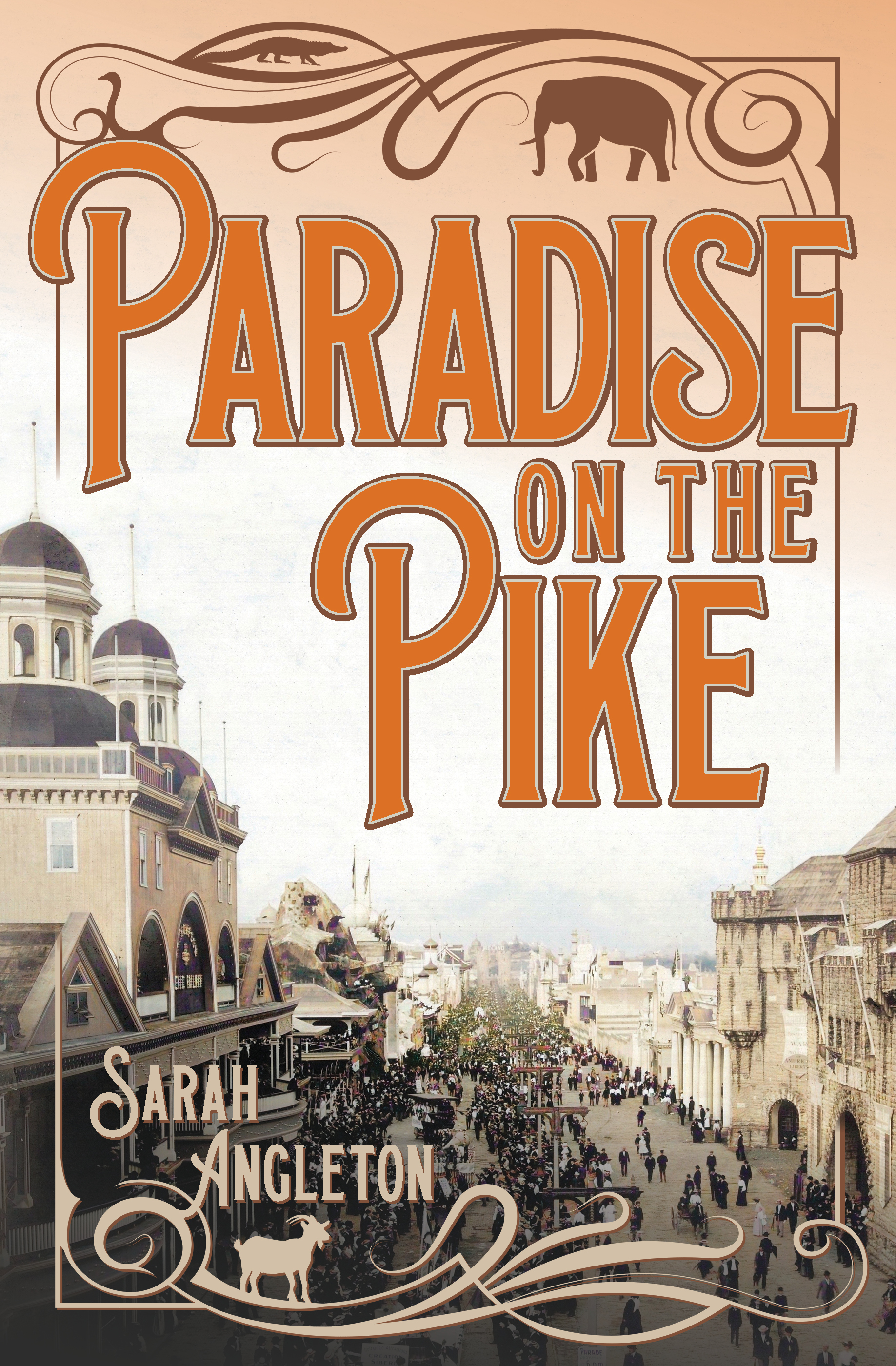 Available today! Order from your favorite independent bookstore or slightly bigger bookstore or Amazon.
And maybe that’s why, one hundred and twenty years later, it still takes up space in our imaginations, because we’re a little like six-year-old Tootie at the end of Benson’s stories when the family marvels over the lights and fountains on the fairgrounds and her sister Agnes asks if it’ll ever be torn down.
Tootie emphatically replies, “They’ll never tear it down. It will be like this forever.”
Agnes, relieved, exclaims, “I can’t believe it. Right here where we live. Right here in St. Louis.”
Forest Park retains very few physical reminders of the enormous event that once filled its every corner and held the attention of the world, but in the hearts of the St. Louisans who stroll through the grounds and wish they could have seen those lights shining, it will never be torn down. It’ll be like this forever.
You can find more information about Paradise on the Pike at this link.
April 11, 2024
Avoiding Traffic
August 15, 1969 was a mild, warm day near the small town of Bethel, New York. It was the perfect day for a leisurely drive down State Highway 17B. By leisurely of course, I mean about an eight hour drive to move about ten miles with nearly half a million of your closest friends.
Just like in the classic children’s book Go Dog, Go! by P.D. Eastman, the place everyone was going on that pretty day in the middle of nowhere, was a great big party—in this case, the Woodstock Music and Art Fair that was to take place for “three days of peace and music” on a 600-acre dairy farm.
 I have lots of friends who made the drive and took the pictures. This isn’t one of theirs, but they all look pretty much like this. Image by Dane from Pixabay
The weather didn’t stay nice, of course. The sky grew overcast and there was a fair amount of rain to try to soak into an already somewhat saturated ground. By the end of the event, which rain delays pushed into a fourth day, there was an awful lot of mud. And the road snarl to get there was bad enough the performers had to be brought in by helicopter. Nearly fifty-five years later it still makes the top ten list of all-time worst traffic jams in history.
But people who attended seem to think it was a pretty good time. The whole thing sounds like an absolute nightmare to me, but then my perfect day would more likely be spent on a dairy farm in the middle of nowhere with no one but the cows and a book. Well, maybe a few people could come with me. And I’d want at least three books. Also, no traffic.
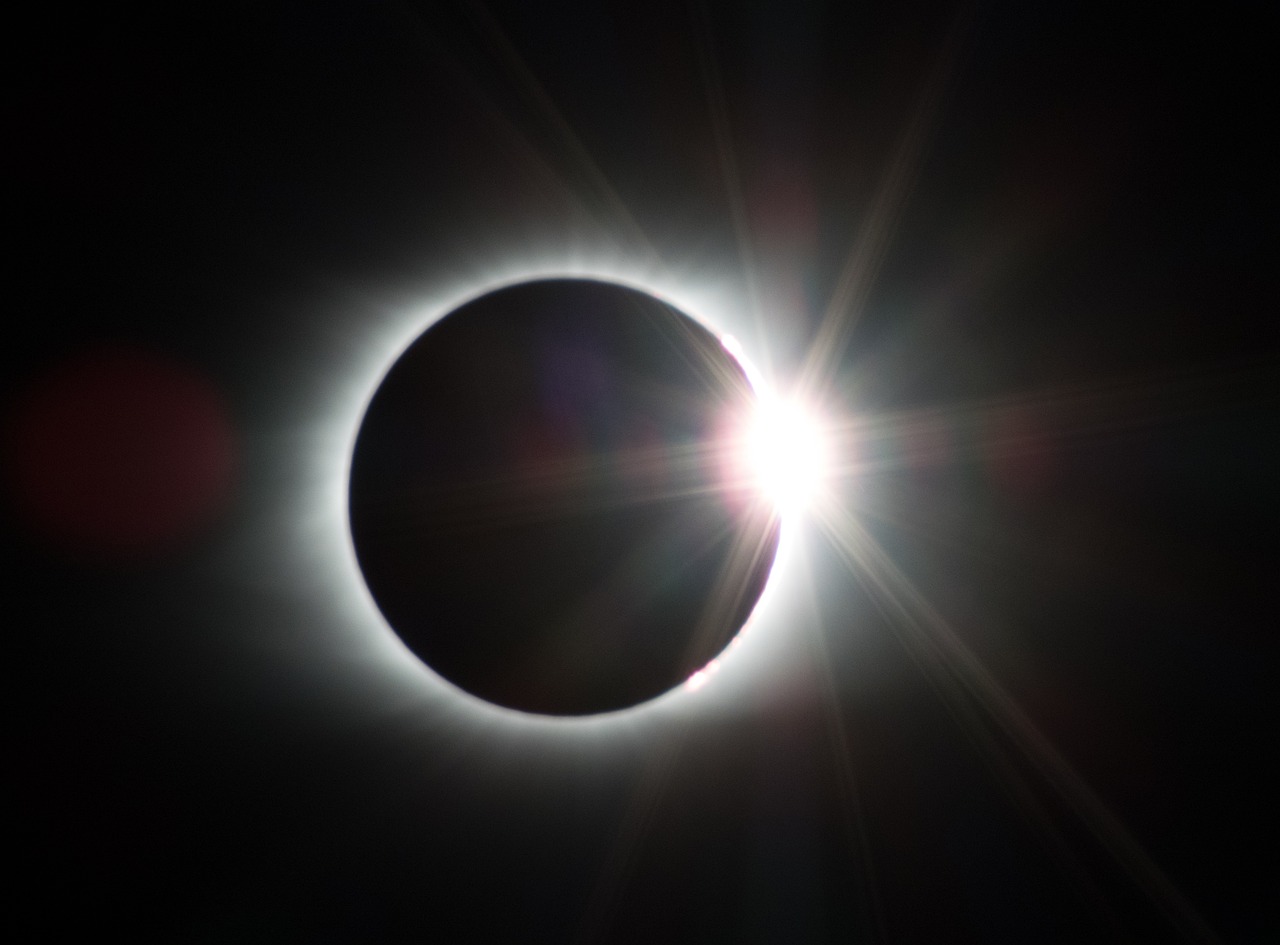
There are probably a lot of things I’d choose not to do just so I could avoid traffic. Earlier this week I made just such a decision when a swath of my state experienced a total solar eclipse. From the vantage point of my driveway, the moon’s coverage of the sun was somewhere close to 98%.
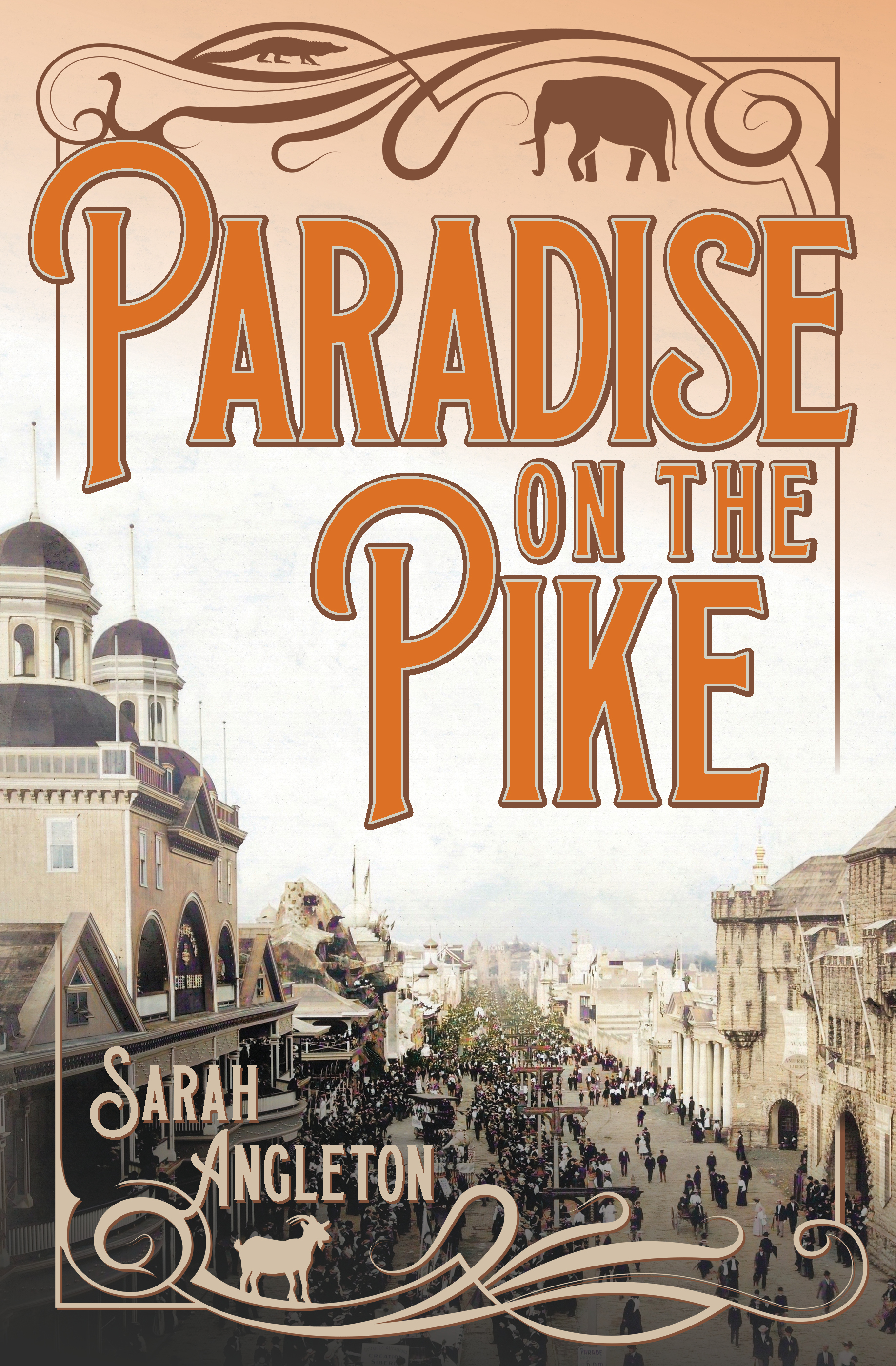 If you do like to avoid a rush, you can still get a free advance digital copy of my new historical mystery by joining the launch team by April 15th: https://forms.gle/psi7ctZ6fNK88dbB9
 A lot of people got pretty excited about the idea of traveling a smidge into the area of totality. I do mean a lot. The news reported that drive times doubled and even more than tripled in parts of the state. In many places, traffic completely shut down during the eclipse itself with motorists donning cardboard eclipse glasses and staring up at the sky.
Of those I know who traveled for the event, most say it was well worth it. I’m sure it was. If I hadn’t experienced a total eclipse seven years ago, I might have been excited enough to travel, too, but the traffic in my driveway was no thicker than usual.
At nearly 98% coverage of the sun, the sky grew noticeably darker, the air got cooler, the insect noise shifted a bit, and my dog grew a touch antsy. I had a pair of cardboard eclipse glasses and I did stare up at a sliver of the sun. Then I had a lengthy conversation with my four-year-old neighbor who was wearing a Spider-Man sweatshirt just in case the eclipse gifted him with superpowers.
It didn’t, which was disappointing for both of us. But the day was mild and warm, perfect for standing on the driveway, looking up at the sky, and avoiding traffic.
April 4, 2024
Shooting for the Moon with A Lot of Help
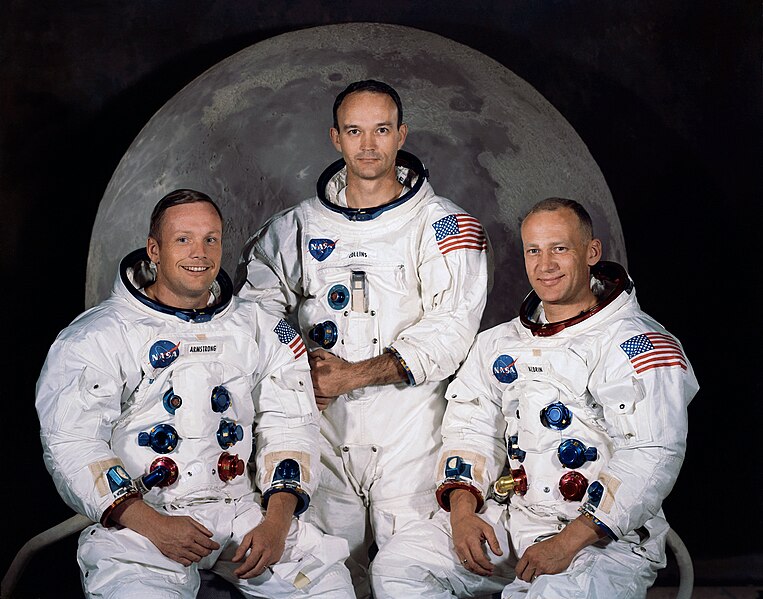 Even astronauts need a little help from 400,000 friends. NASA, Public domain, via Wikimedia Commons
On July 16 of 1969, at 9:32 AM approximately one million people gathered on Florida beaches to witness the launch of Apollo 11. Many of them had camped out for multiple days to claim a spot. I imagine their enthusiasm was palpable.
Millions more people watched on television. Excitement mounted in the first few days of the mission and by the time Neil Armstrong took that first small step, 650 million people tuned in to see it happen, making the event the most widely watched television broadcast in history.
And it couldn’t have happened if NASA’s first female launch controller JoAnn Morgan hadn’t been in the control room, or electrical engineer Tom Sanzone hadn’t designed and monitored the backpack life support systems worn by the moon-walkers, or if astronaut Frank Borman hadn’t used a personal connection to assure that the Luna 15 Soviet spacecraft wouldn’t interfere with the Apollo mission, or if diver Clancy Hatleb hadn’t been on scene to welcome the returning astronauts to earth by whisking them into quarantine in case of space germs.
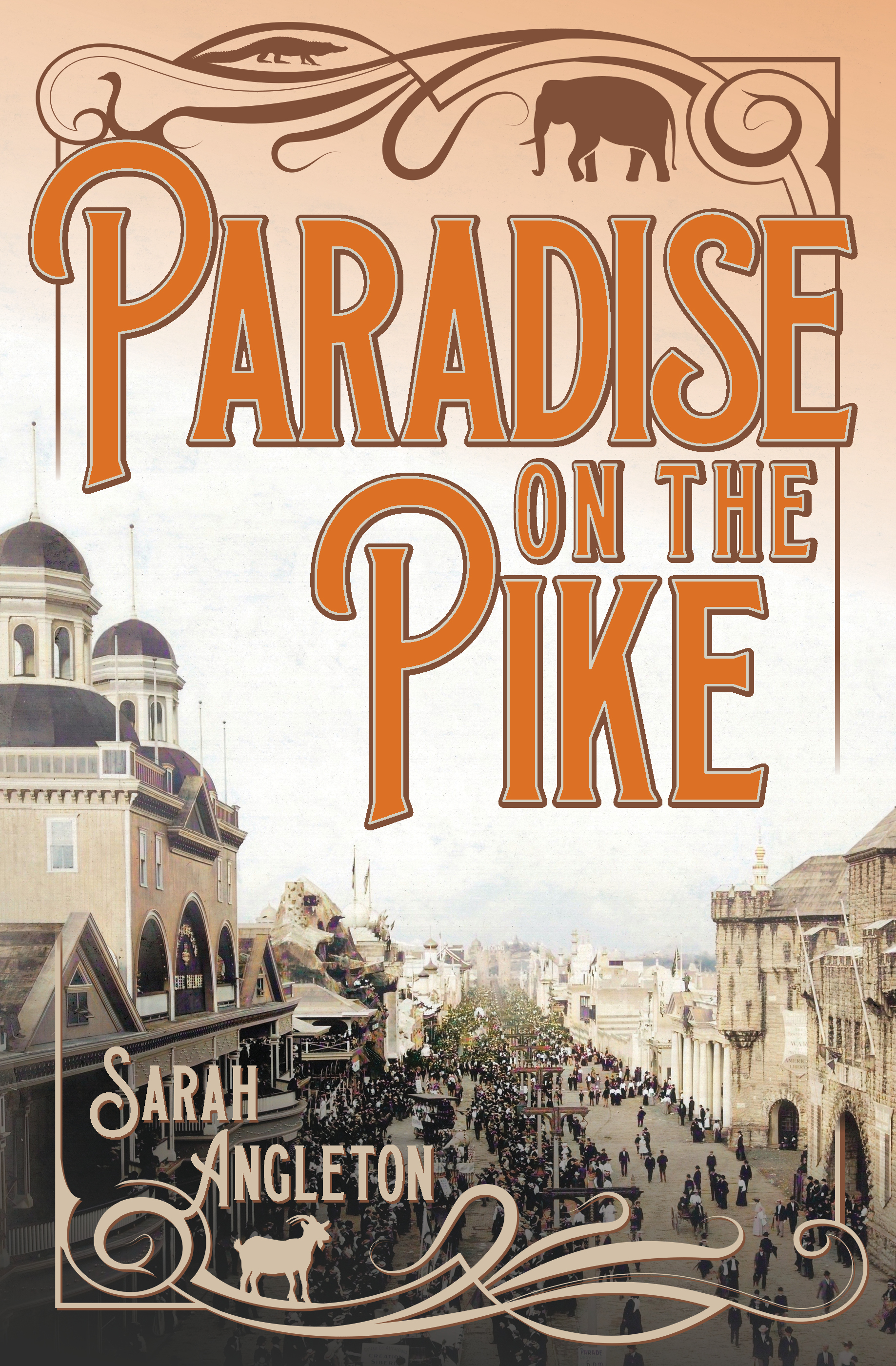 A new historical mystery set against the backdrop of the 1904 World’s Fair in St. Louis, for fans of Water for Elephants and Devil in the White City.
 In all, NASA estimates that approximately 400,000 people contributed to the success of the Apollo 11 moon landing, from thousands of engineers working throughout the world to the janitors and caterers that kept the facilities running smoothly. Every successful launch requires coordinated effort from a lot of people.
That statement is true when applied to Apollo 11, and it’s true when applied to a new book. My fourth historical novel, Paradise on the Pike, a mystery set against the backdrop of the 1904 World’s Fair in St. Louis, will officially launch on April 18 and it’s taken a lot of people to get it this far, from critique partners, beta readers, and cheerleaders to cover artist, formatter, and editor. It maybe hasn’t taken 400,000 people, but it’s been a lot.
And I still need help to get the book off the ground because no matter how enthusiastic I am about this book launch, I can’t make it successful by myself. I could really use an enthusiastic crowd to camp out on the beach and cheer loudly in hopes that even more people will become curious enough to tune in.

If you are interested in being part of that first, important crowd, I would love for you to join my launch team on Facebook. Participation is simple. You’ll receive an advance digital copy of the book to review (along with some helpful guidance if you’re not too sure how to do that) and some graphics to share on social media, There will also be some fun and chances to win prizes along the way. Sign up to be part of the group at this link: https://forms.gle/psi7ctZ6fNK88dbB9
Or if Facebook isn’t your thing, but you happen to be a NetGalley reviewer, you can request a review copy of the book at this link: https://www.netgalley.com/catalog/book/354539
I probably won’t be able to pull together a million, or even 400,000, people to help me with this, though feel free to share the opportunity with anyone you think might be interested. Of course I also wouldn’t be terribly surprised if somewhat fewer than 650 million people eventually read my book. Still, it takes a lot of help to shoot for the moon.
March 28, 2024
Hollow Inside
On December 5, 1942 the Easter Bunny went to war, That’s when the United States War Production Board issued Conservation Order M-145, banning the production of novelty chocolate, including those delightful long-eared treats that had been gracing the Easter baskets of American kids for a few years by then.
The Board defended the decision by suggesting that the move would more intentionally include children in the war effort, providing them with the opportunity to be as sad as the adults in their lives. Instead of enjoying chocolate treats, children would wake up on Easter morning to plush bunnies, or to bunnies carved from soap or wood, which were somewhat less delicious.
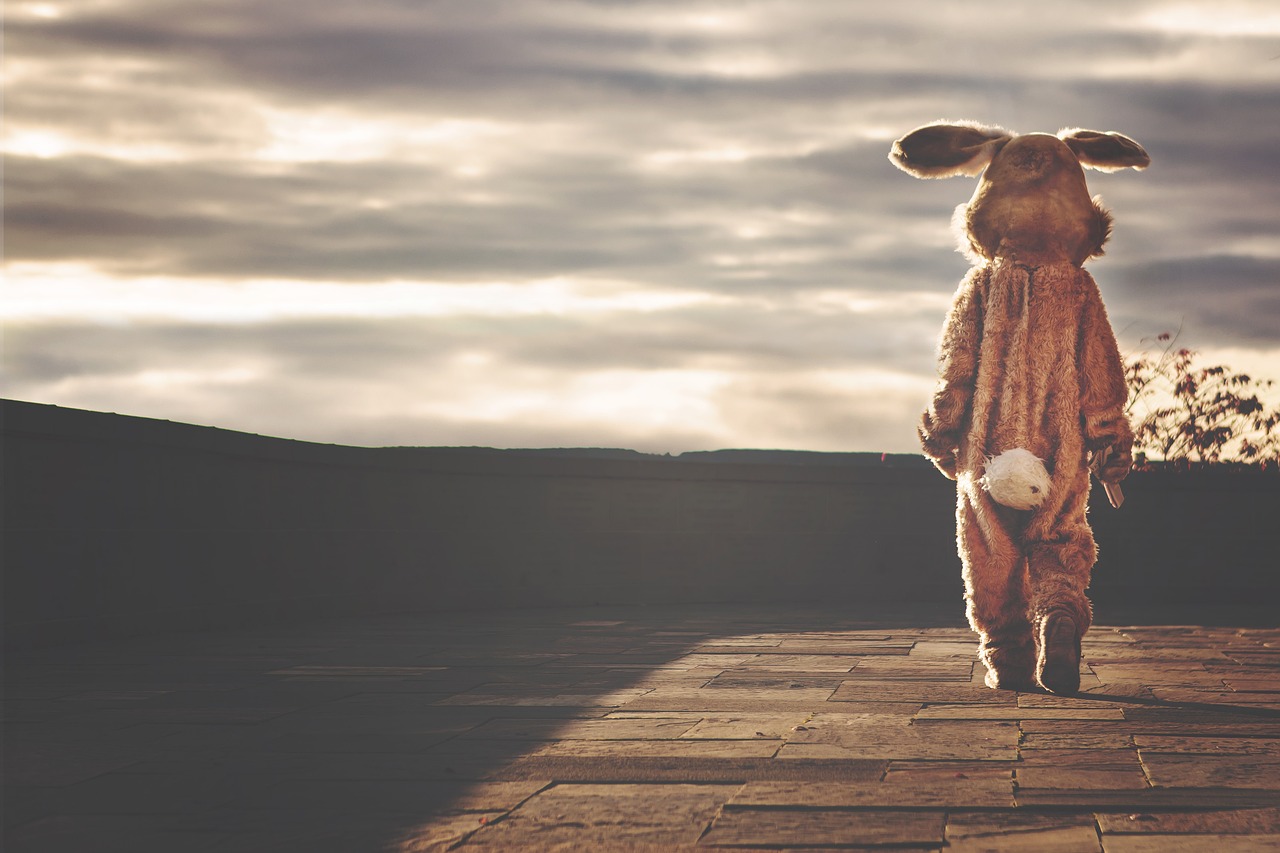 Image by Ryan McGuire from Pixabay
Of course it’s worth noting that chocolate Easter bunnies had been introduced in Germany in 1890, had only come to the United States 1939, and had pretty quickly become hollowed out by vanishing supplies and profit margins. The children had already been sacrificing.
And the real reason for the decision had more to do with supply line interruptions and the diversion of limited resources to the front lines. That makes sense, because I think it’s safe to suggest that chocolate improves morale. It packs a pretty substantial caloric punch and is a mild stimulant, which makes it a great snack for soldiers on the go.
What makes it less great is chocolate’s tendency to melt and spoil. The War Production Board had a solution for that as well. Government contracts went to major chocolate manufacturers who could produce a D-ration chocolate bar with a higher melting point and a flavor described by soldiers as maybe a little bit better than a boiled potato. It was also not shaped like a bunny.
So, nobody was happy, though eventually American children did get their chocolate bunnies back. By about 1947, supply lines were humming along more or less at pre-war efficiency and chocolate was allowed to be both fun and delicious once again. The Easter Bunny returned home, but like so many who go to war, he’d been forever changed by the experience.
 Image by Jill Wellington from Pixabay
Today, it’s hard to find a chocolate bunny that isn’t hollow inside. Manufacturers and chocolatiers will tell you that’s because when chocolate gets too thick, it’s less pleasant to bite into. Personally, I think I could manage, but hollow or not, I certainly won’t hesitate this Easter to bite into the long ears of a chocolate bunny.
According to many not entirely substantiated claims on the internet, more than ninety million such bunnies are sold in the US every year, and 89% of people surveyed claim that biting first into the ears is the right way to consume them. 5% are convinced that the tail should be first. I don’t know what to think of that other 6%. I guess maybe they’re hollow inside.
How about you? How will you be eating your chocolate bunny this Easter?


