
M. Thomas Apple's Blog, page 19
July 1, 2023
Sustainable life choices
Are there things you try to practice daily to live a more sustainable lifestyle?
Now this is an interesting prompt.
1. Organic gardening
I’ve been gardening for just over ten years now. My father had an organically-grown garden for several decades, and I’ve been able to get a lot of advice from him on how to grow vegetables without using chemically-based fertilizers and pesticides/herbicides.
To be honest, sometimes the insects and the weather do get the best of the plants. But at least I know what’s in them, and I can keep the soil healthy as well.
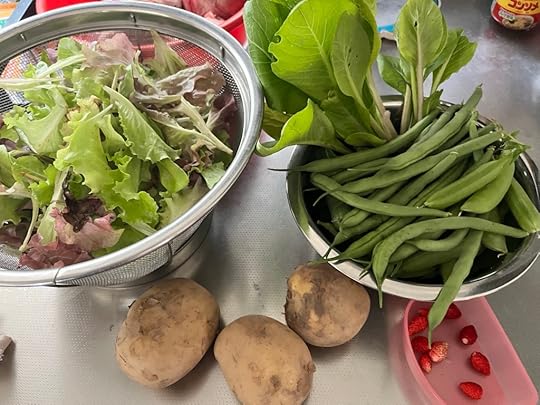 Everything in this photo was organically grown. Well, not the bowls…
2. Composting
Part of gardening is using compost, or rotten food scraps, as fertilizer. We recycle any food left uneaten as well as the bits of vegetables that are often tossed into the garbage, things like roots, insides of peppers, the ends of beans, and of course egg shells.
Egg shells can be reused to help bushes as well, due to their calcium content. Although I have found that the shells need to be rinsed before chucking them near the stem of bushes. Otherwise we get some unwelcome animal nightlife…
3. Reuse reuse reuse
Any clothing we no longer have a use for (kids got too big, Dad spilled coffee on a favorite shirt or cooking oil on a favorite pair of shorts, a towel that frayed and is too dangerous to use…) we do one of two things:
(i) recycle with our local school’s monthly clothing pick up, or
(ii) turn it into rags that can be used to clean up spills rather than use kitchen paper towels.
We also get a lot of plastic bags — and I do mean a lot — because practically everything in Japan comes wrapped in plastic. Cookies and sweets are all wrapped individually. Vegetables are wrapped in plastic. Even meat from the store winds up in separate plastic bags (just in case they leak on the way home).
So we reuse as many of the plastic bags as possible, typically to collect household trash (especially during allergy season!). And, of course, to collect plastic, plastic bottles, cans and bottles for recycling.
4. Bath water
Like most homes in Japan, we have a pump attached to our clothes washer. Japanese are accustomed to taking evening baths (I don’t; at least, not in summer, since the water makes me sweat and then I have to take a shower all over again). The next morning, we reuse the bath water to wash clothes.
5. No AC or dryers
Strictly speaking, we do use the AC on occasion. But we designed our home to have lots of sliding doors between rooms and wide windows and balcony doors. That way, we can just open up everything and have a nice breeze come down the mountain behind us. The house stays relatively cool even during the hot sticky summer months and we can avoid using air conditioning (except when it rains and we have to close windows).
We also hang out clothing to dry to avoid using the dryer. It’s better for clothing, anyway, and in addition to not wasting electricity, lowers our utility bills.
These are just a few examples. It’s not much, but a little bit here and there adds up to a lot over time.
Now if you’ll excuse me, I need to go throw some used egg shells under the tomato plants. 


June 30, 2023
And another post to which I forgot to add a title…
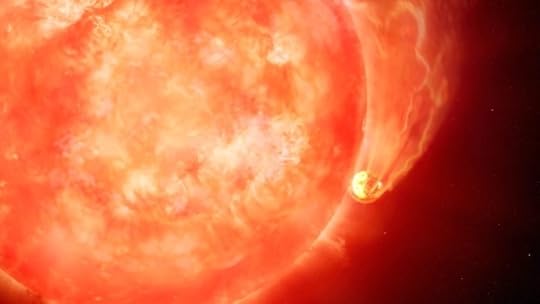
In a few billion years, our aging Sun will run out of hydrogen fuel in its core and begin to swell, eventually engulfing Mercury, Venus, and probably Earth itself. Known as the red giant phase, this is a normal step in a mid-sized star’s life cycle, when it swells to hundreds of times its usual size. There are plenty of red giants in the night sky, but astronomers have never caught one in the act of swallowing its planets — until now.
https://www.astronomy.com/science/star-seen-swallowing-its-planet-whole/
Pack your stuff, folks…
The photo is an artist’s depiction btw. The article describes how the astronomer discovered that star was eating its own planet.
In a few billion years, our aging Sun will run out of hy...
In a few billion years, our aging Sun will run out of hydrogen fuel in its core and begin to swell, eventually engulfing Mercury, Venus, and probably Earth itself. Known as the red giant phase, this is a normal step in a mid-sized star’s life cycle, when it swells to hundreds of times its usual size. There are plenty of red giants in the night sky, but astronomers have never caught one in the act of swallowing its planets — until now.
https://www.astronomy.com/science/star-seen-swallowing-its-planet-whole/
Pack your stuff, folks…
The photo is an artist’s depiction btw. The article describes how the astronomer discovered that star was eating its own planet.
June 20, 2023
Smashwords 2023 Summer/Winter Sale

July is your best chance to find my entire ebook collection for a promotional price at @Smashwords as part of their Annual Summer/Winter Sale! Bookmark https://www.smashwords.com/shelves/promos and stop by from July 1 through 31st! #SWSale2023 #Smashwords
(See my Smashwords profile here: https://www.smashwords.com/profile/view/mapple)
And by the way, thanks for reading!
I’m sorry that I haven’t been posting much lately. Work has just become completely overwhelming, and the rainy season (here in Japan) hasn’t helped.
But I do read your comments and I appreciate them, and all your “likes,” too!
Just realized it’s been MONTHS since I posted the next installment of Bringer of Light.
Yikes.
Time to wrap up the first book and get to the climax already!
June 16, 2023
Chemical traces reveal first-generation stars
 The link below includes a night sky in Montana, which makes little sense when the researchers were in Beijing and Honolulu…
“The first-generation star we observed has the potential to become the oldest star we have ever seen,” said Alexander Heger, a professor in the school of physics and astronomy at Monash University in Australia who was part of the research team. “It probably had only lived for 2 1/2 million years and then exploded.”
https://www.nbcnews.com/science/space/chemical-traces-offer-evidence-universes-earliest-stars-rcna88790
Oh, and it also was discovered to be 260 times the size of our own Sun…just as theorized.
More importantly, this involved scientists from three different countries (China, Japan, and Australia), sharing information and working together for science.
Imagine if that spirit of cooperation could be extended into other domains…
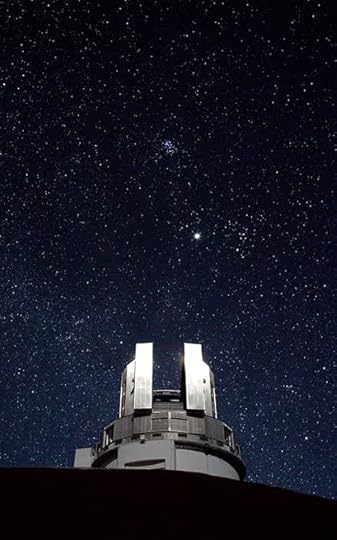 Subaru, how about you?
And today’s vague prompt is…
What notable things happened today?
What do you mean, notable to me, notable to others, notable throughout history or just notable in general?

May 30, 2023
Why Mars Shivers: The Explanation Behind Marsquakes
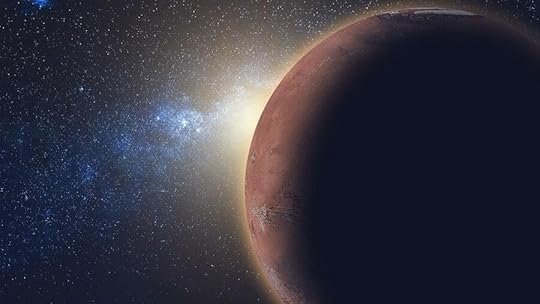
The post Why Mars Shivers: The Explanation Behind Marsquakes first appeared May 30, 2023 on Science Recent – Your Daily Science Source.The human …
Why Mars Shivers: The Explanation Behind Marsquakes
Something else for future potential Mars settlements to consider….
Plume of water seen on Saturn’s moon
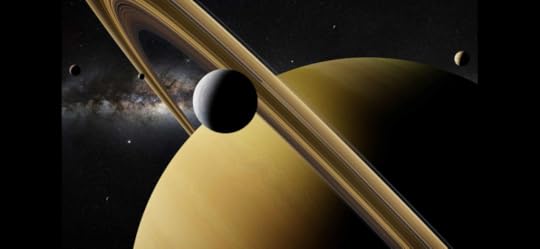
The record-breaking plume reached nearly 6,000 miles into space – covering the distance between Ireland and Japan – and poured water into the void at an estimated rate of 300 litres a second.
https://www.theguardian.com/science/2023/may/30/astronomers-see-6000-mile-water-vapour-plume-blasting-from-saturn-moon
Note that the water jetted out into space nearly 40 times longer than the actual size of the moon (about 500 in diameter, or as the Gurdian puts it “500-mile-wide” for those who forgot the meaning of “diameter).
Enceladus is probably the best bet for life elsewhere in the solar system due to its water — and while whipping around Saturn once per day, which is likely the reason for underwater volcanos and other vents that may provide the proper chemistry for life.
Also the perfect place to trick an inexperienced asteroid hunter crew…
May 29, 2023
This is such a Gen-X prompt…
Do you remember life before the internet?

May as well ask if the writer can identify all the ancient objects in this photo…


