M. Thomas Apple's Blog, page 66
March 13, 2016
Single, hyphenated, or double?
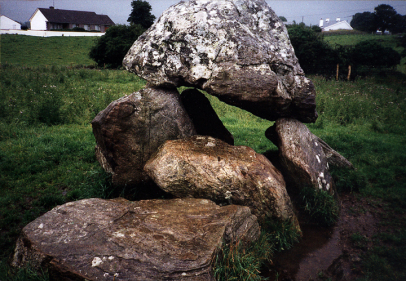 During the final proofreading of Notes from the Nineties, I’m finding small amusements in MS Word…which seems to be contradicting previous versions of spellcheckers.
Or is that spell-checkers? Spell checkers?
I’ve always had a habit of using single words where others prefer double or hyphenated words. To me, reproducing spoken language makes dialog in particular (of course) and prose sound more natural. Now that the automated spellchecker (spell-…spell…) is suggesting single words over other options, I’m finding a number of inconsistencies.
For example, the program suggests “flowerbed” (OK…) but “death bed” (um…why?). Gravestone is one word, but grave marker is two…but they mean the same thing (don’t they?). Rune stone is two words (but it’s only one object, like a gravestone…). Huh?
Which would you prefer? Single word? Double? Hyphens?
Below I’ve written the original form of 2-word nouns and adjectives in my stories (most dating from, you guessed it, the ‘90s) in the order in which they appear. Try to guess which ones were flagged by Word as “misspelled.” (Note: I changed many to single words…which ones would you change?)
camp fire
deathbed
flower bed
roommate
stop light
firebrand
southbound
off season
ear-splitting
firepit
stone walls
newly-graveled
eighteen wheeler
dimly-lit
sidepocket
cut-outs
cubby-hole
wrist watch
name tag
gumline
militia men
apple sauce
sing-song
toll booth
fast forward
day-long
door frame
head-first



March 12, 2016
Notes from the Nineties: Training the Mountain Warrior
This is the second preview of my upcoming collection of short stories and poems, Notes from the Nineties. In the first part, I explained the background behind the first story and poem pair, Cois Fharriage and Ag an gCrosaire.
 From first to last: the final story in the collection, “Training the Mountain Warrior,” is based on two specific events that happened to me shortly after moving to Japan in 1999. The date thus places the story barely in the Nineties; the paired-poem (“Asian Dreams”) was written hastily—scrawled, really—in an old yellow lined notepad the night before I left the US (permanently, as it turned out). I still have the notepad, well used and abused.
The short story describes my attempted nighttime climb of Mt. Fuji (which ended short of the summit due to high winds) and my trek through the ancient mountains of the Kinai peninsula, whose hiking trails later became a World Heritage Site. There were a lot of details that I deliberately left out, and of course the dialogue is completely fictional. But I did, actually, dangle my friend over a cliff.
Seriously.
(He’s fine, in case you were wondering. And currently living in a desert near LA. Maybe I should have left him fall…)
I regret that I don’t have any photos of that particular region of the country to share; in the era before InstaGram, I was using tsukai-tsute cameras (“use and throw away” cameras that were little more than flimsy paper boxes with a built-in tiny lens that took terrible photographs). Somewhere in an upstairs closet of my house (or my parents’ house) are a few out of focus shots of a mountain surrounded by other, similarly out of focus shots of similar mountains. So in the book I opted for a clearer photo of a temple in Kyoto.
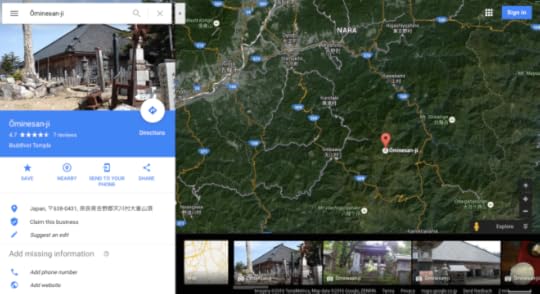
I can, however, provide a map of the area (see below). O-miné-san-ji is a real place, and women are (as I wrote in the story) not allowed into the area. The law says that they have the right to go if they want to, and local women do in fact climb the mountain when the yamabushi (mountain warriors) men-folk aren’t around. But there are still signs at the entrance to the mountain trails proclaiming them offlimits to women. This is the same gender-specific prohibition found in sumo (women can’t enter the sumo ring), highway tunnels still under construction (no, seriously…) and other areas where the traditional Shinto rituals prevail.
Here’s a short quote from the story to explain what yamabushi do:
“The ascetic practice these mountain warriors practice is called shugendo, or “the path of training,” and was supposedly founded by a mystical monk named Enno-gyojya in the seventh century. Enno-gyojya was said to have walked up and down mountains three times a day for decades and eventually attained enlightenment simply by walking.”
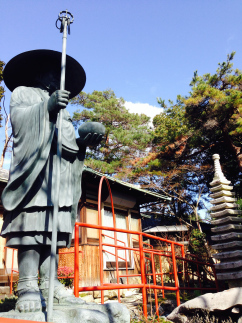
There’s a life-size statue of Enno-gyojya in a water fountain outside the Kintetsu Nara Station, which is a popular meeting place for tourists (also popular for mendicant monks to stand around like statues, saying literally nothing…until you drop a few coins in their bowls, upon which they will raise a hand in benediction and offer a quick prayer for your soul).
And there’s also a larger-than-life statue of the Mountain Warrior standing tall above our children’s nursery school, in front of a small Buddhist temple overlooking the valley (see above).
As for the story itself…I would write more, but that would be telling…hope this description is enough to pique your interest!