Kenneth Winter's Blog, page 15
April 20, 2022
It Really Is Finished!
If you would prefer to listen to this post as a podcast, CLICK HERE.
* * * * *
For our orthodox brothers and sisters, the annual celebration of Christ’s resurrection from the tomb is still a few days away; for the rest of us, it was a few days ago. You may therefore be wondering why i am writing a post about the empty tomb after Easter.
My first reason for doing so is because i believe it is a truth we need to be reminded of every day, not just once per year. That miraculous truth is the foundation of our faith. Without it, we have no hope. As Paul said – if Christ was not raised from the dead, then our faith is futile and we truly of all people are to be the most pitied.(1)
My second reason for doing so is that we might again be challenged by the lives of the men and women who witnessed His resurrection firsthand, and in so doing, live out our lives – everyday – with the same determination that truth prompted in them.
In John 20, we read an account of what happened the morning Jesus rose from the grave.(2) Mary Magdalene was the first at the tomb. She was the one from whom Jesus cast out seven demons.(3) Some scholars also believe that she was the woman who knelt at the feet of Jesus and anointed His feet with perfume and her tears, wiping them off with her hair.(4) She was someone we all need to aspire to be – someone who knew she was loved by Jesus and saved by Him – and never got over it! She was eternally grateful to her Lord for His love and His salvation.
But then, the unthinkable had occurred. Jesus had died on the cross. His death did not cause her love for Him to waver, but it did cause her faith to do so. She and the other ladies who were coming to the tomb that morning were coming to anoint His body for burial. They weren’t expecting to see Him alive. It’s ironic that the religious leaders were concerned about the disciples stealing Jesus’s body, and that Mary’s first thought upon arriving at the empty tomb was that the religious leaders had taken His body. That thought just added to her grief. The idea that Jesus had risen never crossed her mind! She didn’t stick around to look for Jesus. She ran off to find John and Peter as quickly as she could.
When she had done so, the three of them made their way back to the tomb. Mary let John and Peter run on ahead. She wasn’t in any hurry to see the empty tomb. Her thoughts were now even more consumed by her grief.
And truth be told, Peter and John probably weren’t expecting the resurrection of Jesus any more than Mary Magdalene was. They probably thought she had made a mistake in what she thought she had seen. Perhaps, she had gone to the wrong tomb. They weren’t running to the tomb expecting to find Jesus alive. They were expecting to uncover Mary’s error and find His body.
John was the faster runner. He got to the tomb before Peter. But John stopped at the doorway to look in. Uninhibited Peter charged right on past John into the tomb. There they both saw the linen wrappings neatly rolled up. It was at that moment that John writes, “he saw and believed.”(5) John couldn’t yet prove that Jesus was risen, but he remembered what Jesus had said and believed it with all his heart. He believed that Jesus had risen according to the Scriptures, and he believed once and for all that Jesus truly was God in the flesh.
Peter had not yet come to that same conclusion. His shame over denying Jesus was still weighing heavily on his heart and blinding him to the truth. (By the way – shame over unconfessed sin will often do that – it will blind us from the truth of the situation!)
Peter and John then departed. This time they didn’t run. They weren’t running to tell the others. They simply walked, pondering all that they had just seen.
About that time, Mary Magdalene arrived back at the tomb. She remained outside weeping. Then “as she wept, she stooped and looked into the tomb” for the first time. She saw two angels who asked her why she was weeping. “They (the religious leaders) have taken away my Lord, and I do not know where they have laid Him.” She then turned and saw Jesus standing there. But due to her grief, she did not recognize Him. Thinking He was the gardener she again sought an answer from Him as to where His body was laid. At that moment, Jesus spoke her name and she knew! Having seen Jesus, she believed! Off she ran to deliver the good news and His instructions to Peter and John.(6)
The eyes of the “one whom Jesus loved” were opened to the reality of who Jesus was by faith. The woman who had never gotten over what Jesus had done for her encountered the truth of who Jesus was by sight. Peter and others continued to contemplate all of these things based upon what these witnesses were telling them. But the day wasn’t over! Faith would become sight for many more.
In some respects, as followers of Jesus who are following Him today, we are in the same place as these men and women. We have heard the reports from these witnesses. He has given us His Word that we might know that His work on the cross is finished, and the tomb is empty!
The work of Christ’s redemption is complete. There is nothing more to be done. Today, we accept that fact and receive that assurance according to the reports of the many witnesses and the authority of Scripture. Like John, our eyes have been opened to that reality by faith. But “the day” isn’t over – soon our faith will become sight! We have that hope because we follow a Living Savior who rose from the grave. Salvation in Him is complete. Let’s allow that reality to permeate our every thought and every action … every day. Because … it really is finished!
* * * * *
I’ve adapted this post from Taking Up The Cross, chapter 56, entitled “Now It Is Finished!” This fifth book in the Lessons Learned In The Wilderness series is available through Amazon in print or for your e-reader. Click HERE for more information on how you can obtain your copy of the book.
* * * * *
(2) John 20:1-10 (NLT)
Early on Sunday morning, while it was still dark, Mary Magdalene came to the tomb and found that the stone had been rolled away from the entrance. She ran and found Simon Peter and the other disciple, the one whom Jesus loved. She said, “They have taken the Lord’s body out of the tomb, and we don’t know where they have put Him!” Peter and the other disciple started out for the tomb. They were both running, but the other disciple outran Peter and reached the tomb first. He stooped and looked in and saw the linen wrappings lying there, but he didn’t go in. Then Simon Peter arrived and went inside. He also noticed the linen wrappings lying there, while the cloth that had covered Jesus’ head was folded up and lying apart from the other wrappings. Then the disciple who had reached the tomb first also went in, and he saw and believed— for until then they still hadn’t understood the Scriptures that said Jesus must rise from the dead.Then they went home.
(3) Luke 8:2
(4) Luke 7:38
(5) John 20:8 (NLT)
(6) John 20:11-18 (NLT)
Copyright © 2022 Kenneth A. Winter All rights reserved.
Photo by PhotoGranary on Lightstock


April 13, 2022
A Resurrection Story – The Man Who Owned The Upper Room
If you would prefer to listen to this story as an audio recording, CLICK HERE.
* * * * *
NOTE : This is the last of four short stories about four different people who encountered Jesus during the months leading up to His crucifixion and resurrection. You will find each of these individuals in the Gospel accounts, however i have added fictional elements to each of their stories so that we might see each one … as they journeyed through their lives leading up to their encounter … and as they continued their journey in the days that followed. You will read the parts of their stories you may already know … and the rest that could have been. Though some of the other characters and details contained in each story may be fictional, you will find the truth conveyed about the One they each encountered to be very REAL! My prayer is that through the stories, you will see Jesus and be reminded of the Good News of the cross and the empty tomb as we enter into this season of remembrance. To that end, let’s look at their stories:
The Grieving Mother (March 30)
The One Caught In The Act (April 6)
The Man Who Owned The Upper Room (This week - April 13)
* * * * *
My name is Yitzhak and I grew up here in Jerusalem. My ancestors were counted among the remnant that returned here over five hundred years ago with Zerubbabel from Babylon. Those early generations led the effort in rebuilding Jerusalem from the debris left by the Babylonian destruction of the city. My ancestor Pedaiah, son of Parosh, was charged by Nehemiah with the responsibility of rebuilding the section of the wall leading to the Water Gate.
Once the rebuilding was completed, the men returned to their original trade or special craft to meet the demands of a growing city. My ancestors were fullers and weavers. Fullers clean the sheep’s wool and pound it with sticks to clean and prepare it to become cloth. They also clean and retexture old cloth so it can be reused. Weavers, of course, use the wool, as well as flax, to create beautiful woven fabrics of all colors, textures, and styles.
Those early ancestors abutted the building that housed their shops to the area of the wall rebuilt by Pedaiah. As the business grew over the years, other family members added more rooms. Eventually business grew to the point that the family residence was moved to rooms above the shops. Those rooms now serve as my family’s home. With the growing number of pilgrims traveling to Jerusalem for the special feasts, I decided to add a large room on the upper level about three years ago to help accommodate the demand. The rent I charge for that room helps provide additional income for my family.
Jehovah God has continued to bless our business through many generations, and I am now one of the leading tradesmen in Jerusalem. One day my oldest son, Uriah, who is fifteen, will take over the business from me, just as I did from my father. Uriah is a special gift to my wife and me from God – as a matter of fact, He has given him to us twice!
Three years ago, my son was helping me finish the construction of the upper room. We were setting the final roof tiles when my son lost his footing and fell to the street below. I scurried down as fast as I could. Several of my neighbors were already there by his side. My son was not moving, and I could not tell if he was breathing. Gratefully, a neighbor had already run to get the physician.
I felt so helpless as I stared at my son. All I could do was cry out to Jehovah God to help me. Just as I did, a Man knelt beside me. He appeared to be one of the pilgrims who had traveled to Jerusalem for Passover. He had been passing by when Uriah fell and came over to see if He could help.
The next thing I knew He took my son by the hand and said, “Young man, I say to you, rise!” Immediately, Uriah sat up. He looked at me, then he looked at the stranger. The stranger returned my son’s look and said, “Young man, behold your father.” Then He looked at me and said, “Father, behold your son!”
The Man then rose to His feet and reached down to help Uriah stand. My son said he felt fine and that nothing hurt; it was as if he had never fallen. I looked at him in disbelief. Just a moment before he had been lying there crumpled on the street! The neighbors gathered around us stood there with their mouths agape as if to say, “How can this be?”
I was still on my knees looking up at the Man when I said, “Who are You? And what did You do?”
“Yitzhak,” He said, “you cried out to the Father for help. He heard your prayer and your son has been made whole. All so that the Father might be glorified.”
“Sir,” I replied, “how is it You know my name, but I don’t know Yours? Even so, I know I have You to thank for restoring my son!”
“Thank the Father for hearing and answering your prayer,” the Man said as He reached down and helped me stand to my feet. Smiling broadly He added, “Thank Him for giving you your son once again! And now go, give the boy something to eat.”
Then He turned and began to make His way toward the temple. My neighbor came to my side and said, “His name is Jesus. He is from Nazareth. And He created quite an uproar in the temple yesterday. He drove out all of the merchants and money-changers. He cleansed the temple just like Ezra the priest had done so many years ago in the presence of our ancestors.
“The religious leaders were irate and demanded, ‘What are You doing? If God gave You authority to do this, show us a miraculous sign to prove it.’(1)
“’All right,’ Jesus had replied. ‘Destroy this temple, and in three days I will raise it up.’(2)
“’What!’ they exclaimed. ‘It has taken forty-six years to build this Temple, and You can rebuild it in three days?”(3)
“I thought it was a strange thing for Jesus to say to the religious leaders,” my neighbor continued. “But now that I have seen Him awaken your son, I believe He can do anything He says He can do!”
“So do I!” I exclaimed, before I ran to catch Him and thank Him one more time.
Jesus returned to Jerusalem several times after that. Each time He created quite a stir in the temple. The religious leaders continued in their attempts to discredit Him, but each time the city was filled with witnesses who had observed how Jesus rebuffed, rebuked, and corrected the religious leaders. The reports continued of countless people who were healed by that very same touch that made my son whole.
Jesus stopped by to see me personally when He was here for the Feast of Dedication a few months ago. He asked me if my upper room was available for Him and His followers to celebrate the Passover. I told Him it was His to use whenever He needed it and for as long as He liked. He explained He would need it off and on from Passover through the Day of Pentecost. It was such an insignificant way for me to thank Him for all He had done – but I was glad I could repay Him in some small way.
He told me He would send some of His followers on the morning before the Passover to make preparations. He asked me to have one of my servants meet them at the Sheep Gate and then lead them to the room. I told Him I would have my servant carry a pitcher of water so they would know to follow him.
Yesterday morning a few of His disciples arrived to make their preparations. They said, “The Teacher asks, ‘Where is the guest room where I can eat the Passover meal with My disciples?’”(4)
Though Jesus had said His followers would prepare the meal, I had asked that He allow me to provide the meat and grains they would need. He had graciously permitted me to do so. When they arrived at the room, everything was in place, and they busily began their preparations to make things ready.
Later in the day, Jesus and the rest of His disciples arrived. Before He made His way to the upper room, He stopped to greet Uriah and me. He thanked me for providing a place for Him to spend this special time with His followers. He asked Uriah to bring a basin of water and a towel to the upper room and set it by His place at the table. He said He would need them for something He planned to do that evening.
As we were talking, I could tell something was wrong. Jesus’s demeanor was different, and the disarming smile I had become accustomed to was absent. His eyes had the appearance of flint, as if He were solely focused on what was before Him. Uriah and I had been in the street the other day when He entered the city riding on the colt of a donkey. We had joined our voices with the others in shouting, “Hosanna!” But I knew much had happened in the four days since then. The whole city knew about how He had again driven the merchants and money-changers out of the temple.
It was clear that the religious leaders were plotting something against Jesus. No one knew what it was, but there was a sense of foreboding among the people. If the rest of Jerusalem and I were aware of it, I knew Jesus was even more aware of it. That had to be weighing heavily on Him.
I told Jesus to let me know if He needed us to do anything else for the remainder of His time. I assured Him we would have the room ready for His arrival each evening. I asked if He would be able to join our family for a meal before He left Jerusalem. He smiled and thanked me for the invitation, but He never gave me an answer. Then He continued upstairs to gather with His followers.
They remained in the upper room until very late in the evening. Most of the men left with Him as they headed toward the Mount of Olives. After cleaning up from the meal, I saw the women in His party leave, heading in a different direction. Apparently, they would be lodging somewhere else.
All was calm when I finally retired to bed for the night, but when I awoke this morning it was anything but calm! I heard shouting in the street: “Jesus has been arrested! The religious leaders have bound Him, and their temple guards are delivering Him as a prisoner to Pontius Pilate! They say they plan to crucify Him!”
I could not believe my ears! This was madness! What were the religious leaders thinking? What were their accusations against Jesus? If there was ever anyone who didn’t deserve to be crucified, it was Him!
A frenzy ignited as the news spread throughout the city. There were many like me who were weeping and unable to comprehend what was happening. Others were shouting, “He claims to be the Son of God! Crucify Him!” And there were still others who were just curious to see what all the excitement was about.
It wasn’t long before I heard that He was being led through the streets like a common criminal to be crucified. Uriah and I pushed our way through the crowd assembled to gawk at Him. We gasped when we saw Him. He was unrecognizable. His face was broken and bruised. The robe on His back was covered in blood. Someone had placed a crown of thorns on His head and pushed it into His skull. It was such a contrast to a few days ago when we witnessed Him riding on the donkey’s colt through these very streets!
The sight of Him made me nauseous. I could not stand to see what they had done to my Lord! My grief was greater than anything I had ever experienced. Uriah and I retreated from the crowd and wept in each other’s arms. I wanted to help Jesus, but I didn’t know how. I hadn’t felt that helpless since the day Uriah fell from the roof. Jesus had been there to lift Him up that day. But now, who was going to lift up Jesus?
When we finally made it back home, I headed to the upper room. That was one of the last places Jesus had been, and I hoped I would feel closer to Him there. As I entered the room, I discovered one of His disciples – the one called Peter. He, too, was weeping uncontrollably. Neither of us could speak. I did not want to interrupt His time of sorrow, so I made my way back downstairs to find my own quiet place.
“Father,” I cried out, “three years ago I called out to You to save my son, and You did! Father, now would You please save Your Son?”
Soon, the sky turned dark – as black as night. And it remained that way for several hours. I began to realize that the pain I felt paled in comparison to the pain God was feeling. I knew there was nothing greater than a father’s agony when his child is suffering. God had chosen to relieve my pain ... but He was now choosing to endure His own.
I then remembered what Jesus had told the religious leaders: If the temple was destroyed, He would raise it up in three days. Could it be?
The One who had stood before me said the Father had chosen to restore my son to bring glory to His name. I knew He was choosing to not save His Son for the same reason … to bring glory to His name!
* * * * *
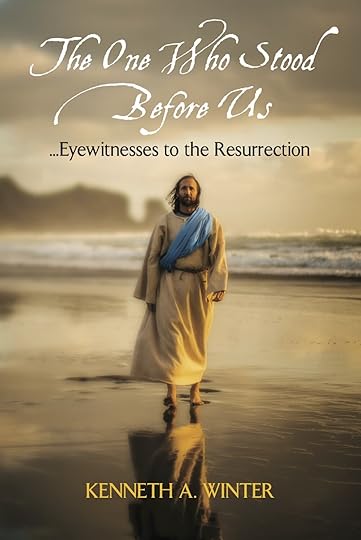
This story is taken from The One Who Stood Before Us , a collection of forty short stories.The entire collection is available through Amazon in standard print, large print, for your e-reader. Click HERE for more information on how you can obtain your copy.
You can listen to an audio recording of this story by tuning into this week’s episode of my podcast by CLICKING HERE
* * * * *
In multiple instances the dialogue in this story comes directly from Scripture. Whenever i am quoting Scripture, it has been italicized. Unless otherwise indicated, all Scripture quotations are taken from the Holy Bible, New Living Translation, copyright © 1996. Used by permission of Tyndale House Publishers, Inc., Wheaton, Illinois 60189. All rights reserved.
The Scripture references are as follows:
(1) John 2:18
(2) John 2:19
(3) John 2:20
(4) Luke 22:11
Copyright © 2022 Kenneth A. Winter All rights reserved.
Photo by LUMO-The Gospels for the visual age on Lightstock
April 6, 2022
A Resurrection Story – The One Caught In The Act
If you would prefer to listen to this story as an audio recording, CLICK HERE.
* * * * *
NOTE : As has become my annual practice, starting two weeks ago and continuing until next week, i am posting four short stories about four different people who encountered Jesus during the months leading up to His crucifixion and resurrection. You will find each of these individuals in the Gospel accounts, however i have added fictional elements to each of their stories so that we might see each one … as they journeyed through their lives leading up to their encounter … and as they continued their journey in the days that followed. You will read the parts of their stories you may already know … and the rest that could have been. Though some of the other characters and details contained in each story may be fictional, you will find the truth conveyed about the One they each encountered to be very REAL! My prayer is that through the stories, you will see Jesus and be reminded of the Good News of the cross and the empty tomb as we enter into this season of remembrance. To that end, let’s look at their stories:
The Grieving Mother (March 30)
The One Caught In The Act (This week – April 6)
The Man Who Owned The Upper Room (April 13)
* * * * *
My name is Hepzibah and I grew up as the only child of a shopkeeper here in Jerusalem. My mother was struck with the fever and died when I was four years old. In many respects, my father died at the same time. He blamed God for my mother’s death and would no longer speak of Him. We never again observed any of the religious feasts, attended synagogue, or went to the temple.
Love died in our home that day as well. No longer were there any expressions of affection. Don’t misunderstand me, my father never treated me badly; he just never again expressed any love for me in any way. He became very cold and distant. The last hug I ever remember receiving was from my mother before she fell ill.
I don’t think my father stopped caring about me, but I believe his heart broke so deeply that he lost his capacity to love. Perhaps he was trying to protect his heart from ever again feeling such pain. I attempted to ask him about it a few times, but he would simply look off into the distance and walk away. I eventually stopped asking. When I tried to express my love for him, it was rejected. So, I grew up desiring love and affection, but it was never requited.
My father never thought about arranging a marriage for me. I don’t know why. Maybe it was because his marriage had ended so tragically. As the years passed – and I got older and older – I tried to talk to him about it, but he just shrugged me off. I was still living in a cold, empty house with my father when I was in my early twenties.
Each of my days pretty much looked the same. I kept my father’s house, cleaned and mended his clothes, and prepared his meals. The highlight of each day was going to the market to purchase food. For the most part, those were the only conversations I had each day. The food vendors became the family and friends I craved. There was one in particular who always took additional time to speak with me. He was the butcher, and one day I noticed he started quietly adding a little extra meat to my purchase.
His name was Alon and, though he was closer to my father’s age, he seemed to be genuinely interested in things that interested me. We would talk about faraway lands and the places I would love to visit. He was originally from northern Galilee. I had never traveled farther than a few miles outside of Jerusalem. So, his stories about the Mediterranean Sea and the Galilean hills captured my imagination. As time went on, he confided to me that he looked forward to my arrival each day.
One day when I showed up at his stand, he invited me to meet him at the pool of Bethesda at the end of the day. It would give us more time to talk without customers interrupting. I welcomed the opportunity. I had never been invited to go on a walk. I had never been invited to go anywhere with someone else. The time passed slowly as I waited to meet him. Then it passed quickly as we walked from the pool to the gardens and back again. The last person who had been this genuinely interested in me was my mother. My heart began to sing again.
That walk was the first of many in the gardens. Though we talked every moment we were together, we never talked about his personal life. I did not know anything about his family, and every time I asked he redirected our conversation. After a while, I stopped giving it a thought. Our time together was now what I lived for. I could endure everything else knowing I was going to spend time with Alon.
Our walks in the evening were now a regular event. My father never asked me why I was gone – and I never told him. As long as there was food on his table when he arrived home, he seemed quite content not to know.
But the absence of my father’s love no longer bothered me. There was another man in my life who was more than making up for it. I realized l had fallen in love with Alon. I had never felt this way before. And I was fairly certain he felt the same way about me.
It was now October. The late afternoons and evenings were cooler, and the sun was beginning to set earlier. We had met in the garden on the Mount of Olives. This was becoming our favorite place to walk. But that day, a bad storm blew in out of nowhere and began pelting us with driving rain. The sky turned dark and the wind was fierce.
Alon told me I could not travel home in that kind of weather. He told me he knew of a place nearby that we could shelter from the rain and the wind. The storm raged outside, but the place seemed strangely quiet and comforting. I felt safe with Alon.
I won’t go into detail about that night, but suffice it to say that Alon and I lay together as if we were husband and wife. The storm continued throughout the night, so we stayed in that place until the next morning.
It was barely light outside when we heard a loud knock. A voice demanded that we open the door. Alon cracked the door open, and several men pushed their way inside. To our surprise, there stood a woman, two priests, and four temple guards.
I soon learned that the woman was Alon’s wife! She began screaming and hitting him.
“I knew you had been up to no good for some time, but even in my wildest imagination I never believed you would be unfaithful to me!” she shouted. Then as I lay there on the bed, she unleashed her wrath on me.
Eventually, she ran out of strength. Though her anger didn’t subside, her screaming and flailing did. She turned to one of the priests who I quickly learned was her brother. “We will take them both to the temple to be condemned and stoned as the law requires!” he said.
But as angry as the woman was with her husband, she apparently didn’t want him stoned to death. “I am certain this is all the fault of this harlot and not my husband. Take her, but leave him for me to deal with!” she told her brother.
The law was clear that both the man and the woman caught in the act of adultery were to be stoned to death. But the other priest, who had been silent up until now, turned to the woman’s brother and said, “This may be just the opportunity we have been looking for to entrap Jesus. Leave the man for your sister to deal with. All we need is the woman.” Then with a smile, he added, “I am certain Caiaphas and Annas will reward us for our efforts!”
The woman’s brother seemed pleased with the suggestion. He instructed the guards to take hold of me and bring me to the temple. They at least allowed me to put on my cloak, though the rest of my garments were left there in the room. As we walked out the door, I looked back at Alon as he was facing his wife’s wrath. He didn’t return my gaze. In fact, he looked relieved.
A jumble of emotions raged inside me. My heart was broken. The only man I had ever loved – and the only man I thought loved me – had been using me and deceiving me. He had never loved me; he only lusted after me. That thought devastated me. My need for love had blinded me to reality.
And now I would be publicly berated and tried as an adulteress, subjected to shame and ridicule. Then I would be pummeled with stones until I died. Alon would suffer no such punishment. I alone would stand before the crowd. My sad and pathetic life was about to come to an end.
When we arrived at the temple, I was taken into a gathering of religious leaders. They all looked away from me with disdain. Obviously, they weren’t expecting a woman to be brought into their presence – particularly one in such disarray. The two priests who had arrested me walked over to speak with the one who appeared to be the high priest. They spoke in hushed tones. Soon a smile crossed the lips of the high priest. I couldn’t imagine why he was smiling. Nothing about this situation merited a smile. He turned to the council and the guards and instructed them to take me into the courtyard where Jesus was teaching.
This was the second time I had heard the name Jesus mentioned. I did not know who He was, but apparently, He would determine my fate.
The Man teaching in the courtyard was surrounded by a great crowd. As soon as we arrived, the crowd began to stir. The Man stopped speaking. All eyes turned toward me. I noticed that each of my accusers was picking up a stone. Suddenly everything became quiet.
The priest who earlier suggested that I, alone, be brought to the temple turned to the Man and smugly said, “Teacher, this woman was caught in the act of adultery. The law of Moses says to stone her. What do You say?”(1)
The Man looked at me. I was now certain He was the One they had referred to as Jesus. I stood there in fear and shame before Him and before them all. Behind me stood my accusers – the religious leaders – with an air of superiority, haughtiness, smugness, and contempt. Around me was the crowd – leering at me and craning their necks to see what Jesus was going to say or do. The only One who didn’t look at me with condemnation was Jesus.
After a few moments, He stooped down and began to write in the sand. He wrote as if He weren’t paying any attention to me or what was going on around Him.
I was close enough to see what Jesus was writing. He was writing a list of names, and beside each name He was writing a sin. By one He wrote “adultery.” By another He wrote “blasphemy.” By still another He wrote “thievery.” And on and on. He must have listed twenty names. But none of them was mine!
Though I did not know the names of my accusers, it looked as if Jesus were listing them in a ledger along with a specific sin each had committed. Was Jesus going to accuse them? These were obviously sins that these men would want to keep private. Not only would these sins be a great source of embarrassment, but if made public they could cost these men their positions of influence … perhaps some of them might even be stoned to death.
The priests continued to demand an answer. But when Jesus looked up, He didn’t look at me, He looked at them and said, “All right, but let the one who has never sinned throw the first stone!”(2)
No one made a move. They just stared at what Jesus had written in the sand. After a few minutes, the only sound was that of the stones dropping from my accusers’ hands. Then one by one they turned and walked away.
Jesus looked at me and said, “Woman, where are your accusers? Didn’t even one of them condemn you?”(3) “No, Lord,”(4) I said. My eyes met His as He said, “Neither do I. Go and sin no more.”(5)
I was stunned. A few moments earlier, I believed I would soon be dead, but now I was being told I could go. Just moments ago, I felt completely alone. There was no one who cared for me. My father had emotionally abandoned me. The man I thought loved me had deceived me. The crowd had leered at me. The religious leaders had condemned me. But now, surprisingly, I no longer felt alone. I knew there was One who truly loved me. I also knew I could no longer remain in Jerusalem. I would leave my father’s home. But I knew there was One I would follow. I would join the group of men and women who were followers of Jesus.
He hadn’t condemned me; He had forgiven me. And I knew that the One who stood before me would never deceive me. He would never forsake me or abandon me. I had found the true love I had been looking for all of my life … and I would follow Him.
* * * * *
This story is taken from The One Who Stood Before Us , a collection of forty short stories.The entire collection is available through Amazon in standard print, large print, for your e-reader. Click HERE for more information on how you can obtain your copy.
You can listen to an audio recording of this story by tuning into this week’s episode of my podcast by CLICKING HERE
* * * * *
In multiple instances the dialogue in this story comes directly from Scripture. Whenever i am quoting Scripture, it has been italicized. Unless otherwise indicated, all Scripture quotations are taken from the Holy Bible, New Living Translation, copyright © 1996. Used by permission of Tyndale House Publishers, Inc., Wheaton, Illinois 60189. All rights reserved.
The Scripture references are as follows:
(1) John 8:4
(2) John 8:7
(3) John 8:10
(4) John 8:11
(5) John 8:11
Copyright © 2022 Kenneth A. Winter All rights reserved.
Photo by Carlos E. Santa Maria on Lightstock
March 30, 2022
A Resurrection Story – The Grieving Mother
If you would prefer to listen to this story as an audio recording, CLICK HERE.
* * * * *
NOTE : As has become my annual practice, starting last week and for the three weeks that follow, i am posting four short stories about four different people who encountered Jesus during the months leading up to His crucifixion and resurrection. You will find each of these individuals in the Gospel accounts, however i have added fictional elements to each of their stories so that we might see each one … as they journeyed through their lives leading up to their encounter … and as they continued their journey in the days that followed. You will read the parts of their stories you may already know … and the rest that could have been. Though some of the other characters and details contained in each story may be fictional, you will find the truth conveyed about the One they each encountered to be very REAL! My prayer is that through the stories, you will see Jesus and be reminded of the Good News of the cross and the empty tomb as we enter into this season of remembrance. To that end, let’s look at their stories:
The Grieving Mother (This week – March 30)
The One Caught In The Act (April 6)
The Man Who Owned The Upper Room (April 13)
* * * * *
I am Susanna, and I grew up here in the small village of Nain in southern Galilee, which is about ten miles southeast of Nazareth. The majority of the people here are farmers. We live off of the land that God provided us. Wheat and barley are our seasonal crops, along with our summer crops of fresh vegetables. But olive oil and honey are our two primary cash crops, so our village presses are active year-round. We enjoy a bountiful harvest each year from the numerous olive tree groves surrounding our village.
The first settlers in Nain also discovered many natural beehives located in the caves and rock cavities surrounding the village. They soon realized they could increase honey production by adding hives made of straw and unbaked clay. Increased honey production led to the export of two derivative products from our village – beeswax and honey wine.
My husband’s family owned and operated the largest olive oil press in the village. Kadan inherited the business when his father died soon after we were married. Most of the olive producers in our village used my husband’s press to grind their olives into oil. Each year harvests were plentiful, demand for olive oil was high, and Kadan’s business prospered.
One other thing you should know about our village is that Mount Tabor, the highest peak in this region, is only two miles north of us. Over the years, it has become customary to light beacons at the top of Mount Tabor to inform the northern villages of our Jewish holy feast days and the beginning of each new month. The beacons can be seen for miles when the fires are lit.
Lighting the beacons for the feast days reminds us of God’s faithfulness in our past, and the monthly beacons remind us of His continuing faithfulness in the days ahead. And they remind me that darkness cannot overcome the light. As a matter of fact, the light shines brightest in the midst of darkness.
I was abruptly and painfully reminded of that fact several years ago when Kadan died in a tragic accident. Our son, Zohar, was eight years old when his father was crushed by a large millstone while making repairs to the press. It was the second darkest day of my life. Kadan was not only a good husband, father, and provider – he was my best friend. He and I had been friends from childhood, and our marriage had been arranged when we were children. We both were our parents’ only child, so in many respects, we had grown up like brother and sister.
Our lives were so intertwined that when Kadan died, a piece of me died with him. Zohar became the only light left in my darkness. Kadan and I had named our son Zohar because his name means “light.” We knew God was placing a light in our family the day he was born, but I never realized just how much I would one day need that light!
Gratefully, the press mill passed to Zohar as my husband’s heir; otherwise, a distant male relative would have inherited it and we would have had no source of income. I was able to employ some of the men who had worked for my husband to run the mill until my son was old enough to take his rightful place.
Kadan had already introduced Zohar to the work at the mill, but now that my husband was gone, my son became even more intent on learning how to manage the business. Gratefully, my husband’s workers were good teachers and patiently trained Zohar. Each day I saw him become more like his father – hardworking, fair in his dealings, wise in his decisions, and liked by all. I knew Kadan would have been proud of the man his son was becoming.
I never really recovered from the loss of my husband, but Zohar brightened my days, and I was hopeful about his future. And I knew he would take care of his widowed mother.
Six months ago, on my son’s eighteenth birthday, he told me he was ready to take over the family business. The men who had been teaching him confirmed that they, too, believed he was ready.
Zohar also had his eye on Zahara, a young woman in our village. He had decided to wait until he was managing the mill and could adequately provide for her before he asked her father’s permission to marry her. His desire to marry Zahara had been further incentive for him to learn the trade well – and the incentive had worked!
A few days later, Zohar and I met with Zahara’s parents and we reached a marriage agreement. They became betrothed and the marriage feast was planned for six months from that date – which is today. As I looked at my son and his betrothed, I saw the same happiness Kadan and I had felt. I forgot my own grief as my heart overflowed with joy thinking about the wonderful life ahead for this couple.
Remember when I said Kadan’s death was the second darkest day of my life? Well, exactly one month ago, we were all making preparations for the wedding feast. Zahara and I were discussing some of the details that still needed to be finalized. All of a sudden, one of the workers from the mill burst into my home. He had urgent news. There had been an accident! Zohar had been making repairs to the oil press. While he was in the crushing basin, the pillar holding the crushing stones gave way. The entire structure had collapsed on him. The other men were working to free Zohar, but this man had been sent to alert me.
Zahara and I ran the short distance from my home to the mill. When we arrived, I saw my son lying on the floor beside the press. They had apparently been able to free him from the rubble, but no one was attending to him. There he lay, bloodied and bruised, but no one was treating him. I immediately cried out asking if they had sent someone for a physician. They hesitated – and then told me they had not. “Zohar is dead,” one of the men said. “He was already dead when we removed the stones from on top of him. Susanna, we are so sorry!”
I don’t remember anything after that. I knelt down and cradled my dead son’s head in my lap. Zahara knelt beside me, and we both wept uncontrollably. The darkness in my life had returned – and this time it had snuffed out all of the light.
After a short while, others began to enter the mill. I saw Zahara’s parents come in and embrace her. Soon they turned their attention to me. The midwife of the village arrived. She immediately looked over Zohar’s dead body and confirmed that there was no life in him. The priest followed right behind her and soon the two of them, together with Zahara’s parents, were making burial arrangements. My son would need to be buried before sundown and it was already approaching the middle of the afternoon.
I couldn’t even think about the details. I was grateful that others were handling the arrangements. The one person who understood my agony was Zahara – and I was the one who most understood her pain. So, the two of us just held onto each other. I cradled my son’s head in my lap for at least an hour, until the priest gently told me I needed to let him go so his body could be prepared for burial.
Several of the women walked Zahara and me back to my home until it was time for the burial procession. As the minutes passed, even with Zahara sitting beside me, I felt completely alone. My husband was gone and now my son was gone. I was a widow with no one to care for me. My son’s business would pass to one of my husband’s distant relatives whom I didn’t even know. I felt like my life was over. The wave of grief that had already overtaken me was now joined by the wave of despair.
Our burial ground was just outside of the village. At this time of day, that ground stood in the shadow of Mount Tabor. As we began to make the journey, I remember thinking that the signal lights of the mount would shine over my son’s grave. It’s strange the things that come to mind when you’re numb with grief.
The priest walked at the head of the procession. He was loudly proclaiming all of my son’s good works. I walked immediately behind the priest with Zahara right beside me. A group of mourning women, including Zahara’s mother, surrounded us. Zohar’s body was being carried behind us on an open bier made of wicker wood. I had requested that his face not be covered. His hands had been folded and carefully placed on his chest.
There were holes in the bier through which poles were inserted. The poles were being carried by four of his friends – some of the very men who just a few hours earlier had feverishly attempted to rescue him. The men were walking barefoot to ensure they would be sure-footed, and the bier would not be jostled in any way. The sounds of the loud lamentations pierced the air. It was a tragic and hopeless scene.
As we made our way, I saw a Man walking toward us. He, too, had a large group surrounding Him – but theirs appeared to be a much happier occasion. He looked like He may be a Teacher and they may be His disciples. He and His entourage were headed into the village while we were headed out.
Through tear-filled eyes, I could see His compassion toward me. I had no idea who He was, but I found a slight degree of solace in His expression. As our two groups passed one another, He looked at me and said, “Don’t cry!”(1)
Though I was grateful for His sentiment, I couldn’t help but wonder to myself, “What do you expect me to do?” He continued on past me, but I could tell He was walking toward the wooden bier on which Zohar’s body had been carefully placed. Next He did something completely unimaginable – He laid hold of the bier to stop the procession.
Everyone in our procession gasped … as did His followers! What He had just done was a violation of Jewish law. Except for those preparing the body for burial, no one is permitted to touch a dead body or the coffin. To do so amounted to the worst kind of defilement. What’s more, He had just disrupted me in the midst of my grief!
But as taken aback as we all were, it was nothing compared to what He did next. He stood there looking at my son’s body for a brief moment and then said, “Young man, I tell you, get up!”(2)
I couldn’t believe my ears! Then immediately, Zohar sat up! Now I couldn’t believe my eyes! My son who had been dead sat up! And he began to talk to his friends who were carrying the bier. I couldn’t hear what he was saying, but I saw the look of amazement on his friends’ faces. Gently they set the wooden bier on the ground, and this Man took my son’s hand to help him stand up. Then He helped Zohar walk to me. Was this real? Was I dreaming it?
Zohar wrapped his arms around me, and then I knew this was real. My son was alive! Then Zohar embraced Zahara. Tears were streaming down all of our faces. Tears of sorrow had been replaced by tears of sheer joy! Everyone else stood in absolute silence as the three of us embraced. Where moments earlier there had been death and hopelessness, this Man had restored life and hope!
After our moment of celebration, we all began to tremble with fear. I fell to my knees before Him and asked Him who He was. Before He could answer, some of those with Him said, “This is Jesus, the Promised One!”
He gently reached down and lifted me to my feet. As I stood there looking into His eyes, I was reminded of the woman from Shunem whose son had died, and yet God had raised him from the dead through the prophet Elisha.
I had always heard that story growing up. You see, our village of Nain is located on the same hill where the ancient village of Shunem was located. I thought it was an amazing story. But now I knew it was true! God in His goodness had now chosen to restore life on this hill of a second son – my son!
Word quickly spread across the region – “A mighty prophet has risen among us! Surely God has visited His people today!”(3) But I knew as I watched Jesus walk away that day He was more than a prophet. He did not raise my son from the dead because He had been granted temporary authority; rather, He is the One who has authority over death!
We celebrated the wedding feast of Zohar and Zahara today! It was a great day of rejoicing. It was a day of new life – life given, life returned by God, and a new life as husband and wife. But it wasn’t only Zohar who was given new life that day – so was I. And I knew that I would follow Jesus. Tomorrow I would leave to join the other women and men who were following Him.
I would no longer live in the light cast from the fire on top of Mount Tabor. Now I would walk in the light that radiates from the One who had stood before me.
* * * * *
This story is taken from The One Who Stood Before Us , a collection of forty short stories.The entire collection is available through Amazon in standard print, large print, for your e-reader. Click HERE for more information on how you can obtain your copy.
You can listen to an audio recording of this story by tuning into this week’s episode of my podcast by CLICKING HERE
* * * * *
In multiple instances the dialogue in this story comes directly from Scripture. Whenever i am quoting Scripture, it has been italicized. Unless otherwise indicated, all Scripture quotations are taken from the Holy Bible, New Living Translation, copyright © 1996. Used by permission of Tyndale House Publishers, Inc., Wheaton, Illinois 60189. All rights reserved.
The Scripture references are as follows:
(1) Luke 7:13
(2) Luke 7:14
(3) Luke 7:16
Copyright © 2022 Kenneth A. Winter All rights reserved.
Photo by LUMO – The Gospels for the visual age on Lightstock
March 23, 2022
A Resurrection Story – The Paralytic
If you would prefer to listen to this story as an audio recording, CLICK HERE.
* * * * *
NOTE : As has become my annual practice, starting this week and for the three weeks that follow, i will be posting four short stories about four different people who encountered Jesus during the months leading up to His crucifixion and resurrection. You will find each of these individuals in the Gospel accounts, however i have added fictional elements to each of their stories so that we might see each one … as they journeyed through their lives leading up to their encounter … and as they continued their journey in the days that followed. You will read the parts of their stories you may already know … and the rest that could have been. Though some of the other characters and details contained in each story may be fictional, you will find the truth conveyed about the One they each encountered to be very REAL! My prayer is that through the stories, you will see Jesus and be reminded of the Good News of the cross and the empty tomb as we enter into this season of remembrance. To that end, let’s look at their stories:
The Paralytic (This week – March 23)
The Grieving Mother (March 30)
The One Caught In The Act (April 6)
The Man Who Owned The Upper Room (April 13)
* * * * *
My name is Yanis. I grew up in the hills overlooking the Sea of Galilee not far from the road that now leads from Tiberias to Nazareth. The men of my family have been shepherds as long as anyone can remember. I never had to wonder what I would do when I grew up. Because I am my father’s oldest son, there was never any question that I, too, would be a shepherd – and one day my father’s flock would become mine.
My father began teaching me how to care for our sheep and goats when I was still very young. We kept the animals in the fold during the months of January and February to protect them from harsh weather. Our fold was a walled enclosure behind our home with a roof overhead to help shield the animals from the elements. Though we never experienced the snow and cold weather that others did farther north, our winters were still very rainy and cool.
I’ll never forget the first time my father told me to feed the animals in the fold. I was eight years old. When they heard me enter, every one of them, young and old, stopped what they were doing and turned their heads to look at me. My father told me to talk to them so they would begin to know my voice.
The older members of the flock walked toward me to get a closer look. They knew I didn’t look or sound like my father. They began to look at me so critically from beneath those shaggy eyebrows that I started to get nervous. They were trying to decide if they could trust me. I worked to control the nervousness in my voice.
I could tell they were anxious as they looked at the food I set before them. They smelled it and then they tasted it. When they decided it was the same food my father gave them each day, they seemed to calm down. As they began to eat, I continued to talk to them. Eventually, they began to know my voice and decided they could trust me. That began a lifelong relationship.
Each year I looked forward to spring. Come spring, the sheep – and the shepherds – are both ready to get out of the fold and step out onto the fresh, green grass pushing out of the ground. The sheep’s winter fleece is sheared and the sounds of new life echo as lambs are born. As a boy, I began to name each new lamb and kid. It always amazed me how quickly they learned to respond to their names.
There is nothing like spring in the hills of Galilee! As you look toward the eastern horizon, you’ll see the morning star fading into daylight, as if it were welcoming the rising sun. It’s calling out to the birds to awaken and serenade the hills with their songs of joy. The flowers are just beginning to paint the hillside with the colors of spring. Yes, there is nothing like spring in the hills of Galilee!
When summer heat set in, we would move our flock to cooler pastures on even higher ground. For days on end, we would work and sleep outdoors, allowing the flock to graze on the steep green slopes. We would construct a temporary sheepfold to shelter the flock and protect them from jackals and hyenas. We took turns with the other shepherds standing guard over the sheepfold gate. If the howl of a hyena or jackal panicked the flock during the night, our reassuring voices would calm them down.
Often, one of the animals would wander off. That’s why we named each one and kept a close count – if one went missing we were able to call it by name. Sheep can find some of the most dangerous places to become stranded. They will step onto a precarious ledge just to get a taste of a small clump of grass.
Fortunately, my father had taught me to carry a staff among other things. He taught me how to gently wrap the crook of my staff around a stranded sheep and lift it safely into my arms. He showed me how to place a rope around a sheep’s midsection to lower it to safety. My father also taught me how to use a rod and a sling to fend off the advances of any attacker. Once I found and rescued a lost sheep, I would lift it and carry it on my shoulders as we returned to the flock. It helped reassure the animal that though it had been lost, now it was found and safe.
Last year, I was off looking for one of our lost sheep. It was early spring. It had been raining for almost a week and the hillside was muddy. I spotted the lost lamb on a ledge sticking out from a steep crag. I had long ago stopped trying to figure out how sheep could ever put themselves in such danger. I knew I needed to climb to the top of the crag and reach down with my staff. The rocks were slippery, so I carefully made my way to the top.
I was able to hook the sheep on my first try. As I began to lift him toward me, he shifted in the crook of the staff and I lost my balance. Suddenly I was sliding down the steep face of the crag. While still cradling the sheep, I reached out with my free hand to grasp something to stop my fall. My hand kept grabbing air until I landed on my back on a rocky ledge. Snap! Suddenly, I realized I couldn’t move. The sheep fell right on top of me, so I clutched him to my chest.
I didn’t have any feeling in my legs. One was limply hanging over the ledge, and the other was somehow folded underneath me. I knew I was too far away from the other shepherds for them to hear me shout. But I trusted that my father would eventually come looking for me.
I don’t know how long I laid there on that ledge. My pain eventually overtook me and graciously I became unconscious. It was my father who found me, and who, with the assistance of several other shepherds, successfully lowered me to the ground. They contrived a pallet so my father and four of my friends could carry me home.
It was the next day before I regained consciousness. The last thing I remembered was lying there on the ledge with the sheep on my chest as I called out to God to rescue me … and like a Good Shepherd, He had.
One of our neighbors traveled to Tiberias to find a physician who could attend to me. After setting my leg, which was broken in two places, the doctor turned to me and my parents and said, “The rock you fell on, young man, injured your spine. I’m sorry, but it is doubtful that you will ever walk again.” That is difficult for anyone to hear – but especially a seventeen-year-old with his whole life ahead of him. I tried to be brave for my family as we absorbed the news – but inside I was still calling out to God to rescue me.
As the months passed, my broken leg healed – for all the good it did me. I still wasn’t able to get out of bed. I was grateful for my four friends. Whenever they weren’t in the hills watching over their sheep, they were there by my side. They did everything they could to encourage me and cheer me up. But still the days passed slowly – and I continued to call out to God to rescue me.
Eventually spring returned, and my friends insisted I was not going to miss the sights and sounds of new life. They took me on my pallet to the top of the hill to look down on the sea. They set me down on the ground so I could feel the fresh grass, smell the new flowers, and hear the birds as they delivered their spring songs. I longed to run free and climb the hill with the flock – so I continued to call out to God to rescue me.
One day, my friends came to me with stories about a Miracle Worker by the name of Jesus. He had lived in nearby Nazareth, but now He was traveling throughout Galilee. My friends told me they had heard how He could make the blind see, the lame walk, and the leper clean. Perhaps He could make me walk! It was the first time I permitted myself to have a glimmer of hope.
“We hear He is in Capernaum,” one of my friends announced.
“But that’s a day’s journey away,” I said. “And that’s if you have two good legs and are able to walk!”
“Yes, but the four of us have eight good legs and we are able to carry you!” my friend replied with a smile. There was no talking them out of it. And I began to have hope that the Good Shepherd had heard my cry.
It took us two days to make the journey. When we arrived in Capernaum, we learned that Jesus was teaching in the synagogue.
It seemed as if every man from every village in all of Judea and Galilee was gathered in that place! The crowd had spilled out into the street and courtyard surrounding the synagogue. There was no way we could enter. My friends had carried me all this way, but now we weren’t going to be able to get to the Miracle Worker. My heart sank – and again I quietly called out to the Good Shepherd to rescue me.
One of my friends suddenly looked up and pointed to the roof of the building. “All of our lives we have been rescuing stranded and injured sheep by lowering them to safety,” he said. “This isn’t any different! We have not traveled this far to turn away!”
They carried me up on the roof. There was a man there observing the commotion below. I could tell from the way he was dressed that he, too, was a shepherd. He didn’t try to stop my friends; he just watched to see what they were going to do. In a matter of moments, my friends were removing roof tiles near where Jesus was speaking. Initially no one seemed to notice, which gave my friends the confidence to keep going.
Once they made the opening large enough, they attached ropes to the four corners of the pallet. By this time everyone inside the synagogue was looking up at us – including Jesus. My friends were not going to stop because of a few stares! They began to gently lower me through the opening. The crowd parted as my friends lowered me onto the ground right in front of Jesus.
As I lay there on the pallet gazing up at Him, He looked at me and smiled. Somehow, I felt like I had seen His face before. Then I realized I had – on the day of my accident. As I had lain unconscious on the ledge, I saw Him looking at me just as He was right now – and He had told me He would rescue me. Standing over me was the Good Shepherd! He had heard my cry then and He heard it now. He was going to rescue me! He would free me so I could walk again. He would raise me up!
Jesus looked at me, looked up at my friends, and then turned back toward me and said, “Young man, your sins are forgiven.”(1) Immediately the religious leaders in the room began to cackle like hens. “Who does He think He is?” they exclaimed. “That’s blasphemy! Only God can forgive sins!”(2)
Having heard them, Jesus replied, “Why do you question? Is it easier for Me to say, ‘Your sins are forgiven,’ or ‘Stand up and walk’? So that you will know that I have authority to forgive sins, I now say to this man, stand up, pick up your mat, and go home!”(3)
The Good Shepherd had just told me to get up. I heard His voice. I knew His voice. I knew I was His sheep. And I knew there was only one thing to do. Get up! The crowd gasped as I jumped to my feet. My friends cheered. And I stood there not quite knowing what to do next. I bowed before Him, then looked into His eyes and thanked Him. I reached down, picked up my pallet, and walked out of the room. The people parted and marveled as they watched me go by.
By the time I got outside, my friends were already there to greet me. As we embraced, I realized that Jesus had not only touched my life that day, He had forever changed my friends’ lives, too. As we stood there together praising God, the man who had been on the roof approached us.
I asked him who he was. “Me? My name is Shimon, and I’m just another shepherd,” he said. “A shepherd who now follows the Good Shepherd.” His eyes brightened even more as he looked into mine and said, “And He just rescued another sheep! You’re why He came here today. He knew you would come. He came to forgive you of your sins – yours and those of each of your friends. As you return to your homes, tell your families and friends what He has done. Tell them that today you have all been rescued by the Good Shepherd.” With that, he turned and walked away.
My thoughts turned back to Jesus. The Good Shepherd had stood before me! He had told me to get up, and I had obeyed. I knew I was His sheep. And I knew there was only one thing I needed to do – and that was to stand up. Now I knew there was one more thing I needed to do. I needed to tell everyone I encountered about the One who had stood before me and rescued me!
* * * * *
This story is taken from The One Who Stood Before Us , a collection of forty short stories.The entire collection is available through Amazon in standard print, large print, for your e-reader. Click HERE for more information on how you can obtain your copy.
You can listen to an audio recording of this story by tuning into this week’s episode of my podcast by CLICKING HERE
* * * * *
In multiple instances the dialogue in this story comes directly from Scripture. Whenever i am quoting Scripture, it has been italicized. Unless otherwise indicated, all Scripture quotations are taken from the Holy Bible, New Living Translation, copyright © 1996. Used by permission of Tyndale House Publishers, Inc., Wheaton, Illinois 60189. All rights reserved.
The Scripture references are as follows:
(1) Luke 5:20
(2) Luke 5:21
(3) Luke 5:22
Copyright © 2022 Kenneth A. Winter All rights reserved.
Photo by LUMO – The Gospels for the visual age on Lightstock
March 16, 2022
We Can't Bury It Deep Enough
If you would prefer to listen to this post as a podcast, CLICK HERE.
* * * * *
Have you ever done something that you knew you weren’t supposed to do? But you rationalized it was okay because no one was ever going to know what you had done. And then you took great effort to cover up what you had done just to make sure no one would ever know. The answer to that question for all of us is “yes”. How do i know? Because we are all sinners … and we all have the proclivity to sin. Allow me to introduce a fellow sinner by the name of Achan.
On the morning the walls of Jericho collapsed, Joshua commanded the people of Israel, “Do not take any of the things set apart for destruction, or you yourselves will be completely destroyed, and you will bring trouble on the camp of Israel. Everything made from silver, gold, bronze, or iron is sacred to the LORD and must be brought into His treasury.”(1) Joshua had repeated this instruction multiple times so that everyone would clearly know and remember what they were to do. And every one of the fighting men took that command to heart and obeyed … except one.
The treasures of Jericho were laid bare that day. Their owners were either killed by the collapsing wall or the sharp edge of an Israelite sword. God had commanded that all the inhabitants be destroyed – there were to be no exceptions. Thus, all their possessions were ripe for the taking. There was no one to lay claim to them. There was no one to object if a few pieces were quietly pocketed. All of their precious treasures were being gathered into a gigantic pile to be taken to the treasury of the Lord. Given the massiveness of the pile, who would possibly miss a few coins, a bar of gold and a robe?
We don’t know how old Achan was. He may have been old enough to have been one of those who had been a young child when the Israelites left Egypt. Thus he would have remembered seeing such finery in an Egyptian home when he was a boy. Perhaps he had wished to possess something of such great value ever since then. He may well have thought, “Why should I not be entitled to have such things?” OR perhaps, he longed for his wife and children to have these special things that he would never be able to provide for them. OR perhaps, the temptation of greed and avarice may have overcome him through that same voice that had spoken in the Garden of Eden in days past, saying, “you will not surely die.”(2) Regardless of his reason, he decided this was his chance! He probably rationalized that pillaging a little bit of wealth along the way wasn’t really going to hurt anyone – after all, the people who had owned them were dead! Whatever his thought process, Achan’s sin began with a rationalization – just like ours does.
The fighting men of Israel were organized. They had to be, or there would have been mass chaos. They were organized into tribes, then within those tribes into clans, and within those clans into families. There would have been an established order in which commands were passed from person to person within the ranks. And that same order would have been used in reverse to report back from the ranks to the commander. It is reasonable that after everything had been destroyed and collected that day in Jericho there would have been a reporting back from the ranks to Joshua.
Each warrior would have reported that all was destroyed, and all of the precious metals had been collected for the LORD’s treasury. It is very reasonable to presume that Achan would have given just such a report to his “superior” that he had done what he had been instructed to do. So he had stolen, and then he had lied about it. That’s the way sin is. As soon as we commit it, we want to cover it up – most often with a lie.
But Achan’s cover up couldn’t stop there. He needed to hide his stolen goods from view. So he attempted to hide his sin by burying it.
As i was writing this article, i experienced a very real time example of this very point! As a matter of fact, it is scary just how real – and real time – it was. i “googled” a phrase i was going to use in this article to describe Achan’s sin. i wanted to make sure that the phrase would be an accurate description. But to my horror the listings that came up under the phrase i was using all pointed to pornographic sites. And i realized that with one click, i could be at a place that i should never enter. And the real frightening thing is that “no one” would know. It would be hidden from view. And if i never said anything about it, “no one” would ever be the wiser. And i realized that at that moment, i had the exact same choice before me that Achan had. Do i obey the command of my Lord – in my case, to keep my heart guarded and my eyes averted from sexual temptation – or do i “steal” a look and then attempt to hide it by covering it up.
You and i both know that it is not accurate to say that “no one” would have known because there is One who will always know. No matter how much i may try to lie about it or cover it up, He will always know. And though my sin would be against others as well – most notably, my wife – it would most importantly be against Him. i may be able to hide it from my wife (though i doubt it!), but i would definitely not be able to hide it from my Lord!
And the reality is that my sin doesn’t just affect me and my relationship with my Lord, it affects those i have sinned against, … and it affects my entire family … my church … and potentially the entire body. Achan’s family was ultimately stoned and burned, and their bodies buried under a “great heap of stones” – all because of what Achan did! The Israelites were defeated, and Israelite warriors were killed at a place called Ai – all because of what Achan did! The name of the God of Israel was dishonored – all because of what Achan did!
When all of the tribes and then the clans of Judah began to pass before the LORD, do you not think that Achan knew where this was heading? i would imagine that his heart began to race, and the guilt began to swell over every part of his body. But still, he remained silent! He was probably hoping that his sin would somehow remain covered up. After all, he had buried it pretty deep.
He didn’t step forward to confess his sin; he waited until he could no longer hide it. Then instead of confessing his sin in repentance, he acknowledged his sin in remorse. Oh, he was sorry for his sin, but he was sorrier that he had been found out! That is when he realized that he could not bury his sin deep enough.
There is a part of Achan in all of us. Scripture tells us that “we all fall short of God’s glorious standard.”(3)None of us are exempt. And “the wages” of that sin “is death.”(4) But if we confess our sins (not just become remorseful over getting caught, but truly repent) He “is faithful and just to forgive us our sins and to cleanse us from all wickedness.”(5)
Are there a few coins, a bar of gold and a robe … or their equivalent … buried in our tents? Let’s quit trying to bury them deeper. We may have some success at first … but in the end, no matter how deep we may think we buried it, the truth will out. And in the meantime, we will be crippled under the weight. Let’s not wait for someone else to discover it. Let’s not live under that weight any longer. We can be freed and cleansed from it today. Let’s not wait until we are defeated at our own Ai.
* * * * *
You will find the story of Achan in Joshua chapter 7.(6) I’ve adapted this post from Possessing The Promise, chapter 20, entitled “You Can’t Bury It Deep Enough” This third book in the Lessons Learned In The Wilderness series is available through Amazon in print or for your e-reader. Click HERE for more information on how you can obtain your copy of the book.
* * * * *
(1) Joshua 6:18-19 (NLT)
(2) Genesis 3:4 (NKJ)
(3) Romans 3:23 (NLT)
(4) Romans 6:23 (NLT)
(5) 1 John 1:9 (NLT)
(6) Joshua 7:10-26 (NLT)
But the LORD said to Joshua, “…Israel has sinned and broken my covenant! They have stolen some of the things that I commanded must be set apart for me. And they have not only stolen them but have lied about it and hidden the things among their own belongings. …So Joshua sent some men to make a search. They ran to the tent and found the stolen goods hidden there, just as Achan had said, with the silver buried beneath the rest. ...Then they laid them on the ground in the presence of the LORD.
Copyright © 2022 Kenneth A. Winter All rights reserved.
Photo by Kevin Carden on Lightstock
March 9, 2022
An Honest Seeker
If you would prefer to listen to this post as a podcast, CLICK HERE.
* * * * *
Since beginning my journey as an author a little over three years ago, i have had the opportunity to engage with a growing number of readers from around the world regarding the Good News of Jesus. In so doing, i have encountered an ever-increasing number who not only tell me they do not believe in Him; they also deny that Jesus is who He said He is. As a matter of fact, those opinions are often shared with me with a surprising amount of vitriol directed toward Him, toward what He taught, and toward those who follow Him.
It has caused me to have a greater understanding of the hatred that was unleashed against Jesus in the first century. Jesus was seen as a threat to many within the religious elite of the day. His teachings threatened not only their religious beliefs but also their power structure. Rather than choosing to honestly seek Jesus and receive His truth, many in the first century opted to harden their hearts and vilify Him.
But there is one man who stands out to me from their midst. He wasn’t the only one … but his story in particular has made a great impression on me. In a day when most religious leaders were known for their efforts to discredit the ministry of Jesus, there came one who earnestly sought Him. In a day when most religious leaders mocked Jesus as He hung on a cross, there came one who meekly chose to help bury His body. And in a day when most religious leaders felt threatened by Jesus, there came one who courageously chose to take a stand for Him.
Nicodemus was a Pharisee and a member of the Sanhedrin. Pharisees were zealous in their keeping of the Laws of Moses. They were all about “doing” the right things – in so far as they defined those “right things” to be. They were well known to strain the letter over the spirit of the Law.(1) For example, the Pharisees developed such detailed rules for the observance of the Sabbath that they missed the whole purpose for why God created it to begin with. (2) In many ways they had marginalized God outside of their thinking and replaced Him with their own beliefs and rules.
Since the Pharisees and the Sanhedrin were charged with interpreting what the “right things” were, it placed them in a position of great authority, and there was no one to question them. There was no higher position of political power for a Jew in the time of Christ.
Jesus had overturned the money changers’ tables and scattered the merchants in the Temple just a few days prior to the night Nicodemus came to meet with Him. As you can imagine, Jesus’s actions had created quite a stir among the Sanhedrin. (3) Who was this upstart Galilean that dared to question their authority and their practice? And to make matters worse, He was gaining notoriety because of the many miracles He was performing among the people. The Sanhedrin understood the axiom of leadership that says, “you are truly only leading if others are following”. The people were beginning to follow this One from Nazareth.
Nicodemus came to Jesus at night.(4) There are three possible explanations for the time of his visit. Perhaps he was an anxious inquirer drawn to Jesus by the miracles that He performed, and he did not want others in the Sanhedrin to know of his visit. Word of his visit would greatly affect his reputation and position on the council. Or perhaps, he came in his capacity as a member of the Sanhedrin, though perhaps self-appointed, to investigate Jesus further and he did not want to lend credence to Jesus by making his visit public knowledge. Or maybe, as is my conviction, it was a combination of both.
When Nicodemus arrived, he believed, or at least he declared, Jesus to be inspired like the prophets of old – on a divine mission, but not having a divine nature. This would explain the source of His power but deny the authority of His Person. But Jesus immediately declared to him that His mission and His nature could not be separated. He declared that He was not only sent by God; He was also the Son of God, sent not to condemn the world, but so that the world through Him might be saved.(5)
Jesus told Nicodemus that not only had he come to Jesus under the cover of darkness, but he was blinded from seeing the truth about Jesus because of the cover of darkness of his sin. “You are a teacher,” Jesus said, “and yet you do not understand.” And to paraphrase, “You do not understand, because you do not see”; and “You do not see, because you are blinded.” But God sent the Light of heaven in the form of His Son into the world to expel the darkness. And yet many denied the Light because they loved the darkness, and they hated the Light because it exposed their darkness.
The religious hierarchy existed and thrived because of that darkness. Their power and their authority came from the people’s fear of that darkness. Eradicating that darkness was tantamount to unmasking the fallacy of their teachings and eroding their basis of power. Those that resist the Light are therefore not condemned by Jesus; they are condemned by their own action. They alone are responsible for their own unbelief. And those who come to the Light gladly are doing what God wants – experiencing their redemption and receiving their salvation.
John records in his Gospel account that Nicodemus continued His interaction with Jesus after that first night. He went from anxious inquiry to sincere belief – when he defended Jesus among the Sanhedrin;(6) and then to a place of bold profession when he and Joseph of Arimathea claimed the body of Jesus for burial.(7)
Tradition tells us that Nicodemus was later baptized by Simon Peter. Having boldly declared himself to be a follower of Jesus, he was removed from his office in the Sanhedrin and expelled from Jerusalem. Josephus wrote that Nicodemus was stripped of his wealth and became so poor as a result of the persecution he received for having embraced Christ, that “his daughter was seen gathering barley corn for food from under the horses’ feet.”
Nicodemus is a picture of one who stepped from the darkness into the Light. He moved from anxious inquiry to bold profession. Yes, in doing so, he stepped from being one of the wealthiest men in Jerusalem, a man of worldly prestige and authority, and became a man without any worldly possession or position. But in so doing, he knew that he was “giving up that which he could not keep, to gain that which he could not lose”.
Nicodemus counted the cost to follow Jesus. He heeded His teaching that the darkness will perish, but the Light will abide forever. If we would walk with the Master, we too must first step from the darkness into the Light. May God grant each one of us the faith and courage to seek Him honestly and set aside our pre-conceived ideas. And may we each follow Him boldly out of the darkness into His Glorious Light.(8)
By the way, if you would like to read more about Nicodemus, i invite you to get a copy of my newest book in the series, The Called. The book releases this week on Amazon and is entitled A Teacher Called Nicodemus. It’s a story about the life of this honest seeker – the portion you may already know, and the rest of the story that could have been. Click HERE for more information about the book.
* * * * *
This post is adapted from Walking With The Master, chapter 9, entitled “From Darkness Into Light” This fourth book in the Lessons Learned In The Wilderness series is available through Amazon in print or for your e-reader. Click HERE for more information on how you can obtain your copy of the book.
* * * * *
(2) Matthew 12:1-8
(3) John 2:13-22
(4) John 3:1-2, 10, 16-21 (NLT)
After dark one evening, a Jewish religious leader named Nicodemus, a Pharisee, came to speak with Jesus. "Teacher," he said, "we all know that God has sent You to teach us. Your miraculous signs are proof enough that God is with You." …Jesus replied, "You are a respected Jewish teacher, and yet you don't understand these things? …For God so loved the world that He gave His only Son, so that everyone who believes in Him will not perish but have eternal life. God did not send His Son into the world to condemn it, but to save it. There is no judgment awaiting those who trust Him. But those who do not trust Him have already been judged for not believing in the only Son of God. Their judgment is based on this fact: The light from heaven came into the world, but they loved the darkness more than the light, for their actions were evil. They hate the light because they want to sin in the darkness. They stay away from the light for fear their sins will be exposed and they will be punished. But those who do what is right come to the light gladly, so everyone can see that they are doing what God wants."
(5) John 3:17
(6) John 7:50-53
(7) John 19:39-40
(8) 1 Peter 2:9
Copyright © 2022 Kenneth A. Winter All rights reserved.
Photo by LUMO-The Gospels for the visual age on Lightstock
March 2, 2022
Unholy Ambition
If you would prefer to listen to this post as a podcast, CLICK HERE.
* * * * *
Unholy ambition is easy to spot in others. It can manifest itself in a lot of ways. The whole world is currently watching as one man’s unholy ambition has led him to direct his armed forces to invade the territory and lives of another sovereign nation. The resulting destruction is a reminder to all of us of just how evil our world can be, left to its own desires.
We continue to pray for the people and the leaders of Ukraine. We pray that the invasion would be stopped, and the selfish ambition of those who started this would be turned aside. We pray that the lives of all people on both sides of the conflict would be spared. We pray for godly wisdom to prevail and peace to return to the land.
But unholy ambition is not limited to what is currently underway in Europe. It comes in all sizes, shapes and behavior. Some may be much more subtle than what is currently playing out across the world stage, but it is selfish ambition, nonetheless.
Sadly, it is almost as old as time. It was selfish ambition that caused Adam and Eve to sin against God. It was selfish ambition that caused Cain to murder his brother. And so it has continued right up to this current day.
We read in the Bible that “all have sinned; all fall short of God’s glorious standard.”(1) Sin, disobedience and rebellion are not limited to any one people, any one nation, any one socio-economic stratum, and the like. None of us are exempt. And so it was as the people of Israel were being led by God Himself to the Promised Land. More than once it led to rebellion against Moses … and against God.
On one such occasion,(2) the revolt was led by a Levite by the name of Korah. He was the cousin of Moses and Aaron. Korah’s father, Izhar, was the brother of Amram, the father of Moses and Aaron. The tribe of Levi was subdivided into three family groups – the Gershonites, the Kohathites and the Merari. Moses, Aaron and Korah were all descendants of Kohath.
The Kohathites were given the responsibility by God of caring for and transporting the Ark of the Covenant, as well as the furnishings and utensils of the tabernacle. The ark represented the presence of God wherever the people went, and as a Kohathite, Korah was charged with bearing the ark. But Korah had a greater ambition than to be the bearer of the Lord’s covenant.
He determined that he and his sons had as much of a birthright to the priesthood as Aaron and his sons. Korah also resented the fact that his cousin Elzaphan had been chosen by Moses to be the leader of the Kohathite families. Korah was not content to serve as a “minister of the ark”; he demanded that he was entitled to a position of greater authority.
He confronted Moses and Aaron saying, “What right do you have to act as though you are greater than anyone else?”(3) What he was really saying was “What right do you have to act as though you are greater than me?” Do not be confused, Korah was not seeking position for others; he was seeking out his own interest to satisfy his own unholy ambition.
Korah enlisted Dathan and Abiram, the sons of Eliab, from the tribe of Reuben. He decided to lend credence to his complaint by enlisting others to join with him. Perhaps Dathan and Abiram were upset that the tribe of Judah had been given the place of honor in the camp, which they felt, as the firstborn of Jacob, belonged to their tribe. With the Kohathites and the Reubenites camped beside one another on the south side of the tabernacle, it didn’t take much for the pride and selfish ambition of these men to infect one another and escalate into this rebellion against Moses. Though they were already men of renown and respect in their own right, they wanted more – the greater position and prestige that their unholy ambition craved.
There is one quick side road worthy of mention before we go on with this account. Joining in this rebellion with those men at the outset was a man named On, the son of Peleth, who was also from the tribe of Reuben. It is interesting to note that he is only mentioned at the outset of the rebellion. In the later verses his name is omitted. Is it perhaps because On awoke to his sin of selfish ambition, repented and turned from his sin and left the rebellion? There can be no other explanation; no other reason would have stayed God’s hand from the delivery of His judgment upon him.
But coming back to the rest of the story, look at how Moses responded to the rebellion of Korah, Dathan, and Abiram – “he threw himself down with his face to the ground.”(4) He immediately humbled himself before God and before the people and agreed to let God decide what should be done. Do you see the contrast between the actions of Moses versus the other three men? Selfish ambition will always attempt to exalt itself, whereas surrendered ambition will always humble itself and submit to the will of the Father. Jesus said it best when He said, “The greatest among you must be a servant. But those who exalt themselves will be humbled, and those who humble themselves will be exalted.”(5)
We read that the Lord punished Korah, Dathan, and Abiram by slaying them. But He didn’t stop there. He caused the earth to swallow them and all of their possessions. He punished them in a way that was without precedent so that there would be no doubt that they had come under the judgment of Almighty God. And it was a fitting judgment, for they, who had attempted to divide the congregation through selfish ambition, were, in fact, consumed by a divide in the land. God will not allow unholy ambition to stand defiantly before Him.
But as i write this, i can’t help but reflect on the times in my own life when i have acted out of unholy ambition. Oh, it may not have been as rebellious as Korah … or Putin … but it was selfish ambition, nonetheless. It was all about me seeking my own way, rejecting God’s plan, and turning away from Him. Gratefully, He pursued me. And He faithfully lived up to His word:
If we confess our sins to Him, He is faithful and just to forgive us our sins
and to cleanse us from all wickedness.(6)
Unholy ambition will stand with the defiance of Korah, Dathan and Abiram; it will seek its own reward and it will lead to rebellion. Surrendered ambition will lay down before Jesus, surrendered and submitted to the Father; it will seek only Him and His will. Yes, God will humble those with unholy ambition, and He will exalt those whose ambition is to exalt Him.
i pray that the ambition of those who are leading this tragic attack on the Ukrainian people will be laid down. But i also pray that the ambition in my own life – and, if you will permit me, in your life – that would endeavor to seek its own way would also be laid down, And the only ambition we would truly seek is the ambition to exalt the only One who alone is worthy to be exalted.
* * * * *
This post is adapted from The Wandering Years, chapter 22, entitled “Unholy Ambition” This second book in the Lessons Learned In The Wilderness series is available through Amazon in print or for your e-reader. Click HERE for more information on how you can obtain your copy of the book.
* * * * *
(1) Romans 6:23 (NLT)
(2) Numbers 16:1-4, 23-24, 27, 32-34 (NLT)
One day Korah, son of Izhar, a descendant of Kohath son of Levi, conspired with Dathan and Abiram, the sons of Eliab, and On son of Peleth, from the tribe of Reuben. They incited a rebellion against Moses, involving 250 other prominent leaders, all members of the assembly. They went to Moses and Aaron and said, "You have gone too far! Everyone in Israel has been set apart by the LORD, and he is with all of us. What right do you have to act as though you are greater than anyone else among all these people of the LORD?" When Moses heard what they were saying, he threw himself down with his face to the ground. …And the LORD said to Moses, "Then tell all the people to get away from the tents of Korah, Dathan, and Abiram." …So all the people stood back from the tents of Korah, Dathan, and Abiram…. The earth opened up and swallowed the men, along with their households and the followers who were standing with them, and everything they owned. So they went down alive into the grave, along with their belongings. The earth closed over them, and they all vanished. All of the people of Israel fled as they heard their screams, fearing that the earth would swallow them, too.
(3) Numbers 16:3 (NLT)
(4) Numbers 16:4 (NLT)
(5) Matthew 23:11-12 (NLT)
(6) 1 John 1:9 (NLT)
Copyright © 2022 Kenneth A. Winter All rights reserved.
Photo by Luis Quintero on Unsplash
February 23, 2022
A Divine Interruption
If you would prefer to listen to this post as a podcast, CLICK HERE.
* * * * *
Some interruptions in our lives are simply unplanned delays. Like i wrote about last week, God can use His divine delays in our journey to bring us into alignment with His perfect timing. He slows us down in order to accomplish His perfect plan in the midst of our journey. But some interruptions are far more than a delay. They are moments, events and/or circumstances He uses in our lives to completely redirect us onto a course that looks very different from the one we’ve been on.
Most often, these interruptions can occur in the midst of a “normal” day. We’re doing what we normally do, going about our routine, perhaps on auto-pilot. When the day started out, we had a pretty good idea of how the day was going to look. We had our “to-do” list in hand, our schedule laid out, and our sights set, not only on the plans for this day but also the others that would follow. We were looking to the plans we had for that evening, or the coming weekend, or the upcoming vacation, or some other occasion. We weren’t planning on the change in direction, and we weren’t anticipating a change in our plans.
Then suddenly … our journey was interrupted by an unexpected event or some unanticipated news … and suddenly we had come to a turn in our path that we had not foreseen. The turn ahead may look overwhelming, it may be devastating, or it may be exciting. But regardless, the One who goes before us has entrusted us with a divine interruption. We would do well to learn from two men who experienced divine interruptions themselves.
Moses was having a “normal” day. He was doing the same thing that he had done almost every day for the prior forty years. He was shepherding his father-in-law’s sheep on the side of a mountain. He did not wake up that morning thinking that he was going to be standing on holy ground before the day was out.(1) That is how most interruptions come; and that is how most changes in our journey begin.
Moses saw something that day which at first glance was not that unusual. Moses was tending his flock and noticed a bush in the distance that was ablaze. That was a common sight on that part of the mountain at that time of year. The dryness of the earth combined with the intensity of the sun often caused bushes to burst into flame. But Moses began to notice that the fire was not burning itself out; and what’s more, the bush was not being consumed. Having never seen anything like it in his life, he decided to draw closer to investigate the phenomenon.
As Moses approached the bush, God knew He had Moses’ attention, so He spoke to Moses, revealing Himself and Who He is. There is no indication in Scripture that God had ever spoken to Moses prior to that day. But on that day, Moses knew that he was hearing the voice of the Lord God Jehovah.
God desires for each and every one of His children to know Him, to know Him more and to know Him more intimately. It is God that initiates His activity. It is God’s plan that we as His children respond to Him, not the other way around. God will initiate activity in our lives to seize our attention, just as He did through the bush that day. Whether it is a circumstance we encounter, or a situation in which we find ourselves, or a word aptly spoken, or any other of the countless ways that He should choose, God will place in our path that “burning bush” that causes us to turn, walk closer and investigate further.
Once He knows He has our attention, He will speak. As He does, He will reveal Himself, Who He is and then extend His invitation. That invitation will always entail leaving where we are and following Him in a new direction that will require increased faith. Leaving may not always mean a change of geography, but it will always mean leaving the status quo. It will always mean that your life will never be the same. You cannot encounter God and walk away unchanged. As Henry Blackaby says, “God’s invitation will require you to make an adjustment to join with Him that will lead to a crisis of belief.” That invitation will lead to a journey through the unknown.
Over five hundred years earlier, God had extended an invitation to Abraham.(2) He told Abraham to take his beloved son, Isaac, to a place He would show him, and there offer him as a burnt sacrifice to God. What Abraham did next is why God commends him for his faith. Abraham did exactly what God told him to do! Abraham knew he had heard God. (God will never leave us in any doubt on that point. If you are not sure, ask Him.)
i often wonder, as he climbed the mountain with Isaac, as he built the altar, as he bound Isaac’s hands and feet, or as he raised the knife to cut Isaac’s throat, what questions he was asking. Then at the very last moment, God stayed his hand and provided the sacrifice. It was not solely Abraham’s action that confirmed his faith; it was also God’s response to Abraham’s faith.
What interruption has God entrusted to you? Your only choice is to go forward by faith, trusting Him. He will use this journey, not only in your life, but also in the lives of your family members and friends. Imagine Sarah, as she watched what Abraham was doing that day. Imagine Zipporah and Jethro when Moses went home and told them what God had told him to do. Many are watching; many are waiting to see what God is going to do through your faithful obedience. He will not forsake you – no matter how things may appear. He will often allow us to come to a place in the journey where things appear to be bleak. But that is where His hand will be the most conspicuously seen. Trust Him!
Has He entrusted you with a divine interruption? You’re in good company – Moses, Abraham and all of the men and women listed in Hebrews 11 and elsewhere throughout Scripture. Trust Him. He will stay your hand … at just the right time. He will guide your steps … each and every step of the way. He will bring you to the place He intends. His plan includes the interruption … because after all, it really wasn’t an interruption … was it?
* * * * *
This post is adapted from The Journey Begins, chapter 2, entitled “An Invitation To Go” This first book in the Lessons Learned In The Wilderness series is available through Amazon in print or for your e-reader. Click HERE for more information on how you can obtain your copy of the book.
* * * * *
(1) Exodus 3:1-6 (NLT)
One day Moses was tending the flock of his father-in-law, Jethro, the priest of Midian, and he went deep into the wilderness near Sinai, the mountain of God. Suddenly, the angel of the LORD appeared to him as a blazing fire in a bush. Moses was amazed because the bush was engulfed in flames, but it didn't burn up. "Amazing!" Moses said to himself. "Why isn't that bush burning up? I must go over to see this." When the LORD saw that he had caught Moses' attention, God called to him from the bush, "Moses! Moses!" "Here I am!" Moses replied. "Do not come any closer," God told him. "Take off your sandals, for you are standing on holy ground." Then he said, "I am the God of your ancestors--the God of Abraham, the God of Isaac, and the God of Jacob." When Moses heard this, he hid his face in his hands because he was afraid to look at God.
(2) Genesis 22:1-19
Copyright © 2022 Kenneth A. Winter All rights reserved.
Photo by Noerpol on Lightstock
February 16, 2022
A Divine Delay
If you would prefer to listen to this post as a podcast, CLICK HERE.
* * * * *
Most of us, if not all of us, have experienced a delay in a journey. Most certainly, we have all experienced a simple travel delay caused by circumstances outside of our control. But the type of delay i’m referring to is related to our life journey. We set out on a path that we believed God had set our feet upon only to encounter an unexpected delay that either went on – or is still going on – for what seems like an eternity. If you find yourself being delayed even now, i encourage you to take a reminder from this delay in the apostle Paul’s life journey.(1)
He was being detained because he had been accused of treason. But there were no witnesses and there was no evidence to support such a charge. If Paul was guilty of treason, according to Roman law, he should have been put to death. But, once the governor had heard the charges against Paul as presented by his accusers, he clearly saw that there was no basis for those charges. Legally, the governor should have let Paul go free right there and then. He didn’t even need to hear Paul’s defense. The prosecution had failed to make its case!
But the Roman governor, above all else, had become a crafty politician. He did not want to needlessly antagonize the Jewish leaders. In order to retain his position as governor of the province, he needed to keep peace with the Jews. And in order to keep peace with the Jews, he needed the religious leaders to see him as an ally – at least in this matter – and not as an adversary. He was more concerned about doing what was politically expedient than he was about doing what was right. He was quite content to keep Paul unjustly imprisoned because it fulfilled his end purpose. Though he said that he wanted to hear from a key witness before he made any decision regarding Paul, there is no indication that the witness was ever asked to give such a report at any time over the two years that followed.
Throughout those two years, Paul repeatedly was given opportunity to preach the Good News to the governor and his wife. But on each occasion, the governor continued to put off making any decision until “the next time”. The writer of the Book of Acts tells us that part of the reason for the governor’s delay as time went on was his hope that Paul would pay him a bribe. He even made it easy for Paul to arrange such a bribe by allowing his friends “to visit him and take care of his needs.” But no bribe every materialized, so Paul remained a prisoner.
It would have been customary for the governor to release Paul from prison when he was turning over rule of the province to his successor, Porcius Festus. But even on that occasion, the outgoing governor was more concerned about the political capital he was earning by keeping Paul imprisoned than he was with doing the right thing.
If we read all of this at face value and attribute Paul’s extended imprisonment to the decisions of the governor, we will have missed the whole point. This was God’s plan, not the governor’s. This delay was a part of the plan that the Holy Spirit confirmed when He told Paul that he would “preach the Good News in Rome.”(2) Paul would not only preach to Romans in Rome; he would preach to Romans along the way.
Paul’s experience can best be described as a divine delay. Divine delays are not necessarily momentary – though they can be. The divine delays that i’m talking about are those seasons that continue for an extended period of time – often with no apparent reason for what is causing the delay.
Scripture is full of people who were delayed by God. Abraham and Sarah waited twenty-five years for the son God promised to give them. Jacob worked for Laban for fourteen years in order to receive the hand of Rachel in marriage. Joseph waited thirteen years to rise from the pit of his imprisonment to the throne room of Pharaoh. The Israelites wandered in the wilderness for forty years before they entered the Promised Land. Fifteen years passed between the time that David was anointed king and the time he actually ascended to the throne. The one hundred twenty disciples waited eight days in the upper room for the Holy Spirit to be poured out upon them. And Paul remained imprisoned for two years by the governor.
What are we to do while we wait in that waiting room of delay? i know the simple answer is “trust God”. But what more has God shown us through the life of Paul and others in Scripture.
First, embrace the promise God has given you. And if you don’t have a promise, ask Him for one! God is at work through every detail of our lives to bring glory to His Name. We have the tendency to live with the myopic view that everything is about us. It isn’t! God created the heavens and the earth and all of us who dwell within it for His purpose – not ours. Everything we have is from Him. Our very lives belong to Him. Every person that i mentioned from Scripture received a promise from God. Abraham and Sarah were told they would have a son. Jacob was promised that his descendants would be as numerous as the dust of the earth. Joseph was promised that his family would bow before him. The Israelites were promised a land in which they would worship God. David was promised the throne. The disciples were promised the Helper. And Paul was given the promise he would preach in Rome. Keep God’s promise before you and don’t let go of it.
Second, remember that a delay is not inactivity. We must walk in obedience, doing all that God has placed before us to do, while we are awaiting the fulfillment of His promise. For Abraham, it included rescuing his nephew. For Joseph, it included being a faithful steward in prison. For David, it included slaying the giant Goliath. For the disciples, it included worshiping in the Temple under the watchful eyes of the very leaders who had arranged to have Jesus crucified. For Paul, it involved preaching to the governor and his wife. Delays are rarely times to just sit back; more often they are a time to press forward in what we know God has called us to do. There is always a temptation to step out on our own to try and find a shortcut around the delay. Abraham and Sarah attempted to do that. Their efforts resulted in the birth of Ishmael, when God’s promise was Isaac. Don’t sit idly by. Take the path God puts before you. But make sure it is His path.
Third, acknowledge that His timing is perfect. God is at work in ways we will never know to accomplish His purpose in His perfect timing. We all know that the Holy Spirit came upon the disciples in that upper room on the Day of Pentecost – but, let’s remember why it was significant that the Holy Spirit came on thatday. Pentecost is a Greek name. The Jews called it the “Festival of the Harvest.” The festival celebrated the first fruits of the harvest season. With the arrival of His Holy Spirit on the “Festival of the Harvest”, God was signifying that the harvest of the first fruits of salvation had now begun. Three thousand people were baptized that day. The church was birthed. His harvest had begun – on the “Festival of the Harvest”. His timing is perfect. He will often delay our journey until it coincides with His perfect timing – and then, He will hasten it. He, Himself, has said, “I am the LORD; in its time I will hasten it.”(3)
If you are in the midst of a delay, take heart – there is an end to the delay! It will end with His promise being fulfilled and with Him being glorified. No matter how much time it takes, no matter how long you have been delayed in the waiting room, remember He will complete what He has begun! Hold onto that promise… no matter how long it takes!
* * * * *
This post is adapted from Until He Returns, chapter 56, entitled “A Divine Delay” This sixth book in the Lessons Learned In The Wilderness series is available through Amazon in print or for your e-reader. Click HERE for more information on how you can obtain your copy of the book.
* * * * *
Also, for a more in-depth look at the life of the apostle Paul, i invite you to read my book, Through the Eyes of a Prisoner . Click HERE for more information on how you can obtain your copy of the book.
* * * * *
(1) Acts 24:10-27 (NLT)
Paul said, “I know, sir, that you have been a judge of Jewish affairs for many years, so I gladly present my defense before you. You can quickly discover that I arrived in Jerusalem no more than twelve days ago to worship at the Temple. My accusers never found me arguing with anyone in the Temple, nor stirring up a riot in any synagogue or on the streets of the city. These men cannot prove the things they accuse me of doing. But I admit that I follow the Way, which they call a cult. I worship the God of our ancestors, and I firmly believe the Jewish law and everything written in the prophets…. Ask these men here what crime the Jewish high council found me guilty of….” At that point Felix, who was quite familiar with the Way, adjourned the hearing and said, “Wait until Lysias, the garrison commander, arrives. Then I will decide the case.” He ordered an officer to keep Paul in custody but to give him some freedom and allow his friends to visit him and take care of his needs. A few days later Felix came back with his wife, Drusilla, who was Jewish. Sending for Paul, they listened as he told them about faith in Christ Jesus. As he reasoned with them about righteousness and self-control and the coming day of judgment, Felix became frightened. “Go away for now,” he replied. “When it is more convenient, I’ll call for you again.” He also hoped that Paul would bribe him, so he sent for him quite often and talked with him. After two years went by in this way, Felix was succeeded by Porcius Festus. And because Felix wanted to gain favor with the Jewish people, he left Paul in prison.
(2) Acts 23:11 (NLT)
(3) Isaiah 60:22 (ESV)
Copyright © 2022 Kenneth A. Winter All rights reserved.
Photo: Mamertine Prison by Todd Bolen/BiblePlaces.com used with permission.