Kenneth Winter's Blog, page 11
January 25, 2023
Take It From The Fish
If you would prefer to listen to this post as a podcast, CLICK HERE.
* * * * *
Have you ever noticed that God works in ways that we rarely expect? It’s His way of reminding us that His ways are not our ways … and His thoughts are not our thoughts.(1) Are you walking through a circumstance in your life today where you are trusting God for an answer? Perhaps you are expecting Him to answer in a certain way … or perhaps you have no idea. Regardless, trust Him to answer in His perfect way … no matter how unexpected it might be. Just ask the fish!
It is not surprising that Matthew, the tax collector, is the only Gospel writer that records this conversation and miracle.(2) The temple tax was a law of God instituted through Moses.(3) It was a required offering given by each male twenty years of age and over for purification. Each man was to annually give half a shekel regardless of whether they were rich or poor. It wasn’t a large sum. It was roughly the equivalent of two days’ wages. The offering was then to be used for the care of the tabernacle, and later the temple.(4)
After Jesus was rejected in Nazareth,(5) Capernaum had become the center of His activities whenever He returned to Galilee. He taught in the local synagogue, so the locals now considered it to be His hometown. As a Jew living in Capernaum, it would have been expected of Him to now pay a tax in that town.
One day, the collectors of the tax came to Peter to inquire about Jesus paying the tax. Though it would have been an appropriate question for them to ask, the way they asked it infers their intent to find “another infraction” with which to accuse Jesus. Peter, who had been paying the tax since he had turned twenty, hastily spoke without thinking … again. He blurted out “yes” without first having asked Jesus. There is a part of me that believes that he did so because he wanted to defend Jesus against another slanderous accusation. Peter’s outbursts were often done with the best intentions, though they were most often ill-conceived.
As he approached Jesus to ask about payment of the tax, he didn’t even have time to get the words out. Jesus already knew what he was going to ask. Let’s pause here for an important truth. There is nothing that we will ever come to ask Jesus that He doesn’t already know. That should never preclude us from asking, but it should give us great confidence. He knows everything that concerns us, and He has truth for our every situation. But He does desire that we ask Him. And He desires that we learn from Peter to ask Him first – before we speak – or before we act.
Jesus walked Peter through an important truth that day that he had not considered – and one we would do well to understand. It is about the notion of “purification”. Remember, this was an offering of purification, and it was given to enable the people of Israel to enter into the presence of a Holy God.
Allow me to add two other terms – justification and sanctification. If we are followers of Jesus, our hearts are purified by faith in Jesus – and Him alone. He has paid the price of our sin debt. He has paid our “temple tax,” if you would. Like justification, it is not a process; it is a one-time act. At the moment of my salvation, God declared me to be purified and justified – to no longer be a sinner, but to be perfectly righteous before His high bar of justice. God credits us with the righteousness of Jesus, by His grace. Then because we are justified (and purified), He is continually working in our lives to “sanctify” us – to conform us more into the image of Jesus through His Holy Spirit.
So the reality is, as Jesus explained to Peter, He did not have to pay the temple tax. He is the Son of the King – and most definitely did not need purification. And Peter was a child of the King by virtue of his faith in the Son – and as Peter would later write, Jesus was about to pay his ransom with His “precious lifeblood” as the Lamb of God.(6)
But as the Son of Man, Jesus did not want to offend the people. Being a Jew, He did not want the people to perceive that He was violating God’s Law. Bear in mind, Jesus had no reluctance to challenge the traditions of men that the Pharisees were placing as burdens on the people. But this was the Father’s Law, and though He knew it did not apply to Him, He also knew that those around Him could not immediately comprehend that truth… even Peter.
So He taught Peter another important truth. We can never use our freedom in Christ to hurt or destroy others. The apostle Paul would later teach the believers living in Rome “to live in such a way that you will not cause another believer to stumble and fall.”(7)
With that in mind, Jesus sent Peter out to make a withdrawal from the first “Fish Bank and Trust Company”. It is significant that Jesus chose to provide the silver coin that was needed through a fish. He had turned five loaves and two fish into a feast for five thousand men. He could have used anything to provide the silver coin that was needed. But He chose a fish. Peter had been fishing all his life. He had probably harvested thousands of fish. And i would venture that not one of them ever had a silver coin in its mouth. But give Peter credit, he never questioned Jesus.
You may recall the day Jesus came to Peter and told him to “Follow Me,” Peter had been fishing all night and hadn’t caught a thing.(8) Jesus told him to go out into the deep water and let down the nets. And when they did, their nets were so full of fish they began to tear! So Peter had already seen enough examples from Jesus to know that He had dominion over all of creation. If Jesus said the silver coin would be in the mouth of the fish – that’s exactly where it would be!
It would be interesting to know the events that our Lord orchestrated for that fish to end up with a coin in its mouth. And how He orchestrated for that one fish to be the first fish that Peter caught that day. We don’t know the details. We rarely do. What we do know is that our Master is able to accomplish His purpose, His plan and even provide the needed resources through any means He chooses.
As you walk with the Master, remember Who He is. He is our Purifier and our Justifier. He is our Savior and our Lord. He is our Provider. He is able to answer anything that concerns us … and probably in the way we least expect. Take it, not only from Matthew, the tax collector … and Peter, the fisherman, but also … from the fish … who i’m sure has quite a story to tell!
* * * * *
Portions of this post are taken from Walking With The Master , chapter 38, entitled “From The Mouth Of A Fish.” This fourth book in the Lessons Learned In The Wilderness series is also available through Amazon in print or for your Kindle or Kindle app. Click HERE for more information on this book.
* * * * *
(1) Isaiah 55:8-9
(2) Matthew 17:24-27 (NLT)
On their arrival in Capernaum, the collectors of the Temple tax came to Peter and asked him, “Doesn’t your Teacher pay the Temple tax?” “Yes, He does,” Peter replied. Then he went into the house. But before he had a chance to speak, Jesus asked him, “What do you think, Peter? Do kings tax their own people or the people they have conquered?” “They tax the people they have conquered,” Peter replied. “Well, then,” Jesus said, “the citizens are free! However, we don’t want to offend them, so go down to the lake and throw in a line. Open the mouth of the first fish you catch, and you will find a large silver coin. Take it and pay the tax for both of us.”
(3) Exodus 30:11-16
(4) Nehemiah 10:32
(5) Luke 4:28-30
(6) 1 Peter 1:18-19
(7) Romans 14:13
(8) Luke 5:2-11
Copyright © 2023 Kenneth A. Winter All rights reserved.
Photo by Pearl on Lightstock


January 18, 2023
It Was By Faith
If you would prefer to listen to this post as a podcast, CLICK HERE.
* * * * *
It was by faith! Those are four powerful words. Apart from those four words, Noah would have perished with everyone else when the flood waters came.(1) Abram would have been a wealthy landowner who none of us would have ever heard of, living in an obscure village none of us would have ever known.(2) Moses would have lived out his life as the spoiled adopted son of Pharaoh’s daughter, surrounded by Israelite slaves.(3)And a woman named Rahab would have lived out her days as a prostitute until her days were abruptly cut short.(4) As a matter of fact, without faith, she would have died in obscurity just like all the rest of the people who were living in Jericho when the walls “came crashing down.”(5)
It is important for us to understand that the Lord God Jehovah had made quite a name for Himself long before the Israelites ever arrived at Jericho. Word of how He had defeated the mightiest army of that era by leading them into the Red Sea to drown had become legend. The Canaanites had feared the Egyptian army … until it was no more. But then they began to fear the God of the Israelites even more.
They had heard how He had destroyed the two Amorite kings east of the Jordan. Their spies had watched Him make a way for His people to cross the Jordan River while it was at flood stage just days before they arrived at the walls of Jericho. It had become well known that the God of the Israelites had promised to give His people the land on which Jericho and all the surrounding cities were built.
As we consider why God chose to destroy the city and every inhabitant within it – except Rahab and her family – we must understand that each one (other than Rahab) had chosen to reject Him. Every resident of Jericho was faced with a choice. It didn’t matter whether they were farmers, merchants, soldiers, prostitutes … or the king. They could choose to hide behind their walls in fear as they worshiped their false gods, or they could choose to trust and worship the One who had become infamous among them.
Whether they were blinded by the evil that pervaded the city, by their worship of the false gods that pandered to the lusts of their flesh, or by their pride in the defenses their hands had built, all but Rahab chose to reject God.
Rahab exercised her faith by sheltering and protecting the spies, and trusting Him to live up to His promise. She demonstrated a sure faith by “receiving the spies” – not based upon her sureness of herself, or her sureness of the two spies – she demonstrated a sure faith because of the sureness of the Supreme God! Listen to her declaration, “The LORD your God is the supreme God of the heavens above and the earth below.”(6)
Flesh and blood did not reveal that to her. By God’s grace – and His alone – He revealed Himself to Rahab and she acknowledged Him as the One True God and acted by faith – despite the peril she was risking from her neighbors and the officials of the city. James writes, “You see that a man is justified by works and not by faith alone. In the same way, was not Rahab the harlot also justified by works when she received the messengers and sent them out by another way? For just as the body without the spirit is dead, so also faith without works is dead.”(7)
It was the truths expressed in this post that prompted me to write the book, A Heroine Called Rahab. In the book, i explore the story behind the story. What was life like in Jericho, and why was the city beyond redemption on that fateful day? How was God at work in Rahab’s life to bring her to that moment of faith when He transformed her from a prostitute to a heroine – elevating her to a place on the roster of faith in Hebrews. Apart from faith, she was on a trajectory of becoming another one of the unknown residents of Jericho who perished. But by faith, she became one of the notables on the earthly ancestral line that led to the advent of Jesus.
It was by faith – unwavering and fully committed to the One in whom that faith was placed – based upon Who He is and what He had promised. We would do well to follow her lead as we take the next step in our life journey. Take that step – and each one that follows – with a faith that is sure.
i invite you to read A Heroine Called Rahab, the eighth book in my series, The Called. Consider her story – the part you may already know – and the portion that could have been. The book releases this week through Amazon in paperback, large print and for Kindle or Kindle app. Click HERE for more information on how you can obtain your copy.
* * * * *
Portions of this post are taken from Possessing The Promise , chapter 4, entitled “A Sure Faith.” This third book in the Lessons Learned In The Wilderness series is also available through Amazon in print or for your Kindle or Kindle app. Click HERE for more information on this book.
* * * * *
(1) Hebrews 11:7
(2) Hebrews 11:8
(3) Hebrews 11:24-25
(4) Hebrews 11:31
(5) Hebrews 11:30
(6) Joshua 2:11 (NLT)
(7) James 2:24-26 (NLT)
Copyright © 2023 Kenneth A. Winter All rights reserved.
Cover image of “The Fall of Jericho” by Sky Light Pictures on Lightstock
January 11, 2023
This Time Let’s Try Doing It God’s Way
If you would prefer to listen to this post as a podcast, CLICK HERE.
* * * * *
As i look back over the events that have unfolded thus far in my life, i can clearly see those moments when i was facing major hurdles. The path ahead included obstacles and circumstances that i knew were well beyond my capability. It didn’t take me long to realize i needed to bring the matter before God. i knew that if He didn’t go before me, or fight for me, my efforts would most definitely end in defeat.
But i can also recall those times when i believed the path ahead did not require God’s intervention. The circumstances or the obstacles were “small potatoes,” that i could easily handle within my own abilities. So, i plowed ahead, never consulting the Lord on what He would have me do.
When i first wrote this chapter for inclusion in my book, my wife and i had just purchased an outdoor dining table and chairs set for our deck. The set had come with those frightful words – “assembly required!”
It is a well-known fact that one of the main differences between men and women is most clearly seen when they encounter those two words. In my experience, women, most frequently, will take the wise course of action of reading and following the instructions. In so doing, they know each step to take – in the correct order – using the appropriate part. And the finished product tends to look just like the instructions show you that it will – and there are usually no leftover parts.
Men, on the other hand – at least some of us – can’t seem to be bothered with reading the detailed instructions. We intrinsically know how things should go together! We can’t be distracted by the instructions. And we often achieve great economies, in that we frequently do not need to use all of the parts!
The sad thing is that all too often – particularly when we are not facing the major issues of life – many of us approach the path ahead in that same manner. We can’t seem to be bothered with reading the “instruction manual” that the Creator has provided so that we will know the steps we should take. And we don’t feel the need to “ask” the Creator how He would have us proceed. Or, if we do ask, too often we are not listening or reading to “hear” His answer.
One of the greatest examples of this truth is found in Joshua chapters 7 and 8 where we read about the disastrous defeat of the Israelites at Ai.(1) Joshua and the Israelites were coming off an overwhelming victory at Jericho. It appeared that nothing could defeat them. And that would have been true if God was going with them. However, in this instance, they took it upon themselves to follow their own plan and never asked God. Ai would be an “easy” defeat as compared to Jericho – or so they thought. As a result, they never sought the Lord. And because of that, they didn’t know about the sin that had entered into their camp. As a result, their efforts ended very badly.
It’s interesting to note that the name “Ai” in Hebrew means “ruin.” It causes me to think allegorically that if i am headed down a path that leads to ruin, do i really want to navigate that path following my own plan, just because i don’t think i need God’s help? Or do i want to follow the instruction of the Creator who knows every aspect of the path and knows how to navigate through all of the twists, turns and pitfalls?
Once the Israelites had turned to the LORD for His direction and were again walking accordingly, they could now take their steps confidently and with His assurance: “Do not be afraid or discouraged.”(2) As long as they stayed true to God’s plan their victory was assured.
Incidentally, three side thoughts: First, God’s plan for the defeat of Ai was very specific and very detailed. God doesn’t leave anything to “chance.” He will show us each step to take if we will but ask. In the case of the Israelites, some of the men were sent to lie in ambush, and some were sent to approach from the front. Some were sent to retreat from the battle, and some were sent to attack from the rear. Each man had a specific part and a specific role. Victory was accomplished as each person did their part according to His plan. There is no instance of murmuring or complaining from the people recorded in the passage about their individual assignments. And it would appear that each one did exactly as they were assigned.
This is a great picture of how the body of Christ is to function – specifically the local church. Each one of us as members of the body is being equipped and empowered by God as He intends in order for us to work and function together as the body.(3) The body is no stronger than the sum total of its members. The outcome at Ai was dependent upon each soldier performing his particular assignment according to God’s plan. None of the soldiers were casual observers. Each of them was an integral part; each one had a vital role. Yes, it was God that assured – and even accomplished the victory – but He did so through the soldiers – just as He chooses to do so through the members of the body. And it was important that each and every one be obedient in carrying out their part. If you don’t believe that each and every person was important in the plan, think about the implications of Achan’s sin in their initial defeat.
Second, there is an ironic twist in the victory over Ai that we can’t miss. Once the victory had been accomplished, “…the treasures of the town were not destroyed, for the Israelites kept these as plunder for themselves, as the LORD had commanded….”(4) If Achan had not taken matters into his own hands and disobeyed God at Jericho, he would have more than likely been able to acquire the equivalent of those same silver coins, bar of gold and robe that he stole at Jericho – and very possibly even more – at Ai. What’s more – he wouldn’t have needed to hide them; he and his family could have enjoyed them to their fullest. Though the temptation of sin’s reward will often look sweet, the outcome of obedience will always be sweeter – and always without the sting and bitterness of sin.
Third, lest we think ill of the Father for leading His people to destroy the people of Ai, let’s be mindful that they had a choice as well. They too had the choice to surrender their lives to the God of the Israelites. They had heard about the fate of the Jerichoites. They knew that the walls of Jericho had been inadequate against the Lord God Jehovah, and yet they hardened their hearts and turned against Him.
Whether it’s the people of Ai, or the family of Achan, or you or me, this overarching truth applies: “There is a way that seems right to a man, but its end is the way of death.”(5) Let’s not walk in our own strength or our own wisdom. Rather, this time … and from here on … whether it’s the big stuff … or the little stuff … let’s do it God’s way.
* * * * *
Portions of this post are taken from Possessing The Promise , chapter 21, entitled “This Time Let’s Do It God’s Way” This third book in the Lessons Learned In The Wilderness series is available through Amazon in print or for your Kindle or Kindle app. Click HERE for more information on this book.
* * * * *
(2) Joshua 8:1 (NLT)
(4) Joshua 8:27 (NLT)
(5) Proverbs 14:12 (NKJ)
Copyright © 2023 Kenneth A. Winter All rights reserved.
Photo by Pearl on Lightstock
January 4, 2023
Light and Truth
If you would prefer to listen to this post as a podcast, CLICK HERE.
* * * * *
We have all embarked on a new journey – 2023. It’s a clean slate, and we haven’t traveled this way before. We would do well to heed the instruction God gave Joshua as he was embarking on a new journey.
He was uniquely prepared and divinely appointed to govern a nation and lead them into a new land. He had received great training under Moses throughout his forty year internship. He had been selected by God and was filled with His Spirit; and yet … God made it clear that he was to do nothing without first asking for and receiving the counsel of God.(1)
God knew that it could be a great temptation, either in his haste or in his own self-confidence, for Joshua to make decisions without first seeking God. In fact, the only times that Joshua failed during his fifteen years as their leader were those times when he failed to seek God’s direction.(2) God’s instruction to Joshua was in essence the same that He has given to you and me: “Trust in the Lord with all your heart; do not depend on your own understanding. Seek His will in ALL you do, and He WILL direct your paths.”(3)
God assured Joshua that in every case He would decide the course of action to be taken. He would show him the beginning point, the stepping off point and the direction he should go. And God would direct the execution of His plan. Nothing would be left to chance or natural order; all would transpire according to God’s supernatural order. No detail was too small or too large. As a result, God would determine the outcome; and it would be according to His plan, fulfill His purpose, and bring glory to His Person.
But though Moses had stood face to face before the Lord,(4) Joshua was to stand before the high priest. Though God would not hide His will from Joshua, He would reveal it through the high priest. And God would reveal His will through the means of sacred lots.
Please don’t equate those lots to the modern day lottery or “roll of the dice.” We see these lots described elsewhere in Scripture as the “Urim” and Thummim”. We read that the high priest was to insert the Urim and Thummim into the pocket of the chestpiece that he wore, and thus they would be carried over his heart as he went before the Lord in the Holy Place. Thus the high priest “will always carry the objects used to determine the LORD’s will for His people whenever he goes in before the LORD.”(5)
The Urim and Thummim were to be used to determine the will of God when His direction was not clearly understood. Most likely they were each marked in some way to indicate “yes” and “no”. Then, when cast, if they both came up “yes” or both came up “no”, that was an indication of God’s will for that situation. It is this very practice that the writer of Proverbs speaks of: “We may throw the dice, but the LORD determines how they fall.”(6)
Before you scurry off to search the internet to see where you can obtain a pair of those “dice” to know God’s will for all of your decisions in the future, i have good news for you - we already have them in our possession! The word “Urim” means “light”; the word “Thummim” means “truth”. The psalmist wrote, “Your Word is a lamp for my feet and a light for my path.”(7)
Jesus said, “If you abide in My word… you shall know the truth.”(8) Remember, we have something that Joshua and the people of his day did not have. We have the written Word of God at our finger tips! God’s Word is our Urim (light) and Thummim (truth). He has given us His Word that we might know Him, and in knowing Him, know His will.
Like Joshua, we are to seek the LORD through His high priest; but our high priest is THE High Priest – Jesus – who is present in our lives through the indwelling presence of His Holy Spirit.(9) What’s more, Jesus said, “He is the Light” – if we follow Him, we will not stumble.(10) And He is the truth!(11) And though our High Priest, as the Son of Man, knows our weaknesses; as the Son of God, He is blameless(10) and is able to direct us perfectly.
We can be assured with even greater confidence than Joshua had, that if we approach God the Father through our High Priest (God the Son), He will clearly and definitively reveal His will. We will confidently know His decision, His direction and His determination for our lives.
And like Joshua, God has placed us on this journey through the days ahead so that through us He might lead others to experience the victory that He has already accomplished over the enemy. Do I hear you saying, “But I could never be a Joshua?” Don’t lose sight – Joshua was not chosen for his abilities; Joshua was chosen for his availability. He did not accomplish anything because of his greatness; all that was accomplished was through the greatness and the goodness of God. If we protest about our ability to be used by God out of some sense of false humility or inadequacy, we are, in fact, protesting God’s ability, which is faithlessness and blasphemy. If God has chosen us, who are we to question Him?
2023 has begun. We have been uniquely prepared and divinely appointed for the journey that lies ahead. We would do well to heed the example of Joshua and not do anything without first seeking and then receiving the counsel of God. If we do, we can proceed boldly and confidently, walking in His Light and His Truth. As the year unfolds, we will find that God has placed people in our path that He intends for us to lead. We will encounter enemies that need to be conquered. And there will be new “lands” for us to possess!
* * * * *
Portions of this post are taken from The Wandering Years , chapter 46, entitled “Light and Truth.” This first book in the Lessons Learned In The Wilderness series is available through Amazon in print or for your Kindle or Kindle app. Click HERE for more information on this book.
* * * * *
(1) Numbers 27:21 (NLT)
“When direction from the LORD is needed, Joshua will stand before Eleazar the priest, who will determine the LORD's will by means of sacred lots. This is how Joshua and the rest of the community of Israel will discover what they should do.”
(2) Joshua 9:3-15
(3) Proverbs 3:5-6 (NLT) – emphasis added
(4) Numbers 12:7-8
(5) Exodus 28:30 (NLT)
(6) Proverbs 16:33 (NLT)
(7) Psalm 119:105 (NLT)
(8) John 8:31-32 (NLT
(9) Hebrews 4:14-16
(10) John 8:12
(11) John 14:6
(12) Hebrews 7:26
Copyright © 2023 Kenneth A. Winter All rights reserved.
Photo by Forgiven Photography on Lightstock
December 28, 2022
What Is That Up Ahead?
If you would prefer to listen to this post as a podcast, CLICK HERE.
* * * * *
Throughout 2022, we have all been trying to figure out how we move on in this new post-pandemic world. Some of us have returned to our offices, either in whole or in part; whereas, some of us have embraced a more permanent remote working paradigm. Some have ventured into entirely new work careers; whereas, others are trying to figure out new roles or the changes in existing roles within our same organizations. The discussions of pro-vax or anti-vax continue. And we are all trying to figure out how to remedy the educational challenges experienced by a generation of students as a result of extended virtual learning.
We all continue to watch hotspots around the world, including the tragic destruction in Ukraine, as its people valiantly defend against the unwarranted aggression of the Russian oligarchy. We reel from the daily reports of senseless killings. We are all experiencing the effects of a volatile global economy. And though the political arena has always had its challenges, one could easily make the case that we have never seen such a leadership void – regardless of our political persuasion, or even the country in which we live.
As we stand on the brink of a new year, it prompts the question: what lies ahead? What will 2023 bring? Just like every other year that has preceded it, it will contain its own set of “unforeseens” and “unexpecteds.” So how do we approach that which awaits us up ahead? There have always been lessons learned in the past that help guide us into the future. Perhaps a good place for us to look is the journey of the Israelites.
They had survived generations of enslavement with little hope of rescue. The more they cried out to God, the more their situation appeared to become bleaker. As a matter of fact, when God’s chosen servant to lead them out of Egypt (Moses) arrived on the scene, pharaoh’s treatment of the people became even more severe.
In Exodus we read, “The people of Israel had lived in Egypt for 430 years. In fact, it was on the last day of the 430th year that all the Lord’s people left the land.”(1) The beginning of a new year stood before them. Imagine how the people felt. Imagine their joy and excitement, as well as their relief. They had clearly heard and seen God’s answer to their prayers. They were witnessing His guiding hand leading them in their journey away from the trials of their past. There was no question that He had made the way. There was no question that He had ordered their steps.
We go on to read, “God did not lead them on the road that runs through Philistine territory, even though that was the shortest way from Egypt to the Promised Land. God said, ‘If the people are faced with a battle, they might change their minds and return to Egypt.’ So God led them along a route through the wilderness toward the Red Sea, and the Israelites left Egypt like a marching army.”(2)
As they arrived at the Red Sea, it appeared to be a good place to rest and be refreshed; a place to stop and enjoy the cool breeze and the green grasses. It was a relaxing oasis. There they could contemplate the blessings that awaited them in the Promised Land. There they could rest from the weariness of the challenges that had preceded their exodus from Egypt and watch to see how God was going to lead them to the other side.
But soon the oasis turned into an obstacle as the Egyptian army appeared, threatening an overwhelming attack. Defeat threatened them at their back door, their provisions appeared to be insufficient to overcome the greatest army of their day, and it appeared that God had now abandoned them. The oasis before them now appeared to obstruct them from experiencing the blessings that God had for them. And even worse, it appeared that God had forsaken them to experience defeat in the wilderness.
But, as it would turn out, the oasis would be the instrument God would use to accomplish His blessing. That which the people now saw as a barrier of defeat, God saw (and had preordained) to be an instrument of His glory.
The Red Sea was always intended by God to be a blessing – never a curse – a blessing to His people and a blessing to the nations – as He would use it to bring glory to His Name throughout the world. What changed the Israelites’ view of the Red Sea from oasis to obstacle – their circumstances or their perspective? God’s perspective looked at the same set of circumstances and saw an oasis that could be used to refresh His people in a way beyond anything they could imagine – an oasis through which He would bring them to an even greater intimacy with Him, a greater fervency in their worship of Him, and a greater testimony of His glory through them.
So how are we looking at what is up ahead of us? Do we see whatever it as the oasis of blessing that our heavenly Father intends or as an obstacle in the way? Let’s not lose sight that the promises He has given us still await us on the other side. But we must bear in mind that we will not cross through our Red Sea until He ordains for us to do so.
Whether the thing that lies ahead appears to be an oasis or an obstacle (or both), He has a purpose for it. He intends to use the Red Sea in our lives to bring us into a greater intimacy with Him, a greater fervency in our worship of Him, and use the circumstance to bring forth greater testimony of His glory.
Only He can make a way through the sea or whatever it is that stands before us. In His omniscience, He has ordered our steps to it. In His sovereignty, He has not ordered our steps to go around it, and in His omnipotence, only He can order our steps through it.
Yes, He placed that Red Sea before us – whatever it looks like in 2023. Let’s enjoy the parts He intends to be an oasis, experiencing the blessings that He has for us through it. And for those that turn out to be an obstacle, let’s trust Him to deliver us through it.
* * * * *
Portions of this post are taken from The Journey Begins , chapter 5, entitled “Oasis or Obstacle?” This first book in the Lessons Learned In The Wilderness series is available through Amazon in print or for your Kindle or Kindle app. Click HERE for more information on this book.
* * * * *
(1) Exodus 12:40-41 (NLT)
(2) Exodus 13:17-18 (NLT)
Copyright © 2022 Kenneth A. Winter All rights reserved.
Photo by Josh Elliott Photography on Lightstock
December 21, 2022
An Advent Story (Part 4) – Annas the scribe
If you would prefer to listen to this post as a podcast, CLICK HERE.
* * * * *
NOTE : This is the last of four stories i have posted for this Advent season about the incarnational birth of Jesus. Each one, as you already know if you have been following along, is a fictional first-person account of the events that surrounded our Savior’s birth. Though some of the characters and details contained in each story are fictional, you will find the truth they convey to be very REAL!
Part 1 as told by Jacob the elder (November 30th)
Part 2 as told by Clopas the uncle (December 7th)
Part 3 as told by Eliezer the cousin (December 14th)
Part 4 as told by Annas the scribe (This week - December 21st)
This week you will hear from a scribe named Annas. His name should sound familiar to you. He would eventually become a high priest in Jerusalem, and he, together with his son-in-law Caiaphas, would be instrumental in the arrest and crucifixion of Jesus. At the time of Jesus’s birth, however, he would have been a young man. So, let’s consider the possibility that his first knowledge of the existence of the King of kings was at the time of Christ’s birth. Let’s listen to this young, ambitious scribe as he shares his eyewitness account of this portion of the Advent story.
* * * * *
My name is Annas and I am a young scribe serving in the court of King Herod the Great. I already have the ear of the king though I’m only nineteen years old. However, I am not content with my current position – my aspirations are much greater. I fully intend to be High Priest one day soon. But I have gotten ahead of myself. Let me start from the beginning.
My father, whose name was Seth, recently died. I am grateful to him for the life of privilege and political connection in which I was raised. With the advent of Roman administration over our land, the Sanhedrin was re-established. The Sanhedrin are our rabbinical courts, which have been established in every city of our land.
Since everything we do as Jews is guided by our religious laws and teachings, the courts are tasked with resolving any disputes or ruling on affairs that are in violation of our teachings. Our Roman rulers are concerned only with matters related to suspected rebellion or capital punishment. Therefore, the Sanhedrin is granted wide latitude in its decision-making process.
The Sanhedrin is divided into the Great Sanhedrin and the Lesser Sanhedrin. The Lesser Sanhedrin is made up of individual courts in each of our cities. The Great Sanhedrin serves as the supreme court of the land, taking appeals from cases decided by the lesser courts. My father was a member of the Great Sanhedrin. As such, he garnered significant influence and power.
I was an excellent student – not only under the teachings of my rabbis – but also the life teachings of my father. As I watched him and listened to him, I learned not only what to do, but also what not to do. My father became an ally of King Herod when he first rose to power under the Roman-given title of “King of the Jews.” That alliance continued to strengthen over the years as Herod’s grip of power over our land did the same.
Prior to the advent of Roman rule, two political influences dominated our land. One is the Pharisees, known for their doctrinal tenacity; the other is the Sadducees, known for their political savviness. Both groups are considered religious bodies, dividing most pointedly over their respective beliefs regarding the resurrection of the dead. There have always been good debates between the two bodies over that singular issue – and I venture those debates will always continue.
Sometimes I wonder if the debate is really over the issue of doctrine or the love of debate. My father was a Sadducee, as am I. Sadducees, because of our political alliance with the Herodian rulers, tend to carry the decision-making weight within the Sanhedrin.
Being a Sadducee fits me well. I am more politically and socially motivated than spiritually. My tendency is to use spiritual beliefs for political advantage. The current High Priest is a friend of my father by the name of Eleazar ben Boethus. He, too, is a Sadducee. Through his relationship with my father, and through my own cunning, I achieved the role of a scribe to the Great Sanhedrin.
Though my role is to give counsel to the members and not be a decision-maker myself, it has placed me in a position of influence over those who are making decisions – and the decisions they make. I am the youngest person to have ever held this position.
In recent years, King Herod has undertaken extensive building projects throughout our land. One of them was the reconstruction of our temple here in Jerusalem, which was completed just a few years ago. The other was the construction and establishment of a new port city along the Mediterranean Sea that he deftly named Caesarea Maritima. He established his palace and the seat of his governance in that showcase city. Caesarea has become our political capital, while Jerusalem remains the religious and accepted capital of our land.
I was honored when Eleazar ben Boethus gave me the choice of serving as a scribe in Herod’s court in Caesarea or here in Jerusalem with the Sanhedrin. Despite any rulers’ attempts to the contrary, I knew the center of power in our land would always be in Jerusalem. So, I determined to remain here.
But Herod also knows that the center of power is here, so periodically he comes here to stay at his palace in Jerusalem. I told Eleazar that I would be available to give counsel to the king as a scribe in his court whenever he was here. That way, I could maintain visibility in both centers of power.
Such was the case a week ago. Herod was staying in his palace here in Jerusalem, and I was attending him in his court. That afternoon, news reached the palace that a royal entourage from the east was making its way through the city in the direction of the palace. The king had not received any message that an envoy was coming. So, the surprise visit created quite an uproar in his court. Who had the audacity to show up at the king’s door without royal permission or invitation? What matters could be so important that protocol would be so disregarded?
The king decided to refuse them an audience, even before hearing their purpose. Even the Romans extended that courtesy to him! He had been told that this was a Parthian delegation. And he would not condescend to their breach in protocol.
I knew, however, how important our trade relations are with the Parthian empire. Also, they are our gateway to the Han Dynasty of China. We could ill-afford offending this strategic trade partner. Fortunately, over recent months, I had begun to develop a trusted relationship with Herod’s son, Antipas. More than likely, he would one day become a ruler of our land when Herod died. So, our developing relationship would be invaluable in the days ahead – but it also was beneficial now.
I sought out Antipas, explained my assessment of the situation, and recommended that he counsel his father to accept the visitors. His powers of persuasion prevailed, and Herod agreed to grant an audience to the Parthian delegation. The king invited Antipas and me to join him in receiving them.
As the delegation entered the king’s throne room, I was taken aback by one detail. I had been told they were bearing gifts befitting a king. And yet the servants reported to me that the gifts remained on their pack animals. The gifts obviously were not intended for this king!
The group was quite ostentatious – as Parthians tend to be. After they had dispensed with the prerequisite pleasantries, the magus by the name of Balthazar asked, “Where is He who has been born King of the Jews? For we saw His star when it rose and have come to worship Him.”(1)
We were all taken off guard by their question. But to his credit, King Herod maintained his composure and instructed the delegation to remain in his throne room while he momentarily excused himself to go get the information they wanted. His composure quickly faded once the three of us were standing in the privacy of his personal chambers.
“The King of the Jews!” he ranted. “I am the King of the Jews! How dare they suggest that anyone apart from me has been born into those ranks! Antipas, my son, you are one of my heirs. Has news of your birth taken seventeen years to make its way to Babylon? How dare these people suggest that one has been born who will displace me and my seed!”
I realized that calmer heads needed to prevail, so I said, “Your majesty, though you were not born a Jew yourself, you are well-versed in our Scriptures and our prophecies. You know that the prophets foretell of One who will come – the Messiah – who will lead our people to rebel against foreign authority and return our nation to its position of glory.
“Our people have prayed for His arrival for hundreds of years. Perhaps these magi have read those writings and seek that One. If truly that prophecy has come to pass, your Majesty will want to know – so that you are able to preserve your own position of authority within the kingdom.
“As I recall, the prophets foretold that such a One will arise out of the town of Bethlehem. Would the King not be prudent to advise the Parthians to seek the Christ there? And if by chance they find such a One, they could return to tell you of their finding. Then you could determine what further action, if any, you need to undertake. That is, if it pleases your Majesty.”
The king’s rage began to subside as he warmed to my suggestion. Antipas added his endorsement to the plan. I arranged to have one of the priests brought to the king’s throne room to read the ancient prophecy to our guests as they stood before our king.
We returned to the throne room, where the priest repeated the prophecy at the king’s request:
“The Christ will be born in Bethlehem of Judea, for so it is written by the prophet: ‘And you, O Bethlehem, in the land of Judah, are by no means least among the rulers of Judah; for from you shall come a ruler who will shepherd My people Israel.’”(2)
King Herod then turned to the magi and told them, ”Go and search diligently for the child, and when you have found him, bring me word, that I too may come and worship him.”(3) That last statement seemed to ingratiate the king with the magi.
After the men departed, Herod was quite pleased with himself. If these Parthian magi did in fact find that such a child had been born, they would tell him about it – and he would do what needed to be done. And if, more likely, they did not find a child, then Herod would be seen as magnanimous in his response and the Parthians foolish in their expedition. It truly was a “win-win” situation for King Herod. He was very pleased that he had come up with the plan. And I was pleased that he thought it was his plan!
For the next several days, Herod walked around the palace quite delighted with himself. On several occasions, he asked if there had been any word from the Parthian magi. The longer they delayed in their return, the more certain he was that their expedition had been fruitless. Obviously, they didn’t want to admit their error – or so he thought.
After several more days passed, I decided to send out spies to find out what the magi were doing and why they had not returned. The spies returned the next day and gave me their report.
I sought out Antipas and together we requested an audience with the king. “The Parthians did in fact make their way to Bethlehem as the king directed, your Majesty,” I said. “Several people witnessed their arrival. But no one could tell our spies if they visited anyone or saw a child while they were there. They apparently camped for the night on one of the hills overlooking the town. The next morning they departed. But instead of returning by way of Jerusalem to bring you a report, your Majesty, they traveled due east through the Arabian desert in order to avoid you. They obviously will not be returning to bring you any report.”
“I knew it!” King Herod responded. “Those Parthians, who thought they knew something we did not, discovered their error and were too embarrassed to return to me to admit it. I will use their disrespect to my advantage in the days ahead!”
“You see Annas, there was no cause for concern,” the king continued. “Our plan was successful, and we will reap the benefits in the days to come.”
“But your Majesty,” I replied, “there is one other matter. Apparently, the gifts the magi brought with them to give the newborn King remained in Bethlehem! Our spies learned that when the magi departed the next morning, their pack animals were not carrying any of the chests. The men must have given them to their intended recipient – but our spies were not able to learn who that recipient is!”
King Herod once again flew into a rage!
Little did I know that one day – many years later – I would come face-to-face with the One who had been the recipient of those gifts.
* * * * *
You can listen to the audiobook version of this story as narrated by Kyle Bullock by tuning into this week’s episode of my podcast by CLICKING HERE .
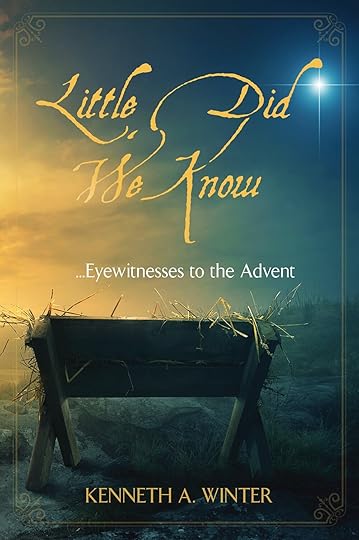
This story is taken from Little Did We Know , a collection of twenty-five short stories for the Advent season. The book is available through Amazon in standard print, large print, and for your Kindle or Kindle app. It is also available as an audiobook. Click HERE for more information on how you can obtain your copy.
* * * * *
(1)Matthew 2:2 (ESV)
(2)Matthew 2:5-6 (ESV)
(3)Matthew 2:8 (ESV)
Copyright © 2022 Kenneth A. Winter All rights reserved.
Photo by LUMO-The Gospels for the visual age on Lightstock
December 14, 2022
An Advent Story (Part 3) – Eliezer the cousin
If you would prefer to listen to this post as a podcast, CLICK HERE.
* * * * *
NOTE : This is the third of four stories i am posting for this Advent season about the incarnational birth of Jesus. These are fictional first-person accounts of the events that surrounded His birth. Though some of the characters and details contained in these stories are fictional, you will find the truth they convey to be very REAL!
Part 1 as told by Jacob the elder (November 30th)
Part 2 as told by Clopas the uncle (December 7th)
Part 3 as told by Eliezer the cousin (This week - December 14th)
Part 4 as told by Annas the scribe (December 21st)
This week you will hear from a fictional character by the name of Eliezer. He is the son of Joseph’s fictional cousin, Achim. Achim, his wife Miriam, and all their family reside in Bethlehem. You heard about some of what Mary and Joseph encountered last week from Clopas. So let’s continue with the advent story through his eyewitness account.
* * * * *
I am Achim and Miriam’s youngest son, Eliezer. My parents named me after the prophet who boldly rebuked our ancestor King Jehoshaphat near the end of his life for aligning himself with King Ahaziah of Israel in disobedience to God. The prophet had bravely proclaimed truth even though it was unpopular, and my parents wanted me to be mindful to always do the same.
My wife Tamar, my infant son, Daniel, and I live here in the home of my parents. Both of my brothers and their families live here, too. After I became betrothed to Tamar, my father and I built a room on the second floor of our home so she and I would have a space of our own after we were married. I was proud to bring Tamar into our home after the wedding feast.
Daniel is now one year old. We’re already talking about building another room for him and his future brothers. This home has grown a lot since my brothers and I were young boys sharing one room.
Like my father and my two older brothers, I am a carpenter. Currently all four of us are working for the temple priests in Jerusalem. We are adding rooms to their administrative quarters on the Royal Porch. Even though the reconstruction work of the temple under King Herod the Great was completed a few years ago, there are always additions and changes that the priests want made.
As long as the temple treasury is able to pay us, we are more than happy to oblige. I am grateful that we are able to leave for Jerusalem just before sunrise each day, get in a good day’s work, and still be back home with our families in time for our evening meal. Occasionally we stay in Jerusalem overnight, but we try to avoid that as much as possible.
For weeks, my parents and the rest of us busily made preparations for the arrival of our extended family coming to town to register for the census. It was hard to believe that such a mundane thing as a government census could bring so much joy. And I would add that is the only joy that Roman rule has brought us!
My parents were particularly glad that my father’s cousin Joseph would be with us. They spoke of it on several occasions. In preparation, we had built an additional room on the third floor of our home just for him. It would also be used by our expanding family in the days ahead – but Joseph would be the first guest to sleep in the room. I had met him when I was a young boy, and I had seen him last spring in Jerusalem for Passover. I was looking forward to getting to know him better.
That’s why I was so surprised when one night my father told us that Joseph wouldn’t be staying with us. One of our other guests mentioned that he had seen Joseph’s brother Clopas. Clopas and his wife, Mary, were staying in the home of her sister – one of our other family members. My father didn’t give any explanation for Joseph’s absence. He and my mother glanced at each other, but nothing more was said.
That night as the rest of our guests arrived, my father insisted on stabling their animals. My brothers and I offered to help, but he would not hear of it. It seemed odd, but we knew that our father always had a reason for everything he did, so we said nothing more. We helped our guests get settled in their rooms. We had moved all of our children together so there was just enough room. We even had one room left over – the one that had been intended for Joseph.
The next day, I sensed tension between my parents. I decided it must be the stress of hosting so many people, even though that seemed out of character. We all made our way to our local synagogue to register for the census.
As I was leaving home, the shepherd’s son Shimon stopped me and asked about the family who had been in our stable the night before. I told him I didn’t know who he was talking about. There hadn’t been anyone in our stable to the best of my knowledge. He was adamant and kept asking me their names and where they had gone. I told him I had no idea who he was talking about. Eventually, he left.
When I arrived at the synagogue, I noticed someone had written “Joseph, son of Jacob, from Nazareth” in the registry. By his name was written, “his wife Mary and newborn son, Jesus.” I was certain that wasn’t our cousin Joseph because he wasn’t married yet – but I wondered who this could be.
I saw our cousin Clopas and went over to greet him. His young son James was with him. I asked about his brother Joseph, but Clopas explained he had unexpectedly been called away shortly after they arrived in town. So, I asked him to pass along my regards and that I regretted not being able to enjoy Joseph’s company.
About a week later during dinner, Tamar mentioned to my mother that she thought she had heard a baby crying on the third floor. I immediately commented with a chuckle that I kept hearing cries coming from all over our home. Between our guests and their infants, as well as my brothers’ families, there was no shortage of crying babies in our home these days.
“It’s difficult to tell from where all the cries are coming,” my mother responded. “But each one is a delight.” And then she changed the subject.
Another month passed. The census registration was completed. All of our guests had long since departed for home, and our lives had returned to normal. The temple priests kept adding to the work they wanted us to do on the administrative quarters. They demanded we have one of the rooms finished the next day. That meant one of us would need to stay in Jerusalem and work through the night. My father and brothers had already stayed, so I agreed it was my turn. I told them goodbye and continued with my work.
After several hours, I needed to get some fresh air. I walked through the Court of the Gentiles. Only a handful of people were walking around this time of night, but I came upon an older man who appeared to be praying. He looked familiar, and as I came closer, I realized it was Joseph. He was praying earnestly and didn’t notice me. As much as I wanted to speak with him and learn if everything was okay, I did not want to interrupt his prayer time.
I waited for a while, but he continued praying. I went back to work but regretted not being able to talk with him. I, like the rest of my family, was concerned for him. The next morning, I told my father and brothers about seeing Joseph. My father did not seem that interested, so the conversation went no further.
Normally, this would not have seemed odd except for what happened last evening. As usual, our household had retired early for the night. But I was restless and couldn’t sleep. I heard a quiet knock at the entry to our home. I was preparing to answer it when I heard my father say, “Greetings, strangers. What is your business here?”
The response was somewhat muffled. I saw my mother step from behind my father and tell the visitors to follow her. What I saw next amazed me! It was a regal processional dressed in colorful, royal attire. There were about a dozen men, plus servants. The servants did not enter at first but were later summoned to bring in three chests that appeared to be heavy. My mother quietly led the men up to the empty room on the third floor.
My father did not join them, but it was obvious he was curious why they had come. I was surprised that he allowed these men to enter our home and follow my mother. The two of them obviously knew something I did not. And I was going to remedy that. I decided to keep a watchful eye on them!
Only a few of the men could fit in the room at one time. As my mother opened the door, the light of a solitary lamp spilled out into the hallway. Initially, the first three men stood quietly with rapt attention focused on something – or someone – in the room. Within a matter of moments, these stately men fell to their knees and bowed their heads as if to worship. They remained kneeling for a while before they called for their servants to bring in the chests they had brought.
When the first chest was opened the sweet fragrance of frankincense began to waft out of the room. I had only smelled the fragrance once before. It was not common in our circles. But soon the soothing richness of its scent permeated our entire home. Next, they opened a chest that glistened in the lamp light. It was a chest filled with gold! They obviously were presenting these gifts to someone. But who was it? And why were they in our upper room?
They subsequently opened a chest with a third gift. It, too, emitted a fragrant scent. I had encountered this scent before. It was commonly used to prepare a body for the grave or for medicinal purposes. This chest was filled with myrrh. After the gifts were presented, the first three men stepped out of the room so the next three could enter. Each group lingered on their knees for a while before exiting, until finally all of the visitors had been in the room.
The room was silent until I heard a woman’s voice – a voice that was not familiar to me. She asked the men how they had found the child. So, there was a child in the room! Tamar had heard a baby crying! And these men had come to worship this baby! But, who was this child?
The visitors explained how they had followed a star. I had noticed a bright light in the sky, but I did not think it was unusual. But now these men were saying that the star led them to our home!
Eventually the men left, and my mother ushered them outside. The door to the upper room, however, remained open. I stepped out of my hiding place and walked to the open doorway. As I peered in, I saw a young woman holding a baby. The child was no older than six weeks. The mother looked up at me and, with a quiet nod, gave me permission to enter.
As I walked toward them, I immediately knew this was not just any child. I was immediately impressed that I needed to kneel. I didn’t know who He was, but I knew He deserved my reverence.
Just then, I heard someone else enter the room. As I looked back, I saw it was my father. Slowly and reverently, he walked into the room. When he came closer, he also fell to his knees. And then he began to weep. Quietly at first, but then he began to cry uncontrollably.
“I am so sorry, Mary,” he said between sobs. “I am so sorry I did not believe you and Joseph. I have thought and spoken evil of you, when all you two did was be faithful servants to our God. I refused you entry into my home! I refused entry to the child of the Living God! I turned my back on you – and Him! Mary, please forgive me!” Then he turned his gaze on the baby and said, “My God, please forgive me!”
My mother entered the room and quickly knelt beside my father, embracing him. Then we all bowed before the baby. I asked His name. “Jesus,” Mary replied. I immediately remembered the entry I had seen on the census registration.
By now, our entire household was awake. I looked around and saw Tamar, my brothers and their wives, as well as some of the older children. Tamar came and knelt beside me. We couldn’t all fit in the room. Some of the family spilled out into the hallway, but we all gathered in worship.
Mary told us the story of how the angel Gabriel had come to her. She told us about the events that had led to today, including the visits from the shepherds and the magi. God had heralded the birth of His Son, right here in our midst – and we hadn’t had eyes to see or hearts to receive – until now!
My mother embraced Mary, as did Tamar and my two sisters-in-law. Each one took turns holding the baby and gazed into His welcoming eyes. We all knew our lives would never be the same. It was a night that will forever be etched in our hearts.
Joseph arrived early the next morning. Mary’s days of purification were now complete. It was time for them to go to the temple in Jerusalem and bring their offerings for purification and redemption. From there, they would return home.
Joseph and my father embraced as my father wept and spoke quietly in his ear. It would be several days before we all knew what had truly transpired. But whatever the misunderstandings were, it appeared that hearts had been mended. However, we regretted not having more time to spend with Mary and Jesus. We were all sad to see them leave.
Since my father, brothers, and I were also headed to Jerusalem, we traveled with Joseph and his family to the temple. My father gave Joseph one of our donkeys so they could transport the gifts from the magi. We embraced and then left them to continue to the temple. As we parted, we promised to see one another in the spring in Jerusalem for the Passover.
Little did I know that we would not see each other at the next Passover. God had a different journey planned for His Son.
* * * * *
You can listen to the audiobook version of this story as narrated by Kyle Bullock by tuning into this week’s episode of my podcast by CLICKING HERE .
This story is taken from Little Did We Know , a collection of twenty-five short stories for the Advent season. The book is available through Amazon in standard print, large print, and for your Kindle or Kindle app. It is also available as an audiobook. Click HERE for more information on how you can obtain your copy.
* * * * *
Copyright © 2022 Kenneth A. Winter All rights reserved.
Photo by LUMO-The Gospels for the visual age on Lightstock
December 7, 2022
An Advent Story (Part 2) – Clopas the uncle
If you would prefer to listen to this post as a podcast, CLICK HERE.
* * * * *
NOTE : Starting last week and continuing for the next two weeks, i am posting a total of four stories about the incarnational birth of Jesus. They are fictional first-person accounts of the events that surrounded the advent of Jesus. Some of the characters and details contained in each story are fictional, but you will find the truth they convey to be very REAL!
My prayer is that through the stories you are reminded of the Good News of the Advent this Christmas season. To that end, let’s look at each part of this story through the eyes of four very different eyewitnesses:
Part 1 as told by Jacob the elder (November 30th)
Part 2 as told by Clopas the uncle (This week – December 7th)
Part 3 as told by Eliezer the cousin (December 14th)
Part 4 as told by Annas the scribe (December 21st)
This week you will hear from Clopas the uncle. Some historians and scholars believe that Clopas was the younger brother of Joseph, and as such, he would have had a unique perspective on the events that were unfolding. So let’s continue with the advent story through his eyewitness account.
* * * * *
My name is Clopas. I am the son of Jacob the carpenter, and the younger brother of Joseph. I was born in Cana of Galilee and lived there for much of my life.
When I was sixteen years old, carpentry work was becoming difficult to find in Cana. My brother relocated to Nazareth while I remained in Cana with our father. Jehovah God continued to provide my father and me with enough work so we could keep food on our table.
When I was twenty-eight, I married a beautiful young woman named Mary. My brother and I must have similar tastes in women since our wives share the same name!
One year later, God blessed my wife and me with a son we named James. Even when he was young, we could tell he was going to be short-statured as an adult. Since he was shorter than other boys his age, he earned the nickname James the Less. But what he lacked in height, he more than made up for in brawn. He has always been a great helper to me in my work!
When James was five, we traveled to Nazareth to meet up with my brother Joseph so we could all travel together to Jerusalem for the Feast of the Passover. This was the first observance of Passover since our father died, so we all wanted to be together.
We were more than surprised to learn that Joseph was betrothed. We had met Mary and her father on previous visits to Nazareth, but we never imagined Joseph and Mary would marry because of their age difference. Though we were surprised, we also were grateful to hear the news. Joseph was filled with joy again – something that had been absent from his life since his wife, Rebekah, died.
Mary was currently in Hebron so her father, Eli, would be joining us in our travels to Jerusalem. Even though I missed our father’s company as we made the journey, Joseph’s glee helped to lighten my heart. I enjoyed watching the brother-like relationship that had developed between Joseph and his future father-in-law. Their friendship had obviously deepened.
We enjoyed our time in Jerusalem and had even briefly visited our cousin, Achim. Our time together passed quickly, and we all looked forward to coming back together again in December for Joseph and Mary’s marriage feast in Nazareth.
So imagine my surprise when in early May, just a few months later, Joseph and Mary paid us an unexpected visit in Cana. It had been over a year since I had last seen Mary, so nothing appeared unusual. I welcomed them into our home and invited them to sit down and rest from their travels as my Mary prepared refreshments.
After my wife rejoined us, Joseph explained that he and Mary had news to tell us. I looked over at my wife and she appeared to already know what this might be about.
“Soon after we announced our betrothal,” Joseph began, “an angel of the Lord came to Mary and told her that Jehovah God had chosen her, and the Spirit of God would come over her and she would conceive a child. The child will be the Son of the Most High God. He is the Messiah – whose coming the prophets foretold.
“Isaiah wrote that the Messiah would be born of a virgin – and now God has chosen Mary to be that virgin. Mary told her father and me about the angel’s visit after she returned from Hebron last month. By that time, she had been pregnant for three months.
“The messenger of God confirmed the message through Mary’s cousins, Zechariah and Elizabeth, and he has confirmed it to me through a dream. We know that she is the most blessed of women – but we also know how this has appeared to our neighbors. The angel confirmed that I should bring her into my home as my wife. And I have done so. However, we will not consummate our marriage until after the child is born.
“You are my closest family, so we wanted you to know and understand as soon as possible. We know how shocking this all sounds. We both have experienced that shock firsthand ourselves. So, feel free to ask us any questions you might have.”
I know my brother – and I know him to be an upright man of integrity. I know that he loves God and strives to stand righteous before Him. I know that my brother will not lie about his own actions or anyone else’s. His word was all I needed to hear to know that what he told us was the truth.
So, I looked at my brother and his wife and said, “We join together with you in praising Jehovah God for His faithfulness in sending His Messiah, for His mercy in allowing us to now sit here in the baby’s presence, and for His grace in the way He is enabling you to walk through this with Him. Mary, you truly are blessed by God above all other women. And Joseph, our God has chosen well to choose you to be the earthly father to His Son.”
We all embraced and spent the remainder of our time together rejoicing and praising God. Two days later, Joseph and Mary returned to Nazareth. As the days went by, my wife and I knew our lives would be different in light of this news. We were to be an uncle and aunt to the Messiah. Our son, James, would be His cousin. How could we have ever supposed that God would allow an unknown family like us to bear witness to His Son in such a way? He is indeed a merciful and gracious God!
My wife and I are both of the tribe of Judah and the line of David. So, when Caesar decreed that every person needed to return to their ancestral home for the census, that meant we must return to Bethlehem. My wife’s sister and her husband live in Bethlehem, so we knew we would be expected to stay with them.
We also knew that Joseph, Mary, and Eli would be making the same journey. And we knew that the baby would soon arrive. We made arrangements to meet up with them in Nazareth and travel to Bethlehem together so we could be of help. When we arrived in Nazareth, we learned that Eli was ill and would not be making the trip. Gratefully, there were others remaining in the town who would care for him. So, the rest of us set out on the journey.
When we arrived in Bethlehem, we parted ways. Joseph and Mary went on to our cousin Achim’s home, while my wife and I continued on to my sister-in-law’s home. We were grateful for their hospitality. Their home was small, and other relatives had also come, so we made the best of the tight sleeping quarters and enjoyed the fellowship.
The next morning, Joseph came to my sister-in-law’s home to see me. He told me the baby had been born the night before. He said a group of angels had announced the birth to shepherds in the hills. He told me how they had come to worship the child. He was in awe of all that had occurred.
But he also told me that Achim had not taken the news of the baby well. Joseph and Mary had spent the night in the stable, but this morning Achim had agreed to allow Mary and the baby to stay in the house until her time of purification was complete.
“However,” Joseph said, “I am not welcome in their home. This morning I went to the synagogue and registered for the census. Now I am headed to Jerusalem to find work for the next few weeks until Mary’s time is completed.”
“Brother, I am so sorry that Achim has treated you this way,” I replied. “I would see if you could stay here in this home, but I know they have no room.”
“I know that Jehovah God has a divine plan in all of this,” Joseph responded. “So we will trust Him that He will use this to further His purpose in everyone’s lives.”
Joseph asked if we would go through Nazareth and check on Eli when we returned home. I told him we would. As we began our journey home, Mary and I talked about the way Joseph and his wife were being treated by family and by their neighbors. We decided we needed to move to Nazareth to help them and encourage them. There was really nothing to keep us in Cana any longer. We knew it was what God would have us do.
When we arrived in Nazareth, Eli was disheartened that Joseph and Mary would be delayed in their return, but he rejoiced in the news of the baby’s birth. I told him the baby’s name was Jesus. He was delighted to hear it and also seemed genuinely pleased about our decision to move to Nazareth. I realized we were not moving here to only encourage Joseph and Mary, we would also be encouraging Eli.
Two months later, we received a message from Joseph that an angel of the Lord had directed them to go to Egypt. They did not know when they would return.
Little did I know what that meant. Little did I know the journey that was before Him. Little did I know where it would lead. But I always knew, wherever the journey led, I would follow.
* * * * *
You can listen to the audiobook version of this story as narrated by Kyle Bullock by tuning into this week’s episode of my podcast by CLICKING HERE .
This story is taken from Little Did We Know , a collection of twenty-five short stories for the Advent season. The book is available through Amazon in standard print, large print, and for your Kindle or Kindle app. It is also available as an audiobook. Click HERE for more information on how you can obtain your copy.
* * * * *
Copyright © 2022 Kenneth A. Winter All rights reserved.
Photo by LUMO-The Gospels for the visual age on Lightstock
November 30, 2022
An Advent Story (Part 1) – Jacob the elder
If you would prefer to listen to this post as a podcast, CLICK HERE.
* * * * *
NOTE : As has become my annual practice, beginning today and for the next three weeks, i will be posting a total of four stories about the incarnational birth of Jesus. They are fictional first-person accounts of the events that surrounded the advent of Jesus. Some of the characters and details contained in each story are fictional, but you will find the truth they convey to be very REAL!
My prayer is that through the stories you are reminded of the Good News of the Advent this Christmas season. To that end, let’s look at each part of this story through the eyes of four very different eyewitnesses:
Part 1 as told by Jacob the elder (This week – November 30th)
Part 2 as told by Clopas the uncle (December 7th)
Part 3 as told by Eliezer the cousin (December 14th)
Part 4 as told by Annas the scribe (December 21st)
* * * * *
I am Jacob, the leading elder and rabbi in Nazareth. My father, Joazar, was sent from Jerusalem to this town by the Hasmonean high priest John Hyrcanus II to serve as the first leading elder of our town. Nazareth was one of the towns being established by the Hasmoneans in the uninhabited wilderness. People were relocating here from other parts of Galilee in the quest to establish a new life in a land of greater opportunity.
Those coming were primarily uneducated farmers, vineyard workers, animal herders, and tradesmen. A local synagogue was the first building established in the center of our town and it was my father’s job to oversee its formation.
I was born soon after my parents arrived in Nazareth. While I was still a boy, my father took me to Jerusalem to be educated at the feet of the Sadducean rabbis. For a short while, I was also schooled under the teaching of the sage Hillel who became well-known for his statement: “That which is hateful to you, do not do to your fellow. That is the whole Torah, the rest is the explanation; now go and learn.”
My father raised me to be a Sadducee. Though the Sanhedrin in Jerusalem includes both Pharisees and Sadducees, the latter have enjoyed the favor of the Hasmoneans, as well as the Romans, because we esteem power and control over the finer details of doctrine. I share my father’s belief that power and prestige are definitely preferred over piety.
My education focused on the tenets of the law of Moses in a similar way to the Pharisees but dismissed the idea of our own immortality. I was raised to believe that there is no resurrection of the dead either for punishment or reward. Our actions, like our souls, stop at the grave. That means our actions today yield their own reward, and money and power are the most desirous of those rewards.
I soon understood that the law can be leveraged in a very convenient way to gain even greater power and control. I studied diligently and modeled the behaviors I witnessed in my father and my teachers. It equipped me for my return to Nazareth to follow my father as the lead elder.
While in Jerusalem, I also experienced the disdain that people in Judea held for Galileans. The people of Galilee were considered uneducated, unsophisticated, and ordinary. When I told people I was born in Nazareth, many asked, “Can any good thing come out of Nazareth?” I soon learned to say my family came from Jerusalem. That statement received greater respect no matter where I was in Judea or Galilee.
As a matter of fact, my father arranged my marriage to the daughter of a Sadducean leader in Jerusalem in order to further build up my social pedigree. I knew from a young age that everything was about outward appearance – and that includes our religious practices. Do not give an offering without making sure that others see you give. Do not pray if others cannot hear you. Do not help someone unless you know they can do something for you in return.
Nazareth is a small town, so it is fairly easy to stay abreast of all the news. I am in the most powerful role in our town. I am fully aware that knowledge is power, so I work to stay informed under the guise of my spiritual leadership of the people. My role as rabbi and elder gives me the ability to use that knowledge to lead our people to think and act in a way that best suits me.
Eli the carpenter lives in our town. His father, Matthat, arrived in Nazareth at the same time as my father. He was one of the main craftsmen responsible for building our synagogue. Matthat was a skilled worker, known for his kindness and humility. The same is true of Eli.
Eli’s now deceased wife bore him a daughter named Mary. She was a pleasant girl who showed great strength of character and compassion as she grew. As I watched Mary come of age, I knew she would be a much sought-after prize for our eligible young men. So, I was surprised last year when Eli announced her betrothal to Joseph the carpenter. The day of the wedding feast was set for one year later.
Joseph is about the same age as Eli and also a widower – his wife died soon after Eli’s wife. I knew that Eli and Joseph were good friends, but I never expected Eli to select Joseph to be his daughter’s husband. And I was not alone. I overheard several conversations at the synagogue about that very subject. Between Joseph’s age and his limited prospects, many of Eli’s neighbors thought he could have done much better in selecting a husband for his daughter.
A few weeks after the betrothal was announced, Mary left Nazareth. It was all arranged very quickly. We heard she was going to visit her cousin. Eli arranged for her to join a caravan of merchants traveling to Hebron. He told me Mary was going to provide a helping hand to her elderly cousin who was expecting her first child.
Three months later, Mary returned home. Two days after that, Joseph took her to be his wife. We were all surprised, but if that is what they decided to do, we would accept it.
But we soon discovered that Mary was with child – and the midwife told me she was a little more than three months along in her pregnancy. That meant she was either pregnant just before leaving for Hebron or soon after arriving there. So that left people wondering whether Joseph and Mary had consummated their marriage before they took their vows – or if Mary had engaged in an adulterous act.
As the lead elder and rabbi of our town, it was my responsibility to find out which was the case. I sent word to Eli, Joseph, and Mary to come meet with me in the synagogue. When they arrived, Eli spoke first. “Rabbi, thank you for inviting us to come speak with you. We have planned to do so, but events have unfolded quickly. We want you and all of our neighbors to rejoice with us in our good news. So, please allow us to tell you what has occurred. Mary will speak first.”
But before Mary could speak, I said, “It is my duty to know what has transpired so the reputation of this synagogue and our citizens is in no way sullied. I have been told that Mary is more than three months pregnant, so events have not unfolded all that quickly. I need to determine if anything has occurred that dishonors God or this community. If anything untoward has happened, we will then discuss appropriate action. Mary, I caution you to be certain that you speak the truth.”
“The day before I departed for Hebron,” Mary began, “I was out walking alone in the vineyard when I was approached by one whom I now know to be an angel of the Lord named Gabriel. He told me, ‘You have found favor with God! You will conceive and give birth to a son. The Lord God will give Him the throne of His ancestor David. The Holy Spirit will come upon you, and the power of the Most High will overshadow you. The baby will be holy and He will be the Son of God.’”(1)
She then went on to tell me how the angel told her about her cousin becoming pregnant and relayed the story of how this same angel had spoken to the priest Zechariah. The angel said the priest’s son would be a messenger preparing the way for the baby in Mary’s womb.
Joseph confirmed that he and Mary have not consummated their marriage. She is – and will remain – a virgin until after the baby is born. Then he told me how this same angel had come to him in a dream. The angel told him the child in Mary’s womb had been conceived by the Holy Spirit. Joseph was not to be fearful about proceeding with his marriage to Mary. All of this was to fulfill the prophecy of the prophet Isaiah, “The virgin will conceive a Child.”(2)
Then Eli spoke up and told me how God had given him a peace that his daughter was to be the mother of the Messiah! “This is joyous news!” he said. “The Messiah for whom we have all waited for centuries will soon arrive! Yes, He is even here with us right now – in the womb of my daughter!”
They all looked at me with an exuberant joy on their faces. They were obviously expecting me to join in their celebration! And what’s more, I think they expected me to assemble the entire town to rejoice in their news!
But nothing could have been further from my mind! “I directed you to tell me the truth,” I said, “and all you have told me are these wild stories! You tell me of an angel coming to you, Mary, in a vineyard, and you, Joseph, in a dream. Who are you that an angel of God would come to you? Angels have not walked on this earth for hundreds of years, but you expect me to believe that one has come no less than three times, including to the old priest in the temple! If he had entered the temple, he would have appeared to the High Priest. If he had come to Nazareth, he would have appeared to me. He would not have come to uneducated people such as yourselves!
“Your story is preposterous! How could a virgin conceive a child? Either you all are naïve or have been bewitched by this girl! Or perhaps, Joseph, you decided not to wait for the year as announced but decided to consummate the marriage sooner. And if so, that is your prerogative if you and Eli have come to that agreement. But don’t make up this wild story to cover up your impatience!
“And do not attempt to justify your story by tying it to a questionable prophecy from Isaiah. You know our Hasmonean leaders dispute the veracity of his prophecies, and they deny the belief that the Messiah will be a descendant of David. You have used statements that no one believes to try and justify your lie! How dare you dishonor God and dishonor me by saying these things! This is blasphemy!”
“We have told you the truth!” Eli countered. “The Spirit of God will confirm that truth to you if you seek Him in prayer – just as we have done!”
I could no longer control my anger. “How dare you speak to God’s anointed in that way!” I shouted. “Joseph has said he and Mary have not consummated this marriage. Either he is lying, or Mary has committed adultery with another man. The idea that the Spirit of God has come upon her is preposterous! There are no witnesses to indicate that she has committed adultery. I can only conclude that the two of you have had relations – as is your right – and the baby is a product of that act.
“I will not allow you to tell your outrageous story to the people of this town! If you do, I will denounce it as heresy and call into question whether Mary is an adulteress who deserves to be stoned to death. Otherwise, we will let the people believe that you have terminated your one-year betrothal period and consummated your marriage. There will be no wedding feast!”
I then got up and walked out of the room. As I did, I shook my robes to reflect my disdain for their actions and their words. As they watched me leave, I saw their hurt and disbelief.
In the days that followed, whenever I encountered anyone speaking in hushed tones about Mary, Joseph, or the child in her womb, I would simply look down piously and shake my head. My displeasure and disapproval were obvious from my response – and I would never breathe a word of any of the heresy they had uttered to me. Most people kept them at a distance for the weeks and months that followed.
Several months later, Caesar Augustus announced that a census was to be taken. Everyone was to return to their ancestral hometown to be counted. Nazareth was not anyone’s ancestral hometown, so everyone would be leaving for the census. When it came time, there were a few people who were either too weak or too ill to travel. They remained in town, together with our midwives who would care for them. Eli was one of those who was sick. I couldn’t help but wonder if God was punishing him for his part in the deception.
As I watched Joseph and Mary leaving to make their way to Bethlehem, I again thought about what they had told me. Surely it was all lies. God wouldn’t choose to send His Messiah through a nobody from Nazareth of all places! Would He?
Little did I know the truth. And little was I wanting to know the truth. I would go to my grave with my heart closed off to the truth ….
* * * * *
You can listen to the audiobook version of this story as narrated by Kyle Bullock by tuning into this week’s episode of my podcast by CLICKING HERE
This story is taken from Little Did We Know , a collection of twenty-five short stories for the Advent season. The book is available through Amazon in standard print, large print, and for your Kindle or Kindle app. It is also available as an audiobook. Click HERE for more information on how you can obtain your copy.
* * * * *
(1) Luke 1:30-32, 35 (NLT)
(2) Matthew 1:23 (NLT)
Copyright © 2022 Kenneth A. Winter All rights reserved.
Photo by LUMO-The Gospels for the visual age on Lightstock
November 23, 2022
Only One Gave Thanks
If you would prefer to listen to this post as a podcast, CLICK HERE.
* * * * *
This week in the U.S., we celebrate Thanksgiving Day. It’s the one day set apart on our calendars to give thanks to God for the many blessings He has given to us. But as we busily prepare for a good meal, and/or time together with friends and/or family, are we truly stopping to give thanks? Have we become so distracted by all that is going on around us, and so consumed with what is taking place in our lives, that we now fail to turn to the One to whom all thanksgiving is due?
Allow me to hastily acknowledge that our thanksgiving to God should never be limited to one day on our calendar, it should be a daily acknowledgement of Him and to Him. But is it? Do we truly stop to give Him thanks? i wonder if i have stopped short of being thankful. i’m grateful for what i have – family, friends, health, strength, possessions and provision (no matter how much or little it might be), and so forth. But am i truly thankful to the One who has provided it all? Or, have i settled for being grateful instead of being thankful?
i believe there is a distinction between gratitude and thanksgiving. Please allow me to explain. Luke records a day of thanksgiving that occurred approximately 2,000 years ago. He writes:
As Jesus continued on toward Jerusalem, He reached the border between Galilee and Samaria. As He entered a village there, ten lepers stood at a distance, crying out, “Jesus, Master, have mercy on us!” He looked at them and said, “Go show yourselves to the priests.” And as they went, they were cleansed of their leprosy. One of them, when he saw that he was healed, came back to Jesus, shouting, “Praise God!” He fell to the ground at Jesus’ feet, thanking Him for what He had done. This man was a Samaritan. Jesus asked, “Didn’t I heal ten men? Where are the other nine? Has no one returned to give glory to God except this foreigner?” And Jesus said to the man, “Stand up and go. Your faith has healed you.”(1)
Jesus had just raised Lazarus from the dead. He was continuing on toward Jerusalem and the impending cross. But like many of Jesus’s journeys, His path was not dictated by what made the most sense geographically. His path was set by the Father, and the encounters He chose for Jesus to have. On this particular day, the Father chose for Jesus to encounter ten men.
This was a diverse group of men. At least one was a Samaritan and certainly some of the others were Galileans. It’s probable there was even a Judean in their midst. They were a group of men from different cultures, different beliefs, and different races. In normal circumstances, they would probably have never come together. But they had become united by an affliction. They were ostracized from the rest of civilization by their leprosy – and united in the fact that they would live out whatever remained of their lives in this debilitating state.
Then one day – along came Jesus! He had become well known across the region. Word of His miracles had spread like wildfire. These men knew that if they had any chance of escaping their leprous fate – Jesus was it. So, they cried out to Him – and Jesus showed mercy upon them.
Suddenly these men who had been united by their disease were now united in their faith. They so trusted Jesus that when He told them to go and show themselves to the priests, they stepped out even though they had not yet been healed. Their healing didn’t occur until they had begun their journey. They stepped out by faith – believing that what Jesus had promised would come to pass. These truly were men of faith – and their faith was rewarded, in that each and every one of them was physically healed. These men who had been united in disease and united in faith had now become united in their healing.
How many were grateful for their healing? Each and every one of them experienced the feeling of gratitude! They were no longer destined to a life of misery and agony. They were no longer to be separated from family and friends. They were no longer subject to living a life of despair. They had been set free! And each and every one of them was ecstatic and grateful!
But here is where their paths diverged. For nine of the men, their path of gratitude led to celebration and restoration with family and friends once they had been declared clean by the priests. They pressed forward to the better days that were ahead and never gave another thought to the One who had made them whole. Only the Samaritan returned with a heart overflowing to express thanksgiving and worship to the One who had transformed his life. Only the Samaritan returned to give glory to God. Only the Samaritan demonstrated a heart of complete surrender and thanksgiving. And, as a result, only the Samaritan experienced the cleansing of his sin and continued his journey in an intimate relationship with Jesus.
Ten lepers leapt, but only one gave thanks.
Ten lepers were healed, but only one was cleansed.
Ten lepers encountered Jesus, but only one followed Him.
You see, gratitude is a feeling, but thanksgiving is an action. As we approach Thanksgiving Day, are we like the nine – content to be grateful for our blessings – or are we like the one – worshipping the One who is due all worship – surrendered to Him with a heart overflowing with perpetual thanksgiving? How often do we bombard heaven with our petitions, but fail to express thanks for the answers we’ve received? Let’s not forget to give glory and thanksgiving to the One to whom it is due! As we walk with the Master, let’s be sure to be like the one.
* * * * *
Portions of this post are taken from Walking With The Master , chapter 58, entitled “Ten Lepers Leapt” This fourth book in the Lessons Learned In The Wilderness series is available through Amazon in print or for your e-reader. Click HERE for more information on this book.
* * * * *
(1) Luke 17:11-19 (NLT)
Copyright © 2022 Kenneth A. Winter All rights reserved.
Photo by Pamela Maxwell on Lightstock