
Kenneth C. Davis's Blog, page 100
November 15, 2012
Don’t Know Much About® Secession?
Since 1892, we’ve been making our schoolchildren say these eloquently simple words: “one Nation indivisible, with liberty and justice for all.” (The “under God” phrase was added in 1954.)
But in the wake of last week’s election, the seemingly sacrosanct Pledge of Allegiance has been shunted aside in a small tsunami of calls for secession –negating the Pledge and dividing the nation.
Secession petitions from a score of states, including one from Texas signed by some 23,000 people, have attracted national attention –even from the White House. Some Americans, unhappy over the election results, want out of the Union. Social media and the press have been filled with stories about the allure of secession.
While these entreaties are perfectly constitutional under the First Amendment’s “right to petition,” this storm surge of secessionist sentiment begs a simple question: Can they do it?
A war fought 150 years ago, and leading to the deaths of approximately 2% of the American population, was thought to have settled that question.
Before that war began, Abraham Lincoln addressed secession in his first inaugural address in March 1861:
“Perpetuity is implied, if not expressed, in the fundamental law of all national governments. It is safe to assert that no government proper ever had a provision in its organic law for its own termination. Continue to execute all the express provisions of our National Constitution, and the Union will endure forever, it being impossible to destroy it except by some action not provided for in the instrument itself.”
But the thread of an “indivisible” Union stretches back farther. During the “nullification” crisis in 1832, Andrew Jackson once said if a state could leave the Union, the Constitution was a “rope of sand.” Jackson’s Proclamation Concerning Nullification, written by Secretary of Sate Edward Livingston, stated:
“Secession, like any other revolutionary act, may be morally justified by the extremity of oppression; but to call it a constitutional right, is confounding the meaning of terms, and can only be done through gross error, or to deceive those who are willing to assert a right, but would pause before they made a revolution, or incur the penalties consequent upon a failure.”
And when the very ratification of the Constitution was being debated 225 years ago, and with it the “right to withdraw,” Alexander Hamilton argued in Federalist 6 that disunion was impractical and historically disastrous.
“A man must be far gone in Utopian speculations who can seriously doubt that, if these States should either be wholly disunited, or only united in partial confederacies, the subdivisions into which they might be thrown would have frequent and violent contests with each other. To presume a want of motives for such contests as an argument against their existence would be to forget that men are ambitious, vindictive, and rapacious. To look for a continuation of harmony between a number of independent, unconnected sovereignties in the same neighborhood, would be to disregard the uniform course of human events, and to set at defiance the accumulated experience of ages.”
But the simple answer to the question of “Can states secede?” is, constitutionally speaking, “No.”
In 1869, the Supreme Court issued a decision in Texas v White, a case related to bonds issued by Texas during the Civil War. In the majority decision, Salmon Chase, who had been Lincoln’s wartime Treasury Secretary, wrote:
“Considered therefore as transactions under the Constitution, the ordinance of secession, adopted by the convention and ratified by a majority of the citizens of Texas, and all the acts of her legislature intended to give effect to that ordinance, were absolutely null. They were utterly without operation in law. The obligations of the State, as a member of the Union, and of every citizen of the State, as a citizen of the United States, remained perfect and unimpaired. It certainly follows that the State did not cease to be a State, nor her citizens to be citizens of the Union.” (Emphasis added)
The Constitution, to oversimplify, is like any contract. Or marriage. One party can’t opt out without the consent of the other party or parties.
No, not even Texas – where some claim a legendary “right” to secede—has a Constitutional leg to stand on. Other commentators throughout history have argued that there is only one way out for “dissatisfied countrymen” –in Lincoln’s phrase—and that is revolution.
So for those seeking to leave the Union, there is the “Romney option” –self-deportation. Or as patriotic Americans often said during the Vietnam era, “Love it or leave it.”
Read more about the secession crisis in America before the Civil War in  Don’t Know Much About® the Civil War and the response of Jackson and Lincoln in Don’t Know Much About the American Presidents[image error]


November 12, 2012
Who Said it 11/12/12
Abraham Lincoln, from the Gettysburg Address, delivered November 19, 1863 (Source: Avalon Project-Yale Law School)
Fourscore and seven years ago our fathers brought forth on this continent a new nation, conceived in liberty and dedicated to the proposition that all men are created equal. Now we are engaged in a great civil war, testing whether that nation or any nation so conceived and so dedicated can long endure. We are met on a great battlefield of that war. We have come to dedicate a portion of that field as a final resting-place for those who here gave their lives that that nation might live. It is altogether fitting and proper that we should do this. But in a larger sense, we cannot dedicate, we cannot consecrate, we cannot hallow this ground. The brave men, living and dead who struggled here have consecrated it far above our poor power to add or detract. The world will little note nor long remember what we say here, but it can never forget what they did here. It is for us the living rather to be dedicated here to the unfinished work which they who fought here have thus far so nobly advanced. It is rather for us to be here dedicated to the great task remaining before us–that from these honored dead we take increased devotion to that cause for which they gave the last full measure of devotion–that we here highly resolve that these dead shall not have died in vain, that this nation under God shall have a new birth of freedom, and that government of the people, by the people, for the people shall not perish from the earth.
Read more about the Gettysburg Address at Our Documents (National Archives) and 273 Words to a New America (Library of Congress)
November 11, 2012
11-11-11: Don’t Know Much About Veterans Day–The Forgotten Meaning
The eleventh hour of the eleventh day of the eleventh month.
On Veterans Day, a reminder of what the day once meant and what it should still mean. (This is a repost of a piece written for Veterans day in 2011. The meaning still applies.)
That was the moment at which World War I largely came to end in 1918. One of the most tragically senseless and destructive periods in all history came to a close in Western Europe with the Armistice –or end of hostilities between Germany and the Allied nations — that began at that moment. Some 20 million people had died in the fighting that raged for more than four years since August 1914. The complete end of the war came with the Treaty of Versailles in June 1919.
The date of November 11th became a national holiday of remembrance in many of the victorious allied nations –a day to commemorate the loss of so many lives in the war. And in the United States, President Wilson proclaimed the first Armistice Day on November 11, 1919. A few years later, in 1926, Congress passed a resolution calling on the President to observe each November 11th as a day of remembrance:
Whereas the 11th of November 1918, marked the cessation of the most destructive, sanguinary, and far reaching war in human annals and the resumption by the people of the United States of peaceful relations with other nations, which we hope may never again be severed, and
Whereas it is fitting that the recurring anniversary of this date should be commemorated with thanksgiving and prayer and exercises designed to perpetuate peace through good will and mutual understanding between nations; and
Whereas the legislatures of twenty-seven of our States have already declared November 11 to be a legal holiday: Therefore be it Resolved by the Senate (the House of Representatives concurring), that the President of the United States is requested to issue a proclamation calling upon the officials to display the flag of the United States on all Government buildings on November 11 and inviting the people of the United States to observe the day in schools and churches, or other suitable places, with appropriate ceremonies of friendly relations with all other peoples.
Of course, the hopes that “the war to end all wars” would bring peace were short-lived. By 1939, Europe was again at war and what was once called “the Great War” would become World War I. With the end of World War II, there was a movement in America to rename Armistice Day and create a holiday that recognized the veterans of all of America’s conflicts. President Eisenhower signed that law in 1954. (In 1971, Veterans Day began to be marked as a Monday holiday on the third Monday in November, but in 1978, the holiday was returned to the traditional November 11th date).
Today, Veterans Day honors the duty, sacrifice and service of America’s nearly 25 million veterans of all wars. We should remember and celebrate those men and women. But lost in that worthy goal is the forgotten meaning of this day in history –the meaning which Congress gave to Armistice Day in 1926:
to perpetuate peace through good will and mutual understanding between nations …
inviting the people of the United States to observe the day … with appropriate ceremonies of friendly relations with all other peoples.
The Veterans Administration website offers more resources on teaching about Veterans Day.
Read more about World War I and all of America’s conflicts in Don’t Know Much About History and Don’t Know Much About the American Presidents
[image error]
Don’t Know Much About History (Anniversary Edition, paperback)
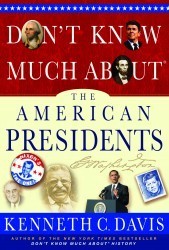
Don’t Know Much About® the American Presidents-now available in hardcover and eBook and audiobook
November 5, 2012
Who Said It 11/5/12
All will, of course, arrange themselves under the will of the law, and unite in common efforts for the common good. All, too, will bear in mind this sacred principle, that though the will of the majority is in all cases to prevail, that will to be rightful must be reasonable; that the minority possess their equal rights, which equal law must protect, and to violate would be oppression. Let us, then, fellow-citizens, unite with one heart and one mind. Let us restore to social intercourse that harmony and affection without which liberty and even life itself are but dreary things. And let us reflect that, having banished from our land that religious intolerance under which mankind so long bled and suffered, we have yet gained little if we countenance a political intolerance as despotic, as wicked, and capable of as bitter and bloody persecutions . . . . We have called by different names brethren of the same principle. We are all Republicans, we are all Federalists.
Thomas Jefferson. First Inaugural Address (March 4, 1801) Source: Avalon Project at Yale Law School.
Jefferson’s first inaugural was delivered after the controversial, bitterly divisive and hard-fought election of 1800 in which Jefferson and Aaron Burr defeated President John Adams, but were tied in the electoral vote. The election was decided in the House of Representatives.
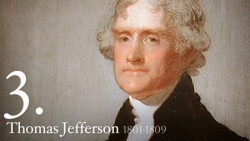
Thomas Jefferson, third president (Source: White House)
November 1, 2012
“It’s the economy, stupid.” Maybe not.

Former President Martin Van Buren (Photo Courtesy of Library of Congress)
Poor old Martin Van Buren, the eighth president –and the first born an American citizen– was also the first incumbent done in by a terrible economy. As I write for CNN.com,
America’s eighth president, Martin Van Buren, had the misfortune of occupying the White House during the Panic of 1837, one of the nation’s first and most severe economic downturns. Cast as “Martin Van Ruin” and attacked for his “lavish” White House expenditures and dandified style, Van Buren lost overwhelmingly in 1840 to William Henry Harrison by 234-60 electoral votes.
In this piece for CNN.com “Economy not key to incumbent winning” I explain how it is not always a simple question of pocketbook politics.
Don’t Know Much About® the American Presidents-now available in hardcover and eBook and audiobook
October 30, 2012
Don’t Know Much About® John Adams
The history of our Revolution will be one continued lie from one end to the other. The essence of the whole will be that Dr. Franklin’s electrical rod smote the earth and out sprang General Washington. That Franklin electrified him with his rod— and thenceforward these two conducted all the policies, negotiations, legislatures, and war.
—John Adams
Letter to Benjamin Rush, April 4, 1790
[image error]
John Adams Birthplace (Source: John Adams Historical Society)
Born today, October 30, 1735, the second president, John Adams.
Pity poor John Adams. When he wrote that slightly miffed, nose out-of- joint letter to his old friend and fellow Declaration- signer Dr. Benjamin Rush, he must have known he would play second fiddle to some of his contemporaries.
As lawyer, statesman, political theorist, and rebel leader he deserved better. Although he never led troops into battle, John Adams was one of the principal forces behind the drive for American independence, a fact some of the men who were there in Philadelphia acknowledged. Rush, the progressive Philadelphia physician and early outspoken abolitionist, told a friend, “Every member of Congress in 1776 acknowledged him to be the first man in the House.” Jefferson, with whom he would later have a sharp, ugly falling- out and then a gradual reunion, remembered that Adams was “the colossus of independence.”
He did not participate in the Constitutional debates— he was in En gland as America’s representative in 1787— but he had written a profoundly influential Massachusetts state constitution in 1779 and his earlier political works were also widely read and admired.
But throughout history, Adams always seemed to be pushed to the background— as if his complaint to Dr. Rush were prophetic. When we think Declaration, we think Jefferson. When we think “president,” John Adams is the only one of the first three presidents who is not
carved in stone on Mount Rushmore, and it is hard to find his likeness on any American currency. As America’s first vice president, an office he did not think very highly of, Adams was left out of Washington’s closest circle of advisers. Adams became president in a dawning era of hardball politics in which he would lose ground to more ambitious, and more ruthless, rivals.
Adams was a man of serious convictions and deep principles, a fact he proved as a young attorney when he defended some clients who today might be equated with murderous terrorists, the British soldiers charged in the “Boston Massacre.”
At their defense, Adams said:
Facts are stubborn things; and whatever may be our wishes, our inclinations, or the dictates of our passions, they cannot alter the state of facts and evidence: nor is the law less stable than the fact; if an assault was made to endanger their lives, the law is clear, they had a right to kill in their own defence; if it was not so severe as to endanger their lives, yet if they were assaulted at all, struck and abused by blows of any sort, by snow-balls, oyster-shells, cinders, clubs, or sticks of any kind; this was a provocation, for which the law reduces the offence of killing, down to manslaughter, in consideration of those passions in our nature, which cannot be eradicated. To your candour and justice I submit the prisoners and their cause.
How many Americans would admire such a lawyer today— or elect him president?
Though his presidency was limited to a single term, and he was done in by political rivals, Adams had revenge of sorts. He named John Marshall Chief Justice of the Supreme Court with long-lasting impact. And he got his own HBO miniseries!
Adams died, like Thomas Jefferson, on July 4, 1826, the fiftieth anniversary of the adoption of the Declaration of Independence.
You can find excellent resources about John Adams and his long, extraordinary life. at the National Park Service site of his home, Boston Massacre Trial Historical Society, the John Adams Historical Society.
And for more on the life and times of the second president, John Adams, read Don’t Know Much About the American Presidents.
Don’t Know Much About@ Halloween–The Hidden History
When I was a kid in the early 1960s, the autumn social calendar was highlighted by the Halloween party in our church. In these simpler day, the kids all bobbed for apples and paraded through a spooky “haunted house” in homemade costumes –Daniel Boone replete with coonskin caps for the boys; tiaras and fairy princess wands for the girls. It was safe, secure and innocent.
The irony is that our church was a Congregational church — founded by the Puritans of New England. The same people who brought you the Salem Witch Trials.
Here’s a link to a history of those Witch Trials in 1692.
Rooted in pagan traditions more than 2000 years old, Halloween grew out of a Celtic Druid celebration that marked summer’s end. Called Samhain (pronounced sow-in or sow-een), it combined the Celts’ harvest and New Year festivals, held in late October and early November by people in what is now Ireland, Great Britain and elsewhere in Europe. This ancient Druid rite was tied to the seasonal cycles of life and death — as the last crops were harvested, the final apples picked and livestock brought in for winter stables or slaughter. Contrary to what some modern critics believe, Samhain was not the name of a malevolent Celtic deity but meant, “end of summer.”
The Celts also saw Samhain as a fearful time, when the barrier between the worlds of living and dead broke, and spirits walked the earth, causing mischief. Going door to door, children collected wood for a sacred bonfire that provided light against the growing darkness, and villagers gathered to burn crops in honor of their agricultural gods. During this fiery festival, the Celts wore masks, often made of animal heads and skins, hoping to frighten off wandering spirits. As the celebration ended, families carried home embers from the communal fire to re-light their hearth fires.
Getting the picture? Costumes, “trick or treat” and Jack-o-lanterns all got started more than two thousand years ago at an Irish bonfire.
Christianity took a dim view of these “heathen” rites. Attempting to replace the Druid festival of the dead with a church-approved holiday, the seventh-century Pope Boniface IV designated November 1 as All Saints’ Day to honor saints and martyrs. Then in 1000 AD, the church made November 2 All Souls’ Day, a day to remember the departed and pray for their souls. Together, the three celebrations –All Saints’ Eve, All Saints’ Day, and All Souls Day– were called Hallowmas, and the night before came to be called All-hallows Evening, eventually shortened to “Halloween.”
And when millions of Irish and other Europeans emigrated to America, they carried along their traditions. The age-old practice of carrying home embers in a hollowed-out turnip still burns strong. In an Irish folk tale, a man named Stingy Jack once escaped the devil with one of these turnip lanterns. When the Irish came to America, Jack’s turnip was exchanged for the more easily carved pumpkin and Stingy Jack’s name lives on in “Jack-o-lantern.”
Halloween, in other words, is deeply rooted in myths –ancient stories that explain the seasons and the mysteries of life and death.
You can read more about ancient myths in the modern world in Don’t Know Much About Mythology
October 29, 2012
October 30-who said it
Facts are stubborn things; and whatever may be our wishes, our inclinations, or the dictates of our passions, they cannot alter the state of facts and evidence: nor is the law less stable than the fact; if an assault was made to endanger their lives, the law is clear, they had a right to kill in their own defence; if it was not so severe as to endanger their lives, yet if they were assaulted at all, struck and abused by blows of any sort, by snow-balls, oyster-shells, cinders, clubs, or sticks of any kind; this was a provocation, for which the law reduces the offence of killing, down to manslaughter, in consideration of those passions in our nature, which cannot be eradicated. To your candour and justice I submit the prisoners and their cause.
Speech by John Adams at the Boston Massacre Trail (Source:Boston Massacre Historical Society. Accessed October 29, 2012
John Adams was born on October 30, 1735
October 23, 2012
Don’t Know Much About® the American Presidents- Publishers Weekly *Starred Review
[image error]Publishers Weekly provides a “Starred Review” of Don’t Know Much About the American Presidents
In this presidential election year, bestselling author Davis (Don’t Know Much About History) returns with an absorbing take on the American presidency. Like his previous works, this hefty but breezy compendium offers brief assessments of America’s chief executives, accompanied here by quotes (often clipped from inauguration speeches), a timeline featuring key moments of their life and term(s) as president, and miscellaneous trivia about each commander-in-chief, concluding with a “final judgment” of their legacy complete with a letter grade. Of course some presidents (e.g., Washington, Lincoln, and FDR) get more in-depth coverage than others. (e.g., William Henry Harrison, Grover Cleveland) and Davis, not one to mince words writes in his assessment of Franklin Pierce: “Good looks, breeding, brains and piety do not a good president make.” Davis’s bipartisan analysis offers a refreshingly agnostic look at the fumbles, foibles and victories large and small that make up a presidential term. Loaded with dishy trivia (Gerald Ford was a male model, FDR tried to have “In God We Trust” removed from currency) and succinct analysis of pivotal events like Watergate, the election of Lincoln (“he most momentous [election] in American history”) and America’s involvement in WWI, Davis remains a highly informed, observant student of history eager to share his discoveries and knowledge.


