
Luanne Castle's Blog, page 10
October 21, 2023
Meet Dame Edith Sitwell
The gardener and I went to a lovely Halloween costume party. I wanted to go as Edgar Allen Poe with a raven on my shoulder. That would have been soooo cool. The gardener would have been my editor, which would have fit him just fine hahaha. But after looking at all the photos of Poe with that high tight collar I knew this hot-blooded person could not wear an outfit like that in Arizona.
I wanted another poet, but it needed to be somebody who lived to be as old as me, so Sylvia Plath was out. A friend suggested Edith Sitwell because she dressed eccentrically in turbans and caftans. She was a well-known British poet active in the 1910s to 1960s. She was an aristocrat and her two brothers were also poets. So I put together a costume as Dame Edith Sitwell, and the gardener dressed as Sir Osbert Sitwell. https://en.wikipedia.org/wiki/Edith_Sitwell

Of course, the gardener won’t let me post his photo on here ;). But here is an image of the vintage purse I carried (that belonged to his aunt) and the calling cards I had made! Just so you know how color-coordinated I was, the pattern of my caftan has lots of yellow from the waist down.

On the back side of the calling card it says: I will be working on my American accent this evening. [I don’t do accents.]
Here is a Sitwell poem from 1919:
At the FairI. Springing Jack
Green wooden leaves clap light away,
Severely practical, as they
Shelter the children candy-pale,
The chestnut-candles flicker, fail . . .
The showman’s face is cubed clear as
The shapes reflected in a glass
Of water—(glog, glut, a ghost’s speech
Fumbling for space from each to each).
The fusty showman fumbles, must
Fit in a particle of dust
The universe, for fear it gain
Its freedom from my cube of brain.
Yet dust bears seeds that grow to grace
Behind my crude-striped wooden face
As I, a puppet tinsel-pink
Leap on my springs, learn how to think—
Till like the trembling golden stalk
Of some long-petalled star, I walk
Through the dark heavens, and the dew
Falls on my eyes and sense thrills through.
II. The Ape Watches “Aunt Sally”
The apples are an angel’s meat;
The shining dark leaves make clear sweet
The juice; green wooden fruits alway
Fall on these flowers as white as day—
(Clear angel-face on hairy stalk:
Soul grown from flesh, an ape’s young talk!)
And in this green and lovely ground
The Fair, world-like, turns round and round
And bumpkins throw their pence to shed
Aunt Sally’s wooden clear-striped head.—
I do not care if men should throw
Round sun and moon to make me go—
As bright as gold and silver pence . . .
They cannot drive their black shade hence!


October 20, 2023
Winter Flowers: #TankaTuesday
This is the 2nd portion of the “Cold Dew” season for Colleen Chesebro’s #TankaTuesday challenge based on the 24 Japanese seasons.
At this time every year in Arizona, we pull out the “summer flowers,” the annuals that we plant in May. We replace them with “winter flowers.” Usually red geraniums are featured, as they are this year. In the last few years we have much fewer choices than we used to have. This year, we had even less choice–and the red geraniums don’t look very good. I hope they perk up once planted. Today is the day we plant!

The topic of my tanka is our winter flowers.
Our summer flowers
have drooped and browned by the house.
Today we release
them from the earth to make room
for winter’s colors.
I made up the kigo “winter flowers” because it is such a part of this season.
On another note, I heard yesterday that my poetry collection Rooted and Winged, which was a Book Excellence winner, is Runnerup in the PenCraft Book Awards 2023. Woot!!!!
On another note, I don’t know how about anybody else, but I am feeling very drained and saddened over world events. I am also horrified by the anti-Semitism rampant on Twitter/X. I’ve joined Bluesky and am only following writers and people I know. Friends, if you want to join, I have a couple of codes. First come, first served.
October 16, 2023
A Flash of Joy
This has been such a distressing week with all the bad news. I had a personal joy though, small as it is. My story, “Incident at Shady Acres,” is First Runnerup for the Julia Peterkin Literary Award. This is a huge honor for me. Smiling . . . .
I know I’ve been writing for quite awhile, but really only started flash and micro fiction in earnest this February, so this really tickled me. I’ll keep keeping on!
Congrats to the winner Caridad Moro-Gronlier and the other finalists.
The stories will be published in the winter issue of South 85 Journal. A thank you to them and to the judges.
So no story to share yet, but I wanted to share my news!
When the eclipse occurred the other day, we had our usual clear blue skies in Phoenix, so the phenomenon was very clearly shadowed on the ground!

October 11, 2023
“Cold Dew” Season: #TankaTuesday
This is the “Cold Dew” season for Colleen Chesebro’s #TankaTuesday challenge based on the 24 Japanese seasons.
All Northern Hemisphere Weather is Not Similar
When I was a child in Michigan I loved fall because by the end of idyllic summers I was bored and ready for a change. My neighbor had a huge garden, and he let us harvest his pumpkin patch. He would gather his corn stalks and tie them together into teepee-shaped shocks. The air began to cool and the maple trees would turn red, the oaks yellow. My father and I would rake the falling leaves into piles. Then I would jump in the crunchy heaps and pretend to be Joan of Arc burning at the stake. Before my father lit the piles, he would pull me out, shaking his head at my dramatics. As an adult, I moved out west, away from the vivid seasons of Michigan. Today I live in Arizona, where it is October 11 and still 100F degrees.
Time to carve pumpkins,
Halloween Jack O’Lanterns,
and swim in the pool.
My kigo (season) word is “pumpkin patch.” I wrote a haibun because I wanted to convey more information than I could in most syllabic forms. This is because of the contrast between the idea of the “Cold Dew” season and the reality of October 2023 in Phoenix, Arizona.
[image error]Pexels.com","created_timestamp":"0","copyright":"","focal_length":"0","iso":"0","shutter_speed":"0","title":"orange pumpkins on a field","orientation":"0"}" data-image-title="pexels-photo-4671692" data-image-description="" data-image-caption="Photo by Ekaterina Belinskaya on Pexels.com
" data-medium-file="https://i0.wp.com/writersite.org/wp-c..." data-large-file="https://i0.wp.com/writersite.org/wp-c..." src="https://i0.wp.com/writersite.org/wp-c..." alt="orange pumpkins on a field" class="wp-image-16207" srcset="https://i0.wp.com/writersite.org/wp-c... 975w, https://i0.wp.com/writersite.org/wp-c... 225w, https://i0.wp.com/writersite.org/wp-c... 768w, https://i0.wp.com/writersite.org/wp-c... 900w, https://i0.wp.com/writersite.org/wp-c... 600w, https://i0.wp.com/writersite.org/wp-c... 450w, https://i0.wp.com/writersite.org/wp-c... 300w, https://i0.wp.com/writersite.org/wp-c... 150w" sizes="(max-width: 500px) 100vw, 500px" data-recalc-dims="1" />Photo by Ekaterina Belinskaya on Pexels.comOctober 9, 2023
My New Dribble Published by The Dribble Drabble Review
Editor Keith Hoerner has published my 50-word story (called a Dribble, which makes me a Dribbler!) at the illustrious The Dribble Drabble Review. The story is called “Historia de La Iglesia Católica del Sagrado Corazón,” but the story itself is in English.
https://www.flipsnack.com/AB7B77BBDC9/the-dribble-drabble-review-2023-issue-viii.html My story is shown below or on page 27, but be sure to check out some of the other fabulous stories! They are all either 50 or 100 words, so quick reads.
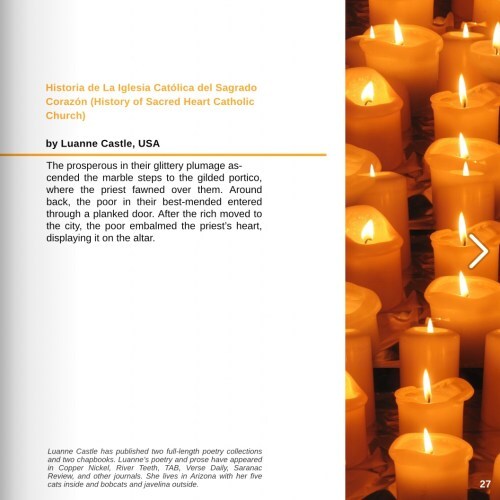
This story was suggested to me by a story I heard when I was in Costa Rica in early 2020.
October 6, 2023
Dog #586 Published by Six Sentences
Editor Robert McEvily has published my six sentence story at, you guessed it, Six Sentences. The story is about animal rescue and called “I Got Sick of Making Excuses for Dog #586 at Paws Perfect No-Kill Shelter.”
https://sixsentences.blogspot.com/2023/10/i-got-sick-of-making-excuses-for-dog.html
My “perfect” rescue cat Perry is in the bag.

October 5, 2023
Carol Balawyder Reviews Our Wolves
One of my favorite novelists, Carol Balawyder, has written a loooovely review of my chapbook Our Wolves. I am so grateful for her reading!!!
Luanne Castle: Our Wolves[image error]Once upon a time \/ by Library of Congress is licensed under CC-CC0 1.0","created_timestamp":"0","copyright":"","focal_length":"0","iso":"0","shutter_speed":"0","title":"Once upon a time \/","orientation":"1"}" data-image-title="Once upon a time / Whitley." data-image-description="
Once upon a time / Whitley.
" data-image-caption="Once upon a time / by is licensed under CC-CC0 1.0
" data-medium-file="https://i0.wp.com/writersite.org/wp-c..." data-large-file="https://i0.wp.com/writersite.org/wp-c..." src="https://i0.wp.com/writersite.org/wp-c..." alt="Once upon a time /" class="wp-image-16159" srcset="https://i0.wp.com/writersite.org/wp-c... 1030w, https://i0.wp.com/writersite.org/wp-c... 201w, https://i0.wp.com/writersite.org/wp-c... 687w, https://i0.wp.com/writersite.org/wp-c... 768w" sizes="(max-width: 500px) 100vw, 500px" data-recalc-dims="1" />Once upon a time / by is licensed under CC-CC0 1.0Week 2 of the Autumn Equinox: #TankaTuesday
This is week two of The Autumn Equinox (September 22 – October 7) Shubun 秋分 for Colleen Chesebro’s new #TankaTuesday challenge based on the 24 Japanese seasons.
My kigo (season) word is Homecoming as in high school and college Homecoming events. This is one I have made up, but for me it represents mid-Autumn, the Autumn Equinox. I have a second kigo for a second poem. I used bonfire because although we had them both summer and fall, the fall ones were the ones that seemed magical, almost mystical.
I wanted to choose a syllabic form that is new to me, and I was intrigued by one that Colleen shared last time.
From the 24 Forms/kouta:The kouta is a popular Japanese verse form of the Muromachi Period, 14th thru 16th century. They resurrected the lyrical song as a geisha song in the late 1800s and it’s still popular today. Koutas were originally meant to be sung out loud, like many other old forms of poetry. Techniques like assonance and consonance would fit right in with the form, but they aren’t required.
The kouta has several variations, though always short in only 4 lines a 5th line is sometimes is added. Themes reflect ordinary life and often use colloquialisms and onomatopoeia. The most popular are love songs.
We write kouta in four lines but sometimes five, that tends to celebrate the average person’s everyday life in song.
Colleen Chesebro
The kouta lines are always an odd number of syllables, usually 5 or 7 mixed, such as 7-5-7-5- or 7-7-7-5.
(untitled)
My son in a new black suit, (7)
daughter in semi-formal, (7)
their dates the first future glimpse. (7)
All are shiny smiles. (5)
Bring on Homecoming! (5)
(untitled)
One year we had a bonfire (7)
post our winning game. (5)
The smell of woodsmoke, night breeze, (7)
the high point before (5)
the descent toward winter. (7)
###
I looked up toward to see if it is one or two syllables. Two!
[image error]Pexels.com","created_timestamp":"0","copyright":"","focal_length":"0","iso":"0","shutter_speed":"0","title":"blaze bonfire campfire dark","orientation":"0"}" data-image-title="pexels-photo-266416" data-image-description="" data-image-caption="Photo by Pixabay on Pexels.com
" data-medium-file="https://i0.wp.com/writersite.org/wp-c..." data-large-file="https://i0.wp.com/writersite.org/wp-c..." src="https://i0.wp.com/writersite.org/wp-c..." alt="blaze bonfire campfire dark" class="wp-image-16152" srcset="https://i0.wp.com/writersite.org/wp-c... 975w, https://i0.wp.com/writersite.org/wp-c... 225w, https://i0.wp.com/writersite.org/wp-c... 768w, https://i0.wp.com/writersite.org/wp-c... 900w, https://i0.wp.com/writersite.org/wp-c... 600w, https://i0.wp.com/writersite.org/wp-c... 450w, https://i0.wp.com/writersite.org/wp-c... 300w, https://i0.wp.com/writersite.org/wp-c... 150w" sizes="(max-width: 500px) 100vw, 500px" data-recalc-dims="1" />Photo by Pixabay on Pexels.comSeptember 28, 2023
Date Harvesting for #TankaTuesday
Colleen Chesebro has created a new #TankaTuesday challenge based on the 24 Japanese seasons. The season right now is The Autumn Equinox (September 22 – October 7) Shubun 秋分.
My kigo (season) word is date because dates are harvested in Arizona only in the months of September and October. Here is my reverse etheree:
DATE HARVESTING
Under the leafy fronds of the date palms
the molasses-rich, honey-sweet fruit
hangs in heavy grape-like bunches.
Pickers with nets try to skim
whole bunches off the tree
without getting spiked
by fierce needles.
These sweet dates
are worth
risk.
[image error]Pexels.com","created_timestamp":"0","copyright":"","focal_length":"0","iso":"0","shutter_speed":"0","title":"smiling man holding branch with dates","orientation":"0"}" data-image-title="pexels-photo-17878425" data-image-description="" data-image-caption="Photo by Radwan Menzer on Pexels.com
" data-medium-file="https://i0.wp.com/writersite.org/wp-c..." data-large-file="https://i0.wp.com/writersite.org/wp-c..." src="https://i0.wp.com/writersite.org/wp-c..." alt="smiling man holding branch with dates" class="wp-image-16069" srcset="https://i0.wp.com/writersite.org/wp-c... 867w, https://i0.wp.com/writersite.org/wp-c... 200w, https://i0.wp.com/writersite.org/wp-c... 683w, https://i0.wp.com/writersite.org/wp-c... 768w" sizes="(max-width: 500px) 100vw, 500px" data-recalc-dims="1" />Photo by Radwan Menzer on Pexels.com###
Switching now from autumn to spring, I have an ekphrastic poem up at Visual Verse here: https://visualverse.org/submissions/paschal-moon-at-midlife/. You can see the artwork that inspired it also. Or you can read the poem here (and the link at my name goes to all the poems and stories I’ve had published at this site):
PASCHAL MOON AT MIDLIFERelease yourself from heavy
coats and boots of winter,
wiggle the toes and sense the air
scouting your arms and calves.
Consider the mud puddle, slide
the long grass along your tongue.
Sing in response to the sweet-
sweet-sweet of the cardinal.
In darkness imagine your guide,
the moon a bountiful platter
mirroring pink phlox-covered hills
of your imagination. Relieve
your mind of artificial restraints.
Let it loose into the unknown.
September 18, 2023
Interview with Eilene Lyon, Author of a Groundbreaking and Exciting Account of the California Gold Rush
I’ve pursued family history research for probably fifteen years and have been reading Eilene Lyon’s fascinating blog Myricopia about her own research for a long time as well. Therefore, I had an inkling of what her new book was going to be about. But I had no idea how thoroughly researched and well-structured Fortune’s Frenzy would be. Nor did I realize how engaging a story she would create about the California gold rush.
Eilene’s perspective, like mine, is that the history of ordinary Americans is important and fascinating. When she discovered that some of her ancestors had been involved in the gold rush—and that their story was something brand new to our traditional historical vision of that event—it was a fabulous starting point for her project.
PLOT SUMMARY PROVIDED BY EILENE LYON
In this true story, Henry Z. Jenkins and a group of Indiana farmers use shady financing to make their way to California during the gold rush, causing devastating impacts to their families and their futures. Fortune’s Frenzy relates previously untold aspects of the gold rush: how the wealthy took advantage of gold fever by offering usurious loans, and how the cold calculus of transporting people to California became a deadly game for profit.

Eilene Lyon immersed herself in American history from an early age,
when her parents took her to iconic sites such as Williamsburg, Philadelphia,
and Gettysburg. She has been putting history into context through
studying the lives of her ancestors for over twenty years. Her work has
appeared in various history journals and can be found on her blog at
Myricopia.com. She speaks on genealogy and family history writing at
regional and national conferences. Eilene lives in Durango, Colorado,
with her husband and husky-lab Sterling (named for a great-grandfather,
naturally).
INTERVIEW OF EILENE LYON
Eilene has agreed to respond to interview questions about her beautiful book.
Your book tells the story of previously unknown ramifications of the gold rush as it affected countless Americans, but your story begins and ends with the story of Henry and Abby Jenkins. How are you related to them? Can you please describe these two characters to give prospective readers an idea of who these people were?They are my 3rd great-grandparents (maternal). At this time there are no known images of Henry and Abby, so I can’t provide a physical description. Both of them have a family background in the Quaker tradition, having been born and reared in Philadelphia. Henry, though, was never a member of the Society of Friends, but his mother was for most her life. Both were well educated—Abby sometimes stepped up to teach her children and others. Henry and Abby had a strong religious faith, but they spent much of their marriage struggling to make ends meet, which added strain to their marriage. I get a sense they were very loving to each other and to their children.
Your book cover provides a startling look at one of the new ways of looking at the gold rush that you provide: a 19th century ship on a choppy sea! All this time I thought that men traveled from the eastern U.S. to California by land—on their horses or with buggies or covered wagons. But your book presents a completely new vision. Can you explain a little about why some people would have traveled on water—and do you have any statistics on how many traveled by water versus overland?The sea route to California was a principal one from the very beginning, even though it had its own dangers. It actually cost less and involved fewer logistics than overland travel. People living on the east coast rounded up any vessel that would float (and some that didn’t) and went around the horn of South America.
Even in 1849, some went across Mexico from Vera Cruz, or across the isthmus at Panama or Nicaragua. Unfortunately, in the early years of the rush, there were few ships available on the Pacific coast of these countries. The isthmus route became favored by 1851, both going to and coming back from California. If you factor in the people who went there from other countries, the majority of people heading to the gold rush arrived by sea, landing in San Francisco. There aren’t any accurate statistics, though.
A detail about the cover image I’d like to note is the early steamship in the background. This painting was done in 1838, but these old ships were very much still in use during the gold rush years.
I was very taken by your writing style. You give beautiful descriptive details of time and place that can only have come from very intensive research. You also tie in what happens in the book with larger financial and political events that really made me feel that I was “there.” What types of sources did you use and how did you find them? And how did you find primary sources, such as letters?Thank you! I spent eight years researching and writing this book. It began with a collection of Jenkins family letters that I’ve had in transcript form for decades, passed on to me by my grandmother. The problem with letters is that the people writing and reading them know the context, but from a 170-year remove, all of that is missing and has to be reconstructed. I was fortunate that I also found a Liestenfeltz family descendant who had a memoir written by another character in the book, and a Lowry descendant with another letter. I combed archives, partly using ArchiveGrid and the Online Archive of California. Some records I could obtain via email, but much of it was collected by visiting places such as the Huntington Library and Bancroft Library in California. I also visited the places in Indiana and Ohio where my characters lived.
There is a character in the book called Allen Makepeace. How would you describe him and how he made a living? Did he perform any vital role in life in those days or was he merely a parasite?That’s an interesting characterization for Makepeace—parasite! He got into the merchandise business as a teen, bringing wagon-loads of goods from Ohio to Native Americans and early settlers in the undeveloped areas of eastern Indiana. He and his extended family were responsible for creating the town of Chesterfield and developing the Madison County seat of Anderson. Once he became wealthy, he served as community banker, because there were no banks at the time. He was not a benevolent lender, though.
I don’t think this is really a question, but I must comment that Fortune’s Frenzy made me imagine that the United States of this time period was really the beginning of the way things are run today by financial movers and shakers and by the legal system. People certainly seemed to take advantage of litigation. If you would like to comment on that, it would be wonderful, but not necessary.It’s actually fair to say that the gold rush helped usher in modern financial practices. Companies like Adams Express and Wells Fargo got their start there and the need to be able to send money to families in eastern states drove the development of money transfer certificates and such. I actually find all the financial aspects of this story quite fascinating. It may seem tedious to others. For a time there were fears that all this gold coming from California would disrupt global finances and markets, causing runaway inflation. Those fears generally weren’t realized.
Eilene, nothing about your book was tedious! What motivated Indiana farmers to leave home and go to California? I imagine the draw of becoming rich overnight was huge, but why leave where they were?You know the acronym FOMO (fear of missing out). Very real back then, too! Indiana in the mid-19th century was nothing like it is today. It was covered in dense, swampy forests. Clearing and draining it to create farms was incredibly difficult, back-breaking work. The pioneer farmers were actually better equipped physically to endure the rigors of mining than the doctors, lawyers, and shopkeepers—once they figured out what to look for and how to extract the gold.
What is the most important idea(s) or feeling(s) you would like your readers to come away with after finishing Fortune’s Frenzy?In one sense, I wanted this work to stand as a valuable piece of historical research. But I did not want it to read like an academic book. I wanted to create a story that anyone could enjoy reading. Hopefully I have managed to meet both of those goals.
I’ve read a lot of gold rush literature—fiction and nonfiction—in the course of researching the book. I think it’s fair to say that even scholars of the era will find new information that will be surprising.
It isn’t important that this is a story about my ancestors and their network, per se. I hope everyone will get a sense that their family history is important. Their ancestors lived through historic events and even created them. History is not just about famous people, politicians, wars, etc. I think the everyday life events in Indiana, as depicted in this book, are fascinating, too.
WHERE TO GET A COPY OF EILENE’S NEW BOOK



![[image error]Pexels.com","created_timestamp":"0","copyright":"","focal_length":"0","iso":"0","shutter_speed":"0","title":"orange pumpkins on a field","orientation":"0"}" data-image-title="pexels-photo-4671692" data-image-description="" data-image-caption="Photo by Ekaterina Belinskaya on Pexels.com" data-medium-file="](https://i0.wp.com/writersite.org/wp-content/uploads/2023/10/pexels-photo-4671692.jpeg?ssl=1)
![[image error]Once upon a time \/ by](https://i0.wp.com/writersite.org/wp-content/uploads/2023/10/cHJpdmF0ZS9zdGF0aWMvaW1hZ2VzL3dlYnNpdGUvMjAyMi0wOS9sb2M5ODUxODI3NC1pbWFnZS5qcGc.jpg?ssl=1)
![[image error]Pexels.com","created_timestamp":"0","copyright":"","focal_length":"0","iso":"0","shutter_speed":"0","title":"blaze bonfire campfire dark","orientation":"0"}" data-image-title="pexels-photo-266416" data-image-description="" data-image-caption="Photo by Pixabay on Pexels.com" data-medium-file="](https://i0.wp.com/writersite.org/wp-content/uploads/2023/10/pexels-photo-266416.jpeg?ssl=1)
![[image error]Pexels.com","created_timestamp":"0","copyright":"","focal_length":"0","iso":"0","shutter_speed":"0","title":"smiling man holding branch with dates","orientation":"0"}" data-image-title="pexels-photo-17878425" data-image-description="" data-image-caption="Photo by Radwan Menzer on Pexels.com" data-medium-file="](https://i0.wp.com/writersite.org/wp-content/uploads/2023/09/pexels-photo-17878425.jpeg?ssl=1)