Doranna Durgin's Blog, page 108
May 6, 2011
Longshot is 6 months old!
By Patty Wilber
When Longshot was born (late September 2010) he had severely contracted tendons in his left front leg.
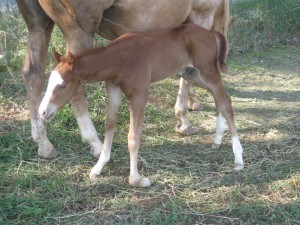
Longshot, a few days old
The vet (Dr. Dralle at Albuquerque Equine) suggested a splint and tetracycline. The tetracycline works to loosen tendons and the splint helps hold the leg in the proper position.
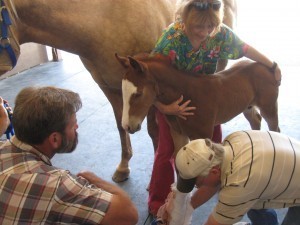
Longshot was (still is) extremely mellow and friendly. Here he is is standing calmly, just a few days old, while Dr. Dralle works on him
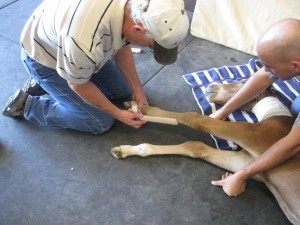
Already got the tetracycline; fitting the splint
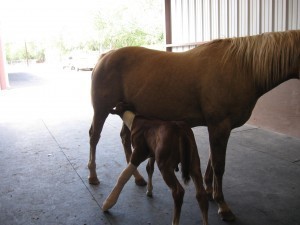
"This splint is humongous! I need a drink!"
A down side of splinting a foal is pressure sores. Longshot came to my house for the splinting period (about a week) and Jim and I changed the splint every 12 hours. Dr. Dralle also came and administered a second dose of tetracyline.
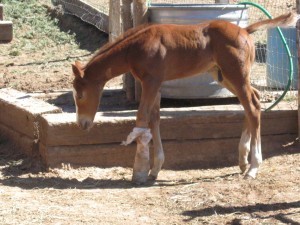
A smaller splint was easier to for Longshot to manage!
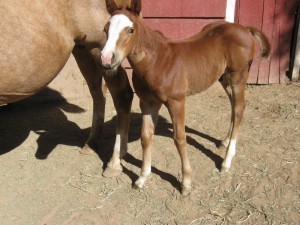
After a few days, he was better and we went to 12 hours with a splint on and 12 hours off. His tendons are not yet as lax as they eventually became.
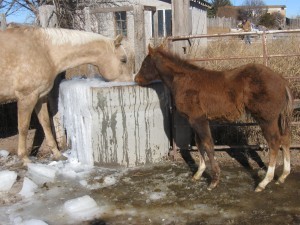
This photo was taken around Christmas time, and you can see that Longshot's leg is not longer contracted, but the angle from his foot to his ankle (pastern--not actually analogous to a human ankle, but you get the idea) is much steeper than in the earlier pictures. This was a result of the tetracycline--still!--more than 2 months later!
This laxity was causing Longshot's left front hoof in particular to grow outward like a ski, and he was walking on the leg BEHIND the hoof. He was having the opposite of the issue he was born with. In addition, the white spots are places where the splint did give him pressure sores.
These areas on Longshot will be white for life. The cells that produce pigment are called melanocytes, and these cells can be temporarily disabled or even killed by pressure. Some horses have white spots at the withers from pressure exerted by poor fitting saddles. If the saddle pressure is moderate the white hairs will shed out and be replaced by normal colored hairs (when the cells start working again). If it was extreme or long-term, the white hairs will be permanent (as the melanocytes died). Wounds can also cause white patches.
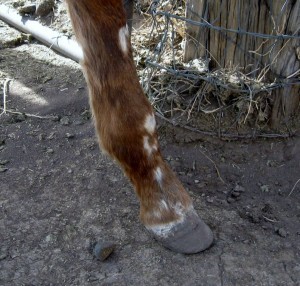
This photo was taken last Friday (4/29/2011). The pastern angle is far less steep, he standing normally on his hoof, but those white spots are still there!
The wind was blowing a gazillion miles per hour last Friday 4/29/2011 when I took this picture and I was so focused on getting the leg pics and getting out of the wind I completely spaced on taking a whole body picture! Doh.
I was surprised at how long the tendon laxity lasted and how much better his legs look now! (I had not seen him since December.) He has really grown but he is still just as sweet as can be.
He had a little boo boo on the other leg, and in the wind (seriously not ordinary wind–this spring we have had day after day of relentless Patagonia style, temper inducing, tree branch snapping wind), with no halter, he snuffled my hair while I picked up his foot and checked things out.
Pretty good outcome so far! Go Longshot!


Longshot is nearly 6 months old!
By Patty Wilber
When Longshot was born (late September 2010) he had severely contracted tendons in his left front leg.
Longshot, a few days old
The vet (Dr. Dralle at Albuquerque Equine) suggested a splint and tetracycline. The tetracycline works to loosen tendons and the splint helps hold the leg in the proper position.
Longshot was (still is) extremely mellow and friendly. Here he is is standing calmly, just a few days old, while Dr. Dralle works on him
Already got the tetracycline; fitting the splint
"This splint is humongous! I need a drink!"
A down side of splinting a foal is pressure sores. Longshot came to my house for the splinting period (about a week) and Jim and I changed the splint every 12 hours. Dr. Dralle also came and administered a second dose of tetracyline.
A smaller splint was easier to for Longshot to manage!
After a few days, he was better and we went to 12 hours with a splint on and 12 hours off. His tendons are not yet as lax as they eventually became.
This photo was taken around Christmas time, and you can see that Longshot's leg is not longer contracted, but the angle from his foot to his ankle (pastern--not actually analogous to a human ankle, but you get the idea) is much steeper than in the earlier pictures. This was a result of the tetracycline--still!--more than 2 months later!
This laxity was causing Longshot's left front hoof in particular to grow outward like a ski, and he was walking on the leg BEHIND the hoof. He was having the opposite of the issue he was born with. In addition, the white spots are places where the splint did give him pressure sores.
These areas on Longshot will be white for life. The cells that produce pigment are called melanocytes, and these cells can be temporarily disabled or even killed by pressure. Some horses have white spots at the withers from pressure exerted by poor fitting saddles. If the saddle pressure is moderate the white hairs will shed out and be replaced by normal colored hairs (when the cells start working again). If it was extreme or long-term, the white hairs will be permanent (as the melanocytes died). Wounds can also cause white patches.
This photo was taken last Friday (4/29/2011). The pastern angle is far less steep, he standing normally on his hoof, but those white spots are still there!
The wind was blowing a gazillion miles per hour last Friday 4/29/2011 when I took this picture and I was so focused on getting the leg pics and getting out of the wind I completely spaced on taking a whole body picture! Doh.
I was surprised at how long the tendon laxity lasted and how much better his legs look now! (I had not seen him since December.) He has really grown but he is still just as sweet as can be.
He had a little boo boo on the other leg, and in the wind (seriously not ordinary wind–this spring we have had day after day of relentless Patagonia style, temper inducing, tree branch snapping wind), with no halter, he snuffled my hair while I picked up his foot and checked things out.
Pretty good outcome so far! Go Longshot!
May 4, 2011
The World in Focus
It's a good thing we tried for more photos the second night of Dart's introduction to the new concept of "leave your dinner in order to get your dinner" training, because by the third night, he started to put the behavioral pieces together.
But we got them, atomic blur and all! And here they are for your viewing pleasure. Along with, may I saw, a bonus picture of Duncan, still in significant recovery mode, but dignity intact.
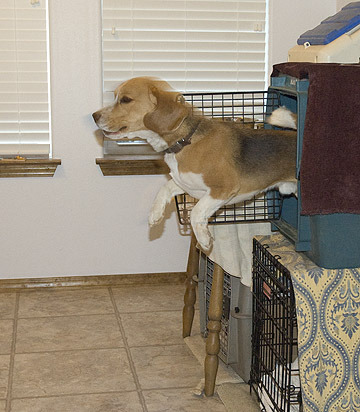
You see that blur? I told you. He vibrates. At atomic speed. (But look at that shoulder action!)
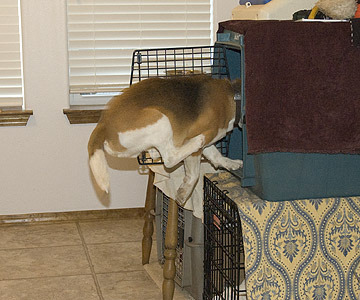
He is a flexible dog. Uh-huh.
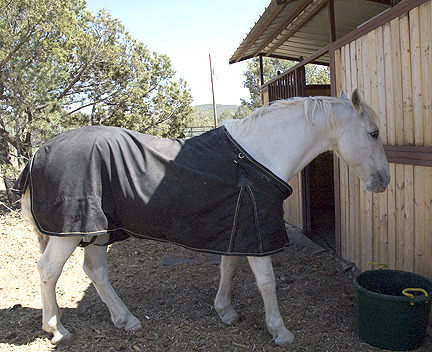
Dignity in Horsie Clothes and Fever
May 2, 2011
Dart Beagle & Dinner Time
Dart Beagle is learning to make choices.
He is especially learning to make choices about default behavior, and how ultimately it behooves him to hang around me and focus on me and…
Well, everything that might be the opposite of splurting away from me at Warp 10 to run circles around not just an agility course, but the entire agility venue.
(But we won't talk about that.)
In general, we're working a lot of pre-mack stuff. Or modified pre-mack, probably. What that means is that if Dart chooses to perform the desired behavior, he GETS WHAT HE WANTS.
Over the past week, this has slowly been seeping into his "this is your brain on black ice" thought process:
Heel past the OMG TOYS, receive instant permission to run over and stuff as many as possible into your mouth.
Do a recall past the OMG TOYS, receive instant permission to run over and grab one for a game of tug.
Maintain a sit-stay with an OMG TOY being casually tossed past, receive instant permission to GO GET IT and prance around making doggy mooing sounds of pride.
When I say "instant," I mean instant. I don't think Dart actually has Warp 10. I think Dart translocates.
Of course, if he chooses wrong, then the toys…oh woe…go away.
His most recent and hardest EVER lesson comes at dinner time. At this time of the day, Dart comes into the house vibrating so hard with excitement that he's barely visible at all. Sort of like an atom. And recently, I've upped the ante on what I expect from him at this time:
In order for permission to enter the crate and eat, he has to come to me past the crate.
Past.
The.
Crate.
Well, we're in the beginning stages of that, and that means…Flying Dart.
Normally I don't allow him to jump from the crate. Too much accumulated impact. But we'll work on that again later. Right now, we're in step one of this process, which means he invites himself into the crate, comes flying out of it to me, pops a wheelie, and returns to the crate. All far too fast for the camera, apparently…
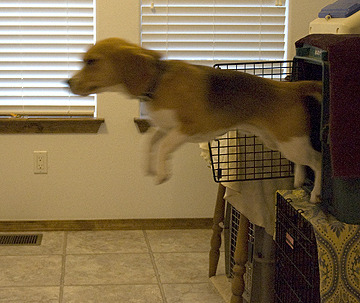
This was Leap #3.
His job? To learn that when he comes to me, he sits and waits. Ultimately, bypassing the crate. At the moment, we're on four rounds of FLY WHEELIE RETURN before we get SIT WAIT RELEASE CRATE FOODFOODFOOD!!
We'll work on step two after we get this one.
I figure it could be a while.
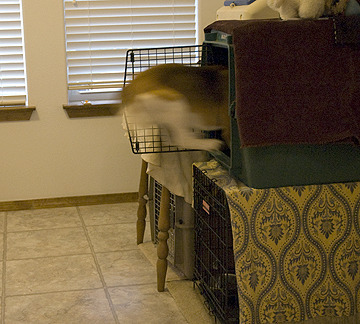
FOODFOODFOOD
April 29, 2011
Freemartin
By Patty Wilber
Unruly Tabooli's (that's a blog for another day) Dad has some cows and one momma had twins. He mentioned one might be a freemartin.
No, Martin is not trapped anywhere…
A freemartin is a sterile female cow with confused sexual characteristics (which explains why she is unbred–and is, in fact unbreedable. The freemartin always has a male twin, and the brother brought on the confusion!
Freemartins occur in 90% of all male-female cow twins (all breeds), and occasionally in sheep, goats, and pigs. Freemartins do not occur in humans.
How does this happen? So glad you asked!
All organisms have DNA, which is the molecule that holds the code to make the proteins that run biological systems. DNA is the "blueprint of life"
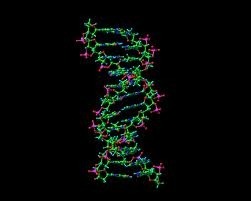
DNA, the double helix
In mammals, the DNA is in pieces called chromosomes. Humans have 46 chromosomes and cows have 60. Look here if you want to see a table of chromosome numbers in some additional species.
Male humans (and bulls) have one X sex chromosome and and one Y sex chromosome, plus all the others. Female mammals have two X chromosomes. (But in platypuses, XXXXXXXXXX creates a female, while XYXYXYXYXY creates a male. In other words, rather than a single chromosome pair, platypuses have a set of ten-chromosomes that determine their sex.)
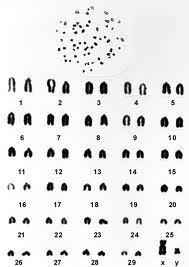
Below is a karyotype (photograph) of cow chromosomes. Note the last pair of chromosomes are the X and the Y. The Y is always small and contains code for proteins involved in producing male characteristics.
In freemartin production, the two fetal siblings are growing in the womb, and their placentas fuse (click if you want to see a photograph), so the heifer calf and the bull calf share blood.
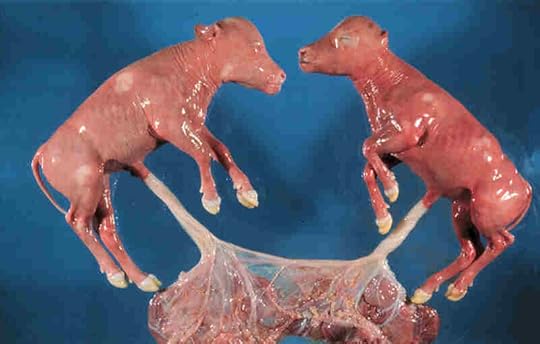
Blood carries all sorts of things throughout the bodies, including hormones produced by the bull calf's gonads. These hormones influence the development of the heifer calf's sex organs, not in a productive way. The male calf is largely unaffected by the sharing.
Furthermore, in addition to hormones, the two calves share cells via the co-circulating blood. Both twins become genetic mosaics, also called chimeras.
A genetic mosaic is an individual with two distinct sets of chromosomes. A normal cow has 60 different chromosomes in each cell. A freemartin has 60 chromosomes in each cell, but some of the cells came from her brother, so she actually has her original 60 chromosomes, PLUS 60 different chromosomes in the cells she got from her brother. The majority of the male cells are blood cells.
Because the male cells in the freemartin are blood cells, they do not have much effect on her sexual organ development, but a freemartin can be detected by a blood test that looks for the Y chromosome!
Turns out, in T's Dad's case, both calves are heifers, and while they may well be chimeras, neither is a freemartin (because that requires a twin brother).
In horses, chimeras (click to see a pic) can form when two fertilized eggs join, to produce one single individual!
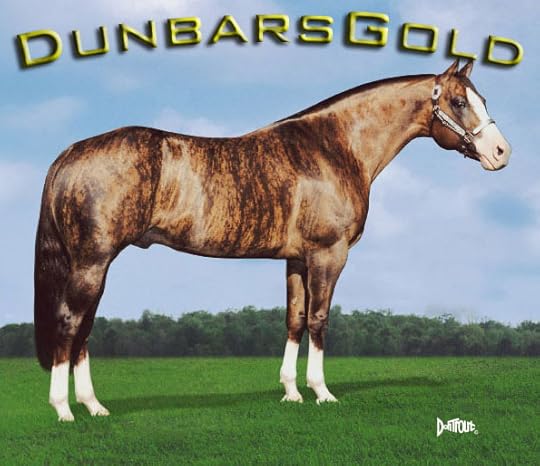
In humans, hermaphrodites can form when an XX (female) fetus is subjected to testosterone produced by an adrenal gland tumor on her mother's kidney.
Chimeras occur in humans too.
And that is the end of today's parade of bizarro bio factoids!
April 27, 2011
Hello!
DuncanHorse continues his slow recovery from virus and colic. I continue trying to work on no sleep.
Therefore, this is the blog of the day, and here is the thing for which we have lived since Friday.
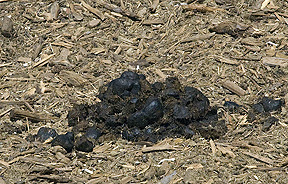
Ohhh yeah.
Rejoice!
April 25, 2011
Insert Cute Dog Photo Here
I had a whole post of Dart's rally pictures and happy little plans to make happy little chatter about the rally fun match the previous weekend and this past weekend, our first UKI trial starring Dart (Connery is on the bench due to his meds).
Then came last Friday morning, when Duncan Horse woke up sick and got sicker. And sicker. And, even as one of us set up trial gear an hour away, ultimately and obviously too sick for owner management.
So at the moment it looks like he got a virus, which snuck quietly up and then bloomed overnight into dehydration, which caused (not too bad) impaction colic, during which the fever spiked up and complicated the colic recovery. All of which caused much back and forth to the barn–checking the horse, walking the horse, petting the horse, kissing the horse's nose, medicating the horse, introducing tiny tiny handfuls of food to the horse, blanketing and coddling and…
Okay, so. I didn't write a blog for today. It would have had cute pictures and happy little chatter, though.
But here is a picture that exemplifies Dart's frame of mind when we ran down to the trial site on Sunday to grab the gear, and grabbed a few quick runs while we were at it (while Duncan had a baby-sitter). That, of course, is the innards of the toy he stretched his evile prehensile toes out of the crate to acquire and smite. The rest of the stuffing is in the background.
INSERT EVILE CUTE DOG HERE
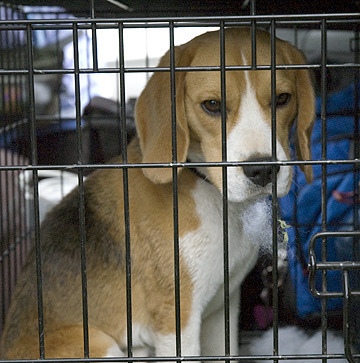
Yeah. Because that little beard of stuffing belongs there.
April 22, 2011
Collection
By Patty Wilber
Collection of what? Of horses of course.
But not collection like "I have a collection of bits in the tack room" or "I have a collection of horses in the barn."
Collection is when
-the horse has shortened his body by bringing his hind end up under himself.
-the horse feels light in the front (because he is driving with his hind end).
-the horse is soft and responsive to the bit.
I once went to a clinic with Leon Harrel, a cutting horse trainer (and clinician-duh!). He offered to ride our horses during lunch, which I thought was really amazing as it was a a three day clinic and he was working hard.
There was a woman there with a black Tennessee Walker cross. The horse was big. The horse was long. The horse looked like it's head was in a different state from its tail and only maybe controlled by the same brain.
Leon got on that horse, and in less than one minute the horse was shorter from nose to tail by about a foot, had his butt up under himself and went from looking like a relative of a camel to a animal that might actually have some athletic potential.
That was the most impressive display of "collecting" a horse (practically instantaneously) that I have ever seen!
Interestingly, I saw the same rider maybe 4 years later on a horse of a different color, and I'll be damned if the new horse didn't look exactly the same as the first horse–one long string bean with its head and tail in different time zones!
Penny was at a show this weekend and I entered her in western pleasure (a class where you walk, jog and lope around the arena and the judge picks the slowest horse there–no actually the judge picks the horse who is the most relaxed and shows the prettiest movement.)
Penny normally does well in this class, but I showed her in a snaffle bit, and what did she do? She leaned on the bit. This resulted in her butt failing to be up under her like it should be, so she was moving too fast because her weight fell onto her front end (forehand). Her movement felt ploddy instead of springy and light.
She was lacking collection.
Of course that makes it sound like a complete disaster, which is was not. It was a more subtle disaster, that this judge could see. She did not place well!
For Penny one solution is a different bit--one that she will not lean on but will instead "get off of" by tucking her head and lifting her front end. When she does this she feels more agile and her feet grace the ground instead of bumping down.
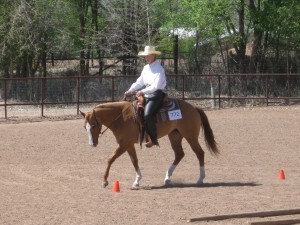
Penny's neck looks pretty relaxed ("soft") and flexible. She has her hind end under her enough to be able to turn easily and lightly around the cone.
Tracy naturally has excellent "self carriage". She almost always uses her butt and is up in the front. She did need to learn to hold her head down a bit more to be "in style" for the show ring, but wow what a spring loaded ride!
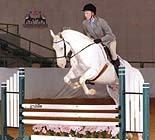
In this picture, Tracy was actually very soft in my hands, but I have her TOO collected. My hands should be up on her neck to allow her to stretch out over this jump and instead I have her bunched up. She is such a great athlete that she handled it fine!
T started off heavy in the front. It felt like he was hammering the ground. He wanted to hold his head with his nose sticking out. This left his big ol' butt in another county.
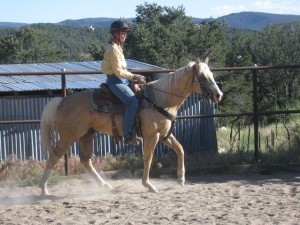
T is not paying real close attention. If I wanted him to change directions right now, it would not happen as his head was not in the game.
Collecting T in a lope (he is trotting in the next pic, but it gives the idea), was the hardest for him to learn. When he figured it out, he got slow and light and very maneuverable. And the one judge he showed under sure liked that!
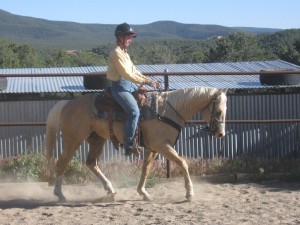
T is all "framed up" or "collected". His neck is soft, his nose is tucked, and he is using his hind end as his motor!
Teaching a horse to collect and then stay framed up is, for me, a fairly long process. The trickiest part to learn was that you can't really PULL a horse's head into place and have collection. Instead, you have to hold your hands steady and use your legs and body to PUSH the horse forward into the shape you want… and then convince him to hold that shape by himself!
Ask (correctly and not too much), get a response (and recognize it as a response), release (quickly–the release is what the horse recognizes as a reward so the release is really important). Repeat 10 million times…horse training does involve a whole lot of repetition and TIME.
But when the collection comes, you've got a horse that is amazing to ride!
April 20, 2011
Roll On, Bloggers!
 Yes, I love Alabama. I have a hankering to ease right on over to that iTunes store and replace my tapes from…oh, so long ago…
Well, if you know that tune, you can hum along while reading. Because as Blog Rolls go, I am quite pleased with mine. These are all Backlist eBooks authors, and boy do they have a lot to talk about–from the industry to the tech of the industry to what's happening at home to…ohhhh yeah…teenaged boys.
Here's a sampling of their latest. And I would have written this blog a lot faster if I hadn't gotten caught up in reading them–!
(PS the links open in a new window, so you don't have to flip back and forth.)
Lorraine Bartlett: What I didn't Want to Hear
Marsha Canham: Guest blog, pithy thoughts from Bob Mayer
Jeffrey A. Carver: Ebook Special Prices!
Jacqueline Lichtenberg: Worldbuilding – Building a Fictional, but Historical, World
Phoebe Matthews: FortuneCookie says: MONDAY SPEND TIME WITH FRIENDS.
Jill Metcalf: Memory Flashes
Maryann Miller: "Screen-Free Week" Starts Today: What to Do without the PDA?
Pati Nagle: Nambe': Life is Full of Surprises
Terry Odell: Guest Blog: The Story of my Life (Egyptian Revolution)
Karen Ranney: Rant Alert
Patricia Rice: All Things Digital
Gerald M. Weinberg: "Smashwords vs Kindle" — Are Your Lights On?
Linda Wisdom: I'm Interviewed Today
Roll on, readers, roll on!
April 18, 2011
The Progress Bar: WINNING!
Goal #1: Sell 1,000 copies of The Heart of Dog to pay for the CT scan ConneryBeagle needs so badly (with the endoscopic procedure to follow, and the meds and vet visits that come with it).
 Goal #2: PUT UP A STUPID PROGRESS BAR SO WE CAN ALL WATCH IT HAPPEN.
The first goal comes on the heels of Connery's visit with his new internist. Thanks to the book sales (and outright donations) so far, we had the chance to visit this specialist. In other words, thanks to the people who have helped to spread the word, hit the "like" buttons on the book's page at Amazon, B&N, and Smashwords, or (bless you) left reviews.
If you did any of those things…thank you for helping me help Connery in a time when the floundering publishing gestalt means I haven't been able to do it on my own!
From Auntie Internist Vet, we learned that the February biopsy of Connery's private nasal recesses showed considerable ongoing damage to those tissues–cause unknown–and that he needs a CT scan to determine what's happening in that little punkin head and how to target the best treatment.

Swallow, Connery, swallow!
Until then, we're desperately trying to extinguish that high inflammation, even though it won't be a permanent solution unless we can target/remove the actual cause. Connery's had his last trial, his last big tracking session, and a glorious evening of course run-throughs at our favorite training yard. Now he's on several frightening meds. I'll keep him active as is possible during this time, but the initial side effects kicked in immediately, so I'm currently in anxious mode.
(Connery's not particularly concerned about it all at this point, though. Except for the part where he's starting hiding when he comes inside because he's afraid it's time for a pill or a nose squirt.)
Goal #2? Because I thought it would be an easy way to let folks know where we stand, not to mention fun!
Well, WordPress wasn't having any of that FUN stuff. WordPress made a snooty face at the very notion!
I tried a progress bar. Initially it looked good, but then I learned it was breaking lots of browsers. Oops. Definitely not fun. I tried a second, and it did the same thing. I tried a third, and the blog…broke.
Broke, broke, BROKE THREE HOURS LATER WAHHHHH BUSTED BROKE.
But I am stubborn, and now it is unbroke. Look! Right over there! ==> And UP. Look UP.^
Goal #1: Bring on the WIN!
Goal #2: WINNING!