
Rod Dreher's Blog, page 579
May 18, 2016
The Great State’s Greatness

The Louisiana State Capitol, tumescently democratic (Burkomaster/Shutterstock)
I’m totally serious: Louisiana is a great state:
During a debate about a bill to regulate strip clubs, a state representative proposed an amendment — in jest, he says — that the strippers should be youthful and thin.
The joke, which is now an official part of the legislative public record, upset several female lawmakers in the House, who called it a new low for inappropriate and sexist comments that regularly pervade the State Capitol.
State Rep. Kenny Havard, R-St. Francisville, officially submitted a written amendment to legislation that would have mandated dancers at strip clubs be no older than 28 and no heavier than 160 pounds. When challenged by other legislators, he quickly withdrew the amendment and later called it a joke about overregulation.
“Looking out over this body, I’ve never been so repulsed to be a part of it,” Rep. Julie Stokes, R-Kenner, said on the House floor after the amendment was pulled. Stokes said the amendment was just the latest exercise in commonplace misogyny that women in the Legislature frequently endure. “It has got to stop. That was utterly disrespectful and disgusting.”
Senate Bill 468, by Sen. Ronnie Johns, would raise the age of dancers at strip clubs from 18 to 21.
Rep. Walt Leger III, D-New Orleans, who presented the measure on Johns’ behalf, said the legislation is intended to combat human trafficking, as recent stings have found underage homeless youth and foster children who have aged out of the system being targeted to work at clubs where prostitution and drug dealing flourish.
As the bill was being presented, Havard — saying he wanted to “trim the fat” — offered his amendment. He withdrew the amendment after another lawmaker called it offensive.
But Havard didn’t apologize and said he doesn’t regret his joke.
“No, it was meant as a poke that we’re overregulating everything around here,” he said in an interview. “It was a joke, that’s why I pulled it. But it was satire to say, ‘Hey, when are we going to stop overregulating everything?’ ”
Oh, for freak’s sake, Kenny Havard is my representative. I’m a Jesus-loving, right-wing troglodyte who voted for him more than once, and he’s a great guy who does a lot for his constituents. And you know what? He’s a real person with a sense of humor. This is Louisiana, ya morons. I salute his sense of absurdity, and no, I’m not joking. In fact, I volunteer to join him and his colleagues on a legislative fact-finding mission to the Woodville Ballet, where they used to have a differently-abled ballerina working with one leg.
Uncle Chuckie, will you come down South and set these people straight? Please?
Other lawmakers left these dollars at podium in jest during strip club age debate #lalege pic.twitter.com/D09t8lP6fV
— Rebekah Allen (@rebekahallen) May 18, 2016


Christian Parent Fights Back
I posted the “Forever Culture Wars” item just now, about the importance of forming a real Christian resistance, and then checked my e-mail. Lo, a pastor sends me notice that since Friday’s Title IX ukase, he has been e-mailing back and forth with the principal and superintendent of his first-grade daughter’s public school, trying to determine what they really believe about the transgender bathroom issue, and what they plan to do about it. He hasn’t gotten a straight answer.
Today the pastor and his wife met with the principal. He writes:
“The key moment came when I asked a simple question: ‘Is there a natural difference between boys and girls?’ Answer: ‘I refuse to answer that question.'” Unbelievable. She also explained that she kept politics and philosophy out of education. When we left, I gave her my copy of Lewis’ The Abolition of Man. Rereading it this week, I realize that it is probably best characterized as a work of philosophical prophecy.
The pastor provided a copy of the letter he wrote to the principal and the superintendent, but removed their names from it for use on this blog, to protect their privacy:
Dear Mrs Principal and Dr Superintendent,
By way of preliminaries – and also to help Dr S in his own deliberations – I would like to clarify a bit how one citizen sees this matter.
First of all, for us, this is not fundamentally a question of “feelings” or about “safety.” A special bathroom would hurt our daughters feelings, certainly; and I do think implementing this decree will lead to an increase in child abuse and sexual assault. Fundamentally, however, this is a question of truth. I “feel” that my daughter would be “safe” at her school for the rest of the school year; that would be very different, Dr S, if she were a 14 year old changing in school locker rooms. But because I am a man of conviction, feelings and safety pale in comparison to telling and living the truth. It is true, I am a Christian – what is perhaps worse, I am a pastor and theologian – and I happen to believe that the Son of Mary who was crucified by Pontius Pilate for telling the truth is Truth himself in our flesh and blood. But on the priority of the truth in the moral fabric of a just society, Plato, Aristotle, Cicero, Lincoln or – what is probably more apposite just now – Vaclav Havel would say nothing less than this. Right:
The real issue here is that the Obama administration’s decree is at the surface a pragmatic directive regarding the use of bathroom facilities etc., but implicitly and by logical necessity, it is a claim about what is in fact the case (i.e., true) regarding human nature as an essentially fluid and endlessly malleable reality. That is to say, it is a denial of the reality of any such thing as “human nature” beyond the self-determining dictates of the sovereign, autonomous will. It is, in short, philosophy decked out in bureaucratic dress and backed with a closed fist aimed at deviant philosophers such as myself. You need to know this; you need to know that by implementing the decree, you are not just acting to protect the feelings or safety of a minority. (For the record, as a citizen of this nation but especially as a Christian, I firmly believe that the feelings and safety of every child, including children who are confused about their own identity, must be respected and protected; I am no bigot, and God helping me I am certainly no Pharisee; if you ever happen to visit my parish, you will hear that in the name of Jesus Christ I preach grace as a free gift for undeserving people such as myself.) Rather, if you implement this decree, you will be enforcing a highly contested philosophical anthropology that is basically 30 years old, a philosophical anthropology that (without exaggeration) every civilization in the history of the human race would regard as sheer folly. You see, the President is making philosophers of you all! Make no mistake: this “policy” decree is fundamentally an issue of truth; it is philosophical.
Second, you need to see, Mrs P, that the beneath surface neutrality of your initial reply to my question there already lies a veiled but definite answer. For in offering to allow my child, a girl, to use a special bathroom of her own, you have implicitly declared that queer is straight and straight is queer. Because I believe my daughter is a girl; because I believe that her femininity is a given fact of her being; because I believe that this givenness is but one instantiation of the order of things which, because of a borrowed goodness derived from the infinite goodness of the Maker of all things, is good; and because I believe that this matters: my daughter is to be “queered,” i.e., she (together with all who think as she does) must be sent to a space of her own. She must be sent to the corner; the dunce cap must be placed upon her head.
Third and last – and I direct this comment esp. to Dr S – Mrs P assures me that nothing will be done “in haste.” I should think not! I should think that, since the civilization-grounding fact of difference between Man and Woman – a difference that is grounded in biology, but that runs down into mystical depths deeper than any of us really understand – since this difference of biological sex is itself the foundation of life, the home, culture, nations … I should think that no one – and surely no one entrusted with the care of infinitely precious little human beings – would dare to manipulate a reality as basic, primal, and awesome as Man and Woman, Boys and Girls. That would be “hasty” indeed; to tinker with human nature after 30 years of philosophical experimentation, to tinker with human nature after a single decree from a federal bureaucracy that does not reflect the consent of the people – for the people have not been consulted – that would be hasty. By contrast: to defend and uphold the reality of sexual difference, a reality that has only seriously been questioned in the past 30 years of human history, to do that would be to act in patience.
With grave concern, but also with patient regard for the givenness of things, and with the hope that rises up in my soul every time I see blades of grass (i.e., nature) break up concrete sidewalks (i.e., the imposition of human will upon nature), I am your fellow citizen,
The Revd Dr N., Citizen of the Republic
Reader, you need to understand the propagandizing that the federal government — and, in the case of the Fort Worth ISD, local school authorities — are pressing on your children. Fortunately, some states have governors that are standing up to Obama on this one (I, it appears, am not governed by such a man). Whatever your local situation, please get it straight in your mind that this is not simply about bathrooms and locker rooms. The pastor understands it well.
“The Benedict Option isn’t an option anymore,” he said.
What are you going to do this fall when school starts again? You had better start talking about it, with your pastor and everybody else in your community.
I was comforted today by Donald Trump’s list of judges he would consider nominating for the Supreme Court. All of them are members of the Federalist Society. All are pro-life. I don’t know where they stand on religious liberty and this transgender stuff, but I have absolutely no doubt that they would be immeasurably better than anybody Hillary Clinton would name.
As an aside, I voted Democratic in the Louisiana governor’s race last fall because the budget was a hellacious mess and I didn’t trust Republicans to fix it. Besides, the Democrat, John Bel Edwards, is a pro-life Catholic. How socially liberal could he be? At the time, my friend and neighbor, a fellow conservative, taunted me for voting D.
Today my neighbor forwarded me this e-mail he received back from the governor’s office, and taunted me even more heavily:
Thank you for contacting the office of Governor John Bel Edwards with your concern regarding the federal issued guidance on transgender access to school restrooms.
Governor Edwards is reviewing the guidance from the US Department of Justice and Department of Education. It appears that this guidance is simply clarifying current law under Title IX. The governor is working closely with the Louisianan [sic] Department of Education to meet our shared goal of fostering a safe, non-discriminatory environment for our children.
Your position has been forwarded to the governor’s policy team for notation. We appreciate your input as we work to meet the needs of our state.
Vote Democratic, roll out the welcome mat to girls with penises in your daughter’s locker room. So noted.
The Forever Culture War
One common rhetorical reflex of progressives is the idea that conservatives, and only conservatives, wage culture war. What they mean — whether they realize it or not — is that conservatives have the nerve to say “no” to whatever progressives propose today. If conservatives wage culture war, it is usually (but not always) a defensive one.
Samuel James takes issue with David Brooks’s idea that because social conservatives have lost the culture war over the Sexual Revolution, they ought to make peace with this fact and change their focus. Brooks wrote in a post-Obergefell column last summer:
Put aside a culture war that has alienated large parts of three generations from any consideration of religion or belief. Put aside an effort that has been a communications disaster, reducing a rich, complex and beautiful faith into a public obsession with sex. Put aside a culture war that, at least over the near term, you are destined to lose.
Consider a different culture war, one just as central to your faith and far more powerful in its persuasive witness.
We live in a society plagued by formlessness and radical flux, in which bonds, social structures and commitments are strained and frayed. Millions of kids live in stressed and fluid living arrangements. Many communities have suffered a loss of social capital. Many young people grow up in a sexual and social environment rendered barbaric because there are no common norms. Many adults hunger for meaning and goodness, but lack a spiritual vocabulary to think things through.
Social conservatives could be the people who help reweave the sinews of society. They already subscribe to a faith built on selfless love. They can serve as examples of commitment. They are equipped with a vocabulary to distinguish right from wrong, what dignifies and what demeans. They already, but in private, tithe to the poor and nurture the lonely.
The defining face of social conservatism could be this: Those are the people who go into underprivileged areas and form organizations to help nurture stable families. Those are the people who build community institutions in places where they are sparse. Those are the people who can help us think about how economic joblessness and spiritual poverty reinforce each other. Those are the people who converse with us about the transcendent in everyday life.
Those are beautiful words, meant sincerely. David is one of the most irenic and good-hearted people I know.
Here’s why he’s wrong, according to Samuel James:
I wrote shortly after this op-ed appeared that, though its appeal to a holistic kind of conservatism was well-intended, it ultimately presented a false choice. Conservatism in its very essence–especially religious conservatism–is about how to preserve good things from humanity’s inherent sinfulness. Because human sin and selfishness cannot be confined only to politics or sex, it’s impossible to cede the ground of human flourishing in one area in order to gain it another. Human nature just doesn’t work like that, thus, conservatism cannot either.
I had no way of knowing how well the Obama administration would prove my point.
James talks about how the administration, through its Title IX overreach, is forcing a radical view down the throats of the entire nation, with no debate. Even Michael Wear, who worked for the Obama White House as its faith outreach coordinator, was shocked:
It is astounding how quickly this is moving without an actual national conversation on the issue. https://t.co/CQjNuovE3Y
— Michael Wear (@MichaelRWear) May 13, 2016
James continues:
Brooks urges conservatives to spend their time on the “fragmentation of society” rather than the definition of marriage and family, but he misses the fact that such fragmentation begins with wrong ideas about those very things.
It is of course possible to believe in traditional things and yet live a broken, fragmented life. That’s why the partisan elements of the culture war are so deceptive. But this doesn’t mean that such belief is inconsequential or a mute partner to more “practical” life. What we call the “culture war” matters not just in the voting booth but in our daily perception of the world around us, a fact that the Obama administration clearly understands.
Of course James is right. I’ve been working this afternoon on finishing the Politics chapter of my forthcoming Benedict Option book, and I’ve been thinking about the distinction Aristotle made between a good citizen and a good man. Ideally, there is no distinction, but as utopia is impossible, we cannot live up to that ideal. The best we can hope for is to maintain a tolerable, peaceable distance between the two categories, always striving to make the public square more virtuous. But for Christians, our liberal democracy has made that gap into a chasm. It’s not only about sex, but sex is at the heart of it.
If you want my longer take on it, read my essay “Sex After Christianity”. In short, what we think about sex and sexuality goes much, much deeper than our opinion of body parts, geography, and pleasant friction. In his own post-Obergefell essay last year, Prof. Dale Kuehne prophetically anticipated this year’s developments, and explained why it matters:
By the time [Obergefell] came, the same-sex marriage debate was no longer about sex and had very little to do with marriage. Rather it was anchored in a redefinition of human identity itself. In the new world order, it is the individual, not biology or God, who determines identity. We are now “selves” of an increasing number of varieties and we are decreasingly male or female in a biologically meaningful sense. One day soon people will cease to use “same-sex” as adjectives for marriage. Every marriage will be the same: Selves who take vows. Two selves. Perhaps even three selves or more.
Moreover, “selves” won’t be limited to human relationships. Professor Sherry Turkle from MIT has written of the question of marriage to a robot. Marriage with animals is tomorrow as well, because it is already today in some places.
Accordingly, tomorrow’s political headlines will be of two variants. One variant are headlines that announce the expansion of the rights of transgender people as well as those whose identity goes beyond gender. Transgender is the next civil rights movement. The second set of headlines will concern the issue of religious freedom for churches and religious institutions whose views on traditionally-accepted morality are deemed discriminatory to “selves.”
What you think about sex ultimately has to do with what you think constitutes human identity. This is not something that any orthodox Christian can compromise on. Brooks writes, to Christians:
Put aside a culture war that has alienated large parts of three generations from any consideration of religion or belief. Put aside an effort that has been a communications disaster, reducing a rich, complex and beautiful faith into a public obsession with sex.
This has about it a whiff of “just burn the pinch of incense to Caesar, and get on with the rest of living out your wonderful faith.” For one thing, the Bible — both the Hebrew Bible and the New Testament — makes a big deal about sexual morality, and that, as Quaker Sarah Ruden has shown in her fantastic, must-read book, one of the big attractions of early Christianity to the poor in the Greco-Roman world was how it gave them and their bodies dignity, and rescued them from the sexual degradation and exploitation foisted upon them by the ruling classes. But for another, deeper reason, the meaning of the human person, in the Christian worldview, is inextricably bound with sex and sexuality.
All Christian churches are in decline, but there is a good reason why the churches that embrace the Sexual Revolution are dying much faster. Sexually progressive Christianity is at best the last stop before apostasy. Maintaining Biblical sexual morality is non-negotiable for orthodox Christians — who, it must be conceded, have done a generally terrible job of countering the culture’s hedonistic catechism on this front. And, as James points out, the “culture war” touches every part of our lives.
Here are two examples from today. In the first, I was talking with a friend in Baton Rouge this morning about the Title IX thing. My friend said he went to a funeral in a small town south of Baton Rouge the other day, and was shocked to see that the funeral home had taped homemade signs over the men’s and women’s bathroom doors. The signs read: “UNISEX”.
“In Gonzales, Louisiana!” said my friend, still shocked. I was shocked too. Nobody is making them do this at a funeral home in Gonzales. They’re breathing it in the cultural air.
Another example is two comments by readers on the “NYC Hits Peak Gender Idiocy” post. The first is from reader Gerbby:
A lot of readers here seem to think Rod exaggerating on the trans issue. As a millennial who recently left liberalism, I assure you, he is not. I too used to think that transgender identity was caused by some rare medical condition.
An important piece of the puzzle is that the number of people seeking treatment for gender dysphoria has skyrocketed. I don’t think there are any official numbers for the United States, but in Britain it has gone up 900% in the past 5 years. (source:http://www.bbc.com/news/uk-england-nottinghamshire-35532491 )
It is hard for me to see this as anything but a cultural phenomenon. Alienated young people believe that changing their gender presentation will solve their loneliness and depression. Being part of the transgender community gives people a sense of purpose and belonging that is lacking for most of us in secular society.
There are transgender people who are also alarmed by the rapid increase in transitioners, and are wondering themselves what role social media and culture is playing in this trend. But the way the demographics work out, they are far in the minority.
The second is by reader PLJ, in response to above:
Gerbby, you’re on to something. I’ve noticed a similar phenomenon watching my daughter navigate from junior high to high school.
There’s nothing quite like having your 12-year-old come home from school and start ticking off which of her classmates are “bi”. I told my daughter it was statistically impossible for there to be that many bisexual students in her class, and that for most girls (and they all were girls), 7th grade was entirely too early to make pronouncements on their sexuality. In return I got a lot of babble about gender being fluid and non-binary.
I called a friend with another 7th-grader and asked her what the hell was going on. “Where have you been?” she laughed. “At least a third of the girls are calling themselves ‘bi’”. Man, did I loathe that 7th-grade year.
Adolescents want to feel unique and special without having to accomplish or earn anything unique and special. It’s just that stage of life. Now, thanks to SJW megaphones like Tumblr, they can declare themselves any one of a growing array of gender identities and BOOM! They’re unique and special. Moreover, they’re victimized, which really takes the unique and special to a whole ‘nother level.
The culture celebrates victims simply for existing as victims. Even our schools partake in it. Every year, my kids’ school hosts a Challenge Day program — six hours in the gym with 100+ of your classmates with no breaks. Six hours of “exercises” designed to “break down facades” and get students to reveal their “true selves”. Adults asking kids if they — or anyone they know — has ever been the victim of racism, homophobia, abuse. Adults handing twelve-year-olds a microphone and asking them to complete the sentence: “If you really knew me, you’d know that I . . . ” Disclose pain and victimization to a gym-ful of your peers? You get a gym-ful of applause. What a great lesson for the most narcissistic generation yet.
We didn’t allow our kids to participate. In a class of nearly 400, our kids were the only 2 to opt out. They sat in the library all day. The bus ride home had a few sobbing girls, but they couldn’t talk about Challenge Day — that would break the “trust”. Nope. Nothing creepy there.
Now, I’m not suggesting things like Tumblr or Challenge Day are going to actually cause transgenderism. I believe it’s a medical condition and I believe you’re born with it. But I do believe the culture at large and as it stands is going to encourage more lost and unmoored individuals to declare themselves transgendered, transracial, trans-species, or whatever type of “trans” will confer the attention and uniqueness that comes with victim status.
These people are destroying lives with bad ideas. And they must be fought. Again: I agree with Brooks that we orthodox Christians have almost entirely lost the culture war regarding the Sexual Revolution. But we cannot afford to become collaborators. To continue the war metaphor, we have no choice but to form a resistance to the Occupation, if only to save our own children and grandchildren from this insanity.
NYC Hits Peak Gender Idiocy
Not long ago, I was talking to a university-based research scientist in New York City about a particular project he’s working on. It was interesting stuff, and I said that his research might have fascinating implications for broader society in light of the radical and relatively swift changes in social norms around sex, marriage, and gender. Ever thought about exploring that? I asked.
The scientist said he wouldn’t even begin to think about it. In his work, he stays far away from anything related to race, sex, and gender, unless it can’t be avoided, and even then he treads very, very carefully. Too risky politically. You never know where the land mines are hidden. You could say something you think is entirely uncontroversial and scientifically neutral, but if someone decides to make trouble for you, and call you a racist, homophobe, transphobe, or whatever, it can ruin your academic career.
The Social Justice Warriors have done their work well. Especially in New York City.
Eugene Volokh reports that in NYC, the Human Rights Commission advises that you can be fined if you don’t refer to someone by the name and crackpot pronoun (“ze,” “hir”) that they prefer. How can you avoid trouble under the NYC Human Rights Law? Says the Commission:
Covered entities may avoid violations of the NYCHRL by creating a policy of asking everyone what their preferred gender pronoun is so that no individual is singled out for such questions and by updating their systems to allow all individuals to self-identify their names and genders. They should not limit the options for identification to male and female only.
Oh for freak’s sake. Volokh is not having it:
So people can basically force us — on pain of massive legal liability — to say what they want us to say, whether or not we want to endorse the political message associated with that term, and whether or not we think it’s a lie.
We have to use “ze,” a made-up word that carries an obvious political connotation (endorsement of the “non-binary” view of gender). We have to call people “him” and “her” even if we believe that people’s genders are determined by their biological sex and not by their self-perceptions — perceptions that, by the way, can rapidly change, for those who are “gender-fluid” — and that using terms tied to self-perception is basically a lie. (I myself am not sure whether people who are anatomically male, for example, but perceive themselves as female should be viewed as men or women; perhaps one day I’ll be persuaded that they should be viewed as women; my objection is to being forced to express that view.) We can’t be required to even display a license plate that says “Live Free or Die” on our car, if we object to the message; that’s what the court held in Wooley v. Maynard (1978). But New York is requiring people to actually say words that convey a message of approval of the view that gender is a matter of self-perception rather than anatomy, and that, as to “ze,” were deliberately created to convey that a message.
It’s much worse. If the patron of an establishment doesn’t comply with the law, the owner has to throw the patron out, on pain of having to pay a fine. And, according to the Commission’s guidance, it “can impose civil penalties up to $125,000 for violations, and up to $250,000 for violations that are the result of willful, wanton, or malicious conduct.”
They could ruin you if you failed to understand this bizarre gender babble, and apply it correctly.
Seriously, how does a business owner operate under these conditions, even a business owner who wants to do the right thing? Read Volokh’s entire piece to get a full appreciation of how lunatic this thing is.
Could you imagine being a business owner in NYC under this fanaticism? “Terror is nothing more than speedy, severe and inflexible justice; it is thus an emanation of virtue,” said Robespierre. So it is with the Gender Robespierres. First they make us all lose our minds and our integrity by acquiescing in their bizarre fantasies, and then, if we don’t, they make us lose our livelihoods. (But not our heads; be thankful for small mercies.)
Volokh points out that this is not likely to remain in New York City, either. Think about that. Three of the scariest words in the English language are “Human Rights Commission.”
You know, liberal friends, next time you want to complain about how conservatives are the ones waging culture war, I want you to think about this.
May 17, 2016
Kursk Root Icon In Starhill

Kursk Root icon, in Starhill (Photo by Rod Dreher)
Amazing time tonight at our mission parish. The Kursk Root icon visited. It dates to the 13th century, and has an incredible history. It is one of the great treasures of Russian Christianity, and it is here in the United States because an Orthodox bishop smuggled it out in 1920 to keep it safe from the Bolsheviks.
Many miracles are associated with this icon. Tonight our little parish church was full as we worshiped God and venerated the icon. People came from all over. I met some ladies from Biloxi, and a bus full of Greek pilgrims came in from New Orleans. I even met some readers of this blog. It was a powerful time.
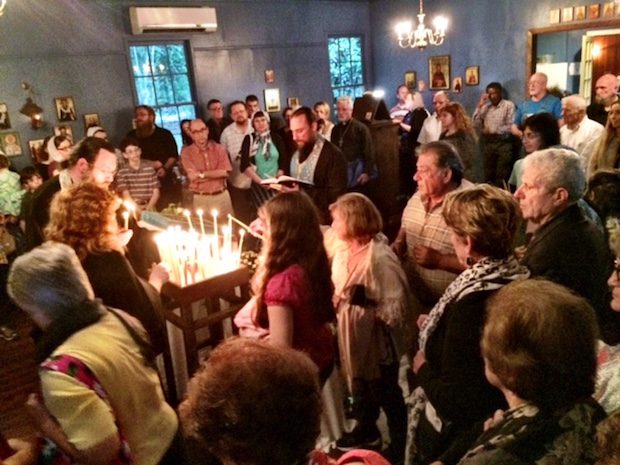
Never have so many candles burned in our church at the same time!
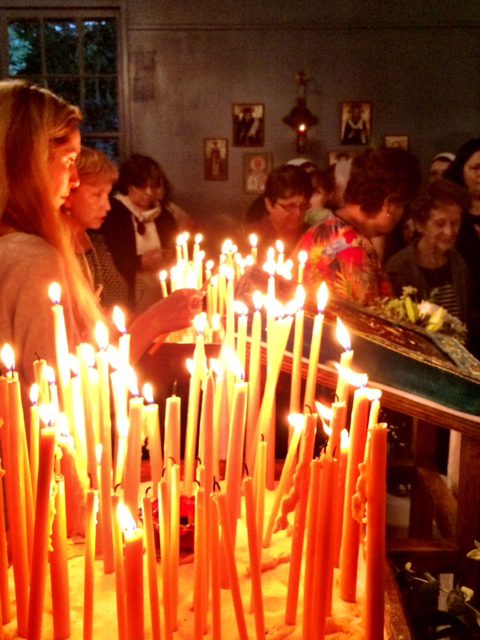
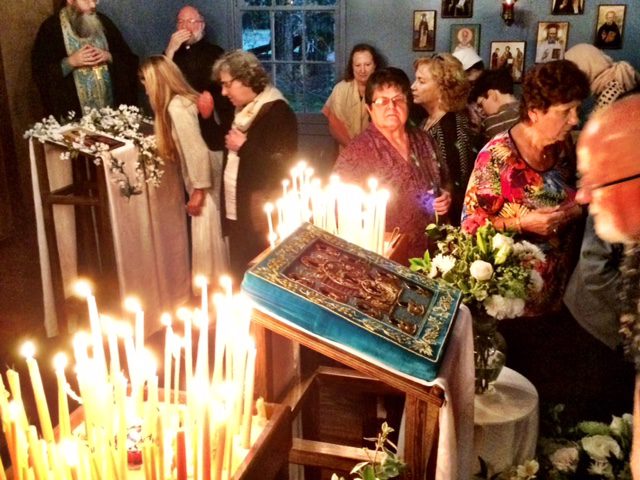
It was such a blessing to have this icon visiting our little country mission parish. When it returned for the first time to Kursk after the reunification of the Russian Church in exile and the Moscow Patriarchate, 200,000 people came to venerate it and welcome it home (see below). We had 150 or so — not bad for a little Russian mission church on the bayou:
Transgender-ish Jesus
Let joy be unconfined! Villanova’s Katie Grimes, America’s Theological Sweetheart™, has pronounced that Our Lord is kinda transgender. Excerpt:
Since Jesus had no human biological father, and since God, his heavenly Father, lacks a body, then Jesus was a man who likely had no Y chromosome. Would this not make Jesus more like a transgender person than a cis-gender one? We could grant Jesus a Y chromosome, but then we would have to assign his virgin mother Mary one as well. Either way, the miracle of sex-less conception suggests that Jesus can qualify as a “real man” only if Mary qualifies as something less than a “real woman.” (And I hope you can tell I that I am using quotation marks in order to signal extreme sarcasm).
The Christian case against transgender people typically trumpets the single line from Genesis in which God presumably created human beings “male and female” as evidence that God intends for each individual to be either male or female. In doing so, these Christians display more than just a disregard for both semantics and logic. They twist the word of God in the shape of their own preconceptions.
They do? Well, alright.
That one has no self-awareness. At all.
Meanwhile, the Joan of Arc of the progressive Evangelicals offers a mot for her flock:
Friends talking about pulling their kids from public schools over the trans bathroom thing reminded me of this https://t.co/x03wjlBjlg
— Rachel Held Evans (@rachelheldevans) May 16, 2016
Of course it did. Never mind all the concerns people have for their kids’ safety, or the far more serious concern about school districts like Fort Worth’s mandating the teaching of gender ideology in the classroom. It’s all just like Jim Crow! The girls’ locker room is the Edmund Pettus Bridge! Etc.
The Rachel Held Evanses and the Katie Grimeses of the world will do their very best to aid and abet the mainstream culture drive orthodox Christians into dhimmitude. The only comforting thing to take from all this is that progressive Christianity is the last stage before apostasy. So their time is short, but they can and will do a lot of damage before they’re done.
Teacher Burnout
Reader Chris Rawlings adds this comment to the thread in which I complained about the Obama administration adding a new and controversial Title IX mandate onto public schools, by citing the experience of a friend who teaches in a poor, rural Southern school. Chris says:
My wife teaches in a poor urban public elementary school that serves a mostly Latino demographic. She would affirm in strikingly similar terms exactly what your friend said to you. Especially this part: for a lot of kids in poor schools, the school day is the most ordered part of their lives. We all think of school as a place where children go to learn how to read, think critically, and reason through basic scientific analysis, and all of that is true, at least in functioning schools. But for poor kids throughout America, growing up as they do swallowed by the neuralgia of their parent(s) and their communities, school is more than anything else a place where they can experience things a lot of us take for granted: good relationships, intellectual curiosity, the joy of their own imagination, and even food. My wife has come home in tears before when she’s learned that at least one of her students literally goes hungry. She’s also constantly amazed that her students don’t know how to eat certain fruits, or even know what they are, because at home they eat Ramen noodles and Cheetos or McDonalds for dinner. She’s had to buy coats for students before, and we live in Colorado, where you really do need more than the hoodie that those kids came to school with. I think my wife would confess that much more than arithmetic or reading, the most valuable thing she does for her students is to simply teach them how to be people, which is an astonishingly heavy burden for a 20-something young teacher like my wife to be charged with.
My wife regularly has students whose parents are deported to Mexico or in jail. Only a small number of them live with a married set of parents. The stories of brokenness, bitterness, and the asphyxiating crush of moral, spiritual, and emotional disorder are overwhelming. It is always bitter sweet when I visit her second-graders, because I’m always taken aback by how much they seem to crave my presence when I’m there, and especially my attention. In reality, though, it isn’t me at all. It is the fact that I’m a man. These kids crave male attention, and it is frankly unnerving the degree to which they do so. It is hard to shake the image of little girls blushing at you because they so very rarely every have any man—let alone their fathers—who bother spending time with them. It isn’t hard to appreciate why so many will end up pregnant or in abusive sexual relationships by the time they are 16. Or little boys who try to act far manlier than they are, because they think that male approval is something that has to be earned by machismo.
The problem with the way our schools educate our kids, generally, is that they teach them a lot without teaching them anything at all. We are creating a generation of moral idiots—automatons, really—who know a lot, but are sociopathic in their orientation to the world around them. We aren’t teaching them how to be truly human, and I don’t believe that especially the students in my wife’s school are getting that at home, either. This year one of my wife’s students asked her, “what is church?” And so many of them aren’t learning that from institutions of faith, either.
For her students, the starting point is opening their hearts and minds to a world better and way beyond the dysfunction and dystopia of the lives they inherit. She teaches them good literature, good manners, and a joy for the things we cannot see. In a public school, that’s about as much as a serious Catholic can do. Frankly, I think it does a lot.
I’ll finish by pointing out that my wife is leaving her school at the end of next week. We’re moving out of the area (actually, the country, to be precise) for another opportunity, but in any case my wife is simply burnt out by the pressure, the weightiness of teaching a population like this. It’s a lot to be a teacher today, and it’s vastly more to be a parent to thirty new kids every year. It’s wears you thin, as you might imagine. My wife is not leaving teaching, but a few more years at her school and she would probably feel no other option than to do just that. I assure you that she isn’t alone, either. It is a tragedy, quite simply. And it is one without the kind of easy, policy-based solutions that people like.
In the midst of the wreckage of the battle our culture has fought against the very understanding of what it means to be human, one of the last things we need is a federal mandate to mainstream transgenderism in our schools. My wife’s students—like any other eight year-old kid—need order, not the anthropological confusion that only deepens the existential ennui that hangs around the neck of American schools like a python slowly squeezing the life out of the schools and the kids who daily seek shelter in them.
Mohammad Goes Trump

Another liberal eager to spread the gospel of America at gunpoint (a katz / Shutterstock.com)
Reader Mohammed, who lives in Iran, writes to draw attention to this Roger Cohen column in The New York Times, in which Cohen derides the Trumpistas as “know-nothings.” The key graf:American isolationism is an oxymoron because America is a universal idea. That does not change however far short of its ideals the nation may fall.
Says our friend Mohammad:
This man has such a skewed knowledge of history, yet he has this contemptuous tone about the people he disagrees with. And if your liberal readers are in any doubt that the liberals are as much prone to needless and stupid interventionism as the most die-hard neoconservative, just let them read what this man says about American as an idea.
If I read this column today, and tomorrow were the election day, I would certainly vote, and vote for Trump.
The Global Benedict Option
Reader Anna Salyi, a Catholic in Hungary, sends two great e-mails. I publish them with her permission:
This is going to be a rather lengthy comment from an – can I say so? – avid reader of AmConMag, which I stumbled upon not a very long time ago. I am a Hungarian millennial (thirty-one, to be precise) and have been looking for the kinds of articles (and conversations) that are featured there. (Pardon me if my English is not always correct – obviously not a native speaker). I currently am writing my PhD on Catholicism in the US, looking at it from the postwar period on.
The concept of the Benedict Option is something I have been grappling with for a long time, although, I believe what I have in mind is something quite different from what you mean by the term (I took it from you – my father would call it “Christian Ghetto”, rather disapprovingly). My quest is informed by my experiences with two Catholic communities present here in Hungary – both are “live-in” communities; monks (priests), nuns and lay people – often families with children – living together. They are usually located in the countryside or on the verge of cities. One was founded in France in the 1970s, the other in Italy in the 1980s, by lay couples. In that, they can be both viewed as “offsprings” of Vatican II (thinking especially about Lumen Gentium here). The French one is much bigger, involving around 500 “live-in” members on all continents in several houses, while the Italian community is only present in Italy, Bosnia, Hungary and Brazil. Also, both are rooted, in one way or another, in the Catholic Charismatic Renewal.
As for my personal involvement, I met the French community in my early 20s here in Hungary (all Hungarians though), and it had a really profound impact on me (I was born and raised Catholic, but had never found the community and prayer aspect anywhere near this satisfying before). Then about 5 years later, I encountered the other (Italian) comunitá and went on to live in Italy, Bosnia and Brazil with them for about half a year. These are fairly closed communities, trying to imitate monastic life, with lots of prayer and restrictions on movement of members (obedience is key). I suspect this is not exactly what you mean by the Benedict Option. However, they are, in a way, reactionary, have been borne out of an urge to counter the tidal wave of secularism in the postwar period in Europe and in this, resemble your efforts (if I am not entirely mistaken regarding your whole modus of thinking). They of course also reach back to age-old Catholic wisdom and practice. Strengthened by their rich prayer life and the sacraments, evangelization is a foremost activity of theirs.
I became fully independent and got married (no kids yet) shortly after I came home from Brazil, am practising my faith the best I can (maybe not terribly well), but am finding it hard to live a meaningful, committed Christian life in an increasingly secular society. Evangelization seems like an impossible dream – I feel good enough if I do not lose sight of my convictions (not so much politically than spiritually speaking).
Why I am writing this is because I wanted to draw your attention to the fact that as far as I know, after the Second Vatican Council in Western Europe a host of these types of communities came to existence, mostly in Italy and France. Many of them are alive and kicking even today, giving vocations to the Church and also solace to believers who are looking for spiritual guidance in vain at their local parishes. I also think the etymology is really important here – it is not by accident that they call themselves “communities” (communauté in French or comunitá in Italian).
It is also not by accident that someone from the former Soviet bloc would be so much drawn to the idea. When I think about the Benedict Option, I certainly not only think in terms of retreating as the secular world becomes ever more aggressive but also in terms of forming circles of people in an increasingly atomised country. [Emphasis mine — RD]
Hungary, for one, is struggling with the rapid and complete loss of the agricultural/rural communities during the Communist era and the transition from an almost feudal pre-war society to a postmodern one. The divorce rate (66%) is one of the highest in Europe, families are in disarray. Weekly church attandence in the Catholic Church, which was around 10-15% at the time of the collapse of the Soviet Union, is in decline. Alienation is so strong a trend that living in a community, even if a fairly secluded one, gives a sense of belonging and peace to someone like me. (My husband comes from a family of 12, so his take is fairly different than mine). The political situation is another story (socially conservative government), but I do not want to go there now (although, fascinating stuff).
I am not sure about these trends in the US (never been there), however, this (the community) aspect to my mind is something crucial here. Think about current social trends among millennials- postponing marriage, kids, even finding a stable job (although I must add it is very often or even mostly not intentional) – this certainly is going to make our societies even more atomised and alienated (at least here in Hungary it already is). Simply put, you cannot live in a “global tribe” or a “global village” – there is a limited number of people you can form real and meaningful bonds with. As far as I see it, Christianity, and specifically Catholicism, has always managed to be both local and global. The Benedict Option might be an answer to the rapid loss of the local aspect.
I have been looking into lots of American traditionalist Catholic websites lately, and am trying to figure out the sometimes quite substantial differences that seem to exist between my experiences here and those of traditional Catholics in the US (although we do seem to see eye to eye on issues relating to this papacy). I am not sure how much all this is influenced by cultural contexts. I have certainly found that Italians in particular (I mean those who take their religion very, very seriously) have a gift for living a deeply religious life which, at the same time, is very much imbued with a sense of the beauty, wonder and joy. They are also incredibly civilised and cultured (even in the absence of a formal education). I also have the impression that there is much too little communication – intellectual or otherwise- between European and American conservative Christians. But this is not exactly to the point.
It just occurred to me that you might find it useful to research those communities a bit for some context (you might already have, or you may not be interested in these at all, in which case sorry for my arrogance). Of course, as with every Catholic individual and organisation, they will have to decide what to do with this whole forced-ecumenism-with-hip-watered-down-teaching. Plus, I think it is worth pondering a little that again, this whole community idea (“living like the first Christians”) came right after Vatican II, in the midst of the sexual, beat, social and whatnot revolution (Paris, Prague 1968, etc.). I find it a bit too simplistic to swipe aside the whole charismatic renewal as a passing phase – these communities were certainly a fruit, even if we have to see if they stand the test of time and recognise properly the signs of the times in the long run.
So, here are the links:
http://www.reginapacis.vr.it/it (only in Italian)
There are a number of others – Chemin Neuf, Communauté Emmanuel, Movimenti dei Focolari, Community of Sant Egidio etc. Some of those, it should be noted, seem more like movements than real communities (at least, to me).
Anna followed up with this e-mail:
I have been reflecting on what I had written. Just a few points by ways of clarification:
I think what I wanted to stress is that there really are quite substantial differences between the experiences of various conservative Christian groups around the world (especially outside North America and Europe, but also within those). To give you an example, I cannot, under any circumstances, imagine that gay marriage will be made official either in Poland, Serbia or Slovakia any time soon. Hungary is, unfortunately, less religious, therefore less sure of its traditional mores, however, still much more conservative than most Western-European nations. (e.g. in Hungary, RE or Ethics was made part of the curriculum a couple of years ago. Under fierce attack ever since by liberals, but still.) For that reason, there is hope for political resistance (even on a national level) too. It is not going to be a case of lily white politicians everywhere, corruption is a huge problem, etc., but certainly the picture is not as bleak as over there (at least this is my belief).
However, the crisis of Christianity is a tragedy on a global scale. One has to live under a rock not to know this. Not only because Christians are called to be “salt and light” of the Earth, but also (or consequently) because Christianity, by definition, is supposed to be global (“therefore go and make desciples of all nations”, cf. Catholic=universal). So, what is happening in the US, or in Western-Europe, or, for that matter, in the Middle-East should concern all of us.
Also, I believe (and that is my main point), we have to be both local and global in our endeavours . Globalization is also an opportunity for us, not only them. We should find ways to work together, without blurring the lines that shape our individual and communal identities. I am not saying one can come up with practical measures for far away places and I absolutely agree with the importance of locality. However, in terms of ideas, I do believe in pooling our resources (to give a negative example, Marxism comes to mind – it practically engulfed the globe at one point. Still not extinct. Or, the way the Roman Empire made the spread of Christianity possible.)
This ongoing transformation is going to be absolutely profound, and quick. Your work, to my mind, reflects an understanding of this (and thus is almost prophetic). It matters, not only to your fellow Americans, but others too.
I cannot express how grateful I am to Anna Salyi for these letters, and for helping me to stay focused on the international value of the Benedict Option. Last year when I had dinner with Jean-François Mayer, the Swiss French religion scholar, I recounted it on this blog like this:
We spoke for a while about the Benedict Option. He said it is an idea whose time has come. There are people all over Europe, he said, who are thinking the same thoughts, but nobody has put a name to it until now. There is a deep sense among a strand of Europeans — mostly Christians, but some not — who intuit a profound civilizational crisis, and who feel the need to prepare for difficult times. He strongly encouraged me to get busy writing the book.
Which I am now doing. I’m well into the politics chapter, and am drawing ideas from the way Vaclav Havel and other dissenters conducted politics under communism. I did visit the Tipiloschi community in Italy, but I didn’t have time to visit any more European communities, such as Anna mentions. Nevertheless, when the book comes out, it will be important for all of us like-minded Christians, all over the world, to find each other, to network, to pray for each other and to help each other in different ways, as circumstances dictate. We are one people, after all. I think of St. Benedict’s mystical vision, recalled here in his life, written by Pope St. Gregory the Great:
The man of God, Benedict, being diligent in watching, rose early before the time of matins (his monks being yet at rest) and came to the window of his chamber where he offered up his prayers to almighty God. Standing there, all of a sudden in the dead of the night, as he looked forth, he saw a light that banished away the darkness of the night and glittered with such brightness that the light which shone in the midst of darkness was far more clear than the light of the day.
During this vision a marvelously strange thing followed, for, as he himself afterward reported, the whole world, gathered together, as it were, under one beam of the sun, was presented before his eyes.
Antipolitical Politics: A Non-Religious Example
David Brooks writes today about the Resnicks, a wealthy couple in California who produce things like Fiji water and Pom pomegranate juice. They are working to build a community among the workers who live around and work in their factories. Excerpts:
Fortunately, we’re beginning to see the rise of intentional community instigators. If social capital isn’t going to form spontaneously, people and groups will try to jump-start it into existence.
He explains how the Resnicks are doing that. More:
Finally, there are more cross-class connections. Dr. Maureen Mavrinac moved here from the UCLA Family Medicine Department. Dr. Rishi Manchanda was the lead physician for homeless primary care at the Los Angeles V.A. These are among the dozens who have come to Lost Hills not to save the place from outside, but to befriend it. Their way of being ripples. I met several local women who said they were shy and quiet, but now they are joining community boards and running meetings.
What’s the right level to pursue social repair? The nation may be too large. The individual is too small. The community is the right level, picking a piece of land and giving people a context in which they can do neighborly things — like the dads here who came to the pre-K center and spent six hours building a shed, and with it, invisibly, a wider circle of care for their children.
Read the whole thing. This is a nice approximation of what I envision the Benedict Option being, except for Christians, and with the telea goals of serving God by deepening one’s knowledge of and commitment to the Christian faith, and helping others.
The Benedict Option is not simply a strategy for how to live and to thrive under conditions of oppression. Even if there were no oppression, we would still need the Benedict Option, because modernity, by its very nature, is leaching the faith out of our souls, churches, families, and communities.
Justice Clarence Thomas said in his Hillsdale commencement address the other day that one need not pick a grand cause and work for its realization in order to be a good citizen. One can do that by just being decent and loyal and of service to one’s neighbors. I was reminded yesterday of how my late sister, Ruthie Leming, did that with the kids she taught in public school. Here’s a short passage from The Little Way of Ruthie Leming:
Kendrick Mitchell, another of Ruthie’s early students, came from a strong home and made good grades. His problem was bullying. A self-described nerd, Kendrick loved Greek mythology and Sherlock Holmes mysteries – unusual tastes for West Feliciana sixth-grade boys, especially so for African-American kids. Kendrick took loads of taunting from classmates for his love of reading.
Ruthie reached out to Kendrick, befriended him, and encouraged him, telling him that it was going to get better, to hang on. More:
Today, working in human resources for a Fortune 500 company in Houston, Kendrick says that the patience and encouragement Ruthie gave him – “She always, always had time for you, no matter what,” he says — was even more important than the knowledge she imparted.
“Mrs. Leming taught me that it was okay that I didn’t want to be on the football field or in the streets doing bad things,” he says. “She would even go as far as recommending books to me. She watched the type of books that I liked to read, and when we would go on library trips, she would hand-pick books from the shelf and say, ‘I think you might like this one.’ That’s how she was. We weren’t just names and faces to her. She saw us.”
I wrote that four years ago, having interviewed Kendrick Mitchell on the phone. Yesterday, at a school event, I actually got to meet him. He’s in law school in Houston now, and doing very well. Ruthie was part of his journey to success. Her great mission in life, though she didn’t think of it that way, was to be of service to her community.
Not all politics happen in state and national legislatures and governmental executive offices, you know.
Rod Dreher's Blog

- Rod Dreher's profile
- 509 followers

