
Rod Dreher's Blog, page 577
May 25, 2016
View From Your Table
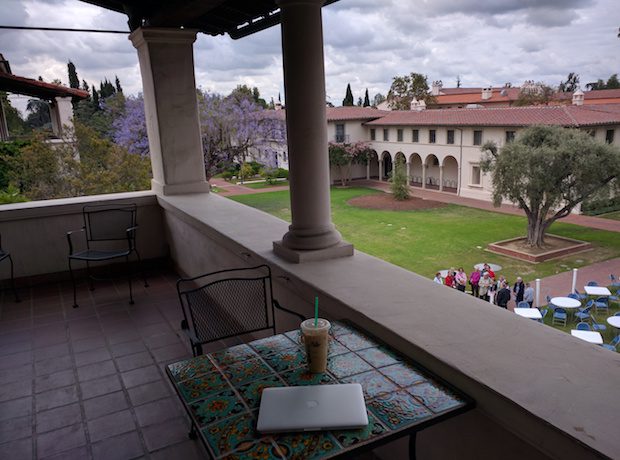
Pasadena, California


‘The Malaise Is Everywhere’
A reader writes:
I have been reading your posts regarding the abandonment of middle America. This is of particular poignancy for me as I was shuttled around between various rural industrial towns and suburban working class as well as upper middle class communities during my youth. This was still when there was a carrot being dangled and a pot of gold to chase even in the most meager cow towns. It’s not just rural America or the rust belt that has been abandoned as Mr [Kevin D.] Williamson’s posts would suggest. The malaise is everywhere. Part of it which few seem to be addressing lies in the attitude of the educational establishment which they purvey to the cannon fodder in their grasp. Even in the 1970s the pervasive sentiment was “What, do you want to work in a factory?”
They succeeded in producing generations with expectations completely out of line with the reality before them. Anecdotally, I can offer this tidbit of my experience. I am by trade an engineer and a manager. I run an engineering department as well as the tool and die and mechanical / electrical maintenance departments for a ( gasp, these still exist? ) Midwestern metalworking company. When we run employment advertisements, the replies to the ads are as follows; Maintenance: Eastern European recent immigrants, primarily Polish. Tool and Die: mostly US born some Polish and Russian, but all are in their 50’s or older, nothing coming down the pike. Engineering: Recent graduates of Indian or Mideastern origin, very few native born. And none of the applications are from native born with experience. It’s as if they vanished into thin air.
And yet, we read about the multitudes who are unemployed. They were merely led astray by those who were entrusted with their developmental care. Now they really do have no applicable skills. And as for the factory floor production positions within our company, the vast majority of applicants we receive are Hispanic. We are a short bus ride from the most impoverished ghettos you could imagine, but few applications come from those quarters. The complacency of generations of parents, placing blind trust in the motivations of the bureaucrats of the kid factories is at least partially to blame. The decline and abandonment in rural areas has been the thread which tied these posts together, but the underlying disease is shot throughout the entire body of our nation as well as most of the western world.
If Trump were to bring those jobs back to America, who would do them? Again, it’s anecdotal in my case, but teachers and administrators in public schools around the nation — schools that serve the poor and working class — e-mail or tell me personally that they don’t know how most of these kids will ever hold a job or form a stable family. Their home lives were too chaotic for them to get their feet on the ground. Many of them have no fathers involved in the picture, and moms with serial boyfriends. Drugs are a big part of their lives. They have no sense of direction or ambition. They are barely educated (despite the teachers’ best efforts). They don’t want to work. Et cetera.
It’s not so much that they’re unemployed as it is that they’re unemployable.
Re-Tribalizing America
Milo Yiannopoulos’ event at DePaul University had to be cut short Tuesday night after protesters stormed the stage, blew whistles, grabbed the microphone out of the interviewer’s hand, and threatened to punch Yiannopoulos in the face.
Watch the video clip here. More from the Breitbart story:
Yiannopoulos attempted to continue the event, but protesters refused to leave the stage and the group of security guards (which DePaul forced both the organisers and Breitbart to pay for) refused to intervene.
And this happened in Albuquerque:
In one of the presidential campaign year’s more grisly spectacles, protesters at a Donald Trump rally in New Mexico threw burning T-shirts, plastic bottles and other items at police officers, injuring several, and toppled trash cans and barricades.
Police responded by firing pepper spray and smoke grenades into the crowd outside the Albuquerque Convention Center.
During the rally, the presumptive Republican presidential nominee was interrupted repeatedly by protesters, who shouted, held up banners and resisted removal by security officers.
The banners included the messages “Trump is Fascist” and “We’ve heard enough.”
Donald Trump and Milo Yiannopoulos are provocateurs, no question. But they are proving something important about the militant left: that it is often racist against whites, and has no intention of allowing any opinions other than its own to be voiced in the public square. And whether in the streets or in a university lecture hall, it will use violence to impose its will.
A reader writes:
Here’s a true story. When I was in medical school there was a group of 20-40 students who were self-defined “progressive brown people” (their words, not mine). I was once told by one member of this group that eventually brown people were going to “outnumber white people” and when “Texas goes Democratic” it is going to be “game over for white people”—they will end the hegemony of white culture and tax me so much there will be no privilege left to give my children. They also had some pretty negative things to say about the allegedly vanilla sexual preferences of a married friend of mine. Now these people were drunk, and being a bow tie and tassel loafer wearing milquetoast, I merely raised my eyebrows and walked away. I know it sounds unbelievable, but it happened at a “top 10” medical school party.
I almost posted that story in the AltRight thread. I mean, what are you supposed to do when people think like this? It’s crazy. BLM protested my midnight Mass, which might make sense if I was in SSPV and invited Williamson to say it. When someone says that loving Western culture makes you a “white supremacist”, it’s hard not to shrug and say “yeah, so, what if I am?” Now, I’m not a white supremacist in any meaningful way (heck I voted for Obama, twice, although, I do regret the second vote, and Cardinal Sarah’s new book is on my must read list), but if all that is left is tribal conflict (and I’m not saying that it is), I’m picking my own tribe. Part of the Alt Right’s appeal is that people like David Brooks (and I really do like poor David and don’t mean to make him a punching bag), and to some extent me, is that we aren’t really willing to go to the mat for what we value because we are afraid of being called mean names. Say what you will about the AltRight, and from what I’ve seen they are pretty odious, but the debate on immigration is the first time I’ve seen the Overton Window shifted to the Right on a major issue. And they successfully fought back over GamerGate. The conventional right could probably learn some backbone from them, if nothing else. I don’t see things getting better anytime in the near future. I’m buying 100 acres and a gun.
The center is not holding. The militant left is going to drive a lot of people towards the militant right. In the fall campaign, Trump is going to go full “Amnesty, Acid, and Abortion” — and the emotional reaction that seeing video of violent Black Lives Matter activists and other Social Justice Warrior militants in action (which we will see, all throughout the fall, because they cannot help themselves, and not even media spin will be able to hide it) will frighten a lot of law-and-order people into voting for Trump.
Relatedly, Damon Linker, a pro-gay rights liberal, whacks Obama hard for his political overreach on trans locker room and bathroom rights:
President Obama’s decision to become a champion of transgender rights just might be enough to move a significant number of culturally conservative voters who have been troubled by Trump firmly into the anti-Democrat column.
Why did Obama do it? The answer isn’t especially clear to me because I’m not the right kind of liberal.
In purely political terms, the decision seems inexplicable. The number of transgendered people in the United States is vanishingly small — something on the order of 0.3 percent of the population. Many people, like me, who have no problem with allowing transgendered adults to use the bathroom of their choice nonetheless think it misguided to indulge the decisions of children in this area. (Kids aren’t allowed to drink alcohol, drive, vote, work, or volunteer to fight in the military, but they should be permitted to change their birth gender?)
And:
I supported gay marriage for 10 years before it became the law of the land. I think opposition to allowing transgendered people to use the bathroom of their choice is silly and sometimes cruel. But there’s more than one way to win an argument. And in all but the most egregious cases of injustice, liberal governments should resist the urge to prevail through force.
Read the whole column. It’s good. It comes from an old-fashioned liberal. The SJWs will deal with his kind too, if they get any more power. The media have soft-pedaled this thing, but when it gets right down to it, all the diversity rhetoric in the world is not going to matter when a man recognizes that in voting Democratic for president, he is voting for a party that wants to send mentally disturbed males into his daughter’s locker room, and call it justice. The liberal elites in this country, as well as the business Republicans, are pleased to virtue-signal by catering to the desires of .03 percent of the population, and throwing a substantial number of ordinary people and their families under the buss. I am absolutely certain that Hillary Clinton will continue Obama’s SJW crusade on the LGBT front, religious liberty and common sense be damned. These pink police state jackboots are trampling out the vintage where the grapes of wrath are stored.
I find myself somewhat unnerved by this comment in a feminism thread on this blog, considered in this context. Brad Wilcox is a Catholic sociologist at UVA who researches the family. He’s also a friend of mine. Jack Donovan is a pagan masculinist/tribalist who has written approvingly of Virginia group that has built a Benedict Option for white supremacist pagan males. As a Christian, I am sorry to say that Jack Donovan is a very smart man who understands something important about what’s happening in this country, something that many of us conservative Christians do not. Here’s the comment, written by a female reader:
On the Maxim Masculinity article, I disagree with Brad Wilcox’s method. He says what the women want to hear, “Men need to man up and get married”, but he fails to account for why men get married, and finally fails to be that enticing to actual single men. They don’t do it so they can live another 10 years, or have better health, or more cash (and really how insulting is that.) They want a loyal woman who will help them achieve their most meaningful goals. Women want this too, just that women’s reproductive goals center around security (essential to having a good family) and men’s reproductive goals center around fertility (also an important aspect of family.)
And feminism has decisively cut down on married-woman fertility, while increasing it among unmarried women. From my vantage point, in an un-moored society, marriage makes no sense for most guys, whose better bet of reproduction lies in large numbers of low-investment ‘scores’.
MGTOW message on (pagan) Jack Donovan’s site is: Courage, Strength, Mastery, Honor. Religious Brad Wilcox’s message: pony up, get married, you’ll get more cash and a longer easier life. Brad’s message is not even in the same universe, which is too bad for people who care about making a viable marriage culture.
Emphasis mine.
I haven’t talked to Brad about this, but my guess is that in the story to which the reader refers, Brad was speaking as a social scientist, not a committed Catholic or family activist. He and Donovan are engaged in two very different modes of discourse. Brad probably holds some of the same basic beliefs about masculinity and culture that Donovan does, though from a Christian point of view, yet he was asked to speak as a sociologist, from the point of view of academic research.
That said, the reader’s comment highlights something powerful: that reason is largely impotent in this fight. I’ve heard it said that one reason American Christian men are attracted to Orthodoxy is because it is so masculine — not in a John Piper way, but in something more organic and ancient. There is something about the vigor of the Orthodox ritual that seems far less tame than Western liturgies or services, but more to the point, Orthodoxy stresses the struggle of the Christian life, the quest to conquer oneself.
Listen to this Russian Orthodox hymn, sung by a Russian male choir. Seriously, give it about 30 seconds. It sounds like something out of Tolkien, as if the mountains themselves were crying out to God. Now, you are not going to experience that kind of singing in your ordinary Orthodox church. But that is the spirit of Orthodoxy, right there, and you will find that the deeper you go into the tradition and its worship.
Look at results of this poll on masculinity in Great Britain. Excerpt:
Even including the second highest level of masculinity, there’s a 56% gap between male 18-24s (18% at level 0 or 1) and over 65s (74%), and a 28% gap between 25-49s (46%) and over 65s.
There is a dramatic difference between young and old women on their self-defined level of femininity as well, but not quite as large. Only 39% of 18-24 year old women say they are almost entirely feminine (at level 5 or 6) compared to 77% of over 65s.
American men are much more likely to think of themselves as exclusively masculine. Overall 42% of American men say they are completely masculine, compared to 28% of British men.
I wonder to what extent America has numbers so high because we have a larger black and Latino population than Britain does. Anyway, here’s Tyler Cowen on masculinity and our current crises:
Donald Trump may get the nuclear suitcase, a cranky “park bench” socialist took Hillary Clinton to the wire, many countries are becoming less free, and the neo-Nazi party came very close to assuming power in Austria. I could list more such events.
Haven’t you, like I, wondered what is up? What the hell is going on?
I don’t know, but let me tell you my (highly uncertain) default hypothesis. I don’t see decisive evidence for it, but it is a kind of “first blast” attempt to fit the basic facts while remaining within the realm of reason.
The contemporary world is not very well built for a large chunk of males. The nature of current service jobs, coddled class time and homework-intensive schooling, a feminized culture allergic to most forms of violence, post-feminist gender relations, and egalitarian semi-cosmopolitanism just don’t sit well with many…what shall I call them? Brutes?
There are constructive forms of masculinity, and destructive forms of masculinity. Giving oneself over to gun violence and fathering children that you won’t care for is a destructive form. But middle-class male culture, at least white male culture, doesn’t know how to nurture a healthy masculinity. The middle-class white American church certainly doesn’t. Eventually, the provocations of Social Justice Warriors, especially when they are race-based, is going to empower the militant whites, especially those drawn to pagan masculinity, and they are going to do what the rest of us would not do: Fight. This, because the best — that is, those who want peace, civility, and tolerance — lack all conviction to defend the conditions under which we can have those things against their enemies.
Trump is a vulgar, crass, alpha-male brute. But he doesn’t care what SJWs and liberals say about him. He fights, and sometimes fights as dirty as they do. That’s not nothing. White liberal middle-class society and many bourgeois conservatives have demonized within themselves, collectively and individually, the instinct that would have given them the strength to fight civilization’s enemies on the Left and on the Right. It’s partly because of self-hating white people like this (from Nathan Heller’s New Yorker story about Oberlin):
Earlier this year, a sophomore, Chloe Vassot, published an essay in the college paper urging white students like her to speak up less in class in certain circumstances. “I understand that I am not just an individual concerned only with comfort but also a part of a society that I believe will benefit from my silence,” she wrote. She told me that it was a corrective for a system that claimed to value marginalized people but actually normalized them to a voice like hers.
Idiot. Nobody has to try to take away her right to speak; she’s giving it up because she feels too ashamed to exercise it, because she’s white.
The answer to this racist SJW garbage is not to embrace white supremacy! But without a forceful, effective, unambivalent response to the unhinged militant left, sooner or later the forces of white supremacy are going to organize the dispossessed, demoralized, chaotic white rabble, and the SJWs, as well as the Washington elites, aren’t going to know what hit them. God knows I’m not saying I want this to happen, but I think it probably will happen if we continue on this current trajectory. Slouching rough beasts and all that. It’s Weimar America.
UPDATE: Reader Grotto comments:
The connection between the Alt-Right and the various masculinity movements deserves some elaboration. As many have mentioned, the demographics of the Alt-Right are young and male, and the role of young male frustration (sexual or otherwise) cannot be overstated.
As Dreher adequately documents, the hegemonic narrative regarding gender is clearly insane. And while the level of insanity has climbed exponentially in the past decade, virtually everyone under-30 (my generation) has been marinated in relentless gender-equivalence propaganda since kindergarden. But, as the male cohort grows older, the distance between the experienced reality of of the dating market and the official dogma becomes unsustainable. The cognitive dissonance is simply too great, and boys are driven to seek answers elsewhere. And those answers come, with varying degrees of accuracy and crudity, from the PUA/Game/MRA/RedPill blogs. Whatever their faults, they all have one redeeming quality – they are manifestly not insane. This comes as a great shock and relief to boys. A shock because they realize the magnitude of the deception they have experienced, and a relief because they realize they are not the crazy ones.
These blogs are essentially applied evolutionary psychology. The systematizing, logical male mind is placed in the dispassionate, clinical service of disassembling every polite fiction about courtship, and replacing it with an amoral imperative. Women are to be understood, then mastered. And once women are mastered, they are irrelevant. Onto the next challenge. Unless you are in this generation, you have no idea the sea-change that is occurring. 35-year-olds are teaching 25-year-olds, who then repackage it for 15-year-olds.
This then becomes the primary infection vector for other forms of thought crime. Once one aspect of the progressive catechism has been shown to be false, the whole edifice falls under suspicion. While the intellectual roots of the alt-Right don’t come from the masculinity crowd, most of their new converts do, and therefore the dominant attitude and aesthetics of the alt-Right come from this wing. They hate sentimentality, and have a Nietzschean sense of life – true meaning in life comes from removing the shackles of slave morality, and freeing your ambition from the cloying masses who might call you racist or sexist or homophobic.
Is it any wonder then, appeals to marriage based on life expectancy or lifetime earnings are rather ineffectual?
Taste-And-See Orthodoxy
So as I said, the monk, who has facilitated our monastic tour, has earned his sermon. He asks us in Romanian, translated by our host, a simple question: What is the point of our learning about key moments in the history of Byzantium or modern Orthodoxy, if we aren’t going to be transformed by these truths ourselves? And we, all of us with Ph.D.s in some aspect of Orthodox history, smile politely, because modern academia does not have an answer to that question, inasmuch as academia is premised upon a tacit agreement never to ask it at all.
That is such an Orthodox question, what the monk asked. I will return to it momentarily. But read on:
As we drive from site to site, the earth is awakening from winter as if to illustrate this resurgence. Between site visits, I am reading Laurus, the oft-discussed recent novel by Eugene Vodolazkin about Arseny, a fifteenth-century Holy Fool. Arseny can see into the future. Somehow, despite living in the Late Middle Ages, he steps on a plastic bottle, as if foreseeing the terribly littered landscape around me that still suffers from the communist years. As I’m reading, our academic host gets up on the bus to explain at last a story so many of us have been asking about. Who is this modern saint whose picture we see in every parish church and corner market? Like the protagonist of the novel, his name too is Arseny—Arsenie Boca (1910-1989). An artist and persecuted priest, he helped with the Philokalia translation into modern Romanian, and was well established as an Abbot when communism arrived. We learn of the miracles, bilocation among them, unwittingly documented by communist authorities. For a moment, Vodolazkin’s enchanting novel does not seem so bizarre.
He’s right. I can no longer imagine what it’s like to read Laurus through non-Orthodox eyes — but here’s the point where I should say that two Orthodox friends of mine who read it after I urged it on them told me they didn’t get it. Anyway, reading Laurus, even the parts that we would call “magical realism,” I kept nodding and thinking, “Yes, that’s how it is. That’s how it is in our religion.” Orthodox believers (in general) expect miracle and wonder with a naturalness that I have never seen outside of Pentecostals. More:
The Romanian Christians I meet do not see their Orthodoxy through rose-colored glasses. Politically speaking, all of them are concerned about the territorial ambitions of Putin’s Russia. Among the clerics, many worry that similar ambitions by the Russian church might overwhelm the long-awaited pan-Orthodox council to be held this summer. Within the Romanian Orthodox Church itself, troubles of nationalism, phyletism, and complicity between church and state remain sources of concern. But its faithful also have recourse to the great cloud of witnesses that awaits them on every church wall, and the humble resilience that—alongside non-Orthodox Christians like the Reformed pastor László Tőkés—proved a match for Communism.
But at each of the places we visit, the question comes up again, from scholars, from monks, and finally—on the eve of Lent—from a bishop: Why, we are asked, are you interested in the history of Orthodoxy if you are not transformed by it yourself?
Milliner’s piece prompted me to muse here on a thought that occurred to me this past Sunday, standing on the side of the nave of the Clear Creek Abbey crypt church, watching a solemn high mass celebrated with austere reverence by the Benedictine monks who live there. It was beautiful, it was holy, and I was privileged to witness it, and to pray with my Catholic brothers and sisters.
But at the same time, I thought: I guess I really am Orthodox now. As beautiful as this is, Orthodoxy is who I am now, and I am grateful to God for it.
Notice that I didn’t say, “Orthodoxy is what I believe now.” It’s much deeper than that. The difference is that I have been marinating in the Divine Liturgy of St. John Chrysostom for so long that it has soaked in and, to use social anthropologist Paul Connerton’s phrase, “sedimented into my bones.”
You might remember my writing last year about Connerton’s dense but powerful book How Societies Remember. Here is an excerpt:
Connerton discusses three types of memories — personal (something in the past that the individual experienced), cognitive (something in the past that the individual knows from having learned it second hand), and habit-memory, which he defines as “our having the capacity to reproduce a certain performance.” It’s like muscle memory: we may not remember how we learned the thing, but we can recall it when necessary. Reading this, I recalled the experience of Father George Calciu, a Romanian Orthodox priest, who was able to celebrate the Divine Liturgy while in a Communist prison because he had committed it to memory. The liturgy reminded him of who he was and what was true, in a time and place in which the authorities brutally tried to force him to forget. Connerton calls this third kind of remembering “habit-memory.”
When a society really wants to remember something as a society — e.g., mythical, religious, or historic stories that tell a people who they are and what they must do — it invents commemorative ceremonies around those stories. It is not enough to tell a particular story; the story has to be “a cult enacted.” That is, the story must convey a metaphysical truth, and thus has to be granted sacred status as an event that is taken out of the past and in some mystical way re-presented in the present. This is, of course, what the Orthodox Divine Liturgy and the Catholic Mass do. Rites are ways that societies maintain a living connection with their past, and enter mystically into it. Connerton says that “performative utterances are as it were the place in which the community is constituted and recalls to itself the fact of its constitution.”
In simpler language, this means that the words spoken in a rite both bind its participants together and remind the people who they are, as a people. Further, the most effective rituals involve the body. Connerton:
To kneel in subordination is not to state subordination, nor is it just to communicate a message of submission. To kneel in subordination is to display it through the visible, present substance of one’s body. Kneelers identify the disposition of their body with their disposition of subordination. Such performative doings are particularly effective, because unequivocal and materially substantial , ways of ‘saying'; and the elementariness of the repertoire from which such ‘sayings’ are drawn makes possible at once their performative power and their effectiveness as mnemonic systems.
The most effective rituals do not vary, and are removed in the form of speech and song from everyday life. And:
Finally, ritualised posture, gesture and movement, instead of flexibly combining to impart a variety and ambiguity of information as in what we conventionally describe as everyday situations, is restrictive in pattern, and hence easily predictable and easily repeatable, from one act to the next and from one ritual occasion to the next.
More:
What he means is that to remember who we are, our Story must be ritualized in some public ceremony, or ceremonies. Those rituals must not be simply commemorative; there has to be something more going on — “a cult enacted,” which is to say, an idea taking material form. And it must be not simply something we carry in our heads, but something that is in our bodies. It must be a “habitual memory” — something we carry with us without thinking about it. “In habitual memory the past is, as it were, sedimented into the body,” writes Connerton.
How does this work? Connerton’s explanation is complex, and hard to summarize. The essence of it, however, is that the Word must be made Flesh. We must live out the ideas in the Story so deeply that they become second nature to us — not ideas, but practices. The beginning pianist knows how to read music, but he cannot really play the piano if is conscious that he’s reading the notes. He becomes a pianist when he can play fluidly, without thinking about it. He has become habituated to music.
This has happened to me with Orthodoxy, to a degree that took me by surprise on Sunday. After I had been Catholic for a few years, Protestant worship (on the occasion I had to experience it) seemed so thin to me. Let me be clear: I am not making a judgment on the moral or spiritual qualities of the worshipers, only on the aesthetic quality of the worship, and the way it affected my response to it. Now, having been Orthodox for a decade, I have the same reaction to Catholic worship. Again, this is not to claim that Orthodox Christianity is more true than Catholic or Protestant Christianity (though I believe it is), but rather to observe that aesthetics matter when it comes to imprinting a particular way of thinking, of being, of experiencing a world.
It genuinely startled me how much the Orthodoxy liturgical life, as well as the modes of prayer, the fasts, and so forth, has formed me internally. Lex orandi, lex credendi. And, to be honest, I probably wouldn’t have been able to say that until we started our little Orthodox mission here in Starhill three years ago, which required me to engage with Orthodoxy on a level I had previously resisted.
The question the Orthodox monk in Romania asked Milliner and his group — What’s the point of learning about Orthodoxy if you aren’t going to be transformed by these truths? — reveals a frame of mind that I recognize immediately as Orthodox, a mindset that has made an enormous difference to me personally. Of course one can study Orthodoxy from the point of view of an academic, and many do. The naive question the monk asked, though, tells you that Orthodoxy doesn’t really care if you know about Orthodoxy in your head; it wants you to know Orthodoxy in your heart, and to live it. Truth is not a proposition, not essentially; truth is a Person, and an experience of that Person. For the Orthodox, it’s wonderful to study theology, but if that study doesn’t lead you to a more direct, real, and transformative encounter with the living God, then it is a poor thing. Or at least a thing that is far less than it could be. It’s like living in a house isolated by a snowdrift, and having a shovel in your garage, but being so taken by the object of the shovel itself that you don’t pick it up and use it to dig your way out.
In my book How Dante Can Save Your Life, I talk about how the daily, hour-long practice of the Jesus Prayer, following the monastic tradition, was key to my healing, even though I didn’t quite see the point of it all when my priest told me to do it. Later, when I was healed, I asked him why he had assigned me that intense prayer rule.
“I had to get you out of your head,” he said.
Which is itself a very Orthodox answer. My priest could see that my knee-jerk tendency to abstract things, to separate myself from them and hold them up as objects of contemplation from a distance, was at the heart of my inner illness. As long as I bracketed the things of God off intellectually, no matter how strongly I affirmed them with my reason, I would always be on the margins, tormented by the analytical mindset. Father saw that it was far more important for me to experience God in prayer, and not prayer composed of a series of stated propositions, but simply being still in the presence of the All-Holy.
This is how Orthodoxy is. Or at least as I have found it to be. And I love it.
A couple of Catholics separately came up to me last weekend at Clear Creek, having heard me say that I am an ex-Catholic, and tried to engage me in a conversation that they plainly wanted to end in my return to Rome. Unless Catholics are hostile and persistent (these folks weren’t), I’m not bothered by these conversations. These people want the best for me, and to them, that means returning to Catholicism. I usually say, “Please pray for me,” and I mean it, because I do need prayers. But I don’t have the slightest interest in returning to Catholicism — and I’m not angry about it.
To the contrary, my extremely painful experience of losing my Catholic faith and being rebuilt, slowly, in Orthodoxy, has made me grateful to see folks thriving in Christianity as Catholics or Protestants. I would make a terrible Orthodox evangelist, because even though I would love for them to discover Orthodoxy and its joyful depths, I am incapable of engaging in apologetic arguments. It’s not that I believe apologetics are unimportant. Of course they are important! But I have no credibility to do them, given my erratic faith history, and besides, I don’t really want to get into it. Living a faithful, small-o orthodox Christian life is hard, no matter which tradition you do it in. I feel that I can better help folks by encouraging them, genuinely, in their own tradition, rather than get all up in their business and telling them how and why they’re getting and doing it wrong. That kind of intellectual arrogance led to my spiritual near-death experience as a Catholic. I was so full of pride in being Catholic, and so willing to talk about Catholicism as an intellectual matter, that I did not see how fragile I had left myself.
God broke me, or rather, allowed me to break myself on the rocks of my own rage and pride and arrogance. And He rebuilt me as an Orthodox Christian which, I suspect, has made me a better mere Christian. Why? Mostly because I have been delivered from the chronic intellectualism that made experiencing God more difficult. It will always be there, because it’s in my nature, but it controls me far less than it once did. Orthodox Christianity showed me the way, and not only showed me the way, but led me. I hope that all people will come and see what we have in Orthodoxy (though a single visit alone probably won’t be enough; I’d say come every Sunday for a month). But even if you don’t, or won’t, I would strongly suggest to every intellectually-oriented Christian of all traditions, including those who are nominally Orthodox, to think about the Romanian monk’s question in context of your own tradition: Why do you ask questions of Christianity if you don’t want to be transformed by Christianity yourself? In other words, what is the point of your intellectual inquiry? Having all the facts and arguments in your head will not help you when you are put to the test.
Oberlin Is An Insane Asylum
Everybody’s talking about the new Nathan Heller piece in The New Yorker, profiling the new left-wing student activist generation at Oberlin College. And boy, is it quite a read. You can read it and guffaw at the crazy Social Justice Warriors, but there’s something deeper going on there (and on many other campuses). Here’s the nut graf:
Such reports flummoxed many people who had always thought of themselves as devout liberals. Wasn’t free self-expression the whole point of social progressivism? Wasn’t liberal academe a way for ideas, good and bad, to be subjected to enlightened reason? Generations of professors and students imagined the university to be a temple for productive challenge and perpetually questioned certainties. Now, some feared, schools were being reimagined as safe spaces for coddled youths and the self-defined, untested truths that they held dear. Disorientingly, too, none of the disputes followed normal ideological divides: both the activists and their opponents were multicultural, educated, and true of heart. At some point, it seemed, the American left on campus stopped being able to hear itself think.
Heller doesn’t take a position at all on any of this, just lets Oberlin voices speak. And it’s damning. For example:
This spring, at Oberlin, I tracked down Cyrus Eosphoros, the student who’d worried about the triggering effects of “Antigone.” We met at the Slow Train Café, a coffee joint on College Street, one of the two main streets that make up Oberlin’s downtown. (The other is called Main Street.) Eosphoros is a shy guy with a lambent confidence. He was a candid, stylish writer for the school newspaper and a senator in student government. That day, he wore a distressed bomber jacket and Clubmaster glasses. His hair was done in the manner of Beaver Cleaver’s, with a cool blue streak across the top. Eosphoros is a trans man. He was educated in Mexico, walks with crutches, and suffers from A.D.H.D. and bipolar disorder. (He’d lately been on suicide watch.) He has cut off contact with his mother, and he supports himself with jobs at the library and the development office. He said, “I’m kind of about as much of a diversity checklist as you can get while still technically being a white man.”
Oh for eff’s sake. More:
Half a century ago, Eosphoros might not have had access to élite higher education in the United States. In that respect, he is exactly the sort of student—bright, self-made, easily marginalized—whom selective colleges like Oberlin have been eager to enroll. So I was taken aback when he told me that he’d just dropped out for want of institutional support.
“There’s this persistent, low-grade dehumanization from everyone,” he said. “Somebody will be, like, ‘Yeah, I had a class with a really great professor, and it was wonderful,’ and I’ll be sitting there, like, ‘Oh, yes, that was the professor who failed me for getting tuberculosis,’ or ‘That was the professor who, because I have double time on exams, scheduled them during lunch.’
I googled Cyrus Eosphorus. On the first Google results page was an op-ed he wrote earlier this month for the Oberlin Review, which introduced his piece promisingly:
Editor’s Note: This op-ed contains discussion of medical malpractice, ableism, transphobia and homophobia.
Oh goodie. Eosphoros launches into a crackpot rant against a local Catholic hospital.
The directives contain no statements on queer people or psychiatric treatment, so the Mercy Health system appears to be making its own decisions there. However, in my experience, it consistently and dangerously provides sub-par treatment on those grounds as well.
Last year, the College forcibly institutionalized me at Mercy Regional Center in Lorain.
Oh, I bet they did! More from young Eosphorus:
While hospitalized in Lorain, the psychiatrist on call asked me what I had to look forward to; I excitedly told him about my plans to propose to my girlfriend. He informed me that I was suicidal due to “anxiety” — this time provoked by “being in a same-sex relationship.” I am a man, but he didn’t believe me the fourth time I told him, either.
Because you have a vagina, you weirdo! No wonder the shrink thought this cat was crazy.
Nathan Heller meets a liberal professor who was targeted by a student he snapped at in class, and who denounced him to the administration for creating an “unsafe” environment:
“On or about December, 2014, student character changed,” Roger Copeland, a professor of theatre and dance, announced early one afternoon. We were sitting at a table in the Feve, a college-town grill. Copeland was wearing an extremely loud Hawaiian shirt. He has thinning silver hair, glasses that darken in the sunlight, and a theatrical style of diction that most people reserve for wild anecdotes at noisy cocktail parties. At one point, I looked up from my notepad to find that he had donned a rubber nose and glasses.
At which point you take nothing else Roger Copeland says seriously. A grown man, having a meeting with a reporter from The New Yorker, behaving that way. Patch Adams meets Chairman Mao.
Here’s where it gets seriously dark. Heller talks to the head of the Comparative American Studies program, which is said to be responsible for a lot of the radicalism on campus:
How, then, to teach? Two years ago, when the Black Lives Matter movement took off, “it felt like it was going to be a moment when we were really going to have a national conversation about police brutality and economic inequality,” Kozol said. She was excited about her students’ work in Cleveland and elsewhere. “But then, at some point, it became really solipsistic.” A professor who taught a Comparative American Studies seminar that was required for majors went on leave, and, as she was replaced by one substitute and then another, Kozol noticed something alarming: the students had started seating themselves by race. Those of color had difficulty with anything that white students had to say; they didn’t want to hear it anymore. Kozol took over the class for the spring, and, she told me, “it played out through identity politics.” The class was supposed to be a research workshop. But students went cold when they had to engage with anyone outside their community.
Kozol tried everything she could think of. She divided the seminar into work groups. She started giving lectures. She asked students to write down one thing they would do to contribute to a more productive dialogue. Only one person responded. So she did what she had never done in two decades of teaching: she dissolved the course mid-semester and let students do independent study for a grade.
Something is very, very seriously wrong at this place, and with a society that produces people like this. When Heller meets with the university president, Marvin Krislov, the man tells the reporter that he loves getting together with students over ice cream to work out their problems.“There is nothing like ice cream to bring people together,” he says.
Yeah, he said that.
The sense of entitlement among these students is simply off-the-charts. One girl named Megan, a Bronx native who “identifies as Afro-Latinx,” expresses her exhaustion after the living hell that is life at Oberlin:
Then she wanted to get as far away from the United States as she could. “Working my piece of land somewhere and living autonomously—that’s the dream,” she said. “Just getting the eff out of America. It’s a sinking ship.”
Babe, you come from the Bronx. You would be lucky to be able to grow a Chia pet.
Heller transcribes a priceless snit-fit among minority students he meets with, who apparently just make stuff up:
But the alumni reactions were the worst, according to Adams. “They are quick to turn around and call twenty-year-old students the N-word, and monkeys, and illiterate uneducated toddlers, and tell us to go back to Africa where we came from, and that Martin Luther King would be ashamed of us,” she says. “We knew realistically that most of those demands were not going to be met. We understand legality. We understand finances—”
Thank you, Tawana Brawley. How many people in this room believe that alumni of one of the most legendarily liberal colleges in the nation call black students racist names and tell them to go back to Africa? Nobody? Right. Let’s continue:
“We see the pattern of nonresponse,” Slay says.
Zakiya Acey furrows his brow. “The argument was ‘Oh, so students ask for this, but it’s not legal,’ ” he says. “But it’s what I need. And it’s what this country needs, and it’s my country. That’s the whole point. We’re asking—”
“We’re asking to be reflected in our education,” Adams cuts in. “I literally am so tired of learning about Marx, when he did not include race in his discussion of the market!” She shrugs incredulously. “As a person who plans on returning to my community, I don’t want to assimilate into middle-class values. I’m going home, back to the ’hood of Chicago, to be exactly who I was before I came to Oberlin.”
Yes, this person in dire need of a straitjacket is griping because a 19th-century German Jew writing a dense book of economic and social theory while sitting in the British library didn’t factor race into his analysis of capitalism. And so it goes.
Please read the whole thing, especially if you have children who are thinking of applying to college. You would ruin them if you sent them there, or to other colleges also overrun with SJW derangement. The college professor who sent me this piece comments:
The stories tell the ways in which, like Dostoevsky’s demons, students have turned against their teachers. Really, however, the subtext of the story is the abandonment of authority by one generation, and what happens to the next generation when adults forgo their obligation to enrich and pass on an inheritance. (This is what I refer to as the “Friday Night Lights” problem: a culture falls apart when adults are interested only in their own happiness, and the kids are left to their own devices to figure out ways to survive amidst heartbreak and dissolution.) When a president believes he can still the students’ pain and quiet their confusion with ice cream socials, and a professor – while wearing a rubber nose and glasses – complains that students won’t look him in the eyes, you know that authority has ceased to function. Students will have no choice but to adopt the empty slogans of their elders, having no knowledge of a rich cultural inheritance to draw upon, and fill them with their rage.
There’s a part of me that takes pleasure in the irrationality of the contemporary cultural left destroying itself. But these are actual lives here, and institutions that people now gone have loved, and took generations to build. All being dismembered by ideology and pathology. This doesn’t just happen, though, and Oberlin is not the only school like this. This sickness says something about the American ruling class. Only because he takes his cues from a culture like this could a President of the United States order every public school in the country to let boys who think they are girls use the locker room. The backlash in this country when it all starts to come apart is going to be a terrible thing to behold. If you’ve read your Dostoevsky, and if you know your early 20th century history, you know where this kind of thing went in Russia.
May 24, 2016
Too Complex To Survive?

There will be no coffee and donuts in the Apocalypse (Niloo / Shutterstock.com)
Reader Ingvar writes, in a comment on a thread that’s fallen off the main page:
We live in a many times more complex society than our ancestors did. If you shut off the power in my home city of Toronto in a winter with subzero temperatures for more than lets say two days tens of thousands will die. Heat goes out, elevators stop working, water becomes scarce (you can’t drink ice or snow if you can’t melt it), people can’t cook or dispose of waste in a safe fashion. Add to that social unrest which makes it difficult for the tradespeople and engineers to get around so they can fix things and you’ve quickly got a major disaster. Millions dead.
In Toronto I don’t think we have a collective story any more than can help us to weather this sort of thing. We don’t identify with any past or collective history that might inspire resilience or the necessary mutual social support. The Raptors or the Blue Jays winning championships won’t help us then. Churches and other religious communities might provides some support, but there aren’t enough of us I think to make that big a difference. All of a sudden, once our current prosperity goes, the survivors (probably grouping largely around racial lines) will be warily facing one another groping for weapons. And we’ll have to relearn, if we can, the civic virtues that currently mark our community (relatively honest police for example, something 80% of the world doesn’t have). If you asked the average Canadian what makes our government less corrupt than most in the world, they probably couldn’t give an answer. They don’t know. I don’t think we are mature enough anymore to even ask that question collectively and give an honest answer. We are turning our backs on the ideas and communal bonds that made our society possible. Not that they were perfect, but they got us this far.
I don’t want to catastrophize too much, but I really don’t know what to think. I don’t know that anyone does. We’ve never had a community like Toronto before in the history of the world. We’ve never had a society this complex. If a disaster does happen, I hope there is a sufficient remnant that can identify effectively with our Christian and British/European past to rebuild something based on those roots which have given us what we already have. And I hope capable of learning not to make the same mistakes we are making.
I don’t have anything to add to this, except I think he’s very much on to something. And heaven knows it’s not just Toronto. It’s most of us. Except you, Clear Creek.
‘Oh My God, This Fetus Is Moving!’
Newly released 911 tapes reveal tense moments after a baby may or may not have survived an abortion at a Phoenix family planning clinic back in February.
The incident struck a chord with many pro-life advocates, who held a vigil and protested the incident. Others wondered about not only the legality, but the morality of the incident.
In the 911 calls, a clinic worker told the dispatcher a fetus that was removed had vital signs.
“There was a termination that was performed,” the worker said. “There is a fetus that is breathing right now, so we need someone to do services.”
The 911 operator asks if the fetus has been harmed in any way.
The worker answered no, and said the fetus needed further help other than what the clinic could provide.
“The fetus is breathing so we need care for it now,” said the caller. “We can’t provide that care except for oxygen and we’re trying to keep the fetus stable until someone arrives.”
Federal law states that a clinic has to provide medical care to a baby who survives an abortion.
That was the case in this incident.
“Nobody did anything wrong,” said Kat Sabine, Executive Director of the Arizona chapter of NARAL Pro-Choice America in April when she spoke with 12 News.
Sure, if by “wrong” you mean “illegal.” In truth, you people are a bunch of baby killers.
Here’s how WKYC KPNX, the Phoenix TV station, ends its report:
According to documents, the fetus died minutes after being taken to the hospital.
Wait, do “fetuses” die? No, babies die. Tell us, WKYC KPNX, is a just-delivered infant who is alive and breathing on her own, fully separate from her mother’s body, not a human being until and unless the abortion clinic decides she is? What kind of journalism is this?
UPDATE: My apologies to WKYC, which as readers point out, is a Cleveland TV station. They apparently used text from KPNX, the Phoenix affiliate. It’s still WKYC’s responsibility — it chose to present the text on its own website — but the text originated at KPNX.
Pro-Lexa Protesters Need Lexapro
O Fortuna, you never disappoint.
A reader writes about stopping at a Burbank, Calif., office building last week, a place that houses offices for a bunch of media companies, “not your normal targets for the ire of the LGBT community.” But there were 12 or so protesters raising Cain outside the building. Says the reader:
Curiosity got the better of me, so after I parked I approached a group of the protesters, who by now I noticed were all female.
Turns out they were all lesbians, they were protesting the killing off of their beloved character Lexa on the CW show The 100. And the startling revelation that lesbian TV characters and killed off at a shockingly higher rate then those that are G, B, T or (+).
Here’s the rest of the flier (flyer?), and a link to protesters’ photos of their protest:
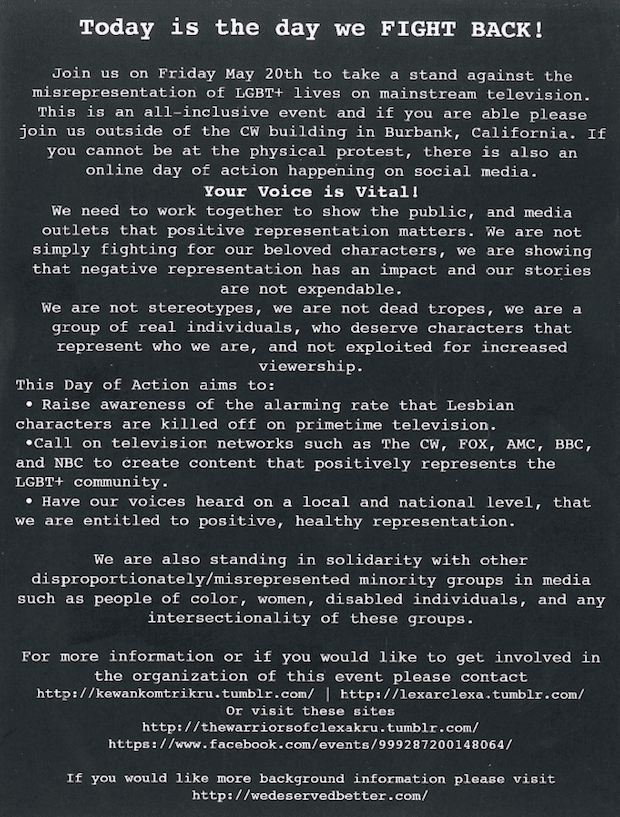
Man (ahem), the things people get worked up over. Is there anything the Left can’t weaponize for the culture war? Ladies, might I suggest margaritas and Lexapro?
The Gifts of the Czechs
I’m finishing up both the politics chapter of the Benedict Option book and the speech I’m going to deliver at the Academy of Philosophy and Letters conference in suburban Baltimore this weekend. I think it’s still possible to do a late registration online. The whole conference is going to be about the Benedict Option, and there will be some pretty high-level conservative theorists present. Check out the link, and if you’re in the area, please come.
I’m going to give the keynote address Friday night, on the theme, “What Is The Benedict Option?” Because this is a political audience, I’m going to talk a lot about how much Benedict Option politics has to learn from the way Vaclav Havel and Czech dissidents resisted communism. Benedict Option politics are antipolitical politics, as Havel conceived them, though in a more explicitly Christian mode. I won’t go into details here. Come to the conference if you want to hear them, or wait for the Ben Op book to come out in the spring.
As part of my research, I read an essay by Rudolf Battek, a Czech sociologist and dissident. Here is an excerpt:
How much scope does an individual have in living his or her life? What choices does he or she have? When and how can he or she decide how far his or her own decisions, actions, and efforts to determine direction and meaning will reach, and what effect they will have?
In principle, there are two alternatives. The first is spiritual, which includes ethical postulates, sensitive creation, analytical and synthetic processes of learning and self-discovery in openness and progress, and the relevant concepts are: feeling, knowing, giving, learning, loving, believing. Second, by contrast, the consumer values (those having to do with consuming and maintaining one’s physical existence) include a preference for comfort, surplus, material wealth, and the relevant concepts are: having, getting, receiving, and using.
To build and direct one’s life exclusively in terms of consumer values leads to “microcosmic tragedy,” to “a loss of humanity.” Spiritual orientation is the only possible goal that satisfies the meaning of humanity in ways that are accessible to human beings. The defining forms of spiritual self-realization can be perceived in philosophy, culture or religion. Their basic presupposition is an immanent welling forth of truthfulness, ethical clarity, a widely conceived humanitas (the postulate of a genuine humanity) and, above all, a predisposition to truth and resistance to evil and lies. The combination of both (active and passive) leads to freedom.
Ben Op politics are a politics that rejects “consumer values” in favor of spiritual values, and creating a space for those spiritual values to flourish. Havel held that conventional politics in his society (he called it “post-totalitarian,” for reasons too complicated to explain here) wouldn’t work because the system had lost all basis in spiritual values.
The post-totalitarian system, after all, is not the manifestation of a particular political line followed by a particular government. It is something radically different: it is a complex, profound and long-term violation of society, or rather the self-violation of society. To oppose it merely by establishing a different political line and then striving for a change in government would not only be unrealistic, it would be utterly inadequate, for it would never come near to touching the root of the matter. For some time now, the problem has no longer resided in a political line or program: it is a problem of life itself.
Havel’s “antipolitical politics” is a response that acknowledges the primary need to rebuild the pre-political basis for a decent life in the ruins left by modernity. Though he was not a religious believer, Havel warned in 1978 that the West and the Eastern bloc were captive to the same atheistic, materialistic spiritual malaise, and that we in the West were simply at another stage on the spectrum.
We Benedict Option Christian conservatives have a lot to learn from the Czech dissidents on how to “live in truth” (Havel) in a society and culture that demands that we lie. If you want to buy a used copy of the out-of-print book of Czech dissident essays I’ve been reading, go here.
Postcards From The Other America
A reader who lives in a poor neighborhood writes:
“This past weekend, at the festival in Oklahoma, I talked to a Christian from the Midwest who said that many of his fellow middle-class Evangelicals have no idea what’s really going on in America.”
This is going on for most people who don’t live in the low rent apartments, or the messiness of multiethnic working class neighborhoods. I think things often get overstated in terms of malevolence versus neglect, but just how bad many peoples bad situations are isn’t even remotely grasped to many doing well. Lower middle class liberals with no kids who don’t have to really deal with the consequences of their feel good ideologies fuels the problem too.
At my house, what started as babysitting one kid after school, has now turned to a bunch of misfit 12 year olds congregating at my house every afternoon. They say they like it that they feel safe and that we don’t tolerate disrespectful behavior. The stories I hear of rape, molestation, drug abuse, family incarceration, lack of anyone who cares or disciplines them, and being loaded up on prescription drugs either by parents who think that’s the normal way of dealing with kids, or of their own volition when they inevitably cry out for attention, is heart breaking.
No amount of money is going to fix these problems, and you can’t just throw God at these people either. It’s a process. It’s like trying to teach feral cats to first trust you and then trying to train them to successfully live indoors. You can tell they “get it” that your house is different, but they don’t really get it. There’s a stability they want, but they don’t know how to internalize the conditions that lead to it, since they’ve never had it. Those who haven’t been in that chaos think these people are a lot closer to being good than they really are, and those who need the help deep down don’t really believe they’re worth it or have any hope so they sabotage themselves.
It’s going to take sustained effort, and looking at your own personal home life as a sort of mini Ben Op island for lack of a better term.
A different reader wrote:
Without giving too much away, I work every single day with dirt poor white and minority Americans living in the heartland. These are people “living off the government dole” so to speak. I know more about abject poverty, government dependence, drug abuse, drug overdoses and disintegrated family systems, and what these things do to people, than your average middle-class or upper-class American by far (I would call myself upper-middle-class). This is an extraordinarily difficult population to work with. You try to look past their unfortunate circumstances and their poor choices to retain some sense of their basic humanity. When you try to help them see the sense in making better choices in the hopes of improving their miserable lot in life even a little bit, a great many of them resist you at almost every turn. It’s like they’re stuck in a negative feedback loop. The more you try to help them avoid making more poor choices which will only dig them into a deeper hole, the more they think you’re looking down your nose at them and acting all uppity and superior–so they tell you to piss off. The more you try to help, the more they resent you for being a “privileged” person who’s in a position to help in the first place.
A genuine spirit of charity is now a thing to be scorned and spit on instead of welcomed. It’s a bit like cursing God for sending you a Savior instead of appointing you as one. It’s the most insane thing you can imagine. It defies the simplest definition of reason.
They accuse you of “not getting it” because you’re not offering the kind of “help” they expect, because you know what that kind of “help” has done to them. The more they push back and resist, the more frustrated and angry you become. You try to remind yourself that it’s not really their fault, because many of them have never known any other way of living since before they could crawl, but there comes a point at which you inevitably start to wonder if you’re wasting your time. You hate yourself for thinking that way, but you don’t want to burn yourself up trying to fix what you don’t have the power to fix. So you desperately start searching for little reminders of why you wanted to reach out to help these folks in the first place, and little clues that maybe–just maybe–you might be making a small difference in some way that’s hard for you to see. That’s all you can do because there are no big, miraculous success stories to feel happy about.
I’ve done what I do for something close to fifteen years. I don’t know if I have fifteen more in me.
Not too long ago, I was having a conversation with a wealthy, Blue State liberal friend, who said that it’s obvious to him that the only way to solve the problems of the poor is for the government to commit massive amounts of money, and flood the zone with experts to show the dysfunctional poor how to live. The dream never dies.
I never tire of citing this point made in a 1994 reported essay by Robert Kaplan:
Slum quarters in Abidjan terrify and repel the outsider. In Turkey it is the opposite. The closer I got to Golden Mountain [a huge slum in Ankara] the better it looked, and the safer I felt. I had $1,500 worth of Turkish lira in one pocket and $1,000 in traveler’s checks in the other, yet I felt no fear. Golden Mountain was a real neighborhood. The inside of one house told the story: The architectural bedlam of cinder block and sheet metal and cardboard walls was deceiving. Inside was a home—order, that is, bespeaking dignity. I saw a working refrigerator, a television, a wall cabinet with a few books and lots of family pictures, a few plants by a window, and a stove. Though the streets become rivers of mud when it rains, the floors inside this house were spotless.
Other houses were like this too. Schoolchildren ran along with briefcases strapped to their backs, trucks delivered cooking gas, a few men sat inside a cafe sipping tea. One man sipped beer. Alcohol is easy to obtain in Turkey, a secular state where 99 percent of the population is Muslim. Yet there is little problem of alcoholism. Crime against persons is infinitesimal. Poverty and illiteracy are watered-down versions of what obtains in Algeria and Egypt (to say nothing of West Africa), making it that much harder for religious extremists to gain a foothold.
My point in bringing up a rather wholesome, crime-free slum is this: its existence demonstrates how formidable is the fabric of which Turkish Muslim culture is made. A culture this strong has the potential to dominate the Middle East once again. Slums are litmus tests for innate cultural strengths and weaknesses. Those peoples whose cultures can harbor extensive slum life without decomposing will be, relatively speaking, the future’s winners. Those whose cultures cannot will be the future’s victims. Slums—in the sociological sense—do not exist in Turkish cities. The mortar between people and family groups is stronger here than in Africa. Resurgent Islam and Turkic cultural identity have produced a civilization with natural muscle tone. Turks, history’s perennial nomads, take disruption in stride.
It has been over 20 years since Kaplan published those lines, and perhaps he would adjust his view. I don’t know. Still, I think his point is sound: a society that can tolerate material poverty without falling apart will thrive; those that cannot will not.
How you regenerate what has been lost, I don’t know. As Jones put it in another context:
Hey, most of the world lives in conditions that today’s well-off Americans find unthinkable. Therefore, another term for “apocalypse” is “regression to the mean.” What we are calling apocalypse is not all that surprising or unlikely. The world will keep going. But the world you are so fond of will be gone. And enormous numbers of people will be suffering. That’s a prospect that should give anyone pause.
I’ve lived (briefly) in the third world–not as some first world princeling on tour, but as one among equals. To me this should all be viewed as an unearned blessing, which means it would be sad but not surprising to see it go. Life will go on, but you should take care to distinguish between the better and worse forms of it.
I also think people underestimate the fragility of civilization. It’s very natural. But it’s a conservative’s job to remind them of its fragility. What do you think Germans in the late nineteenth century felt? They had reached the greatest heights of progress and civilization of any people on the earth up to that point. They were the most advanced, the most impressive, the most cultured, the most scientific. What do you think they would have said if someone told them that, in a few decades, they would introduce the world to the greatest depths of barbarism that it had ever seen?
Rod Dreher's Blog

- Rod Dreher's profile
- 509 followers

