
Henry Gee's Blog, page 14
May 31, 2021
Wild!
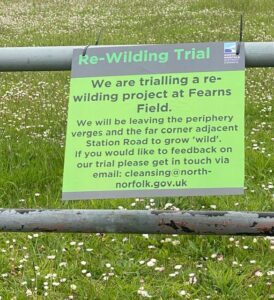 Cromer is going wild!
This notice from my daily constitutional shows that a small corner of a park, wedged between a childrens’ playground and the bowls club, is being allowed to let its hair down.
I suspect that this will lead to a bit of moaning, as the first stages of rewilding are rather scruffy, consisting of infestations of triffids stinging nettles and brambles, before the ground settles down into what we scientific types call ‘climax’ vegetation.
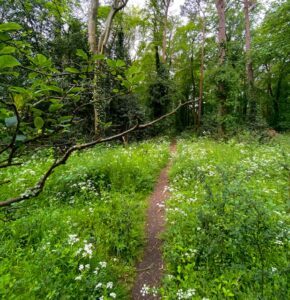 In fact, one doesn’t have to walk very far from this notice to see rewilding in its more advanced stages.
This picture (left) shows a sward of grass and other weedy plants (goose grass, cow parsley and so on) with tall young conifers in the background. If left to its own devices long enough this will turn into something like this…
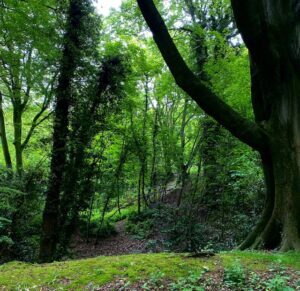
… a sylvan glade of mature, deciduous trees such as beech and oak.
All it takes is time – but not as much time as you’d think.
These two pictures were taken in a patch of land only a few acres in extent that sits almost unnoticed between a council estate, a farmer’s field, a go-karting track and a country lane. When you’re in the woods it seems a lot bigger – especially when the trees are in leaf. Over the past year or so I’ve followed the progress of the wood, starting with snowdrops, then bluebells, then horse-parsley or alexanders (a kind of green umbellifer that grows well near the coast), then proper cow parsley and a riot of speedwell and red campion and ferns and goodness knows what (don’t shoot me, I’m not a botanist), leading to foxgloves and so on and so forth: in the autumn, sloes and brambles yield their bounty, and mushrooms sprout beneath, all under a canopy of beech, oak, sycamore, holly and pine of very all ages. Roe deer and muntjacs are a common sight, passing silently between the trees. Woodpeckers rattle away above my head, while jays and magpies and .. er … other birds flit between the trunks (I’m not an ornithologist, either).
You’d think it had been there for, like, ever.
You’d be wrong.
For a brief period at the end of the nineteenth century, Cromer was a tourist magnet, served by not just one but two yes two count ’em TWO railway lines, and this woodland was a writhing mass of lines and railway-related impedimenta where the lines crossed. One line led to a terminus at Cromer High: another sidled off eastwards to Overstrand (much more fashionable than Cromer, still has houses designed by Lutyens). Cromer High station no longer exists. Overstrand station, likewise, has been consigned to history. Today’s railway station, once called Cromer Beach, and now just called Cromer, is some way to the west. In the 1960s Dr Beeching made his infamous cuts — and, what with one thing and another, the land has gone back to nature. In less than a single human lifetime.
It might come as a surprise, given the often well-advertised hand-wringing about the state of the environment, that the UK has more woodland now than at any time since the Middle Ages. Back at the time of the Domesday Book, some 15% of England was forested, declining to around 8% in the 17th Century. In 1905 – the first date when definite records started to be kept — only 5.2% of England (681,000 hectares) was forested. By 2018, the area had almost doubled, to 10% (1,241,000 hectares). The figures for the whole of the UK are more startling still — from 4.7% (1,140,000 hectares) in 1905, to 13.1% (3,173,000) in 2018. And all this given that the population of the UK was just 38 million in 1901, and, as of today, it’s 68,214,575. Not quite a doubling, whereas the area of woodland has almost tripled over approximately the same period. So, contrary to what one might believe, the growth rate of woodland over the past century or so has outstripped that of the human population.
To be sure, some of this forest will be diversity-poor conifer plantation; there is precious little woodland that one could call ‘ancient’; and all woodland in the UK, these days, requires a certain amount of management. But once one adds up all the seemingly neglected wedges of woods that clothe what once groaned under the fires of industry and the clank of the locomotive, it comes to a bucolic lot.
The benefits are manifold. In 2017 alone, the UK’s woods removed enough air pollution to save the health service almost a billion pounds. Over the same period, the UK’s woodlands soaked up 18.1 million tonnes of carbon dioxide, equivalent to 4% of total UK greenhouse gas emissions. And they do this without any fuss, all the while allowing me and my dogs a restful and healthful refuge during our daily walks.
I have come to value our woods during the past year or so. So have many other people. Our woods are a resource that should be treasured.


May 13, 2021
Rock
There’s been a lot of it about. Musicians, that is, unable to play live during lockdown, finding other ways to express themselves. During the recent hiatus I have become very keen on home recording, and some of the results are available commercially (you can browse them here). Much of this is done all on my own, tout seul, and, what’s more, in the absence of others. An exception has been this, a collaboration between me and an old friend, Mr A. T. of Bracknell.
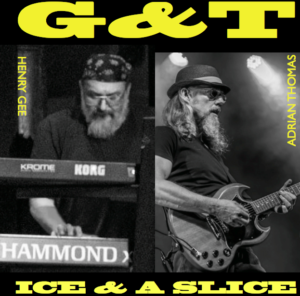
This. Recently.
At least twenty years ago, A. T. and I were in the same band, both together, at once, simultaneously and at the same time. As someone once said, much water has been passed since then. A. T. has since turned professional, teaches guitar, and plays guitar and drums in a variety of outfits notably the Voodoo Sheiks. It was the Voodoo Sheiks that got Adrian (that’s his name) and I back together.
Like me, Adrian had started to explore home recording and had asked a number of his friends to send bits and pieces to his ongoing Blues Alliance collaboration (you can hear an example here). Adrian also asked me to contribute keyboards to the Voodoo Sheik’s single, Norm (now available through Apple Music). One thing led to another, and, what with my finding a songwriting hot streak and a need for a guitarist better than me [that’ll be any guitarist at all, then – Ed] to turn my ideas into reality, Adrian was only too happy to oblige. The result has been our collaboration G&T and our album Ice and a Slice, which you can hear here for free, for the next month or so, before it’s released commercially for download. Release is scheduled for 21 June, and you can pre-save it on Spotify.
Ice and a Slice is a 9-track, 56-minute album that owes quite a lot to our formative years listening to rock in the 70s and 80s. There are some more-or-less obvious nods to Deep Purple (Indigo), Pink Floyd (Lorem Ipsum), Status Quo (Red), Jeff Beck (Silver Lining), and Joe Satriani (Bunky Flooze). I’d come up with backing tracks in my home studio Flabbey Road, email them to Adrian, who’d send back loads of separate guitar tracks done in ProSonus. I’d mix them all into GarageBand, duplicating, splitting and harmonising as I went. I think at one point there were 22 separate guitar tracks in my 80s-stadium-rock-power-ballad Slow Burn, though in my West-Coast style jangly choral pop tune Was That You? I lost count of the number of vocal tracks once they’d passed 30.
The album is now complete — and just in time as the Voodoo Sheiks will be back on the road soon, as will my own combo The D. C. Wilson Band. But Adrian and I had so much fun with G&T that we might be back for a second round. Watch this space.
MUSOS’ CORNER: For this recording, I’d do the backing track on Garageband 11 and email a rough mix to Adrian.
He’d then add the guitar parts, zip them up for easy emailing and send them to me. I’d unpack them, paste each guitar part into its own track in Garageband, and get mixing.
Adrian’s guitars were (in no particular order, as they say on all the game shows) a Fender Telecaster; two Fender Stratocasters; a PRS Custom 24; a Gibson SG, and an Ernie Ball Musicman. All were played through a Mesa Boogie Mk5:25 amplifier and from that, a Focusrite Scarlett 2i2 interface and into ProSonus Studio 1 Professional 4.5.
All the bass and drums and a few of the keyboard sounds come from GarageBand 11. Apart from that, the keyboards used were a Yamaha Clavinova CLP800 (mainly for piano, but there’s a cathedral organ at the end of Lorem Ipsum); and a Crumar Mojo 61 (Hammond organ, Rhodes piano and clavinet).
The rest came from apps on my iPad Mk2 played either from the iPad itself or from a M-Audio Keystation 49 Mk3. The apps included a Minimoog Model D, ARP Odyssey, Korg iMS20, Oberheim OBXd, Solina string ensemble, Mellotron XL, Tal-U-No-LX (basically, a Roland Juno 60) and Magellan2 synth. All non-Garageband, non-guitar sounds, including vocals (recorded with a no-name dynamic microphone) went through a Behringer Xenyx 802 mixer and into the computer. Monitoring was through a Behringer Xenyx 302 mixer into Beyer Dynamic headphones.
May 3, 2021
Allotment
Many years ago when the Gees lived in east London, and I commuted regularly to an orifice office that was located away from my home [fancy! did they still have typewriters? Horse-drawn omnibuses? Public executions? – Ed] I had an allotment. It was conveniently placed between our home and the tube station, so even on working days I could pop in, especially on summer evenings after work, when I could water things and come home with a bag of salad.
I loved my allotment. The Offspring enjoyed it, too. Our plot in London was bounded on one side by an abandoned patch on which fruit bushes had been allowed to run riot; and on the other by a plot laid out to grass, which I rented as an add-on to my own. I mowed a maze in the grass, and, when the Offspring had collected enough currants and blackberries on one side, they’d set themselves up inside the maze on the other, for a picnic. One gloriously sunny day in July I went to the allotment with the Offspring and spent a happy timeless time watering, tending, hoeing and harvesting, and when I had done pretty much everything I needed to do, I summoned the Offspring (they were aged about 7 and 5) for the short walk home. ‘Please can we stay for a few more hours?’ came the plaintive cry from somewhere in the tall grass.
But that was then. We moved to Cromer in 2006, and although we are blessed with a large garden, we have never had a vegetable patch of any size. And I have always missed my allotment. Until recently Mrs Gee has been head gardener and she likes to grow things in pots, on a smaller scale, though we’ve usually had a few vegetables and herbs for the table. This year, however, she is too busy for gardening as she’s doing Other Stuff (she is embarking on her Third Career) so I have stepped in. Think of me as Mellors to her Lady Chatterley. On second thoughts, don’t.
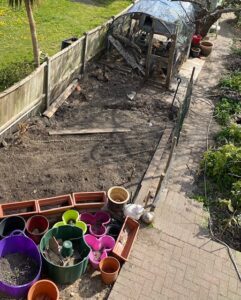
The Blessed Plot.
So I get to do things my way, and I have cleared a sizeable patch of ground on the sunny side of the garden for a plot. And here it is. The polytunnel in the background is the chicken coop: to the right of the path is the shady side of the garden, currently a shrubbery-in-progress, though some of it will be turfed in August, when one does turf. Regular readers of these annals will recognize this garden from earlier posts, of course. Over the past month I’ve sown potatoes, red onions, garlic, carrots, radishes, something called garlic kale, and dwarf French beans. So far the radishes have shot up – you can just about see them in a small green dotted line in front of my kneeling-plank. The garlic is following, as are the onions, although at a more leisurely pace. The carrots might just be starting to peep above ground though as yet there are no signs of spuds. I’ve sown some cucumber seeds in a propagating tray on a windowsill. After a promised spell of bad weather I’ll tidy up the front garden, plant a pumpkin in a planter, sow some lettuces and rocket and endive and… and … and …
Watching the plants grow is a never-ending sauce tzores source of delight, and having them in neat rows will make it easier to keep the weeds down (in the past we’ve hosted what looks like the British National Collection of stinging nettles).
And I have found something very surprising.
I love digging. I’ll say it again. I LOVE DIGGING. Give me my extra-long steel back-saver spade and I can dig (almost) indefinitely. I’m starting to get the kind of endorphin buzz that athletes do from running. It never used to be like this – but over the past year I have shed five or six kilos and have had a lot more exercise than usual. This means I am fit enough – just – to start to enjoy digging, rather than finding it a back-breaking chore.
More from the allotment as things shoot up.


