Jennifer R. Hubbard's Blog, page 89
September 30, 2011
Special live giveaway
Tomorrow (Saturday, October 1) I'll be at the Collingswood Book Festival in Collingswood, NJ. And I thought I would do a fun little feature for those wonderful people who come out to live book events. I will have with me an advance copy of my next book, Try Not to Breathe. It doesn't come out until January and won't be on display, but if you find me at the festival and you're the first person to ask for it*, you will get the advance copy. The point of such advance copies is for people to write reviews about them and spread the word, and I hope you will do that--review it on Goodreads or on your blog or Facebook or Google+, pass it on to your local librarian, etc.--but I'm not going to put any specific requirement on that. And if nobody claims the book, it will come back home with me for use in a future giveaway.

Try Not to Breathe: contemporary, YA. In the summer after his suicide attempt, sixteen-year-old Ryan struggles with guilty secrets and befriends a girl who's visiting psychics to try to reach her dead father.
Hope to see you there!
*Must be at least 13 years old. My fellow authors of the Kidlit Authors Club, who will be appearing at the festival, will not be eligible, to give the general reader a chance.
Try Not to Breathe: contemporary, YA. In the summer after his suicide attempt, sixteen-year-old Ryan struggles with guilty secrets and befriends a girl who's visiting psychics to try to reach her dead father.
Hope to see you there!
*Must be at least 13 years old. My fellow authors of the Kidlit Authors Club, who will be appearing at the festival, will not be eligible, to give the general reader a chance.


September 29, 2011
Inspiring posts
I've been saving up all this linky goodness for you. All week people have been saying brilliant things online, and I've been making these notes: "Oooh, I should link to that!"
I love these posts so much that I hope you'll read them in full. But here are a few tastes:
In the motivation department, find your focus with Becky Levine who asks, "What brings you back to your WIP, even when you are tired or doubtful or drifting? What is it about this story that makes you need to write it? What is the call you can't ignore?"
Tabitha Olson says of soliciting critique: "if you don't know the heart of your story, you are not ready for feedback." And she explains why.
Susan Taylor Brown gets to the heart of the matter: "I've spent many years measuring my writing worth against too many of the wrong things --- Whether I write like someone else or as often as someone else. Whether I sell to a certain publisher or make a certain amount of money. Whether I get mentioned some place or not. Whether my reviews are good or bad or whether my books are even reviewed. Like I said, all the wrong measurements. ... my writing worth can't be measured by what someone else does or doesn't do ..."
This is one of those posts that's great for printing out and sticking up on the wall of one's writing office.
Victoria Patterson over at ThreeGuysOneBook delves into the line between fact and fiction: "Writers often use real life narratives and personages to build fiction. ... How can we best tell our stories while valuing integrity? What would a writer be without his or her borrowings?" With some fascinating real-life examples of "borrowing," as befits this topic!
Megan Frazer interviews me as part of her "bloggers on blogging" series, and I discuss blog-preparation questions such as, "What has the breadth and depth necessary to sustain a blog?" But the truly great thing about this series is that it includes blogging thoughts and advice from Melissa Walker and Cynthia Leitich Smith!
And in the news department, Bethany Hegedus announces the opening of a "writing barn" for rental as a writing retreat, and issues a call for Hunger Mountain submissions.
I love these posts so much that I hope you'll read them in full. But here are a few tastes:
In the motivation department, find your focus with Becky Levine who asks, "What brings you back to your WIP, even when you are tired or doubtful or drifting? What is it about this story that makes you need to write it? What is the call you can't ignore?"
Tabitha Olson says of soliciting critique: "if you don't know the heart of your story, you are not ready for feedback." And she explains why.
Susan Taylor Brown gets to the heart of the matter: "I've spent many years measuring my writing worth against too many of the wrong things --- Whether I write like someone else or as often as someone else. Whether I sell to a certain publisher or make a certain amount of money. Whether I get mentioned some place or not. Whether my reviews are good or bad or whether my books are even reviewed. Like I said, all the wrong measurements. ... my writing worth can't be measured by what someone else does or doesn't do ..."
This is one of those posts that's great for printing out and sticking up on the wall of one's writing office.
Victoria Patterson over at ThreeGuysOneBook delves into the line between fact and fiction: "Writers often use real life narratives and personages to build fiction. ... How can we best tell our stories while valuing integrity? What would a writer be without his or her borrowings?" With some fascinating real-life examples of "borrowing," as befits this topic!
Megan Frazer interviews me as part of her "bloggers on blogging" series, and I discuss blog-preparation questions such as, "What has the breadth and depth necessary to sustain a blog?" But the truly great thing about this series is that it includes blogging thoughts and advice from Melissa Walker and Cynthia Leitich Smith!
And in the news department, Bethany Hegedus announces the opening of a "writing barn" for rental as a writing retreat, and issues a call for Hunger Mountain submissions.
September 27, 2011
How to have fun with denial
Yesterday I bemoaned the evils of denial, and I am certainly unenthusiastic when denial is embraced by readers or writers. (Which isn't to say I never embrace it myself, on occasion. But I don't view it as a virtue.)
However, denial can be a great feature in a fictional character. It's a defense mechanism that can arouse our sympathy or our contempt, depending on the situation.
Chris Lynch's Keir, the narrator of Inexcusable, is one of my favorite examples of a character in denial. Nabokov's Humbert Humbert, in Lolita, is another.
It takes skill to tip off a reader that a first-person narrator is in denial. Once the reader sees it, she will often become impatient for the character's self-realization, so the pacing of that (and the decision about whether the character ever has that realization) can be tricky. Often we're clued in to denial by a gap between what the character says and what he does, or by a gap between his version of events and the other characters' versions. There's often a period of disorientation, where we wonder which version of the truth to accept, and then there's the point where we become sure of the truth. We break with the narrator's version. (I suppose we don't have to become sure of the truth, though--a book could leave us hanging, wondering which version of events is real.)
If the character comes out of denial, it can be an occasion for growth, but it has to seem natural. In real life, people are able to carry on living with incredible amounts of cognitive dissonance. People don't like to give up their defense mechanisms. And so the motivation for a character to shed denial must be compelling. It could be the result of a long-present vulnerability, or new safety in the character's life, or a consequence of having something very important at stake.
However, denial can be a great feature in a fictional character. It's a defense mechanism that can arouse our sympathy or our contempt, depending on the situation.
Chris Lynch's Keir, the narrator of Inexcusable, is one of my favorite examples of a character in denial. Nabokov's Humbert Humbert, in Lolita, is another.
It takes skill to tip off a reader that a first-person narrator is in denial. Once the reader sees it, she will often become impatient for the character's self-realization, so the pacing of that (and the decision about whether the character ever has that realization) can be tricky. Often we're clued in to denial by a gap between what the character says and what he does, or by a gap between his version of events and the other characters' versions. There's often a period of disorientation, where we wonder which version of the truth to accept, and then there's the point where we become sure of the truth. We break with the narrator's version. (I suppose we don't have to become sure of the truth, though--a book could leave us hanging, wondering which version of events is real.)
If the character comes out of denial, it can be an occasion for growth, but it has to seem natural. In real life, people are able to carry on living with incredible amounts of cognitive dissonance. People don't like to give up their defense mechanisms. And so the motivation for a character to shed denial must be compelling. It could be the result of a long-present vulnerability, or new safety in the character's life, or a consequence of having something very important at stake.
September 26, 2011
Denial
In replying to a comment on my last post, I described censorship as "shoring up the walls of denial." And I realize that's it, that's one of the core elements of censorship that offends me and pains me so much.
Because for me, writing is about puncturing denial. It's about acknowledging truths--beautiful truths, ugly truths. Saying yes, this is real. Yes, this thing you know to be true, this feeling or fact or experience--it exists. Now what do you want to do about it?
It's about opening doors, not closing them.
I have seen denial cause incredible pain. The lie we tell ourselves is that denial keeps us safe. In fact, it does the opposite.
I'm always asking myself: What is the truth about the situation I'm writing about? How does it really feel? I want to dig beyond the cliches that build up around common experiences: red as a beet, happy as a clam, tears of joy, cold sweat--forget all that, that's how we're supposed to feel, but how does it really feel?
I want to measure the gap between how things do go and how they ought to go. I want to use all the crayons in the box. I want to show how my characters act when they think nobody else is looking.
Masks don't interest me much. The real story is usually going on behind the mask, as the authors of The Phantom of the Opera and The Wizard of Oz knew.
Because for me, writing is about puncturing denial. It's about acknowledging truths--beautiful truths, ugly truths. Saying yes, this is real. Yes, this thing you know to be true, this feeling or fact or experience--it exists. Now what do you want to do about it?
It's about opening doors, not closing them.
I have seen denial cause incredible pain. The lie we tell ourselves is that denial keeps us safe. In fact, it does the opposite.
I'm always asking myself: What is the truth about the situation I'm writing about? How does it really feel? I want to dig beyond the cliches that build up around common experiences: red as a beet, happy as a clam, tears of joy, cold sweat--forget all that, that's how we're supposed to feel, but how does it really feel?
I want to measure the gap between how things do go and how they ought to go. I want to use all the crayons in the box. I want to show how my characters act when they think nobody else is looking.
Masks don't interest me much. The real story is usually going on behind the mask, as the authors of The Phantom of the Opera and The Wizard of Oz knew.
September 25, 2011
More than banned books
An addition to this year's Banned Books Week is Banned Websites Awareness Day, September 28. The American Association of School Librarians is launching the day "to spotlight the problem of excessive filtering of legitimate educational Internet websites in many K-12 schools."
As an author who has spoken with librarians and teachers, I've heard many complaints about the wholesale filtering of many legitimate and useful sites. According to AASL president Carl Harvey, "Many schools filter far beyond the requirements of the Children's Internet Protection Act, because they wish to protect students ... Relying solely on filters does not teach young citizens how to be savvy searchers or how to evaluate the accuracy of information."
In addition to the sheer inefficiency of overly broad filtering, there are other problems with filters. The ACLU has launched a "Don't Filter Me" campaign in partnership with Yale Law School to stop censorship of pro-LGBT (lesbian-gay-bisexual-transgendered)-related websites on public school computer systems.
Among the sites the ACLU project uses to test whether illegally targeted filters are in place is this one: the "It Gets Better" project, whose mission is described this way: "In response to a number of students taking their own lives after being bullied in school, they wanted to create a personal way for supporters everywhere to tell LGBT youth that, yes, it does indeed get better."
I post the First Amendment to the US Constitution at this time every year, so here it is:
"Congress shall make no law respecting an establishment of religion, or prohibiting the free exercise thereof; or abridging the freedom of speech, or of the press; or the right of the people peaceably to assemble, and to petition the Government for a redress of grievances."
As an author who has spoken with librarians and teachers, I've heard many complaints about the wholesale filtering of many legitimate and useful sites. According to AASL president Carl Harvey, "Many schools filter far beyond the requirements of the Children's Internet Protection Act, because they wish to protect students ... Relying solely on filters does not teach young citizens how to be savvy searchers or how to evaluate the accuracy of information."
In addition to the sheer inefficiency of overly broad filtering, there are other problems with filters. The ACLU has launched a "Don't Filter Me" campaign in partnership with Yale Law School to stop censorship of pro-LGBT (lesbian-gay-bisexual-transgendered)-related websites on public school computer systems.
Among the sites the ACLU project uses to test whether illegally targeted filters are in place is this one: the "It Gets Better" project, whose mission is described this way: "In response to a number of students taking their own lives after being bullied in school, they wanted to create a personal way for supporters everywhere to tell LGBT youth that, yes, it does indeed get better."
I post the First Amendment to the US Constitution at this time every year, so here it is:
"Congress shall make no law respecting an establishment of religion, or prohibiting the free exercise thereof; or abridging the freedom of speech, or of the press; or the right of the people peaceably to assemble, and to petition the Government for a redress of grievances."
September 23, 2011
Authorial intent
I've been thinking about authorial intent, and I haven't come up with any easy answers or absolutes. (But that won't surprise longtime readers of this blog, who know that I rarely find easy answers and I shy away from absolutes.)
Authors are responsible for what they write, but how responsible are they for what readers find?
In thinking about that question, I conclude: Authorial intent matters, and it doesn't. How's that for a fence-straddle?
On one hand, I've long felt that a good review will look at a book in the light of authorial intent. That is, a reviewer should not blast a light romance for not being a murder mystery, especially if it doesn't bill itself as a murder mystery. A reviewer shouldn't criticize an author for failing to write the book the reviewer would have written. And yet--how is a reviewer supposed to know an author's intent? Sometimes reviewers guess at this and get it drastically wrong; is that the author's fault or the reviewer's? At the end of the day, reviewers can only criticize the texts in front of them, not the books the authors were trying to write.
Then there are issues to which readers take offense. Authorial intent alone is not necessarily a defense against bigotry or cultural appropriation. It's like stepping on someone's foot while walking down the street--even if I didn't mean to step on that person's foot, I still apologize, because I caused the person pain, however accidentally. I don't say to the person, "Oh, your foot can't possibly hurt, because I wasn't trying to step on it." And I try to watch my feet.
But there comes a point where a reader can read way, way too much into a text. "The character is wearing an orange shirt in Chapter 4, which is an obvious alignment with the 1987 Weemblelock Movement, whose followers wore the color orange. The Weemblelock Movement recommends the colonization of Mars for military purposes, and the author obviously sympathizes with that objective." How responsible am I for such an interpretation if I've never even heard of the Weemblelock Movement (which, by the way, is totally invented for the hypothetical purposes of this blog post)? I believe in the ownership a reader takes of a text--and yet I also believe wholeheartedly in the author's right to reject interpretations that are along Weemblelockian lines.
I've been alternately dismayed, amused, puzzled, heartened, and delighted by reader reactions to various things I've written. The fact is that a story doesn't exist in isolation; every reader brings a context to it. The writer can guess at some of that context, but can never know the whole story of every reader's life. Some of what a reader brings to the reading experience is unique to that reader.
The more I look at these issues, the more I think we hammer out the answers between ourselves, negotiating the boundaries between human beings. Nobody ever really knows what anyone else means; we make lots of assumptions, we look for clues and evidence, we go back and forth. We ask questions. We bring our own experience and opinions to the table.
And at the end of the day, a reader can get something from a book that the author never even imagined. That can be wonderful or horrible or anywhere in between. A book released into the world never belongs wholly to the author from the first moment that anyone else lays eyes on it.
Authors are responsible for what they write, but how responsible are they for what readers find?
In thinking about that question, I conclude: Authorial intent matters, and it doesn't. How's that for a fence-straddle?
On one hand, I've long felt that a good review will look at a book in the light of authorial intent. That is, a reviewer should not blast a light romance for not being a murder mystery, especially if it doesn't bill itself as a murder mystery. A reviewer shouldn't criticize an author for failing to write the book the reviewer would have written. And yet--how is a reviewer supposed to know an author's intent? Sometimes reviewers guess at this and get it drastically wrong; is that the author's fault or the reviewer's? At the end of the day, reviewers can only criticize the texts in front of them, not the books the authors were trying to write.
Then there are issues to which readers take offense. Authorial intent alone is not necessarily a defense against bigotry or cultural appropriation. It's like stepping on someone's foot while walking down the street--even if I didn't mean to step on that person's foot, I still apologize, because I caused the person pain, however accidentally. I don't say to the person, "Oh, your foot can't possibly hurt, because I wasn't trying to step on it." And I try to watch my feet.
But there comes a point where a reader can read way, way too much into a text. "The character is wearing an orange shirt in Chapter 4, which is an obvious alignment with the 1987 Weemblelock Movement, whose followers wore the color orange. The Weemblelock Movement recommends the colonization of Mars for military purposes, and the author obviously sympathizes with that objective." How responsible am I for such an interpretation if I've never even heard of the Weemblelock Movement (which, by the way, is totally invented for the hypothetical purposes of this blog post)? I believe in the ownership a reader takes of a text--and yet I also believe wholeheartedly in the author's right to reject interpretations that are along Weemblelockian lines.
I've been alternately dismayed, amused, puzzled, heartened, and delighted by reader reactions to various things I've written. The fact is that a story doesn't exist in isolation; every reader brings a context to it. The writer can guess at some of that context, but can never know the whole story of every reader's life. Some of what a reader brings to the reading experience is unique to that reader.
The more I look at these issues, the more I think we hammer out the answers between ourselves, negotiating the boundaries between human beings. Nobody ever really knows what anyone else means; we make lots of assumptions, we look for clues and evidence, we go back and forth. We ask questions. We bring our own experience and opinions to the table.
And at the end of the day, a reader can get something from a book that the author never even imagined. That can be wonderful or horrible or anywhere in between. A book released into the world never belongs wholly to the author from the first moment that anyone else lays eyes on it.
September 21, 2011
One true story
I vaguely recall a comment exchange I once had with April Henry about generalizing: how people assume their own experience is universal. I don't remember the original topic that sparked the exchange, but I do remember that realization hitting like a bolt of lightning: I generalize, too, even though I know how faulty generalizations can be.
Growing up, the generalizations that bothered me usually had to do with my being a girl. I never seemed to fit the stereotypes. Girls were supposed to be bad at math ... uninterested in science ... afraid of snakes and spiders ... adore makeup ... complain about being fat ... love shoe shopping ... None of which applied to me. It's not surprising, given that there are more than three billion girls and women on this planet, that we're not all alike. And what bothers me even more is when people take a single instance from their lives as proof that these generalizations are true. "My son prefers football to dolls, so it's true that boys are more sports-oriented." That kind of thing.
Here's an example from my own life. I grew up in a heavily Catholic neighborhood, and because of that, I assumed Catholicism was the world's (or at least the country's) dominant religion. Imagine my surprise to hear in history class that some people thought John F. Kennedy might not be able to get elected President because of prejudice against Catholics. I may have been in junior high school before I realized a group I had thought of as a majority was a minority; I'd assumed that because almost everyone around me was Catholic, almost everyone everywhere was. That's just one small example, but I think it makes my point about how we think of our own lives as normal, our own experiences as universal. (But of course, this may be a generalization also! Maybe others are more aware than I was of how specific our lives really are.)
Some experiences are widely shared, of course: I suspect that love and fear and anger and hope feel much the same to people everywhere, although they may come in a variety of packages. For me, part of the joy of reading is discovering that common ground. But when I was reading this post of Brent Hartinger's, I started thinking again about generalizations. He makes a lot of great points in that post, but at the moment I want to focus on the idea that there is no single experience of how it is to be ... [fill in the blank]. There is no single authentic female experience, no single authentic gay experience, etc., etc. Yet every story is individual and tells of an authentic experience.
In my writing, I'm conscious of trying to build a body of work. Although I have overlapping themes and some similar characters from one work to another, I try to cover different worlds and different perspectives in each book. Rich and poor; experienced and innocent; confident and insecure; male and female; etc., etc. And even so, I don't claim to tell the true story of the world I'm writing about; I'm just trying to tell one true story. (And by true I don't mean literally true, since I'm writing fiction, but emotionally true.)
Growing up, the generalizations that bothered me usually had to do with my being a girl. I never seemed to fit the stereotypes. Girls were supposed to be bad at math ... uninterested in science ... afraid of snakes and spiders ... adore makeup ... complain about being fat ... love shoe shopping ... None of which applied to me. It's not surprising, given that there are more than three billion girls and women on this planet, that we're not all alike. And what bothers me even more is when people take a single instance from their lives as proof that these generalizations are true. "My son prefers football to dolls, so it's true that boys are more sports-oriented." That kind of thing.
Here's an example from my own life. I grew up in a heavily Catholic neighborhood, and because of that, I assumed Catholicism was the world's (or at least the country's) dominant religion. Imagine my surprise to hear in history class that some people thought John F. Kennedy might not be able to get elected President because of prejudice against Catholics. I may have been in junior high school before I realized a group I had thought of as a majority was a minority; I'd assumed that because almost everyone around me was Catholic, almost everyone everywhere was. That's just one small example, but I think it makes my point about how we think of our own lives as normal, our own experiences as universal. (But of course, this may be a generalization also! Maybe others are more aware than I was of how specific our lives really are.)
Some experiences are widely shared, of course: I suspect that love and fear and anger and hope feel much the same to people everywhere, although they may come in a variety of packages. For me, part of the joy of reading is discovering that common ground. But when I was reading this post of Brent Hartinger's, I started thinking again about generalizations. He makes a lot of great points in that post, but at the moment I want to focus on the idea that there is no single experience of how it is to be ... [fill in the blank]. There is no single authentic female experience, no single authentic gay experience, etc., etc. Yet every story is individual and tells of an authentic experience.
In my writing, I'm conscious of trying to build a body of work. Although I have overlapping themes and some similar characters from one work to another, I try to cover different worlds and different perspectives in each book. Rich and poor; experienced and innocent; confident and insecure; male and female; etc., etc. And even so, I don't claim to tell the true story of the world I'm writing about; I'm just trying to tell one true story. (And by true I don't mean literally true, since I'm writing fiction, but emotionally true.)
September 19, 2011
Fear, Loathing and Joy: Writing a Second Book
The latest guest blogger in my "second book" series is Ellen Jensen Abbott. She discusses the special challenges of writing a sequel.
There's a lot said about fear and loathing and the Second Book. Writers are notoriously insecure, but the Second Book takes all the normal writerly fears and magnifies them. If your first book did well, you may fear that your next one will be a flop, proving that you are indeed the hack you always secretly believed you were. If your first book didn't do well, you may fear that the Second Book is your final chance at a writing career.
Or, maybe it's the reviews that keep you up at night. You've been through publication once, and you know that everyone gets a least one bad review. You also know that it's easy to take all your reviews to heart, especially the bad ones.
Like any author, you fear that no one will read your book. Since I was writing a sequel, readership held special terror for me. My audience for my first book, Watersmeet, was every kid in the English speaking world from the ages of 12 to 99—and some much younger, as kids tend to read up. But what about the Second Book, The Centaur's Daughter? Is my audience only those who read the first? Does that mean that I am selling to thousands now, whereas before I was selling to millions? I wrote The Centaur's Daughter so that you didn't have to read Watersmeet to understand it, but Second Book fears are only vaguely rational, and this has been little comfort.
In writing The Centaur's Daughter, I found that there are plenty of joys with the Second Book, even if they don't get the attention the loathing does. If nothing else, you got a second contract. You are not a one-shot wonder! (You can start worrying about being a two-shot wonder when you start the Third Book.) In fact, several acquaintances, on hearing that I was publishing a Second Book, have said to me, "Wow! You're a real author now." (Which is funny because they said something very similar when I'd announced that I was publishing my first book.)
I also enjoyed launching myself into the Second Book knowing that I was capable of writing a full-length novel. I'd done it before! With the first book, it took a long time for me to even say out loud that I was writing a novel. Loads and loads of people start them, but was I going to be one of those who finished one? Now I know I can.
With the Second Book, I also had the joys of a deadline. Very, very few people sell their first book without writing the whole thing first. At least in the world of fiction. But I sold The Centaur's Daughter based on a synopsis, sample chapters, and the success of Watersmeet. It was a different experience to write a book knowing that someone was waiting for it. It was no longer just about disappointing myself—and those people I had confessed myself as a writer to. There was money on the line. Nothing like a little cash to light a fire on those days you just can't bring yourself to turn on your computer. I enjoyed the sense of purpose this gave me.
Probably more important than cash was the knowledge that someone out there wanted the book. My editor and my publisher, yes. More motivating were the e-mails, facebook posts and blog posts from readers telling me that they enjoyed Watersmeet and they were excited to read The Centaur's Daughter. On days when neither my own motivation nor the contract could get me going, those readers could.
Even the fact that The Centaur's Daughter was a sequel brought joy. I struggled with how much back-story to include, but I also got to return to characters and a world I knew and loved. Both surprised me. I found new reserves of strength in my main character, Abisina, as well as new stores of empathy. Her best friend, Haret the dwarf, had to face again a demon I had thought he conquered. Findlay, the love interest from Watersmeet, had much more scope for his sense of humor, and two other characters (who will remain nameless!) fell in love. I hadn't seen that coming!


I got to go places in the world of Seldara that I hadn't been in before—even though I had created it. The Motherland, home of the fairies, became a three-dimensional place with strange dwellings and wild ritual. Abisina stumbled upon the Chasm of Couldin, a place she had never heard of. Even Haret (and the author of the book) had only heard rumors about it! There were interesting challenges—such as when I wanted to move the entire Obrun Mountain range. There it was on the map for Watersmeet, so I had to invent a new plot twist to get my characters where they needed to go.
All of these discoveries gave me the chance to marvel at the human brain. I had planted seeds in Watersmeet that I didn't even know were there. And then, just when I needed something good in The Centaur's Daughter, I would find them and realize those seeds had grown into just what I needed. It boggles the mind.
So back in June, when The Centaur's Daughter had already gone to the printer, I took the next step, and started … the Third Book. First chapters and synopsis are with my editor right now. What will I discover in this process? What new characters will walk into my pages? What new qualities will my heroine and hero develop? What new frustrations await me?
I sure hope I get the chance to find out….even if it means once again, facing all those fears.
Ellen Jensen Abbott, author of Watersmeet (Marshall Cavendish, 2009) and The Centaur's Daughter (Marshall Cavendish, September, 2011) can be found online at www.ellenjensenabbott.com
There's a lot said about fear and loathing and the Second Book. Writers are notoriously insecure, but the Second Book takes all the normal writerly fears and magnifies them. If your first book did well, you may fear that your next one will be a flop, proving that you are indeed the hack you always secretly believed you were. If your first book didn't do well, you may fear that the Second Book is your final chance at a writing career.
Or, maybe it's the reviews that keep you up at night. You've been through publication once, and you know that everyone gets a least one bad review. You also know that it's easy to take all your reviews to heart, especially the bad ones.
Like any author, you fear that no one will read your book. Since I was writing a sequel, readership held special terror for me. My audience for my first book, Watersmeet, was every kid in the English speaking world from the ages of 12 to 99—and some much younger, as kids tend to read up. But what about the Second Book, The Centaur's Daughter? Is my audience only those who read the first? Does that mean that I am selling to thousands now, whereas before I was selling to millions? I wrote The Centaur's Daughter so that you didn't have to read Watersmeet to understand it, but Second Book fears are only vaguely rational, and this has been little comfort.
In writing The Centaur's Daughter, I found that there are plenty of joys with the Second Book, even if they don't get the attention the loathing does. If nothing else, you got a second contract. You are not a one-shot wonder! (You can start worrying about being a two-shot wonder when you start the Third Book.) In fact, several acquaintances, on hearing that I was publishing a Second Book, have said to me, "Wow! You're a real author now." (Which is funny because they said something very similar when I'd announced that I was publishing my first book.)
I also enjoyed launching myself into the Second Book knowing that I was capable of writing a full-length novel. I'd done it before! With the first book, it took a long time for me to even say out loud that I was writing a novel. Loads and loads of people start them, but was I going to be one of those who finished one? Now I know I can.
With the Second Book, I also had the joys of a deadline. Very, very few people sell their first book without writing the whole thing first. At least in the world of fiction. But I sold The Centaur's Daughter based on a synopsis, sample chapters, and the success of Watersmeet. It was a different experience to write a book knowing that someone was waiting for it. It was no longer just about disappointing myself—and those people I had confessed myself as a writer to. There was money on the line. Nothing like a little cash to light a fire on those days you just can't bring yourself to turn on your computer. I enjoyed the sense of purpose this gave me.
Probably more important than cash was the knowledge that someone out there wanted the book. My editor and my publisher, yes. More motivating were the e-mails, facebook posts and blog posts from readers telling me that they enjoyed Watersmeet and they were excited to read The Centaur's Daughter. On days when neither my own motivation nor the contract could get me going, those readers could.
Even the fact that The Centaur's Daughter was a sequel brought joy. I struggled with how much back-story to include, but I also got to return to characters and a world I knew and loved. Both surprised me. I found new reserves of strength in my main character, Abisina, as well as new stores of empathy. Her best friend, Haret the dwarf, had to face again a demon I had thought he conquered. Findlay, the love interest from Watersmeet, had much more scope for his sense of humor, and two other characters (who will remain nameless!) fell in love. I hadn't seen that coming!
I got to go places in the world of Seldara that I hadn't been in before—even though I had created it. The Motherland, home of the fairies, became a three-dimensional place with strange dwellings and wild ritual. Abisina stumbled upon the Chasm of Couldin, a place she had never heard of. Even Haret (and the author of the book) had only heard rumors about it! There were interesting challenges—such as when I wanted to move the entire Obrun Mountain range. There it was on the map for Watersmeet, so I had to invent a new plot twist to get my characters where they needed to go.
All of these discoveries gave me the chance to marvel at the human brain. I had planted seeds in Watersmeet that I didn't even know were there. And then, just when I needed something good in The Centaur's Daughter, I would find them and realize those seeds had grown into just what I needed. It boggles the mind.
So back in June, when The Centaur's Daughter had already gone to the printer, I took the next step, and started … the Third Book. First chapters and synopsis are with my editor right now. What will I discover in this process? What new characters will walk into my pages? What new qualities will my heroine and hero develop? What new frustrations await me?
I sure hope I get the chance to find out….even if it means once again, facing all those fears.
Ellen Jensen Abbott, author of Watersmeet (Marshall Cavendish, 2009) and The Centaur's Daughter (Marshall Cavendish, September, 2011) can be found online at www.ellenjensenabbott.com
September 18, 2011
Blog salad
Today, a random mix. Kind of a "blog salad."
***One of the joys of reading is coming across striking quotable quotes, like these:
"My point here is that even under ideal circumstances, public-school teaching is one of the hardest jobs a person can do. Most sensible people know that. Anyone who claims not to know that is either a scoundrel or a nincompoop ... "--Garret Keizer, "Getting Schooled," Harper's, September 2011, page 34.
"Will there never be an end to the cynical misuse of language by those who rule us?"--Aidan Chambers, Postcards from No Man's Land
"I marvel at how unexciting it is to be famous, how mundane famous people are. They're confused, uncertain, insecure, and often hate what they do. It's something we always hear--like that old adage that money can't buy happiness--but we never believe it until we see it for ourselves."--Andre Agassi, Open: An Authobiography
***I'm currently the guest on Kitty Keswick's blog. What's special about her blog, "Discover Something Wonderful," is that she is working to open a NEW BOOKSTORE (are there more thrilling words than those?), and the blog is a mix of author features and her adventures in getting the store ready.
***My first book, The Secret Year, is up for grabs at Free Book Friday Teens, while an advance copy of my upcoming novel, Try Not to Breathe, is up for grabs at Goodreads
***If you're anywhere near Doylestown, PA, and you like YA, join Ellen Jensen Abbott, Cyn Balog, Alissa Grosso, Amy Holder and me for Teen Night at the Doylestown Bookshop, Friday September 23, 7 to 9 PM. Or if you can't make it but want a signed book by one of us, call the store (215.230.7610) and order one over the phone to be signed that night.
***I read this book last week and quite enjoyed it. It's a boy-meets-girl story that tackles a couple of issues I haven't seen discussed much in YA, and as a verse novel, it reads very quickly (perfect for reluctant readers). I don't want to get spoilery, so I'll just state the starting premise: a girl has set aside a day to herself right before she is expected to undergo a life-changing event. She meets a boy who is facing his own life-changing event. Together they seize this day, but they can't stave off "tomorrow" forever ...
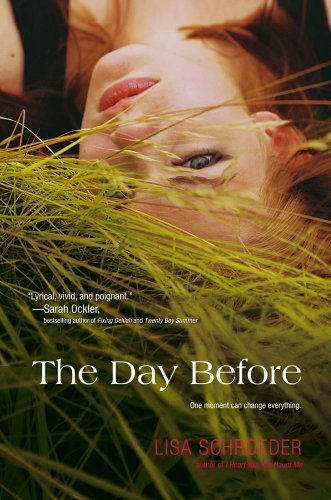
The Day Before, by Lisa Schroeder.
source of recommended read: bought
***One of the joys of reading is coming across striking quotable quotes, like these:
"My point here is that even under ideal circumstances, public-school teaching is one of the hardest jobs a person can do. Most sensible people know that. Anyone who claims not to know that is either a scoundrel or a nincompoop ... "--Garret Keizer, "Getting Schooled," Harper's, September 2011, page 34.
"Will there never be an end to the cynical misuse of language by those who rule us?"--Aidan Chambers, Postcards from No Man's Land
"I marvel at how unexciting it is to be famous, how mundane famous people are. They're confused, uncertain, insecure, and often hate what they do. It's something we always hear--like that old adage that money can't buy happiness--but we never believe it until we see it for ourselves."--Andre Agassi, Open: An Authobiography
***I'm currently the guest on Kitty Keswick's blog. What's special about her blog, "Discover Something Wonderful," is that she is working to open a NEW BOOKSTORE (are there more thrilling words than those?), and the blog is a mix of author features and her adventures in getting the store ready.
***My first book, The Secret Year, is up for grabs at Free Book Friday Teens, while an advance copy of my upcoming novel, Try Not to Breathe, is up for grabs at Goodreads
***If you're anywhere near Doylestown, PA, and you like YA, join Ellen Jensen Abbott, Cyn Balog, Alissa Grosso, Amy Holder and me for Teen Night at the Doylestown Bookshop, Friday September 23, 7 to 9 PM. Or if you can't make it but want a signed book by one of us, call the store (215.230.7610) and order one over the phone to be signed that night.
***I read this book last week and quite enjoyed it. It's a boy-meets-girl story that tackles a couple of issues I haven't seen discussed much in YA, and as a verse novel, it reads very quickly (perfect for reluctant readers). I don't want to get spoilery, so I'll just state the starting premise: a girl has set aside a day to herself right before she is expected to undergo a life-changing event. She meets a boy who is facing his own life-changing event. Together they seize this day, but they can't stave off "tomorrow" forever ...
The Day Before, by Lisa Schroeder.
source of recommended read: bought
September 17, 2011
A scene from the glamorous life of a writer
Writer: Will you please leave the bubble wrap alone? I want it to sit on top of that box of books, out of the way.
Cat: You do not understand how delicious this bubble wrap is! How much fun! I must rub my face against it repeatedly, mouth the edges, and then drag it artistically onto the floor. See how beautiful it looks, blocking your way to the door.
Writer: Yes, blocking my way. I would like to leave the room without having to pick up the bubble wrap every time.
Cat: The aesthetic balance of the room requires a chunk of bubble wrap lying there, just so.
Writer: I could put the wrap on a high shelf, out of your way.
Cat: You wouldn't dare!
Writer: I might.
Cat: You're just jealous. You are not the only artist in the family, you know. Between my graceful poses and my skill with bubble-wrap-dragging, I am surpassing you! You are Salieri to my Mozart!
Writer: Don't be such a diva.
Cat: It comes with the territory of genius, my friend.
Writer: Oh, go chase down a rubber band, like you did this morning.
Cat: That rubber band was totally going to attack us if I had not leaped upon it and given it a sound thrashing. You're welcome!
Cat: You do not understand how delicious this bubble wrap is! How much fun! I must rub my face against it repeatedly, mouth the edges, and then drag it artistically onto the floor. See how beautiful it looks, blocking your way to the door.
Writer: Yes, blocking my way. I would like to leave the room without having to pick up the bubble wrap every time.
Cat: The aesthetic balance of the room requires a chunk of bubble wrap lying there, just so.
Writer: I could put the wrap on a high shelf, out of your way.
Cat: You wouldn't dare!
Writer: I might.
Cat: You're just jealous. You are not the only artist in the family, you know. Between my graceful poses and my skill with bubble-wrap-dragging, I am surpassing you! You are Salieri to my Mozart!
Writer: Don't be such a diva.
Cat: It comes with the territory of genius, my friend.
Writer: Oh, go chase down a rubber band, like you did this morning.
Cat: That rubber band was totally going to attack us if I had not leaped upon it and given it a sound thrashing. You're welcome!