
Lea Wait's Blog, page 83
August 9, 2022
Editing: A Follow-up to Jule’s Post
I was going to write about The Grateful Dead today. But then I read Jule’s intriguing post yesterday and decided to do a fun follow up post about editing.
Julie’s sense of bewilderment amused me because I know just how she feels. Editing a manuscript is an art form, and both subjective and objective in its critique. An editor must be technical, meticulous, a therapist and a cruel master at the same time. Every editor is different and unique, and has their own set of biases. So how long do we let our editors take these manuscripts for the proverbial spin? And as writers, how fierce should we pushback?
The first readers and editors of my manuscript are the members of my writers’ group. While they are my friends, I almost don’t want to be on friendly terms with them because honest feedback can sometimes cause resentment and bitterness, even though a critique is meant to help a manuscript become tighter. The members of my current group, though, really are my friends, in part because they are so willing and eager to accept my honest critiques, as I am to receive their invaluable feedback. In fact, I’ve matured as a writer because of them, to where I embrace their honest opinions. You can’t succeed as a writer if you’re not able to take feedback and synthesize it into the work-in-progress. It’s like the development of a prize fighter: he or she can’t improve their skills unless they take a few punches to the chin, and then learn strategies how to defend themself against such an attack.
I’ve had so many editors during my career that I know how different one editor can be from another. But a great editor is a gift to a dedicated and serious writer. They see things that the writer like myself does not—or cannot—see. They find the glitches in all our literary blind spots. It’s like the shapes hidden in those pixilated puzzles: a good editor sees the mistakes, the inconsistencies, and the troubling tics a writer keeps repeating. A good editor makes a writer want to rework their manuscript. And a good edit should excite and illuminate a writer, no matter the intensive work needed to ‘fix’ a manuscript.
There are different kind of edits. I call this the Hierarchy of Editing. Line edits, while extremely important, reside at the bottom of this pyramid. You can’t perform a line edit on a manuscript until the Universal Edit is completed. The Universal Edit comprises higher conscious story needs: tone, consistency of the plot, tense and POV, proper characterization and structural integrity. Chronology is important, as is dialogue and plot pacing. Then when all that is completed, comes the vigorous line edits: dotting the i’s and crossing the t’s.
I just went through a horrendous edit—and yet it was one of the best edit jobs I’d ever received. Somehow, someway, my editor edited an older version of my most recent manuscript. This manuscript was part of a trilogy, and I had completely rewritten the first novel after it was accepted for publication. A miscommunication occurred, and my editor’s emails were not getting through to me, and going straight to spam. By the time we finally connected, and because of the nature of the contract I had signed, I had to make edit changes for the first manuscript, only I had to incorporate all these edits into the rewritten manuscript—and I had two weeks to get it back to her. This meant I would be working on the manuscript nonstop. I had already changed the tense and many of the plot points, as well as reworked much of the dialogue. It was a long two weeks. And yet it was one of the most thoughtful, helpful and in-depth edits I had ever received. There were line-by-line markups, as well as universal feedback on characterization, tone and consistency. On top of that, she had me do a second edit after I had completed the first, but she also admitted that we were close to a final version. Her hard work allowed me to extrapolate her suggestions into Books 2 and 3.
Is there a difference between editing a literary book and a genre novel? One might think genre novels would be easier because they follow certain well-known parameters, and that maybe true, but I believe all novels follow a similar narrative structure. As far as chewing on a novel for a year after receiving edits, that seems even hard for me to stomach. And yet many novelists go years between the publication of their novels. John Irving’s last novel came out in 2015. His next novel comes out in the fall and is over nine-hundred pages long. That’s a lot of editing.
Can editors be pals? It’s like the old joke that a man and women can never be in a platonic friendship. The relationship between editor and writer is fraught with perils and inherently antagonistic in nature. And yet . . . And yet we writers are so desperate to be read and praised, and considered deep thinkers, that we become like slaves to the dominatrix. We suffer from Stockholm Syndrome whereby the editor kidnaps the writer and treats him/her like the literary version of Patty Hearst. Most of the time, at this last editing stage, the novel has already been accepted for publication. It’s so close to being a masterpiece that we can virtually taste it. We’ve toiled so long and hard, in silence and obscurity, that the editor’s words—both good and bad—seem like a form of therapy. Or love. We’re like audience members enraptured by a charismatic self-help guru telling us about our unrealized potential. Now we just need to do the hard work.
But will the hard work to self-improvement irrevocably change our nature or personality?
The danger in agreeing with an editor’s feedback is this: where do we writers draw the line! Does a writer blindly follow an editor’s advice, and in the process lose the heart and soul of the novel? I’m always reminded of the story of Gordon Lish’s edits of Raymond Carver’s short stories. The edits were so severe and harsh that they essentially changed the nature of Carver’s stories. Carver nearly had a nervous breakdown because of Lish’s heavy hand. Carver genuinely feared Lish and his control over his intellectual property. Only when Carver got older and more successful did he attempt to push back from Lish’s brutal feedback. And yet, dictatorial as he was in his harsh edits, there can be no doubt that Lish made Carver’s stories better. You can read a before and after version of one of Carver’s stories in The New Yorker, and see for yourself how better the edited version is. This may have contributed to Carver’s alcoholism and growing mental instability. Lish even changed the names of many of Carver’s stories. In fact, many people believe that Lish could have been billed as Carver’s co-writer. https://www.newyorker.com/magazine/2007/12/24/rough-crossings
The question is: would you agree to such radical changes of your novel if it made it better? If it made it a New York Times bestseller? A lot of writers, dare I say most, would agree to a deal with the editorial devil.
A writer has to stay true to themself. A writer must write utilizing his or her own unique vision. A writer must intuit what changes to accept and and what to reject from an editor. It’s all part of the publishing process; a give and take relationship that puts the work over any individual ego. It is not wrong to say it takes a village to publish a novel. But a writer also has to remember that an editor has skin in this game, too, and edits a manuscript in a way that promotes their own best interests. What editor doesn’t want to boast about editing a mega-selling, Pulitzer Prize winning novel? An editor wants what is best for the writer’s work, because that is what’s best for them, and their publisher. Their discerning and unbiased eyes can help a submission shizzle, and make them look better in the process. This is their job. And most are good at it. A gifted editor is worth their weight in gold to a writer, and I tend to defer to them more often than not, picking and choosing my battles where I see fit.
A quality edit is cleansing and like a rebirth. Yes, it can be tiresome going over an entire novel again and again, but this is the price we must pay to get published and improve our craft. It’s maddening at times. Uplifting. Depressing too. But these emotions can be used as fuel for growth and renewal. Choosing to embrace this laborious and humbling process is the only way forward. Best to view it like the finest vodka filtered seven times through Herkimer Diamonds. It may be the last great chances to make your novel shine before it gets into the public’s hands.


August 8, 2022
EDITOR – WHAT DOES YOURS DO?
by Jule Selbo
Serious question, sorry. Does everyone have a different experience?

I had dinner with some writing friends the other night (at a place that didn’t put a serious dent in our bank accounts – yeah, hard to find these days). Over beer and local oysters, there was hilarity and gossip and tales of recent hikes and writers’ blocks, concerns about the world and never-ending humidity. In my experience, writers tend to like other writers. Maybe it’s the common pain that bonds us, common loneliness of living with brains that can – alternately – burst out of the starting gate or refuse to leave the stall. Combine that with a predilection of assigning character quirks and motivations for everyone standing at the gas pump or at the grocery store counter, we tend to understand each other. The conversation turned to the craft of writing. I brought up a question that had been on my mind. I prefaced it because I haven’t (like many bloggers on this site) published dozens of books, I wanted to check out their experiences. I asked a question that – surprising to me – sort of stopped the conversation. I had struck a nerve.
The question was: What does your editor do?

It was like an NFL defense line had entered the room and sat across the table and were ready to put me in a chokehold.

I wondered – is this was a verboten question?

My friends suddenly got very protective – their editors were fabulous, insightful (not only because they recognized my friends’ talents), but they had “great ideas”, were “so creative” and “helped me come up with a new ending.” Their editors were all “at the top of their game”.
I wondered – what game?
BACKGROUND: The other writers at the table were not crime/mystery writers, they toil in “literary fiction” and “pop fiction”. When they finish the draft of the book they feel good about, it goes to their editor who (it seems) has a lot of influence on content and usually gives a lot of notes that send the writers back to the computer. For months – maybe even a year. (Or if the book has not been pre-sold, it goes to their agent who then tries to place it with an editor at one of the publishers houses to get an advance and/or book deal… and when this is accomplished, then the editor’s notes begin.)
One of the writers of “pop” fiction, told me he’d just gotten his notes from his editor. He thought it would take him a year to “re-think, rewrite, re-submit”.
In my head I was shouting, “A YEAR!” I worry about who I will be in a year, if the same things will interest me and if, after putting in months (more than a year) into this initial, solid (as I see the story) draft – would I want to keep kicking it around for another few months/a year? Will the “year-later-me” want to tell the story in a different way? Do I want to head down a rabbit’s hole where – knowing if I change one thing, the rest could slip away and totally disappear?
I didn’t dare ask this question, because I felt everyone had gotten a bit uptight. So I’m asking the question now: after the re-submission, was there a possibility that the editor might ask for more “re-thinks and rewrites”? And another question: If the editor who “championed” the buying of the book is not pleased with the subsequent draft – does the advance/deal have to be “re-thunk”? Monies returned? (I googled this question, so I have the answer to this one.)
Do some novelists, after completing the draft-they-feel-good-about, use the editor as a beta-read?
I look to friends who claim they want to do an early read of a finished manuscript and give me thoughts, reactions. Am I taking advantage of those friends? They say they don’t mind and they often have great suggestions.
I also love my writing groups, where we give each other feedback (it’s about 5,000 words per submission). The “deal” is that we read each other’s work, engage in a give and take of reactions. Sure, it’s a commitment, but with the right group, it’s fantastic. And no one is holding me hostage to change something I don’t think needs changing. But of course, feedback can have me doing some rewriting, re-noodling.
I’ve never thought of the editor at the publishing house as a creative partner in a novel. But some of my friends seem to. And there also seems to be a great need to please those editors. (Can that trap you from being true to yourself?)

I put “best editors of fiction” into my search engine and got a few descriptions of the editor’s job: (name withheld) “…is an editor with a track record of acquiring, developing, and launching critically acclaimed books and high-impact bestsellers that span a wide range of categories—including “big ideas,” history, narrative nonfiction, and fiction. He has a proven talent for identifying and broadening trendsetting ideas for a general audience, and a keen ability to marshal the power of marketing, publicity, and social media to strategic advantage.”
(Name withheld) “…is an experienced ghostwriter, screenwriter, and New York Times-bestselling editor who has collaborated with hundreds of aspiring writers and widely-published authors.”
One editor marketed himself by saying “I’ll help you write a book you’re proud of.”
Some of the above are “scary” thoughts – to me.
I know I have a bias against “gate-keepers” in artistic/creative endeavors. When I worked in Los Angeles as a screenwriter, there was the oft-told tale among my fellow screenwriting friends (oft-told because it happened over and over): one of us would be taking a meeting at a studio with a development executive (their job is to bring stories/scripts they deem as possibilities for production to the “next-level boss”), this person would often be fresh out of college (or not, but semi-young and feeling powerful) and likely didn’t know who John Ford or Orson Welles was, had never viewed The Godfather or Some Like it Hot or Animal House or Pulp Fiction or Casablanca or American Psycho (much less Hitchcock’s Psycho), didn’t know the plot of Hamlet (except to quip about the fact they’d heard The Lion King story had some similar plot points).
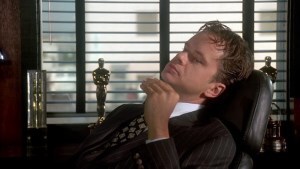
Horror, to them, meant “Jordan Peele movie hits”, did not include Craven, Cronenberg, or Carpenter. The subsequent discussion among my screenwriting friends centered around this: did this person want to help make your idea/your script “better” or did they want it to be as close as possible to what just won the box office weekend, or did they want to make it “different” (more like what they have written if they had the stamina/patience to crank out a full screenplay). Did they actually have the chops to make your story “better”? Being a professional screenwriter in Hollywood is all about taking notes, new drafts, reacting to an executive’s newest brain fart. (Photo is Tim Robbins in the super fun movie The Player (1992).
When I had a solid draft (beta-read by friends and writers’ groups) of my first novel, Find Me In Florence (it has some mystery in it, but no crime… my publisher calls it: “Women’s Fiction” – I call it a coming-of-age, romance, mystery novel that takes place in the fine city of Florence Italy), I hired an freelance editor (let’s call him Pete) that a friend of mine had been paired with at Penguin. (Editor Pete had left Penguin and had gone freelance). I was insecure, thought before I sent it off to a gatekeeper, I should get a professional’s opinion. Pete was a super nice guy, but he wanted to change the whole story. My story is about a young woman (Lynn) who, at her mother’s deathbed, makes a promise to fulfill her mom’s ask to “find me in Florence.” Her mother had been a Mud Angel. (When the Arno River flooded in Florence in 1966 to catastrophic levels (flooding museums, libraries, churches), volunteers hurried there from all over the world to help dig up paintings, sculptures, relics, books etc. that had been trapped in the muck and mud – to unearth and save great treasures to ensure that generations-to-come could appreciate a Cellini or Botticelli or…
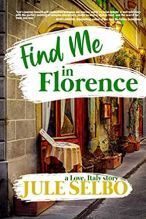
These people were called “Mud Angels” and, for various reasons that Lynn discovered, it was a life-changing experience for Lynn’s mother. While in Florence, Lynn finds out her husband (still in NYC) is a shit, she meets a super-great Italian man, finds out the secreted details of her mother’s past, and comes to a new understanding of what she “should” be doing with her life. Pete (the editor) became fond of a character in the beginning of the book – Lynn’s best friend and said something like this… “Why don’t you drop the Mud Angels thing and make it more about the friendship and get in a few cat-fights in between the women.” Perhaps he’d just read Elena Ferrante’s My Brilliant Friend and thought I should slide under its popular umbrella.
 Or perhaps he wanted to string me along, get me to do a 90% rewrite so I’d pay him for another “tell me what you think” session. But after stewing on his response for a week, I knew I didn’t want to go back and shape the book to please him. (In fairness, I did beef up the friend’s role (made it a stronger “C” story) but decided to stick to what had made me want to write the book.) Find Me In Florence found a publisher and was up for a few small awards – so all was good. So, instead of re-working the project for a year to please someone else, I was free to go on to the next thing I wanted to write.
Back to the oysters and beer dinner with friends a few nights ago. When they sensed my distrust of how much creative weight they put into their editor’s hands, they asked me about my publisher. I told them the publishing company assigns “an exec”, one content editor, one line editor, and then one of the “brass” of the company does a final read before they press “publish”. The first go-through is with “my exec”; he’s been assigned twenty or so authors to keep track of and answer questions regarding what the publishing company is doing with the writers’ works. He reads the author’s draft, logs it, gives a quick response to author and a report to publishing heads. Then, if approved, it’s put into the machinery. The “content editor” is assigned. In my experience, they catch inconsistences in timeline or note where there could be better clarity in plot/character/structure. The content editor who had been assigned my last two books was on maternity leave, so I had a new content editor for 9 DAYS (second book in the Dee Rommel series). I so appreciated her input because she (who had not read the first book in the series) was voracious in pointing out where a reader (who had not read 10 DAYS) might need more background on a recurring character. She did not suggest story changes. I made the small adjustments in a few days.
The second is the line editor who checks for typos, wonky sentences, dropped words and other things that can be a writer’s nightmare. Then the draft is returned to me for another read (I ask for this, not sure it’s always done?) and I get to send in my list of remaining typos. Then one of the “brass” in the publishing company reads it and if there is a small question, it gets addressed – and it’s done and goes out for publication. This is the way that makes sense to me. Does my publisher give more “creative/story” notes to other writers and hold off publication if they think the rewrites are not satisfactory? I don’t know. I’ll have ask “my (very approachable) exec”. (Just got a note back, an answer to that question: “Rarely, but yes it does happen, each for its own peculiar reason.”)

Is this “less than invasive approach” I’ve experienced with my publisher consistent with other crime/mystery writers’ relationships with their editors? Is it a genre thing? Are crime-mystery novels handled differently than “lit” or “pop” fiction – because they’re more reliant on a tight plot and parts can’t “move around” willy-nilly?
Some writers have a close relationship with their editors. Do you?
I would love to hear about people’s “take” on what role their editor should/does play.
August 5, 2022
Weekend Update: August 6-7, 2022
 Next week at Maine Crime Writers there will be posts by Jule Selbo (Monday), Joe Souza (Tuesday), Susan Vaughan (Thursday), and Vaughn Hardacker (Friday).
In the news department, here’s what’s happening with some of us who blog regularly at Maine Crime Writers:
An invitation to readers of this blog: Do you have news relating to Maine, Crime, or Writing? We’d love to hear from you. Just comment below to share.
And a reminder: If your library, school, or organization is looking for a speaker, we are often available to talk about the writing process, research, where we get our ideas, and other mysteries of the business, along with the very popular “Making a Mystery” with audience participation, and “Casting Call: How We Staff Our Mysteries.” We also do programs on Zoom. Contact Kate Flora
August 4, 2022
Roger Angell, Triggerman of Sweet Memories
In August, when we often spend some time Downeast, one of my traditions is to write about talented writers who have a connection to this beautiful part of Maine. The great Roger Angell, who died in May at the age of 101, is the obvious choice this year. The longtime fiction editor of The New Yorker, he also was an essayist par excellence, especially on the topic of baseball. In 2014, he was awarded the Baseball Hall of Fame’s J.G. Taylor Spink Award, its highest honor for a baseball writer.
Roger Angell didn’t confine himself to the topic of baseball. He was a top-notch essayist, up there with his stepfather (another of my writing heroes, E.B. White). He wrote about everything from losing an engagement ring on a rural nine-hole golf course to balky automobiles he had driven to his experiences in the Air Force during WWII. His writing was so strong, so relatable, that in 2015, the year after his Spink Award, he was elected to the American Academy of Arts and Letters.
That’s versatility.
His essays about baseball stand out because they were insightful not only about the sport, but so much more. If you’ve not had the chance to read his work. a marvelous collection published in 1991, ONCE MORE ABOUT THE PARK, A BASEBALL READER, is a deeply pleasurable read.
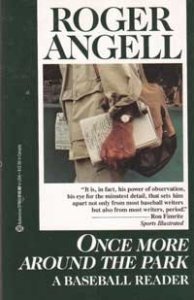
I have my own independent memories of some of the games he chronicles in that collection, essays with such poetic power they rouse again the emotions he captured on the page. Take this passage from his October, 1975 masterpiece, Agincourt and After, about the pivotal Game Six of that year’s World Series between the Sox and the Reds. I feel certain many readers of this blog will remember exactly where they were when this happened, including my wife Diane, who was a Cincinnati fan at the time, and my friends Dick Cass and Bill Carito, who, like me, are lifelong Red Sox fans:
. . . Carlton Fisk, leading off the bottom of the twelfth against Pat Darcy, the eighth Reds pitcher of the night – it was well into morning now, in fact – socked the second pitch up and out, farther and farther into the darkness above the lights, and when it came down at last, reilluminated, it struck the topmost, innermost edge of the screen inside the yellow left-field foul pole and glanced sharply down and bounced on the grass: a fair ball, fair all the way. I was watching the ball, of course, so I missed what everyone on television saw – Fisk waving wildly, weaving and writhing and gyrating along the first-base line, as he wished the ball fair, forced it fair with his entire body. He circled the bases in triumph, in sudden company with several hundred fans, and jumped on home plate with both feet, and John Kiley, the Fenway Park organist, played Handel’s “Hallelujah Chorus,” fortissimo, and then followed with other appropriately exuberant classical selections, and for the second time that evening I suddenly remembered all my old absent and distant Sox-afflicted friends (and all the other Red Sox fans, all over New England), and I thought of them – in Brookline, Mass., and Brooklin, Maine; in Beverly Farms and Mashpee and Presque Isle and North Conway and Damariscotta; in Pomfret, Connecticut, and Pomfret, Vermont; in Wayland and Providence and Revere and Nashua, and in both the Concords and all five Manchesters, and in Raymond, New Hampshire (where Carlton Fisk lives), and Bellows Falls, Vermont (where Carlton Fisk was born), and I saw all of them dancing and shouting and kissing and leaping about like the fans at Fenway – jumping up and down in their bedrooms and kitchens and living rooms, and in bars and trailers, and even in some boats here and there, I suppose, and on back-country roads (a lone driver getting the news over the radio and blowing his horn over and over, and finally pulling up and getting out and leaping up and down on the cold macadam, yelling into the night), and all of them, for once at least, utterly joyful and believing in that joy – alight with it.
— Published in The New Yorker, November 17, 1975.
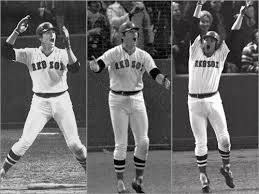
The beauty of Roger Angell’s work is that even if you weren’t watching, even if you weren’t then or aren’t now a Red Sox fan, this piece transports you to a that time and place, makes your heart sink and then explode with elation when the Red Sox wrestled it back in the twelfth inning with Fisk’s never-to-be-forgotten walk-off home run.
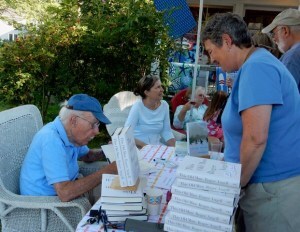
Roger and me, Brooklin, Maine, August, 2016.
I had the good fortune to be in the presence of Roger Angell twice, both times in Brooklin, Maine, where he spent many summers from boyhood to 2021, and where I once lived and still visit often.
The first time was at a signing for his final collection of essays, THIS OLD MAN, during the summer of 2016. He was affable and curious about everyone who asked for his autograph that afternoon, and made me, at least, feel like a longtime pal.
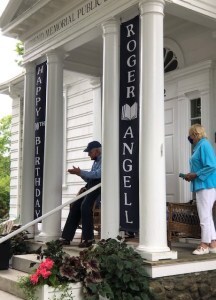
The last time was at his 100th birthday celebration in 2020 in front of the Friend Memorial Library, when a crowd of townspeople and tourists (and Governor Mills) came to wish him well and serenade him with a rousing rendition of Happy Birthday.
Again, he was cheerful and energetic, doffing his cap to the crowd after the song was over, like the gracious hero of the game, which is what he was.
Rest in peace, Roger Angell. Thank you for leaving us, in your writing, a treasure trove of happiness to re-experience when our days need a jolt of joy.

Brenda Buchanan brings years of experience as a journalist and a lawyer to her crime fiction. She has published three books featuring Joe Gale, a newspaper reporter who covers the crime and courts beat. She is now hard at work on new projects. FMI, go to http://brendabuchananwrites.com
Ten Years After, Sans Band
John Clark at the end of a literary journey. Some ten years ago, I began putting together short stories about Maine kids who struggled with seemingly impossible situations. Some of the inspiration came from my own growing up experiences, some from my 27 years working in mental health, others from my library experiences, still others from suggestions by other Maine librarians.
My sweepstaking friend out in Oklahoma, Judy McCurdy gave me an idea based on a Revolutionary War soldier named Joe Kerr. She told me I needed to tell his story. She was right, but it took a lot longer than anyone, especially me, ever imagined.
What got in the way? Life, insecurity, losing half of Joe’s story, laziness, and more life. In fact, aside from my annual effort to get a short story into the New England crime anthologies, I barely attempted to write or publish for longer than I care to admit. It was easier to sell other people’s books online or win sweepstakes prizes.
That all changed a year ago. First came my discovery that the heated swimming pool at the Alfond Center was perfect for coming up with ideas, then I bought the creativity candle that seems to be eerily effective. Between February and June, I wrote Don’t Say It, a historical YA book set in 1969. In March of this year, I took one of the story prompts I shared in a MCW post and by June, that was another YA book, Over The Edge, this one about an alternate universe. Both manuscripts are on my revision radar.
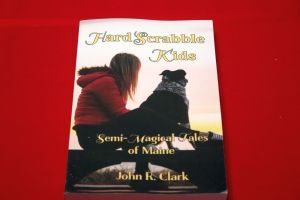
Three months ago, I decided it was time to get serious about the teen anthology. It’s called Hardscrabble Kids: Semi-magical tales of Maine. There are sixteen short stories, plus Statue of Limitations, which is Joe’s story. Others feature two girls who find a way to exact revenge on a high school bully without ever laying a hand on him, a girl who has trouble explaining to a Jewish genie what will make her happy, back-to-back stories by different teens as they meet and find hope from Berek Metcalf, protagonist in my book The Wizard of Simonton Pond.
Other tales feature a homeless boy who has schizophrenia and is befriended by an alien masquerading as a dime in a mall parking lot, a girl who uses her most precious gift to save her friend and a teacher from a demon, a kind hearted high school basketball player who’s in danger of getting kicked off the team until a most unusual group helps tutor him, a girl who discovers a secret group that helps her achieve her dream of going to college, a girl living on the Maine coast who has a bittersweet summer romance, and a moderately retarded boy who can fix anything mechanical and uses that skill to rescue other teens who have been kidnapped. Add in a magical deer, a supernatural fish, A girl who survives the despicable family of welfare sucking drug addicts to become a star in a profession girls don’t often consider, a brother and sister who end up being loved when their hope is almost extinguished, and a boy who turns the tables on creatures who try to take him hostage.
Is it perfect? No, but Beth and I have gone over the printed proofs with a fine tooth comb and we believe it’s good to go. Clif Graves of Hinterlands Press has been terrific to work with and I’m already looking forward to creating an adult short story anthology with his help. I’ve added the cover below. I expect the book will be ready in a week, so stay tuned for more.
August 2, 2022
She Has a Strange Idea of Fun
Kate Flora: Last week I took a break from revising my non-mystery book, Unleashed  Love, the story of a woman who discovers the post-breakup dog she got from the shelter was a match-making dog. For two days, I drove from the island to Colby College in Waterville to attend part of the annual Coby Forensics Conference. While forensics are not everyone’s cup of tea, I know, I enjoy two information-filled days in a college classroom, learning about DNA and Genetic Genealogy, unidentified remains, expert witness testimony, and stress-induced markers in cases of child abuse.
Sound like fun to you? It was fascinating to me.
The first speaker I got to watch was from the Doe Project. I knew that there were a couple of large organizations that worked with genetic genealogy. What I didn’t know is that one of them, The Doe Project, limits its investigative work to identifying bodies, whether homicide victims or simply those who have died without identification, rather than taking on cases like that of the Golden State Killer, where the process was used to identify the man who’d committed multiple homicides. My mother was fascinated by genealogy back when it didn’t happen on line but through correspondence with record keepers and older family members who might have memories or old family records. Getting a glimpse of how complicated it can be, even when there is a usable DNA sample, to trace ancestry, was illuminating, and far more difficult that I had ever imagined.
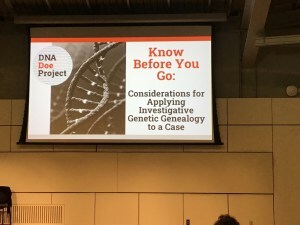
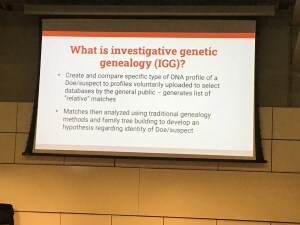
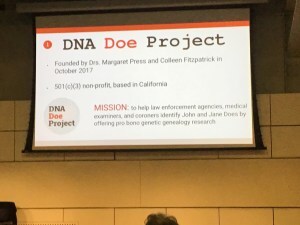
Along with the fascination of learning new information was learning that one of the founders of the Doe Project was Dr. Margaret Press. I knew Margaret back when we were both writers in the New England chapter of Sisters in Crime. When Susan Oleksiw, Skye Alexander and I founded Level Best Books and were publishing crime stories by New England writers, we published at least one of Margaret’s stories. Margaret also inspired me to try writing true crime when she published her own book about a murder, A Scream on the Water. The way she handled the victim’s story was particularly inspirational and became a model for me when I was working on Finding Amy. Margaret’s book was subsequently republished as Counterpoint. https://www.amazon.com/Counterpoint-Murder-Massachusetts-Margaret-Press-ebook/dp/B009Z774G2/ref=sr_1_1?crid=2YEMB2RRMXUL1&keywords=Margaret+Press&qid=1659375478&sprefix=margaret+press%2Caps%2C120&sr=8-1
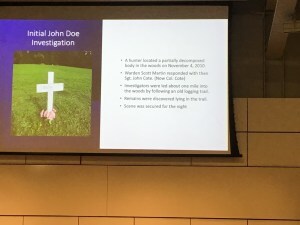
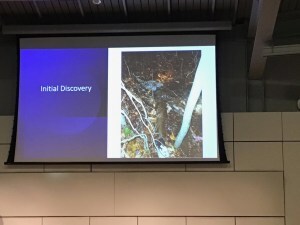
About six weeks ago, I had the privilege of speaking at the annual training and conference of the Maine Association of Search and Rescue. One of the presentations was by Maine’s forensic anthropologist, Dr. Marcella Sorg on identifying bones. At the Colby Conference, Dr. Sorg paired with Maine’s former Chief Medical Examiner, Dr. Margaret Greenwald, on a presentation titled: An Unusual Maine Case. Using medical forensics and information from bones and a scene of a decomposed body in the woods, they told the story of a man’s body found by a hunter in the town of Stacyville in 2010.
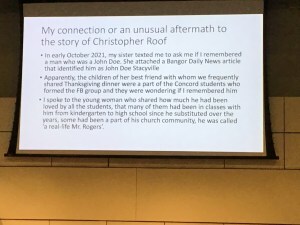
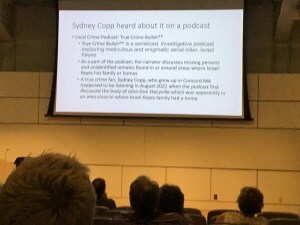
The body was found with a book bag and various items but no identification beyond a knit hat with the name “Chris.” Autopsy and toxicology revealed no criminal cause of death. Despite years long efforts and many contacts with missing persons databases and families looking for their missing, the body remained unidentified for about ten years. In the end, it was the amateur efforts of a blogger fascinated by true crime connecting with a group of students at a school in Concord, Massachusetts looking for a missing teacher that ultimately led to the man being identified. As I sat in the audience, I was stunned to realize that the man had been a popular substitute teacher in the Concord school system, Christopher Roof, and he had taught my son.
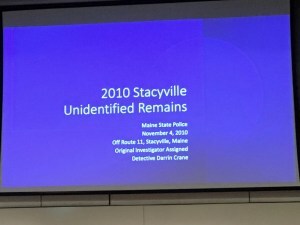
There was much more, ending on Wednesday with a complex (if you were an English major like me), and heartbreaking presentation by Maine’s current Chief Medical Examiner, Mark Flomenbaum, on some cases of child abuse homicide and markers in those cases of the effects of stress and subsequent damage to the children’s bodies. Drawn from a recently published paper, an aim of the talk was to alert those dealing with child abuse to issues that might be identified in time to save future children’s lives as well as further information about issues to look for at autopsy.
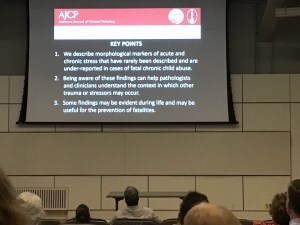
Between sessions, I also ran into Vermont mystery writer Archer Mayor, who writes the Joe Gunther mystery series. Archer is a writer I much admire. He is also a death investigator for the Vermont OCME.
Grim. Gruesome. Disturbing. Sad. Enlightening. Thought provoking. An amazing two days with some surprising coincidences. And of course, some new ideas to use in a future book.
July 31, 2022
The Mystery of Miron Gonzalous Hornbeck
Kaitlyn Dunnett/Kathy Lynn Emerson here. One of the nice things about being semi-retired is having the time to work at solving some of the mysteries hanging on my family tree. Since I’m not famous enough to be on Finding Your Roots or Who Do You Think You Are? and since I really don’t want to shell out the hard cash to hire a professional genealogist, who might not be able to find anything new either, I muddle along online, following leads that, for the most part, are dead ends. Fortunately, I’m not writing a book. I don’t have to solve the mystery. The fun part is the search for answers. I guess you could say I’m on a quest. I may never find out everything I want to know, but there’s a lot of enjoyment in the trying.

Miron with his parents and sister
Who was Miron Gonzalous Hornbeck? He was one of my great-grandfathers. His birth on the family farm in Hurleyville, New York, on January 19, 1861, is recorded in the family Bible, with that specific spelling. So what’s the mystery? It’s in his name. Miron is easy enough to understand. Myrons and Mynderts were common among the families of Dutch descent in that part of New York State. One minor mystery is why he went by Miles instead, but the real question is where the Gonzalous came from, and Constantia, the first name of Miron’s sister, who was born the following year.

Miron with his family on his 50th wedding anniversary
For a while matters were confused by the fact that my grandmother, Miron’s daughter, thought that her grandmother’s maiden name was Berrigan. It was not. Miron’s parents were Lawrence Hornbeck and Catherine Gardner, as proven by documents concerning the disposition of property belonging to Catherine’s father, David Gardner, after his death in 1865. Thank you, Ancestry.com, which also led me to the 1850 and 1860 census records for Liberty, New York, which listed David, his daughter Catherine, and his wife . . . Constantia.

Katie Hornbeck, who got her grandmother’s maiden name wrong
One mystery solved. Or so I thought. It would be logical to assume that Constantia’s maiden name was Gonzalous (or one of its many and varied spellings). And it just so happens that there was a rather famous Gonsalus family in the Orange-Ulster-Sullivan County triangle from the earliest days of settlement.
The Hornbecks in America go back to Warnaar Hornbeck, who came to New Amsterdam from Holland on the Cormick David in 1641, married twice, and was fruitful and multiplied. I’m actually descended from him through both wives. Anyway, for several generations the family was centered around Rochester (now Accord) in Ulster County, New York. My branch had moved to Hurleyville by 1850.

Ulster County towns settled by the Dutch
Manuel Gun Sallus is reputed to have been the first white settler in Sullivan County, arriving in Mamakating Hollow from Rochester (Accord) in 1730. He was a Spaniard who had married a Dutch woman. He farmed and traded with the Indians. The inscription on his headstone reads: MANUEL GONSALUS IS GESTORVEN DE 8 APRIL ANNO 1752. Translated that means Manuel died on that date. Anyway, Manuel had numerous sons and grandsons, frequently confused in the records, including Manuel., who built the first grist mill in the area near Wurtsboro, Jacobus, who may have kept a tavern, and Daniel, who was killed by Indians during the French and Indian War.
All this is fascinating to me, but trying to link up the generations between Manuel’s sons and Constantia, assuming there even is a link, is not easy. It may not even be possible, but making the attempt is a challenge. And really, what’s the advantage of being semi-retired if you can’t fall down the occasional rabbit hole?

Kathy Lynn Emerson/Kaitlyn Dunnett has had sixty-four books traditionally published and has self published others, including several children’s books. She won the Agatha Award and was an Anthony and Macavity finalist for best mystery nonfiction of 2008 for How to Write Killer Historical Mysteries and was an Agatha Award finalist in 2015 in the best mystery short story category. She was the Malice Domestic Guest of Honor in 2014. Her most recent publications are The Valentine Veilleux Mysteries (a collection of three short stories and a novella, written as Kaitlyn) and I Kill People for a Living: A Collection of Essays by a Writer of Cozy Mysteries (written as Kathy). She maintains websites at www.KaitlynDunnett.com and www.KathyLynnEmerson.com.
July 29, 2022
Weekend Update: July 30-31, 2022
Next week at Maine Crime Writers there will be posts by Kaitlyn Dunnett/Kathy Lynn Emerson (Monday), Kate Flora (Tuesday), John Clark (Thursday), and Brenda Buchanan (Friday). On Wednesday, Susan Vaughan will be here for a Win-a-Book Wednesday giveaway.
Coming soon will be a fun group post where we share some of our favorite Maine summer things. Stay tuned!
In the news department, here’s what’s happening with some of us who blog regularly at Maine Crime Writers:
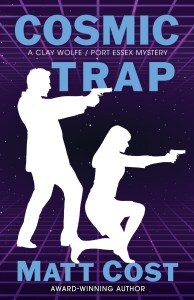
Matt Cost here: I have a cover reveal from the wonderful graphic artist Deirdre Wait of Encircle Publications for the fourth book in my Clay Wolfe/Port Essex series. Cosmic Trap will be released December 21st, 2022.
Kate Flora: And I have a cover reveal for the next Thea Kozak mystery, Death Sends a Message, scheduled for October 18th:

An invitation to readers of this blog: Do you have news relating to Maine, Crime, or Writing? We’d love to hear from you. Just comment below to share.
And a reminder: If your library, school, or organization is looking for a speaker, we are often available to talk about the writing process, research, where we get our ideas, and other mysteries of the business, along with the very popular “Making a Mystery” with audience participation, and “Casting Call: How We Staff Our Mysteries.” We also do programs on Zoom. Contact Kate Flora
Summer Selling by Matt Cost
I like to write. That’s why I do it. But I also like to sell. Promote. Market. Make people aware of what I’ve written and let them decide on whether they are interested. And there is never a better time to do this than summer selling.
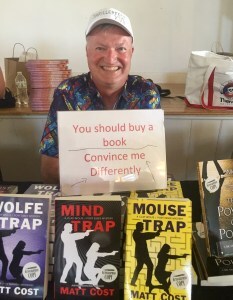
Summer selling includes bookstore events, library events, craft fairs, music festivals, and just about any opportunity that comes along to talk about, sign, and sell the books I’ve written. Sometimes it is with other writers, sometimes it is just me, but I am never alone.
I began my summer selling in June, three days before the official start of summer, at the Maine Blues Festival in Lisbon Falls. What could be better? I spent the day listening to fantastic blues music, working on my tan, and trying not to be blown away by the insistent wind. There were food vendors, my publisher, Eddie Vincent, came to hang out for the day, and I managed to stay away from the beer tent. And, of course, I sold books.
July has brought variety, starting with my hometown of Brunswick’s 2nd Friday Artwalk! I was given a sidewalk location right in front of the band, Blue Fuse Gypsy Swing, sat next to a gentleman clattering out poems on an ancient typewrite, and was joined by friend and fellow author, Anne Britting Oleson, who danced a number with my dad! And, of course, I sold books.
[image error] [image error][image error]The day after the Artwalk, I went to Books in Boothbay. I was joined in the drive by friend and fellow author, BJ Magnani, who was spending the night with my wife and I. Books in Boothbay is an author signing event broken into morning and afternoon sessions, and of course, it is wonderful to interact with the readers, but it was a true joy to see and talk with so many wonderful writer friends. I walked in the door and chatted with Kate Flora, Jule Selbo, and Bill Anthony before I even reached my assigned table. The day was filled with too many people to mention all the names, but it was, indeed, fabulous. And, of course, I sold books.
I’ve also had two library events during the month, one in Boothbay Harbor, and the other in Readfield, Maine. Both were outside, had wonderful audiences, and were hosted by terrific librarians. My Clay Wolfe/Port Essex series is loosely based on Boothbay Harbor, and it gave me an opportunity to poke around and get a feel for the town. The climax of my 2023 release, Mainely Wicked, takes place in the town of Readfield and is horrific, so it might be the last time I’m invited back, but it was a wonderful time. And, of course, I sold books.
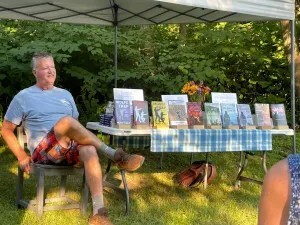
Sherman’s Maine Coast Bookshops have invited me to do upcoming signings, one on July 30th in Topsham, and the other on August 13th in Damariscotta. They will be inside, but will give me the opportunity to interact with the staff of two separate stores of the best bookshop in the world. There will be another 2nd Friday Artwalk in Brunswick. I also am planning an event at my local golf club, with music, cocktails, and food. I will be attending Killer Nashville, a book conference, where my mystery, Mainely Money, is a finalist for the Silver Falchion Award in the mystery category. The common theme? And, of course, I will sell books.
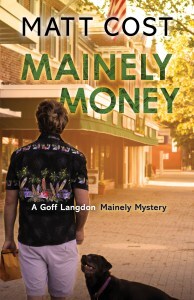
Summer in Maine is a grand thing. Especially when I’m selling books.
Matt Cost is the highly acclaimed, award-winning author of the Mainely Mystery series, the Clay Wolfe/Port Essex series, and several works of historical fiction.
Cost was a history major at Trinity College. He owned a mystery bookstore, a video store, and a gym, before serving a ten-year sentence as a junior high school teacher. In 2014 he was released and began writing. And that’s what he does. He writes histories and mysteries.
Cost now lives in Brunswick, Maine, with his wife, Harper. There are four grown children: Brittany, Pearson, Miranda, and Ryan. A chocolate Lab and a basset hound round out the mix. He now spends his days at the computer, writing.
July 27, 2022
Not Crime, Not Writing, But Really Maine
Neither crime nor writing this month, but something definitely Maine that I believe deserves your attention. Full disclosure—my wife Anne is on the Board of the organization I’m describing below, and takes an active part in awarding these scholarships to Maine High School Seniors. And we support the organization financially.
 Mainely Character (https://mainelycharacter.org/) is an organization formed in 2001 to award college scholarships to Maine High School students based solely on character. The scholarship process does not consider a student’s academic achievement, athletic prowess, musical ability, artistic talent or financial need. Character, demonstrated through personal action, is the sole criterion the board uses to decide who receives scholarships.
Character is defined as:
Courage—taking appropriate risks and following one’s conscienceIntegrity—being truthful and trustworthyResponsibility—conveying commitment and convictionConcern—demonstrating compassion and care toward othersI’m particularly taken with the notion that the usual marks by which we rank high school students are explicitly thrown out of the mix here. So often, some of the strongest kids we have are the quiet ones, not the athletes or high-achieving academic students, the socially ept. So I’m pleased to see that there is an effort here to seek out the students who maybe don’t get the accolades or attention they might deserve, simply for modeling good citizenship and humanity.
Students awarded Mainely Character scholarships come from all over the state. This year, the awardees came from seven of Maine’s sixteen counties: Hancock, Lincoln, Kennebec, Washington, Cumberland, Penobscot, and York.
Here are a couple of their stories, names and details redacted to preserve their privacy.
A young woman from Midcoast Maine, diagnosed with a malignant brain tumor, pushed through that challenge to organize activities at the Barbara Bush Children’s Hospital while she was receiving treatment. Even with the impact on her academic life, she made it to graduation and will attend the University of Maine in the fall.
A remarkable young man from southern Maine with muscular dystrophy turned his own challenges into helping other young people with the disease adjust to summer camp, many of these kids away from home for the first time. He led fundraising efforts for research and for scholarships to send kids to camp. He will attend the University of Southern Maine.
Another young woman from Downeast, who works summers on her brother’s lobster boat, respectfully and successfully challenged her high school’s administration to ease the way for transgender students and expand athletic possibilities for young women. Her peers voted her “Voice of the Students” at her high school. She will attend the University of Maine.
Other stories of these remarkable young people are here.
In 2022, seven other Maine young people were awarded scholarships by Mainely Character. These are often students with other challenges, for whom a scholarship might make the difference between college education and none. I’m proud to have met some of these kids and proud of the way they are emblematic of the state of Maine’s character.
Lea Wait's Blog

- Lea Wait's profile
- 509 followers


![[image error]](https://mainecrimewriters.com/wp-content/uploads/2022/07/DBFD8DFB-31F2-4469-BE9C-AD64F68B58F6.heic)
![[image error]](https://mainecrimewriters.com/wp-content/uploads/2022/07/B885BEE6-80FA-4A77-A65B-01316087EE41.heic)